Formulation of Objectives Sanjaya Mishra
Overview What are objectives? Conceptual developments Writing objectives Why should you use objectives?
What are objectives? Dictionary meaning: aim, goal and intention It is an aid to the learners as well as to the teacher It helps in planning the lesson It also helps in identification of appropriate activities, methods and techniques It helps in assessment of learner performance, and then provide feedback on learning/ teaching Objectives are defined as what the students should be able to do following instuction
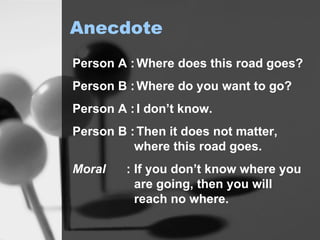
Anecdote Person A : Where does this road goes? Person B : Where do you want to go? Person A : I don’t know. Person B : Then it does not matter, where this road goes. Moral   : If you don’t know where you are going, then you will reach no where.
Conceptual developments Educational objectives Bloom’s taxonomy Mager’s  instructional objectives Behavioural  objectives Learning outcomes
Educational objectives Change in behaviours that an educational institution seeks to bring in its students Taylor, 1948
Blooms’ taxonomy (1956) Primarily for assessment of student performance Knowledge-Understanding-Application-Analysis-Synthesis-Evaluation
Instructional Objectives (1962) Unambiguous action verbs, conditions and standards Though instruction is used, Mager believed objectives to be what the students should be able to do at the end of instruction
Behavioural Objectives Excess emphasis on the use of action verbs and behavioual objectives led to this phrase Duchastel and Merrill (1973) said behavioural objectives serve three functions: direction for teaching and curriculum development, guidance in evaluation, and facilitation of learning
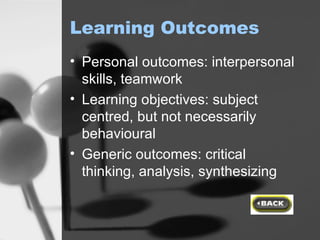
Learning Outcomes Personal outcomes: interpersonal skills, teamwork Learning objectives: subject centred, but not necessarily behavioural Generic outcomes: critical thinking, analysis, synthesizing
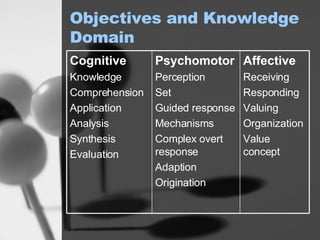
Objectives and Knowledge Domain Affective Receiving Responding Valuing Organization Value concept Psychomotor Perception Set Guided response Mechanisms Complex overt response Adaption Origination Cognitive Knowledge Comprehension Application Analysis Synthesis Evaluation
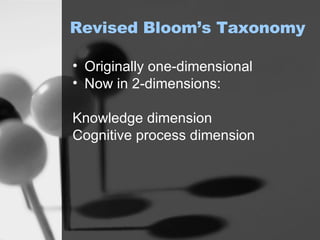
Revised Bloom’s Taxonomy Originally one-dimensional Now in 2-dimensions:  Knowledge dimension Cognitive process dimension
Remember Apply Understand Analyze Evaluate Create Factual Conceptual Procedural Meta-cognitive
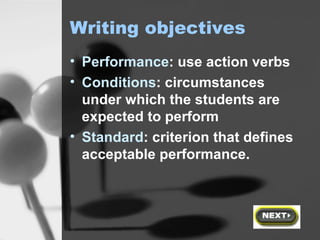
Writing objectives Performance : use action verbs Conditions : circumstances under which the students are expected to perform Standard : criterion that defines acceptable performance.
Performance The learner will be able to define… The learner will be able to identify the components… The learner will be able to determine the kind of nutrients…
Condition Given a list of examples… Given a list of terms… While in the laboratory… Using a soil sample kit… After observing a videotape…
Standard … accurate to the nearest tenth … according to the steps listed in the manual … within twenty minutes … at the rate of 100 per hour … without any errors
Example Given a list of generic drugs, the learner will be able to identify the antibiotics with 95% accuracy.
Criticism Objectives are written at a minimum acceptable standard
Criticism Objectives dehumanize by focusing on requirements and not on students
Criticism It takes time, and teachers’ workload are unrealistic
Criticism Objectives are difficult to set for affective domain
Criticism Objectives ‘lock’ the curriculum and are not flexible
Criticism It sets the tone of “teach and test”
Criticism Objectives stop creativity
Criticism It is not useful to the teachers in colleges
ABCD of objectives A udience B ehaviour C onditions D egree of performance
Objectives should be SMART S pecific M easurable A chievable R ealistic T ime-bound

Objectives in Self-Learning Materials

  • 1.
  • 2.
    Overview What areobjectives? Conceptual developments Writing objectives Why should you use objectives?
  • 3.
    What are objectives?Dictionary meaning: aim, goal and intention It is an aid to the learners as well as to the teacher It helps in planning the lesson It also helps in identification of appropriate activities, methods and techniques It helps in assessment of learner performance, and then provide feedback on learning/ teaching Objectives are defined as what the students should be able to do following instuction
  • 4.
    Anecdote Person A: Where does this road goes? Person B : Where do you want to go? Person A : I don’t know. Person B : Then it does not matter, where this road goes. Moral : If you don’t know where you are going, then you will reach no where.
  • 5.
    Conceptual developments Educationalobjectives Bloom’s taxonomy Mager’s instructional objectives Behavioural objectives Learning outcomes
  • 6.
    Educational objectives Changein behaviours that an educational institution seeks to bring in its students Taylor, 1948
  • 7.
    Blooms’ taxonomy (1956)Primarily for assessment of student performance Knowledge-Understanding-Application-Analysis-Synthesis-Evaluation
  • 8.
    Instructional Objectives (1962)Unambiguous action verbs, conditions and standards Though instruction is used, Mager believed objectives to be what the students should be able to do at the end of instruction
  • 9.
    Behavioural Objectives Excessemphasis on the use of action verbs and behavioual objectives led to this phrase Duchastel and Merrill (1973) said behavioural objectives serve three functions: direction for teaching and curriculum development, guidance in evaluation, and facilitation of learning
  • 10.
    Learning Outcomes Personaloutcomes: interpersonal skills, teamwork Learning objectives: subject centred, but not necessarily behavioural Generic outcomes: critical thinking, analysis, synthesizing
  • 11.
    Objectives and KnowledgeDomain Affective Receiving Responding Valuing Organization Value concept Psychomotor Perception Set Guided response Mechanisms Complex overt response Adaption Origination Cognitive Knowledge Comprehension Application Analysis Synthesis Evaluation
  • 12.
    Revised Bloom’s TaxonomyOriginally one-dimensional Now in 2-dimensions: Knowledge dimension Cognitive process dimension
  • 13.
    Remember Apply UnderstandAnalyze Evaluate Create Factual Conceptual Procedural Meta-cognitive
  • 14.
    Writing objectives Performance: use action verbs Conditions : circumstances under which the students are expected to perform Standard : criterion that defines acceptable performance.
  • 15.
    Performance The learnerwill be able to define… The learner will be able to identify the components… The learner will be able to determine the kind of nutrients…
  • 16.
    Condition Given alist of examples… Given a list of terms… While in the laboratory… Using a soil sample kit… After observing a videotape…
  • 17.
    Standard … accurateto the nearest tenth … according to the steps listed in the manual … within twenty minutes … at the rate of 100 per hour … without any errors
  • 18.
    Example Given alist of generic drugs, the learner will be able to identify the antibiotics with 95% accuracy.
  • 19.
    Criticism Objectives arewritten at a minimum acceptable standard
  • 20.
    Criticism Objectives dehumanizeby focusing on requirements and not on students
  • 21.
    Criticism It takestime, and teachers’ workload are unrealistic
  • 22.
    Criticism Objectives aredifficult to set for affective domain
  • 23.
    Criticism Objectives ‘lock’the curriculum and are not flexible
  • 24.
    Criticism It setsthe tone of “teach and test”
  • 25.
  • 26.
    Criticism It isnot useful to the teachers in colleges
  • 27.
    ABCD of objectivesA udience B ehaviour C onditions D egree of performance
  • 28.
    Objectives should beSMART S pecific M easurable A chievable R ealistic T ime-bound