CURRICULUM
Prepared by – Amitha Raghunathan
ETYMOLOGY : ‘currere’(Latin)
meaning = path
 Curriculum is the path through which the student has to go
forward.
 Every teacher has to get clear and thorough knowledge about the
importance, meaning ,scope and nature of a good curriculum
together with the principles for its development and transaction.
 Totality of experiences a pupil is exposed to within the boundaries
of the school and outside during course with a view to achieve the
anticipated educational goals.
Definition
 “Curriculum embodies all the experiences which are utilized
by the school to attain the aims of education.”
- Munroe
 “Curriculum is a tool in the hands of an artist(teacher) to
mould his materials(pupils) according to his
ideals(objectives) in his studio(school).”
-Arthur Cunningham
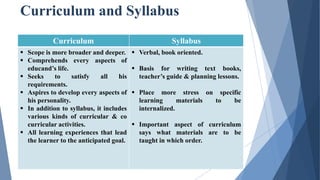
Curriculum and Syllabus
Curriculum Syllabus
 Scope is more broader and deeper.
 Comprehends every aspects of
educand’s life.
 Seeks to satisfy all his
requirements.
 Aspires to develop every aspects of
his personality.
 In addition to syllabus, it includes
various kinds of curricular & co
curricular activities.
 All learning experiences that lead
the learner to the anticipated goal.
 Verbal, book oriented.
 Basis for writing text books,
teacher’s guide & planning lessons.
 Place more stress on specific
learning materials to be
internalized.
 Important aspect of curriculum
says what materials are to be
taught in which order.
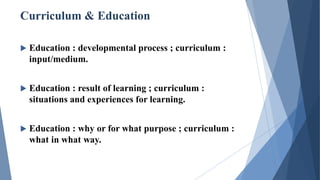
Curriculum & Education
 Education : developmental process ; curriculum :
input/medium.
 Education : result of learning ; curriculum :
situations and experiences for learning.
 Education : why or for what purpose ; curriculum :
what in what way.
Curriculum is the plan for guiding the
goal-oriented educative process.
This plan considers 4 important components :
1. The objectives.
2. The content or learning materials.
3. Teaching-learning strategies and activities.
4. Evaluation.
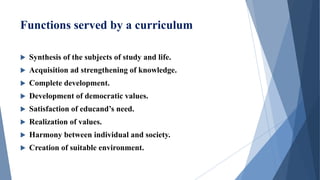
Functions served by a curriculum
 Synthesis of the subjects of study and life.
 Acquisition ad strengthening of knowledge.
 Complete development.
 Development of democratic values.
 Satisfaction of educand’s need.
 Realization of values.
 Harmony between individual and society.
 Creation of suitable environment.
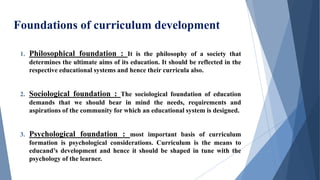
Foundations of curriculum development
1. Philosophical foundation : It is the philosophy of a society that
determines the ultimate aims of its education. It should be reflected in the
respective educational systems and hence their curricula also.
2. Sociological foundation : The sociological foundation of education
demands that we should bear in mind the needs, requirements and
aspirations of the community for which an educational system is designed.
3. Psychological foundation : most important basis of curriculum
formation is psychological considerations. Curriculum is the means to
educand’s development and hence it should be shaped in tune with the
psychology of the learner.
Types of curriculum
 Traditional or subject oriented curriculum :
 curriculum organized with greatest emphasis on knowledge.
 Stress was on cognitive development of learner.
 Activity centered curriculum :
 Subject matters translated in terms of activities.
 Knowledge gained as an outcome &product of activities.
 Activity, medium for imparting knowledge, attitudes, skills etc.
 Child centered curriculum :
 Learner oriented.
 Subjects are chosen and taught by catering social, emotional and
intellectual needs of children and their capabilities and developmental
status.
contd…
 Experience centered curriculum :
 Stress on experience individual gets while participating in the process of
learning.
 Experience is the starting point of learning.
 Undifferentiated curriculum :
 Does not aims at specialized study of various subjects.
 At primary and secondary level we should have undifferentiated or
integrated curriculum.
 Development of all-round personality through integrayed experience.
 Unification of subjects.
Curriculum

Curriculum

  • 2.
    CURRICULUM Prepared by –Amitha Raghunathan
  • 3.
    ETYMOLOGY : ‘currere’(Latin) meaning= path  Curriculum is the path through which the student has to go forward.  Every teacher has to get clear and thorough knowledge about the importance, meaning ,scope and nature of a good curriculum together with the principles for its development and transaction.  Totality of experiences a pupil is exposed to within the boundaries of the school and outside during course with a view to achieve the anticipated educational goals.
  • 4.
    Definition  “Curriculum embodiesall the experiences which are utilized by the school to attain the aims of education.” - Munroe  “Curriculum is a tool in the hands of an artist(teacher) to mould his materials(pupils) according to his ideals(objectives) in his studio(school).” -Arthur Cunningham
  • 5.
    Curriculum and Syllabus CurriculumSyllabus  Scope is more broader and deeper.  Comprehends every aspects of educand’s life.  Seeks to satisfy all his requirements.  Aspires to develop every aspects of his personality.  In addition to syllabus, it includes various kinds of curricular & co curricular activities.  All learning experiences that lead the learner to the anticipated goal.  Verbal, book oriented.  Basis for writing text books, teacher’s guide & planning lessons.  Place more stress on specific learning materials to be internalized.  Important aspect of curriculum says what materials are to be taught in which order.
  • 6.
    Curriculum & Education Education : developmental process ; curriculum : input/medium.  Education : result of learning ; curriculum : situations and experiences for learning.  Education : why or for what purpose ; curriculum : what in what way.
  • 7.
    Curriculum is theplan for guiding the goal-oriented educative process. This plan considers 4 important components : 1. The objectives. 2. The content or learning materials. 3. Teaching-learning strategies and activities. 4. Evaluation.
  • 8.
    Functions served bya curriculum  Synthesis of the subjects of study and life.  Acquisition ad strengthening of knowledge.  Complete development.  Development of democratic values.  Satisfaction of educand’s need.  Realization of values.  Harmony between individual and society.  Creation of suitable environment.
  • 9.
    Foundations of curriculumdevelopment 1. Philosophical foundation : It is the philosophy of a society that determines the ultimate aims of its education. It should be reflected in the respective educational systems and hence their curricula also. 2. Sociological foundation : The sociological foundation of education demands that we should bear in mind the needs, requirements and aspirations of the community for which an educational system is designed. 3. Psychological foundation : most important basis of curriculum formation is psychological considerations. Curriculum is the means to educand’s development and hence it should be shaped in tune with the psychology of the learner.
  • 10.
    Types of curriculum Traditional or subject oriented curriculum :  curriculum organized with greatest emphasis on knowledge.  Stress was on cognitive development of learner.  Activity centered curriculum :  Subject matters translated in terms of activities.  Knowledge gained as an outcome &product of activities.  Activity, medium for imparting knowledge, attitudes, skills etc.  Child centered curriculum :  Learner oriented.  Subjects are chosen and taught by catering social, emotional and intellectual needs of children and their capabilities and developmental status.
  • 11.
    contd…  Experience centeredcurriculum :  Stress on experience individual gets while participating in the process of learning.  Experience is the starting point of learning.  Undifferentiated curriculum :  Does not aims at specialized study of various subjects.  At primary and secondary level we should have undifferentiated or integrated curriculum.  Development of all-round personality through integrayed experience.  Unification of subjects.