 Design and analyze basic hydraulic circuit
both for single-acting and double-acting
cylinder
 A Hydraulic circuit is a group of components
such as pumps, actuators, and control valves
so arranged that they will perform a useful
task.
 When analyzing or designing a hydraulic
circuit, the following three important
considerations must be taken into account:
 1. Safety of operation
 2. Performance of desired function
 3. Efficiency of operation
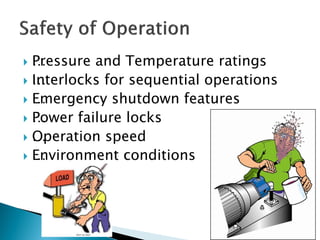
 …Pressure and Temperature ratings
 …Interlocks for sequential operations
 …Emergency shutdown features
 …Power failure locks
 …Operation speed
 …Environment conditions
 …Meet required performance specification
 …Life expectancy same as machine
 …Facilitate good maintenance practice
 …Compatibility with electrical and mechanical
components
 …Withstand operational hazards
 …Keep system Simple, Safe and Functional
 …Access to parts need repair or adjustment
 …Design to keep min operational cost
 …Design to prevent and remove
contamination.
 Each design must have following
section
1. Power supply section – pump, elec
motor, engine, etc
2. Power control section – valve,
magnetic valve, plc, controller, etc
3. Drive section – cylinders, motors
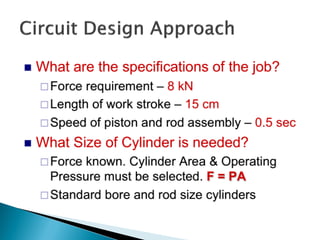
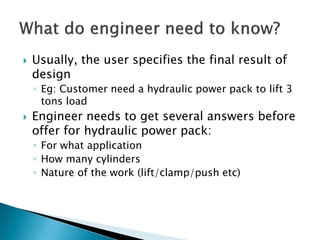
 Usually, the user specifies the final result of
design
◦ Eg: Customer need a hydraulic power pack to lift 3
tons load
 Engineer needs to get several answers before
offer for hydraulic power pack:
◦ For what application
◦ How many cylinders
◦ Nature of the work (lift/clamp/push etc)
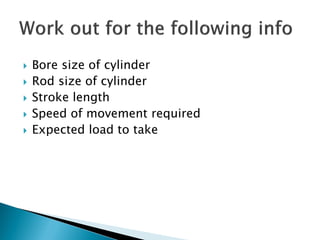
 Bore size of cylinder
 Rod size of cylinder
 Stroke length
 Speed of movement required
 Expected load to take
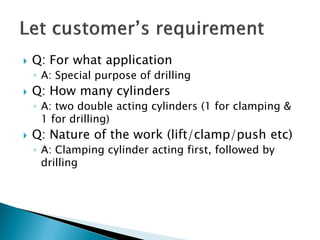
 Q: For what application
◦ A: Special purpose of drilling
 Q: How many cylinders
◦ A: two double acting cylinders (1 for clamping &
1 for drilling)
 Q: Nature of the work (lift/clamp/push etc)
◦ A: Clamping cylinder acting first, followed by
drilling
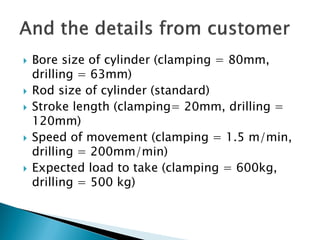
 Bore size of cylinder (clamping = 80mm,
drilling = 63mm)
 Rod size of cylinder (standard)
 Stroke length (clamping= 20mm, drilling =
120mm)
 Speed of movement (clamping = 1.5 m/min,
drilling = 200mm/min)
 Expected load to take (clamping = 600kg,
drilling = 500 kg)
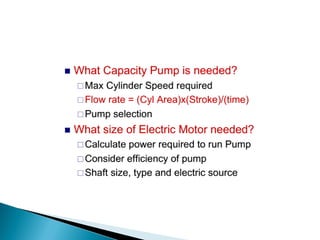
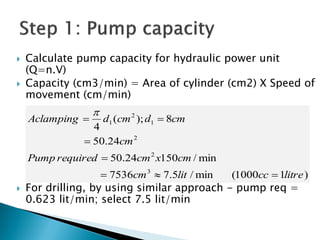
 Calculate pump capacity for hydraulic power unit
(Q=n.V)
 Capacity (cm3/min) = Area of cylinder (cm2) X Speed of
movement (cm/min)
 For drilling, by using similar approach - pump req =
0.623 lit/min; select 7.5 lit/min
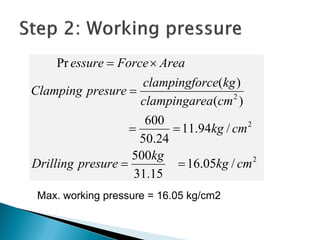
)11000(min/5.77536
min/15024.50
24.50
8);(
4
3
2
2
1
2
1
litrecclitcm
cmxcmrequiredPump
cm
cmdcmdAclamping





2
2
2
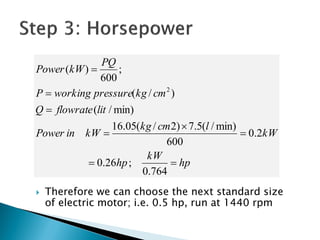
/05.16
15.31
500
/94.11
24.50
600
)(
)(
Pr
cmkg
kg
presureDrilling
cmkg
cmeaclampingar
kgrceclampingfo
presureClamping
AreaForceessure




Max. working pressure = 16.05 kg/cm2
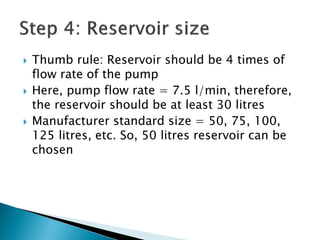
 Therefore we can choose the next standard size
of electric motor; i.e. 0.5 hp, run at 1440 rpm
hp
kW
hp
kW
lcmkg
kWinPower
litflowrateQ
cmkgpressureworkingP
PQ
kWPower







764.0
;26.0
2.0
600
min)/(5.7)2/(05.16
min)/(
)/(
;
600
)(
2
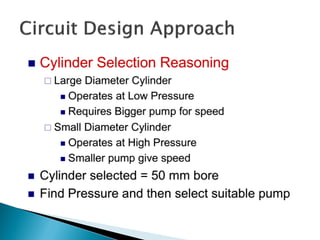
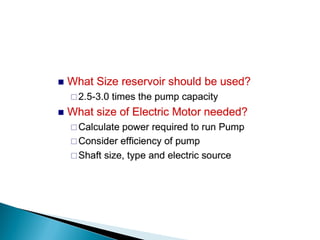
 Thumb rule: Reservoir should be 4 times of
flow rate of the pump
 Here, pump flow rate = 7.5 l/min, therefore,
the reservoir should be at least 30 litres
 Manufacturer standard size = 50, 75, 100,
125 litres, etc. So, 50 litres reservoir can be
chosen
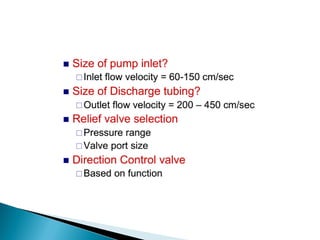
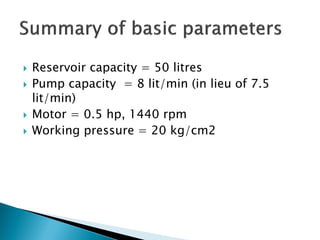
 Reservoir capacity = 50 litres
 Pump capacity = 8 lit/min (in lieu of 7.5
lit/min)
 Motor = 0.5 hp, 1440 rpm
 Working pressure = 20 kg/cm2
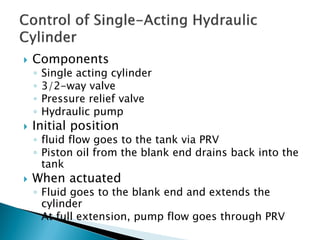
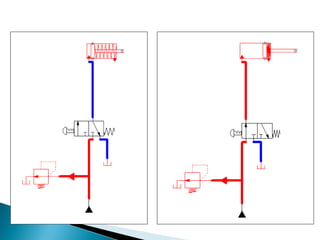
 Components
◦ Single acting cylinder
◦ 3/2-way valve
◦ Pressure relief valve
◦ Hydraulic pump
 Initial position
◦ fluid flow goes to the tank via PRV
◦ Piston oil from the blank end drains back into the
tank
 When actuated
◦ Fluid goes to the blank end and extends the
cylinder
◦ At full extension, pump flow goes through PRV
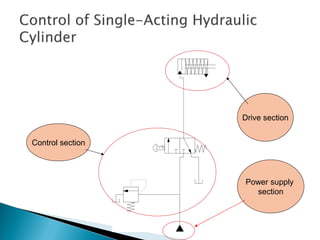
Power supply
section
Control section
Drive section
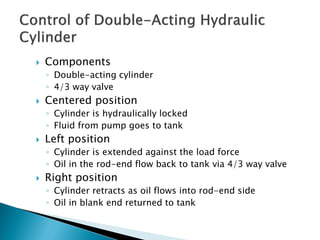
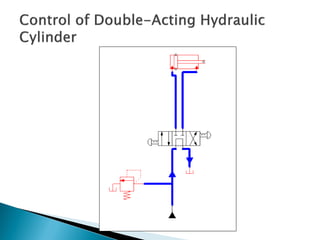
 Components
◦ Double-acting cylinder
◦ 4/3 way valve
 Centered position
◦ Cylinder is hydraulically locked
◦ Fluid from pump goes to tank
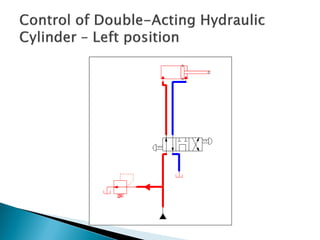
 Left position
◦ Cylinder is extended against the load force
◦ Oil in the rod-end flow back to tank via 4/3 way valve
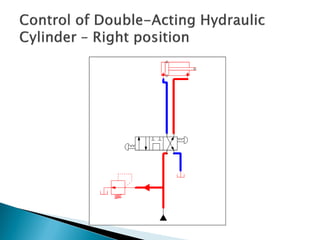
 Right position
◦ Cylinder retracts as oil flows into rod-end side
◦ Oil in blank end returned to tank
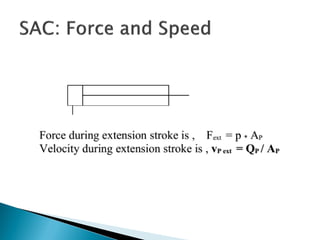
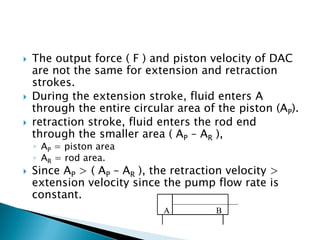
 The output force ( F ) and piston velocity of DAC
are not the same for extension and retraction
strokes.
 During the extension stroke, fluid enters A
through the entire circular area of the piston (AP).
 retraction stroke, fluid enters the rod end
through the smaller area ( AP – AR ),
◦ AP = piston area
◦ AR = rod area.
 Since AP > ( AP – AR ), the retraction velocity >
extension velocity since the pump flow rate is
constant.
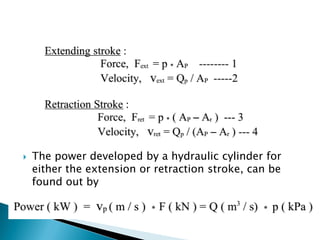
 The power developed by a hydraulic cylinder for
either the extension or retraction stroke, can be
found out by
HYDRAULIC AND PNEUMATIC
Regenerative Cylinder Circuit
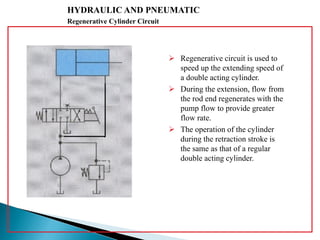
 Regenerative circuit is used to
speed up the extending speed of
a double acting cylinder.
 During the extension, flow from
the rod end regenerates with the
pump flow to provide greater
flow rate.
 The operation of the cylinder
during the retraction stroke is
the same as that of a regular
double acting cylinder.
HYDRAULIC AND PNEUMATIC
Regenerative Cylinder Circuit
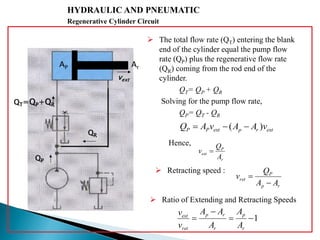
 The total flow rate (QT) entering the blank
end of the cylinder equal the pump flow
rate (QP) plus the regenerative flow rate
(QR) coming from the rod end of the
cylinder.
QT= QP + QR
Solving for the pump flow rate,
QP= QT - QR
extrpextPP vAAvAQ )( 
QR
QT=QP+QR
QP
vext
AP Ar
r
P
ext
A
Q
v 
Hence,
 Retracting speed :
rp
P
ret
AA
Q
v


1


r
p
r
rp
ret
ext
A
A
A
AA
v
v
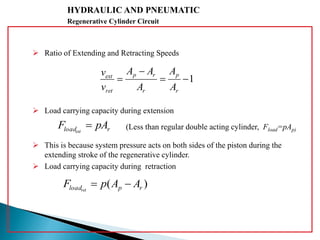
 Ratio of Extending and Retracting Speeds
HYDRAULIC AND PNEUMATIC
Regenerative Cylinder Circuit
1


r
p
r
rp
ret
ext
A
A
A
AA
v
v
 Ratio of Extending and Retracting Speeds
 Load carrying capacity during extension
 This is because system pressure acts on both sides of the piston during the
extending stroke of the regenerative cylinder.
 Load carrying capacity during retraction
rload pAF ext
 (Less than regular double acting cylinder, Fload=pAp)
)( rpload AApF ret


Week 3 3_hydraulics_circuit_design

  • 2.
     Design andanalyze basic hydraulic circuit both for single-acting and double-acting cylinder
  • 3.
     A Hydrauliccircuit is a group of components such as pumps, actuators, and control valves so arranged that they will perform a useful task.  When analyzing or designing a hydraulic circuit, the following three important considerations must be taken into account:  1. Safety of operation  2. Performance of desired function  3. Efficiency of operation
  • 4.
     …Pressure andTemperature ratings  …Interlocks for sequential operations  …Emergency shutdown features  …Power failure locks  …Operation speed  …Environment conditions
  • 5.
     …Meet requiredperformance specification  …Life expectancy same as machine  …Facilitate good maintenance practice  …Compatibility with electrical and mechanical components  …Withstand operational hazards
  • 6.
     …Keep systemSimple, Safe and Functional  …Access to parts need repair or adjustment  …Design to keep min operational cost  …Design to prevent and remove contamination.
  • 7.
     Each designmust have following section 1. Power supply section – pump, elec motor, engine, etc 2. Power control section – valve, magnetic valve, plc, controller, etc 3. Drive section – cylinders, motors
  • 13.
     Usually, theuser specifies the final result of design ◦ Eg: Customer need a hydraulic power pack to lift 3 tons load  Engineer needs to get several answers before offer for hydraulic power pack: ◦ For what application ◦ How many cylinders ◦ Nature of the work (lift/clamp/push etc)
  • 14.
     Bore sizeof cylinder  Rod size of cylinder  Stroke length  Speed of movement required  Expected load to take
  • 15.
     Q: Forwhat application ◦ A: Special purpose of drilling  Q: How many cylinders ◦ A: two double acting cylinders (1 for clamping & 1 for drilling)  Q: Nature of the work (lift/clamp/push etc) ◦ A: Clamping cylinder acting first, followed by drilling
  • 16.
     Bore sizeof cylinder (clamping = 80mm, drilling = 63mm)  Rod size of cylinder (standard)  Stroke length (clamping= 20mm, drilling = 120mm)  Speed of movement (clamping = 1.5 m/min, drilling = 200mm/min)  Expected load to take (clamping = 600kg, drilling = 500 kg)
  • 17.
     Calculate pumpcapacity for hydraulic power unit (Q=n.V)  Capacity (cm3/min) = Area of cylinder (cm2) X Speed of movement (cm/min)  For drilling, by using similar approach - pump req = 0.623 lit/min; select 7.5 lit/min )11000(min/5.77536 min/15024.50 24.50 8);( 4 3 2 2 1 2 1 litrecclitcm cmxcmrequiredPump cm cmdcmdAclamping     
  • 18.
  • 19.
     Therefore wecan choose the next standard size of electric motor; i.e. 0.5 hp, run at 1440 rpm hp kW hp kW lcmkg kWinPower litflowrateQ cmkgpressureworkingP PQ kWPower        764.0 ;26.0 2.0 600 min)/(5.7)2/(05.16 min)/( )/( ; 600 )( 2
  • 20.
     Thumb rule:Reservoir should be 4 times of flow rate of the pump  Here, pump flow rate = 7.5 l/min, therefore, the reservoir should be at least 30 litres  Manufacturer standard size = 50, 75, 100, 125 litres, etc. So, 50 litres reservoir can be chosen
  • 21.
     Reservoir capacity= 50 litres  Pump capacity = 8 lit/min (in lieu of 7.5 lit/min)  Motor = 0.5 hp, 1440 rpm  Working pressure = 20 kg/cm2
  • 22.
     Components ◦ Singleacting cylinder ◦ 3/2-way valve ◦ Pressure relief valve ◦ Hydraulic pump  Initial position ◦ fluid flow goes to the tank via PRV ◦ Piston oil from the blank end drains back into the tank  When actuated ◦ Fluid goes to the blank end and extends the cylinder ◦ At full extension, pump flow goes through PRV
  • 23.
  • 26.
     Components ◦ Double-actingcylinder ◦ 4/3 way valve  Centered position ◦ Cylinder is hydraulically locked ◦ Fluid from pump goes to tank  Left position ◦ Cylinder is extended against the load force ◦ Oil in the rod-end flow back to tank via 4/3 way valve  Right position ◦ Cylinder retracts as oil flows into rod-end side ◦ Oil in blank end returned to tank
  • 30.
     The outputforce ( F ) and piston velocity of DAC are not the same for extension and retraction strokes.  During the extension stroke, fluid enters A through the entire circular area of the piston (AP).  retraction stroke, fluid enters the rod end through the smaller area ( AP – AR ), ◦ AP = piston area ◦ AR = rod area.  Since AP > ( AP – AR ), the retraction velocity > extension velocity since the pump flow rate is constant.
  • 31.
     The powerdeveloped by a hydraulic cylinder for either the extension or retraction stroke, can be found out by
  • 32.
    HYDRAULIC AND PNEUMATIC RegenerativeCylinder Circuit  Regenerative circuit is used to speed up the extending speed of a double acting cylinder.  During the extension, flow from the rod end regenerates with the pump flow to provide greater flow rate.  The operation of the cylinder during the retraction stroke is the same as that of a regular double acting cylinder.
  • 33.
    HYDRAULIC AND PNEUMATIC RegenerativeCylinder Circuit  The total flow rate (QT) entering the blank end of the cylinder equal the pump flow rate (QP) plus the regenerative flow rate (QR) coming from the rod end of the cylinder. QT= QP + QR Solving for the pump flow rate, QP= QT - QR extrpextPP vAAvAQ )(  QR QT=QP+QR QP vext AP Ar r P ext A Q v  Hence,  Retracting speed : rp P ret AA Q v   1   r p r rp ret ext A A A AA v v  Ratio of Extending and Retracting Speeds
  • 34.
    HYDRAULIC AND PNEUMATIC RegenerativeCylinder Circuit 1   r p r rp ret ext A A A AA v v  Ratio of Extending and Retracting Speeds  Load carrying capacity during extension  This is because system pressure acts on both sides of the piston during the extending stroke of the regenerative cylinder.  Load carrying capacity during retraction rload pAF ext  (Less than regular double acting cylinder, Fload=pAp) )( rpload AApF ret 