BASIC HYDRAULIC
    CIRCUIT
Basic Hydraulic Circuits
Structure of a hydraulic
             system
 This simplified block
 diagram shows the
 division of hydraulic
 systems into a signal
 control section and a
 hydraulic power
 section. This signal
 control section is used
 to activate the valves in
 the power control
 section.
Hydraulic power section
 The diagram of the hydraulic power
  section is complemented in this
  case by a circuit diagram to allow
  correlation of the various function
  groups; the power supply section
  contains the hydraulic pump and
  drive motor and the components for
  the preparation of the hydraulic
  fluid. The energy control section
  consists of the various valves used to
  provide control and regulate the
  flow rate, pressure and direction of
  the hydraulic fluid. This drive
  section consists of cylinders or
  hydraulic motors, depending on the
  application in question.
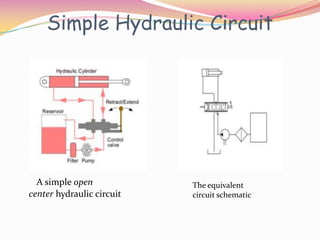
Simple Hydraulic Circuit


  A simple open            The equivalent
center hydraulic circuit   circuit schematic
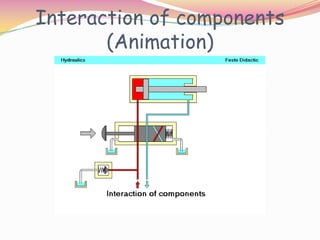
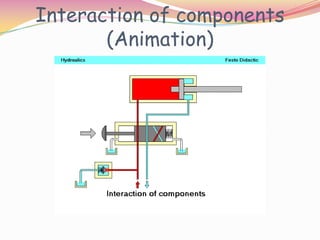
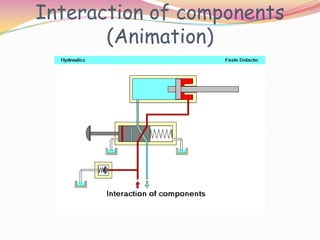
Interaction of components
 The animations show the
 sequences in a basic
 hydraulic circuit in
 simplified form - the
 actuation and spring
 return of the final control
 element (4/2-way valve),
 the advance and return of
 the drive component
 (double acting cylinder)
 and the opening and
 closing of the pressure
 relief valve.
Interaction of components
       (Animation)
Interaction of components
       (Animation)
Interaction of components
       (Animation)
Interaction of components
       (Animation)
Interaction of components
       (Animation)
Interaction of components
       (Animation)
Interaction of components
       (Animation)
Interaction of components
       (Animation)
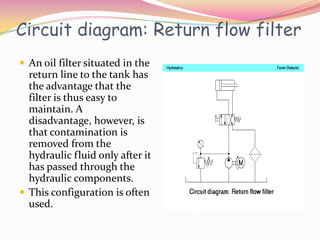
Circuit diagram: Return flow filter
 An oil filter situated in the
  return line to the tank has
  the advantage that the
  filter is thus easy to
  maintain. A
  disadvantage, however, is
  that contamination is
  removed from the
  hydraulic fluid only after it
  has passed through the
  hydraulic components.
 This configuration is often
  used.
Circuit diagram : Pump inlet filter
 With this
  configuration, the pump is
  protected from
  contamination. The filter
  is, on the other hand, less
  easily accessible.
 If these filters have a too
  fine mesh, suction
  problems and cavitation
  effects may occur.
  Additional coarse filters
  upstream of the pump are
  recommended.
Circuit diagram: Pressure line
                filter
 Pressure filters can be
  installed selectively
  upstream of valves which
  are sensitive to
  contamination; this also
  enables smaller mesh sizes
  to be used.
 A pressure-resistant
  housing is required, which
  makes this configuration
  more expensive.
Circuit diagram: Contamination
               indicator
 It is important that the effectiveness
  of a filter can be checked by a
  contamination indicator. The
  contamination of a filter is
  measured by the pressure drop; as
  the contamination increases, the
  pressure upstream of the filter
  increases. The pressure acts on a
  spring- loaded piston. As the
  pressure increases, the piston is
  pushed against a spring.
 There are a number of different
  display methods. Either the piston
  movement is directly visible or it is
  converted into an electrical or visual
  indication by electrical contacts.
Circuit diagram: Hydraulic power
              unit
 The illustration shows
  the detailed circuit
  symbol for a hydraulic
  power unit.
 Since this is an
  combination unit, a
  dot/dash line is placed
  around the symbols
  representing the
  individual units.
Pressure relief valve (1)
 In this design
  incorporating a poppet
  valve, a seal is pressed
  against the inlet port P by a
  pressure spring when the
  valve is in its normal
  position.
 In this situation, for
  example, an unloaded
  piston rod is executing an
  advance stroke and the
  entire pump delivery is
  flowing to the cylinder.
Circuit diagram: Pressure relief
              valve (2)
 As soon as the force
  exerted by the inlet
  pressure at A exceeds the
  opposing spring force, the
  valve begins to open.
 In this situation, for
  example, the piston rod is
  fully advanced; the entire
  pump delivery is flowing at
  the preset system pressure
  to the tank.
PRV used to limit system pressure
 This illustration shows a
  pressure relief valve within
  a basic hydraulic circuit
  (used to control a double
  acting cylinder).
 The resistances at the
  outlet (tank line, filter)
  must be added to the force
  of the spring in the
  pressure relief valve. See
  also the animation
  “Interaction of
  components” (at page 7).
PRV used to limit system pressure
 This illustration shows
 the same circuit as the
 previous
 illustration, but with
 the cut-away view of
 the PRV replaced by
 the appropriate circuit
 symbol.
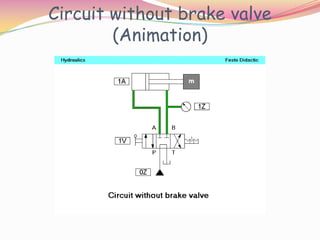
(1A) Circuit without brake valve
            (Animation)
 One application of pressure
  relief valves is as brake valves;
  these prevent pressure peaks
  which may otherwise occur as
  the result of mass moments of
  inertia when a directional
  control valve is suddenly closed.
  The animation shows an
  (incorrect) circuit in schematic
  form in which the working line
  on the exhaust side has
  fractured due to the absence of a
  brake valve.
 The next animation shows the
  correct circuit.
Circuit without brake valve
        (Animation)
Circuit without brake valve
        (Animation)
Circuit without brake valve
        (Animation)
Circuit without brake valve
        (Animation)
(2) Circuit diagram: Brake valve
 This illustration shows the
  correct circuit for the problem in
  topic 1A. This circuit
  incorporates not only a brake
  valve on the piston-rod side but
  also a non-return valve on the
  inlet side via which oil can be
  taken in from a reservoir during
  the vacuum phase following the
  closure of the directional control
  valve.
 The following animation shows
  the events which occur in the
  two working lines.
Circuit with brake valve
              (Animation)
 The animation (2a) shows
  in schematic form the
  behavior of the PRV during
  the braking phase, while
  (2b) shows the behavior of
  the non-return valve
  (NRV) in the supply line
  and (2) shows the two
  events together in
  summary.
 The necessity of the brake
  valve can be demonstrated
  by the preceding
  animation.
[2a] Circuit with brake valve
         (Animation)
[2b] Circuit with brake valve
         (Animation)
Thank you

Basic hydraulic circuit

  • 1.
  • 2.
  • 3.
    Structure of ahydraulic system  This simplified block diagram shows the division of hydraulic systems into a signal control section and a hydraulic power section. This signal control section is used to activate the valves in the power control section.
  • 4.
    Hydraulic power section The diagram of the hydraulic power section is complemented in this case by a circuit diagram to allow correlation of the various function groups; the power supply section contains the hydraulic pump and drive motor and the components for the preparation of the hydraulic fluid. The energy control section consists of the various valves used to provide control and regulate the flow rate, pressure and direction of the hydraulic fluid. This drive section consists of cylinders or hydraulic motors, depending on the application in question.
  • 5.
    Simple Hydraulic Circuit A simple open The equivalent center hydraulic circuit circuit schematic
  • 6.
    Interaction of components The animations show the sequences in a basic hydraulic circuit in simplified form - the actuation and spring return of the final control element (4/2-way valve), the advance and return of the drive component (double acting cylinder) and the opening and closing of the pressure relief valve.
  • 7.
  • 8.
  • 9.
  • 10.
  • 11.
  • 12.
  • 13.
  • 14.
  • 15.
    Circuit diagram: Returnflow filter  An oil filter situated in the return line to the tank has the advantage that the filter is thus easy to maintain. A disadvantage, however, is that contamination is removed from the hydraulic fluid only after it has passed through the hydraulic components.  This configuration is often used.
  • 16.
    Circuit diagram :Pump inlet filter  With this configuration, the pump is protected from contamination. The filter is, on the other hand, less easily accessible.  If these filters have a too fine mesh, suction problems and cavitation effects may occur. Additional coarse filters upstream of the pump are recommended.
  • 17.
    Circuit diagram: Pressureline filter  Pressure filters can be installed selectively upstream of valves which are sensitive to contamination; this also enables smaller mesh sizes to be used.  A pressure-resistant housing is required, which makes this configuration more expensive.
  • 18.
    Circuit diagram: Contamination indicator  It is important that the effectiveness of a filter can be checked by a contamination indicator. The contamination of a filter is measured by the pressure drop; as the contamination increases, the pressure upstream of the filter increases. The pressure acts on a spring- loaded piston. As the pressure increases, the piston is pushed against a spring.  There are a number of different display methods. Either the piston movement is directly visible or it is converted into an electrical or visual indication by electrical contacts.
  • 19.
    Circuit diagram: Hydraulicpower unit  The illustration shows the detailed circuit symbol for a hydraulic power unit.  Since this is an combination unit, a dot/dash line is placed around the symbols representing the individual units.
  • 20.
    Pressure relief valve(1)  In this design incorporating a poppet valve, a seal is pressed against the inlet port P by a pressure spring when the valve is in its normal position.  In this situation, for example, an unloaded piston rod is executing an advance stroke and the entire pump delivery is flowing to the cylinder.
  • 21.
    Circuit diagram: Pressurerelief valve (2)  As soon as the force exerted by the inlet pressure at A exceeds the opposing spring force, the valve begins to open.  In this situation, for example, the piston rod is fully advanced; the entire pump delivery is flowing at the preset system pressure to the tank.
  • 22.
    PRV used tolimit system pressure  This illustration shows a pressure relief valve within a basic hydraulic circuit (used to control a double acting cylinder).  The resistances at the outlet (tank line, filter) must be added to the force of the spring in the pressure relief valve. See also the animation “Interaction of components” (at page 7).
  • 23.
    PRV used tolimit system pressure  This illustration shows the same circuit as the previous illustration, but with the cut-away view of the PRV replaced by the appropriate circuit symbol.
  • 24.
    (1A) Circuit withoutbrake valve (Animation)  One application of pressure relief valves is as brake valves; these prevent pressure peaks which may otherwise occur as the result of mass moments of inertia when a directional control valve is suddenly closed. The animation shows an (incorrect) circuit in schematic form in which the working line on the exhaust side has fractured due to the absence of a brake valve.  The next animation shows the correct circuit.
  • 25.
    Circuit without brakevalve (Animation)
  • 26.
    Circuit without brakevalve (Animation)
  • 27.
    Circuit without brakevalve (Animation)
  • 28.
    Circuit without brakevalve (Animation)
  • 29.
    (2) Circuit diagram:Brake valve  This illustration shows the correct circuit for the problem in topic 1A. This circuit incorporates not only a brake valve on the piston-rod side but also a non-return valve on the inlet side via which oil can be taken in from a reservoir during the vacuum phase following the closure of the directional control valve.  The following animation shows the events which occur in the two working lines.
  • 30.
    Circuit with brakevalve (Animation)  The animation (2a) shows in schematic form the behavior of the PRV during the braking phase, while (2b) shows the behavior of the non-return valve (NRV) in the supply line and (2) shows the two events together in summary.  The necessity of the brake valve can be demonstrated by the preceding animation.
  • 31.
    [2a] Circuit withbrake valve (Animation)
  • 32.
    [2b] Circuit withbrake valve (Animation)
  • 33.