nfi

Training on
Industrial
Hydraulics
NFI – Industrial Automation
Training Academy
www.nfiautomation.org

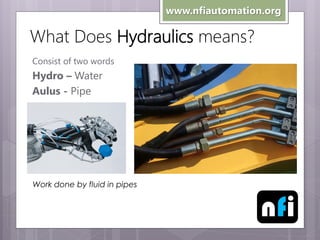
What Does Hydraulics means?
Consist of two words

Hydro – Water
Aulus - Pipe

Work done by fluid in pipes

nfi
www.nfiautomation.org

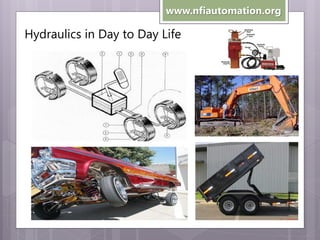
Hydraulics in Day to Day Life
www.nfiautomation.org

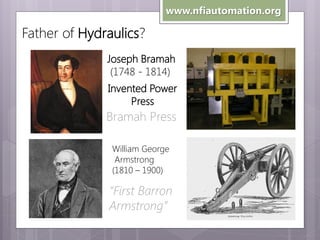
Father of Hydraulics?
Joseph Bramah
(1748 - 1814)
Invented Power
Press

Bramah Press
William George
Armstrong
(1810 – 1900)

“First Barron
Armstrong”
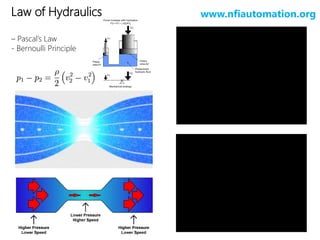
Law of Hydraulics
– Pascal’s Law
- Bernoulli Principle

www.nfiautomation.org
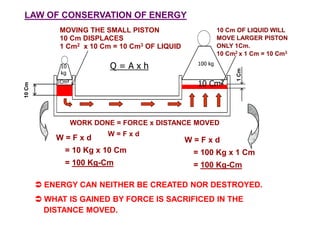
LAW OF CONSERVATION OF ENERGY
MOVING THE SMALL PISTON
10 Cm DISPLACES
1 Cm2 x 10 Cm = 10 Cm3 OF LIQUID

10 Cm

100 kg

10 Cm2

1Cm2

1 Cm

Q=Axh

10
kg

10 Cm OF LIQUID WILL
MOVE LARGER PISTON
ONLY 1Cm.
10 Cm2 x 1 Cm = 10 Cm3

WORK DONE = FORCE x DISTANCE MOVED

W=Fxd

W=Fxd

W=Fxd

= 10 Kg x 10 Cm

= 100 Kg x 1 Cm

= 100 Kg-Cm

= 100 Kg-Cm

 ENERGY CAN NEITHER BE CREATED NOR DESTROYED.
 WHAT IS GAINED BY FORCE IS SACRIFICED IN THE
DISTANCE MOVED.
www.nfiautomation.org

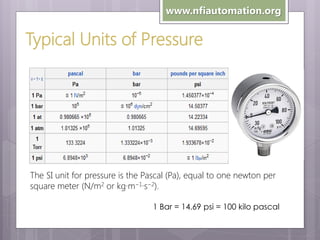
Typical Units of Pressure

The SI unit for pressure is the Pascal (Pa), equal to one newton per
square meter (N/m2 or kg·m−1·s−2).
1 Bar = 14.69 psi = 100 kilo pascal
www.nfiautomation.org

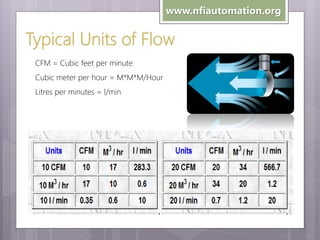
Typical Units of Flow
CFM = Cubic feet per minute
Cubic meter per hour = M*M*M/Hour
Litres per minutes = l/min
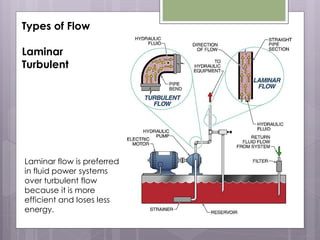
Types of Flow
Laminar
Turbulent

Laminar flow is preferred
in fluid power systems
over turbulent flow
because it is more
efficient and loses less
energy.
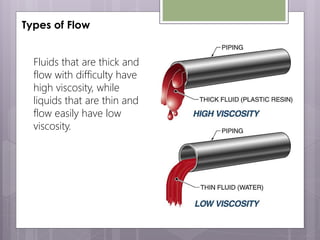
Types of Flow
Fluids that are thick and
flow with difficulty have
high viscosity, while
liquids that are thin and
flow easily have low
viscosity.
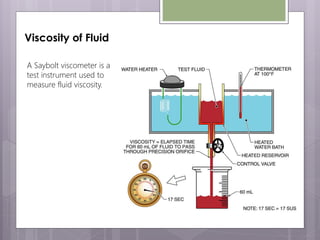
Viscosity of Fluid
A Saybolt viscometer is a
test instrument used to
measure fluid viscosity.
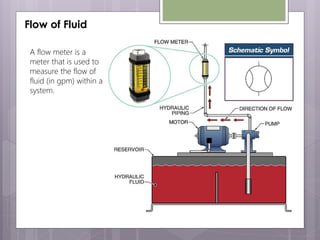
Flow of Fluid
A flow meter is a
meter that is used to
measure the flow of
fluid (in gpm) within a
system.
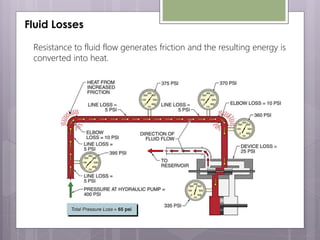
Fluid Losses
Resistance to fluid flow generates friction and the resulting energy is
converted into heat.
www.nfiautomation.org

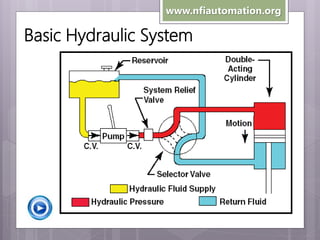
Basic Hydraulic System
www.nfiautomation.org

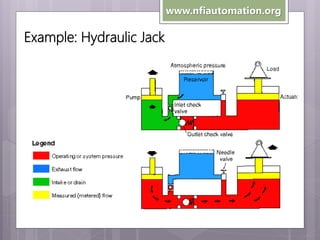
Example: Hydraulic Jack
www.nfiautomation.org

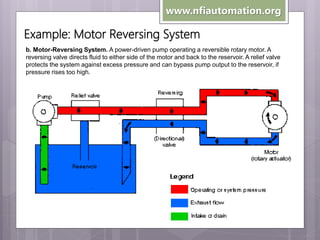
Example: Motor Reversing System
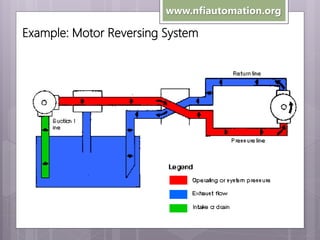
b. Motor-Reversing System. A power-driven pump operating a reversible rotary motor. A
reversing valve directs fluid to either side of the motor and back to the reservoir. A relief valve
protects the system against excess pressure and can bypass pump output to the reservoir, if
pressure rises too high.
www.nfiautomation.org

Example: Motor Reversing System
www.nfiautomation.org

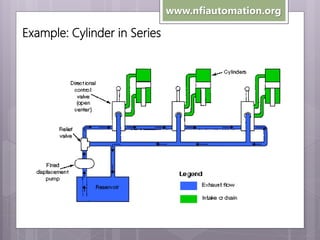
Example: Cylinder in Series
www.nfiautomation.org

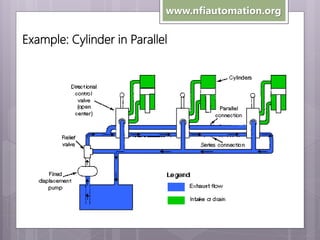
Example: Cylinder in Parallel
www.nfiautomation.org

Hydraulic Pumps
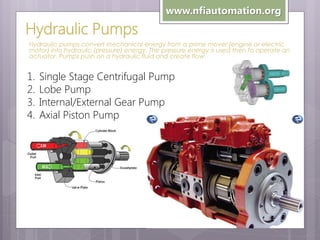
Hydraulic pumps convert mechanical energy from a prime mover (engine or electric
motor) into hydraulic (pressure) energy. The pressure energy is used then to operate an
actuator. Pumps push on a hydraulic fluid and create flow.

1.
2.
3.
4.

Single Stage Centrifugal Pump
Lobe Pump
Internal/External Gear Pump
Axial Piston Pump
Pump

www.nfiautomation.org
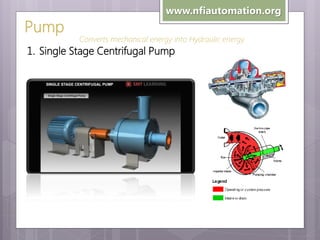
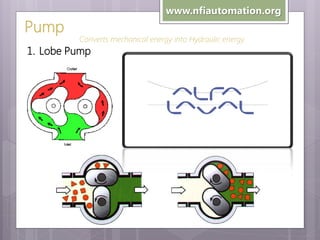
Converts mechanical energy into Hydraulic energy

1. Single Stage Centrifugal Pump
Pump

www.nfiautomation.org
Converts mechanical energy into Hydraulic energy

1. Lobe Pump
Pump

www.nfiautomation.org
Converts mechanical energy into Hydraulic energy

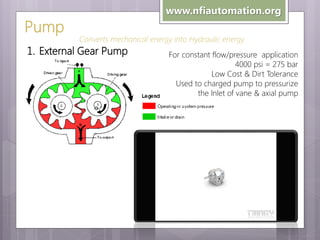
1. External Gear Pump

For constant flow/pressure application
4000 psi = 275 bar
Low Cost & Dirt Tolerance
Used to charged pump to pressurize
the lnlet of vane & axial pump
Pump

www.nfiautomation.org
Converts mechanical energy into Hydraulic energy

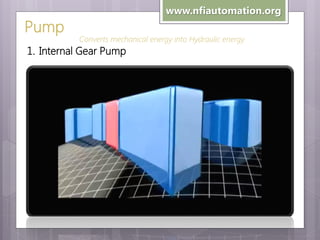
1. Internal Gear Pump
Pump
Vane Pump

www.nfiautomation.org
Converts mechanical energy into Hydraulic energy
Pump

www.nfiautomation.org
Converts mechanical energy into Hydraulic energy

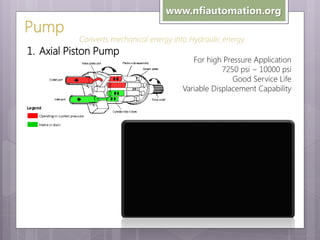
1. Axial Piston Pump

For high Pressure Application
7250 psi ~ 10000 psi
Good Service Life
Variable Displacement Capability
www.nfiautomation.org

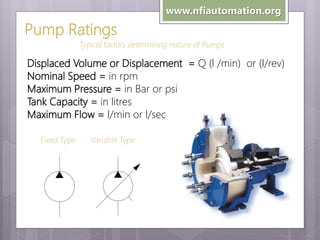
Pump Ratings
Typical factors determining nature of Pumps

Displaced Volume or Displacement = Q (l /min) or (l/rev)
Nominal Speed = in rpm
Maximum Pressure = in Bar or psi
Tank Capacity = in litres
Maximum Flow = l/min or l/sec
Fixed Type

Variable Type
www.nfiautomation.org

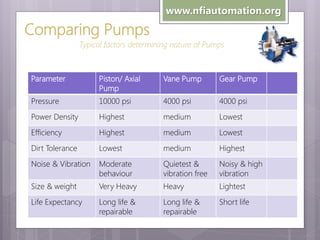
Comparing Pumps
Typical factors determining nature of Pumps

Parameter

Piston/ Axial
Pump

Vane Pump

Gear Pump

Pressure

10000 psi

4000 psi

4000 psi

Power Density

Highest

medium

Lowest

Efficiency

Highest

medium

Lowest

Dirt Tolerance

Lowest

medium

Highest

Noise & Vibration

Moderate
behaviour

Quietest &
vibration free

Noisy & high
vibration

Size & weight

Very Heavy

Heavy

Lightest

Life Expectancy

Long life &
repairable

Long life &
repairable

Short life
www.nfiautomation.org

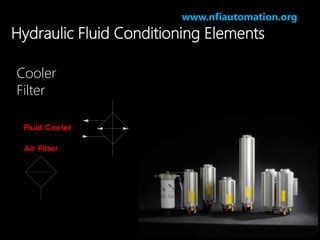
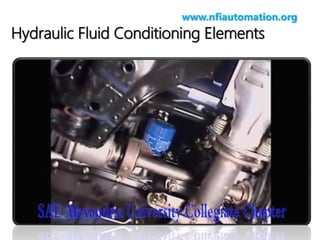
Hydraulic Fluid Conditioning Elements
Cooler
Filter
Fluid Cooler
Air Filter
www.nfiautomation.org

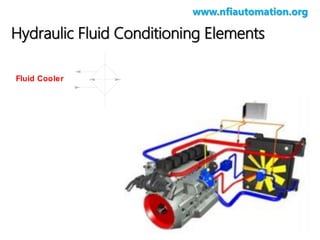
Hydraulic Fluid Conditioning Elements
Cooler

Fluid Cooler
www.nfiautomation.org

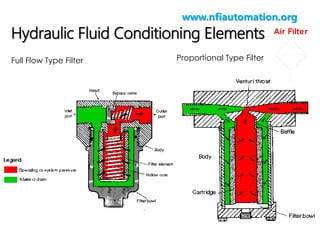
Hydraulic Fluid Conditioning Elements
Filter

Full Flow Type Filter

Proportional Type Filter

Air Filter
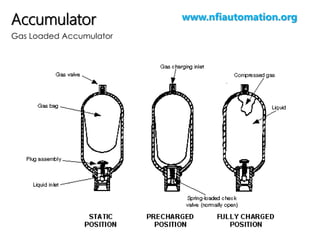
Accumulator
Gas Loaded Accumulator

Filter

www.nfiautomation.org
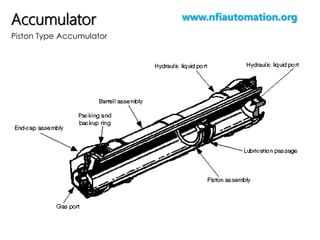
Accumulator
Piston Type Accumulator

Filter

www.nfiautomation.org

Hydraulic Fluid Conditioning Elements
Filter
www.nfiautomation.org

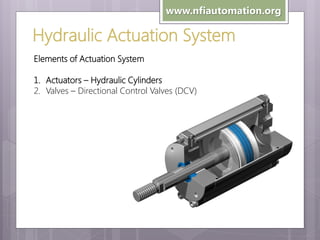
Hydraulic Actuation System
Elements of Actuation System
1. Actuators – Hydraulic Cylinders
2. Valves – Directional Control Valves (DCV)
www.nfiautomation.org

Hydraulic Actuation System
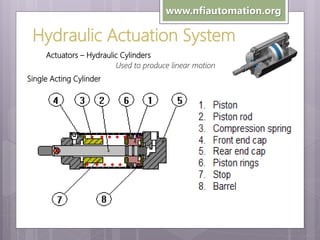
Actuators – Hydraulic Cylinders
Used to produce linear motion
Single Acting Cylinder
www.nfiautomation.org

Hydraulic Actuation System
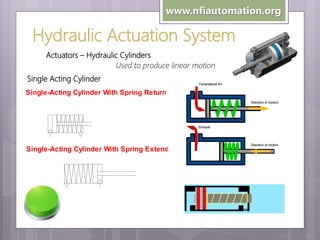
Actuators – Hydraulic Cylinders
Used to produce linear motion
Single Acting Cylinder
Single-Acting Cylinder With Spring Return

Single-Acting Cylinder With Spring Extend
www.nfiautomation.org

Hydraulic Actuation System
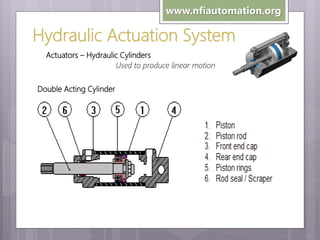
Actuators – Hydraulic Cylinders
Used to produce linear motion
Double Acting Cylinder
www.nfiautomation.org

Hydraulic Actuation System
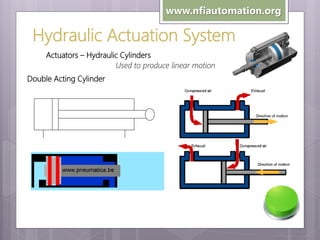
Actuators – Hydraulic Cylinders
Used to produce linear motion
Double Acting Cylinder
Double-Acting 2-Cushion

www.nfiautomation.org

Hydraulic Actuation System
Actuators – Hydraulic Cylinders
Used to produce linear motion
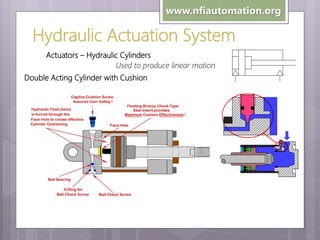
Double Acting Cylinder with Cushion
www.nfiautomation.org

Hydraulic Actuation System
Actuators – Hydraulic Cylinders
Used to produce linear motion
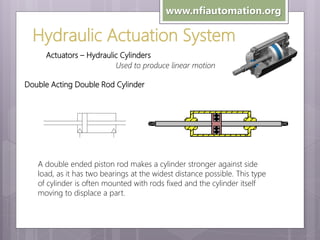
Double Acting Double Rod Cylinder

Double-Acting Double-Rod Cylinder

A double ended piston rod makes a cylinder stronger against side
load, as it has two bearings at the widest distance possible. This type
of cylinder is often mounted with rods fixed and the cylinder itself
moving to displace a part.
www.nfiautomation.org

Hydraulic Actuation System
Actuators – Hydraulic Cylinders
Used to produce linear motion
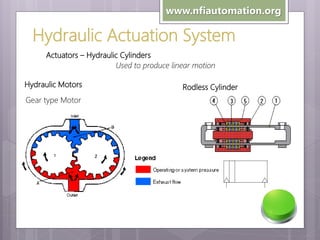
Hydraulic Motors
Gear type Motor

Rodless Cylinder
www.nfiautomation.org

Piston Force
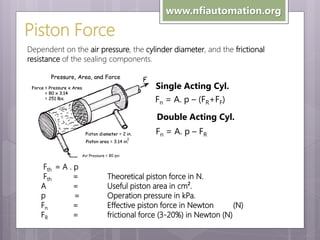
Dependent on the air pressure, the cylinder diameter, and the frictional
resistance of the sealing components.

Single Acting Cyl.
Fn = A. p – (FR+FF)
Double Acting Cyl.
Fn = A. p – FR

Fth = A . p
Fth
=
A
=
p
=
Fn
=
FR
=

Theoretical piston force in N.
Useful piston area in cm².
Operation pressure in kPa.
Effective piston force in Newton
(N)
frictional force (3-20%) in Newton (N)
www.nfiautomation.org

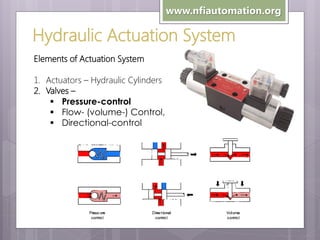
Hydraulic Actuation System
Elements of Actuation System
1. Actuators – Hydraulic Cylinders
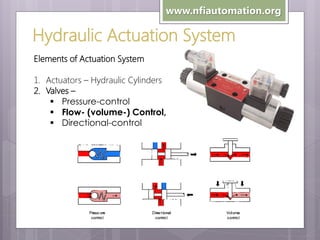
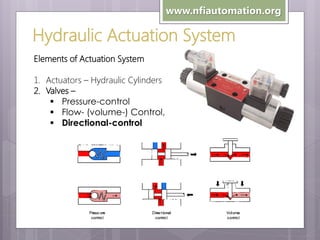
2. Valves –
 Pressure-control
 Flow- (volume-) Control,
 Directional-control
www.nfiautomation.org

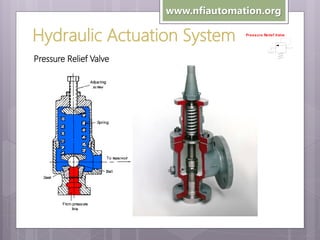
Hydraulic Actuation System
Pressure Relief Valve

Pres sure Re lief Valve
www.nfiautomation.org

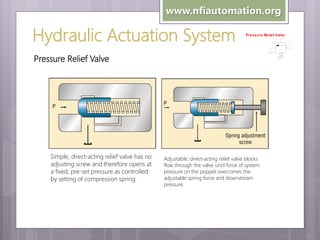
Hydraulic Actuation System

Pres sure Re lief Valve

Pressure Relief Valve

Simple, direct-acting relief valve has no
adjusting screw and therefore opens at
a fixed, pre-set pressure as controlled
by setting of compression spring.

Adjustable, direct-acting relief valve blocks
flow through the valve until force of system
pressure on the poppet overcomes the
adjustable spring force and downstream
pressure.
www.nfiautomation.org

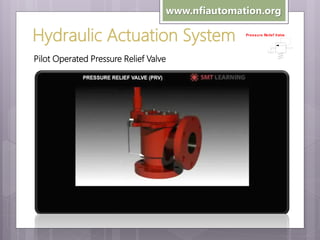
Hydraulic Actuation System
Pilot Operated Pressure Relief Valve

Pres sure Re lief Valve
www.nfiautomation.org

Hydraulic Actuation System
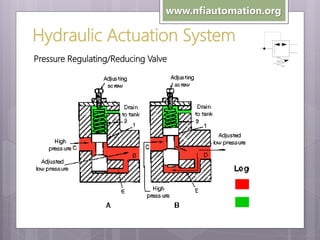
Pressure Regulating/Reducing Valve
www.nfiautomation.org

Hydraulic Actuation System
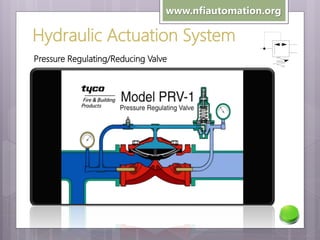
Pressure Regulating/Reducing Valve
www.nfiautomation.org

Hydraulic Actuation System
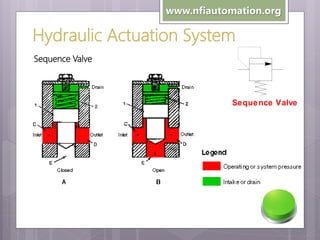
Sequence Valve

Seque nce Valve
www.nfiautomation.org

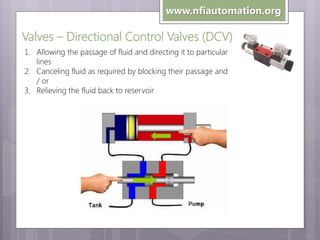
Valves – Directional Control Valves (DCV)
1. Allowing the passage of fluid and directing it to particular
lines
2. Canceling fluid as required by blocking their passage and
/ or
3. Relieving the fluid back to reservoir
www.nfiautomation.org

Hydraulic Actuation System
Elements of Actuation System
1. Actuators – Hydraulic Cylinders
2. Valves –
 Pressure-control
 Flow- (volume-) Control,
 Directional-control
www.nfiautomation.org

Hydraulic Actuation System
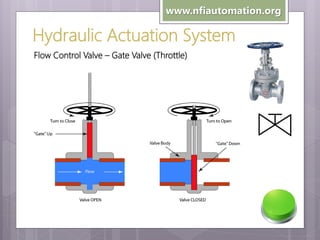
Flow Control Valve – Gate Valve (Throttle)
www.nfiautomation.org

Hydraulic Actuation System
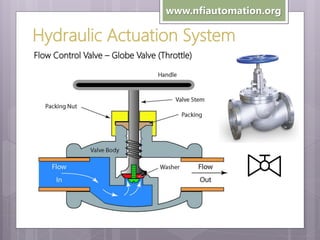
Flow Control Valve – Globe Valve (Throttle)
www.nfiautomation.org

Hydraulic Actuation System
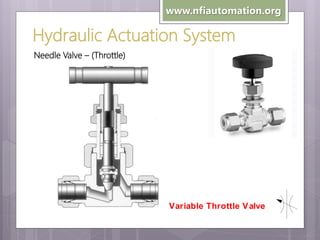
Needle Valve – (Throttle)

Variable Throttle Valve
www.nfiautomation.org

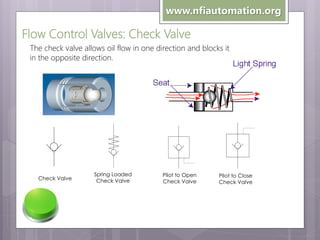
Flow Control Valves: Check Valve
The check valve allows oil flow in one direction and blocks it
in the opposite direction.

Check Valve

Spring Loaded
Check Valve

Pilot to Open
Check Valve

Pilot to Close
Check Valve
www.nfiautomation.org

Hydraulic Actuation System
Elements of Actuation System
1. Actuators – Hydraulic Cylinders
2. Valves –
 Pressure-control
 Flow- (volume-) Control,
 Directional-control
www.nfiautomation.org

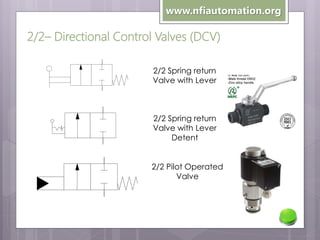
2/2– Directional Control Valves (DCV)

er w ith Spring Return

2/2 Spring return
Valve with Lever

2/2 Spring return
Valve with Lever
Detent
2/2 Pilot Operated
Valve
www.nfiautomation.org

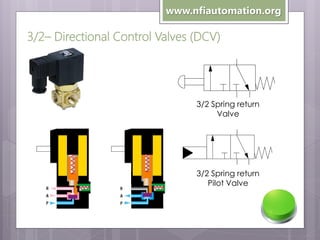
3/2– Directional Control Valves (DCV)

3/2-Way NC - External Pilot with Spring Retur

3/2 Spring return
Valve

3/2 Spring return
Pilot Valve
www.nfiautomation.org

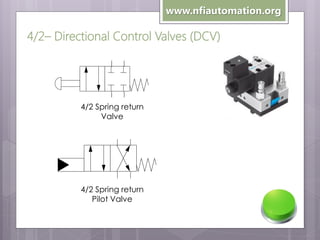
4/2– Directional Control Valves (DCV)

y NO - External Pilot with Spring Return

4/2 Spring return
Valve

4/2 Spring return
Pilot Valve
www.nfiautomation.org

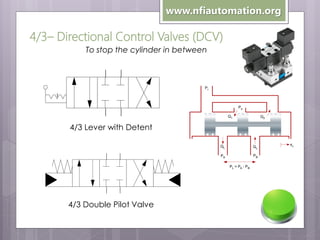
4/3– Directional Control Valves (DCV)
To stop the cylinder in between

4/3-Way NC - Double External Pilot Control

4/3 Lever with Detent

4/3 Double Pilot Valve
www.nfiautomation.org

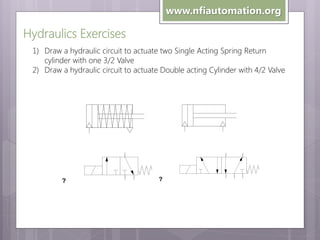
Hydraulics Exercises
1) Draw a hydraulic circuit to actuate two Single Acting Spring Return
cylinder with one 3/2 Valve
2) Draw a hydraulic circuit to actuate Double acting Cylinder with 4/2 Valve

?

?
www.nfiautomation.org

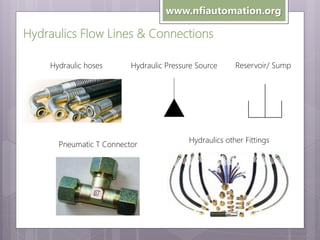
Hydraulics Flow Lines & Connections
Hydraulic hoses

Hydraulic Pressure Source

Pneumatic T Connector

Reservoir/ Sump

Hydraulics other Fittings
www.nfiautomation.org

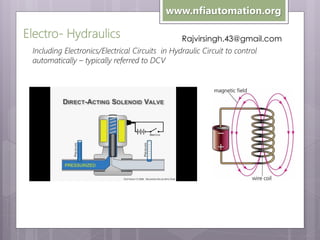
Electro- Hydraulics

Rajvirsingh.43@gmail.com
Including Electronics/Electrical Circuits in Hydraulic Circuit to control
automatically – typically referred to DCV
www.nfiautomation.org

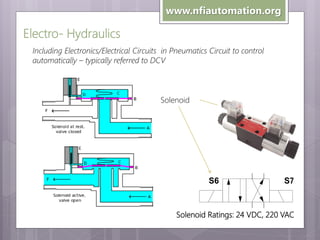
Electro- Hydraulics
Including Electronics/Electrical Circuits in Pneumatics Circuit to control
automatically – typically referred to DCV

Solenoid

S6

S7

Solenoid Ratings: 24 VDC, 220 VAC
www.nfiautomation.org

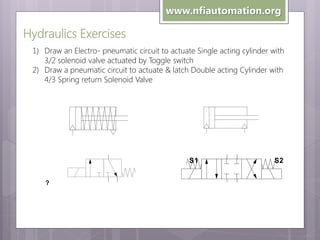
Hydraulics Exercises
1) Draw an Electro- pneumatic circuit to actuate Single acting cylinder with
3/2 solenoid valve actuated by Toggle switch
2) Draw a pneumatic circuit to actuate & latch Double acting Cylinder with
4/3 Spring return Solenoid Valve
4/3-Way NC - Double Electrical Control

S1
?

S2
www.nfiautomation.org

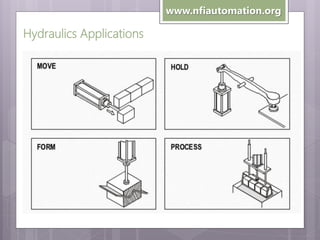
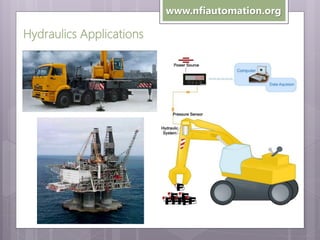
Hydraulics Applications
www.nfiautomation.org

Hydraulics Applications
100+ Video Tutorials

Coupon Code

in $99 $49

https://www.udemy.com/nfi-plc-online-leaning/?couponCode=slideshare

Life time Access
Course Outline

Learn to Code | Code to Learn

nfi Learn 4 PLC’s in a Day
presents

PLC – Programmable Logic Controller
Delta DVP 14 SS + 16 SP
• 100+ PLC Video Tutorials
Allen Bradley M1000
• Doubt Clearing Complementary LIVE Sessions on Team Viewer
Siemens S7 200
• Ladder Logic Programming
Schneider
• PLC Presentations, PLC Circuits, PLC Codes
Analog Cards Programming
• FREE PLC Simulation Software for Practice
04 AD – Analog to Digital
04DA- Digital to Analog
For more courses visit www.nfiautomation.org
PLC & VFD Advanced
Course

4 PLC’s Training
Platforms

$149
Course Link:

Course Highlights: http://www.wiziq.com/course/28882-plc-andac-drives-online-certificate-trainaing-course

• 30 Live Practical Classes on PLC, Analog Cards & AC drives- VFD
• 100+ PLC Video Tutorials with Lifetime Access & FREE PLC Simulator
• FREE Circuits Diagram

For more courses visit www.nfiautomation.org
thank you

nfi
rajvir@nfiautomation.org

Industrial hydraulics