Pumps
CHARACTERISTICS &
PERFORMANCE EVALUATION
CHAPTER 1
2- Pumps Classification
1- Function Of Pumps
3-Code and Standards
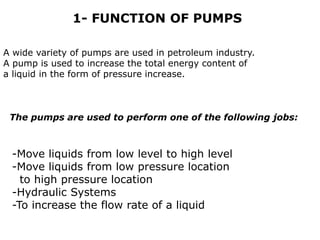
A wide variety of pumps are used in petroleum industry.
A pump is used to increase the total energy content of
a liquid in the form of pressure increase.
-Move liquids from low level to high level
-Move liquids from low pressure location
to high pressure location
-Hydraulic Systems
-To increase the flow rate of a liquid
1- FUNCTION OF PUMPS
The pumps are used to perform one of the following jobs:
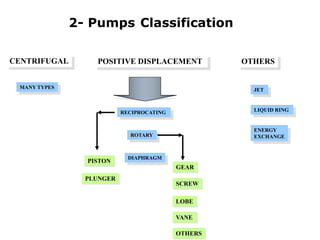
CENTRIFUGAL POSITIVE DISPLACEMENT
DIAPHRAGM
2- Pumps Classification
ROTARY
GEAR
VANE
LOBE
SCREW
OTHERS
RECIPROCATING
PISTON
PLUNGER
OTHERS
JET
LIQUID RING
ENERGY
EXCHANGE
MANY TYPES
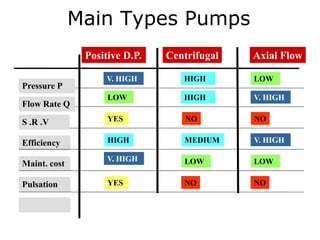
Main Types Pumps
HIGH LOW
V. HIGH
NO NO
YES
LOW HIGH V. HIGH
YES NO NO
Pressure P
Flow Rate Q
S .R .V
Efficiency
Maint. cost
Pulsation
Positive D.P. Centrifugal Axial Flow
V. HIGH LOW LOW
HIGH MEDIUM V. HIGH
100
1000
10,000
20
50
200
500
2000
5000
2 5 20 50 200 500
1000
2000 5000
10000
100
1000
10,000
20
50
200
500
2000
5000
100
10
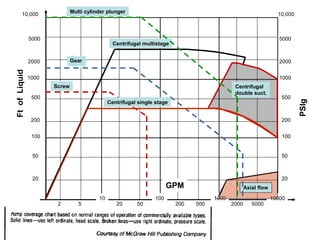
Centrifugal multistage
Centrifugal
double suct.
Axial flow
Screw
Gear
Multi cylinder plunger
GPM
Ft
of
Liquid
PSIg
Centrifugal single stage
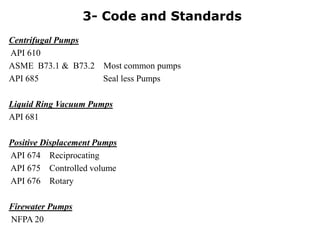
Centrifugal Pumps
API 610
ASME B73.1 & B73.2 Most common pumps
API 685 Seal less Pumps
Liquid Ring Vacuum Pumps
API 681
Positive Displacement Pumps
API 674 Reciprocating
API 675 Controlled volume
API 676 Rotary
Firewater Pumps
NFPA 20
3- Code and Standards
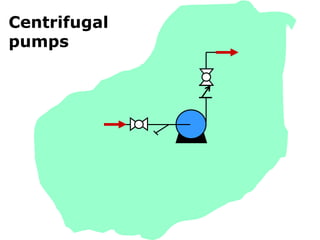
Centrifugal
pumps
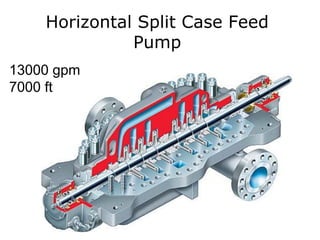
Horizontal Split Case Feed
Pump
13000 gpm
7000 ft
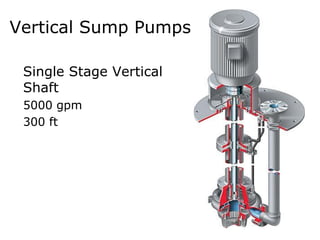
Vertical Sump Pumps
Single Stage Vertical
Shaft
5000 gpm
300 ft
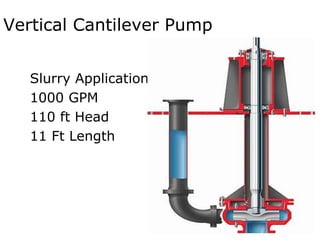
Vertical Cantilever Pump
Slurry Applications
1000 GPM
110 ft Head
11 Ft Length
1- Centrifugal pumps Types
2- Pumps arrangement
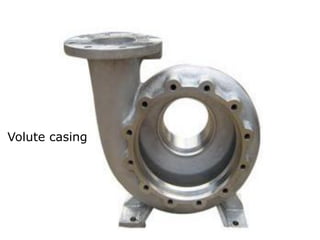
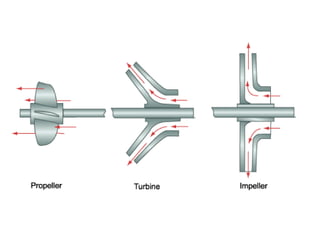
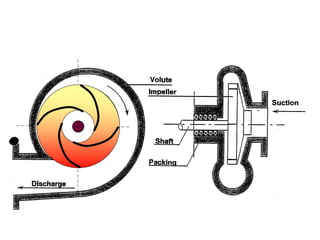
Volute casing
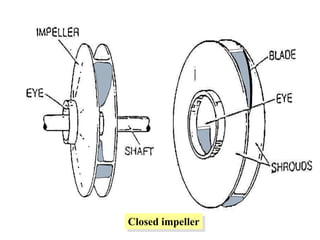
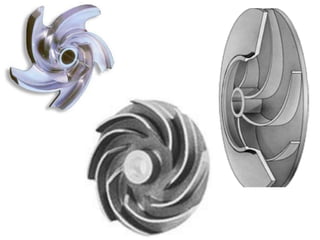
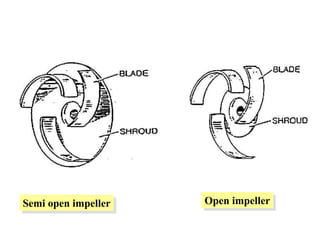
Closed impeller
Semi open impeller Open impeller
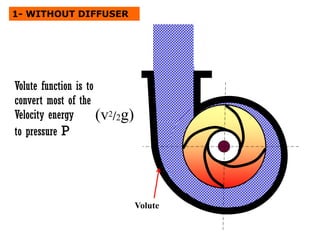
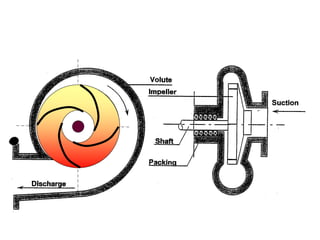
Volute
1- WITHOUT DIFFUSER
Volute function is to
convert most of the
Velocity energy
to pressure P
(v2/2g)
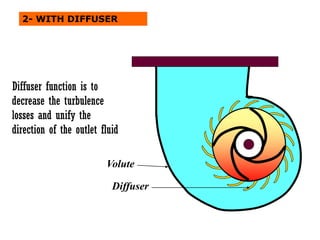
Volute
Diffuser
2- WITH DIFFUSER
Diffuser function is to
decrease the turbulence
losses and unify the
direction of the outlet fluid
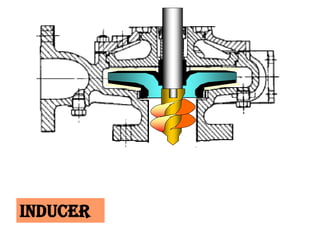
Inducer
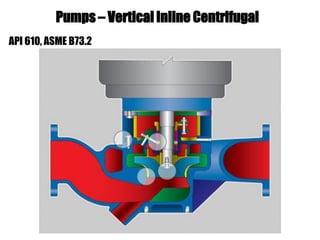
Pumps – Vertical Inline Centrifugal
API 610, ASME B73.2
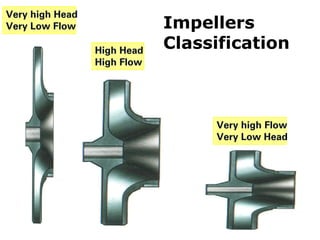
Very high Head
Very Low Flow Impellers
Classification
High Head
High Flow
Very high Flow
Very Low Head
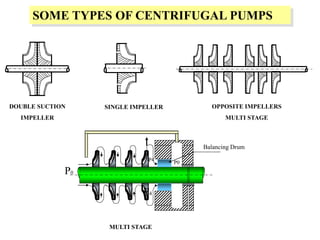
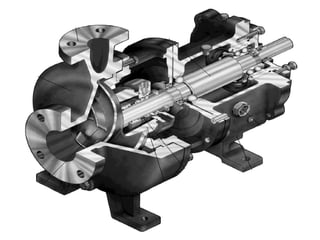
SOME TYPES OF CENTRIFUGAL PUMPS
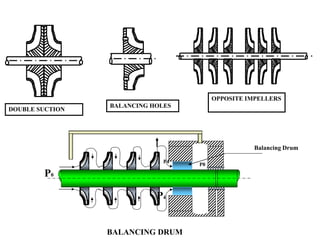
DOUBLE SUCTION
IMPELLER
SINGLE IMPELLER OPPOSITE IMPELLERS
MULTI STAGE
P0
P0
P4
P4
Balancing Drum
MULTI STAGE
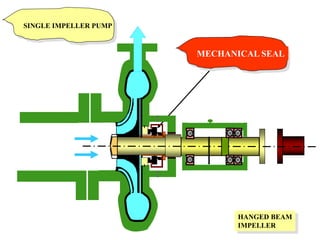
SINGLE IMPELLER PUMP
MECHANICAL SEAL
HANGED BEAM
IMPELLER
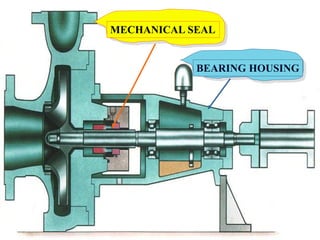
MECHANICAL SEAL
BEARING HOUSING
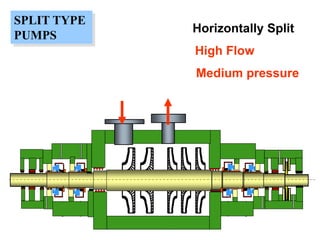
SPLIT TYPE
PUMPS
Horizontally Split
High Flow
Medium pressure
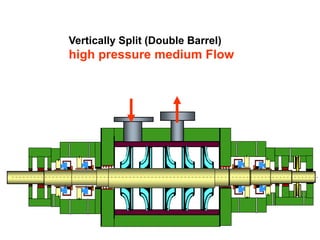
Vertically Split (Double Barrel)
high pressure medium Flow
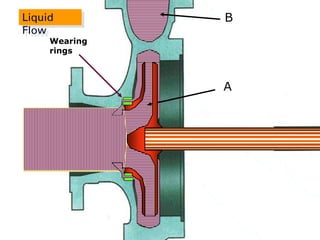
Liquid
Flow
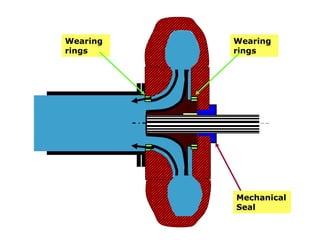
Wearing
rings
A
B
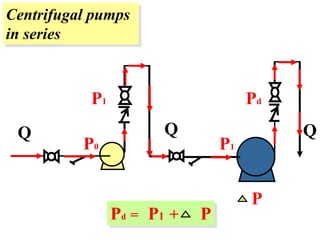
Pd = P1 + P
Centrifugal pumps
in series
Q Q Q
P1 Pd
P0 P1
P
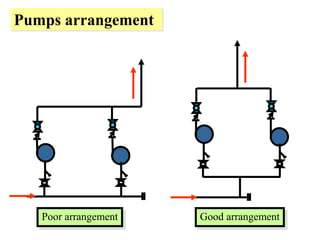
Pumps arrangement
Poor arrangement Good arrangement
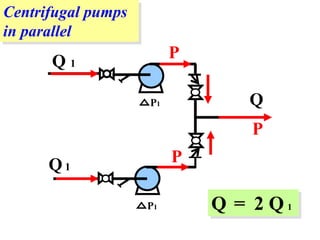
Centrifugal pumps
in parallel
Q = 2 Q 1
Q1
P1
P1
Q 1
P
Q
P
P
Mechanical
Seal
Wearing
rings
Wearing
rings
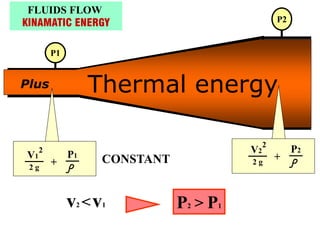
FLUIDS FLOW
KINAMATIC ENERGY
v2 <v1 P2 > P1
P1
P2
+
2 g
V2
2
P2
+
2 g
V1
2
P1
CONSTANT
Thermal energy
Plus
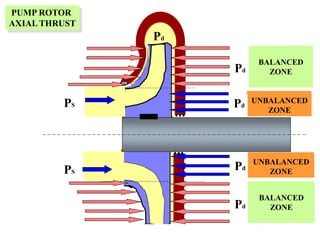
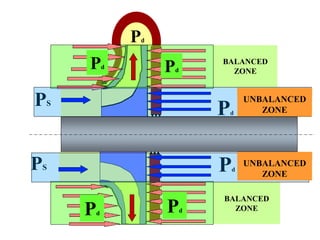
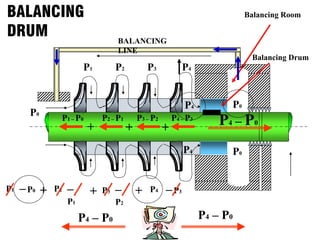
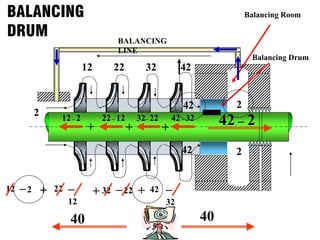
Pumps Thrust balance
DOUBLE SUCTION
BALANCING HOLES
P0
P0
P4
P4
Balancing Drum
BALANCING DRUM
OPPOSITE IMPELLERS
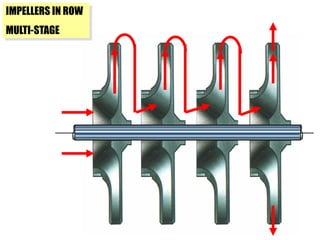
IMPELLERS IN ROW
MULTI-STAGE
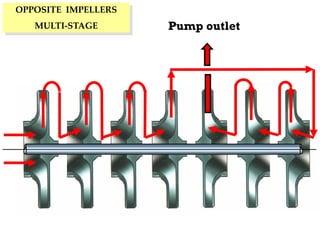
OPPOSITE IMPELLERS
MULTI-STAGE Pump outlet
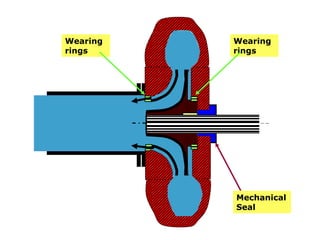
Mechanical
Seal
Wearing
rings
Wearing
rings
Pd
Pd
BALANCED
ZONE
Pd
BALANCED
ZONE
Pd
UNBALANCED
ZONE
Pd Pd
UNBALANCED
ZONE
PUMP ROTOR
AXIAL THRUST
PS
PS
Pd
PS
PS
BALANCED
ZONE
BALANCED
ZONE
Pd
Pd
Pd
Pd
Pd
Pd
UNBALANCED
ZONE
UNBALANCED
ZONE
P4 – P0
P4 – P0
BALANCING
DRUM
P4
P0
P1 P2 P3
P0
P4
P0
P4
P1 – P0 P2 – P1
+
P3 – P2
+
P4 – P3
+ P4 – P0
BALANCING
LINE
Balancing Drum
Balancing Room
P1
+
–P0 –
P1
+
P2
+
–
P2
P3 –P3
P4
40
40
BALANCING
DRUM
42
2
12 22 32
2
42
2
42
12– 2 22– 12
+
32– 22
+
42– 32
+ 42 – 2
BALANCING
LINE
Balancing Drum
Balancing Room
12 +
–2 –
12
+
22 +
–22
32 –
32
42
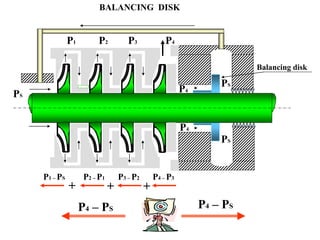
BALANCING DISK
P4
PS
P1 P2 P3
PS
PS
P4
Balancing disk
P4
P1 – PS P2 – P1 P3 – P2 P4 – P3
+ + +
P4 – PS P4 – PS
P4
P4
P
P
Ps
Ps
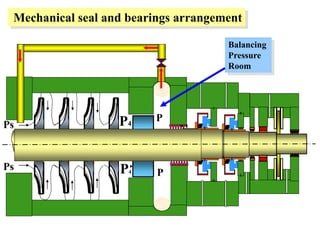
Mechanical seal and bearings arrangement
Balancing
Pressure
Room
GAS LIFT
PUMPING
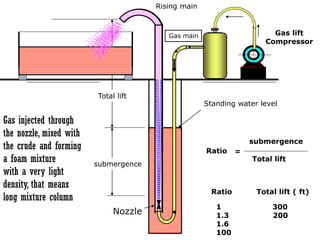
submergence
Total lift
Nozzle
Gas main
Rising main
Standing water level
submergence
Total lift
=
Ratio
1 300
1.3 200
1.6
100
Ratio Total lift ( ft)
Gas lift
Compressor
Gas injected through
the nozzle, mixed with
the crude and forming
a foam mixture
with a very light
density, that means
long mixture column
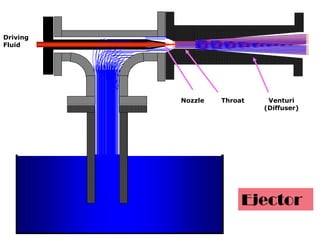
JET
PUMPING
Driving
Fluid
Throat
Nozzle Venturi
(Diffuser)
Ejector
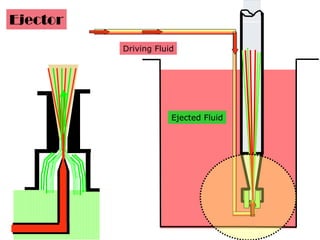
Driving Fluid
Ejector
Ejected Fluid
ROTARY
PUMPS
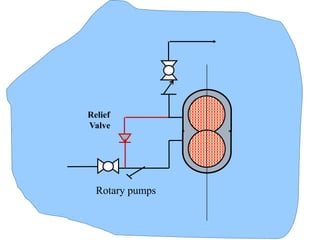
Rotary pumps
Relief
Valve
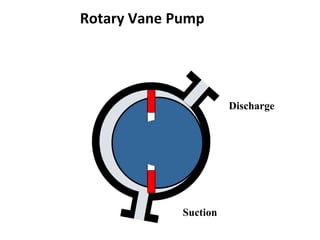
Suction
Discharge
Rotary Vane Pump
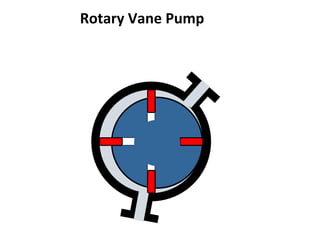
Rotary Vane Pump
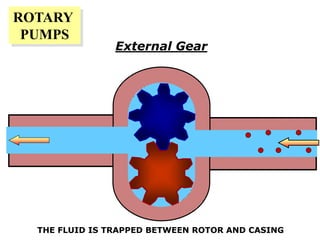
ROTARY
PUMPS
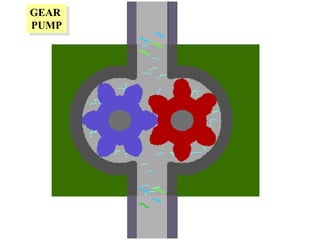
External Gear
THE FLUID IS TRAPPED BETWEEN ROTOR AND CASING
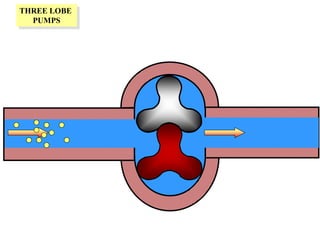
THREE LOBE
PUMPS
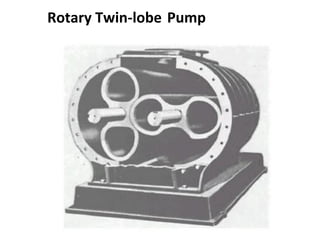
Rotary Twin-lobe Pump
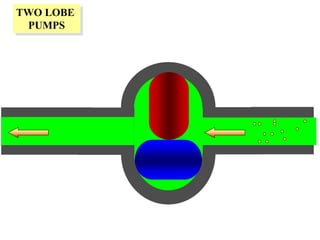
TWO LOBE
PUMPS
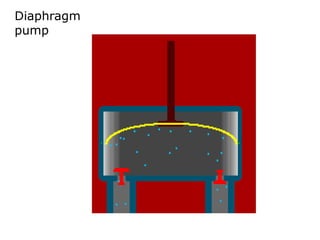
Diaphragm
pump
GEAR
PUMP
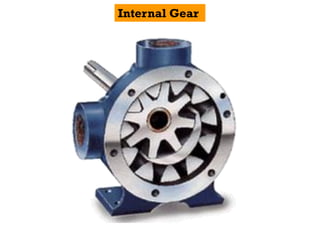
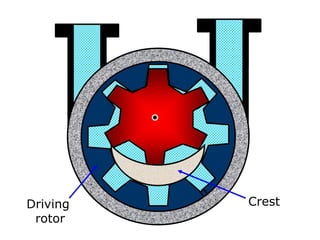
Internal Gear
Driving
rotor
Crest
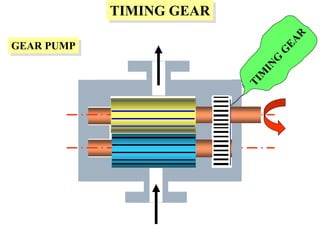
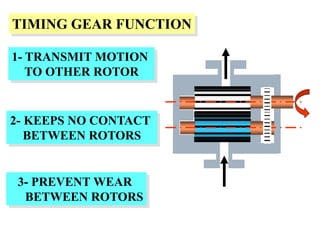
TIMING GEAR
GEAR PUMP
TIMING GEAR FUNCTION
2- KEEPS NO CONTACT
BETWEEN ROTORS
1- TRANSMIT MOTION
TO OTHER ROTOR
3- PREVENT WEAR
BETWEEN ROTORS
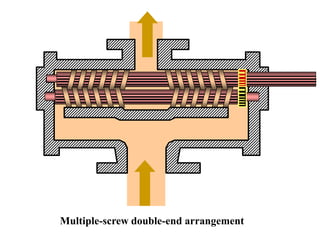
Multiple-screw double-end arrangement
RECIPROCATING
PUMPS
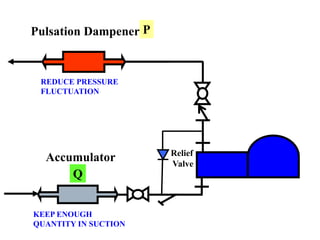
Pulsation Dampener P
Accumulator
Q
Relief
Valve
KEEP ENOUGH
QUANTITY IN SUCTION
REDUCE PRESSURE
FLUCTUATION
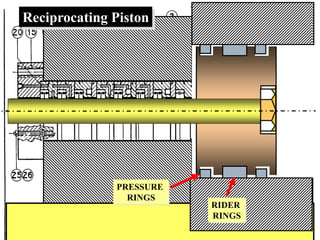
RIDER
RINGS
PRESSURE
RINGS
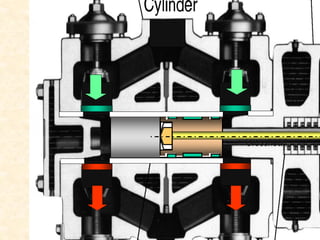
Reciprocating Piston
GLAND
FOLLOWER
PACKING
LANTERN RING
THROAT BUSH
Reciprocating Plunger
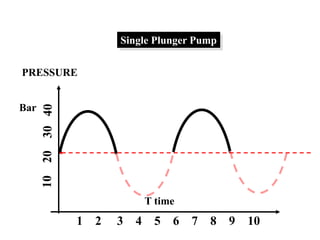
PRESSURE
Bar
T time
1 2 3 4 5 6 7 8 9 10
Single Plunger Pump
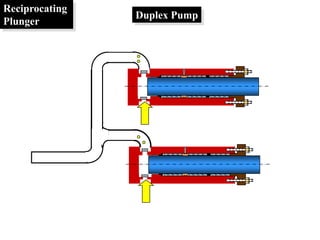
Reciprocating
Plunger
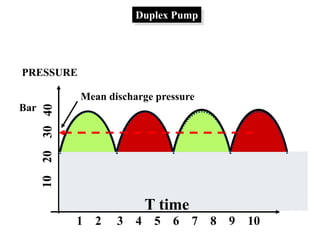
Duplex Pump
PRESSURE
Bar
Mean discharge pressure
T time
1 2 3 4 5 6 7 8 9 10
Duplex Pump
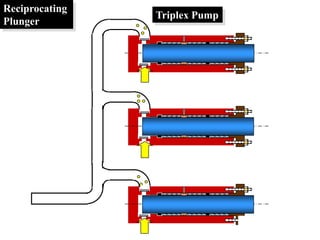
Reciprocating
Plunger
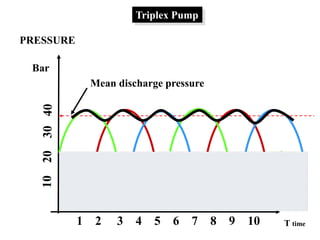
Triplex Pump
PRESSURE
Bar
T time
1 2 3 4 5 6 7 8 9 10
Triplex Pump
Mean discharge pressure
Vacuum
Pumps
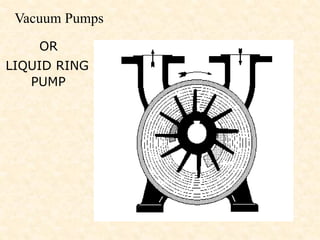
LIQUID RING
PUMP
OR
Vacuum Pumps
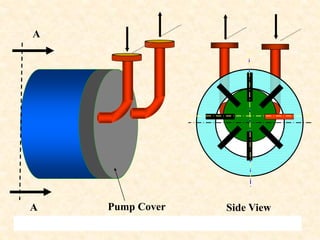
A
A Side View
Pump Cover
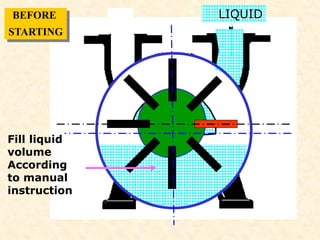
LIQUID
Fill liquid
volume
According
to manual
instruction
BEFORE
STARTING
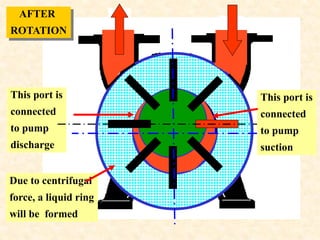
AFTER
ROTATION
This port is
connected
to pump
discharge
Due to centrifugal
force, a liquid ring
will be formed
This port is
connected
to pump
suction
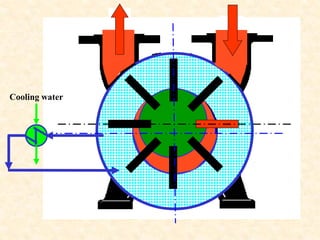
Cooling water
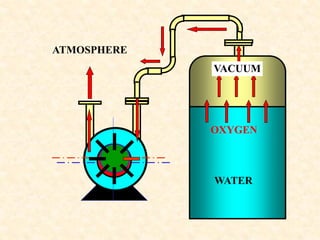
WATER
OXYGEN
ATMOSPHERE
VACUUM
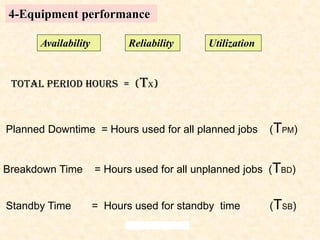
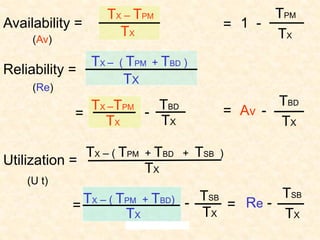
Planned Downtime = Hours used for all planned jobs (TPM)
Breakdown Time = Hours used for all unplanned jobs (TBD)
Standby Time = Hours used for standby time (TSB)
4-Equipment performance
Availability Reliability Utilization
Total Period Hours = (TX)
Reliability =
TX – ( TPM + TBD )
TX
(Re)
Utilization =
TX – ( TPM + TBD + TSB )
TX
(U t)
Av -
TBD
TX
TX
TX –TPM
-
TBD
TX
= =
1 -
TPM
TX
Availability =
TX – TPM
TX
(Av)
=
Re -
TSB
TX
= TX – ( TPM + TBD)
TX
TSB
TX
- =
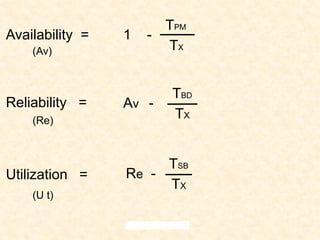
1 -
TPM
TX
Availability =
(Av)
Av -
TBD
TX
Reliability =
(Re)
Utilization =
(U t)
Re -
TSB
TX
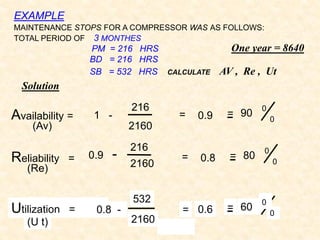
EXAMPLE
MAINTENANCE STOPS FOR A COMPRESSOR WAS AS FOLLOWS:
TOTAL PERIOD OF 3 MONTHES
PM = 216 HRS
BD = 216 HRS
SB = 532 HRS CALCULATE AV , Re , Ut
= 0.8
Reliability =
216
2160
(Re)
= 80
0
0
0.9 -
Utilization =
(U t)
0.8 -
532
2160
= 0.6 = 60
0
0
= 0.9
Availability =
216
2160
(Av)
= 90
0
0
1 -
Solution
One year = 8640
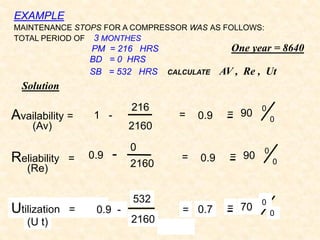
EXAMPLE
MAINTENANCE STOPS FOR A COMPRESSOR WAS AS FOLLOWS:
TOTAL PERIOD OF 3 MONTHES
PM = 216 HRS
BD = 0 HRS
SB = 532 HRS CALCULATE AV , Re , Ut
= 0.9
Reliability =
0
2160
(Re)
= 90
0
0
0.9 -
Utilization =
(U t)
0.9 -
532
2160
= 0.7 = 70
0
0
= 0.9
Availability =
216
2160
(Av)
= 90
0
0
1 -
Solution
One year = 8640
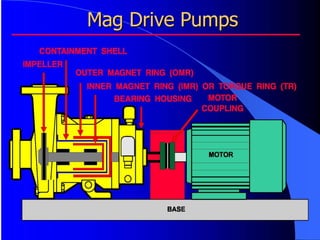
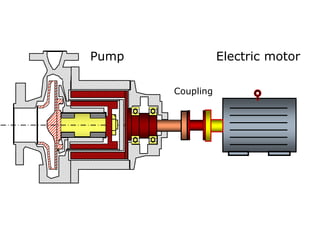
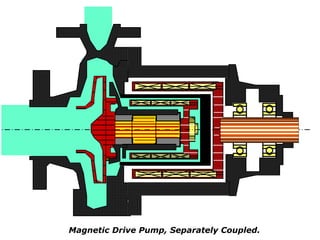
SEAL LESS
PUMPS
Electric motor
Coupling
Pump
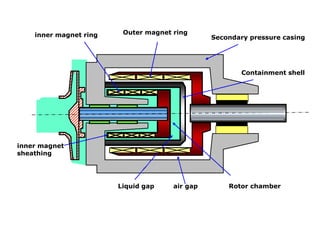
Containment shell
Outer magnet ring
Rotor chamber
air gap
Liquid gap
inner magnet
sheathing
Secondary pressure casing
inner magnet ring
Magnetic Drive Pump, Separately Coupled.
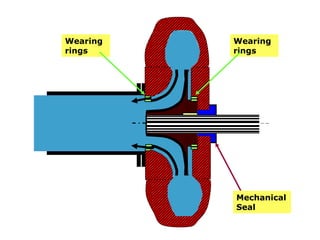
Mechanical
Seal
Wearing
rings
Wearing
rings
2- Pumps Specific speed
1- Centrifugal pumps Performance curve
3- Pumps Horse Power
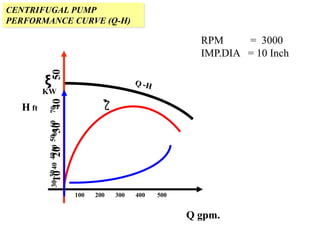
CENTRIFUGAL PUMP
PERFORMANCE CURVE (Q-H)
H ft
Q gpm.
100 200 300 400 500
ξ
KW
RPM = 3000
IMP.DIA = 10 Inch
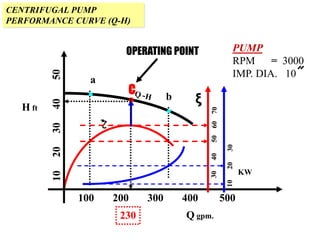
CENTRIFUGAL PUMP
PERFORMANCE CURVE (Q-H)
a
. b
.
Q gpm.
100 200 300 400 500
H ft
KW
ξ
PUMP
RPM = 3000
IMP. DIA. 10
.C
230
OPERATING POINT
Q gpm.
100 200 300 400 500
H ft 60
50
N1
N3
N2 .70
40
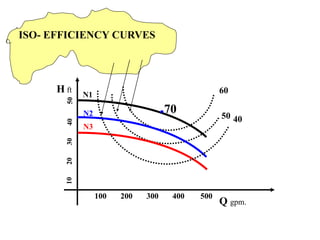
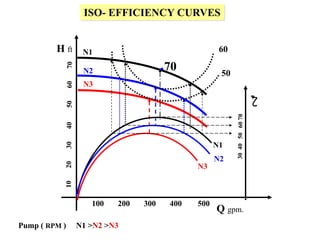
ISO- EFFICIENCY CURVES
Q gpm.
100 200 300 400 500
H ft N1
N3
N2
60
50
.70
N1
N2
N3
Pump ( RPM ) N1 >N2 >N3
1 (PSI) = 2.31 (Ft)
Pressure = Head (Ft ) x (SG) / 2.31 (PSI)
Water 231 Ft x 1.0 / 2.31 = 100 PSI
HCL 231 Ft x 1.2 / 2.31 = 120 PSI
Gas oil 231 Ft x 0.80 / 2.31 = 80 PSI
Gas
oil
For water
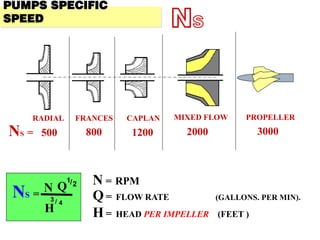
FRANCES
RADIAL CAPLAN MIXED FLOW PROPELLER
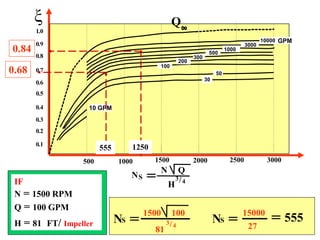
NS = 500 800 1200 2000 3000
NS =
Q
1/2
H
3 / 4
N
Q= FLOW RATE (GALLONS. PER MIN).
H= HEAD PER IMPELLER (FEET )
N = RPM
PUMPS SPECIFIC
SPEED NS
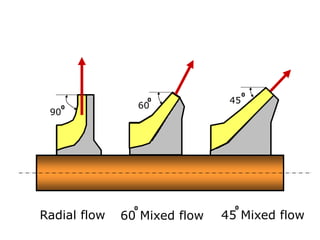
Radial flow 60 Mixed flow
0
45 Mixed flow
0
45
0
60
0
90
0
0.1
0.2
0.3
0.4
0.5
0.6
0.7
0.8
0.9
1.0
ξ
50
30
10 GPM
3000
500
300
200
100
1000
10000 GPM
Q
500 1000 1500 2000 2500 3000
NS
N Q
H
3/4
IF
N = 2000 RPM
Q = 1600 GPM
H = 256 FT/ Impeller NS
2000 1600
256
3/4
NS
64
80000
1250
0.84
1250
IF
N = 1500 RPM
Q = 100 GPM
H = 81 FT/ Impeller NS
1500 100
81
3/4
NS
27
15000
555
0.68
555
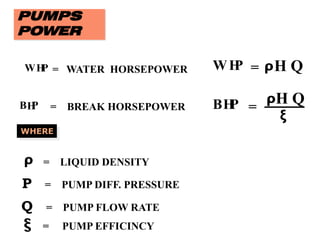
H
P
W = H Q
ρ
H
P
B =
H Q
ξ
ρ
H
P
W = WATER HORSEPOWER
ρ = LIQUID DENSITY
P = PUMP DIFF. PRESSURE
Q = PUMP FLOW RATE
ξ = PUMP EFFICINCY
= BREAK HORSEPOWER
BH
P
WHERE
PUMPS
POWER
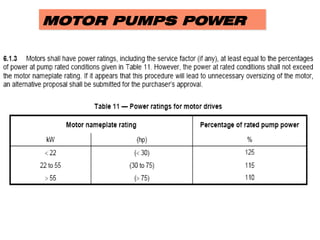
MOTOR PUMPS POWER
H
P
W = P Q
0.00058
P = p s i
Q = GPM
H
P
W = P Q
0.037
P = bar
Q = M
3
hr
HP
B = P Q
ξ
0.037
HP
B = P Q
ξ
0.00058
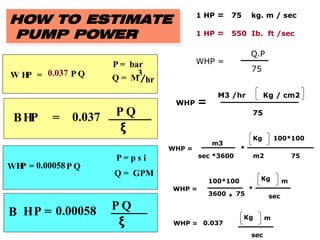
HOW TO ESTIMATE
PUMP POWER
1 HP = 75 kg. m / sec
1 HP = 550 Ib. ft /sec
WHP =
Q.P
75
WHP =
75
Kg / cm2
M3 /hr
WHP =
75
Kg
m3
sec *3600
*
100*100
m2
WHP =
75
Kg
3600
*
100*100 m
sec
*
WHP =
Kg
0.037
m
sec
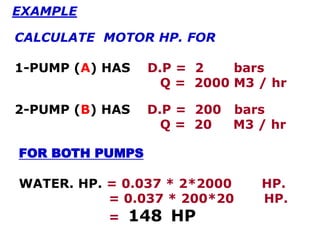
FOR BOTH PUMPS
WATER. HP. = 0.037 * 2*2000 HP.
= 0.037 * 200*20 HP.
= 148 HP
EXAMPLE
CALCULATE MOTOR HP. FOR
1-PUMP (A) HAS D.P = 2 bars
Q = 2000 M3 / hr
2-PUMP (B) HAS D.P = 200 bars
Q = 20 M3 / hr
500 1000 1500 2000 2500 3000
0.1
0.2
0.3
0.4
0.5
0.6
0.7
0.8
0.9
1.0
ξ
50
30
10 GPM
3000
500
300
200
100
1000
10000 GPM
Q
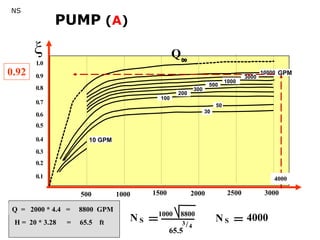
0.92
NS
Q = 2000 * 4.4 = 8800 GPM
H = 20 * 3.28 = 65.5 ft
4000
N S
1000 8800
65.5
3/4
N S 4000
PUMP (A)
BRAKE HP = 148 /0.92 = 160 HP.
Motor HP = 160*1.25 = 200 HP
PUMP A
NS =
Q
1/2
H
3 / 4
N
N = 1000 RPM
D.P = 2O*3.28 = 65.5 ft
Q = 2000*4.4 = 8800 GPM
NS = 1000 * 8800
1/2
65.5
3/4
=
1000 * 93.8
23
4000
=
ξ = 0.92
N S
1000 88
655
3/4
500 1000 1500 2000 2500 3000
0.1
0.2
0.3
0.4
0.5
0.6
0.7
0.8
0.9
1.0
ξ
50
30
10 GPM
3000
500
300
200
100
1000
10000 GPM
Q
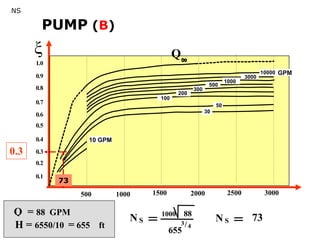
0.3
NS
Q = 88 GPM
H = 6550/10 = 655 ft
N S 73
73
PUMP (B)
BRAKE HP = 148 /0.3 = 500 HP.
Motor HP = 500 * 1.25 = 625 HP
PUMP B
NS =
Q
1/2
H
3 / 4
N
N = 1000 RPM
D.P = 2O00*3.28 = 6550 ft
D.P/impeller (10 imp) = 655 ft
Q = 20*4.4 = 88 GPM
NS = 1000 * 88
1/2
655
3/4
=
1000 * 9.38
130
73
=
ξ = 0.3
Q 5000 gpm BHP 1818
P/stage 169 psi MHP 2182
N 1800 rpm
H/stage 391 ft Ns 1448
ξ 0.81
END PRESSURE 500 psi
D.P. 507.8 psi
n 3 stages
ELEVATION/2.31 5 psi
EFFICIENCY AS A FUNCTION OF SPECIFIC SPEED AND CAPACITY
0.1
0.2
0.3
0.4
0.5
0.6
0.7
0.8
0.9
1.0
500 1000 1500 2000 2500 3000
50
30
10 GPM
5
10000
3000
500
1000
300
200
100
N S
GPM
0.81
2- Pumps Affinity Laws
1- Theory Of Pressure Increase In Impeller
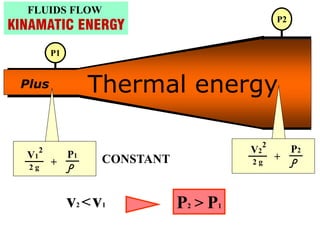
FLUIDS FLOW
KINAMATIC ENERGY
v2 <v1 P2 > P1
P1
P2
+
2 g
V2
2
P2
+
2 g
V1
2
P1
CONSTANT
Thermal energy
Plus
DIMENTIONS
2
V
2g
ft
2
sec 2
ft
2
sec
= ( ft )
=
ft
2
sec
ft
2
sec
=
P
density
ft
3
2
ft
= ( ft )
=
Lb
Lb
2
ft 3
ft
=
velocity
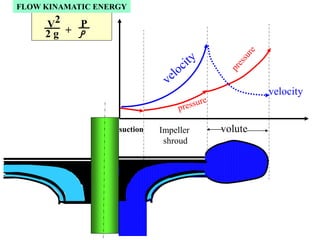
volute
suction Impeller
shroud
+
2 g
V2 P
FLOW KINAMATIC ENERGY
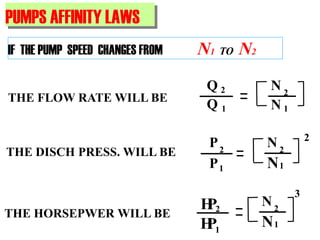
THE FLOW RATE WILL BE
Q 2
Q 1
N 2
1
N
IF THE PUMP SPEED CHANGES FROM N1 TO N2
PUMPS AFFINITY LAWS
THE DISCH PRESS. WILL BE
2
P2
P1
N2
1
N
THE HORSEPWER WILL BE
3
N2
1
N
2
1
P
H
P
H
Exercise
s
m
9
,
0
1
5
,
0
45
,
0
Q
D
D
Q
n
n
D
D
c
B
D
c
B
D
Q
Q
3
1
1
2
2
2
1
2
1
2
m
2
2
1
m
1
1
2
1
=

=

=

=
=








=
m
81
100
5
,
0
45
,
0
H
D
D
H
2
1
2
1
2
2 =







=









=
kW
90
123
5
,
0
45
,
0
P
D
D
P
3
1
3
1
2
2 =







=









=
• Find the flow rate, head and power for a centrifugal
pump impeller that has reduced its diameter
• Given data:
hh = 80 % P1 = 123 kW
D1 = 0,5 m H1 = 100 m
D2 = 0,45 m Q1 = 1 m3/s
Exercise
s
m
1
,
1
1
1000
1100
Q
n
n
Q 3
1
1
2
2 =

=

=
m
121
100
1000
1100
H
n
n
H
2
1
2
1
2
2 =







=









=
kW
164
123
1000
1100
P
n
n
P
3
1
3
1
2
2 =







=









=
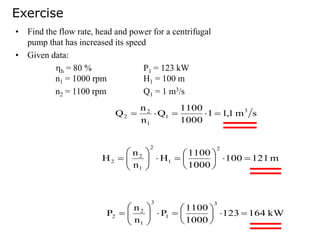
• Find the flow rate, head and power for a centrifugal
pump that has increased its speed
• Given data:
hh = 80 % P1 = 123 kW
n1 = 1000 rpm H1 = 100 m
n2 = 1100 rpm Q1 = 1 m3/s
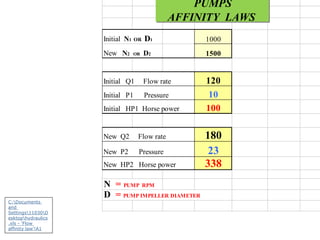
Initial N1 OR D1 1000
New N2 OR D2 1500
Initial Q1 Flow rate 120
Initial P1 Pressure 10
Initial HP1 Horse power 100
New Q2 Flow rate 180
New P2 Pressure 23
New HP2 Horse power 338
N = PUMP RPM
D = PUMP IMPELLER DIAMETER
PUMPS
AFFINITY LAWS
C:Documents
and
Settings11030D
esktophydraulics
.xls - 'Flow
affinity law'!A1

pumps and thier characteristics study details