PASCAL
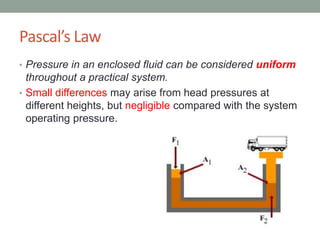
• Pressure in an enclosed fluid can be considered uniform
throughout a practical system.
• Small differences may arise from head pressures at
different heights, but negligible compared with the system
operating pressure.
Pascal’s Law
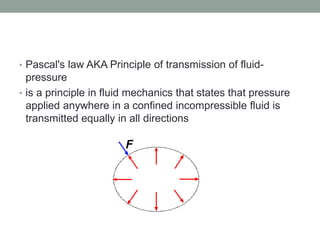
• Pascal's law AKA Principle of transmission of fluid-
pressure
• is a principle in fluid mechanics that states that pressure
applied anywhere in a confined incompressible fluid is
transmitted equally in all directions
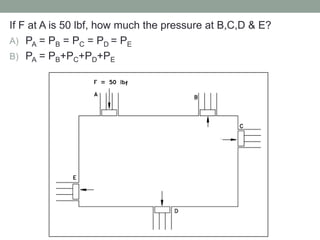
If F at A is 50 lbf, how much the pressure at B,C,D & E?
A) PA = PB = PC = PD = PE
B) PA = PB+PC+PD+PE
• Hydraulic and pneumatic systems are concerned with the flow
of fluid down a pipe.
• Velocity flow of a system measures linear speed past a point of
measurement.
Flow rate
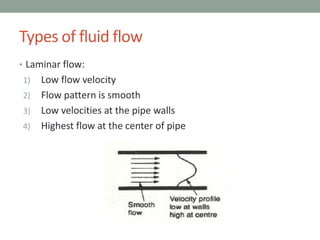
• Laminar flow:
1) Low flow velocity
2) Flow pattern is smooth
3) Low velocities at the pipe walls
4) Highest flow at the center of pipe
Types of fluid flow
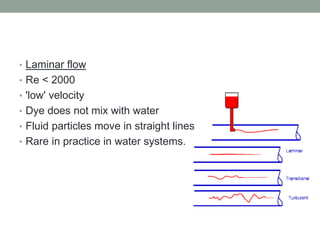
• Laminar flow
• Re < 2000
• 'low' velocity
• Dye does not mix with water
• Fluid particles move in straight lines
• Rare in practice in water systems.
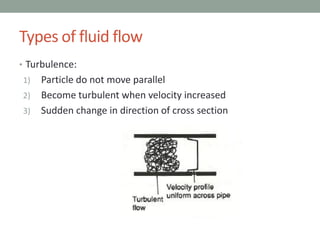
• Turbulence:
1) Particle do not move parallel
2) Become turbulent when velocity increased
3) Sudden change in direction of cross section
Types of fluid flow
• Turbulent flow
• Re > 4000
• 'high' velocity
• Dye mixes rapidly and completely
• Particle paths completely irregular
• Average motion is in the direction of the flow
• Cannot be seen by the naked eye
• Changes/fluctuations are very difficult to detect. Must use laser.
• Mathematical analysis very difficult - so experimental measures
are used
• Most common type of flow
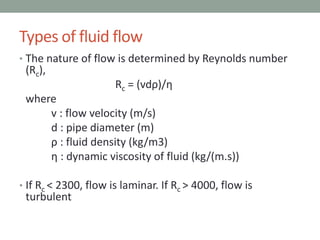
• The nature of flow is determined by Reynolds number
(Rc),
Rc = (vdρ)/η
where
v : flow velocity (m/s)
d : pipe diameter (m)
ρ : fluid density (kg/m3)
η : dynamic viscosity of fluid (kg/(m.s))
• If Rc < 2300, flow is laminar. If Rc > 4000, flow is
turbulent
Types of fluid flow
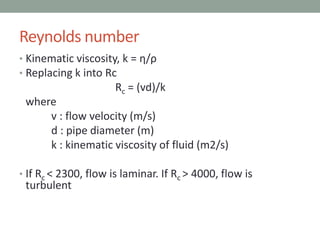
• Kinematic viscosity, k = η/ρ
• Replacing k into Rc
Rc = (vd)/k
where
v : flow velocity (m/s)
d : pipe diameter (m)
k : kinematic viscosity of fluid (m2/s)
• If Rc < 2300, flow is laminar. If Rc > 4000, flow is
turbulent
Reynolds number
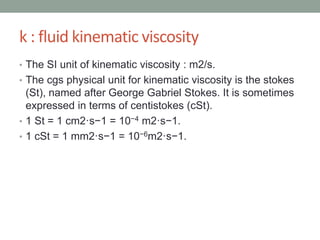
k : fluid kinematic viscosity
• The SI unit of kinematic viscosity : m2/s.
• The cgs physical unit for kinematic viscosity is the stokes
(St), named after George Gabriel Stokes. It is sometimes
expressed in terms of centistokes (cSt).
• 1 St = 1 cm2·s−1 = 10−4 m2·s−1.
• 1 cSt = 1 mm2·s−1 = 10−6m2·s−1.
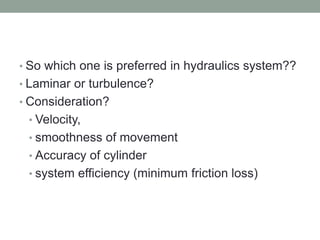
• So which one is preferred in hydraulics system??
• Laminar or turbulence?
• Consideration?
• Velocity,
• smoothness of movement
• Accuracy of cylinder
• system efficiency (minimum friction loss)
• If the flow rate in a system is constant, then the total energy in
the system will also be constant irrespective of the variation in
the cross section of the fluid passage.
TOTAL ENERGY = POTENTIAL ENERGY + KINETIC ENERGY
Bernoulli’s Principle
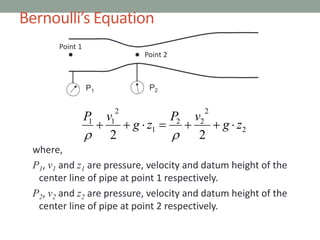
where,
P1, v1 and z1 are pressure, velocity and datum height of the
center line of pipe at point 1 respectively.
P2, v2 and z2 are pressure, velocity and datum height of the
center line of pipe at point 2 respectively.
Bernoulli’s Equation
2
2
22
1
2
11
22
zg
vP
zg
vP


P1 P2
Point 1
Point 2
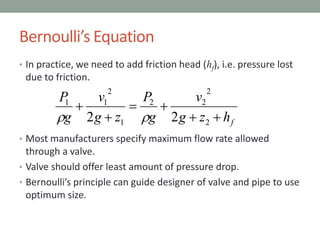
• In practice, we need to add friction head (hf), i.e. pressure lost
due to friction.
• Most manufacturers specify maximum flow rate allowed
through a valve.
• Valve should offer least amount of pressure drop.
• Bernoulli’s principle can guide designer of valve and pipe to use
optimum size.
Bernoulli’s Equation
fhzg
v
g
P
zg
v
g
P




2
2
22
1
2
11
22 
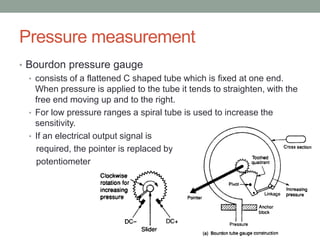
Pressure measurement
• Bourdon pressure gauge
• consists of a flattened C shaped tube which is fixed at one end.
When pressure is applied to the tube it tends to straighten, with the
free end moving up and to the right.
• For low pressure ranges a spiral tube is used to increase the
sensitivity.
• If an electrical output signal is
required, the pointer is replaced by a
potentiometer
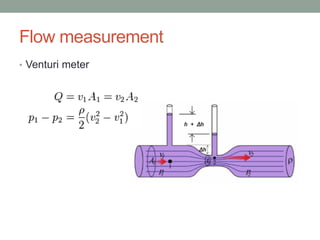
Flow measurement
• Venturi meter
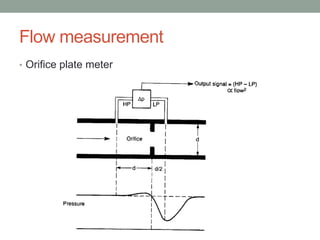
Flow measurement
• Orifice plate meter

Week 1 3_pascal_bernoulli

  • 1.
  • 2.
    • Pressure inan enclosed fluid can be considered uniform throughout a practical system. • Small differences may arise from head pressures at different heights, but negligible compared with the system operating pressure. Pascal’s Law
  • 3.
    • Pascal's lawAKA Principle of transmission of fluid- pressure • is a principle in fluid mechanics that states that pressure applied anywhere in a confined incompressible fluid is transmitted equally in all directions
  • 4.
    If F atA is 50 lbf, how much the pressure at B,C,D & E? A) PA = PB = PC = PD = PE B) PA = PB+PC+PD+PE
  • 5.
    • Hydraulic andpneumatic systems are concerned with the flow of fluid down a pipe. • Velocity flow of a system measures linear speed past a point of measurement. Flow rate
  • 6.
    • Laminar flow: 1)Low flow velocity 2) Flow pattern is smooth 3) Low velocities at the pipe walls 4) Highest flow at the center of pipe Types of fluid flow
  • 7.
    • Laminar flow •Re < 2000 • 'low' velocity • Dye does not mix with water • Fluid particles move in straight lines • Rare in practice in water systems.
  • 8.
    • Turbulence: 1) Particledo not move parallel 2) Become turbulent when velocity increased 3) Sudden change in direction of cross section Types of fluid flow
  • 9.
    • Turbulent flow •Re > 4000 • 'high' velocity • Dye mixes rapidly and completely • Particle paths completely irregular • Average motion is in the direction of the flow • Cannot be seen by the naked eye • Changes/fluctuations are very difficult to detect. Must use laser. • Mathematical analysis very difficult - so experimental measures are used • Most common type of flow
  • 10.
    • The natureof flow is determined by Reynolds number (Rc), Rc = (vdρ)/η where v : flow velocity (m/s) d : pipe diameter (m) ρ : fluid density (kg/m3) η : dynamic viscosity of fluid (kg/(m.s)) • If Rc < 2300, flow is laminar. If Rc > 4000, flow is turbulent Types of fluid flow
  • 11.
    • Kinematic viscosity,k = η/ρ • Replacing k into Rc Rc = (vd)/k where v : flow velocity (m/s) d : pipe diameter (m) k : kinematic viscosity of fluid (m2/s) • If Rc < 2300, flow is laminar. If Rc > 4000, flow is turbulent Reynolds number
  • 12.
    k : fluidkinematic viscosity • The SI unit of kinematic viscosity : m2/s. • The cgs physical unit for kinematic viscosity is the stokes (St), named after George Gabriel Stokes. It is sometimes expressed in terms of centistokes (cSt). • 1 St = 1 cm2·s−1 = 10−4 m2·s−1. • 1 cSt = 1 mm2·s−1 = 10−6m2·s−1.
  • 13.
    • So whichone is preferred in hydraulics system?? • Laminar or turbulence? • Consideration? • Velocity, • smoothness of movement • Accuracy of cylinder • system efficiency (minimum friction loss)
  • 14.
    • If theflow rate in a system is constant, then the total energy in the system will also be constant irrespective of the variation in the cross section of the fluid passage. TOTAL ENERGY = POTENTIAL ENERGY + KINETIC ENERGY Bernoulli’s Principle
  • 15.
    where, P1, v1 andz1 are pressure, velocity and datum height of the center line of pipe at point 1 respectively. P2, v2 and z2 are pressure, velocity and datum height of the center line of pipe at point 2 respectively. Bernoulli’s Equation 2 2 22 1 2 11 22 zg vP zg vP   P1 P2 Point 1 Point 2
  • 16.
    • In practice,we need to add friction head (hf), i.e. pressure lost due to friction. • Most manufacturers specify maximum flow rate allowed through a valve. • Valve should offer least amount of pressure drop. • Bernoulli’s principle can guide designer of valve and pipe to use optimum size. Bernoulli’s Equation fhzg v g P zg v g P     2 2 22 1 2 11 22 
  • 17.
    Pressure measurement • Bourdonpressure gauge • consists of a flattened C shaped tube which is fixed at one end. When pressure is applied to the tube it tends to straighten, with the free end moving up and to the right. • For low pressure ranges a spiral tube is used to increase the sensitivity. • If an electrical output signal is required, the pointer is replaced by a potentiometer
  • 18.
  • 19.