ECE614: Device
Modelling and Circuit
SimulationSimulation
Unit 1 Wafer Cleaning
By Dr. Ghanshyam Singh
Sharda University
Outline
• Section 1:
– Sources of Contaminations
– Problems
– How to rectify? How to clean?– How to rectify? How to clean?
• Section 2:
– Wet Chemical Solutions
– Cleaning Techniques
– Wafer Priming
Device/Wafer
Fabrication
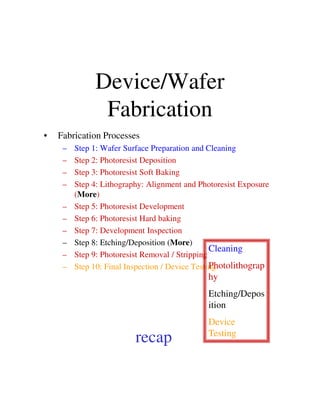
• Fabrication Processes
– Step 1: Wafer Surface Preparation and Cleaning
– Step 2: Photoresist Deposition
– Step 3: Photoresist Soft Baking
– Step 4: Lithography: Alignment and Photoresist Exposure
(More)
– Step 5: Photoresist Development– Step 5: Photoresist Development
– Step 6: Photoresist Hard baking
– Step 7: Development Inspection
– Step 8: Etching/Deposition (More)
– Step 9: Photoresist Removal / Stripping
– Step 10: Final Inspection / Device Testing
recap
Cleaning
Photolithograp
hy
Etching/Depos
ition
Device
Testing
Wafer Cleaning
• Wafer Cleaning simply means
– “Get rid of particles and
contamination”
This is the most
important step
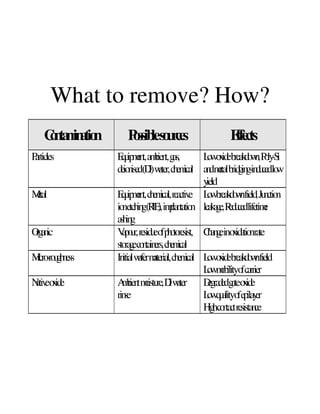
What to remove? How?
Contamination Possiblesources Effects
Particles Equipment,ambient,gas,
deionised(DI)water,chemical
Lowoxidebreakdown,Poly-Si
andmetalbridging-inducedlow
yield
Metal Equipment,chemical,reactive
ionetching(RIE),implantation
Lowbreakdownfield,Junction
leakage,Reducedlifetimeionetching(RIE),implantation
ashing
leakage,Reducedlifetime
Organic Vapour,residueofphotoresist,
storagecontainers,chemical
Changeinoxidationrate
Micro-roughness Initialwafermaterial,chemical Lowoxidebreakdownfield
Lowmobilityofcarrier
Nativeoxide Ambientmoisture,DIwater
rinse
Degradedgateoxide
Lowqualityofepilayer
Highcontactresistance
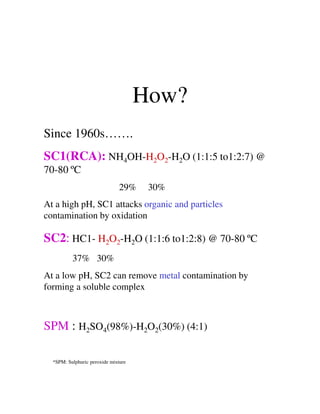
How?
Since 1960s…….
SC1(RCA): NH4OH-H2O2-H2O (1:1:5 to1:2:7) @
70-80 ºC
29% 30%
At a high pH, SC1 attacks organic and particlesAt a high pH, SC1 attacks organic and particles
contamination by oxidation
SPM : H2SO4(98%)-H2O2(30%) (4:1)
SC2: HC1- H2O2-H2O (1:1:6 to1:2:8) @ 70-80 ºC
37% 30%
At a low pH, SC2 can remove metal contamination by
forming a soluble complex
*SPM: Sulphuric peroxide mixture
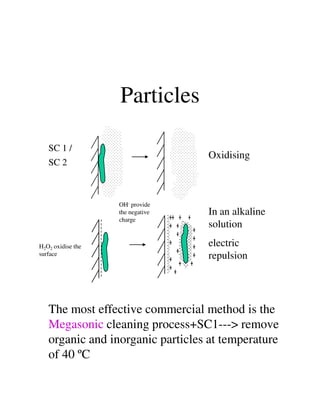
Particles
Oxidising
In an alkaline
OH- provide
SC 1 /
SC 2
The most effective commercial method is the
Megasonic cleaning process+SC1---> remove
organic and inorganic particles at temperature
of 40 ºC
In an alkaline
solution
electric
repulsion
H2O2 oxidise the
surface
OH provide
the negative
charge
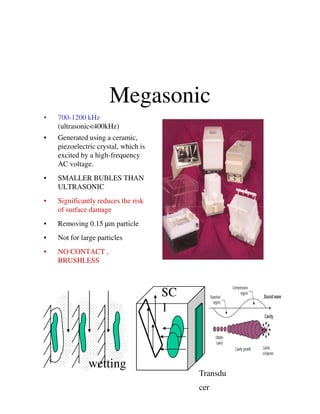
Megasonic
• 700-1200 kHz
(ultrasonic<400kHz)
• Generated using a ceramic,
piezoelectric crystal, which is
excited by a high-frequency
AC voltage.
• SMALLER BUBLES THAN
ULTRASONIC
• Significantly reduces the risk
of surface damageof surface damage
• Removing 0.15 µm particle
• Not for large particles
• NO CONTACT ,
BRUSHLESS
wetting
Transdu
cer
SC
1
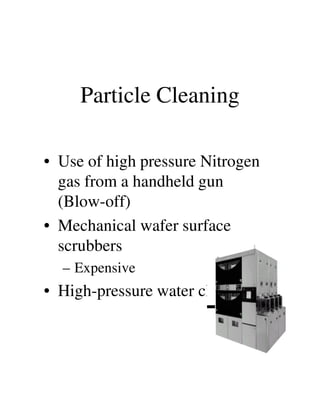
Particle Cleaning
• Use of high pressure Nitrogen
gas from a handheld gun
(Blow-off)(Blow-off)
• Mechanical wafer surface
scrubbers
– Expensive
• High-pressure water cleaning
Metal Contamination
• Sources : RIE etching, chemical solution,
ion implantation
• Problems:
– Induce leakage current of p-n junctions
– Reduce minority carrier lifetime– Reduce minority carrier lifetime
– fault built up during regrow
• Wet Cleaning: dilute HF(0.5%)-
H2O2(10%) and SC1 SC2
Organic Contamination
• Sources : Vapour, photoresist, containers,
chemical, fingerprints (oil),
carbon(compound)
• Problems:
– Incomplete cleaning of surface, leaving– Incomplete cleaning of surface, leaving
contaminations such as native oxide or metal
impurities
– micromasking-->RIE process
– photoresist is the main contamination source in
IC processes
• Cleaning process:
– Ozone-injected ultrapure water(strong oxidising
agent O3)
– Acetone and alcohol (simple way)
Native Oxide: own oxide of the solid; e.g. SiO2 in the case of silicon and
Al2O3 in the case of aluminum.
Surface Microroughness
• Surface microroughness is an important
factor in the manufacture of high
performance and quality devices
• For growing 100Å thin film, the surface
requirement should be atomically flatrequirement should be atomically flat
• Sources : SC1 cleaning, NH4OH (etchant) ,
H2O2(oxidant)
• Problems: low performance, low yield
• Problem solving:
– reduce the proportion of NH4OH, temperature,
time
– use SPM and SC 2
Native Oxide
• Sources : Oxidation, exposure time,
organic contamination, metallic impurities
• 7 days of exposure to cleanroom air for
silicon----> 6.7 Å
• Problems:• Problems:
– Uncontrollable ultrathin oxide growth, high
contact resistance, hard for epitaxial growths
(MBE and MOCVD)
– A problem for high performance devices.
• Problem solving:
– shorten processing time
– HF(0.5%)-H2O2(10%)
– Etching
own oxide of the solid; e.g. SiO2 in the case of silicon and Al2O3 in the case of aluminum.
End
of
Secti
on
Wet-chemical cleaning
Techniques
• Sulfuric acid:
– The most common chemical cleaning solution is
hot (90-125ºC) sulfuric acid, removing most
inorganic residues and particles.
• Sulfuric acid+H2O2 : (Very effective)
– Oxidants are added to remove organic residues.– Oxidants are added to remove organic residues.
C+O2--->CO2 (gas)
– Photoresist stripper
• Sulfuric acid + (NH4)2SO4:
– A drawback of adding H2O2 (strong oxidiser).
Precaution needed.
– H2O2 decays rapidly
• Standard procedures:
– Chemical cleaning-->DI water rinsing--
>Drying (Nitrogen blow-off + baking)
Cleaning Techniques
• Immersion Cleaning: common, easy
– Expensive (lot of chemical solutions)
– Present potential recontamination
– Cannot reaches smaller and deeper pattern/structure
• Spray Cleaning:
– Chemical costs are decreased (Spray, less chemical)– Chemical costs are decreased (Spray, less chemical)
– Free from recontamination
– Cleaning efficiency improved due to high pressure of
the spray assists in cleaning small patterns and holes
– Immediate spray rinsing in one station (save time)
• Dry Cleaning: (to rectify some problems in wet tech. I.e.
Particle generation/drying)
– Ultraviolet-ozone clean, vapor clean, plasma,
thermal
Water Rinsing
• Wet cleaning chemicals can also be contaminants if
left on the surface.
• Therefore, chemical cleanings follow with DI water
rinsing
• DI water rinsing also serves after etching
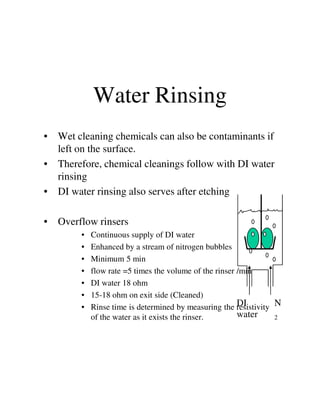
• Overflow rinsers
• Continuous supply of DI water
• Enhanced by a stream of nitrogen bubbles
• Minimum 5 min
• flow rate =5 times the volume of the rinser /min
• DI water 18 ohm
• 15-18 ohm on exit side (Cleaned)
• Rinse time is determined by measuring the resistivity
of the water as it exists the rinser.
N
2
DI
water
Water Rinsing
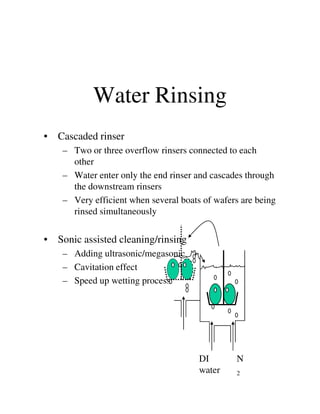
• Cascaded rinser
– Two or three overflow rinsers connected to each
other
– Water enter only the end rinser and cascades through
the downstream rinsers
– Very efficient when several boats of wafers are being
rinsed simultaneouslyrinsed simultaneously
• Sonic assisted cleaning/rinsing
– Adding ultrasonic/megasonic
– Cavitation effect
– Speed up wetting process
N
2
DI
water
Drying
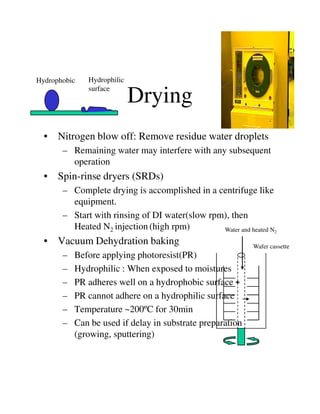
• Nitrogen blow off: Remove residue water droplets
– Remaining water may interfere with any subsequent
operation
• Spin-rinse dryers (SRDs)
– Complete drying is accomplished in a centrifuge like
equipment.
Hydrophobic Hydrophilic
surface
– Start with rinsing of DI water(slow rpm), then
Heated N2 injection (high rpm)
• Vacuum Dehydration baking
– Before applying photoresist(PR)
– Hydrophilic : When exposed to moistures
– PR adheres well on a hydrophobic surface
– PR cannot adhere on a hydrophilic surface
– Temperature ~200ºC for 30min
– Can be used if delay in substrate preparation
(growing, sputtering)
Water and heated N2
Wafer cassette
Wafer Priming
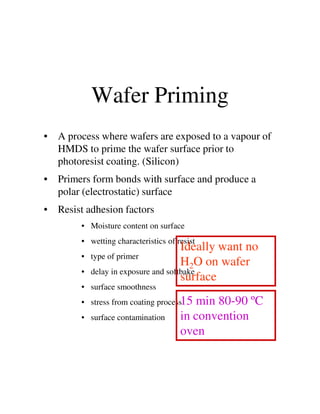
• A process where wafers are exposed to a vapour of
HMDS to prime the wafer surface prior to
photoresist coating. (Silicon)
• Primers form bonds with surface and produce a
polar (electrostatic) surface
• Resist adhesion factors• Resist adhesion factors
• Moisture content on surface
• wetting characteristics of resist
• type of primer
• delay in exposure and softbake
• surface smoothness
• stress from coating process
• surface contamination
Ideally want no
H2O on wafer
surface
15 min 80-90 ºC
in convention
oven
Wafer Priming
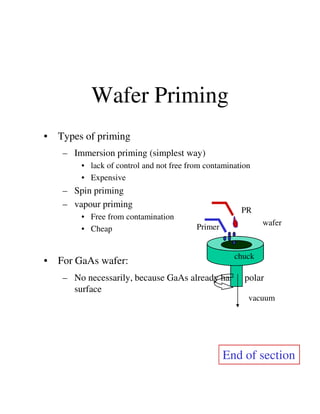
• Types of priming
– Immersion priming (simplest way)
• lack of control and not free from contamination
• Expensive
– Spin priming
– vapour priming
PR
– vapour priming
• Free from contamination
• Cheap
• For GaAs wafer:
– No necessarily, because GaAs already has a polar
surface
vacuum
PR
Primer
wafer
chuck
End of section
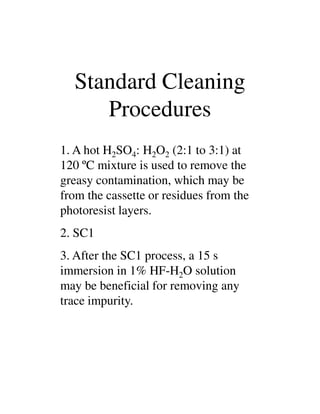
Standard Cleaning
Procedures
1. A hot H2SO4: H2O2 (2:1 to 3:1) at
120 ºC mixture is used to remove the
greasy contamination, which may be
from the cassette or residues from the
photoresist layers.photoresist layers.
2. SC1
3. After the SC1 process, a 15 s
immersion in 1% HF-H2O solution
may be beneficial for removing any
trace impurity.
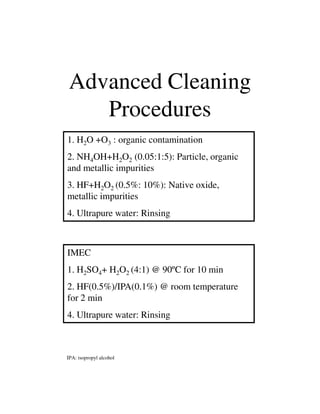
Advanced Cleaning
Procedures
1. H2O +O3 : organic contamination
2. NH4OH+H2O2 (0.05:1:5): Particle, organic
and metallic impurities
3. HF+H2O2 (0.5%: 10%): Native oxide,
metallic impurities
4. Ultrapure water: Rinsing
IMEC
1. H2SO4+ H2O2 (4:1) @ 90ºC for 10 min
2. HF(0.5%)/IPA(0.1%) @ room temperature
for 2 min
4. Ultrapure water: Rinsing
IPA: isopropyl alcohol
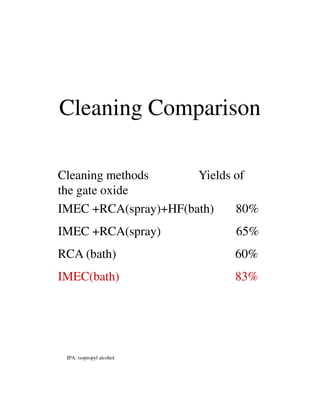
Cleaning Comparison
IMEC +RCA(spray)+HF(bath) 80%
Cleaning methods Yields of
the gate oxide
IPA: isopropyl alcohol
IMEC +RCA(spray)+HF(bath) 80%
IMEC +RCA(spray) 65%
RCA (bath) 60%
IMEC(bath) 83%

Wafer cleaning

  • 1.
    ECE614: Device Modelling andCircuit SimulationSimulation Unit 1 Wafer Cleaning By Dr. Ghanshyam Singh Sharda University
  • 2.
    Outline • Section 1: –Sources of Contaminations – Problems – How to rectify? How to clean?– How to rectify? How to clean? • Section 2: – Wet Chemical Solutions – Cleaning Techniques – Wafer Priming
  • 3.
    Device/Wafer Fabrication • Fabrication Processes –Step 1: Wafer Surface Preparation and Cleaning – Step 2: Photoresist Deposition – Step 3: Photoresist Soft Baking – Step 4: Lithography: Alignment and Photoresist Exposure (More) – Step 5: Photoresist Development– Step 5: Photoresist Development – Step 6: Photoresist Hard baking – Step 7: Development Inspection – Step 8: Etching/Deposition (More) – Step 9: Photoresist Removal / Stripping – Step 10: Final Inspection / Device Testing recap Cleaning Photolithograp hy Etching/Depos ition Device Testing
  • 4.
    Wafer Cleaning • WaferCleaning simply means – “Get rid of particles and contamination” This is the most important step
  • 5.
    What to remove?How? Contamination Possiblesources Effects Particles Equipment,ambient,gas, deionised(DI)water,chemical Lowoxidebreakdown,Poly-Si andmetalbridging-inducedlow yield Metal Equipment,chemical,reactive ionetching(RIE),implantation Lowbreakdownfield,Junction leakage,Reducedlifetimeionetching(RIE),implantation ashing leakage,Reducedlifetime Organic Vapour,residueofphotoresist, storagecontainers,chemical Changeinoxidationrate Micro-roughness Initialwafermaterial,chemical Lowoxidebreakdownfield Lowmobilityofcarrier Nativeoxide Ambientmoisture,DIwater rinse Degradedgateoxide Lowqualityofepilayer Highcontactresistance
  • 6.
    How? Since 1960s……. SC1(RCA): NH4OH-H2O2-H2O(1:1:5 to1:2:7) @ 70-80 ºC 29% 30% At a high pH, SC1 attacks organic and particlesAt a high pH, SC1 attacks organic and particles contamination by oxidation SPM : H2SO4(98%)-H2O2(30%) (4:1) SC2: HC1- H2O2-H2O (1:1:6 to1:2:8) @ 70-80 ºC 37% 30% At a low pH, SC2 can remove metal contamination by forming a soluble complex *SPM: Sulphuric peroxide mixture
  • 7.
    Particles Oxidising In an alkaline OH-provide SC 1 / SC 2 The most effective commercial method is the Megasonic cleaning process+SC1---> remove organic and inorganic particles at temperature of 40 ºC In an alkaline solution electric repulsion H2O2 oxidise the surface OH provide the negative charge
  • 8.
    Megasonic • 700-1200 kHz (ultrasonic<400kHz) •Generated using a ceramic, piezoelectric crystal, which is excited by a high-frequency AC voltage. • SMALLER BUBLES THAN ULTRASONIC • Significantly reduces the risk of surface damageof surface damage • Removing 0.15 µm particle • Not for large particles • NO CONTACT , BRUSHLESS wetting Transdu cer SC 1
  • 9.
    Particle Cleaning • Useof high pressure Nitrogen gas from a handheld gun (Blow-off)(Blow-off) • Mechanical wafer surface scrubbers – Expensive • High-pressure water cleaning
  • 10.
    Metal Contamination • Sources: RIE etching, chemical solution, ion implantation • Problems: – Induce leakage current of p-n junctions – Reduce minority carrier lifetime– Reduce minority carrier lifetime – fault built up during regrow • Wet Cleaning: dilute HF(0.5%)- H2O2(10%) and SC1 SC2
  • 11.
    Organic Contamination • Sources: Vapour, photoresist, containers, chemical, fingerprints (oil), carbon(compound) • Problems: – Incomplete cleaning of surface, leaving– Incomplete cleaning of surface, leaving contaminations such as native oxide or metal impurities – micromasking-->RIE process – photoresist is the main contamination source in IC processes • Cleaning process: – Ozone-injected ultrapure water(strong oxidising agent O3) – Acetone and alcohol (simple way) Native Oxide: own oxide of the solid; e.g. SiO2 in the case of silicon and Al2O3 in the case of aluminum.
  • 12.
    Surface Microroughness • Surfacemicroroughness is an important factor in the manufacture of high performance and quality devices • For growing 100Å thin film, the surface requirement should be atomically flatrequirement should be atomically flat • Sources : SC1 cleaning, NH4OH (etchant) , H2O2(oxidant) • Problems: low performance, low yield • Problem solving: – reduce the proportion of NH4OH, temperature, time – use SPM and SC 2
  • 13.
    Native Oxide • Sources: Oxidation, exposure time, organic contamination, metallic impurities • 7 days of exposure to cleanroom air for silicon----> 6.7 Å • Problems:• Problems: – Uncontrollable ultrathin oxide growth, high contact resistance, hard for epitaxial growths (MBE and MOCVD) – A problem for high performance devices. • Problem solving: – shorten processing time – HF(0.5%)-H2O2(10%) – Etching own oxide of the solid; e.g. SiO2 in the case of silicon and Al2O3 in the case of aluminum. End of Secti on
  • 14.
    Wet-chemical cleaning Techniques • Sulfuricacid: – The most common chemical cleaning solution is hot (90-125ºC) sulfuric acid, removing most inorganic residues and particles. • Sulfuric acid+H2O2 : (Very effective) – Oxidants are added to remove organic residues.– Oxidants are added to remove organic residues. C+O2--->CO2 (gas) – Photoresist stripper • Sulfuric acid + (NH4)2SO4: – A drawback of adding H2O2 (strong oxidiser). Precaution needed. – H2O2 decays rapidly • Standard procedures: – Chemical cleaning-->DI water rinsing-- >Drying (Nitrogen blow-off + baking)
  • 15.
    Cleaning Techniques • ImmersionCleaning: common, easy – Expensive (lot of chemical solutions) – Present potential recontamination – Cannot reaches smaller and deeper pattern/structure • Spray Cleaning: – Chemical costs are decreased (Spray, less chemical)– Chemical costs are decreased (Spray, less chemical) – Free from recontamination – Cleaning efficiency improved due to high pressure of the spray assists in cleaning small patterns and holes – Immediate spray rinsing in one station (save time) • Dry Cleaning: (to rectify some problems in wet tech. I.e. Particle generation/drying) – Ultraviolet-ozone clean, vapor clean, plasma, thermal
  • 16.
    Water Rinsing • Wetcleaning chemicals can also be contaminants if left on the surface. • Therefore, chemical cleanings follow with DI water rinsing • DI water rinsing also serves after etching • Overflow rinsers • Continuous supply of DI water • Enhanced by a stream of nitrogen bubbles • Minimum 5 min • flow rate =5 times the volume of the rinser /min • DI water 18 ohm • 15-18 ohm on exit side (Cleaned) • Rinse time is determined by measuring the resistivity of the water as it exists the rinser. N 2 DI water
  • 17.
    Water Rinsing • Cascadedrinser – Two or three overflow rinsers connected to each other – Water enter only the end rinser and cascades through the downstream rinsers – Very efficient when several boats of wafers are being rinsed simultaneouslyrinsed simultaneously • Sonic assisted cleaning/rinsing – Adding ultrasonic/megasonic – Cavitation effect – Speed up wetting process N 2 DI water
  • 18.
    Drying • Nitrogen blowoff: Remove residue water droplets – Remaining water may interfere with any subsequent operation • Spin-rinse dryers (SRDs) – Complete drying is accomplished in a centrifuge like equipment. Hydrophobic Hydrophilic surface – Start with rinsing of DI water(slow rpm), then Heated N2 injection (high rpm) • Vacuum Dehydration baking – Before applying photoresist(PR) – Hydrophilic : When exposed to moistures – PR adheres well on a hydrophobic surface – PR cannot adhere on a hydrophilic surface – Temperature ~200ºC for 30min – Can be used if delay in substrate preparation (growing, sputtering) Water and heated N2 Wafer cassette
  • 19.
    Wafer Priming • Aprocess where wafers are exposed to a vapour of HMDS to prime the wafer surface prior to photoresist coating. (Silicon) • Primers form bonds with surface and produce a polar (electrostatic) surface • Resist adhesion factors• Resist adhesion factors • Moisture content on surface • wetting characteristics of resist • type of primer • delay in exposure and softbake • surface smoothness • stress from coating process • surface contamination Ideally want no H2O on wafer surface 15 min 80-90 ºC in convention oven
  • 20.
    Wafer Priming • Typesof priming – Immersion priming (simplest way) • lack of control and not free from contamination • Expensive – Spin priming – vapour priming PR – vapour priming • Free from contamination • Cheap • For GaAs wafer: – No necessarily, because GaAs already has a polar surface vacuum PR Primer wafer chuck End of section
  • 21.
    Standard Cleaning Procedures 1. Ahot H2SO4: H2O2 (2:1 to 3:1) at 120 ºC mixture is used to remove the greasy contamination, which may be from the cassette or residues from the photoresist layers.photoresist layers. 2. SC1 3. After the SC1 process, a 15 s immersion in 1% HF-H2O solution may be beneficial for removing any trace impurity.
  • 22.
    Advanced Cleaning Procedures 1. H2O+O3 : organic contamination 2. NH4OH+H2O2 (0.05:1:5): Particle, organic and metallic impurities 3. HF+H2O2 (0.5%: 10%): Native oxide, metallic impurities 4. Ultrapure water: Rinsing IMEC 1. H2SO4+ H2O2 (4:1) @ 90ºC for 10 min 2. HF(0.5%)/IPA(0.1%) @ room temperature for 2 min 4. Ultrapure water: Rinsing IPA: isopropyl alcohol
  • 23.
    Cleaning Comparison IMEC +RCA(spray)+HF(bath)80% Cleaning methods Yields of the gate oxide IPA: isopropyl alcohol IMEC +RCA(spray)+HF(bath) 80% IMEC +RCA(spray) 65% RCA (bath) 60% IMEC(bath) 83%