Flexible · Affordable · Accessible
the people’s university
TEL 213/05 Telecommunication Principle
Tutorial 2: Digital
Communication Principle
Semester January 2012
the people’s university
Flexible · Affordable · Accessible
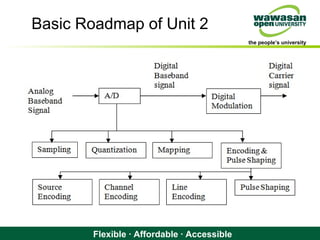
Basic Roadmap of Unit 2
the people’s university
Flexible · Affordable · Accessible
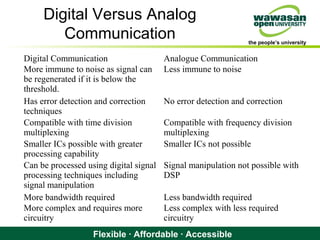
Digital Versus Analog
Communication
Digital Communication Analogue Communication
More immune to noise as signal can
be regenerated if it is below the
threshold.
Less immune to noise
Has error detection and correction
techniques
No error detection and correction
Compatible with time division
multiplexing
Compatible with frequency division
multiplexing
Smaller ICs possible with greater
processing capability
Smaller ICs not possible
Can be processed using digital signal
processing techniques including
signal manipulation
Signal manipulation not possible with
DSP
More bandwidth required Less bandwidth required
More complex and requires more
circuitry
Less complex with less required
circuitry
the people’s university
Flexible · Affordable · Accessible
Sampling
• The challenge is always to represent analog signals in digital form to ease
transmission.
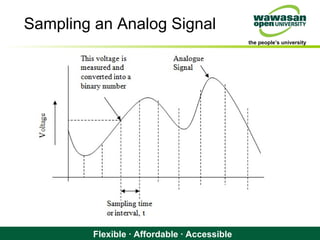
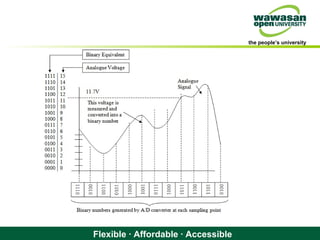
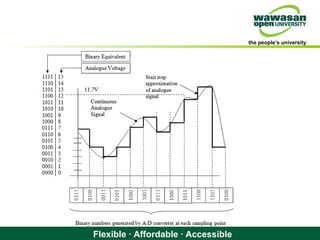
• To do this, sampling of analog data needs to be done.
• Sampling is a process of approximation (estimation) of an analog quantity.
• After sampling, mathematical modeling can be done to represent the signal
in digital form.
• Sampling must be done at regular intervals and must cover most of the data
(at least twice the bandwidth frequency) to have an accurate depiction of the
whole data.
• This concept is called the Nyquist-Shannon Sampling Theory
• The phenomenon called “aliasing” (misrepresentation) will happen if not
enough samples are taken to represent the whole population.
Sampling Frequency = 2 * Bandwidth
the people’s university
Flexible · Affordable · Accessible
Sampling an Analog Signal
the people’s university
Flexible · Affordable · Accessible
the people’s university
Flexible · Affordable · Accessible
the people’s university
Flexible · Affordable · Accessible
Example
• If a 12 bits A/D converter were to be used,
how many voltage increments are there?
• 12 bits would produce 212
or 4096 voltage
increments.
the people’s university
Flexible · Affordable · Accessible
Example
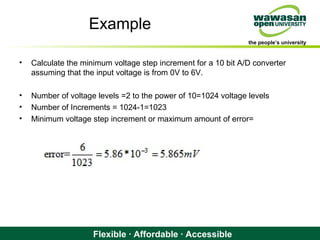
• Calculate the minimum voltage step increment for a 10 bit A/D converter
assuming that the input voltage is from 0V to 6V.
• Number of voltage levels =2 to the power of 10=1024 voltage levels
• Number of Increments = 1024-1=1023
• Minimum voltage step increment or maximum amount of error=
the people’s university
Flexible · Affordable · Accessible
Example
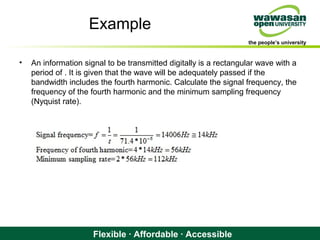
• An information signal to be transmitted digitally is a rectangular wave with a
period of . It is given that the wave will be adequately passed if the
bandwidth includes the fourth harmonic. Calculate the signal frequency, the
frequency of the fourth harmonic and the minimum sampling frequency
(Nyquist rate).
the people’s university
Flexible · Affordable · Accessible
Noise and S/N
• Noise is an electronic signal that is a mixture of
many random frequencies at different
amplitudes that gets added to a radio or
information signal as it is transmitted from one
place to another as it is processed
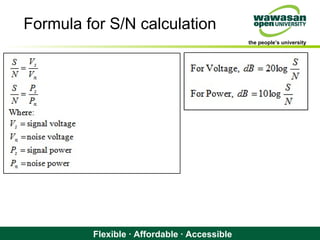
• The signal-noise (S/N) ratio is also called SNR,
and is an indication of the relative strengths of
the signal and noise in a communication system.
The stronger the signal and the weaker the
noise, the higher the S/N ratio
the people’s university
Flexible · Affordable · Accessible
Formula for S/N calculation
the people’s university
Flexible · Affordable · Accessible
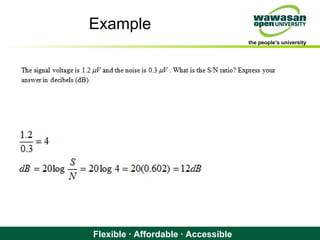
Example
the people’s university
Flexible · Affordable · Accessible
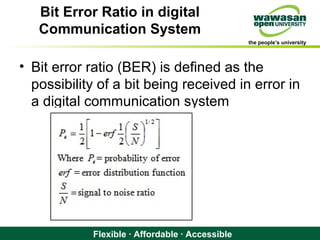
Bit Error Ratio in digital
Communication System
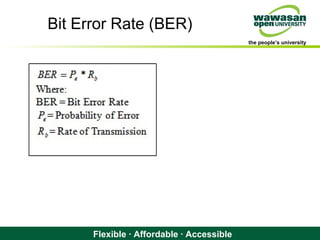
• Bit error ratio (BER) is defined as the
possibility of a bit being received in error in
a digital communication system
the people’s university
Flexible · Affordable · Accessible
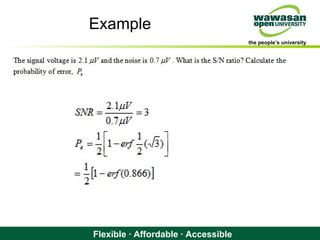
Example
the people’s university
Flexible · Affordable · Accessible
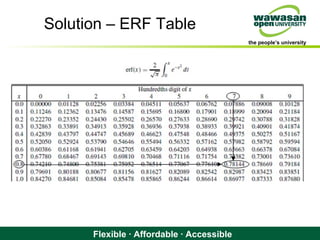
Solution – ERF Table
the people’s university
Flexible · Affordable · Accessible
Bit Error Rate (BER)
the people’s university
Flexible · Affordable · Accessible
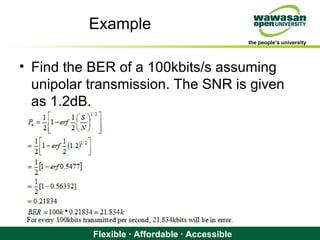
Example
• Find the BER of a 100kbits/s assuming
unipolar transmission. The SNR is given
as 1.2dB.
the people’s university
Flexible · Affordable · Accessible
Data Transmission
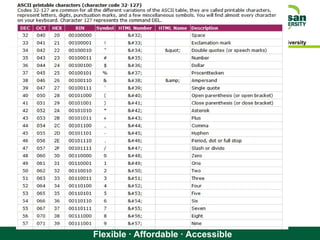
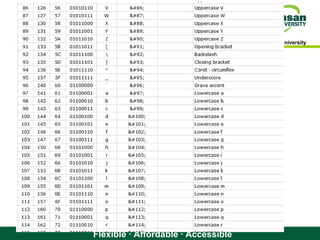
• All data need to be converted to ASCII
code first: http://www.ascii-code.com/
the people’s university
Flexible · Affordable · Accessible
the people’s university
Flexible · Affordable · Accessible
the people’s university
Flexible · Affordable · Accessible
the people’s university
Flexible · Affordable · Accessible
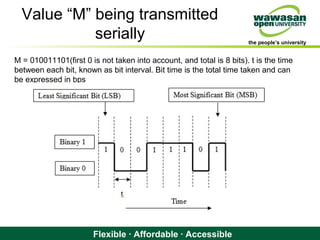
Value “M” being transmitted
serially
M = 010011101(first 0 is not taken into account, and total is 8 bits). t is the time
between each bit, known as bit interval. Bit time is the total time taken and can
be expressed in bps
the people’s university
Flexible · Affordable · Accessible
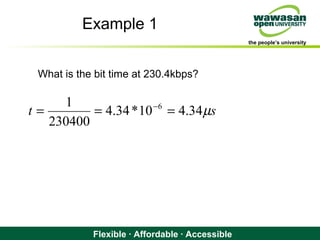
Example 1
What is the bit time at 230.4kbps?
st µ34.410*34.4
230400
1 6
=== −
the people’s university
Flexible · Affordable · Accessible
the people’s university
Flexible · Affordable · Accessible
No PAM
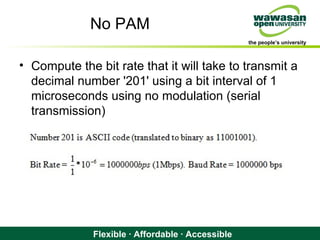
• Compute the bit rate that it will take to transmit a
decimal number '201' using a bit interval of 1
microseconds using no modulation (serial
transmission)
the people’s university
Flexible · Affordable · Accessible
With PAM
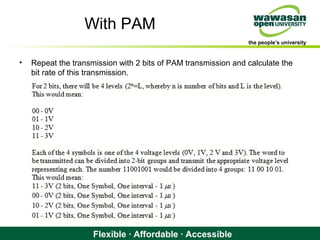
• Repeat the transmission with 2 bits of PAM transmission and calculate the
bit rate of this transmission.
the people’s university
Flexible · Affordable · Accessible
PCM
• Digitizing = converting analogue signals to digital signals.
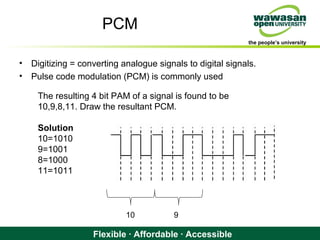
• Pulse code modulation (PCM) is commonly used
The resulting 4 bit PAM of a signal is found to be
10,9,8,11. Draw the resultant PCM.
Solution
10=1010
9=1001
8=1000
11=1011
10 9
the people’s university
Flexible · Affordable · Accessible
FSK
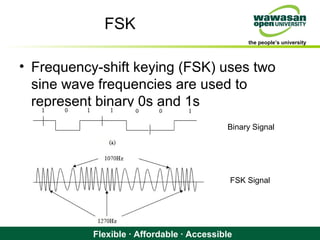
• Frequency-shift keying (FSK) uses two
sine wave frequencies are used to
represent binary 0s and 1s
Binary Signal
FSK Signal
the people’s university
Flexible · Affordable · Accessible
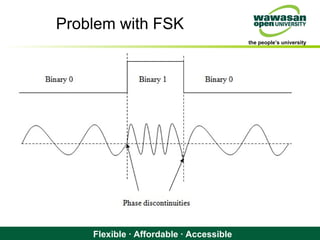
Problem with FSK
the people’s university
Flexible · Affordable · Accessible
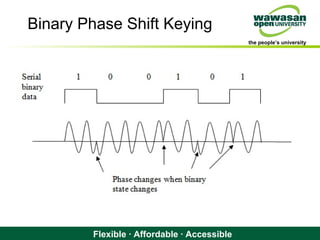
Binary Phase Shift Keying
the people’s university
Flexible · Affordable · Accessible
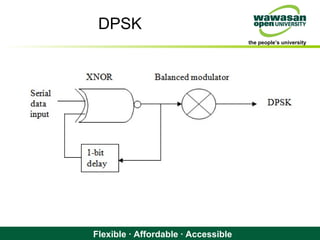
DPSK
the people’s university
Flexible · Affordable · Accessible
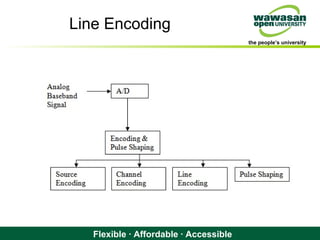
Line Encoding
the people’s university
Flexible · Affordable · Accessible
the people’s university
Flexible · Affordable · Accessible
Example
• Transmit the word “Data Com” in the
transmission line and calculate the
LRC/BCC and parity of VRC (odd)
the people’s university
Flexible · Affordable · Accessible
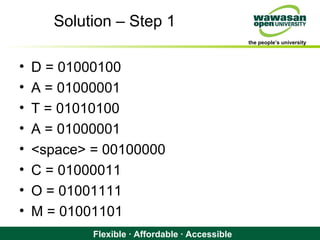
Solution – Step 1
• D = 01000100
• A = 01000001
• T = 01010100
• A = 01000001
• <space> = 00100000
• C = 01000011
• O = 01001111
• M = 01001101
the people’s university
Flexible · Affordable · Accessible
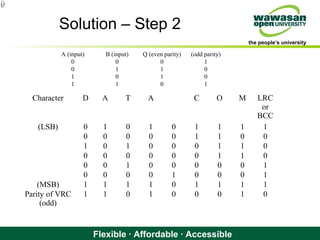
Solution – Step 2
A (input) B (input) Q (even parity) (odd parity)
0 0 0 1
0 1 1 0
1 0 1 0
1 1 0 1
Q
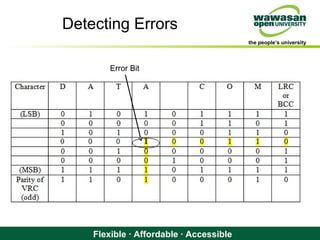
Character D A T A C O M LRC
or
BCC
(LSB) 0 1 0 1 0 1 1 1 1
0 0 0 0 0 1 1 0 0
1 0 1 0 0 0 1 1 0
0 0 0 0 0 0 1 1 0
0 0 1 0 0 0 0 0 1
0 0 0 0 1 0 0 0 1
(MSB) 1 1 1 1 0 1 1 1 1
Parity of VRC
(odd)
1 1 0 1 0 0 0 1 0
the people’s university
Flexible · Affordable · Accessible
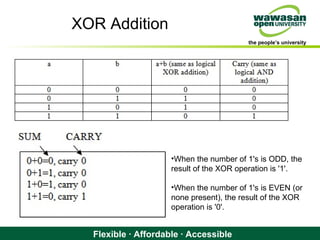
XOR Addition
•When the number of 1's is ODD, the
result of the XOR operation is '1'.
•When the number of 1's is EVEN (or
none present), the result of the XOR
operation is '0'.
the people’s university
Flexible · Affordable · Accessible
Detecting Errors
Error Bit
the people’s university
Flexible · Affordable · Accessible
Hamming Detection (FEC)
Example
• The data word is 01101010. Use
Hamming FEC Method to transmit this
data across the transmission line
the people’s university
Flexible · Affordable · Accessible
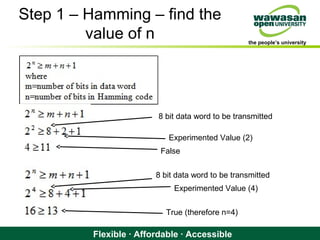
Step 1 – Hamming – find the
value of n
8 bit data word to be transmitted
Experimented Value (2)
False
8 bit data word to be transmitted
Experimented Value (4)
True (therefore n=4)
the people’s university
Flexible · Affordable · Accessible
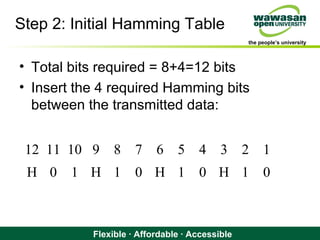
Step 2: Initial Hamming Table
• Total bits required = 8+4=12 bits
• Insert the 4 required Hamming bits
between the transmitted data:
12 11 10 9 8 7 6 5 4 3 2 1
H 0 1 H 1 0 H 1 0 H 1 0
the people’s university
Flexible · Affordable · Accessible
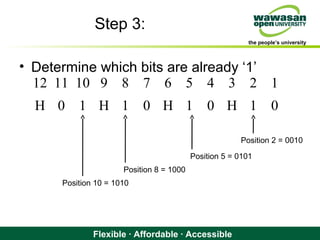
Step 3:
• Determine which bits are already ‘1’
12 11 10 9 8 7 6 5 4 3 2 1
H 0 1 H 1 0 H 1 0 H 1 0
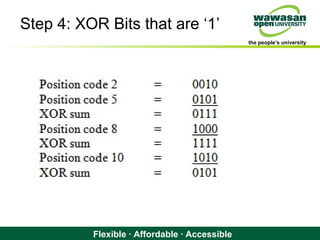
Position 2 = 0010
Position 5 = 0101
Position 8 = 1000
Position 10 = 1010
the people’s university
Flexible · Affordable · Accessible
Step 4: XOR Bits that are ‘1’
the people’s university
Flexible · Affordable · Accessible
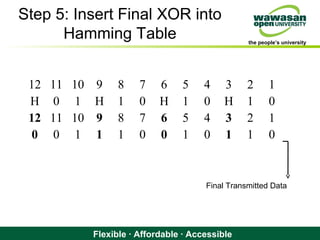
Step 5: Insert Final XOR into
Hamming Table
12 11 10 9 8 7 6 5 4 3 2 1
H 0 1 H 1 0 H 1 0 H 1 0
12 11 10 9 8 7 6 5 4 3 2 1
0 0 1 1 1 0 0 1 0 1 1 0
Final Transmitted Data
the people’s university
Flexible · Affordable · Accessible
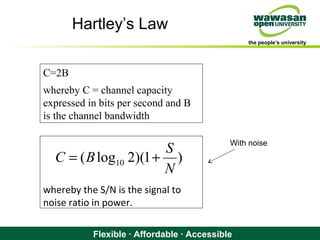
Hartley’s Law
C=2B
whereby C = channel capacity
expressed in bits per second and B
is the channel bandwidth
whereby the S/N is the signal to
noise ratio in power.
)1)(2log( 10
N
S
BC +=
With noise
the people’s university
Flexible · Affordable · Accessible
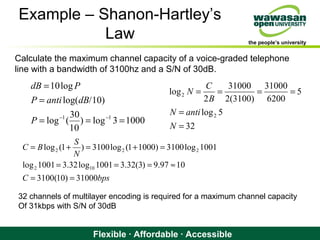
Example – Shanon-Hartley’s
Law
Calculate the maximum channel capacity of a voice-graded telephone
line with a bandwidth of 3100hz and a S/N of 30dB.
10003log)
10
30
(log
)10/log(
log10
11
===
=
=
−−
P
dBantiP
PdB
bpsC
N
S
BC
31000)10(3100
1097.9)3(32.31001log32.31001log
1001log3100)10001(log3100)1(log
102
222
==
≈===
=+=+=
32
5log
5
6200
31000
)3100(2
31000
2
log
2
2
=
=
====
N
antiN
B
C
N
32 channels of multilayer encoding is required for a maximum channel capacity
Of 31kbps with S/N of 30dB
the people’s university
Flexible · Affordable · Accessible
Summary
• A signal needs to be sampled as the first process in converting an analogue
signal to a digital signal
• To properly sample a signal and to ensure aliasing does not occur and the
whole signal can be adequately reconstructed from its digital representation,
the sampling frequency needs to be twice the value of the original signal.
• The process of quantization and mapping changes the digitally acquired
signals to become numerical values
• Pulse Code Modulation (PCM) uses multiplexing to convert the signals into
a stream of data.
• The encoding process is the last process of the A/D converter and serves to
change the numerical values for optimization prior to transmission.
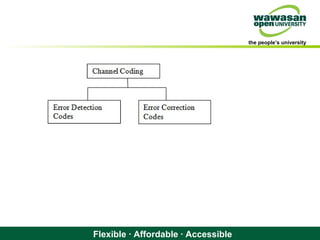
• There are 3 main types of encoding available namely source encoding,
channel encoding and line encoding.
the people’s university
Flexible · Affordable · Accessible
Thank you!

Digital Communication Principle

  • 1.
    Flexible · Affordable· Accessible the people’s university TEL 213/05 Telecommunication Principle Tutorial 2: Digital Communication Principle Semester January 2012
  • 2.
    the people’s university Flexible· Affordable · Accessible Basic Roadmap of Unit 2
  • 3.
    the people’s university Flexible· Affordable · Accessible Digital Versus Analog Communication Digital Communication Analogue Communication More immune to noise as signal can be regenerated if it is below the threshold. Less immune to noise Has error detection and correction techniques No error detection and correction Compatible with time division multiplexing Compatible with frequency division multiplexing Smaller ICs possible with greater processing capability Smaller ICs not possible Can be processed using digital signal processing techniques including signal manipulation Signal manipulation not possible with DSP More bandwidth required Less bandwidth required More complex and requires more circuitry Less complex with less required circuitry
  • 4.
    the people’s university Flexible· Affordable · Accessible Sampling • The challenge is always to represent analog signals in digital form to ease transmission. • To do this, sampling of analog data needs to be done. • Sampling is a process of approximation (estimation) of an analog quantity. • After sampling, mathematical modeling can be done to represent the signal in digital form. • Sampling must be done at regular intervals and must cover most of the data (at least twice the bandwidth frequency) to have an accurate depiction of the whole data. • This concept is called the Nyquist-Shannon Sampling Theory • The phenomenon called “aliasing” (misrepresentation) will happen if not enough samples are taken to represent the whole population. Sampling Frequency = 2 * Bandwidth
  • 5.
    the people’s university Flexible· Affordable · Accessible Sampling an Analog Signal
  • 6.
    the people’s university Flexible· Affordable · Accessible
  • 7.
    the people’s university Flexible· Affordable · Accessible
  • 8.
    the people’s university Flexible· Affordable · Accessible Example • If a 12 bits A/D converter were to be used, how many voltage increments are there? • 12 bits would produce 212 or 4096 voltage increments.
  • 9.
    the people’s university Flexible· Affordable · Accessible Example • Calculate the minimum voltage step increment for a 10 bit A/D converter assuming that the input voltage is from 0V to 6V. • Number of voltage levels =2 to the power of 10=1024 voltage levels • Number of Increments = 1024-1=1023 • Minimum voltage step increment or maximum amount of error=
  • 10.
    the people’s university Flexible· Affordable · Accessible Example • An information signal to be transmitted digitally is a rectangular wave with a period of . It is given that the wave will be adequately passed if the bandwidth includes the fourth harmonic. Calculate the signal frequency, the frequency of the fourth harmonic and the minimum sampling frequency (Nyquist rate).
  • 11.
    the people’s university Flexible· Affordable · Accessible Noise and S/N • Noise is an electronic signal that is a mixture of many random frequencies at different amplitudes that gets added to a radio or information signal as it is transmitted from one place to another as it is processed • The signal-noise (S/N) ratio is also called SNR, and is an indication of the relative strengths of the signal and noise in a communication system. The stronger the signal and the weaker the noise, the higher the S/N ratio
  • 12.
    the people’s university Flexible· Affordable · Accessible Formula for S/N calculation
  • 13.
    the people’s university Flexible· Affordable · Accessible Example
  • 14.
    the people’s university Flexible· Affordable · Accessible Bit Error Ratio in digital Communication System • Bit error ratio (BER) is defined as the possibility of a bit being received in error in a digital communication system
  • 15.
    the people’s university Flexible· Affordable · Accessible Example
  • 16.
    the people’s university Flexible· Affordable · Accessible Solution – ERF Table
  • 17.
    the people’s university Flexible· Affordable · Accessible Bit Error Rate (BER)
  • 18.
    the people’s university Flexible· Affordable · Accessible Example • Find the BER of a 100kbits/s assuming unipolar transmission. The SNR is given as 1.2dB.
  • 19.
    the people’s university Flexible· Affordable · Accessible Data Transmission • All data need to be converted to ASCII code first: http://www.ascii-code.com/
  • 20.
    the people’s university Flexible· Affordable · Accessible
  • 21.
    the people’s university Flexible· Affordable · Accessible
  • 22.
    the people’s university Flexible· Affordable · Accessible
  • 23.
    the people’s university Flexible· Affordable · Accessible Value “M” being transmitted serially M = 010011101(first 0 is not taken into account, and total is 8 bits). t is the time between each bit, known as bit interval. Bit time is the total time taken and can be expressed in bps
  • 24.
    the people’s university Flexible· Affordable · Accessible Example 1 What is the bit time at 230.4kbps? st µ34.410*34.4 230400 1 6 === −
  • 25.
    the people’s university Flexible· Affordable · Accessible
  • 26.
    the people’s university Flexible· Affordable · Accessible No PAM • Compute the bit rate that it will take to transmit a decimal number '201' using a bit interval of 1 microseconds using no modulation (serial transmission)
  • 27.
    the people’s university Flexible· Affordable · Accessible With PAM • Repeat the transmission with 2 bits of PAM transmission and calculate the bit rate of this transmission.
  • 28.
    the people’s university Flexible· Affordable · Accessible PCM • Digitizing = converting analogue signals to digital signals. • Pulse code modulation (PCM) is commonly used The resulting 4 bit PAM of a signal is found to be 10,9,8,11. Draw the resultant PCM. Solution 10=1010 9=1001 8=1000 11=1011 10 9
  • 29.
    the people’s university Flexible· Affordable · Accessible FSK • Frequency-shift keying (FSK) uses two sine wave frequencies are used to represent binary 0s and 1s Binary Signal FSK Signal
  • 30.
    the people’s university Flexible· Affordable · Accessible Problem with FSK
  • 31.
    the people’s university Flexible· Affordable · Accessible Binary Phase Shift Keying
  • 32.
    the people’s university Flexible· Affordable · Accessible DPSK
  • 33.
    the people’s university Flexible· Affordable · Accessible Line Encoding
  • 34.
    the people’s university Flexible· Affordable · Accessible
  • 35.
    the people’s university Flexible· Affordable · Accessible Example • Transmit the word “Data Com” in the transmission line and calculate the LRC/BCC and parity of VRC (odd)
  • 36.
    the people’s university Flexible· Affordable · Accessible Solution – Step 1 • D = 01000100 • A = 01000001 • T = 01010100 • A = 01000001 • <space> = 00100000 • C = 01000011 • O = 01001111 • M = 01001101
  • 37.
    the people’s university Flexible· Affordable · Accessible Solution – Step 2 A (input) B (input) Q (even parity) (odd parity) 0 0 0 1 0 1 1 0 1 0 1 0 1 1 0 1 Q Character D A T A C O M LRC or BCC (LSB) 0 1 0 1 0 1 1 1 1 0 0 0 0 0 1 1 0 0 1 0 1 0 0 0 1 1 0 0 0 0 0 0 0 1 1 0 0 0 1 0 0 0 0 0 1 0 0 0 0 1 0 0 0 1 (MSB) 1 1 1 1 0 1 1 1 1 Parity of VRC (odd) 1 1 0 1 0 0 0 1 0
  • 38.
    the people’s university Flexible· Affordable · Accessible XOR Addition •When the number of 1's is ODD, the result of the XOR operation is '1'. •When the number of 1's is EVEN (or none present), the result of the XOR operation is '0'.
  • 39.
    the people’s university Flexible· Affordable · Accessible Detecting Errors Error Bit
  • 40.
    the people’s university Flexible· Affordable · Accessible Hamming Detection (FEC) Example • The data word is 01101010. Use Hamming FEC Method to transmit this data across the transmission line
  • 41.
    the people’s university Flexible· Affordable · Accessible Step 1 – Hamming – find the value of n 8 bit data word to be transmitted Experimented Value (2) False 8 bit data word to be transmitted Experimented Value (4) True (therefore n=4)
  • 42.
    the people’s university Flexible· Affordable · Accessible Step 2: Initial Hamming Table • Total bits required = 8+4=12 bits • Insert the 4 required Hamming bits between the transmitted data: 12 11 10 9 8 7 6 5 4 3 2 1 H 0 1 H 1 0 H 1 0 H 1 0
  • 43.
    the people’s university Flexible· Affordable · Accessible Step 3: • Determine which bits are already ‘1’ 12 11 10 9 8 7 6 5 4 3 2 1 H 0 1 H 1 0 H 1 0 H 1 0 Position 2 = 0010 Position 5 = 0101 Position 8 = 1000 Position 10 = 1010
  • 44.
    the people’s university Flexible· Affordable · Accessible Step 4: XOR Bits that are ‘1’
  • 45.
    the people’s university Flexible· Affordable · Accessible Step 5: Insert Final XOR into Hamming Table 12 11 10 9 8 7 6 5 4 3 2 1 H 0 1 H 1 0 H 1 0 H 1 0 12 11 10 9 8 7 6 5 4 3 2 1 0 0 1 1 1 0 0 1 0 1 1 0 Final Transmitted Data
  • 46.
    the people’s university Flexible· Affordable · Accessible Hartley’s Law C=2B whereby C = channel capacity expressed in bits per second and B is the channel bandwidth whereby the S/N is the signal to noise ratio in power. )1)(2log( 10 N S BC += With noise
  • 47.
    the people’s university Flexible· Affordable · Accessible Example – Shanon-Hartley’s Law Calculate the maximum channel capacity of a voice-graded telephone line with a bandwidth of 3100hz and a S/N of 30dB. 10003log) 10 30 (log )10/log( log10 11 === = = −− P dBantiP PdB bpsC N S BC 31000)10(3100 1097.9)3(32.31001log32.31001log 1001log3100)10001(log3100)1(log 102 222 == ≈=== =+=+= 32 5log 5 6200 31000 )3100(2 31000 2 log 2 2 = = ==== N antiN B C N 32 channels of multilayer encoding is required for a maximum channel capacity Of 31kbps with S/N of 30dB
  • 48.
    the people’s university Flexible· Affordable · Accessible Summary • A signal needs to be sampled as the first process in converting an analogue signal to a digital signal • To properly sample a signal and to ensure aliasing does not occur and the whole signal can be adequately reconstructed from its digital representation, the sampling frequency needs to be twice the value of the original signal. • The process of quantization and mapping changes the digitally acquired signals to become numerical values • Pulse Code Modulation (PCM) uses multiplexing to convert the signals into a stream of data. • The encoding process is the last process of the A/D converter and serves to change the numerical values for optimization prior to transmission. • There are 3 main types of encoding available namely source encoding, channel encoding and line encoding.
  • 49.
    the people’s university Flexible· Affordable · Accessible Thank you!