by
Louis Anitha,
 Introduction
 Oxidation of silicon
 Classification of oxidation process
 Advantages and disadvantages
 Application
 Semiconductor can be oxidized by various methods, including
Thermal oxidation, electrochemical anodization and plasma
enhanced chemical vapour deposition.
 Among these thermal oxidation is most commonly used.
 It is a key process in modern silicon IC technology.
 The most widely used technique to grow SiO₂ on
silicon is Thermal oxidation.
 This is usually carried out in an open tube quartz
furnace at atmospheric pressure between 800-1200℃.
 When a silicon heated in a furnace at a high temperature in the
presence of oxygen gas. This oxidation process carried out in
the furnace which is called an oxidation Furnace.
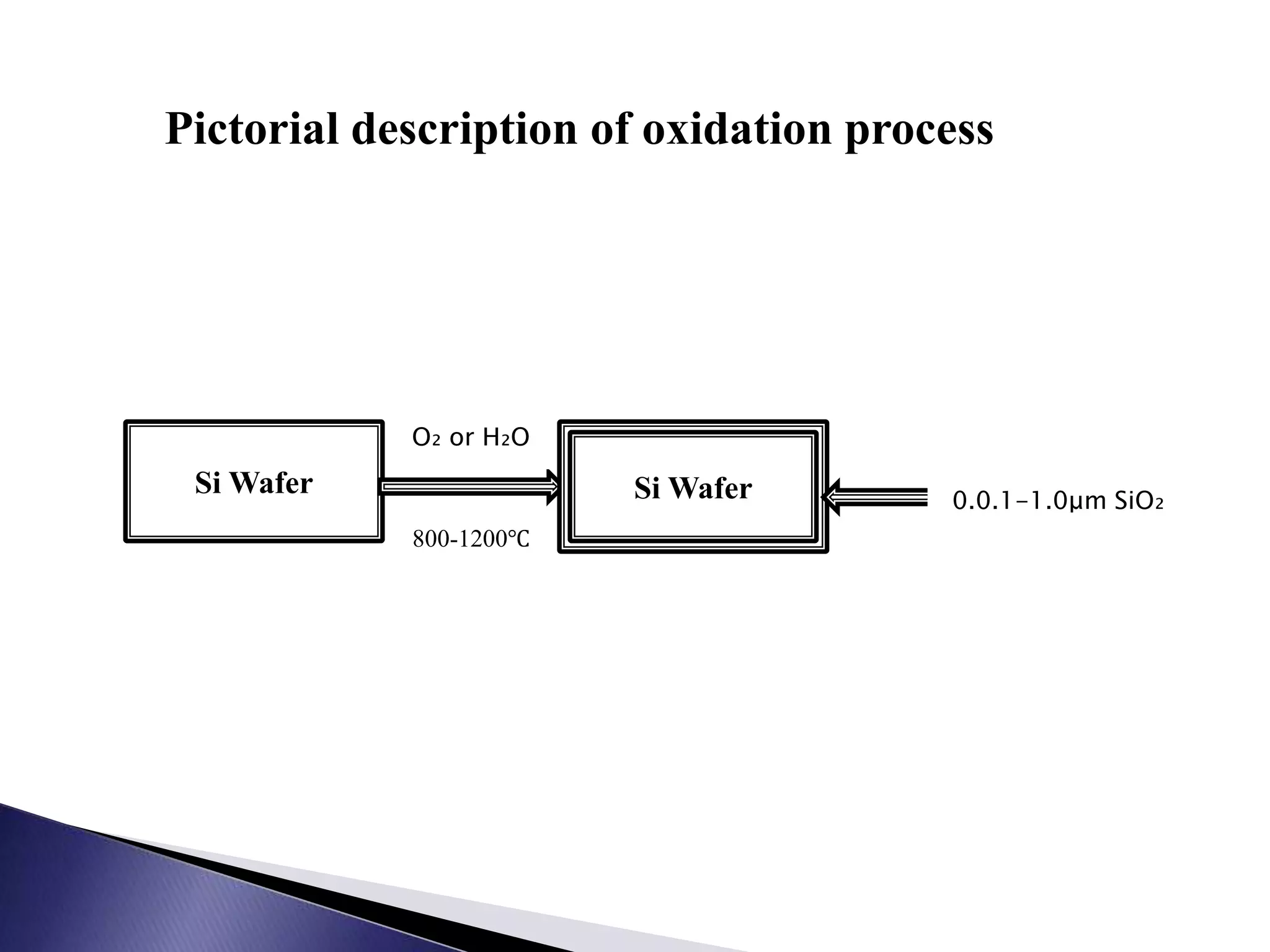
 Schematic of an oxidation Furnace :
Pictorial description of oxidation process
Si Wafer Si Wafer
Si Wafer
O₂ or H₂O
800-1200℃
0.0.1-1.0μm SiO₂
Classification of oxidation process:
There are two type of oxidation process used in
fabrication namely,
 Dry Oxidation
 Wet Oxidation
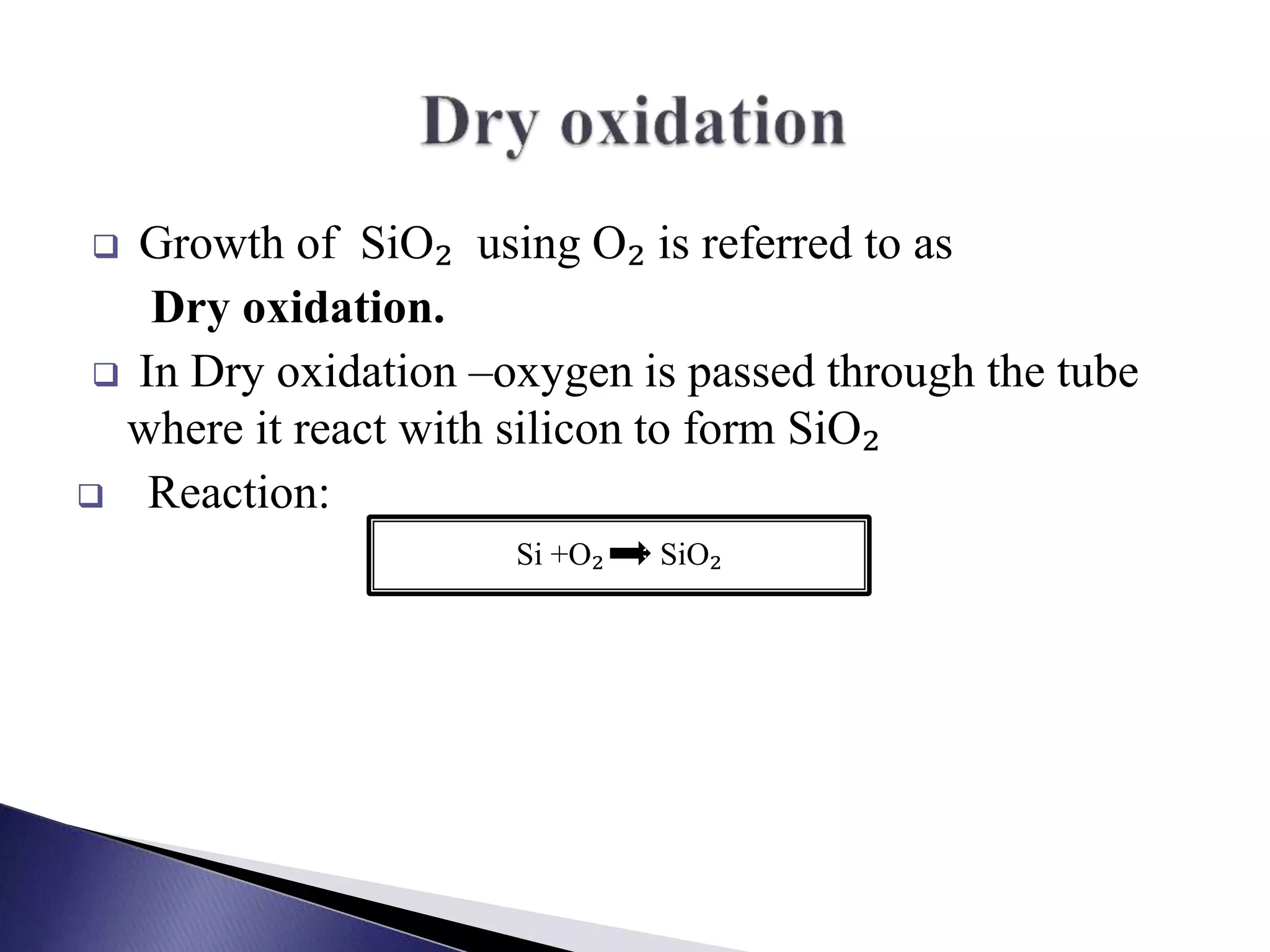
 Growth of SiO₂ using O₂ is referred to as
Dry oxidation.
 In Dry oxidation –oxygen is passed through the tube
where it react with silicon to form SiO₂
 Reaction:
Si +O₂ SiO₂
Advantage:
 Oxide layer are very uniform.
 Relatively few defects exist at oxide interface
Disadvantage:
 Dry oxide grows slowly.
 High purity de-ionised water, kept in a quartz bubbler at inlet
of the furnace, is heated to a temperature close to its boiling
point
 High purity oxygen or nitrogen is passed through it so that the
gas flow into furnace is saturated with water vapour.
 Water then acts as the oxidizing agent and the oxidation
reaction is given by
Si +2H₂O SiO₂ +2H₂
Advantage:
Wet oxide grows fast.
Disadvantage:
Hydrogen atom liberated by decomposition of wter
molecules produce perfections that may degrade the oxides
quality.
 The oxidation rate of wet oxidation is significantly higher
than that of dry oxidation hence, whenever thickness oxide is
needed, wet oxidation process is used.
 Wet oxidation –Thick oxide layer
 Dry oxidation-Thin oxide layer
THANK YOU

Oxidation

  • 1.
  • 2.
     Introduction  Oxidationof silicon  Classification of oxidation process  Advantages and disadvantages  Application
  • 3.
     Semiconductor canbe oxidized by various methods, including Thermal oxidation, electrochemical anodization and plasma enhanced chemical vapour deposition.  Among these thermal oxidation is most commonly used.  It is a key process in modern silicon IC technology.
  • 4.
     The mostwidely used technique to grow SiO₂ on silicon is Thermal oxidation.  This is usually carried out in an open tube quartz furnace at atmospheric pressure between 800-1200℃.
  • 5.
     When asilicon heated in a furnace at a high temperature in the presence of oxygen gas. This oxidation process carried out in the furnace which is called an oxidation Furnace.  Schematic of an oxidation Furnace :
  • 6.
    Pictorial description ofoxidation process Si Wafer Si Wafer Si Wafer O₂ or H₂O 800-1200℃ 0.0.1-1.0μm SiO₂
  • 7.
    Classification of oxidationprocess: There are two type of oxidation process used in fabrication namely,  Dry Oxidation  Wet Oxidation
  • 8.
     Growth ofSiO₂ using O₂ is referred to as Dry oxidation.  In Dry oxidation –oxygen is passed through the tube where it react with silicon to form SiO₂  Reaction: Si +O₂ SiO₂
  • 9.
    Advantage:  Oxide layerare very uniform.  Relatively few defects exist at oxide interface Disadvantage:  Dry oxide grows slowly.
  • 10.
     High purityde-ionised water, kept in a quartz bubbler at inlet of the furnace, is heated to a temperature close to its boiling point  High purity oxygen or nitrogen is passed through it so that the gas flow into furnace is saturated with water vapour.  Water then acts as the oxidizing agent and the oxidation reaction is given by Si +2H₂O SiO₂ +2H₂
  • 11.
    Advantage: Wet oxide growsfast. Disadvantage: Hydrogen atom liberated by decomposition of wter molecules produce perfections that may degrade the oxides quality.
  • 12.
     The oxidationrate of wet oxidation is significantly higher than that of dry oxidation hence, whenever thickness oxide is needed, wet oxidation process is used.  Wet oxidation –Thick oxide layer  Dry oxidation-Thin oxide layer
  • 13.