CMOS Fabrication
1.Introduction-Trends
2.Fabrication Process -Basic steps
3.NMOS Fabrication
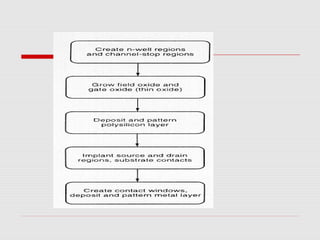
4.N-well Process
5.P-well Process
6.Twin-tub Process
7.Latch Up Problem
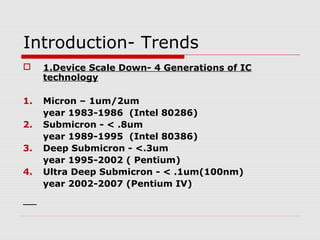
Introduction- Trends
 1.Device Scale Down- 4 Generations of IC
technology
1. Micron – 1um/2um
year 1983-1986 (Intel 80286)
2. Submicron - < .8um
year 1989-1995 (Intel 80386)
3. Deep Submicron - <.3um
year 1995-2002 ( Pentium)
4. Ultra Deep Submicron - < .1um(100nm)
year 2002-2007 (Pentium IV)
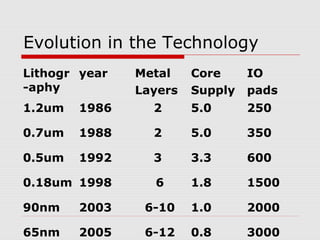
Evolution in the Technology
Lithogr
-aphy
year Metal
Layers
Core
Supply
IO
pads
1.2um 1986 2 5.0 250
0.7um 1988 2 5.0 350
0.5um 1992 3 3.3 600
0.18um 1998 6 1.8 1500
90nm 2003 6-10 1.0 2000
65nm 2005 6-12 0.8 3000
Improvements of Increased Density
 Reduction in Si area reduces the
parasitic capacitance of junctions and
interconnects thus increasing the
switching speed
 The shorter dimension of device itself
speeds up switching thus further
increasing clock frequency
2.Increasing of speed in digital
circuits
 GaAs may ultimately supplant Si for
high frequency requirements
3. Increasing Complexity of Circuits
4. Ever-growing dependence on
EDA/CAD tools
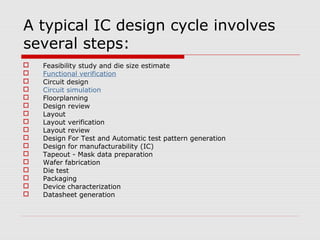
A typical IC design cycle involves
several steps:
 Feasibility study and die size estimate
 Functional verification
 Circuit design
 Circuit simulation
 Floorplanning
 Design review
 Layout
 Layout verification
 Layout review
 Design For Test and Automatic test pattern generation
 Design for manufacturability (IC)
 Tapeout - Mask data preparation
 Wafer fabrication
 Die test
 Packaging
 Device characterization
 Datasheet generation
Fabrication Process-Basic steps
 Fabrication process, circuit design
process and performance of the
resulting chip strongly depend on
each other
 Circuit designer should have a clear
understanding of various masks
 Masks – Each processing step
requires certain areas to be defined
on the chip by masks
 Lithography – The process used to
transfer a pattern to a layer on the
chip
 Wells – To accommodate both nmos
& pmos devices, special regions
called wells or tubs are created
Characteristics of CMOS family
 High Noise immunity
 Low static Power
 High Packaging density
N-well Process
CMOS fabrication sequence
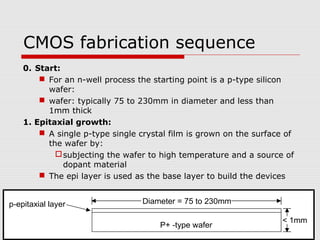
0. Start:
 For an n-well process the starting point is a p-type silicon
wafer:
 wafer: typically 75 to 230mm in diameter and less than
1mm thick
1. Epitaxial growth:
 A single p-type single crystal film is grown on the surface of
the wafer by:
subjecting the wafer to high temperature and a source of
dopant material
 The epi layer is used as the base layer to build the devices
P+ -type wafer
p-epitaxial layer Diameter = 75 to 230mm
< 1mm
CMOS fabrication sequence
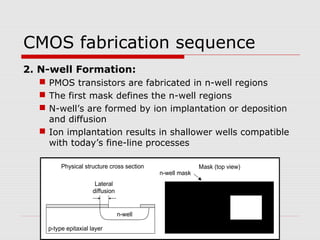
2. N-well Formation:
 PMOS transistors are fabricated in n-well regions
 The first mask defines the n-well regions
 N-well’s are formed by ion implantation or deposition
and diffusion
 Ion implantation results in shallower wells compatible
with today’s fine-line processes
p-type epitaxial layer
n-well
Lateral
diffusion
Physical structure cross section Mask (top view)
n-well mask
CMOS fabrication sequence
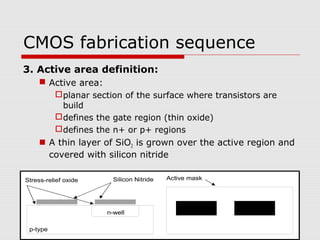
3. Active area definition:
 Active area:
planar section of the surface where transistors are
build
defines the gate region (thin oxide)
defines the n+ or p+ regions
 A thin layer of SiO2 is grown over the active region and
covered with silicon nitride
n-well
Silicon NitrideStress-relief oxide
p-type
Active mask
CMOS fabrication sequence
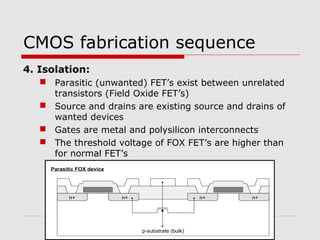
4. Isolation:
 Parasitic (unwanted) FET’s exist between unrelated
transistors (Field Oxide FET’s)
 Source and drains are existing source and drains of
wanted devices
 Gates are metal and polysilicon interconnects
 The threshold voltage of FOX FET’s are higher than
for normal FET’s
p-substrate (bulk)
n+ n+
Parasitic FOX device
n+ n+
CMOS fabrication sequence
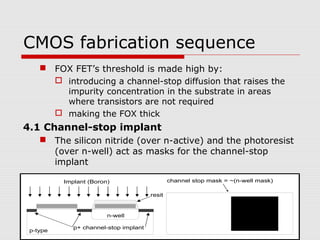
 FOX FET’s threshold is made high by:
 introducing a channel-stop diffusion that raises the
impurity concentration in the substrate in areas
where transistors are not required
 making the FOX thick
4.1 Channel-stop implant
 The silicon nitride (over n-active) and the photoresist
(over n-well) act as masks for the channel-stop
implant
n-well
p-type
channel stop mask = ~(n-well mask)
resit
Implant (Boron)
p+ channel-stop implant
CMOS fabrication sequence
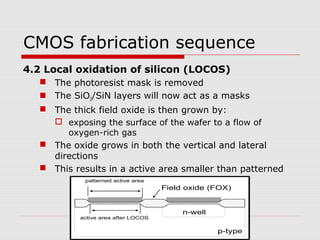
4.2 Local oxidation of silicon (LOCOS)
 The photoresist mask is removed
 The SiO2/SiN layers will now act as a masks
 The thick field oxide is then grown by:
 exposing the surface of the wafer to a flow of
oxygen-rich gas
 The oxide grows in both the vertical and lateral
directions
 This results in a active area smaller than patterned
n-well
p-type
Field oxide (FOX)
patterned active area
active area after LOCOS
CMOS fabrication sequence
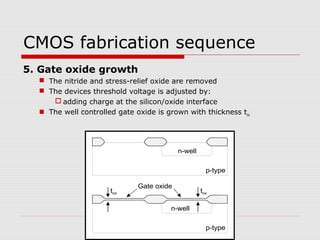
5. Gate oxide growth
 The nitride and stress-relief oxide are removed
 The devices threshold voltage is adjusted by:
 adding charge at the silicon/oxide interface
 The well controlled gate oxide is grown with thickness tox
n-well
p-type
n-well
p-type
tox tox
Gate oxide
CMOS fabrication sequence
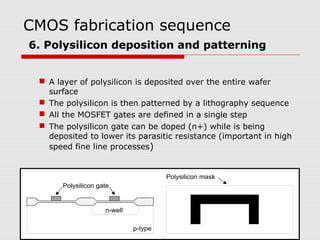
6. Polysilicon deposition and patterning
 A layer of polysilicon is deposited over the entire wafer
surface
 The polysilicon is then patterned by a lithography sequence
 All the MOSFET gates are defined in a single step
 The polysilicon gate can be doped (n+) while is being
deposited to lower its parasitic resistance (important in high
speed fine line processes)
n-well
p-type
Polysilicon gate
Polysilicon mask
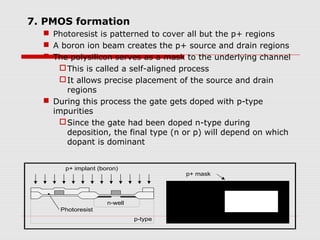
7. PMOS formation
 Photoresist is patterned to cover all but the p+ regions
 A boron ion beam creates the p+ source and drain regions
 The polysilicon serves as a mask to the underlying channel
This is called a self-aligned process
It allows precise placement of the source and drain
regions
 During this process the gate gets doped with p-type
impurities
Since the gate had been doped n-type during
deposition, the final type (n or p) will depend on which
dopant is dominant
n-well
p-type
p+ implant (boron)
p+ mask
Photoresist
CMOS fabrication sequence
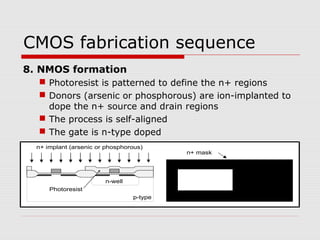
8. NMOS formation
 Photoresist is patterned to define the n+ regions
 Donors (arsenic or phosphorous) are ion-implanted to
dope the n+ source and drain regions
 The process is self-aligned
 The gate is n-type doped
n-well
p-type
n+ implant (arsenic or phosphorous)
n+ mask
Photoresist
CMOS fabrication sequence
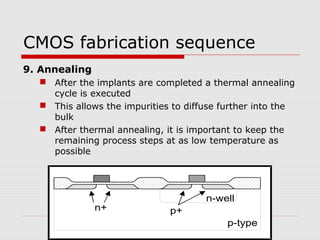
9. Annealing
 After the implants are completed a thermal annealing
cycle is executed
 This allows the impurities to diffuse further into the
bulk
 After thermal annealing, it is important to keep the
remaining process steps at as low temperature as
possible
n-well
p-type
n+ p+
CMOS fabrication sequence
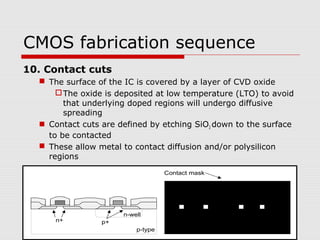
10. Contact cuts
 The surface of the IC is covered by a layer of CVD oxide
The oxide is deposited at low temperature (LTO) to avoid
that underlying doped regions will undergo diffusive
spreading
 Contact cuts are defined by etching SiO2 down to the surface
to be contacted
 These allow metal to contact diffusion and/or polysilicon
regions
n-well
p-type
n+ p+
Contact mask
CMOS fabrication sequence
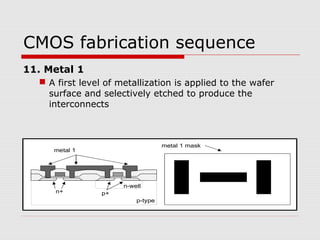
11. Metal 1
 A first level of metallization is applied to the wafer
surface and selectively etched to produce the
interconnects
n-well
p-type
n+ p+
metal 1 mask
metal 1
CMOS fabrication sequence
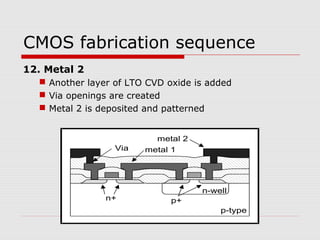
12. Metal 2
 Another layer of LTO CVD oxide is added
 Via openings are created
 Metal 2 is deposited and patterned
n-well
p-type
n+ p+
Via metal 1
metal 2
CMOS fabrication sequence
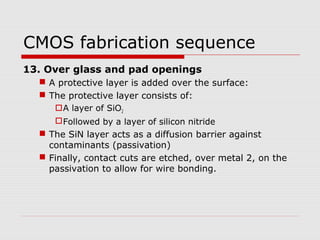
13. Over glass and pad openings
 A protective layer is added over the surface:
 The protective layer consists of:
A layer of SiO2
Followed by a layer of silicon nitride
 The SiN layer acts as a diffusion barrier against
contaminants (passivation)
 Finally, contact cuts are etched, over metal 2, on the
passivation to allow for wire bonding.
Other processes
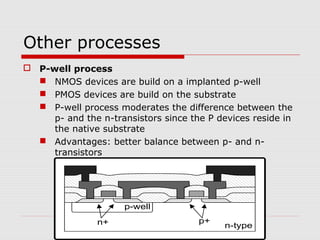
 P-well process
 NMOS devices are build on a implanted p-well
 PMOS devices are build on the substrate
 P-well process moderates the difference between the
p- and the n-transistors since the P devices reside in
the native substrate
 Advantages: better balance between p- and n-
transistors
p-well
n-typen+ p+
Other processes
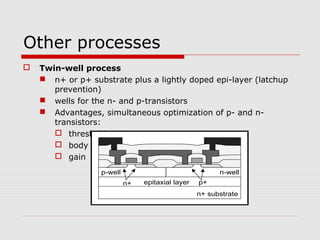
 Twin-well process
 n+ or p+ substrate plus a lightly doped epi-layer (latchup
prevention)
 wells for the n- and p-transistors
 Advantages, simultaneous optimization of p- and n-
transistors:
 threshold voltages
 body effect
 gain
p-well
n+ substrate
n+ p+
n-well
epitaxial layer

Vlsi 2

  • 1.
    CMOS Fabrication 1.Introduction-Trends 2.Fabrication Process-Basic steps 3.NMOS Fabrication 4.N-well Process 5.P-well Process 6.Twin-tub Process 7.Latch Up Problem
  • 2.
    Introduction- Trends  1.DeviceScale Down- 4 Generations of IC technology 1. Micron – 1um/2um year 1983-1986 (Intel 80286) 2. Submicron - < .8um year 1989-1995 (Intel 80386) 3. Deep Submicron - <.3um year 1995-2002 ( Pentium) 4. Ultra Deep Submicron - < .1um(100nm) year 2002-2007 (Pentium IV)
  • 3.
    Evolution in theTechnology Lithogr -aphy year Metal Layers Core Supply IO pads 1.2um 1986 2 5.0 250 0.7um 1988 2 5.0 350 0.5um 1992 3 3.3 600 0.18um 1998 6 1.8 1500 90nm 2003 6-10 1.0 2000 65nm 2005 6-12 0.8 3000
  • 4.
    Improvements of IncreasedDensity  Reduction in Si area reduces the parasitic capacitance of junctions and interconnects thus increasing the switching speed  The shorter dimension of device itself speeds up switching thus further increasing clock frequency
  • 5.
    2.Increasing of speedin digital circuits  GaAs may ultimately supplant Si for high frequency requirements 3. Increasing Complexity of Circuits 4. Ever-growing dependence on EDA/CAD tools
  • 6.
    A typical ICdesign cycle involves several steps:  Feasibility study and die size estimate  Functional verification  Circuit design  Circuit simulation  Floorplanning  Design review  Layout  Layout verification  Layout review  Design For Test and Automatic test pattern generation  Design for manufacturability (IC)  Tapeout - Mask data preparation  Wafer fabrication  Die test  Packaging  Device characterization  Datasheet generation
  • 7.
    Fabrication Process-Basic steps Fabrication process, circuit design process and performance of the resulting chip strongly depend on each other  Circuit designer should have a clear understanding of various masks
  • 9.
     Masks –Each processing step requires certain areas to be defined on the chip by masks  Lithography – The process used to transfer a pattern to a layer on the chip  Wells – To accommodate both nmos & pmos devices, special regions called wells or tubs are created
  • 10.
    Characteristics of CMOSfamily  High Noise immunity  Low static Power  High Packaging density
  • 11.
  • 12.
    CMOS fabrication sequence 0.Start:  For an n-well process the starting point is a p-type silicon wafer:  wafer: typically 75 to 230mm in diameter and less than 1mm thick 1. Epitaxial growth:  A single p-type single crystal film is grown on the surface of the wafer by: subjecting the wafer to high temperature and a source of dopant material  The epi layer is used as the base layer to build the devices P+ -type wafer p-epitaxial layer Diameter = 75 to 230mm < 1mm
  • 13.
    CMOS fabrication sequence 2.N-well Formation:  PMOS transistors are fabricated in n-well regions  The first mask defines the n-well regions  N-well’s are formed by ion implantation or deposition and diffusion  Ion implantation results in shallower wells compatible with today’s fine-line processes p-type epitaxial layer n-well Lateral diffusion Physical structure cross section Mask (top view) n-well mask
  • 14.
    CMOS fabrication sequence 3.Active area definition:  Active area: planar section of the surface where transistors are build defines the gate region (thin oxide) defines the n+ or p+ regions  A thin layer of SiO2 is grown over the active region and covered with silicon nitride n-well Silicon NitrideStress-relief oxide p-type Active mask
  • 15.
    CMOS fabrication sequence 4.Isolation:  Parasitic (unwanted) FET’s exist between unrelated transistors (Field Oxide FET’s)  Source and drains are existing source and drains of wanted devices  Gates are metal and polysilicon interconnects  The threshold voltage of FOX FET’s are higher than for normal FET’s p-substrate (bulk) n+ n+ Parasitic FOX device n+ n+
  • 16.
    CMOS fabrication sequence FOX FET’s threshold is made high by:  introducing a channel-stop diffusion that raises the impurity concentration in the substrate in areas where transistors are not required  making the FOX thick 4.1 Channel-stop implant  The silicon nitride (over n-active) and the photoresist (over n-well) act as masks for the channel-stop implant n-well p-type channel stop mask = ~(n-well mask) resit Implant (Boron) p+ channel-stop implant
  • 17.
    CMOS fabrication sequence 4.2Local oxidation of silicon (LOCOS)  The photoresist mask is removed  The SiO2/SiN layers will now act as a masks  The thick field oxide is then grown by:  exposing the surface of the wafer to a flow of oxygen-rich gas  The oxide grows in both the vertical and lateral directions  This results in a active area smaller than patterned n-well p-type Field oxide (FOX) patterned active area active area after LOCOS
  • 18.
    CMOS fabrication sequence 5.Gate oxide growth  The nitride and stress-relief oxide are removed  The devices threshold voltage is adjusted by:  adding charge at the silicon/oxide interface  The well controlled gate oxide is grown with thickness tox n-well p-type n-well p-type tox tox Gate oxide
  • 19.
    CMOS fabrication sequence 6.Polysilicon deposition and patterning  A layer of polysilicon is deposited over the entire wafer surface  The polysilicon is then patterned by a lithography sequence  All the MOSFET gates are defined in a single step  The polysilicon gate can be doped (n+) while is being deposited to lower its parasitic resistance (important in high speed fine line processes) n-well p-type Polysilicon gate Polysilicon mask
  • 20.
    7. PMOS formation Photoresist is patterned to cover all but the p+ regions  A boron ion beam creates the p+ source and drain regions  The polysilicon serves as a mask to the underlying channel This is called a self-aligned process It allows precise placement of the source and drain regions  During this process the gate gets doped with p-type impurities Since the gate had been doped n-type during deposition, the final type (n or p) will depend on which dopant is dominant n-well p-type p+ implant (boron) p+ mask Photoresist
  • 21.
    CMOS fabrication sequence 8.NMOS formation  Photoresist is patterned to define the n+ regions  Donors (arsenic or phosphorous) are ion-implanted to dope the n+ source and drain regions  The process is self-aligned  The gate is n-type doped n-well p-type n+ implant (arsenic or phosphorous) n+ mask Photoresist
  • 22.
    CMOS fabrication sequence 9.Annealing  After the implants are completed a thermal annealing cycle is executed  This allows the impurities to diffuse further into the bulk  After thermal annealing, it is important to keep the remaining process steps at as low temperature as possible n-well p-type n+ p+
  • 23.
    CMOS fabrication sequence 10.Contact cuts  The surface of the IC is covered by a layer of CVD oxide The oxide is deposited at low temperature (LTO) to avoid that underlying doped regions will undergo diffusive spreading  Contact cuts are defined by etching SiO2 down to the surface to be contacted  These allow metal to contact diffusion and/or polysilicon regions n-well p-type n+ p+ Contact mask
  • 24.
    CMOS fabrication sequence 11.Metal 1  A first level of metallization is applied to the wafer surface and selectively etched to produce the interconnects n-well p-type n+ p+ metal 1 mask metal 1
  • 25.
    CMOS fabrication sequence 12.Metal 2  Another layer of LTO CVD oxide is added  Via openings are created  Metal 2 is deposited and patterned n-well p-type n+ p+ Via metal 1 metal 2
  • 26.
    CMOS fabrication sequence 13.Over glass and pad openings  A protective layer is added over the surface:  The protective layer consists of: A layer of SiO2 Followed by a layer of silicon nitride  The SiN layer acts as a diffusion barrier against contaminants (passivation)  Finally, contact cuts are etched, over metal 2, on the passivation to allow for wire bonding.
  • 27.
    Other processes  P-wellprocess  NMOS devices are build on a implanted p-well  PMOS devices are build on the substrate  P-well process moderates the difference between the p- and the n-transistors since the P devices reside in the native substrate  Advantages: better balance between p- and n- transistors p-well n-typen+ p+
  • 28.
    Other processes  Twin-wellprocess  n+ or p+ substrate plus a lightly doped epi-layer (latchup prevention)  wells for the n- and p-transistors  Advantages, simultaneous optimization of p- and n- transistors:  threshold voltages  body effect  gain p-well n+ substrate n+ p+ n-well epitaxial layer