ORGANIZATION AND
ORGANIZING
CHAPTER-3
AUTHORS:
DR. KIRAN NERKAR
DR. VILAS CHOPDE
 An organization comes into existence when there are a
number of persons in communication and relationship to each
other and are willing to contribute to a common endeavor.
---Barnard
 A social relationship which is either closed or limits the
admission of outsiders by rules, will be called a 'corporate
group' (Verband) so far as its order is enforced by the action
of specific individuals whose regular function this is, of a
chief or 'head' (Leiter) and usually also an administrative
staff. These functionaries will normally also have
representative authorities. --- Weber
DEFINE ORGANIZATION
© 2011, Dreamtech Press :: Chapter 3 2
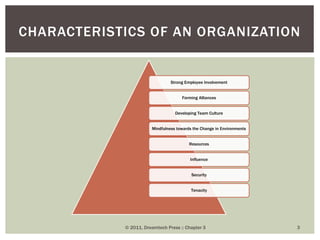
Strong Employee Involvement
Forming Alliances
Developing Team Culture
Mindfulness towards the Change in Environments
Resources
Influence
Security
Tenacity
© 2011, Dreamtech Press :: Chapter 3 3
CHARACTERISTICS OF AN ORGANIZATION
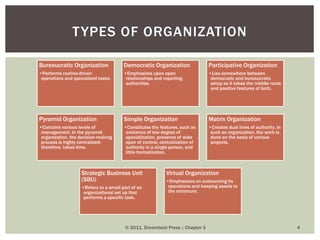
Bureaucratic Organization
•Performs routine-driven
operations and specialized tasks.
Democratic Organization
•Emphasizes upon open
relationships and reporting
authorities.
Participative Organization
•Lies somewhere between
democratic and bureaucratic
setup as it takes the middle route
and positive features of both.
Pyramid Organization
•Contains various levels of
management. In the pyramid
organization, the decision-making
process is highly centralized;
therefore, takes time.
Simple Organization
•Constitutes the features, such as
existence of low degree of
specialization, presence of wide
span of control, centralization of
authority in a single person, and
little formalization.
Matrix Organization
•Creates dual lines of authority. In
such an organization, the work is
done on the basis of various
projects.
Strategic Business Unit
(SBU)
•Refers to a small part of an
organizational set up that
performs a specific task.
Virtual Organization
•Emphasizes on outsourcing its
operations and keeping assets to
the minimum.
© 2011, Dreamtech Press :: Chapter 3 4
TYPES OF ORGANIZATION
© 2011, Dreamtech Press :: Chapter 3 5
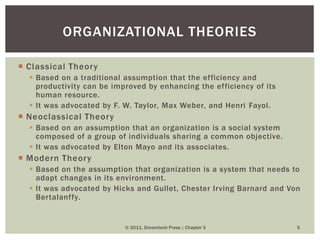
ORGANIZATIONAL THEORIES
 Classical Theory
 Based on a traditional assumption that the efficiency and
productivity can be improved by enhancing the efficiency of its
human resource.
 It was advocated by F. W. Taylor, Max Weber, and Henri Fayol.
 Neoclassical Theory
 Based on an assumption that an organization is a social system
composed of a group of individuals sharing a common objective.
 It was advocated by Elton Mayo and its associates.
 Modern Theory
 Based on the assumption that organization is a system that needs to
adapt changes in its environment.
 It was advocated by Hicks and Gullet, Chester Irving Barnard and Von
Bertalanffy.
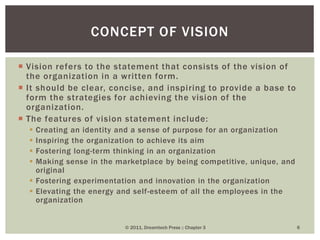
 Vision refers to the statement that consists of the vision of
the organization in a written form.
 It should be clear, concise, and inspiring to provide a base to
form the strategies for achieving the vision of the
organization.
 The features of vision statement include:
 Creating an identity and a sense of purpose for an organization
 Inspiring the organization to achieve its aim
 Fostering long-term thinking in an organization
 Making sense in the marketplace by being competitive, unique, and
original
 Fostering experimentation and innovation in the organization
 Elevating the energy and self-esteem of all the employees in the
organization
© 2011, Dreamtech Press :: Chapter 3 6
CONCEPT OF VISION
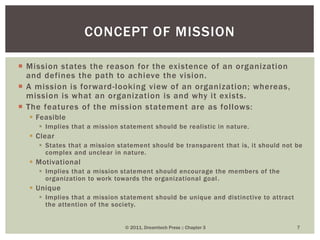
 Mission states the reason for the existence of an organization
and defines the path to achieve the vision.
 A mission is forward-looking view of an organization; whereas,
mission is what an organization is and why it exists.
 The features of the mission statement are as follows:
 Feasible
 Implies that a mission statement should be realistic in nature.
 Clear
 States that a mission statement should be transparent that is, it should not be
complex and unclear in nature.
 Motivational
 Implies that a mission statement should encourage the members of the
organization to work towards the organizational goal.
 Unique
 Implies that a mission statement should be unique and distinctive to attract
the attention of the society.
© 2011, Dreamtech Press :: Chapter 3 7
CONCEPT OF MISSION
 Understandable
 Implies that objectives should have clarity and use simple language.
 Specific time-horizon
 Refers that objectives should be designed in a particular time frame.
 Set within the constraints
 Mean that an organization faces various constraints internally, such
as scarcity of resources and externally, such as legal restrictions.
 Measurable and controllable
 Implies that an objective should be quantifiable in nature.
 Form a hierarchy
 Refers that an objective should begin with the vision and mission,
and end with the key goals.
© 2011, Dreamtech Press :: Chapter 3 8
FEATURES OF ORGANIZATIONAL
OBJECTIVES
 Refers to a process of setting the discrete and specific goals
for the entire organization.
 The features of MBO are given as follows:
 Emphasizes participation in setting definite and measurable goals
 Lays emphasis on what is to be accomplished rather than how it is to
be accomplished
 Provides systematic and rational approach to management and helps
in crisis management
 Concentrates on key result areas
© 2011, Dreamtech Press :: Chapter 3 9
MANAGEMENT BY OBJECTIVES (MBO)
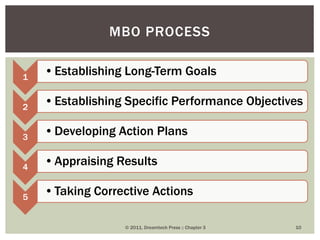
1
•Establishing Long-Term Goals
2
•Establishing Specific Performance Objectives
3
•Developing Action Plans
4
•Appraising Results
5
•Taking Corrective Actions
© 2011, Dreamtech Press :: Chapter 3 10
MBO PROCESS
 Organizing is one of the basic managerial functions preceded
by the planning function of the management.
 Once the planning is done, managers are required to establish
a suitable organizational structure and organize resources to
implement the planning effectively.
 Organizing function of managers involves creating an
organizational structure and organizing resources for various
activities.
© 2011, Dreamtech Press :: Chapter 3 11
ORGANIZING FUNCTION OF MANAGEMENT
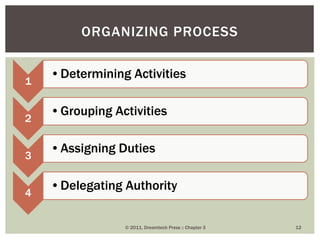
1
•Determining Activities
2
•Grouping Activities
3
•Assigning Duties
4
•Delegating Authority
© 2011, Dreamtech Press :: Chapter 3 12
ORGANIZING PROCESS
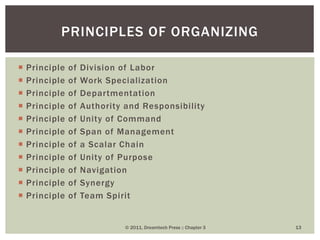
 Principle of Division of Labor
 Principle of Work Specialization
 Principle of Departmentation
 Principle of Authority and Responsibility
 Principle of Unity of Command
 Principle of Span of Management
 Principle of a Scalar Chain
 Principle of Unity of Purpose
 Principle of Navigation
 Principle of Synergy
 Principle of Team Spirit
© 2011, Dreamtech Press :: Chapter 3 13
PRINCIPLES OF ORGANIZING
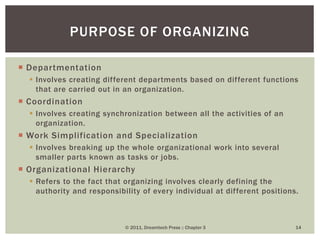
 Departmentation
 Involves creating different departments based on different functions
that are carried out in an organization.
 Coordination
 Involves creating synchronization between all the activities of an
organization.
 Work Simplification and Specialization
 Involves breaking up the whole organizational work into several
smaller parts known as tasks or jobs.
 Organizational Hierarchy
 Refers to the fact that organizing involves clearly defining the
authority and responsibility of every individual at different positions.
© 2011, Dreamtech Press :: Chapter 3 14
PURPOSE OF ORGANIZING
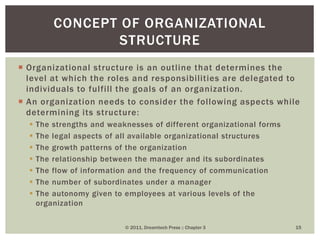
 Organizational structure is an outline that determines the
level at which the roles and responsibilities are delegated to
individuals to fulfill the goals of an organization.
 An organization needs to consider the following aspects while
determining its structure:
 The strengths and weaknesses of different organizational forms
 The legal aspects of all available organizational structures
 The growth patterns of the organization
 The relationship between the manager and its subordinates
 The flow of information and the frequency of communication
 The number of subordinates under a manager
 The autonomy given to employees at various levels of the
organization
© 2011, Dreamtech Press :: Chapter 3 15
CONCEPT OF ORGANIZATIONAL
STRUCTURE
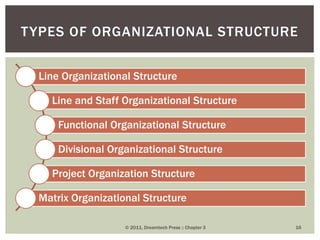
Line Organizational Structure
Line and Staff Organizational Structure
Functional Organizational Structure
Divisional Organizational Structure
Project Organization Structure
Matrix Organizational Structure
© 2011, Dreamtech Press :: Chapter 3 16
TYPES OF ORGANIZATIONAL STRUCTURE
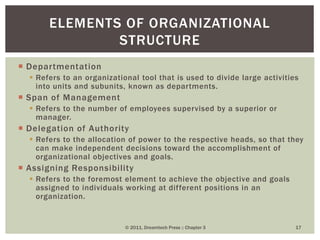
 Departmentation
 Refers to an organizational tool that is used to divide large activities
into units and subunits, known as departments.
 Span of Management
 Refers to the number of employees supervised by a superior or
manager.
 Delegation of Authority
 Refers to the allocation of power to the respective heads, so that they
can make independent decisions toward the accomplishment of
organizational objectives and goals.
 Assigning Responsibility
 Refers to the foremost element to achieve the objective and goals
assigned to individuals working at different positions in an
organization.
© 2011, Dreamtech Press :: Chapter 3 17
ELEMENTS OF ORGANIZATIONAL
STRUCTURE
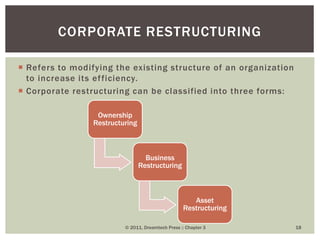
 Refers to modifying the existing structure of an organization
to increase its efficiency.
 Corporate restructuring can be classified into three forms:
© 2011, Dreamtech Press :: Chapter 3 18
CORPORATE RESTRUCTURING
Ownership
Restructuring
Business
Restructuring
Asset
Restructuring
 Staffing aims at managing the organization structure
effectively by selecting efficient employees and developing
them.
 The main objectives of the staffing function of an
organization:
 Filling vacant positions
 Developing employee competencies
 Retaining employees
© 2011, Dreamtech Press :: Chapter 3 19
STAFFING
 The vision statement of an organization describes the
objectives that an organization aspires to achieve in the
future.
 The mission statement defines the means to achieve the
vision.
 The organizing function of management is mainly concerned
with the proper delegation of roles and responsibilities among
individuals.
 It is necessary for the organization to have an efficient
structure to accomplish its goals and objectives successfully.
© 2011, Dreamtech Press :: Chapter 3 20
RECAP

Chapter 03 organization and organizing

  • 1.
  • 2.
     An organizationcomes into existence when there are a number of persons in communication and relationship to each other and are willing to contribute to a common endeavor. ---Barnard  A social relationship which is either closed or limits the admission of outsiders by rules, will be called a 'corporate group' (Verband) so far as its order is enforced by the action of specific individuals whose regular function this is, of a chief or 'head' (Leiter) and usually also an administrative staff. These functionaries will normally also have representative authorities. --- Weber DEFINE ORGANIZATION © 2011, Dreamtech Press :: Chapter 3 2
  • 3.
    Strong Employee Involvement FormingAlliances Developing Team Culture Mindfulness towards the Change in Environments Resources Influence Security Tenacity © 2011, Dreamtech Press :: Chapter 3 3 CHARACTERISTICS OF AN ORGANIZATION
  • 4.
    Bureaucratic Organization •Performs routine-driven operationsand specialized tasks. Democratic Organization •Emphasizes upon open relationships and reporting authorities. Participative Organization •Lies somewhere between democratic and bureaucratic setup as it takes the middle route and positive features of both. Pyramid Organization •Contains various levels of management. In the pyramid organization, the decision-making process is highly centralized; therefore, takes time. Simple Organization •Constitutes the features, such as existence of low degree of specialization, presence of wide span of control, centralization of authority in a single person, and little formalization. Matrix Organization •Creates dual lines of authority. In such an organization, the work is done on the basis of various projects. Strategic Business Unit (SBU) •Refers to a small part of an organizational set up that performs a specific task. Virtual Organization •Emphasizes on outsourcing its operations and keeping assets to the minimum. © 2011, Dreamtech Press :: Chapter 3 4 TYPES OF ORGANIZATION
  • 5.
    © 2011, DreamtechPress :: Chapter 3 5 ORGANIZATIONAL THEORIES  Classical Theory  Based on a traditional assumption that the efficiency and productivity can be improved by enhancing the efficiency of its human resource.  It was advocated by F. W. Taylor, Max Weber, and Henri Fayol.  Neoclassical Theory  Based on an assumption that an organization is a social system composed of a group of individuals sharing a common objective.  It was advocated by Elton Mayo and its associates.  Modern Theory  Based on the assumption that organization is a system that needs to adapt changes in its environment.  It was advocated by Hicks and Gullet, Chester Irving Barnard and Von Bertalanffy.
  • 6.
     Vision refersto the statement that consists of the vision of the organization in a written form.  It should be clear, concise, and inspiring to provide a base to form the strategies for achieving the vision of the organization.  The features of vision statement include:  Creating an identity and a sense of purpose for an organization  Inspiring the organization to achieve its aim  Fostering long-term thinking in an organization  Making sense in the marketplace by being competitive, unique, and original  Fostering experimentation and innovation in the organization  Elevating the energy and self-esteem of all the employees in the organization © 2011, Dreamtech Press :: Chapter 3 6 CONCEPT OF VISION
  • 7.
     Mission statesthe reason for the existence of an organization and defines the path to achieve the vision.  A mission is forward-looking view of an organization; whereas, mission is what an organization is and why it exists.  The features of the mission statement are as follows:  Feasible  Implies that a mission statement should be realistic in nature.  Clear  States that a mission statement should be transparent that is, it should not be complex and unclear in nature.  Motivational  Implies that a mission statement should encourage the members of the organization to work towards the organizational goal.  Unique  Implies that a mission statement should be unique and distinctive to attract the attention of the society. © 2011, Dreamtech Press :: Chapter 3 7 CONCEPT OF MISSION
  • 8.
     Understandable  Impliesthat objectives should have clarity and use simple language.  Specific time-horizon  Refers that objectives should be designed in a particular time frame.  Set within the constraints  Mean that an organization faces various constraints internally, such as scarcity of resources and externally, such as legal restrictions.  Measurable and controllable  Implies that an objective should be quantifiable in nature.  Form a hierarchy  Refers that an objective should begin with the vision and mission, and end with the key goals. © 2011, Dreamtech Press :: Chapter 3 8 FEATURES OF ORGANIZATIONAL OBJECTIVES
  • 9.
     Refers toa process of setting the discrete and specific goals for the entire organization.  The features of MBO are given as follows:  Emphasizes participation in setting definite and measurable goals  Lays emphasis on what is to be accomplished rather than how it is to be accomplished  Provides systematic and rational approach to management and helps in crisis management  Concentrates on key result areas © 2011, Dreamtech Press :: Chapter 3 9 MANAGEMENT BY OBJECTIVES (MBO)
  • 10.
    1 •Establishing Long-Term Goals 2 •EstablishingSpecific Performance Objectives 3 •Developing Action Plans 4 •Appraising Results 5 •Taking Corrective Actions © 2011, Dreamtech Press :: Chapter 3 10 MBO PROCESS
  • 11.
     Organizing isone of the basic managerial functions preceded by the planning function of the management.  Once the planning is done, managers are required to establish a suitable organizational structure and organize resources to implement the planning effectively.  Organizing function of managers involves creating an organizational structure and organizing resources for various activities. © 2011, Dreamtech Press :: Chapter 3 11 ORGANIZING FUNCTION OF MANAGEMENT
  • 12.
    1 •Determining Activities 2 •Grouping Activities 3 •AssigningDuties 4 •Delegating Authority © 2011, Dreamtech Press :: Chapter 3 12 ORGANIZING PROCESS
  • 13.
     Principle ofDivision of Labor  Principle of Work Specialization  Principle of Departmentation  Principle of Authority and Responsibility  Principle of Unity of Command  Principle of Span of Management  Principle of a Scalar Chain  Principle of Unity of Purpose  Principle of Navigation  Principle of Synergy  Principle of Team Spirit © 2011, Dreamtech Press :: Chapter 3 13 PRINCIPLES OF ORGANIZING
  • 14.
     Departmentation  Involvescreating different departments based on different functions that are carried out in an organization.  Coordination  Involves creating synchronization between all the activities of an organization.  Work Simplification and Specialization  Involves breaking up the whole organizational work into several smaller parts known as tasks or jobs.  Organizational Hierarchy  Refers to the fact that organizing involves clearly defining the authority and responsibility of every individual at different positions. © 2011, Dreamtech Press :: Chapter 3 14 PURPOSE OF ORGANIZING
  • 15.
     Organizational structureis an outline that determines the level at which the roles and responsibilities are delegated to individuals to fulfill the goals of an organization.  An organization needs to consider the following aspects while determining its structure:  The strengths and weaknesses of different organizational forms  The legal aspects of all available organizational structures  The growth patterns of the organization  The relationship between the manager and its subordinates  The flow of information and the frequency of communication  The number of subordinates under a manager  The autonomy given to employees at various levels of the organization © 2011, Dreamtech Press :: Chapter 3 15 CONCEPT OF ORGANIZATIONAL STRUCTURE
  • 16.
    Line Organizational Structure Lineand Staff Organizational Structure Functional Organizational Structure Divisional Organizational Structure Project Organization Structure Matrix Organizational Structure © 2011, Dreamtech Press :: Chapter 3 16 TYPES OF ORGANIZATIONAL STRUCTURE
  • 17.
     Departmentation  Refersto an organizational tool that is used to divide large activities into units and subunits, known as departments.  Span of Management  Refers to the number of employees supervised by a superior or manager.  Delegation of Authority  Refers to the allocation of power to the respective heads, so that they can make independent decisions toward the accomplishment of organizational objectives and goals.  Assigning Responsibility  Refers to the foremost element to achieve the objective and goals assigned to individuals working at different positions in an organization. © 2011, Dreamtech Press :: Chapter 3 17 ELEMENTS OF ORGANIZATIONAL STRUCTURE
  • 18.
     Refers tomodifying the existing structure of an organization to increase its efficiency.  Corporate restructuring can be classified into three forms: © 2011, Dreamtech Press :: Chapter 3 18 CORPORATE RESTRUCTURING Ownership Restructuring Business Restructuring Asset Restructuring
  • 19.
     Staffing aimsat managing the organization structure effectively by selecting efficient employees and developing them.  The main objectives of the staffing function of an organization:  Filling vacant positions  Developing employee competencies  Retaining employees © 2011, Dreamtech Press :: Chapter 3 19 STAFFING
  • 20.
     The visionstatement of an organization describes the objectives that an organization aspires to achieve in the future.  The mission statement defines the means to achieve the vision.  The organizing function of management is mainly concerned with the proper delegation of roles and responsibilities among individuals.  It is necessary for the organization to have an efficient structure to accomplish its goals and objectives successfully. © 2011, Dreamtech Press :: Chapter 3 20 RECAP