Chapter 1
Operational Amplifier and
Application Circuits
Slide 1
• An Operational amplifier ("op-amp") is a DC-coupled high-gain electronic
voltage amplifier with a differential input and, usually, a single-ended
output.
• An op-amp produces an output voltage that is typically hundreds of
thousands times larger than the voltage difference between its input
terminals.
• Operational amplifiers are important building blocks for a wide range of
electronic circuits. They had their origins in analog computers where they
were used in many linear, non-linear and frequency-dependent circuits
(summation, integration, …).
• Op-amps are among the most widely used electronic devices today,
being used in a vast array of consumer, industrial, and scientific devices.
• The op-amp is one type of differential amplifier.
5.1. Introduction
Definition and Notation of Operational Amplifier (op-amp)
Operational Amplifier Slide 3
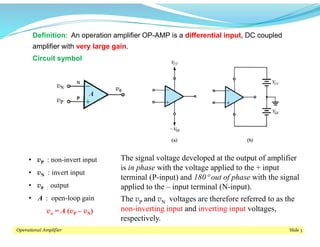
Definition: An operation amplifier OP-AMP is a differential input, DC coupled
amplifier with very large gain.
The signal voltage developed at the output of amplifier
is in phase with the voltage applied to the + input
terminal (P-input) and 180 out of phase with the signal
applied to the – input terminal (N-input).
The vP and vN voltages are therefore referred to as the
non-inverting input and inverting input voltages,
respectively.
• vP : non-invert input
• vN : invert input
• v0 : output
• A : open-loop gain
vo = A (vP – vN)
Circuit symbol
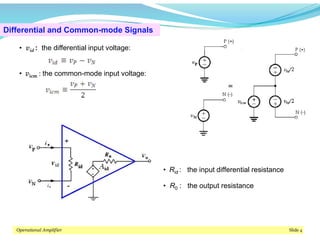
Differential and Common-mode Signals
• Rid : the input differential resistance
• R0 : the output resistance
• vid : the differential input voltage:
• vicm : the common-mode input voltage:
Operational Amplifier Slide 4
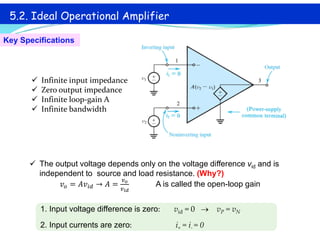
5.2. Ideal Operational Amplifier
1. Input voltage difference is zero: vid = 0  vP = vN
2. Input currents are zero: i+ = i- = 0
Key Specifications
 Infinite input impedance
 Zero output impedance
 Infinite loop-gain A
 Infinite bandwidth
 The output voltage depends only on the voltage difference vid and is
independent to source and load resistance. (Why?)
𝑣 = 𝐴𝑣 → 𝐴 = A is called the open-loop gain
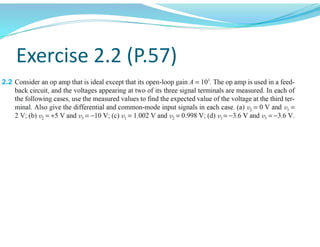
Exercise 2.2 (P.57)
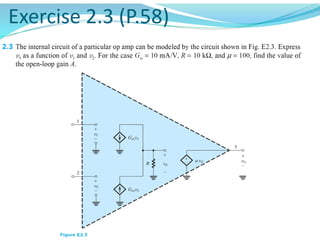
Exercise 2.3 (P.58)
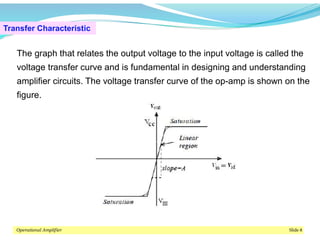
The graph that relates the output voltage to the input voltage is called the
voltage transfer curve and is fundamental in designing and understanding
amplifier circuits. The voltage transfer curve of the op-amp is shown on the
figure.
Transfer Characteristic
Operational Amplifier Slide 8
Operational Amplifier Slide 9
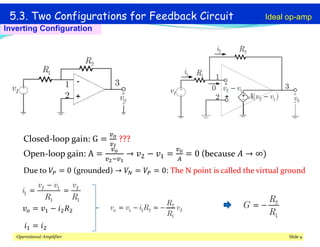
Inverting Configuration
5.3. Two Configurations for Feedback Circuit Ideal op-amp
Closed-loop gain: G = ???
Open-loop gain: A = → 𝑣 − 𝑣 = = 0 (because 𝐴 → ∞)
Due to 𝑉 = 0 (grounded) → 𝑉 = 𝑉 = 0: The N point is called the virtual ground
𝑖 = 𝑖
𝑣 = 𝑣 − 𝑖 𝑅
Inverting Configuration
(A is finite)
A is finite → 𝑉 = −
(If 𝐴 → ∞ then 𝐺 = −𝑅 𝑅
⁄ )
𝑣 − 𝑣 =
𝑣
𝐴
𝑣 = 0
𝑣 = −
𝑣
𝐴
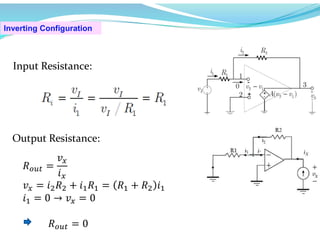
Inverting Configuration
Input Resistance:
Output Resistance:
𝑅 =
𝑣
𝑖
𝑣 = 𝑖 𝑅 + 𝑖 𝑅 = 𝑅 + 𝑅 𝑖
𝑖 = 0 → 𝑣 = 0
𝑅 = 0
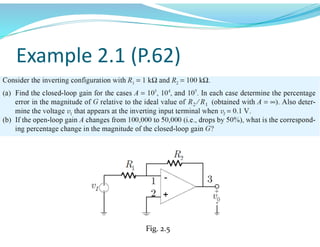
Example 2.1 (P.62)
Fig. 2.5
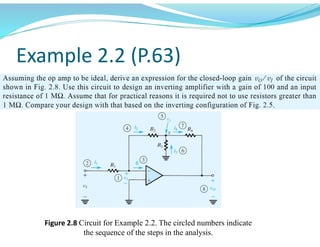
Example 2.2 (P.63)
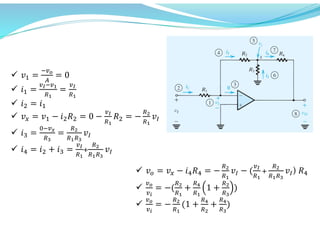
Figure 2.8 Circuit for Example 2.2. The circled numbers indicate
the sequence of the steps in the analysis.
 𝑣 = = 0
 𝑖 = =
 𝑖 = 𝑖
 𝑣 = 𝑣 − 𝑖 𝑅 = 0 − 𝑅 = − 𝑣
 𝑖 = = 𝑣
 𝑖 = 𝑖 + 𝑖 = + 𝑣
 𝑣 = 𝑣 − 𝑖 𝑅 = − 𝑣 − ( + 𝑣 ) 𝑅
 = −( + 1 + )
 = − (1 + + )
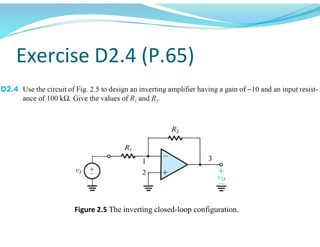
Exercise D2.4 (P.65)
Figure 2.5 The inverting closed-loop configuration.
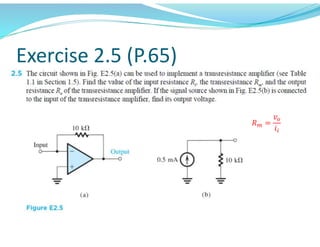
Exercise 2.5 (P.65)
𝑅 =
𝑣
𝑖
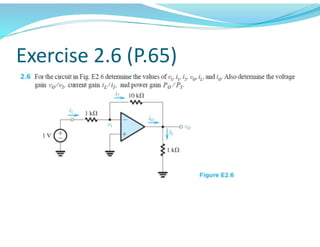
Exercise 2.6 (P.65)
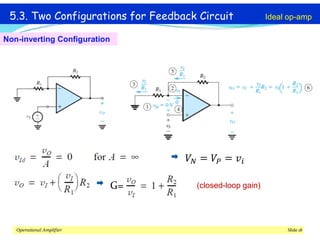
Non-inverting Configuration
5.3. Two Configurations for Feedback Circuit Ideal op-amp
Operational Amplifier Slide 18
(closed-loop gain)
𝑉 = 𝑉 = 𝑣
G=
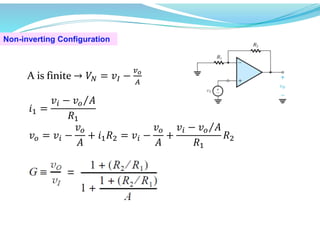
Non-inverting Configuration
A is finite → 𝑉 = 𝑣 −
𝑖 =
𝑣 − 𝑣 𝐴
⁄
𝑅
𝑣 = 𝑣 −
𝑣
𝐴
+ 𝑖 𝑅 = 𝑣 −
𝑣
𝐴
+
𝑣 − 𝑣 𝐴
⁄
𝑅
𝑅
Operational Amplifier Slide 20
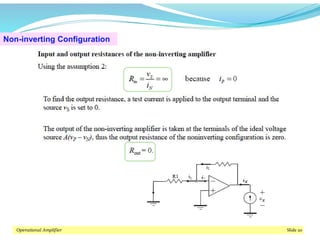
Non-inverting Configuration
Operational Amplifier Slide 21
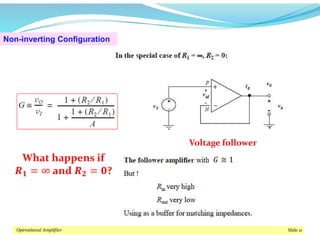
Non-inverting Configuration
𝐺 ≅ 1
Voltage follower
What happens if
𝑹𝟏 = ∞ and 𝑹𝟐 = 𝟎?
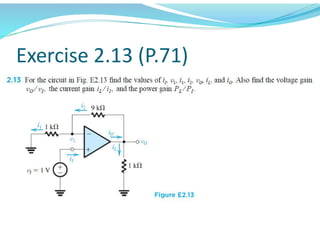
Exercise 2.13 (P.71)
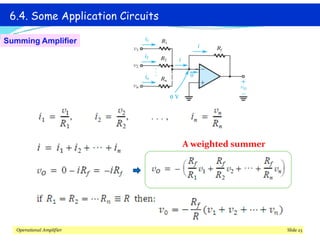
Summing Amplifier
6.4. Some Application Circuits
Operational Amplifier Slide 23
A weighted summer
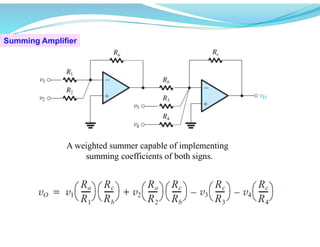
Summing Amplifier
A weighted summer capable of implementing
summing coefficients of both signs.
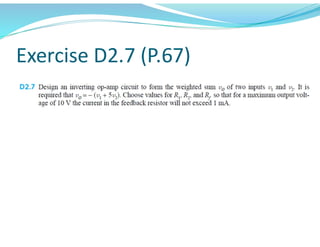
Exercise D2.7 (P.67)
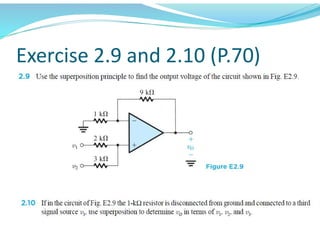
Exercise 2.9 and 2.10 (P.70)
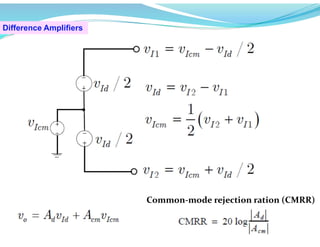
Difference Amplifiers
Common-mode rejection ration (CMRR)
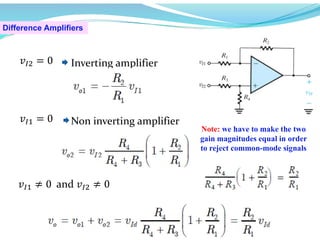
Difference Amplifiers
𝑣 = 0 Inverting amplifier
𝑣 = 0 Non inverting amplifier
𝑣 ≠ 0 and 𝑣 ≠ 0
Note: we have to make the two
gain magnitudes equal in order
to reject common-mode signals
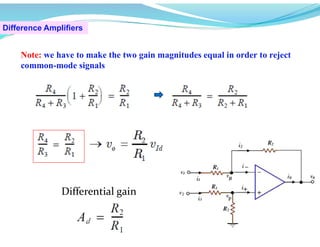
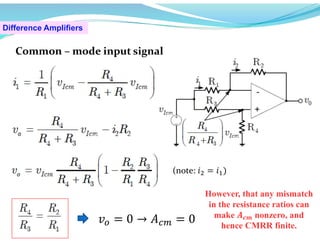
Difference Amplifiers
Note: we have to make the two gain magnitudes equal in order to reject
common-mode signals
Differential gain
Difference Amplifiers
Common – mode input signal
(note: 𝑖 = 𝑖 )
𝑣 = 0 → 𝐴 = 0
However, that any mismatch
in the resistance ratios can
make 𝑨𝒄𝒎 nonzero, and
hence CMRR finite.
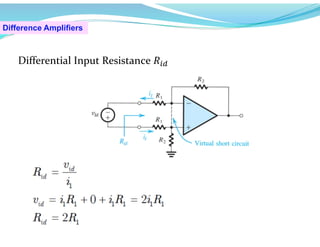
Difference Amplifiers
Differential Input Resistance 𝑅
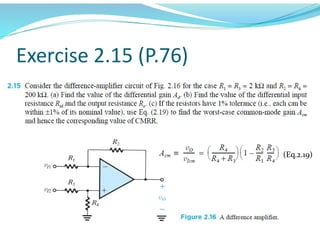
Exercise 2.15 (P.76)
(Eq.2.19)
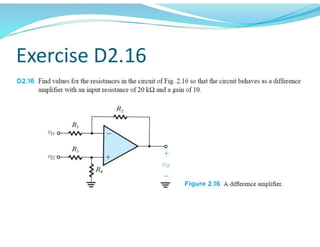
Exercise D2.16
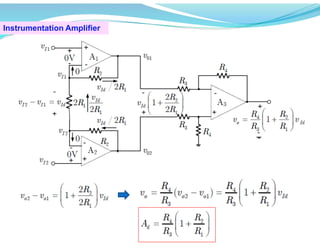
Instrumentation Amplifier
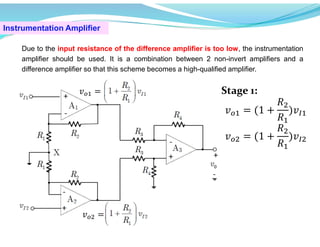
Due to the input resistance of the difference amplifier is too low, the instrumentation
amplifier should be used. It is a combination between 2 non-invert amplifiers and a
difference amplifier so that this scheme becomes a high-qualified amplifier.
𝑣 =
𝑣 =
Stage 1:
𝑣 = (1 +
𝑅
𝑅
)𝑣
𝑣 = (1 +
𝑅
𝑅
)𝑣
Instrumentation Amplifier
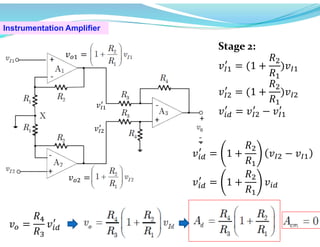
Stage 2:
𝑣 = (1 +
𝑅
𝑅
)𝑣
𝑣 = (1 +
𝑅
𝑅
)𝑣
𝑣 = 𝑣 − 𝑣
𝑣 =
𝑣 =
𝑣
𝑣
𝑣 = 1 +
𝑅
𝑅
𝑣 − 𝑣
𝑣 = 1 +
𝑅
𝑅
𝑣
𝑣 =
𝑅
𝑅
𝑣
Instrumentation Amplifier
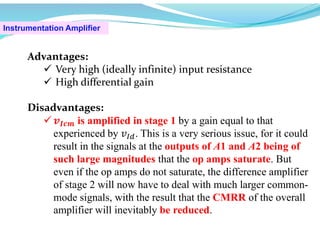
Advantages:
 Very high (ideally infinite) input resistance
 High differential gain
Disadvantages:
 𝒗𝑰𝒄𝒎 is amplified in stage 1 by a gain equal to that
experienced by 𝑣 . This is a very serious issue, for it could
result in the signals at the outputs of A1 and A2 being of
such large magnitudes that the op amps saturate. But
even if the op amps do not saturate, the difference amplifier
of stage 2 will now have to deal with much larger common-
mode signals, with the result that the CMRR of the overall
amplifier will inevitably be reduced.
Instrumentation Amplifier
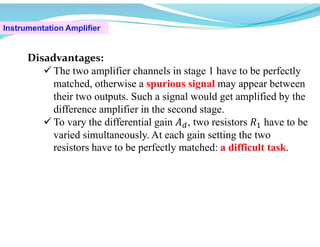
Disadvantages:
 The two amplifier channels in stage 1 have to be perfectly
matched, otherwise a spurious signal may appear between
their two outputs. Such a signal would get amplified by the
difference amplifier in the second stage.
 To vary the differential gain 𝐴 , two resistors 𝑅 have to be
varied simultaneously. At each gain setting the two
resistors have to be perfectly matched: a difficult task.
Instrumentation Amplifier
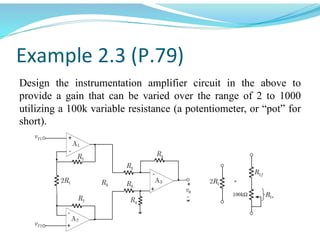
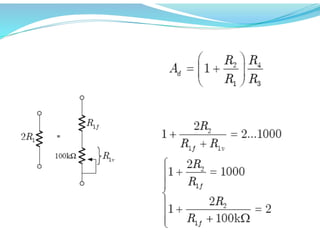
Example 2.3 (P.79)
Design the instrumentation amplifier circuit in the above to
provide a gain that can be varied over the range of 2 to 1000
utilizing a 100kvariable resistance (a potentiometer, or “pot” for
short).
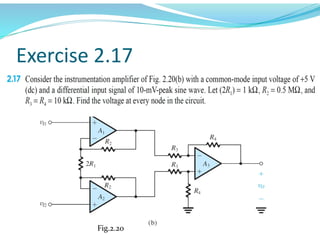
Exercise 2.17
Fig.2.20
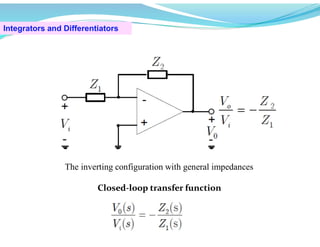
Integrators and Differentiators
The inverting configuration with general impedances
Closed-loop transfer function
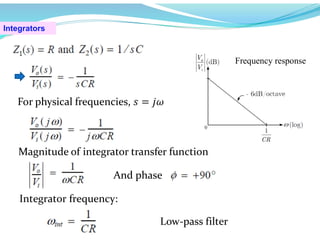
Integrators
Operational Amplifier Slide 43
Miller or Inverting Integrator
𝑖 (𝑡) flows through the capacitor C,
causing charge to accumulate on C
equal to∫ 𝑖 (𝑡) 𝑑𝑡.
Capacitor voltage 𝑣 (𝑡) charges
by ∫ 𝑖 𝑡 𝑑𝑡.
where 𝑉 is initial voltage on C
Output voltage
Integrators
For physical frequencies, 𝑠 = 𝑗𝜔
And phase
Integrator frequency:
Frequency response
Magnitude of integrator transfer function
Low-pass filter
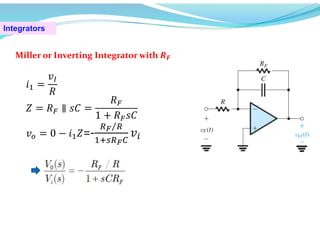
Integrators
Miller or Inverting Integrator with 𝑹𝑭
𝑖 =
𝑣
𝑅
𝑍 = 𝑅 ∥ 𝑠𝐶 =
𝑅
1 + 𝑅 𝑠𝐶
𝑣 = 0 − 𝑖 𝑍=-
⁄
𝑣
Example 2.5 (P.85)
Find the output produced by a Miller integrator in response to an
input pulse of 1-V height and 1-ms width [below figure]. Let
R10kand C 10nF. The op amp is specified to saturate at
± 13𝑉.
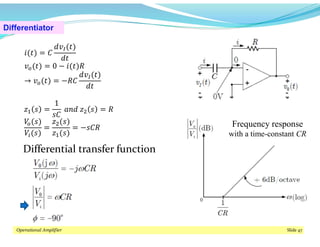
Differentiator
Operational Amplifier Slide 47
𝑖(𝑡) = 𝐶
𝑑𝑣 (𝑡)
𝑑𝑡
𝑣 (𝑡) = 0 − 𝑖(𝑡)𝑅
→ 𝑣 (𝑡) = −𝑅𝐶
𝑑𝑣 (𝑡)
𝑑𝑡
𝑧 𝑠 =
1
𝑠𝐶
𝑎𝑛𝑑 𝑧 𝑠 = 𝑅
𝑉 (𝑠)
𝑉 (𝑠)
=
𝑧 (𝑠)
𝑧 (𝑠)
= −𝑠𝐶𝑅
Differential transfer function
Frequency response
with a time-constant CR
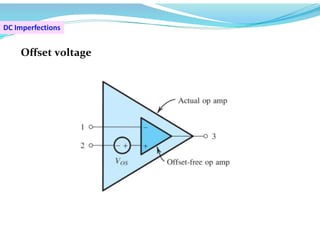
DC Imperfections
Offset voltage
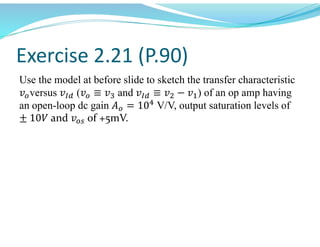
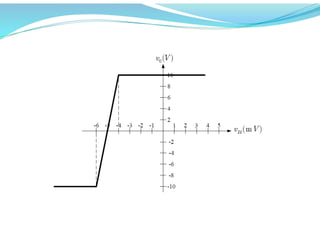
Exercise 2.21 (P.90)
Use the model at before slide to sketch the transfer characteristic
𝑣 versus 𝑣 (𝑣 ≡ 𝑣 and 𝑣 ≡ 𝑣 − 𝑣 of an op amp having
an open-loop dc gain 𝐴 = 10 V/V, output saturation levels of
± 10𝑉 and 𝑣 of +5mV.
DC Imperfections
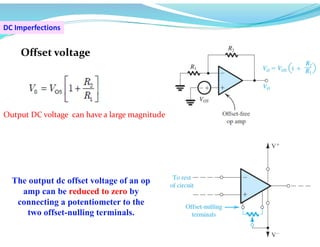
Offset voltage
Output DC voltage can have a large magnitude
The output dc offset voltage of an op
amp can be reduced to zero by
connecting a potentiometer to the
two offset-nulling terminals.
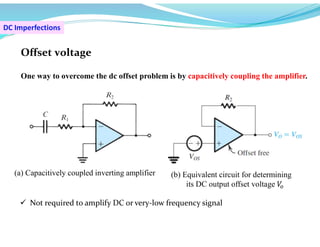
DC Imperfections
Offset voltage
One way to overcome the dc offset problem is by capacitively coupling the amplifier.
(b) Equivalent circuit for determining
its DC output offset voltage 𝑉
(a) Capacitively coupled inverting amplifier
 Not required to amplify DC or very-low frequency signal
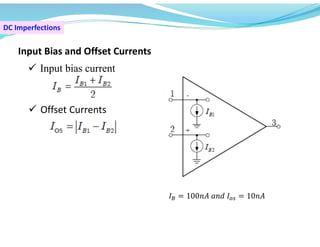
DC Imperfections
Input Bias and Offset Currents
 Offset Currents
 Input bias current
𝐼 = 100𝑛𝐴 𝑎𝑛𝑑 𝐼 = 10𝑛𝐴
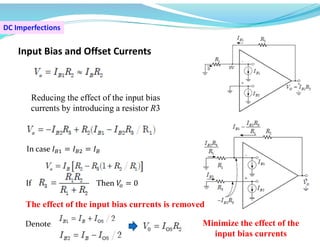
DC Imperfections
Input Bias and Offset Currents
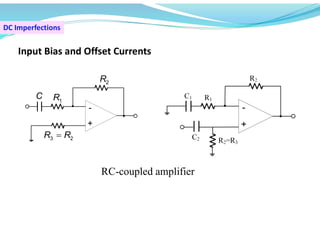
Reducing the effect of the input bias
currents by introducing a resistor R3
In case 𝐼 = 𝐼 = 𝐼
If Then 𝑉 = 0
The effect of the input bias currents is removed
Denote Minimize the effect of the
input bias currents
DC Imperfections
Input Bias and Offset Currents
2
R
1
R
3 2
R R

C
RC-coupled amplifier
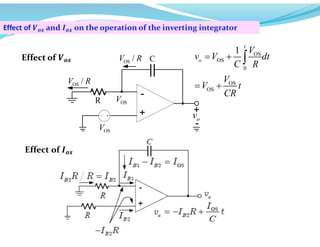
Effect of 𝑽𝒐𝒔 and 𝑰𝒐𝒔 on the operation of the inverting integrator
OS
V
OS
V
OS /
V R
OS /
V R
o
v
OS
OS
0
OS
OS
1
t
o
V
v V dt
C R
V
V t
CR
 
 

Effect of 𝑽𝒐𝒔
Effect of 𝑰𝒐𝒔
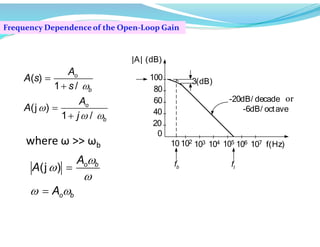
Frequency Dependence of the Open-Loop Gain
where ω >> ωb
( )
1 /
(j )
1 /
o
b
o
b
A
A s
s
A
A
j


 




(j ) o b
o b
A
A
A



 


b
f t
f
or
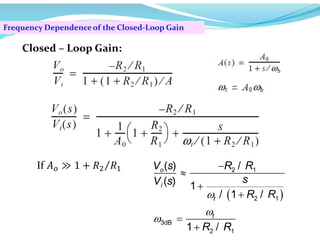
Frequency Dependence of the Closed-Loop Gain
Closed – Loop Gain:
If 𝐴 ≫ 1 + 𝑅 𝑅
⁄
 
2 1
2 1
3dB
2 1
( ) /
( ) 1
/ 1 /
1 /
o
i
t
t
V s R R
s
V s
R R
R R









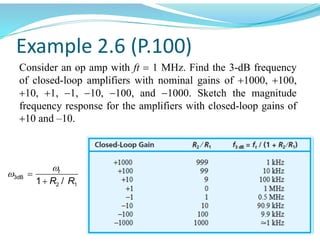
Example 2.6 (P.100)
Consider an op amp with ft 1 MHz. Find the 3-dB frequency
of closed-loop amplifiers with nominal gains of 1000, 100,
10, 1, 1, 10, 100, and 1000. Sketch the magnitude
frequency response for the amplifiers with closed-loop gains of
10 and –10.
3dB
2 1
1 /
t
R R

 

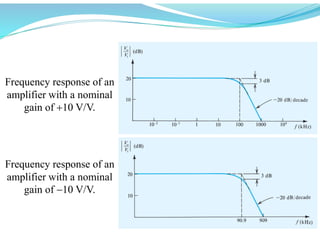
Frequency response of an
amplifier with a nominal
gain of 10 V/V.
Frequency response of an
amplifier with a nominal
gain of 10 V/V.
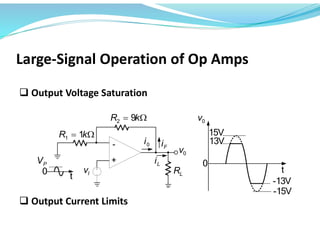
Large-Signal Operation of Op Amps
-
+
0
t
0
t
15V
13V
-15V
-13V
1 1
R k
 
2 9
R k
 
P
V
I
v
0
i
L
i
F
i
L
R
0
v
0
v
 Output Voltage Saturation
 Output Current Limits
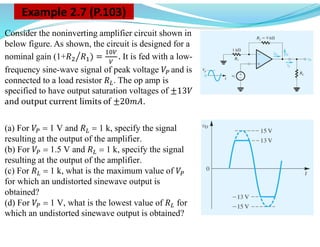
Example 2.7 (P.103)
Consider the noninverting amplifier circuit shown in
below figure. As shown, the circuit is designed for a
nominal gain (1+𝑅 𝑅 ) = . It is fed with a low-
frequency sine-wave signal of peak voltage 𝑉 and is
connected to a load resistor 𝑅 . The op amp is
specified to have output saturation voltages of ±13𝑉
and output current limits of ±20𝑚𝐴.
(a) For 𝑉 1 V and 𝑅 1 kspecify the signal
resulting at the output of the amplifier.
(b) For 𝑉 1.5 V and 𝑅 1 k, specify the signal
resulting at the output of the amplifier.
(c) For 𝑅 1 k, what is the maximum value of 𝑉
for which an undistorted sinewave output is
obtained?
(d) For 𝑉 1 V, what is the lowest value of 𝑅 for
which an undistorted sinewave output is obtained?
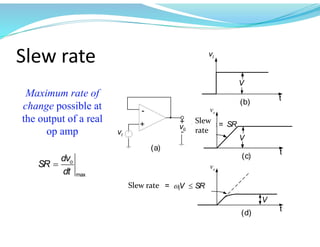
Slew rate
max
o
dv
SR
dt

I
v
V
o
v
o
v
V
V
I
v 0
v
tV SR
 
SR
Slew rate
Slew
rate
Maximum rate of
change possible at
the output of a real
op amp
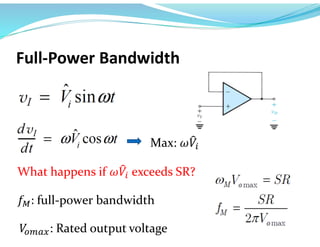
Full-Power Bandwidth
Max: 𝜔𝑉
What happens if 𝜔𝑉 exceeds SR?
𝑓 : full-power bandwidth
𝑉 : Rated output voltage
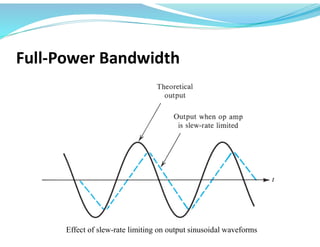
Full-Power Bandwidth
Effect of slew-rate limiting on output sinusoidal waveforms
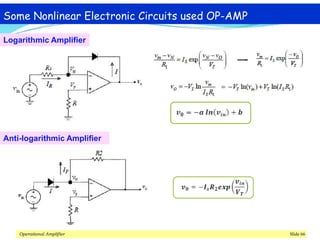
Some Nonlinear Electronic Circuits used OP-AMP
Logarithmic Amplifier
Anti-logarithmic Amplifier
Operational Amplifier Slide 66
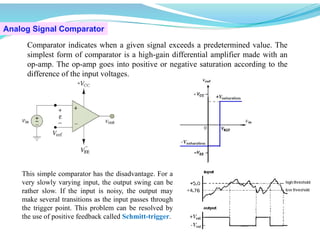
Analog Signal Comparator
Comparator indicates when a given signal exceeds a predetermined value. The
simplest form of comparator is a high-gain differential amplifier made with an
op-amp. The op-amp goes into positive or negative saturation according to the
difference of the input voltages.
This simple comparator has the disadvantage. For a
very slowly varying input, the output swing can be
rather slow. If the input is noisy, the output may
make several transitions as the input passes through
the trigger point. This problem can be resolved by
the use of positive feedback called Schmitt-trigger.
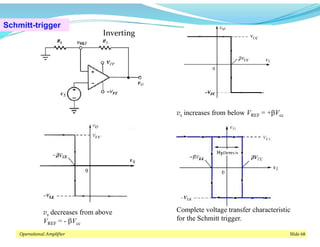
Schmitt-trigger
vs increases from below VREF = +Vcc
vs decreases from above
VREF = - Vcc
Complete voltage transfer characteristic
for the Schmitt trigger.
Operational Amplifier Slide 68
Inverting

Chapter1 analog electric op-amp and application

  • 1.
    Chapter 1 Operational Amplifierand Application Circuits Slide 1
  • 2.
    • An Operationalamplifier ("op-amp") is a DC-coupled high-gain electronic voltage amplifier with a differential input and, usually, a single-ended output. • An op-amp produces an output voltage that is typically hundreds of thousands times larger than the voltage difference between its input terminals. • Operational amplifiers are important building blocks for a wide range of electronic circuits. They had their origins in analog computers where they were used in many linear, non-linear and frequency-dependent circuits (summation, integration, …). • Op-amps are among the most widely used electronic devices today, being used in a vast array of consumer, industrial, and scientific devices. • The op-amp is one type of differential amplifier. 5.1. Introduction Definition and Notation of Operational Amplifier (op-amp)
  • 3.
    Operational Amplifier Slide3 Definition: An operation amplifier OP-AMP is a differential input, DC coupled amplifier with very large gain. The signal voltage developed at the output of amplifier is in phase with the voltage applied to the + input terminal (P-input) and 180 out of phase with the signal applied to the – input terminal (N-input). The vP and vN voltages are therefore referred to as the non-inverting input and inverting input voltages, respectively. • vP : non-invert input • vN : invert input • v0 : output • A : open-loop gain vo = A (vP – vN) Circuit symbol
  • 4.
    Differential and Common-modeSignals • Rid : the input differential resistance • R0 : the output resistance • vid : the differential input voltage: • vicm : the common-mode input voltage: Operational Amplifier Slide 4
  • 5.
    5.2. Ideal OperationalAmplifier 1. Input voltage difference is zero: vid = 0  vP = vN 2. Input currents are zero: i+ = i- = 0 Key Specifications  Infinite input impedance  Zero output impedance  Infinite loop-gain A  Infinite bandwidth  The output voltage depends only on the voltage difference vid and is independent to source and load resistance. (Why?) 𝑣 = 𝐴𝑣 → 𝐴 = A is called the open-loop gain
  • 6.
  • 7.
  • 8.
    The graph thatrelates the output voltage to the input voltage is called the voltage transfer curve and is fundamental in designing and understanding amplifier circuits. The voltage transfer curve of the op-amp is shown on the figure. Transfer Characteristic Operational Amplifier Slide 8
  • 9.
    Operational Amplifier Slide9 Inverting Configuration 5.3. Two Configurations for Feedback Circuit Ideal op-amp Closed-loop gain: G = ??? Open-loop gain: A = → 𝑣 − 𝑣 = = 0 (because 𝐴 → ∞) Due to 𝑉 = 0 (grounded) → 𝑉 = 𝑉 = 0: The N point is called the virtual ground 𝑖 = 𝑖 𝑣 = 𝑣 − 𝑖 𝑅
  • 10.
    Inverting Configuration (A isfinite) A is finite → 𝑉 = − (If 𝐴 → ∞ then 𝐺 = −𝑅 𝑅 ⁄ ) 𝑣 − 𝑣 = 𝑣 𝐴 𝑣 = 0 𝑣 = − 𝑣 𝐴
  • 11.
    Inverting Configuration Input Resistance: OutputResistance: 𝑅 = 𝑣 𝑖 𝑣 = 𝑖 𝑅 + 𝑖 𝑅 = 𝑅 + 𝑅 𝑖 𝑖 = 0 → 𝑣 = 0 𝑅 = 0
  • 12.
  • 13.
    Example 2.2 (P.63) Figure2.8 Circuit for Example 2.2. The circled numbers indicate the sequence of the steps in the analysis.
  • 14.
     𝑣 == 0  𝑖 = =  𝑖 = 𝑖  𝑣 = 𝑣 − 𝑖 𝑅 = 0 − 𝑅 = − 𝑣  𝑖 = = 𝑣  𝑖 = 𝑖 + 𝑖 = + 𝑣  𝑣 = 𝑣 − 𝑖 𝑅 = − 𝑣 − ( + 𝑣 ) 𝑅  = −( + 1 + )  = − (1 + + )
  • 15.
    Exercise D2.4 (P.65) Figure2.5 The inverting closed-loop configuration.
  • 16.
  • 17.
  • 18.
    Non-inverting Configuration 5.3. TwoConfigurations for Feedback Circuit Ideal op-amp Operational Amplifier Slide 18 (closed-loop gain) 𝑉 = 𝑉 = 𝑣 G=
  • 19.
    Non-inverting Configuration A isfinite → 𝑉 = 𝑣 − 𝑖 = 𝑣 − 𝑣 𝐴 ⁄ 𝑅 𝑣 = 𝑣 − 𝑣 𝐴 + 𝑖 𝑅 = 𝑣 − 𝑣 𝐴 + 𝑣 − 𝑣 𝐴 ⁄ 𝑅 𝑅
  • 20.
    Operational Amplifier Slide20 Non-inverting Configuration
  • 21.
    Operational Amplifier Slide21 Non-inverting Configuration 𝐺 ≅ 1 Voltage follower What happens if 𝑹𝟏 = ∞ and 𝑹𝟐 = 𝟎?
  • 22.
  • 23.
    Summing Amplifier 6.4. SomeApplication Circuits Operational Amplifier Slide 23 A weighted summer
  • 24.
    Summing Amplifier A weightedsummer capable of implementing summing coefficients of both signs.
  • 25.
  • 26.
    Exercise 2.9 and2.10 (P.70)
  • 27.
  • 28.
    Difference Amplifiers 𝑣 =0 Inverting amplifier 𝑣 = 0 Non inverting amplifier 𝑣 ≠ 0 and 𝑣 ≠ 0 Note: we have to make the two gain magnitudes equal in order to reject common-mode signals
  • 29.
    Difference Amplifiers Note: wehave to make the two gain magnitudes equal in order to reject common-mode signals Differential gain
  • 30.
    Difference Amplifiers Common –mode input signal (note: 𝑖 = 𝑖 ) 𝑣 = 0 → 𝐴 = 0 However, that any mismatch in the resistance ratios can make 𝑨𝒄𝒎 nonzero, and hence CMRR finite.
  • 31.
  • 32.
  • 33.
  • 34.
    Instrumentation Amplifier Due tothe input resistance of the difference amplifier is too low, the instrumentation amplifier should be used. It is a combination between 2 non-invert amplifiers and a difference amplifier so that this scheme becomes a high-qualified amplifier. 𝑣 = 𝑣 = Stage 1: 𝑣 = (1 + 𝑅 𝑅 )𝑣 𝑣 = (1 + 𝑅 𝑅 )𝑣
  • 35.
    Instrumentation Amplifier Stage 2: 𝑣= (1 + 𝑅 𝑅 )𝑣 𝑣 = (1 + 𝑅 𝑅 )𝑣 𝑣 = 𝑣 − 𝑣 𝑣 = 𝑣 = 𝑣 𝑣 𝑣 = 1 + 𝑅 𝑅 𝑣 − 𝑣 𝑣 = 1 + 𝑅 𝑅 𝑣 𝑣 = 𝑅 𝑅 𝑣
  • 36.
    Instrumentation Amplifier Advantages:  Veryhigh (ideally infinite) input resistance  High differential gain Disadvantages:  𝒗𝑰𝒄𝒎 is amplified in stage 1 by a gain equal to that experienced by 𝑣 . This is a very serious issue, for it could result in the signals at the outputs of A1 and A2 being of such large magnitudes that the op amps saturate. But even if the op amps do not saturate, the difference amplifier of stage 2 will now have to deal with much larger common- mode signals, with the result that the CMRR of the overall amplifier will inevitably be reduced.
  • 37.
    Instrumentation Amplifier Disadvantages:  Thetwo amplifier channels in stage 1 have to be perfectly matched, otherwise a spurious signal may appear between their two outputs. Such a signal would get amplified by the difference amplifier in the second stage.  To vary the differential gain 𝐴 , two resistors 𝑅 have to be varied simultaneously. At each gain setting the two resistors have to be perfectly matched: a difficult task.
  • 38.
  • 39.
    Example 2.3 (P.79) Designthe instrumentation amplifier circuit in the above to provide a gain that can be varied over the range of 2 to 1000 utilizing a 100kvariable resistance (a potentiometer, or “pot” for short).
  • 41.
  • 42.
    Integrators and Differentiators Theinverting configuration with general impedances Closed-loop transfer function
  • 43.
    Integrators Operational Amplifier Slide43 Miller or Inverting Integrator 𝑖 (𝑡) flows through the capacitor C, causing charge to accumulate on C equal to∫ 𝑖 (𝑡) 𝑑𝑡. Capacitor voltage 𝑣 (𝑡) charges by ∫ 𝑖 𝑡 𝑑𝑡. where 𝑉 is initial voltage on C Output voltage
  • 44.
    Integrators For physical frequencies,𝑠 = 𝑗𝜔 And phase Integrator frequency: Frequency response Magnitude of integrator transfer function Low-pass filter
  • 45.
    Integrators Miller or InvertingIntegrator with 𝑹𝑭 𝑖 = 𝑣 𝑅 𝑍 = 𝑅 ∥ 𝑠𝐶 = 𝑅 1 + 𝑅 𝑠𝐶 𝑣 = 0 − 𝑖 𝑍=- ⁄ 𝑣
  • 46.
    Example 2.5 (P.85) Findthe output produced by a Miller integrator in response to an input pulse of 1-V height and 1-ms width [below figure]. Let R10kand C 10nF. The op amp is specified to saturate at ± 13𝑉.
  • 47.
    Differentiator Operational Amplifier Slide47 𝑖(𝑡) = 𝐶 𝑑𝑣 (𝑡) 𝑑𝑡 𝑣 (𝑡) = 0 − 𝑖(𝑡)𝑅 → 𝑣 (𝑡) = −𝑅𝐶 𝑑𝑣 (𝑡) 𝑑𝑡 𝑧 𝑠 = 1 𝑠𝐶 𝑎𝑛𝑑 𝑧 𝑠 = 𝑅 𝑉 (𝑠) 𝑉 (𝑠) = 𝑧 (𝑠) 𝑧 (𝑠) = −𝑠𝐶𝑅 Differential transfer function Frequency response with a time-constant CR
  • 48.
  • 49.
    Exercise 2.21 (P.90) Usethe model at before slide to sketch the transfer characteristic 𝑣 versus 𝑣 (𝑣 ≡ 𝑣 and 𝑣 ≡ 𝑣 − 𝑣 of an op amp having an open-loop dc gain 𝐴 = 10 V/V, output saturation levels of ± 10𝑉 and 𝑣 of +5mV.
  • 51.
    DC Imperfections Offset voltage OutputDC voltage can have a large magnitude The output dc offset voltage of an op amp can be reduced to zero by connecting a potentiometer to the two offset-nulling terminals.
  • 52.
    DC Imperfections Offset voltage Oneway to overcome the dc offset problem is by capacitively coupling the amplifier. (b) Equivalent circuit for determining its DC output offset voltage 𝑉 (a) Capacitively coupled inverting amplifier  Not required to amplify DC or very-low frequency signal
  • 53.
    DC Imperfections Input Biasand Offset Currents  Offset Currents  Input bias current 𝐼 = 100𝑛𝐴 𝑎𝑛𝑑 𝐼 = 10𝑛𝐴
  • 54.
    DC Imperfections Input Biasand Offset Currents Reducing the effect of the input bias currents by introducing a resistor R3 In case 𝐼 = 𝐼 = 𝐼 If Then 𝑉 = 0 The effect of the input bias currents is removed Denote Minimize the effect of the input bias currents
  • 55.
    DC Imperfections Input Biasand Offset Currents 2 R 1 R 3 2 R R  C RC-coupled amplifier
  • 56.
    Effect of 𝑽𝒐𝒔and 𝑰𝒐𝒔 on the operation of the inverting integrator OS V OS V OS / V R OS / V R o v OS OS 0 OS OS 1 t o V v V dt C R V V t CR      Effect of 𝑽𝒐𝒔 Effect of 𝑰𝒐𝒔
  • 57.
    Frequency Dependence ofthe Open-Loop Gain where ω >> ωb ( ) 1 / (j ) 1 / o b o b A A s s A A j         (j ) o b o b A A A        b f t f or
  • 58.
    Frequency Dependence ofthe Closed-Loop Gain Closed – Loop Gain: If 𝐴 ≫ 1 + 𝑅 𝑅 ⁄   2 1 2 1 3dB 2 1 ( ) / ( ) 1 / 1 / 1 / o i t t V s R R s V s R R R R         
  • 59.
    Example 2.6 (P.100) Consideran op amp with ft 1 MHz. Find the 3-dB frequency of closed-loop amplifiers with nominal gains of 1000, 100, 10, 1, 1, 10, 100, and 1000. Sketch the magnitude frequency response for the amplifiers with closed-loop gains of 10 and –10. 3dB 2 1 1 / t R R    
  • 60.
    Frequency response ofan amplifier with a nominal gain of 10 V/V. Frequency response of an amplifier with a nominal gain of 10 V/V.
  • 61.
    Large-Signal Operation ofOp Amps - + 0 t 0 t 15V 13V -15V -13V 1 1 R k   2 9 R k   P V I v 0 i L i F i L R 0 v 0 v  Output Voltage Saturation  Output Current Limits
  • 62.
    Example 2.7 (P.103) Considerthe noninverting amplifier circuit shown in below figure. As shown, the circuit is designed for a nominal gain (1+𝑅 𝑅 ) = . It is fed with a low- frequency sine-wave signal of peak voltage 𝑉 and is connected to a load resistor 𝑅 . The op amp is specified to have output saturation voltages of ±13𝑉 and output current limits of ±20𝑚𝐴. (a) For 𝑉 1 V and 𝑅 1 kspecify the signal resulting at the output of the amplifier. (b) For 𝑉 1.5 V and 𝑅 1 k, specify the signal resulting at the output of the amplifier. (c) For 𝑅 1 k, what is the maximum value of 𝑉 for which an undistorted sinewave output is obtained? (d) For 𝑉 1 V, what is the lowest value of 𝑅 for which an undistorted sinewave output is obtained?
  • 63.
    Slew rate max o dv SR dt  I v V o v o v V V I v 0 v tVSR   SR Slew rate Slew rate Maximum rate of change possible at the output of a real op amp
  • 64.
    Full-Power Bandwidth Max: 𝜔𝑉 Whathappens if 𝜔𝑉 exceeds SR? 𝑓 : full-power bandwidth 𝑉 : Rated output voltage
  • 65.
    Full-Power Bandwidth Effect ofslew-rate limiting on output sinusoidal waveforms
  • 66.
    Some Nonlinear ElectronicCircuits used OP-AMP Logarithmic Amplifier Anti-logarithmic Amplifier Operational Amplifier Slide 66
  • 67.
    Analog Signal Comparator Comparatorindicates when a given signal exceeds a predetermined value. The simplest form of comparator is a high-gain differential amplifier made with an op-amp. The op-amp goes into positive or negative saturation according to the difference of the input voltages. This simple comparator has the disadvantage. For a very slowly varying input, the output swing can be rather slow. If the input is noisy, the output may make several transitions as the input passes through the trigger point. This problem can be resolved by the use of positive feedback called Schmitt-trigger.
  • 68.
    Schmitt-trigger vs increases frombelow VREF = +Vcc vs decreases from above VREF = - Vcc Complete voltage transfer characteristic for the Schmitt trigger. Operational Amplifier Slide 68 Inverting