PLL Basics 2-28-2009
    Stan Goldman
  Goldman Technology


           Goldman Technology   1/26/2012   Page 1   1
PLL Basics Agenda

•   History
•   Applications
•   Overview of PLLs
•   Background information
•   Control Systems
•   Test and Measurement
•   References and Background Material

                       Goldman Technology   1/26/2012   Page 2
History

• De Bellescize in 1932
  – Synchronous reception of radio signals
  – Received audio amplified to speaker
• Television, 1st wide spread use
  – Synchronization of horizontal and vertical scan
    in television


                               Goldman Technology   1/26/2012   Page 3
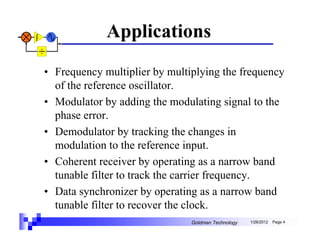
Applications
• Frequency multiplier by multiplying the frequency
  of the reference oscillator.
• Modulator by adding the modulating signal to the
  phase error.
• Demodulator by tracking the changes in
  modulation to the reference input.
• Coherent receiver by operating as a narrow band
  tunable filter to track the carrier frequency.
• Data synchronizer by operating as a narrow band
  tunable filter to recover the clock.
                               Goldman Technology   1/26/2012   Page 4
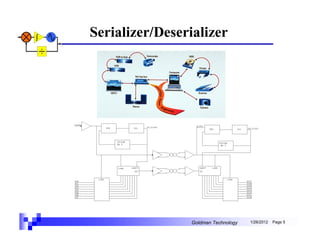
Serializer/Deserializer


                Goldman Technology   1/26/2012   Page 5
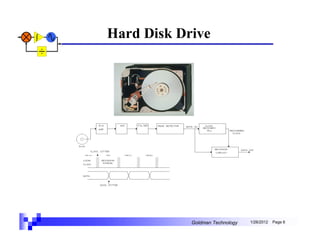
Hard Disk Drive


            Goldman Technology   1/26/2012   Page 6
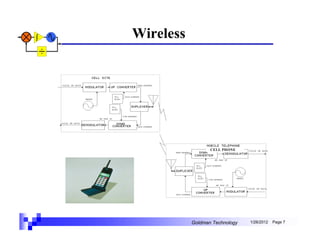
Wireless


                  CELL PHONE


           Goldman Technology   1/26/2012   Page 7
KEY PLL DESIGN REQUIREMENTS


•   Architecture
•   Loop Stability
•   Frequency Range
•   Time Jitter


                      Goldman Technology   1/26/2012   Page 8
PLL Control System Block Diagram
                With Phase Relationships

                 θo
θi         θi                                         θ0
                n mf


                                                [Goldman 2007 p19]

                                 Goldman Technology        1/26/2012   Page 9
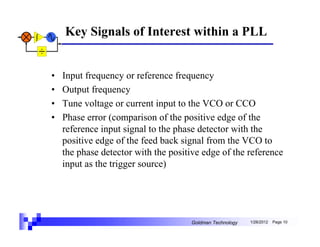
Key Signals of Interest within a PLL


•   Input frequency or reference frequency
•   Output frequency
•   Tune voltage or current input to the VCO or CCO
•   Phase error (comparison of the positive edge of the
    reference input signal to the phase detector with the
    positive edge of the feed back signal from the VCO to
    the phase detector with the positive edge of the reference
    input as the trigger source)


                                     Goldman Technology   1/26/2012   Page 10
Ideal VCO Transfer Function,
       Transduces Voltage to Frequency (Edges)

             ωout=ωoff+Kv Vtune   ωout=∆θout/∆t

1 E9


8 E8

                                                     To = 2 M Td


4 E8


   0


                                                            [Goldman 2007 p3]


                                       Goldman Technology      1/26/2012   Page 11
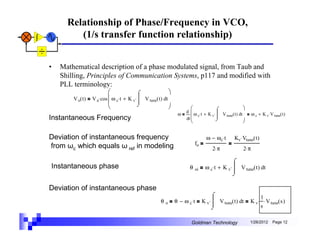
Relationship of Phase/Frequency in VCO,
         (1/s transfer function relationship)


•   Mathematical description of a phase modulated signal, from Taub and
    Shilling, Principles of Communication Systems, p117 and modified with
    PLL terminology:
                                                    
        V o( t ) V a⋅ cos  ω ⋅ t + K ⋅ ⌠ V ( t ) dt
                                        
                           c        v
                                        
                                        ⌡
                                           tune
                                                                              ⌠                
                                                              d 
                                                          ω        ω c⋅ t + K v⋅  V tune( t ) dt       ω c + K v⋅ V tune( t )
Instantaneous Frequency                                       dt                
                                                                                 ⌡
                                                                                                 

Deviation of instantaneous frequency                                       ω − ωc⋅ t        Kv⋅ Vtune( t)
                                                                    fo
from ωc which equals ω ref in modeling                                        2⋅ π               2⋅ π

                                                                                        ⌠
Instantaneous phase                                             θ         ω c⋅ t + K v⋅  V tune( t ) dt
                                                                    oi                  
                                                                                        ⌡

Deviation of instantaneous phase
                                                                              ⌠
                                                                         K v⋅  V tune( t) dt
                                                                                                          1
                                                 θ       θ − ω c⋅ t                                   K v⋅ ⋅ V tune( s )
                                                     o                        
                                                                              ⌡                           s

                                                                 Goldman Technology                   1/26/2012      Page 12
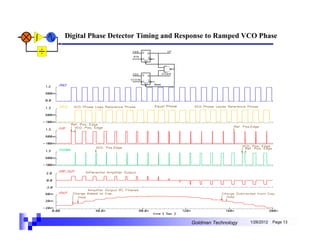
Digital Phase Detector Timing and Response to Ramped VCO Phase

                   VDD     D                 UP
                               Q
                    RIN
                           C Q
                            CL


                   VDD                     DOWN
                           D   Q
                   VCOIN
                           C Q
                            CL
                                   Reset


                                                  Goldman Technology   1/26/2012   Page 13
Ideal Phase Detector Transfer Function,
  Transduces Frequency (Edge) Differences to Voltage
                 Vpdavg=Kd θe (5MHz Ref. Freq.)


-200       -100        0                          100            200
           Ref. – VCO Edge (ns)                                  [Goldman 2007 p2]


                                            Goldman Technology     1/26/2012   Page 14
Output of Analog Phase Detector vs Phase Error (-cos)
               with Various Measures of Abscissa


                                                          [Goldman 2007 p18]
                                     Goldman Technology       1/26/2012   Page 15
Example of Lock, Digital Loop
           (In Phase)


                                             [Goldman 2007 p4]

                        Goldman Technology       1/26/2012   Page 16
Mathematical Relationship of Phase and Frequency (Analog Phase Detector)
                                             Phase detector as a mixer (analog multiplier)

                  Mixing of Two Signals                                                   Signal Definition

 V1(t) V2(t) = Vp1Vp2 cos(ωrf t + θe ) cos(ωlo t )
                                                                                 V1(t)= Vp1 cos(ωrft+ θe )
                                                                                 where:
 Using the trigonometric identity for products of a trigonometric function:
                                                                                    V1(t)= Source 1 signal,
                                                                                     Vp1= Maximum amplitude of source 1 (volts),
 V1(t) V2(t)=Vp1Vp2 0.5 [cos ( ωrf t- ωlo t + θe ) +cos( ωrf t + ωlo t + θe )]
                                                                                      ωrf= Angular frequency of a Signal at the RF port of the mixer (rad./sec),
   where:                                                                               = 2 π frf,
     V1(t) V2(t) = Mixing process.                                                     θe= Phase error difference between signal 1 and 2 (rad.), and
                                                                                                t= Time variable (seconds).
Eliminating the high frequency product                                           V2(t) = Vp2 cos(ωlo t )
with a low pass filter yields                                                    where:
                                                                                     V2(t)= Source 2 signal,
V1(t) V2(t) =Vp1 Vp2 0.5 [ cos(ωrf t - ωlo t + θe ) ]                                  Vp2= Maximum amplitude of source 2 (volts), and
                                                                                        ωlo= Angular frequency of a signal at the LO port of a mixer (rad./sec).
            =Vpbeat cos( ωbeat t + θe )

               where:
                  ωbeat = ωrf - ωlo for ωrf > ωlo,
                  Vpbeat = Vp1 Vp2 x 0.5 x mixer losses, and
                      = The resulting voltage level after mixing (volts).


  Slope
          V pds
                   d
                                     ( )
                          V pbeat ⋅cos θ e              ( )
                                             V pbeat ⋅sin θ e
                   dθ e
      where:

          Vpds ( φ)= Phase detector phase slope (volts).
                                                                          Phase Detector Gain

          Vpds(θe) = Vpbeat sin(θe )                                      Kd=Vpbeat

                                                                                                Goldman Technology                   1/26/2012     Page 17
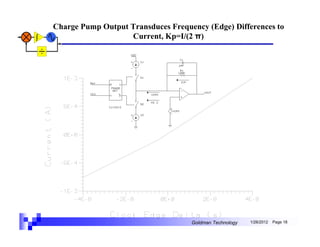
Charge Pump Output Transduces Frequency (Edge) Differences to
                   Current, Kp=I/(2 π)


                                    Goldman Technology   1/26/2012   Page 18
Loop Classifications


                                   [Goldman 2007 p8]


                  Goldman Technology    1/26/2012   Page 19
Loop Classifications (Continued)


                                      [Goldman 2007 p8]

                       Goldman Technology   1/26/2012   Page 20
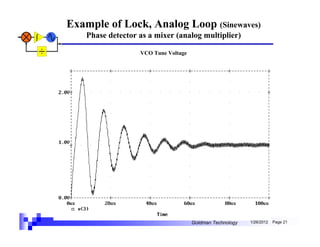
Example of Lock, Analog Loop (Sinewaves)
    Phase detector as a mixer (analog multiplier)

                   VCO Tune Voltage


                                      Goldman Technology   1/26/2012   Page 21
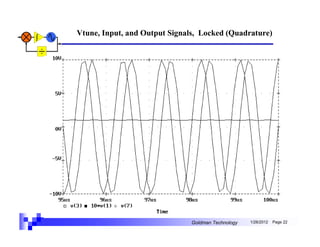
Vtune, Input, and Output Signals, Locked (Quadrature)


                               Goldman Technology   1/26/2012   Page 22
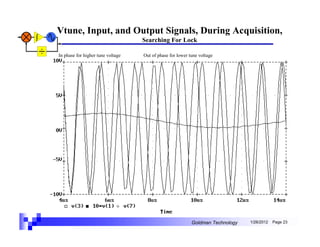
Vtune, Input, and Output Signals, During Acquisition,
                                   Searching For Lock

In phase for higher tune voltage   Out of phase for lower tune voltage


                                                           Goldman Technology   1/26/2012   Page 23
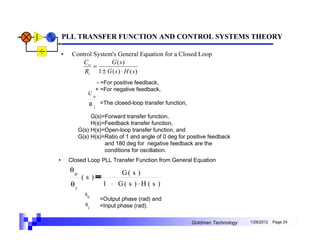
PLL TRANSFER FUNCTION AND CONTROL SYSTEMS THEORY

    •    Control System's General Equation for a Closed Loop
             Co        G (s)
                 =
             Ri 1 ± G ( s ) ⋅ H ( s )
                     - =For positive feedback,
                     + =For negative feedback,
                 Co
                 R i =The closed-loop transfer function,

                  G(s)=Forward transfer function,
                  H(s)=Feedback transfer function,
             G(s) H(s)=Open-loop transfer function, and
             G(s) H(s)=Ratio of 1 and angle of 0 deg for positive feedback
                       and 180 deg for negative feedback are the
                       conditions for oscillation.
•       Closed Loop PLL Transfer Function from General Equation
        θo                    G( s )
              (s)
        θi             1     G( s ) . H ( s )
               θ0
                      =Output phase (rad) and
                θi    =Input phase (rad).

                                                           Goldman Technology   1/26/2012   Page 24
Judging Stability from Step Response
                            Freqeuncy (Hz)
                                 6 10 4


     .035 Damping
     4 deg. Phase Margin        3 10 4


     ~90% Overshoot
                                          0
                                          4
                                 6   10


     .2 Damping
     22 deg. Phase Margin        3 10 4


    ~60% Overshoot
                                            0
                                          4
                                 6   10


     .42 Damping                        4
     45 deg. Phase Margin        3 10


    ~40% Overshoot
                                        0
                                                0   0.001   0.002   0.003   0.004   0.005       0.006   0.007   0.008   0.009      0.01

                                                                                     Time (s)
[Goldman 2007 p20]
                                     30 deg or 45 deg. Phase Margin are levels supported in references

                                                                                            Goldman Technology                  1/26/2012   Page 25
PLL Basic Block Diagram
For Cascade of Transfer functions for Open Loop Gain


                                               [Goldman 2007 p22]

                                Goldman Technology    1/26/2012   Page 26
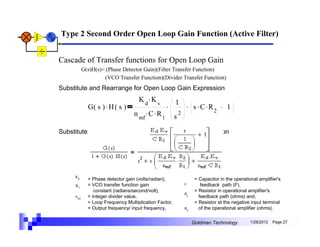
Type 2 Second Order Open Loop Gain Function (Active Filter)


Cascade of Transfer functions for Open Loop Gain
            G(s)H(s)= (Phase Detector Gain)(Filter Transfer Function)
                     (VCO Transfer Function)(Divider Transfer Function)
Substitute and Rearrange for Open Loop Gain Expression
                                     K d. K v
              G( s ) . H ( s )                   . 1 . s . C. R              1
                                                                2
                                   n mf . C . R 1 s 2

Substitute and Rearrange for Closed Loop Gain Expression


     Kd
              = Phase detector gain (volts/radian),           = Capacitor in the operational amplifier's
     Kv       = VCO transfer function gain              C        feedback path (F),
                 constant (radians/second/volt),              = Resistor in operational amplifier's
                                                        R1
     n mf     = Integer divider value,                          feedback path (ohms) and,
              = Loop Frequency Multiplication Factor,         = Resistor at the negative input terminal
              = Output frequency/ input frequency,      R2      of the operational amplifier (ohms).


                                                             Goldman Technology          1/26/2012   Page 27
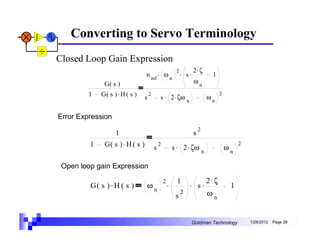
Converting to Servo Terminology
Closed Loop Gain Expression
                                                              . s. 2 ζ
                                                          2         .
                                 n mf . ω n                                        1
              G( s )                                               ωn
         1   G( s ) . H ( s )    s
                                     2
                                             s . 2 . ζω                           ωn
                                                                                       2
                                                                  n


Error Expression
                                                                          2
                   1                                                  s
         1    G( s ) . H ( s )           s
                                             2
                                                         s . 2 . ζω                        ωn
                                                                                                2
                                                                              n

 Open loop gain Expression

                                                                      . s.2 ζ
                                                 2        1                .
         G( s ) . H ( s )        ωn                  .                                      1
                                                          s
                                                              2           ωn


                                                                      Goldman Technology            1/26/2012   Page 28
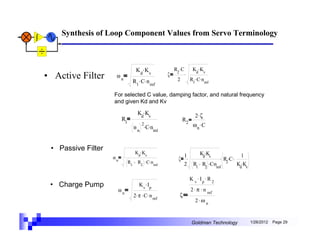
Synthesis of Loop Component Values from Servo Terminology


                                    Kd. Kv              R2. C        Kd. Kv
• Active Filter      ωn                             ζ           .
                                   R1. C. n mf           2          R1. C. nmf

                    For selected C value, damping factor, and natural frequency
                    and given Kd and Kv

                                     Kd.Kv                       2. ζ
                         R1                                  R2
                                       2
                                   ω n .C.nmf                   ω .C    n


 • Passive Filter
                                    Kd. Kv                      Kd.Kv
                    ωn                                      1.                   1
                                                          ζ             . R .C
                              R1     R2 . C. n mf           2 R1 R2 .Cnmf 2
                                                                      .        Kd.Kv

                                                                    K v . Ip . R 2
 • Charge Pump                        K v . Ip
                     ωn                                             2 . π . n mf
                                   2. π . C. n mf         ζ
                                                                       2.ω n


                                                                     Goldman Technology   1/26/2012   Page 29
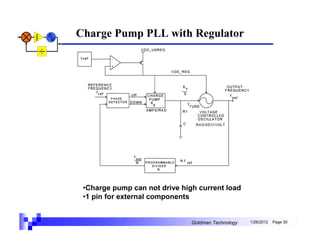
Charge Pump PLL with Regulator


 •Charge pump can not drive high current load
 •1 pin for external components


                               Goldman Technology   1/26/2012   Page 30
Loop Stability, Bode Plot

      Magnitude


                  Phase Margin
  Phase

                                        Gain Margin


                                      [Goldman 2007 p27]

                       Goldman Technology    1/26/2012   Page 31
Graphical Relationship of Natural Frequency to 0 dB Crossover Frequency


                                                         [Goldman 2007 p29]

                                          Goldman Technology    1/26/2012   Page 32
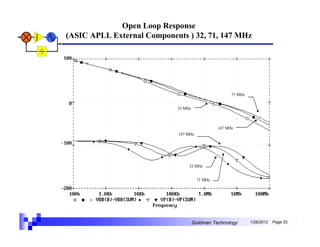
Open Loop Response
(ASIC APLL External Components ) 32, 71, 147 MHz


                                                      71 MHz


                            32 MHz


                                                147 MHz
                             147 MHz


                                 32 MHz


                                       71 MHz


                                     Goldman Technology        1/26/2012   Page 33
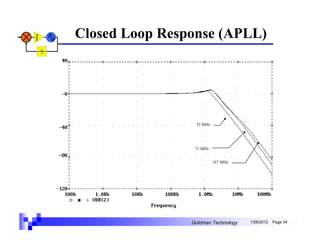
Closed Loop Response (APLL)


                 32 MHz


                 71 MHz


                          147 MHz


                Goldman Technology   1/26/2012   Page 34
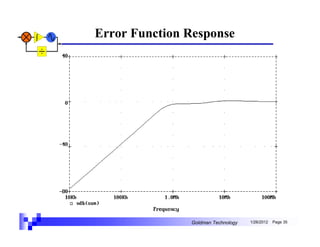
Error Function Response


               Goldman Technology   1/26/2012   Page 35
Test and Measurement of PLL (Brief)


• Spurious signals, hold in range, and
  lock range
• Frequency Switching Time
• Jitter


                           Goldman Technology   1/26/2012   Page 36
Spurious Signals


                       [Goldman 2007 p357]

             Goldman Technology   1/26/2012   Page 37
Hold In Range, Lock In Range


                        [Goldman 2007 p355]


                   Goldman Technology   1/26/2012   Page 38
Jitter Measurements


• Oscilloscope (Time Domain)
• Modulation Domain Analyzer
• Spectrum Analyzer ( Frequency Domain)


                         Goldman Technology   1/26/2012   Page 39
Jitter, Oscilloscope


                                    [Goldman 2007 p388]


               Goldman Technology   1/26/2012   Page 40
Relationship of Modulation Domain to
     Spectrum Analyzer and Oscilloscope


            F


                                       T

V


                                              [Goldman 2007 p378]


                              Goldman Technology    1/26/2012   Page 41
Oscilloscope Measurement of 1 and Multiple Periods

    1 clo ck p eriod oscilloscop e m easurem ent w ith jitter FM m odulation

                    1 p eriod scope m easurem ent
    1
T


    1

    6 clock periods o scilloscope m easurem ent w ith jitter F M m odulation

                                                                               6 th period scop e m easurem ent
    1
T


    1                                                                                           [Goldman 2007 p380]


                                                                          Goldman Technology            1/26/2012   Page 42
Frequency Switching Time, Modulation Domain Analyzer


                                                 [Goldman 2007 p358]


                                 Goldman Technology    1/26/2012   Page 43
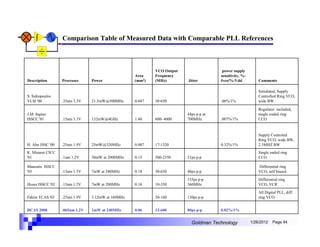
Comparison Table of Measured Data with Comparable PLL References


                                                           VCO Output                  power supply
                                                   Area    Frequency                  sensitivity, %-
Description       Processes     Power              (mm2)   (MHz)        Jitter        fvco/%-Vdd            Comments

                                                                                                            Simulated, Supply
S. Sidropoulos                                                                                              Controlled Ring VCO,
VLSI '00          .35um 3.3V    21.5mW@500MHz      0.047   30-650                     .06%/1%               wide BW

                                                                                                            Regulator included,
J.M. Ingino                                                             44ps p-p at                         single ended ring
ISSCC '01         .15um 3.3V    132mW@4GHz         1.48    600- 4000    700MHz        .007%/1%              CCO


                                                                                                            Supply Controled
                                                                                                            Ring VCO, wide BW,
H. Ahn JSSC '00   .25um 1.9V    25mW@320MHz        0.087   17-1320                    0.32%/1%              2.5MHZ BW
K. Minami CICC                                                                                              Single ended ring
'01               .1um 1.2V     30mW at 2000MHz    0.15    500-2350     21ps p-p                            CCO

Maneatis ISSCC                                                                                              Differential ring
'03               .13um 1.5V    7mW at 240MHz      0.18    30-650       48ps p-p                            VCO, self biased
                                                                        155ps p-p                           Differential ring
Hozer ISSCC '02   .13um 1.5V    7mW at 200MHz      0.16    10-350       360MHz                              VCO, VCR
                                                                                                            All Digital PLL, diff.
Fahim TCAS '03    .25um 1.9V    3.12mW at 160MHz           30-160       130ps p-p                           ring VCO


DCAS 2008         .065um 1.2V   1mW at 240MHz      0.06    12-600       80ps p-p      0.02%/1%


                                                                          Goldman Technology            1/26/2012   Page 44
Recommended PLL Books

1. Stanley
         Goldman, Phase Locked Loop Engineering Handbook,
    Artech House, Boston, 2007.
2. Roland Best, Phase Locked Loops Design Simulation, & Applications,
     McGraw Hill, New York, 1997.
3. Behzad Razavi, Monolithic Phase-Locked Loops and Clock Recovery
     Circuits, EEE Press, New York 1996.
4. James A. Crawford, Frequency Synthesizer Design Handbook, Artech
     House, Boston.
5. William Egan, Frequency Synthesis by Phase-Lock, Wiley Interscience,
     New York, 1981.
6. Floyd Martin Gardner, Phaselock Techniques, Wiley Interscience, New
     York, 1979.


                                               Goldman Technology   1/26/2012   Page 45
Recommended Background Books


Feedback Control Systems by Charles L. Phillips and Royce
  D. Harbor
The Fast Fourier Transform by E. Oran Brigham
Network Analysis by Van Valkenburg
Analysis and Design of Analog Integrated Circuits by Paul
  R. Gray and Robert G. Meyer
Principles of CMOS VLSI Design by Neil H. E. Weste and
  Kamran Eshraghian
Principles of Communicaton Systems by H. Taub and D. L.
  Schilling


                                   Goldman Technology   1/26/2012   Page 46
External Websites

•   Texas Instruments, High Performance PLLs
        http://www.ti.com/sc/docs/products/msp/clock/pll/overview.htm
•   National Semiconductor
        http://www.national.com/appinfo/wireless/
•   Frequency Response Analysis and Design Tutorials
        http://me.www.ecn.purdue.edu/~me475/ctm/freq/freq.html
•   Chip Directory
        http://icat.snu.ac.kr/chipdir/f/pll.htm
•   Phase Locked Loop Fundamentals ( Minicircuits)
        http://www.minicircuits.com/appnote/vco15-10.pdf
•   Monolithic CMOS RF Transceiver (Berkeley)
        http://kabuki.eecs.berkeley.edu/rf/rf.html
•   Analog IC Design, Dr Hellums (UTD)
        http://www.utdallas.edu/~hellums/
•   PLLs , Stan Goldman
        http://home.tx.rr.com/sgold_1


                                                     Goldman Technology   1/26/2012   Page 47

Pll Basic Linkedin2

  • 1.
    PLL Basics 2-28-2009 Stan Goldman Goldman Technology Goldman Technology 1/26/2012 Page 1 1
  • 2.
    PLL Basics Agenda • History • Applications • Overview of PLLs • Background information • Control Systems • Test and Measurement • References and Background Material Goldman Technology 1/26/2012 Page 2
  • 3.
    History • De Bellescizein 1932 – Synchronous reception of radio signals – Received audio amplified to speaker • Television, 1st wide spread use – Synchronization of horizontal and vertical scan in television Goldman Technology 1/26/2012 Page 3
  • 4.
    Applications • Frequency multiplierby multiplying the frequency of the reference oscillator. • Modulator by adding the modulating signal to the phase error. • Demodulator by tracking the changes in modulation to the reference input. • Coherent receiver by operating as a narrow band tunable filter to track the carrier frequency. • Data synchronizer by operating as a narrow band tunable filter to recover the clock. Goldman Technology 1/26/2012 Page 4
  • 5.
    Serializer/Deserializer Goldman Technology 1/26/2012 Page 5
  • 6.
    Hard Disk Drive Goldman Technology 1/26/2012 Page 6
  • 7.
    Wireless CELL PHONE Goldman Technology 1/26/2012 Page 7
  • 8.
    KEY PLL DESIGNREQUIREMENTS • Architecture • Loop Stability • Frequency Range • Time Jitter Goldman Technology 1/26/2012 Page 8
  • 9.
    PLL Control SystemBlock Diagram With Phase Relationships θo θi θi θ0 n mf [Goldman 2007 p19] Goldman Technology 1/26/2012 Page 9
  • 10.
    Key Signals ofInterest within a PLL • Input frequency or reference frequency • Output frequency • Tune voltage or current input to the VCO or CCO • Phase error (comparison of the positive edge of the reference input signal to the phase detector with the positive edge of the feed back signal from the VCO to the phase detector with the positive edge of the reference input as the trigger source) Goldman Technology 1/26/2012 Page 10
  • 11.
    Ideal VCO TransferFunction, Transduces Voltage to Frequency (Edges) ωout=ωoff+Kv Vtune ωout=∆θout/∆t 1 E9 8 E8 To = 2 M Td 4 E8 0 [Goldman 2007 p3] Goldman Technology 1/26/2012 Page 11
  • 12.
    Relationship of Phase/Frequencyin VCO, (1/s transfer function relationship) • Mathematical description of a phase modulated signal, from Taub and Shilling, Principles of Communication Systems, p117 and modified with PLL terminology:   V o( t ) V a⋅ cos  ω ⋅ t + K ⋅ ⌠ V ( t ) dt   c v  ⌡ tune    ⌠  d  ω ω c⋅ t + K v⋅  V tune( t ) dt ω c + K v⋅ V tune( t ) Instantaneous Frequency dt   ⌡   Deviation of instantaneous frequency ω − ωc⋅ t Kv⋅ Vtune( t) fo from ωc which equals ω ref in modeling 2⋅ π 2⋅ π ⌠ Instantaneous phase θ ω c⋅ t + K v⋅  V tune( t ) dt oi  ⌡ Deviation of instantaneous phase ⌠ K v⋅  V tune( t) dt 1 θ θ − ω c⋅ t K v⋅ ⋅ V tune( s ) o  ⌡ s Goldman Technology 1/26/2012 Page 12
  • 13.
    Digital Phase DetectorTiming and Response to Ramped VCO Phase VDD D UP Q RIN C Q CL VDD DOWN D Q VCOIN C Q CL Reset Goldman Technology 1/26/2012 Page 13
  • 14.
    Ideal Phase DetectorTransfer Function, Transduces Frequency (Edge) Differences to Voltage Vpdavg=Kd θe (5MHz Ref. Freq.) -200 -100 0 100 200 Ref. – VCO Edge (ns) [Goldman 2007 p2] Goldman Technology 1/26/2012 Page 14
  • 15.
    Output of AnalogPhase Detector vs Phase Error (-cos) with Various Measures of Abscissa [Goldman 2007 p18] Goldman Technology 1/26/2012 Page 15
  • 16.
    Example of Lock,Digital Loop (In Phase) [Goldman 2007 p4] Goldman Technology 1/26/2012 Page 16
  • 17.
    Mathematical Relationship ofPhase and Frequency (Analog Phase Detector) Phase detector as a mixer (analog multiplier) Mixing of Two Signals Signal Definition V1(t) V2(t) = Vp1Vp2 cos(ωrf t + θe ) cos(ωlo t ) V1(t)= Vp1 cos(ωrft+ θe ) where: Using the trigonometric identity for products of a trigonometric function: V1(t)= Source 1 signal, Vp1= Maximum amplitude of source 1 (volts), V1(t) V2(t)=Vp1Vp2 0.5 [cos ( ωrf t- ωlo t + θe ) +cos( ωrf t + ωlo t + θe )] ωrf= Angular frequency of a Signal at the RF port of the mixer (rad./sec), where: = 2 π frf, V1(t) V2(t) = Mixing process. θe= Phase error difference between signal 1 and 2 (rad.), and t= Time variable (seconds). Eliminating the high frequency product V2(t) = Vp2 cos(ωlo t ) with a low pass filter yields where: V2(t)= Source 2 signal, V1(t) V2(t) =Vp1 Vp2 0.5 [ cos(ωrf t - ωlo t + θe ) ] Vp2= Maximum amplitude of source 2 (volts), and ωlo= Angular frequency of a signal at the LO port of a mixer (rad./sec). =Vpbeat cos( ωbeat t + θe ) where: ωbeat = ωrf - ωlo for ωrf > ωlo, Vpbeat = Vp1 Vp2 x 0.5 x mixer losses, and = The resulting voltage level after mixing (volts). Slope V pds d ( ) V pbeat ⋅cos θ e ( ) V pbeat ⋅sin θ e dθ e where: Vpds ( φ)= Phase detector phase slope (volts). Phase Detector Gain Vpds(θe) = Vpbeat sin(θe ) Kd=Vpbeat Goldman Technology 1/26/2012 Page 17
  • 18.
    Charge Pump OutputTransduces Frequency (Edge) Differences to Current, Kp=I/(2 π) Goldman Technology 1/26/2012 Page 18
  • 19.
    Loop Classifications [Goldman 2007 p8] Goldman Technology 1/26/2012 Page 19
  • 20.
    Loop Classifications (Continued) [Goldman 2007 p8] Goldman Technology 1/26/2012 Page 20
  • 21.
    Example of Lock,Analog Loop (Sinewaves) Phase detector as a mixer (analog multiplier) VCO Tune Voltage Goldman Technology 1/26/2012 Page 21
  • 22.
    Vtune, Input, andOutput Signals, Locked (Quadrature) Goldman Technology 1/26/2012 Page 22
  • 23.
    Vtune, Input, andOutput Signals, During Acquisition, Searching For Lock In phase for higher tune voltage Out of phase for lower tune voltage Goldman Technology 1/26/2012 Page 23
  • 24.
    PLL TRANSFER FUNCTIONAND CONTROL SYSTEMS THEORY • Control System's General Equation for a Closed Loop Co G (s) = Ri 1 ± G ( s ) ⋅ H ( s ) - =For positive feedback, + =For negative feedback, Co R i =The closed-loop transfer function, G(s)=Forward transfer function, H(s)=Feedback transfer function, G(s) H(s)=Open-loop transfer function, and G(s) H(s)=Ratio of 1 and angle of 0 deg for positive feedback and 180 deg for negative feedback are the conditions for oscillation. • Closed Loop PLL Transfer Function from General Equation θo G( s ) (s) θi 1 G( s ) . H ( s ) θ0 =Output phase (rad) and θi =Input phase (rad). Goldman Technology 1/26/2012 Page 24
  • 25.
    Judging Stability fromStep Response Freqeuncy (Hz) 6 10 4 .035 Damping 4 deg. Phase Margin 3 10 4 ~90% Overshoot 0 4 6 10 .2 Damping 22 deg. Phase Margin 3 10 4 ~60% Overshoot 0 4 6 10 .42 Damping 4 45 deg. Phase Margin 3 10 ~40% Overshoot 0 0 0.001 0.002 0.003 0.004 0.005 0.006 0.007 0.008 0.009 0.01 Time (s) [Goldman 2007 p20] 30 deg or 45 deg. Phase Margin are levels supported in references Goldman Technology 1/26/2012 Page 25
  • 26.
    PLL Basic BlockDiagram For Cascade of Transfer functions for Open Loop Gain [Goldman 2007 p22] Goldman Technology 1/26/2012 Page 26
  • 27.
    Type 2 SecondOrder Open Loop Gain Function (Active Filter) Cascade of Transfer functions for Open Loop Gain G(s)H(s)= (Phase Detector Gain)(Filter Transfer Function) (VCO Transfer Function)(Divider Transfer Function) Substitute and Rearrange for Open Loop Gain Expression K d. K v G( s ) . H ( s ) . 1 . s . C. R 1 2 n mf . C . R 1 s 2 Substitute and Rearrange for Closed Loop Gain Expression Kd = Phase detector gain (volts/radian), = Capacitor in the operational amplifier's Kv = VCO transfer function gain C feedback path (F), constant (radians/second/volt), = Resistor in operational amplifier's R1 n mf = Integer divider value, feedback path (ohms) and, = Loop Frequency Multiplication Factor, = Resistor at the negative input terminal = Output frequency/ input frequency, R2 of the operational amplifier (ohms). Goldman Technology 1/26/2012 Page 27
  • 28.
    Converting to ServoTerminology Closed Loop Gain Expression . s. 2 ζ 2 . n mf . ω n 1 G( s ) ωn 1 G( s ) . H ( s ) s 2 s . 2 . ζω ωn 2 n Error Expression 2 1 s 1 G( s ) . H ( s ) s 2 s . 2 . ζω ωn 2 n Open loop gain Expression . s.2 ζ 2 1 . G( s ) . H ( s ) ωn . 1 s 2 ωn Goldman Technology 1/26/2012 Page 28
  • 29.
    Synthesis of LoopComponent Values from Servo Terminology Kd. Kv R2. C Kd. Kv • Active Filter ωn ζ . R1. C. n mf 2 R1. C. nmf For selected C value, damping factor, and natural frequency and given Kd and Kv Kd.Kv 2. ζ R1 R2 2 ω n .C.nmf ω .C n • Passive Filter Kd. Kv Kd.Kv ωn 1. 1 ζ . R .C R1 R2 . C. n mf 2 R1 R2 .Cnmf 2 . Kd.Kv K v . Ip . R 2 • Charge Pump K v . Ip ωn 2 . π . n mf 2. π . C. n mf ζ 2.ω n Goldman Technology 1/26/2012 Page 29
  • 30.
    Charge Pump PLLwith Regulator •Charge pump can not drive high current load •1 pin for external components Goldman Technology 1/26/2012 Page 30
  • 31.
    Loop Stability, BodePlot Magnitude Phase Margin Phase Gain Margin [Goldman 2007 p27] Goldman Technology 1/26/2012 Page 31
  • 32.
    Graphical Relationship ofNatural Frequency to 0 dB Crossover Frequency [Goldman 2007 p29] Goldman Technology 1/26/2012 Page 32
  • 33.
    Open Loop Response (ASICAPLL External Components ) 32, 71, 147 MHz 71 MHz 32 MHz 147 MHz 147 MHz 32 MHz 71 MHz Goldman Technology 1/26/2012 Page 33
  • 34.
    Closed Loop Response(APLL) 32 MHz 71 MHz 147 MHz Goldman Technology 1/26/2012 Page 34
  • 35.
    Error Function Response Goldman Technology 1/26/2012 Page 35
  • 36.
    Test and Measurementof PLL (Brief) • Spurious signals, hold in range, and lock range • Frequency Switching Time • Jitter Goldman Technology 1/26/2012 Page 36
  • 37.
    Spurious Signals [Goldman 2007 p357] Goldman Technology 1/26/2012 Page 37
  • 38.
    Hold In Range,Lock In Range [Goldman 2007 p355] Goldman Technology 1/26/2012 Page 38
  • 39.
    Jitter Measurements • Oscilloscope(Time Domain) • Modulation Domain Analyzer • Spectrum Analyzer ( Frequency Domain) Goldman Technology 1/26/2012 Page 39
  • 40.
    Jitter, Oscilloscope [Goldman 2007 p388] Goldman Technology 1/26/2012 Page 40
  • 41.
    Relationship of ModulationDomain to Spectrum Analyzer and Oscilloscope F T V [Goldman 2007 p378] Goldman Technology 1/26/2012 Page 41
  • 42.
    Oscilloscope Measurement of1 and Multiple Periods 1 clo ck p eriod oscilloscop e m easurem ent w ith jitter FM m odulation 1 p eriod scope m easurem ent 1 T 1 6 clock periods o scilloscope m easurem ent w ith jitter F M m odulation 6 th period scop e m easurem ent 1 T 1 [Goldman 2007 p380] Goldman Technology 1/26/2012 Page 42
  • 43.
    Frequency Switching Time,Modulation Domain Analyzer [Goldman 2007 p358] Goldman Technology 1/26/2012 Page 43
  • 44.
    Comparison Table ofMeasured Data with Comparable PLL References VCO Output power supply Area Frequency sensitivity, %- Description Processes Power (mm2) (MHz) Jitter fvco/%-Vdd Comments Simulated, Supply S. Sidropoulos Controlled Ring VCO, VLSI '00 .35um 3.3V 21.5mW@500MHz 0.047 30-650 .06%/1% wide BW Regulator included, J.M. Ingino 44ps p-p at single ended ring ISSCC '01 .15um 3.3V 132mW@4GHz 1.48 600- 4000 700MHz .007%/1% CCO Supply Controled Ring VCO, wide BW, H. Ahn JSSC '00 .25um 1.9V 25mW@320MHz 0.087 17-1320 0.32%/1% 2.5MHZ BW K. Minami CICC Single ended ring '01 .1um 1.2V 30mW at 2000MHz 0.15 500-2350 21ps p-p CCO Maneatis ISSCC Differential ring '03 .13um 1.5V 7mW at 240MHz 0.18 30-650 48ps p-p VCO, self biased 155ps p-p Differential ring Hozer ISSCC '02 .13um 1.5V 7mW at 200MHz 0.16 10-350 360MHz VCO, VCR All Digital PLL, diff. Fahim TCAS '03 .25um 1.9V 3.12mW at 160MHz 30-160 130ps p-p ring VCO DCAS 2008 .065um 1.2V 1mW at 240MHz 0.06 12-600 80ps p-p 0.02%/1% Goldman Technology 1/26/2012 Page 44
  • 45.
    Recommended PLL Books 1.Stanley Goldman, Phase Locked Loop Engineering Handbook, Artech House, Boston, 2007. 2. Roland Best, Phase Locked Loops Design Simulation, & Applications, McGraw Hill, New York, 1997. 3. Behzad Razavi, Monolithic Phase-Locked Loops and Clock Recovery Circuits, EEE Press, New York 1996. 4. James A. Crawford, Frequency Synthesizer Design Handbook, Artech House, Boston. 5. William Egan, Frequency Synthesis by Phase-Lock, Wiley Interscience, New York, 1981. 6. Floyd Martin Gardner, Phaselock Techniques, Wiley Interscience, New York, 1979. Goldman Technology 1/26/2012 Page 45
  • 46.
    Recommended Background Books FeedbackControl Systems by Charles L. Phillips and Royce D. Harbor The Fast Fourier Transform by E. Oran Brigham Network Analysis by Van Valkenburg Analysis and Design of Analog Integrated Circuits by Paul R. Gray and Robert G. Meyer Principles of CMOS VLSI Design by Neil H. E. Weste and Kamran Eshraghian Principles of Communicaton Systems by H. Taub and D. L. Schilling Goldman Technology 1/26/2012 Page 46
  • 47.
    External Websites • Texas Instruments, High Performance PLLs http://www.ti.com/sc/docs/products/msp/clock/pll/overview.htm • National Semiconductor http://www.national.com/appinfo/wireless/ • Frequency Response Analysis and Design Tutorials http://me.www.ecn.purdue.edu/~me475/ctm/freq/freq.html • Chip Directory http://icat.snu.ac.kr/chipdir/f/pll.htm • Phase Locked Loop Fundamentals ( Minicircuits) http://www.minicircuits.com/appnote/vco15-10.pdf • Monolithic CMOS RF Transceiver (Berkeley) http://kabuki.eecs.berkeley.edu/rf/rf.html • Analog IC Design, Dr Hellums (UTD) http://www.utdallas.edu/~hellums/ • PLLs , Stan Goldman http://home.tx.rr.com/sgold_1 Goldman Technology 1/26/2012 Page 47