OPERATIONAL AMPLIFIER   An operational amplifier or  OP AMP  is a very high gain differential amplifier with  high input impedance  and  low output impedance .
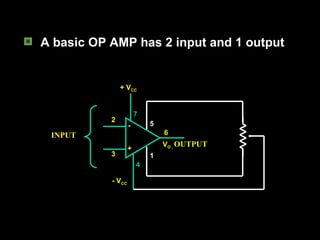
A basic OP AMP has 2 input and 1 output   - + V O ,  OUTPUT 2 3 6 + V CC 4 7 - V CC INPUT 1 5
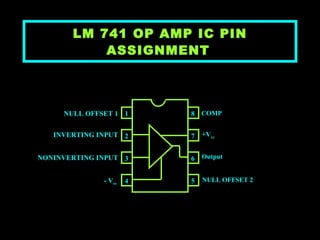
LM 741 OP AMP IC PIN ASSIGNMENT   OP-AMP LM741 IC Pin Assignment   NULL OFFSET 1 INVERTING INPUT NONINVERTING INPUT - V cc NULL OFFSET 2 Output +V cc COMP 1 2 3 4 8 7 6 5
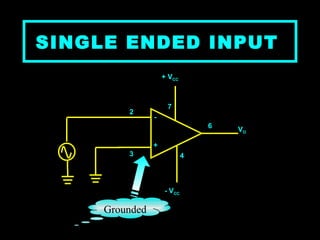
Single ended Input operation results when the  input signal is connected to one input  and with the  other input is connected to the ground . SINGLE ENDED INPUT  
- + V O 2 3 6 + V CC 4 7 - V CC Grounded  SINGLE ENDED INPUT  
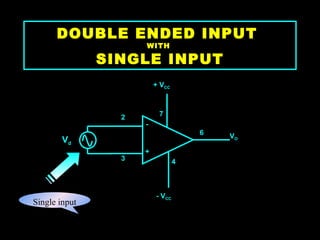
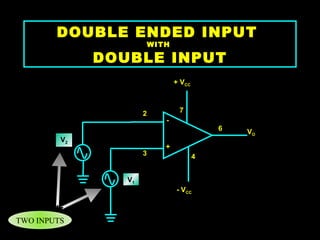
A double-ended input can be designed using a  single input  or using  double inputs  DOUBLE ENDED INPUT  
DOUBLE ENDED INPUT  WITH  SINGLE INPUT - + V O 2 3 6 + V CC 4 7 - V CC V d Single input
DOUBLE ENDED INPUT  WITH  DOUBLE INPUT - + V O 2 3 6 + V CC 4 7 - V CC V 2 V 1 TWO INPUTS
For the  double input circuit  the supplied voltage is equal to the difference between the two input signals.   DOUBLE ENDED INPUT  
DIFFERENTIAL INPUT When separate inputs are applied to the op-amp, the resulting difference signal is the difference between the two inputs.
COMMON INPUT When both input signals are the same, a common signal element due to the two inputs can be defined as the average of the sum of the two signals.
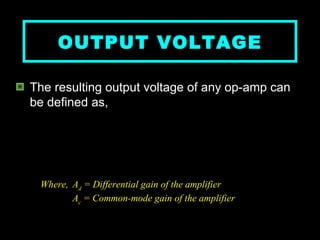
OUTPUT VOLTAGE The resulting output voltage of any op-amp can be defined as,   Where,  A d  = Differential gain of the amplifier A c  = Common-mode gain of the amplifier
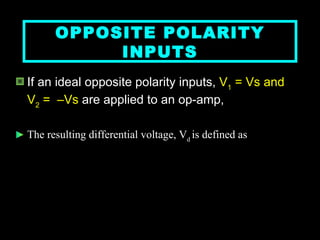
OPPOSITE POLARITY INPUTS If an ideal opposite polarity inputs,  V 1  = Vs and V 2  =  –Vs  are applied to an op-amp,  The resulting differential voltage, V d  is defined as
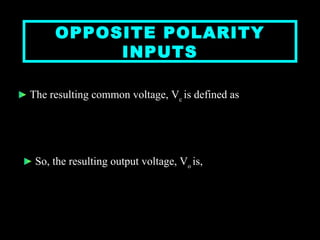
OPPOSITE POLARITY INPUTS The resulting common voltage, V c  is defined as   So, the resulting output voltage, V o  is,
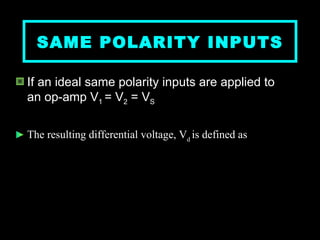
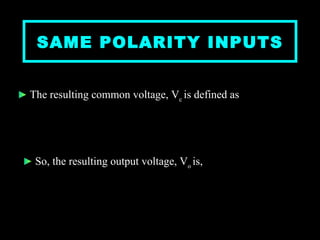
SAME POLARITY INPUTS If an ideal same polarity inputs are applied to an op-amp  V 1  = V 2  = V S The resulting differential voltage, V d  is defined as
SAME POLARITY INPUTS The resulting common voltage, V c  is defined as   So, the resulting output voltage, V o  is,
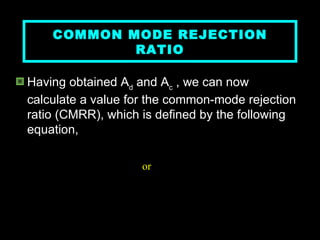
COMMON MODE REJECTION RATIO Having obtained A d  and A c  , we can now calculate a value for the common-mode rejection ratio (CMRR), which is defined by the following equation,   or
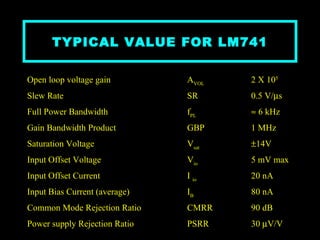
TYPICAL VALUE FOR LM741 Open loop voltage gain A VOL 2 X 10 5   Slew Rate SR 0.5 V/  s   Full Power Bandwidth f PL   6 kHz   Gain Bandwidth Product GBP 1 MHz Saturation Voltage V sat  14V Input Offset Voltage V io 5 mV max  Input Offset Current I  io 20 nA Input Bias Current (average) I B 80 nA Common Mode Rejection Ratio  CMRR 90 dB Power supply Rejection Ratio PSRR 30   V/V

Op-Amp Fundamental

  • 1.
    OPERATIONAL AMPLIFIER An operational amplifier or OP AMP is a very high gain differential amplifier with high input impedance and low output impedance .
  • 2.
    A basic OPAMP has 2 input and 1 output - + V O , OUTPUT 2 3 6 + V CC 4 7 - V CC INPUT 1 5
  • 3.
    LM 741 OPAMP IC PIN ASSIGNMENT OP-AMP LM741 IC Pin Assignment NULL OFFSET 1 INVERTING INPUT NONINVERTING INPUT - V cc NULL OFFSET 2 Output +V cc COMP 1 2 3 4 8 7 6 5
  • 4.
    Single ended Inputoperation results when the input signal is connected to one input and with the other input is connected to the ground . SINGLE ENDED INPUT  
  • 5.
    - + VO 2 3 6 + V CC 4 7 - V CC Grounded SINGLE ENDED INPUT  
  • 6.
    A double-ended inputcan be designed using a single input or using double inputs DOUBLE ENDED INPUT  
  • 7.
    DOUBLE ENDED INPUT WITH SINGLE INPUT - + V O 2 3 6 + V CC 4 7 - V CC V d Single input
  • 8.
    DOUBLE ENDED INPUT WITH DOUBLE INPUT - + V O 2 3 6 + V CC 4 7 - V CC V 2 V 1 TWO INPUTS
  • 9.
    For the double input circuit the supplied voltage is equal to the difference between the two input signals. DOUBLE ENDED INPUT  
  • 10.
    DIFFERENTIAL INPUT Whenseparate inputs are applied to the op-amp, the resulting difference signal is the difference between the two inputs.
  • 11.
    COMMON INPUT Whenboth input signals are the same, a common signal element due to the two inputs can be defined as the average of the sum of the two signals.
  • 12.
    OUTPUT VOLTAGE Theresulting output voltage of any op-amp can be defined as, Where, A d = Differential gain of the amplifier A c = Common-mode gain of the amplifier
  • 13.
    OPPOSITE POLARITY INPUTSIf an ideal opposite polarity inputs, V 1 = Vs and V 2 = –Vs are applied to an op-amp, The resulting differential voltage, V d is defined as
  • 14.
    OPPOSITE POLARITY INPUTSThe resulting common voltage, V c is defined as So, the resulting output voltage, V o is,
  • 15.
    SAME POLARITY INPUTSIf an ideal same polarity inputs are applied to an op-amp V 1 = V 2 = V S The resulting differential voltage, V d is defined as
  • 16.
    SAME POLARITY INPUTSThe resulting common voltage, V c is defined as So, the resulting output voltage, V o is,
  • 17.
    COMMON MODE REJECTIONRATIO Having obtained A d and A c , we can now calculate a value for the common-mode rejection ratio (CMRR), which is defined by the following equation, or
  • 18.
    TYPICAL VALUE FORLM741 Open loop voltage gain A VOL 2 X 10 5 Slew Rate SR 0.5 V/  s Full Power Bandwidth f PL  6 kHz Gain Bandwidth Product GBP 1 MHz Saturation Voltage V sat  14V Input Offset Voltage V io 5 mV max Input Offset Current I io 20 nA Input Bias Current (average) I B 80 nA Common Mode Rejection Ratio CMRR 90 dB Power supply Rejection Ratio PSRR 30  V/V