Opamp
The 741 Op-Amp Circuit
• Schematic diagram of OP-AMP consists:
• The input stage
• The intermediate stage
• The output stage
• The biasing circuits
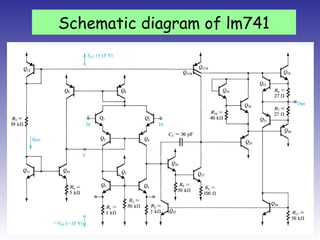
Schematic diagram of lm741
• 24 transistors, few resistors and only
one capacitor
• Two power supplies
• Short-circuit protection
General Description
• The input stage consists of transistors Q1
through Q7.
• Q1-Q4 is the differential version of CC and
CB configuration.
• High input resistance.
• Current source (Q5-Q7) is the active load of
input stage. It not only provides a high-
resistance load but also converts the signal
from differential to single-ended form with no
loss in gain or common-mode rejection.
The Input Stage
• The intermediate stage is composed of
Q16, Q17 and Q13B.
• Common-collector configuration for Q16
gives this stage a high input resistance
as well as reduces the load effect on
the input stage.
• Common-emitter configuration for Q17
provides high voltage gain because of
the active load Q13B.
The Intermediate Stage
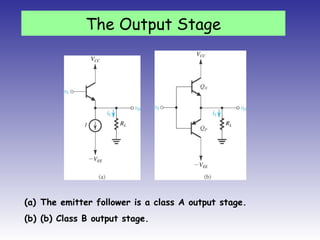
• The output stage is the efficient circuit called class
AB output stage.
• Voltage source composed of Q18 and Q19 supplies
the DC voltage for Q14 and Q20 in order to reduce
the cross-over distortion.
• Q23 is the CC configuration to reduce the load
effect on intermediate stage.
The Output Stage
(a) The emitter follower is a class A output stage.
(b) (b) Class B output stage.
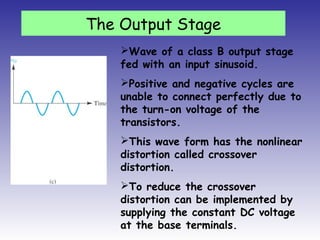
The Output Stage
Wave of a class B output stage
fed with an input sinusoid.
Positive and negative cycles are
unable to connect perfectly due to
the turn-on voltage of the
transistors.
This wave form has the nonlinear
distortion called crossover
distortion.
To reduce the crossover
distortion can be implemented by
supplying the constant DC voltage
at the base terminals.
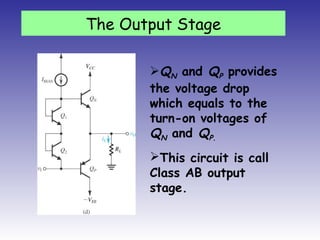
The Output Stage
QN and QP provides
the voltage drop
which equals to the
turn-on voltages of
QN and QP.
This circuit is call
Class AB output
stage.
The Output Stage
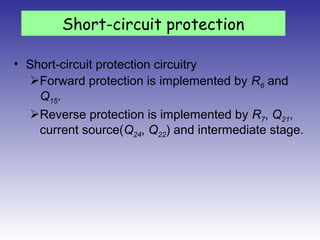
• Short-circuit protection circuitry
Forward protection is implemented by R6 and
Q15.
Reverse protection is implemented by R7, Q21,
current source(Q24, Q22) and intermediate stage.
Short-circuit protection
• Reference current is generated by Q12, Q11
and R5.
• Wilder current provides biasing current in the
order of μA.
• Q13B provides biasing current for intermediate
stage, Q13A for output stage.
• Q5, Q6 and Q7 is composed of the current
source to be an active load for input stage.
The Biasing Circuits
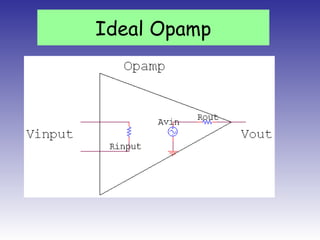
Ideal Opamp
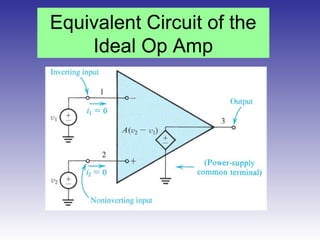
Equivalent Circuit of the
Ideal Op Amp
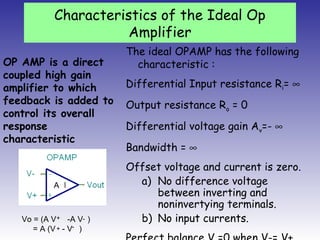
Characteristics of the Ideal Op
Amplifier
The ideal OPAMP has the following
characteristic :
Differential Input resistance Ri= ∞
Output resistance Ro = 0
Differential voltage gain Av=- ∞
Bandwidth = ∞
Offset voltage and current is zero.
a) No difference voltage
between inverting and
noninvertying terminals.
b) No input currents.
A
Vo = (A V -A V )
= A (V - V )
+
+
-
-
OP AMP is a direct
coupled high gain
amplifier to which
feedback is added to
control its overall
response
characteristic
Operational Amplifier (OP AMP)
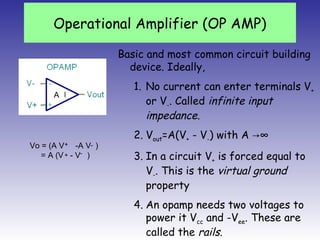
Basic and most common circuit building
device. Ideally,
1. No current can enter terminals V+
or V-. Called infinite input
impedance.
2. Vout=A(V+ - V-) with A ∞→
3. In a circuit V+ is forced equal to
V-. This is the virtual ground
property
4. An opamp needs two voltages to
power it Vcc and -Vee. These are
called the rails.
A
Vo = (A V -A V )
= A (V - V )
+
+
-
-
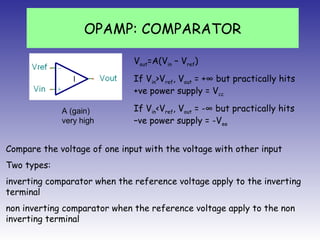
OPAMP: COMPARATOR
Vout=A(Vin – Vref)
If Vin>Vref, Vout = +∞ but practically hits
+ve power supply = Vcc
If Vin<Vref, Vout = -∞ but practically hits
–ve power supply = -Vee
Compare the voltage of one input with the voltage with other input
Two types:
inverting comparator when the reference voltage apply to the inverting
terminal
non inverting comparator when the reference voltage apply to the non
inverting terminal
A (gain)
very high
24
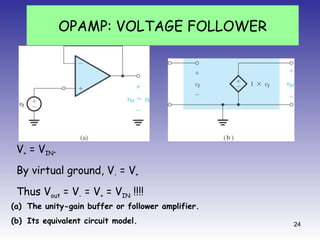
(a) The unity-gain buffer or follower amplifier.
(b) Its equivalent circuit model.
V+ = VIN.
By virtual ground, V- = V+
Thus Vout = V- = V+ = VIN !!!!
OPAMP: VOLTAGE FOLLOWER
SJTU Zhou Lingling 25
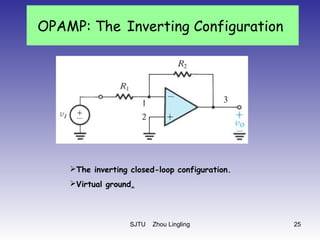
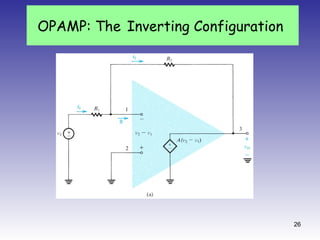
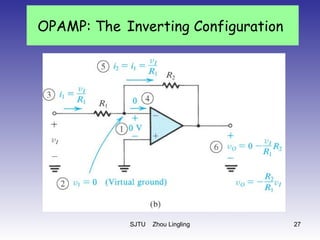
The inverting closed-loop configuration.
Virtual ground.
OPAMP: The Inverting Configuration
26
OPAMP: The Inverting Configuration
SJTU Zhou Lingling 27
OPAMP: The Inverting Configuration
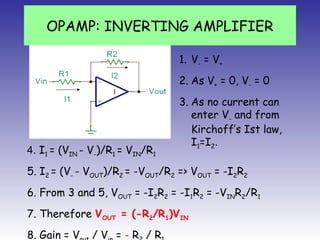
OPAMP: INVERTING AMPLIFIER
1. V- = V+
2. As V+ = 0, V- = 0
3. As no current can
enter V- and from
Kirchoff’s Ist law,
I1=I2.
4. I1 = (VIN - V-)/R1 = VIN/R1
5. I2 = (V- - VOUT)/R2 = -VOUT/R2 => VOUT = -I2R2
6. From 3 and 5, VOUT = -I2R2 = -I1R2 = -VINR2/R1
7. Therefore VOUT = (-R2/R1)VIN
8. Gain = V / V = - R / R
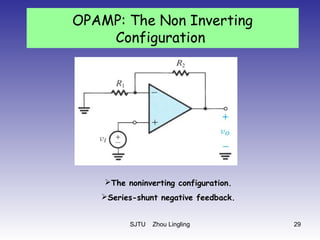
SJTU Zhou Lingling 29
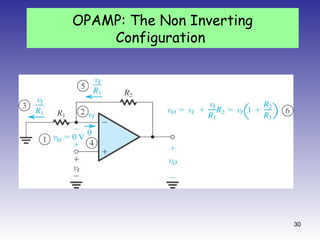
The noninverting configuration.
Series-shunt negative feedback.
OPAMP: The Non Inverting
Configuration
30
OPAMP: The Non Inverting
Configuration
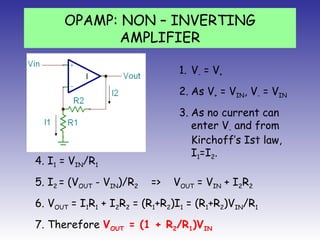
OPAMP: NON – INVERTING
AMPLIFIER
1. V- = V+
2. As V+ = VIN, V- = VIN
3. As no current can
enter V- and from
Kirchoff’s Ist law,
I1=I2.
4. I1 = VIN/R1
5. I2 = (VOUT - VIN)/R2 => VOUT = VIN + I2R2
6. VOUT = I1R1 + I2R2 = (R1+R2)I1 = (R1+R2)VIN/R1
7. Therefore VOUT = (1 + R2/R1)VIN
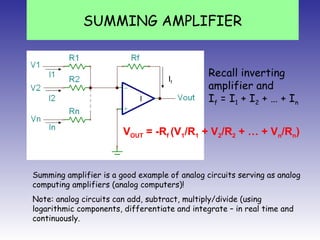
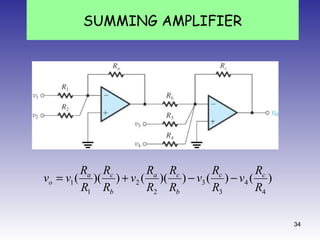
SUMMING AMPLIFIER
VOUT = -Rf (V1/R1 + V2/R2 + … + Vn/Rn)
If
Recall inverting
amplifier and
If = I1 + I2 + … + In
Summing amplifier is a good example of analog circuits serving as analog
computing amplifiers (analog computers)!
Note: analog circuits can add, subtract, multiply/divide (using
logarithmic components, differentiate and integrate – in real time and
continuously.
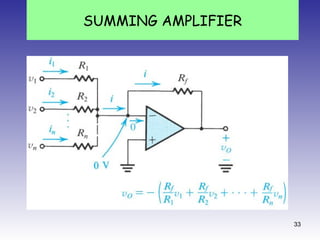
33
SUMMING AMPLIFIER
34
)()())(())((
4
4
3
3
2
2
1
1
R
R
v
R
R
v
R
R
R
R
v
R
R
R
R
vv cc
b
ca
b
ca
o −−+=
SUMMING AMPLIFIER
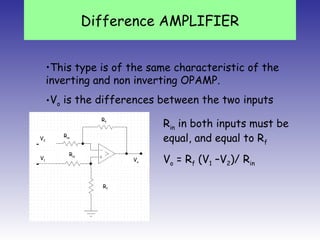
Difference AMPLIFIER
•This type is of the same characteristic of the
inverting and non inverting OPAMP.
•Vo is the differences between the two inputs
• Rin in both inputs must be
equal, and equal to Rf
Vo = Rf (V1 –V2)/ Rin
Rf
Rin
Rin
V2
V1
Rf
Vo
37
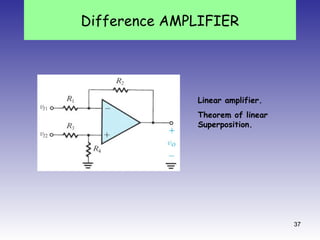
Linear amplifier.
Theorem of linear
Superposition.
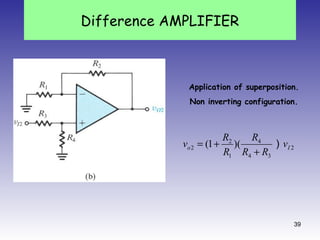
Difference AMPLIFIER
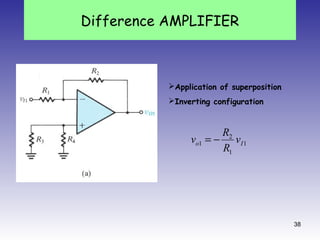
38
Application of superposition
Inverting configuration
1
1
2
1 Io v
R
R
v −=
Difference AMPLIFIER
39
Application of superposition.
Non inverting configuration.
2
34
4
1
2
2 )(1( Io v
RR
R
R
R
v )
+
+=
Difference AMPLIFIER
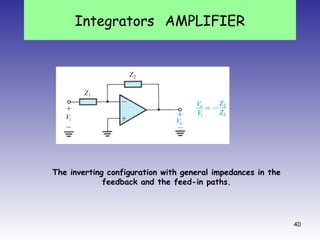
40
The inverting configuration with general impedances in the
feedback and the feed-in paths.
Integrators AMPLIFIER
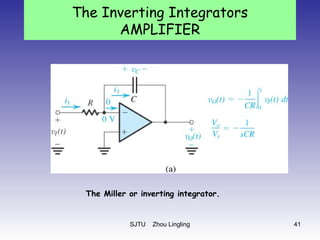
SJTU Zhou Lingling 41
The Miller or inverting integrator.
The Inverting Integrators
AMPLIFIER

Operational Amplifier (OpAmp)

  • 1.
  • 4.
    The 741 Op-AmpCircuit • Schematic diagram of OP-AMP consists: • The input stage • The intermediate stage • The output stage • The biasing circuits
  • 5.
  • 6.
    • 24 transistors,few resistors and only one capacitor • Two power supplies • Short-circuit protection General Description
  • 7.
    • The inputstage consists of transistors Q1 through Q7. • Q1-Q4 is the differential version of CC and CB configuration. • High input resistance. • Current source (Q5-Q7) is the active load of input stage. It not only provides a high- resistance load but also converts the signal from differential to single-ended form with no loss in gain or common-mode rejection. The Input Stage
  • 8.
    • The intermediatestage is composed of Q16, Q17 and Q13B. • Common-collector configuration for Q16 gives this stage a high input resistance as well as reduces the load effect on the input stage. • Common-emitter configuration for Q17 provides high voltage gain because of the active load Q13B. The Intermediate Stage
  • 9.
    • The outputstage is the efficient circuit called class AB output stage. • Voltage source composed of Q18 and Q19 supplies the DC voltage for Q14 and Q20 in order to reduce the cross-over distortion. • Q23 is the CC configuration to reduce the load effect on intermediate stage. The Output Stage
  • 10.
    (a) The emitterfollower is a class A output stage. (b) (b) Class B output stage. The Output Stage
  • 11.
    Wave of aclass B output stage fed with an input sinusoid. Positive and negative cycles are unable to connect perfectly due to the turn-on voltage of the transistors. This wave form has the nonlinear distortion called crossover distortion. To reduce the crossover distortion can be implemented by supplying the constant DC voltage at the base terminals. The Output Stage
  • 12.
    QN and QPprovides the voltage drop which equals to the turn-on voltages of QN and QP. This circuit is call Class AB output stage. The Output Stage
  • 13.
    • Short-circuit protectioncircuitry Forward protection is implemented by R6 and Q15. Reverse protection is implemented by R7, Q21, current source(Q24, Q22) and intermediate stage. Short-circuit protection
  • 14.
    • Reference currentis generated by Q12, Q11 and R5. • Wilder current provides biasing current in the order of μA. • Q13B provides biasing current for intermediate stage, Q13A for output stage. • Q5, Q6 and Q7 is composed of the current source to be an active load for input stage. The Biasing Circuits
  • 15.
  • 16.
    Equivalent Circuit ofthe Ideal Op Amp
  • 17.
    Characteristics of theIdeal Op Amplifier The ideal OPAMP has the following characteristic : Differential Input resistance Ri= ∞ Output resistance Ro = 0 Differential voltage gain Av=- ∞ Bandwidth = ∞ Offset voltage and current is zero. a) No difference voltage between inverting and noninvertying terminals. b) No input currents. A Vo = (A V -A V ) = A (V - V ) + + - - OP AMP is a direct coupled high gain amplifier to which feedback is added to control its overall response characteristic
  • 18.
    Operational Amplifier (OPAMP) Basic and most common circuit building device. Ideally, 1. No current can enter terminals V+ or V-. Called infinite input impedance. 2. Vout=A(V+ - V-) with A ∞→ 3. In a circuit V+ is forced equal to V-. This is the virtual ground property 4. An opamp needs two voltages to power it Vcc and -Vee. These are called the rails. A Vo = (A V -A V ) = A (V - V ) + + - -
  • 19.
    OPAMP: COMPARATOR Vout=A(Vin –Vref) If Vin>Vref, Vout = +∞ but practically hits +ve power supply = Vcc If Vin<Vref, Vout = -∞ but practically hits –ve power supply = -Vee Compare the voltage of one input with the voltage with other input Two types: inverting comparator when the reference voltage apply to the inverting terminal non inverting comparator when the reference voltage apply to the non inverting terminal A (gain) very high
  • 20.
    24 (a) The unity-gainbuffer or follower amplifier. (b) Its equivalent circuit model. V+ = VIN. By virtual ground, V- = V+ Thus Vout = V- = V+ = VIN !!!! OPAMP: VOLTAGE FOLLOWER
  • 21.
    SJTU Zhou Lingling25 The inverting closed-loop configuration. Virtual ground. OPAMP: The Inverting Configuration
  • 22.
  • 23.
    SJTU Zhou Lingling27 OPAMP: The Inverting Configuration
  • 24.
    OPAMP: INVERTING AMPLIFIER 1.V- = V+ 2. As V+ = 0, V- = 0 3. As no current can enter V- and from Kirchoff’s Ist law, I1=I2. 4. I1 = (VIN - V-)/R1 = VIN/R1 5. I2 = (V- - VOUT)/R2 = -VOUT/R2 => VOUT = -I2R2 6. From 3 and 5, VOUT = -I2R2 = -I1R2 = -VINR2/R1 7. Therefore VOUT = (-R2/R1)VIN 8. Gain = V / V = - R / R
  • 25.
    SJTU Zhou Lingling29 The noninverting configuration. Series-shunt negative feedback. OPAMP: The Non Inverting Configuration
  • 26.
    30 OPAMP: The NonInverting Configuration
  • 27.
    OPAMP: NON –INVERTING AMPLIFIER 1. V- = V+ 2. As V+ = VIN, V- = VIN 3. As no current can enter V- and from Kirchoff’s Ist law, I1=I2. 4. I1 = VIN/R1 5. I2 = (VOUT - VIN)/R2 => VOUT = VIN + I2R2 6. VOUT = I1R1 + I2R2 = (R1+R2)I1 = (R1+R2)VIN/R1 7. Therefore VOUT = (1 + R2/R1)VIN
  • 28.
    SUMMING AMPLIFIER VOUT =-Rf (V1/R1 + V2/R2 + … + Vn/Rn) If Recall inverting amplifier and If = I1 + I2 + … + In Summing amplifier is a good example of analog circuits serving as analog computing amplifiers (analog computers)! Note: analog circuits can add, subtract, multiply/divide (using logarithmic components, differentiate and integrate – in real time and continuously.
  • 29.
  • 30.
  • 31.
    Difference AMPLIFIER •This typeis of the same characteristic of the inverting and non inverting OPAMP. •Vo is the differences between the two inputs • Rin in both inputs must be equal, and equal to Rf Vo = Rf (V1 –V2)/ Rin Rf Rin Rin V2 V1 Rf Vo
  • 32.
    37 Linear amplifier. Theorem oflinear Superposition. Difference AMPLIFIER
  • 33.
    38 Application of superposition Invertingconfiguration 1 1 2 1 Io v R R v −= Difference AMPLIFIER
  • 34.
    39 Application of superposition. Noninverting configuration. 2 34 4 1 2 2 )(1( Io v RR R R R v ) + += Difference AMPLIFIER
  • 35.
    40 The inverting configurationwith general impedances in the feedback and the feed-in paths. Integrators AMPLIFIER
  • 36.
    SJTU Zhou Lingling41 The Miller or inverting integrator. The Inverting Integrators AMPLIFIER