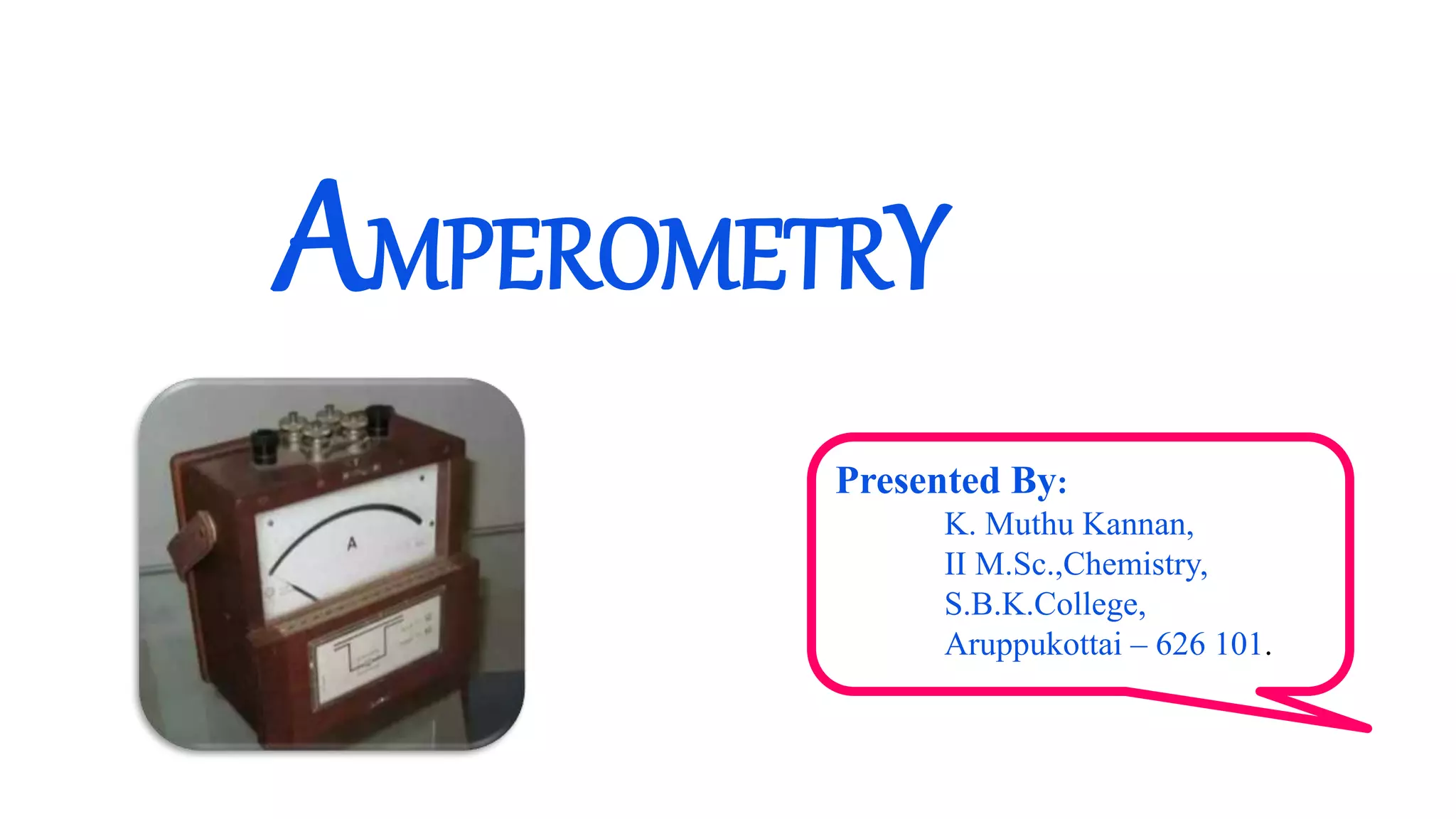


AMPEROMETRY
Presented By:
K. Muthu Kannan,
II M.Sc.,Chemistry,
S.B.K.College,
Aruppukottai – 626 101.
2
CONTENTS
Introduction
Principle
Instrumentation
Titration curves
Advantages
Disadvantages
Applications
 It is one of the electrochemical method.
 It is form of quantitative analysis.
 Derived form ampere, the unit of current.
 It refers to the measurement of current under a constant applied voltage.
 Concentration of the analyte which determine magnitude of the current.
 Diffusion current (or limiting current – residual current) is proportional to the
concentration of the electroactive material present in the solution.
 Electroactive material is removed by interaction with titrating reagent, the
diffusion current will decrease.
INTRODUCTION
3
PRINCIPLE
 Potential applied between the indicator electrode (Dropping mercury
electrode) and reference electrode (Saturated calomel electrode) is kept
constant and the current through the electrolytic cell is then measured on
the addition of each increment of titrating solution.
 The diffusion current at an appropriate applied voltage is measured as a
function of the volume of the titrating solution.
 The end point is the intersection of two lines giving the change of current
before and after the equivalence point.
4
PRINCIPLE
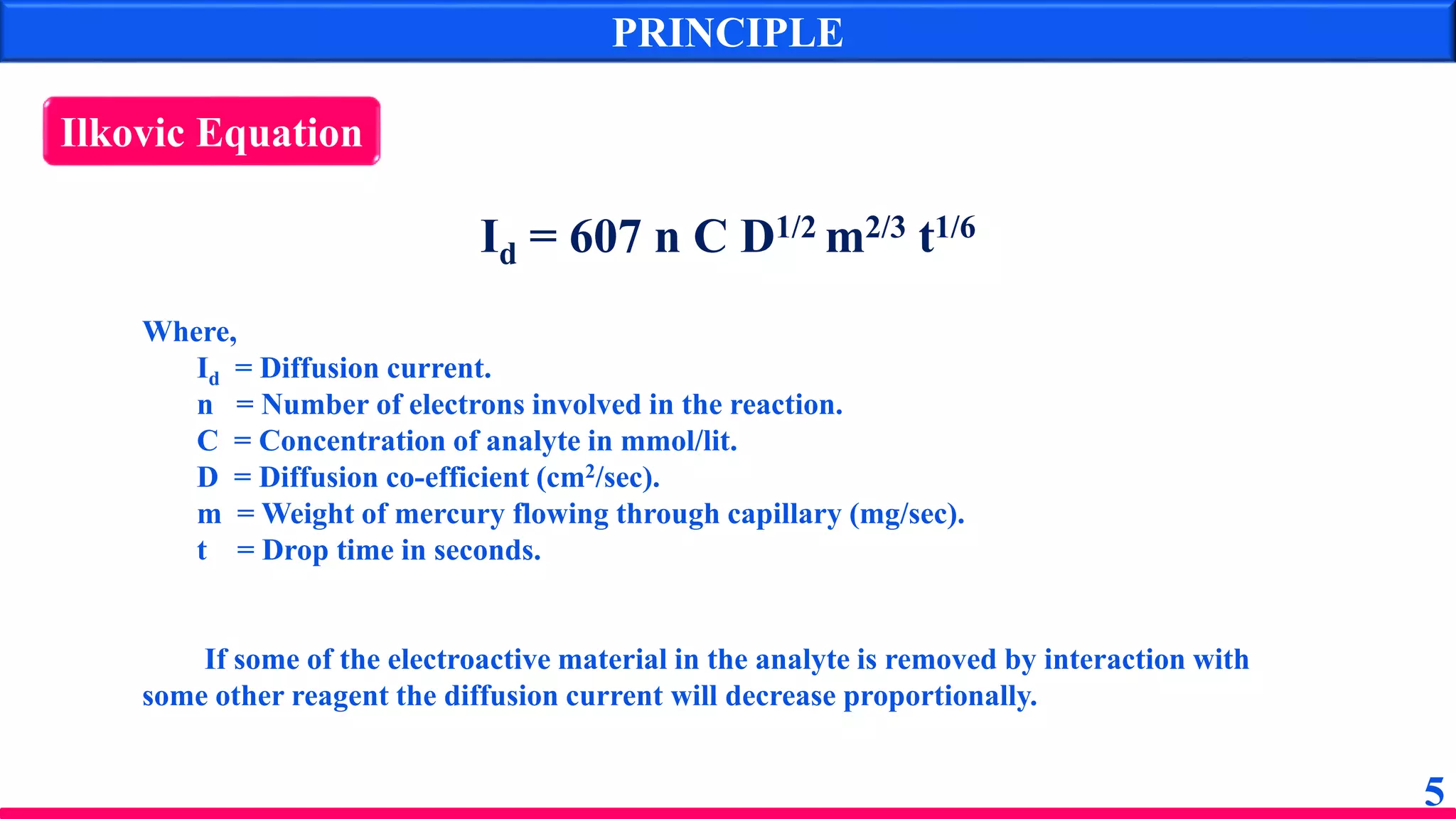
Id = 607 n C D1/2 m2/3 t1/6
Where,
Id = Diffusion current.
n = Number of electrons involved in the reaction.
C = Concentration of analyte in mmol/lit.
D = Diffusion co-efficient (cm2/sec).
m = Weight of mercury flowing through capillary (mg/sec).
t = Drop time in seconds.
If some of the electroactive material in the analyte is removed by interaction with
some other reagent the diffusion current will decrease proportionally.
Ilkovic Equation
5
INSTRUMENTATION
Apparatus
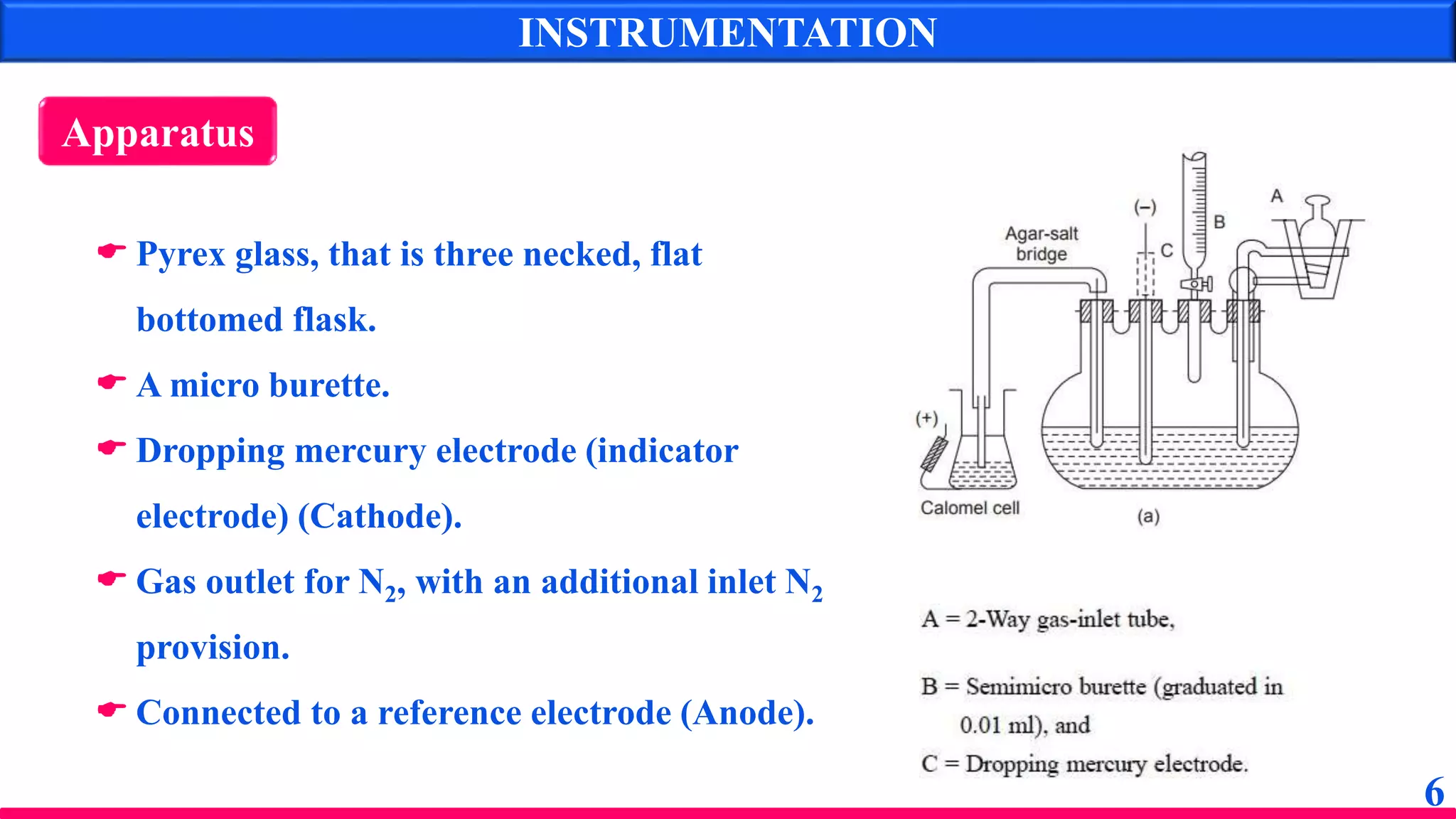
 Pyrex glass, that is three necked, flat
bottomed flask.
 A micro burette.
 Dropping mercury electrode (indicator
electrode) (Cathode).
 Gas outlet for N2, with an additional inlet N2
provision.
 Connected to a reference electrode (Anode).
6
7
INSTRUMENTATION
Dropping Mercury Electrode
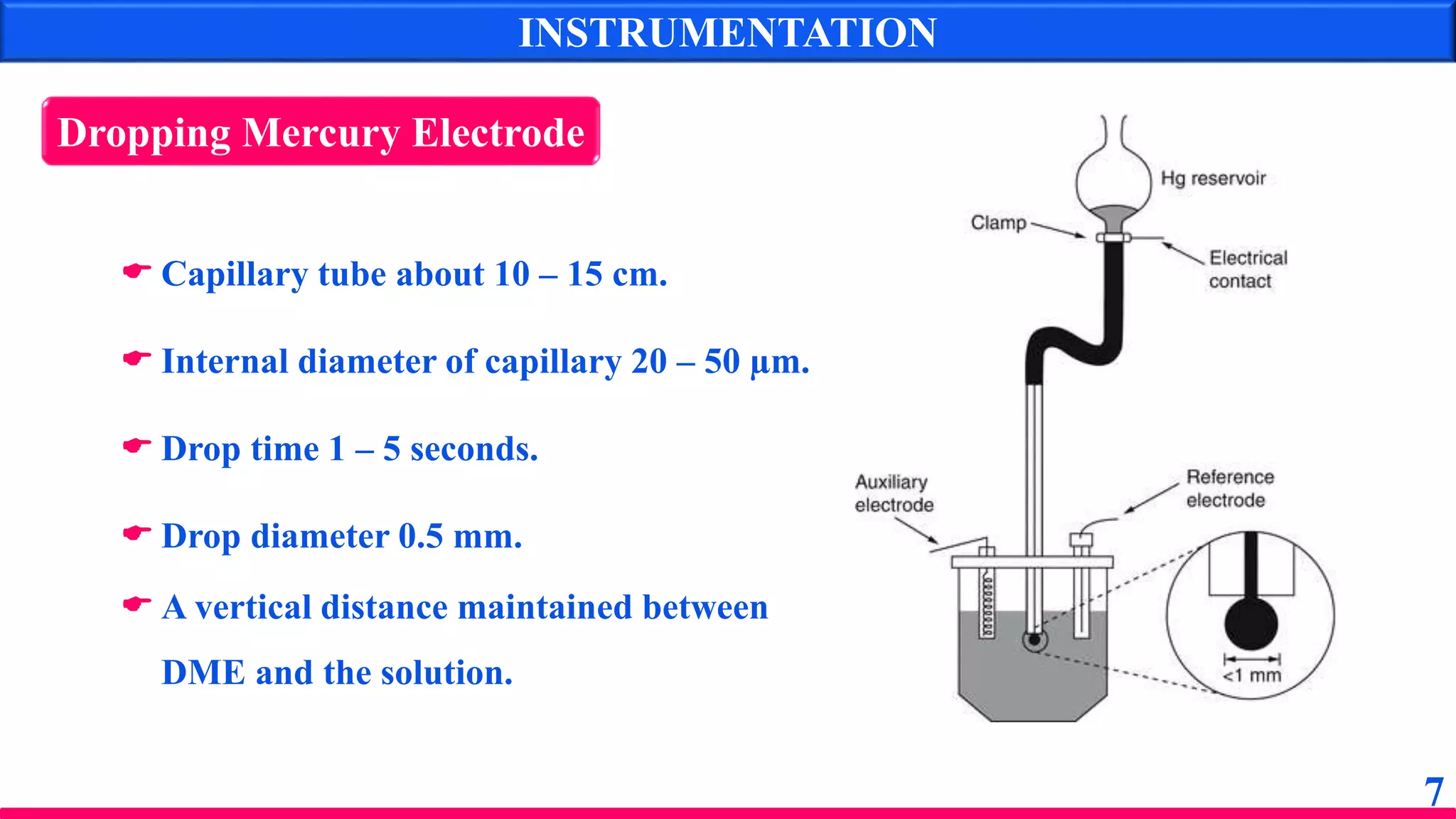
 Capillary tube about 10 – 15 cm.
 Internal diameter of capillary 20 – 50 µm.
 Drop time 1 – 5 seconds.
 Drop diameter 0.5 mm.
 A vertical distance maintained between
DME and the solution.
8
INSTRUMENTATION
Rotating Platinum Micro-Electrode
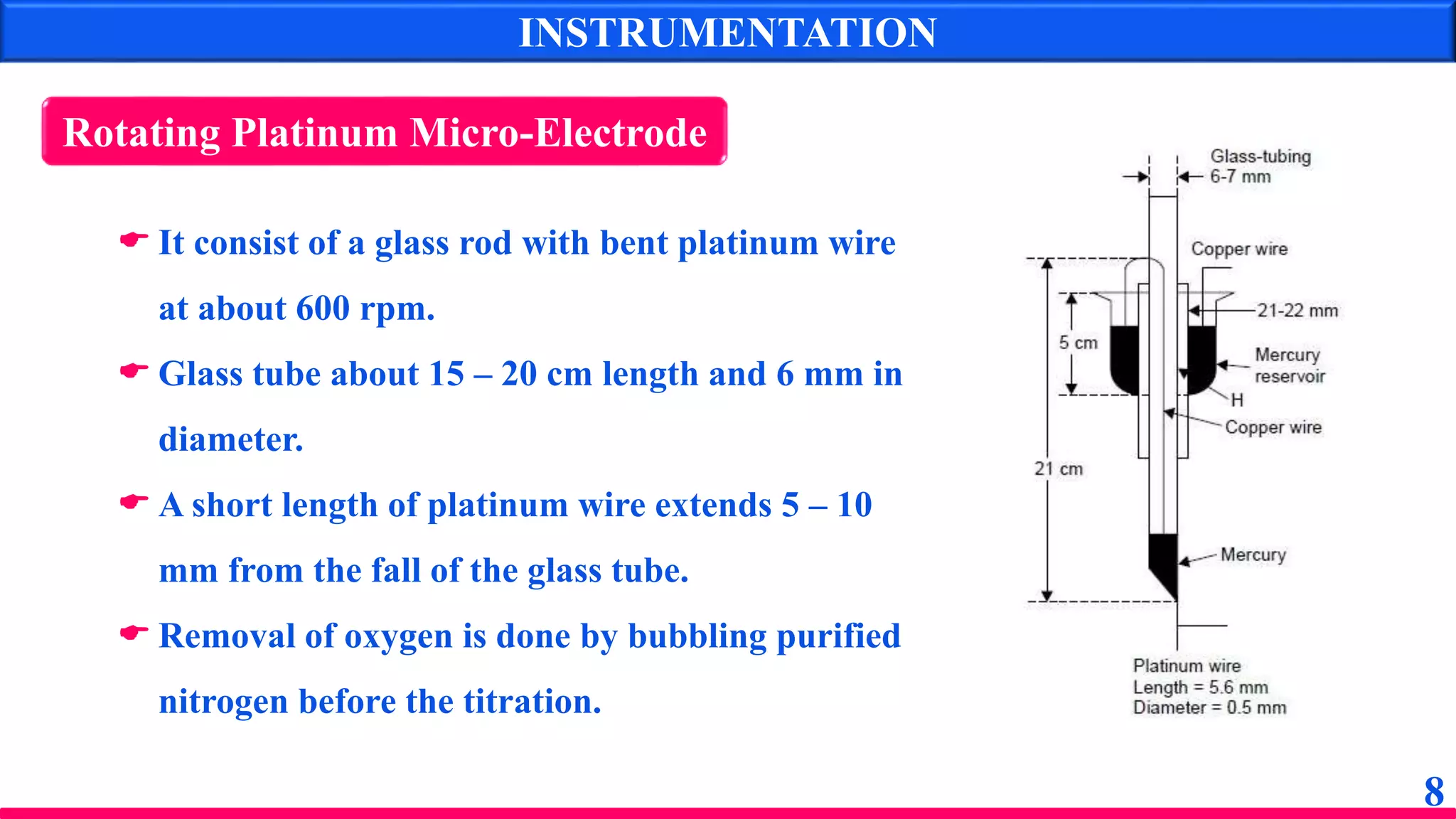
 It consist of a glass rod with bent platinum wire
at about 600 rpm.
 Glass tube about 15 – 20 cm length and 6 mm in
diameter.
 A short length of platinum wire extends 5 – 10
mm from the fall of the glass tube.
 Removal of oxygen is done by bubbling purified
nitrogen before the titration.
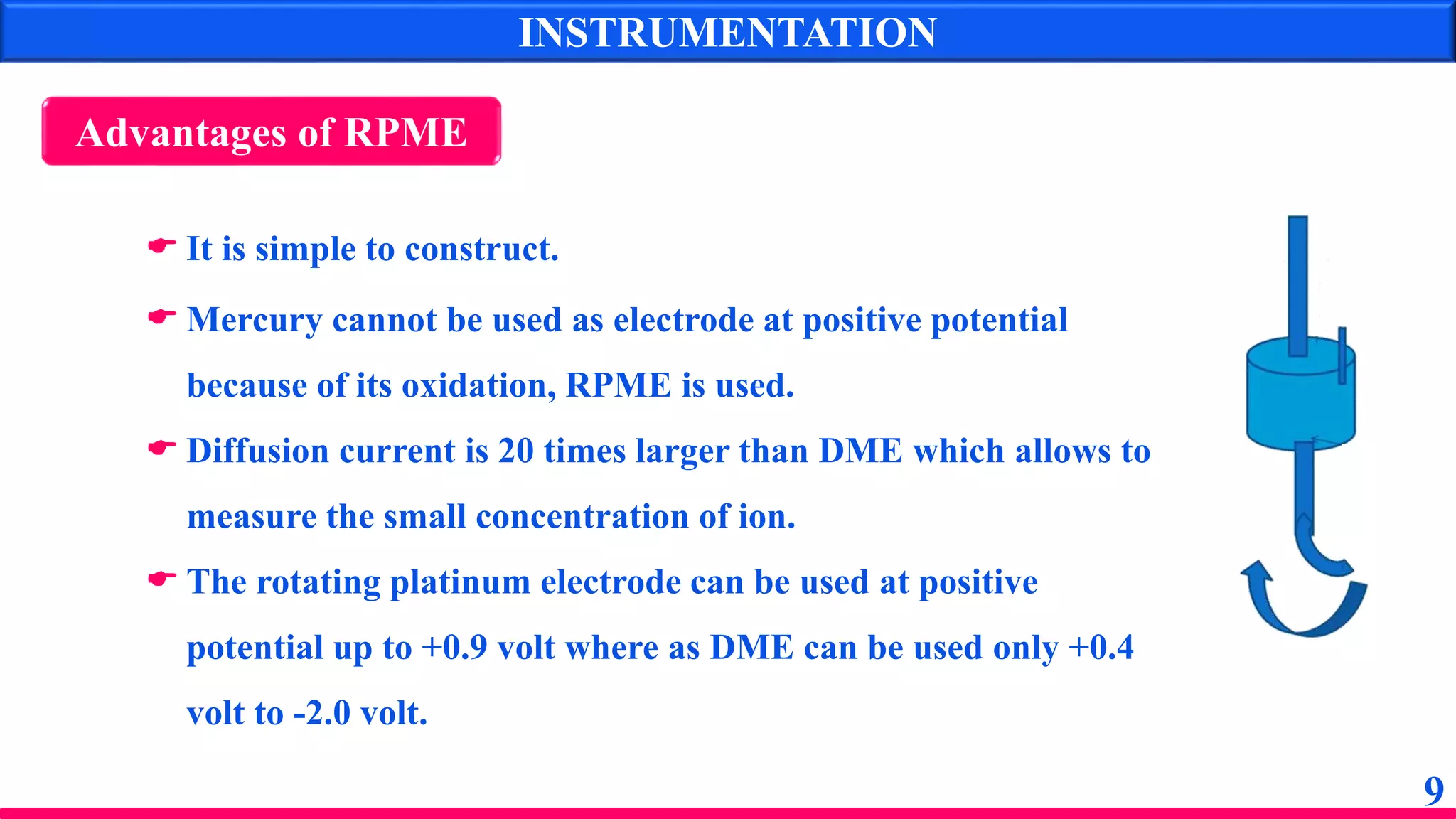
 It is simple to construct.
 Mercury cannot be used as electrode at positive potential
because of its oxidation, RPME is used.
 Diffusion current is 20 times larger than DME which allows to
measure the small concentration of ion.
 The rotating platinum electrode can be used at positive
potential up to +0.9 volt where as DME can be used only +0.4
volt to -2.0 volt.
Advantages of RPME
INSTRUMENTATION
9
AMPEROMETRIC TITRATION
10
 The diffusion current at an appropriate applied voltage is measured
as a function of the volume of the titrating solution.
 Intersection of two lines providing the change of current before and
after the equivalence point.
 Depending on the selection of the applied voltage among DME and
reference electrode various kinds of titration curves are obtained.
Titrating Curves
11
AMPEROMETRIC TITRATION CURVES
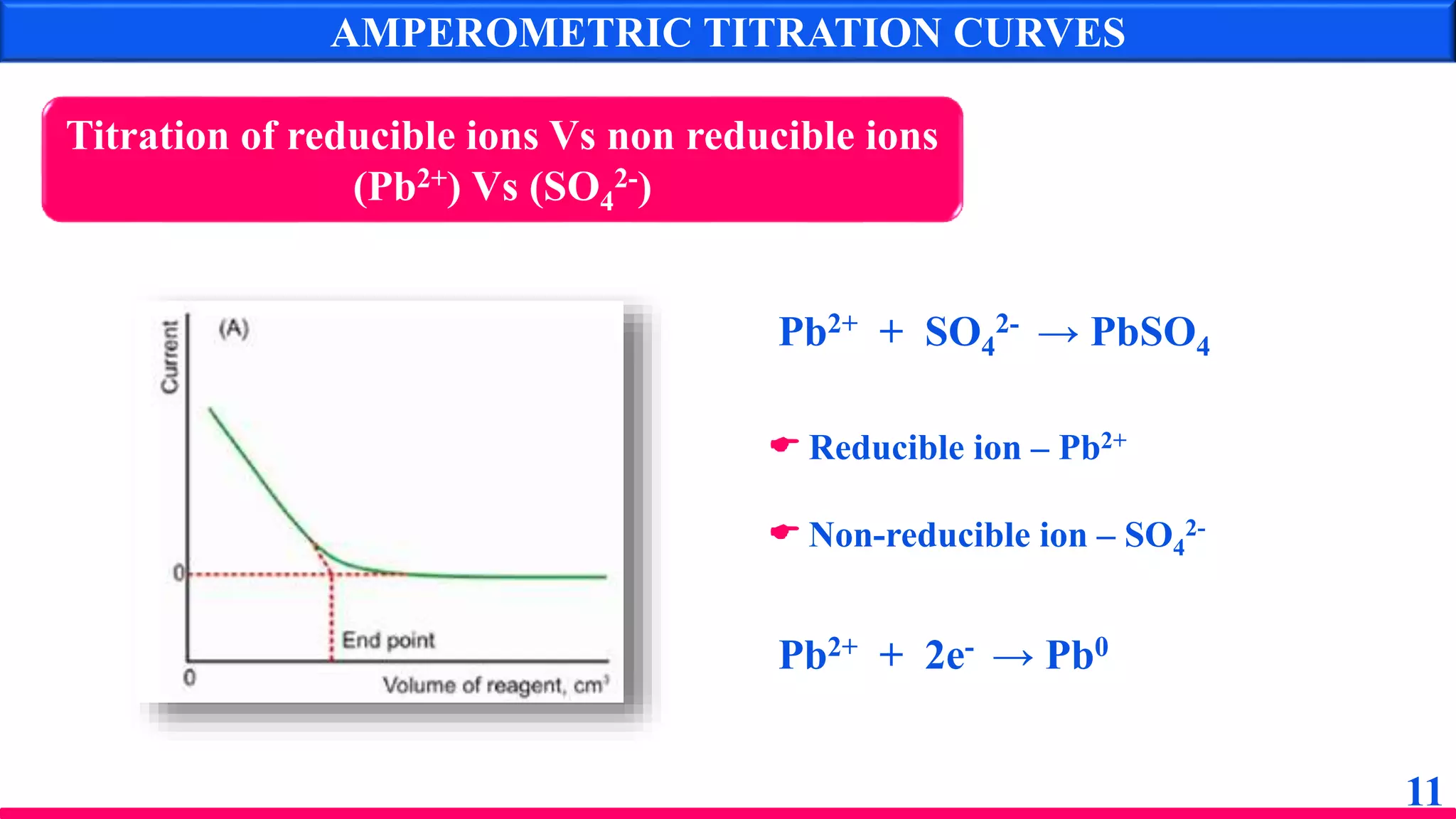
Titration of reducible ions Vs non reducible ions
(Pb2+) Vs (SO4
2-)
 Reducible ion – Pb2+
 Non-reducible ion – SO4
2-
Pb2+ + SO4
2- → PbSO4
Pb2+ + 2e- → Pb0
12
AMPEROMETRIC TITRATION CURVES
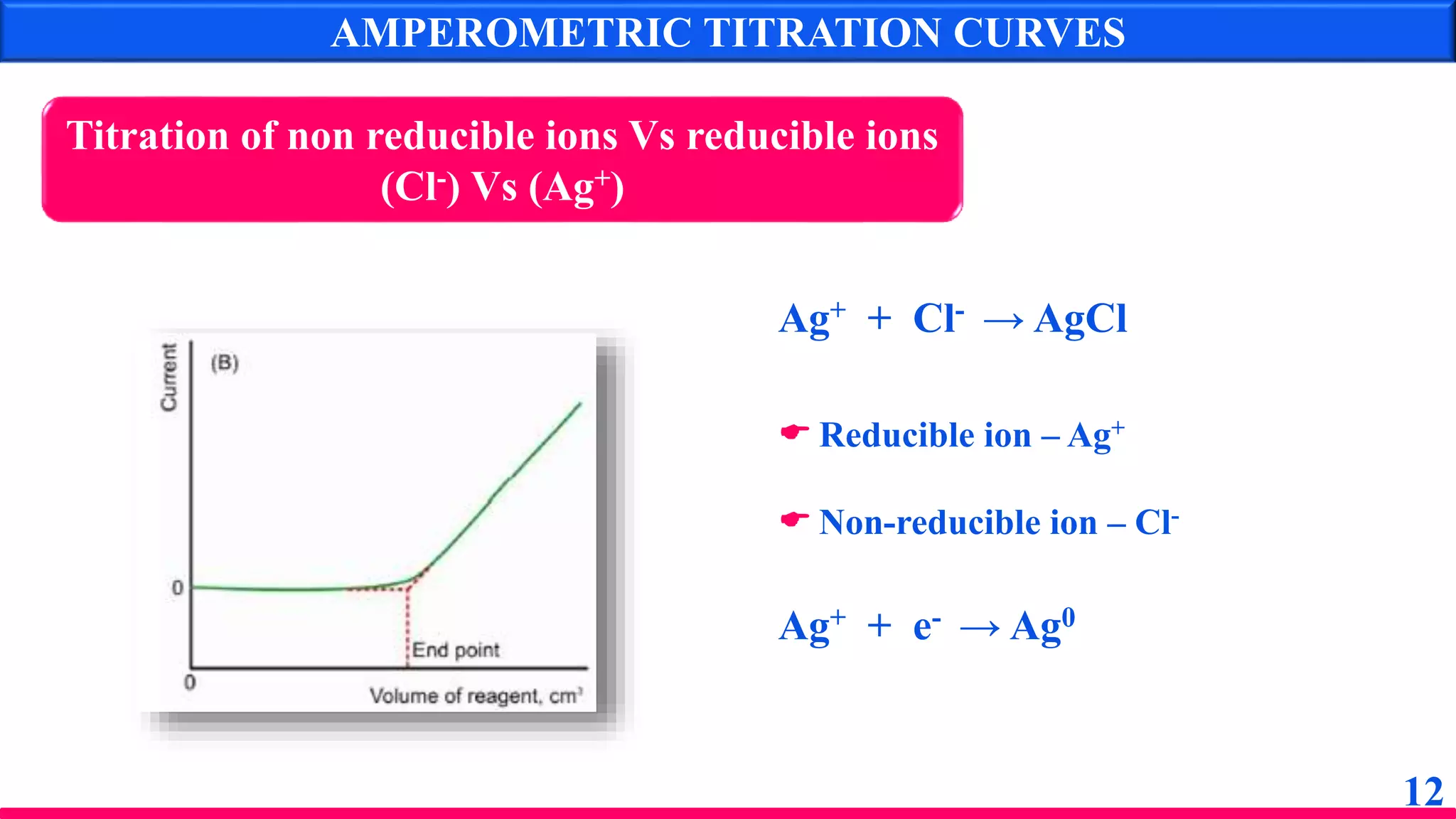
Titration of non reducible ions Vs reducible ions
(Cl-) Vs (Ag+)
 Reducible ion – Ag+
 Non-reducible ion – Cl-
Ag+ + Cl- → AgCl
Ag+ + e- → Ag0
13
AMPEROMETRIC TITRATION CURVES
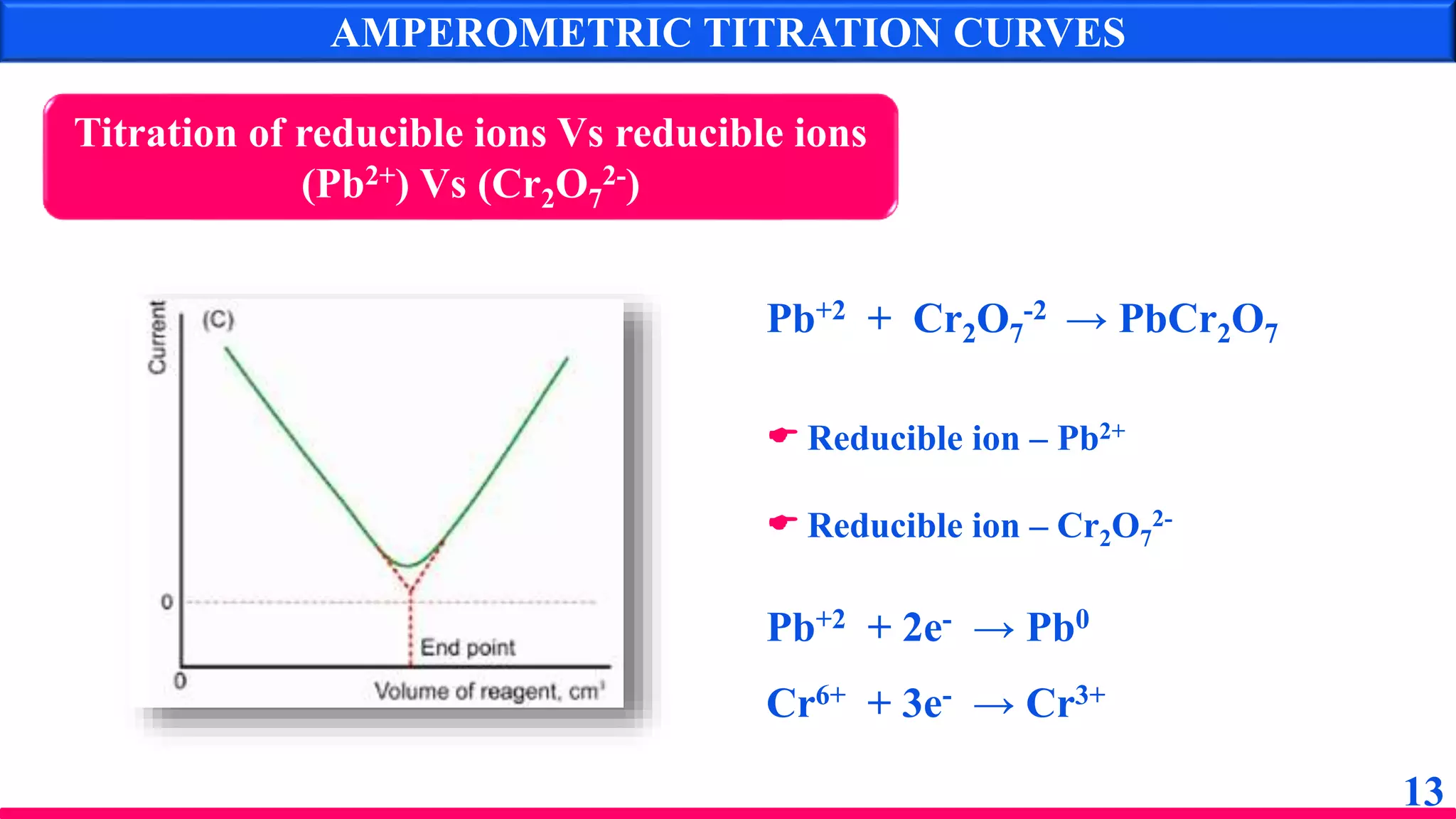
Titration of reducible ions Vs reducible ions
(Pb2+) Vs (Cr2O7
2-)
 Reducible ion – Pb2+
 Reducible ion – Cr2O7
2-
Pb+2 + Cr2O7
-2 → PbCr2O7
Pb+2 + 2e- → Pb0
Cr6+ + 3e- → Cr3+
14
AMPEROMETRIC TITRATION CURVES
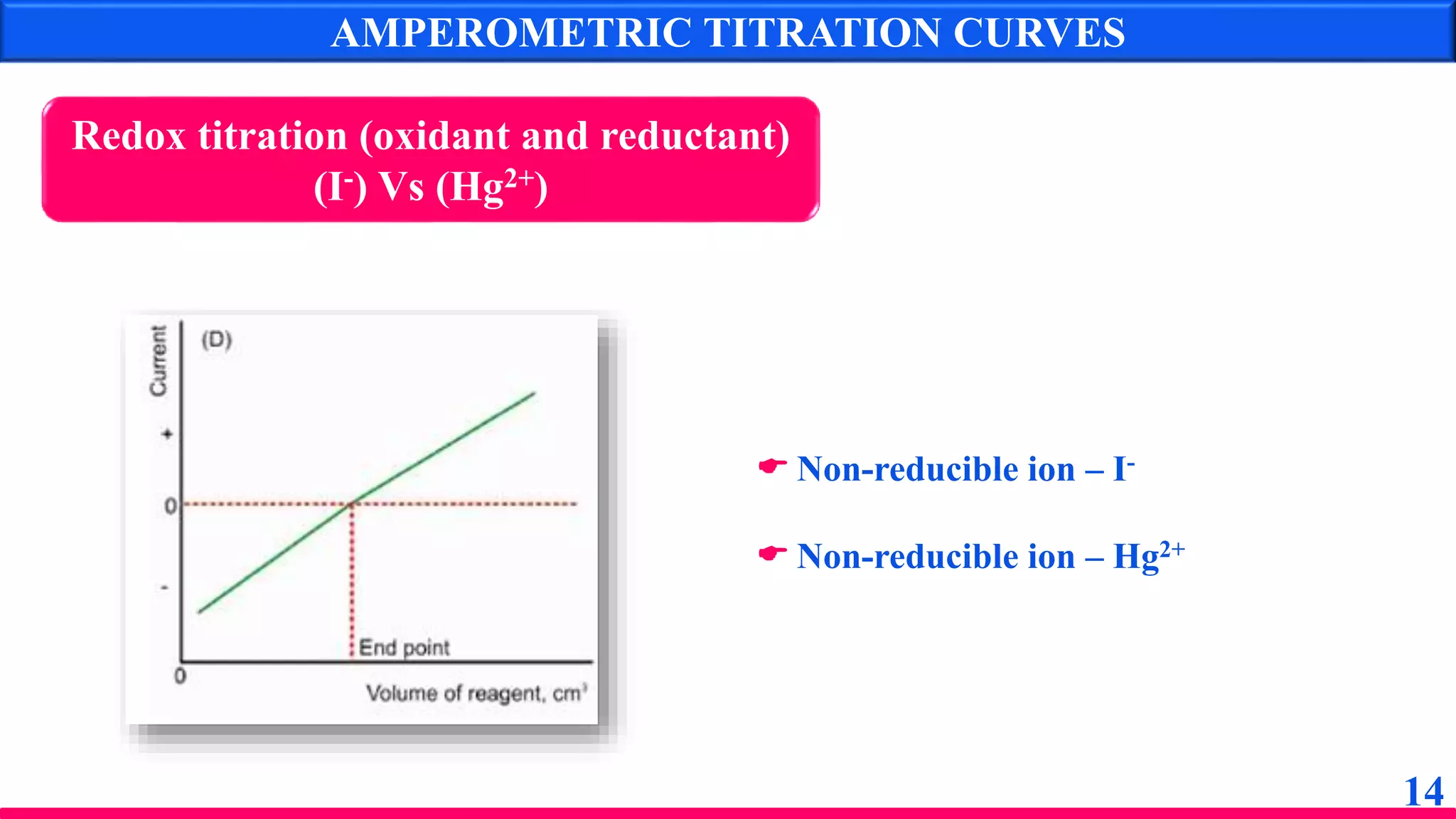
Redox titration (oxidant and reductant)
(I-) Vs (Hg2+)
 Non-reducible ion – I-
 Non-reducible ion – Hg2+
ADVANTAGES
15
 Rapid, simple apparatus.
 The reaction carried out can be reversible or irreversible.
 These titration can be carried rapidly because the end point is found
graphically.
 Determining traces 0.001M (0.00001M) with ease and good precision.
 Accuracy is higher in amperometric titration than polarography.
 Amperometric titration can be performed in those cases where both the
titrant and titrated ion do not undergo electrolytic reaction.
DISADVANTAGES
16
 If the foreign substances are present in higher concentration than the
substance to be titrated then relative changes of the current becomes
smaller and unreliable results are obtained.
 In accurate results are sometimes obtained because of co-
precipitation.
APPLICATIONS
17
 Wider range of applications than polarography because even electro-
inactive substances can be determined using electro-active titrant.
 Determination of moisture by Karl Fischer reagent
(bioamperometry).
 Qualification of ions or mixture of ions.
 Amperometric titrations are used for redox, precipitation and
complexometric titrations of reducible inorganic or organic ions.
EXCRCISE PROBLEMS
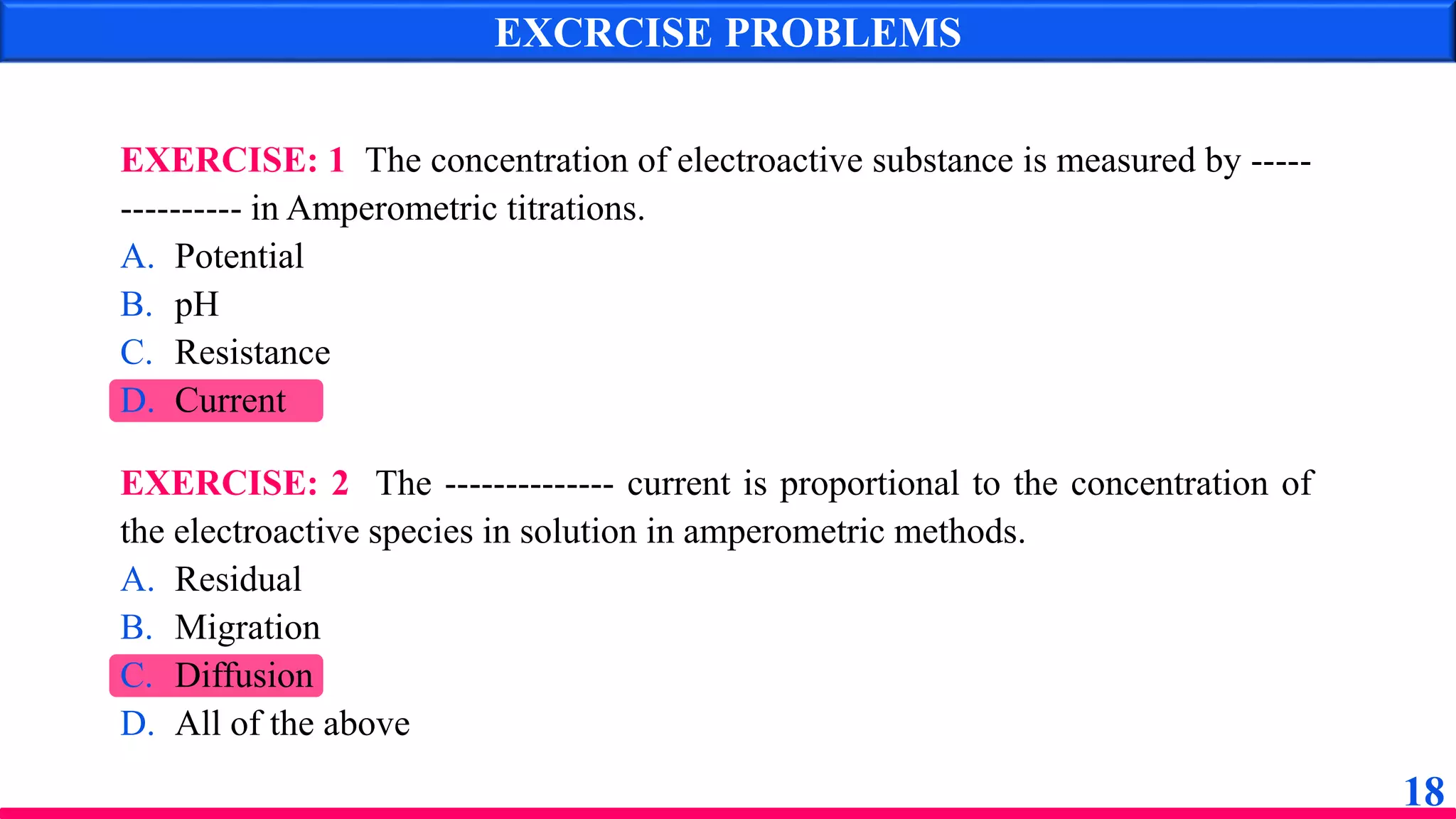
EXERCISE: 1 The concentration of electroactive substance is measured by -----
---------- in Amperometric titrations.
A. Potential
B. pH
C. Resistance
D. Current
EXERCISE: 2 The -------------- current is proportional to the concentration of
the electroactive species in solution in amperometric methods.
A. Residual
B. Migration
C. Diffusion
D. All of the above
18
EXCRCISE PROBLEMS
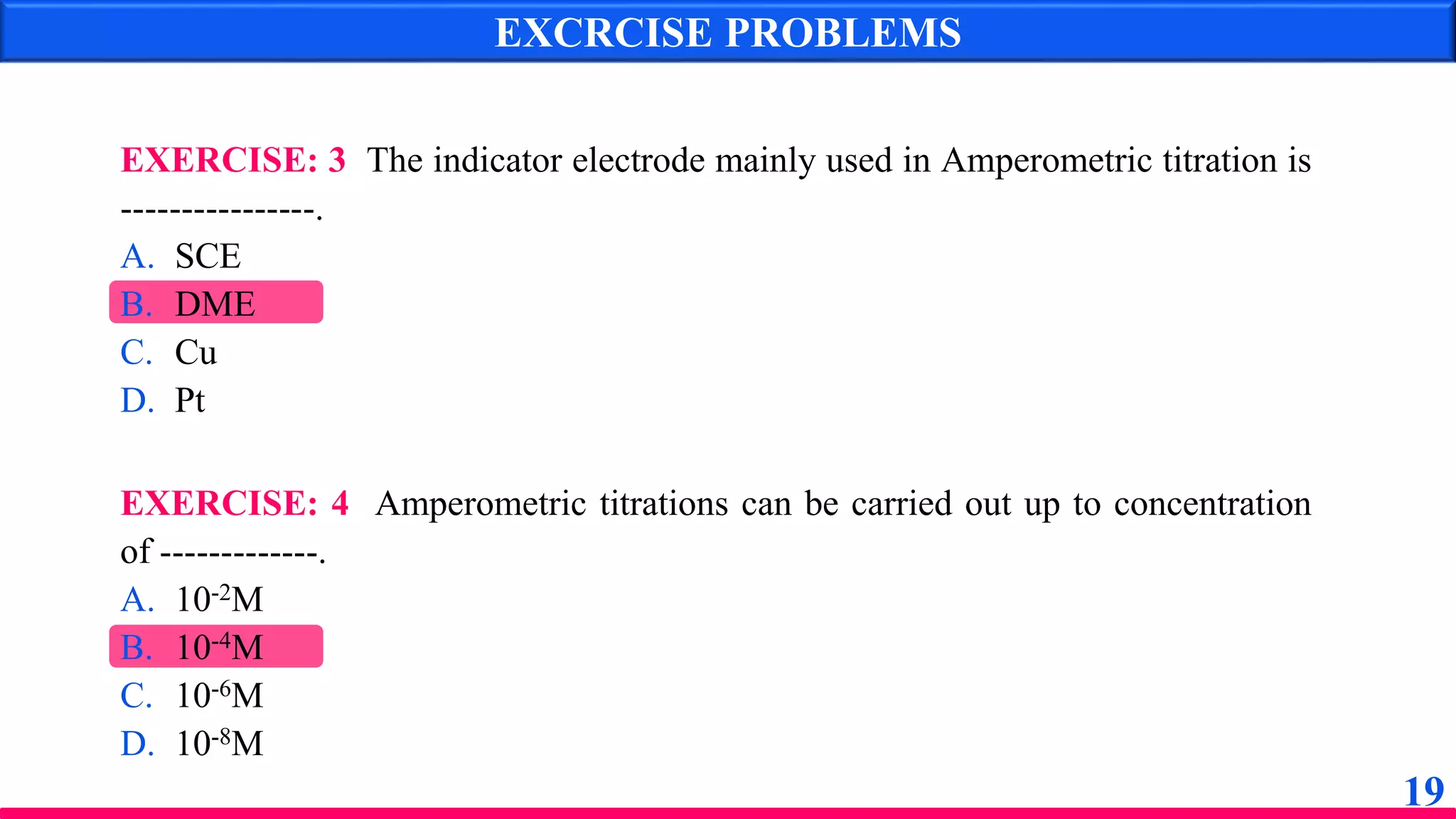
EXERCISE: 3 The indicator electrode mainly used in Amperometric titration is
----------------.
A. SCE
B. DME
C. Cu
D. Pt
EXERCISE: 4 Amperometric titrations can be carried out up to concentration
of -------------.
A. 10-2M
B. 10-4M
C. 10-6M
D. 10-8M
19
EXCRCISE PROBLEMS
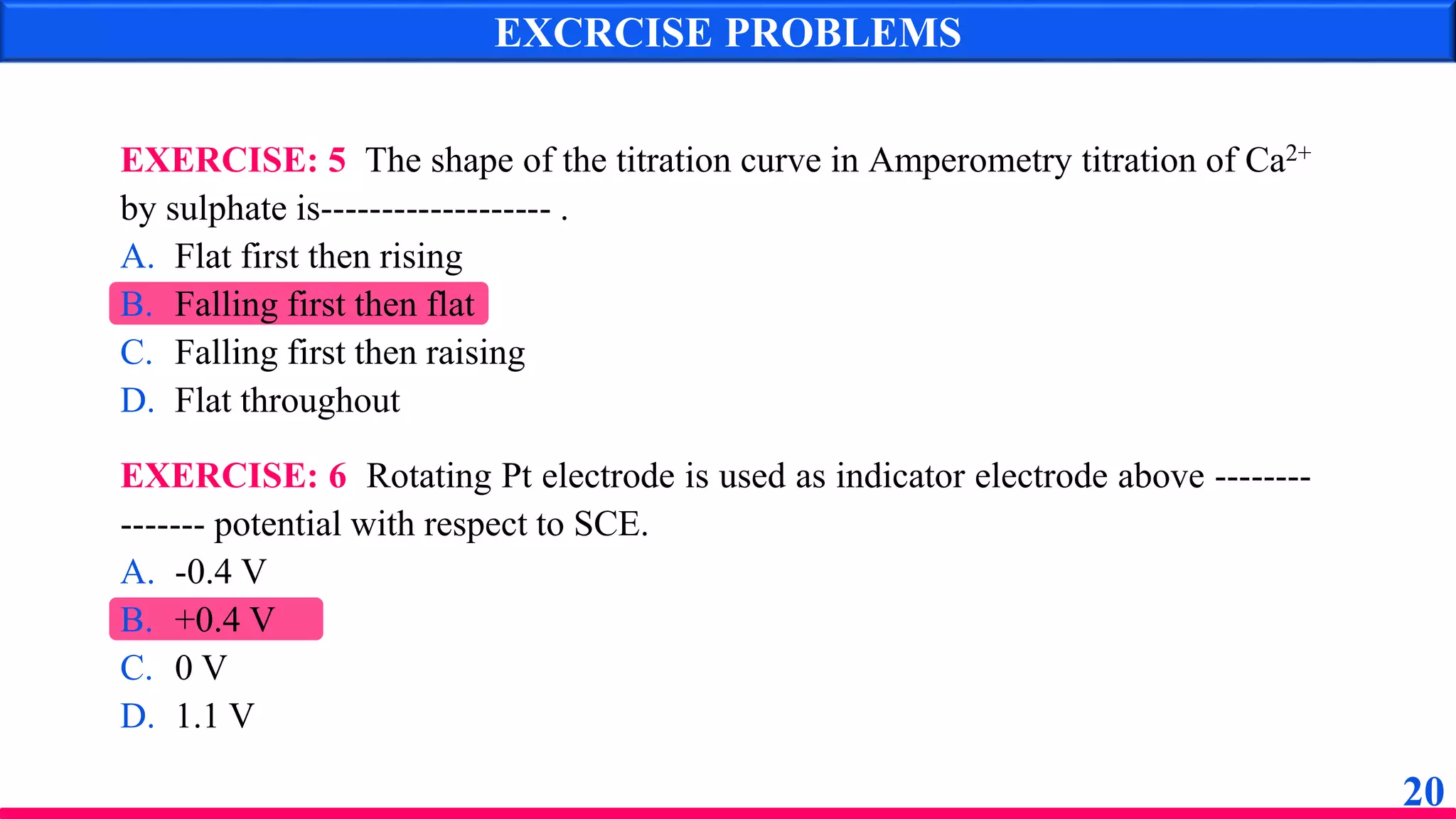
EXERCISE: 5 The shape of the titration curve in Amperometry titration of Ca2+
by sulphate is------------------- .
A. Flat first then rising
B. Falling first then flat
C. Falling first then raising
D. Flat throughout
EXERCISE: 6 Rotating Pt electrode is used as indicator electrode above --------
------- potential with respect to SCE.
A. -0.4 V
B. +0.4 V
C. 0 V
D. 1.1 V
20
EXCRCISE PROBLEMS
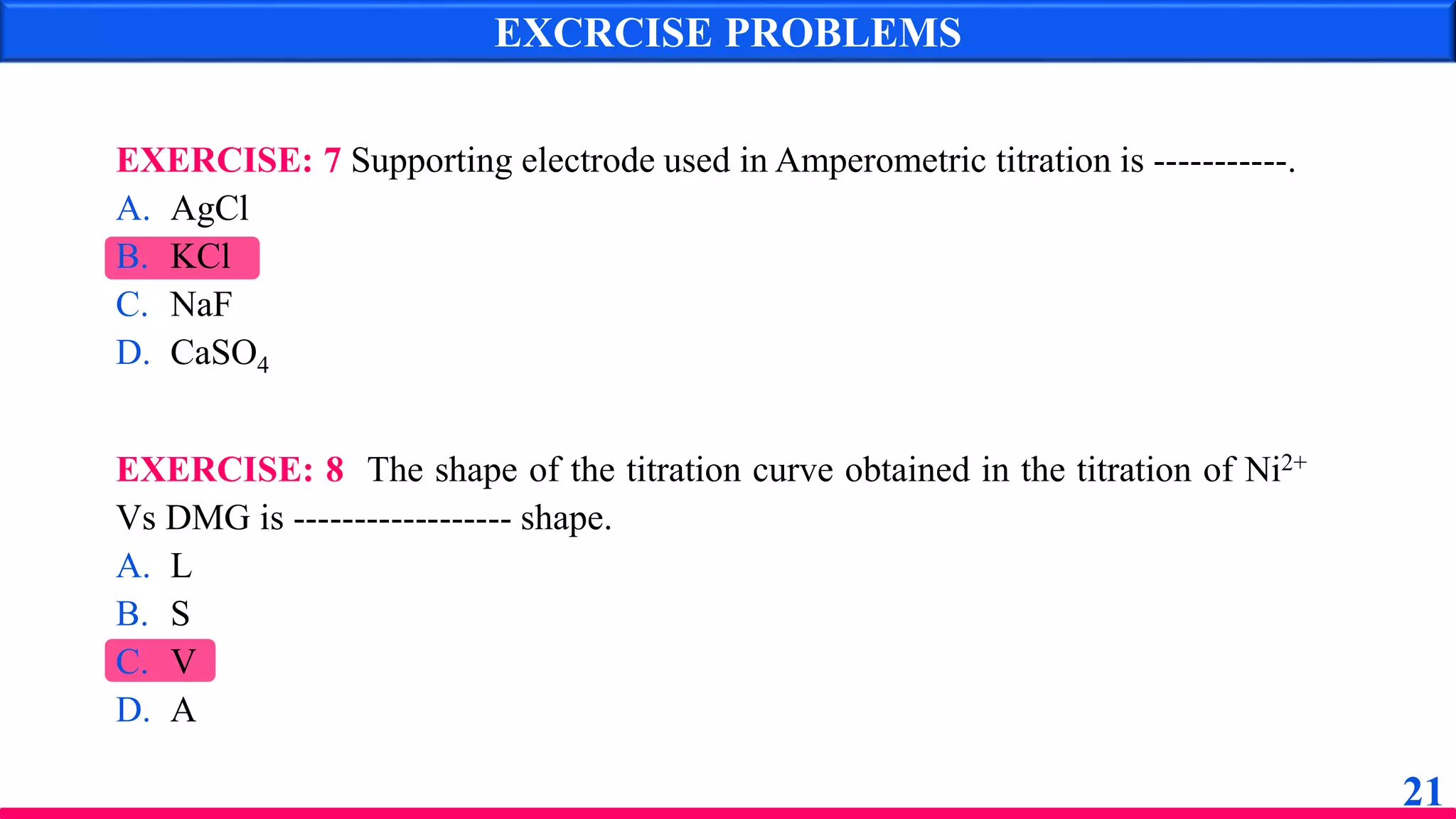
EXERCISE: 8 The shape of the titration curve obtained in the titration of Ni2+
Vs DMG is ------------------ shape.
A. L
B. S
C. V
D. A
EXERCISE: 7 Supporting electrode used in Amperometric titration is -----------.
A. AgCl
B. KCl
C. NaF
D. CaSO4
21
EXCRCISE PROBLEMS
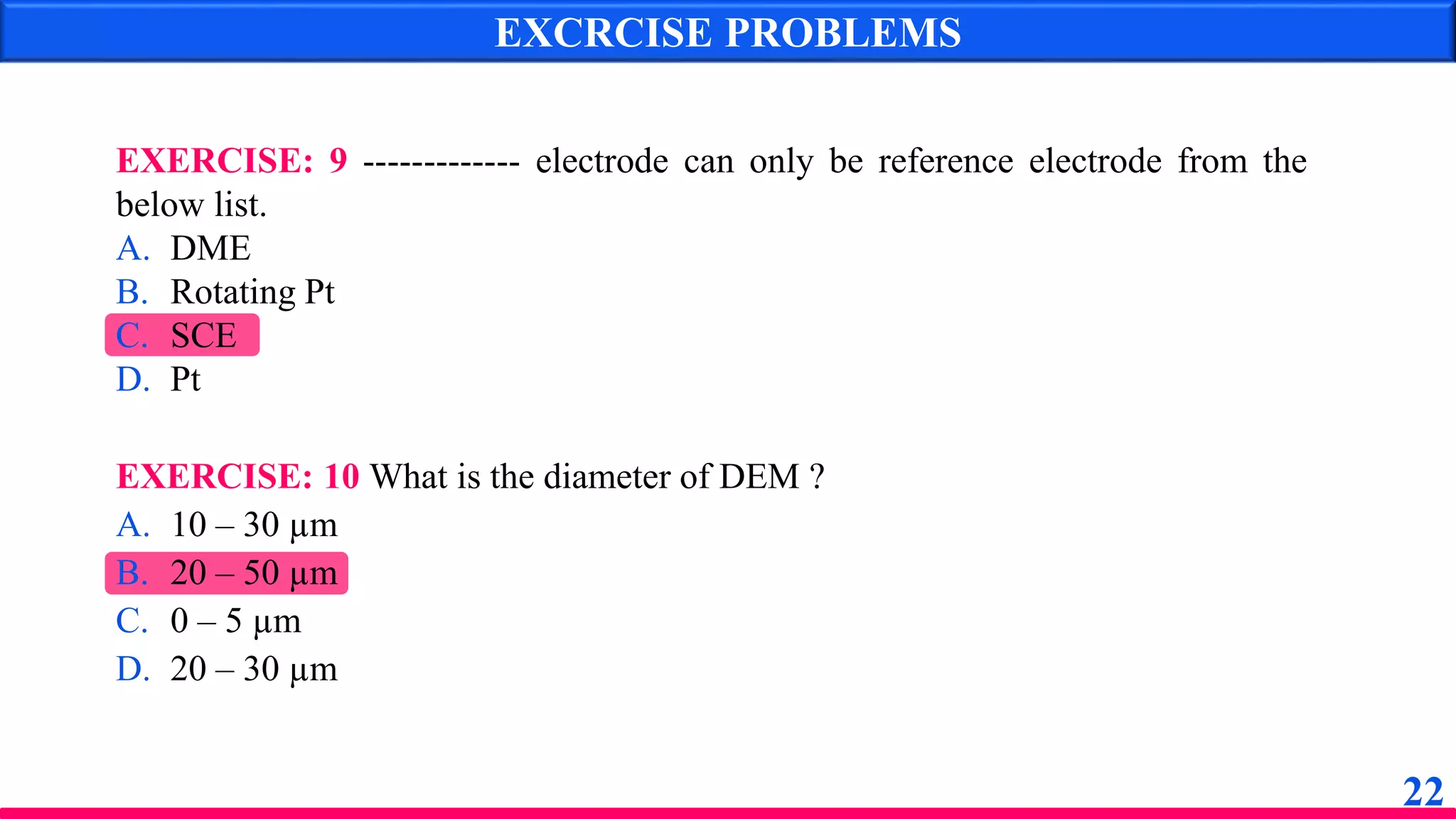
EXERCISE: 9 ------------- electrode can only be reference electrode from the
below list.
A. DME
B. Rotating Pt
C. SCE
D. Pt
EXERCISE: 10 What is the diameter of DEM ?
A. 10 – 30 µm
B. 20 – 50 µm
C. 0 – 5 µm
D. 20 – 30 µm
22
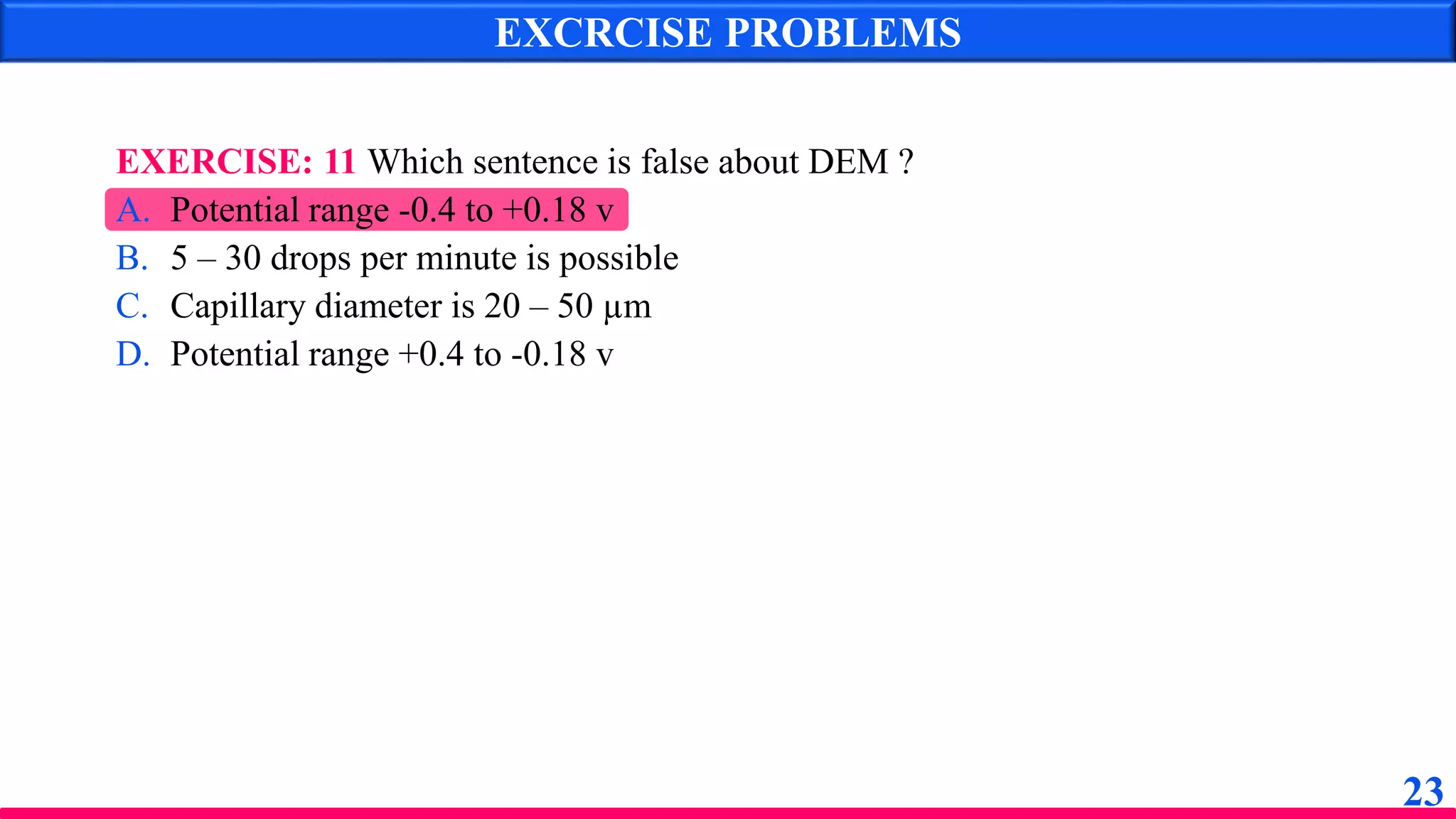
EXERCISE: 11 Which sentence is false about DEM ?
A. Potential range -0.4 to +0.18 v
B. 5 – 30 drops per minute is possible
C. Capillary diameter is 20 – 50 µm
D. Potential range +0.4 to -0.18 v
EXCRCISE PROBLEMS
23
REFERENCES
 https://www.brainkart.com/article/Amperometric-Methods_30873/
 https://www.brainkart.com/article/Amperometric-Methods--Theory_30874/
 https://www.brainkart.com/article/Amperometric-Methods--Instrumentation_30875/
 https://www.brainkart.com/article/Applications-of-Amperometric-Titrations-in-Pharmaceutical-
Substances_30876/
 https://www.slideshare.net/AkshayAkotkar/amperometry
 https://www.slideshare.net/ISFCPISFCollegeofPha/amperometric-titrations
 https://www.slideshare.net/ArpitSuralkar/amperometry-249854286
 https://youtu.be/5mRoyvSOYVA
 https://gpatindia.com/amperometry-titration-principleinstrumentation-and-multiple-choice-questions/
 http://www.expertsmind.com/topic/polarography-and-amperometric-titrations/amperometric-
titrations-911514.aspx
AMPEROMETRY and AMPEROMETRIC TITRATIONS

AMPEROMETRY and AMPEROMETRIC TITRATIONS

  • 1.
    AMPEROMETRY Presented By: K. MuthuKannan, II M.Sc.,Chemistry, S.B.K.College, Aruppukottai – 626 101.
  • 2.
  • 3.
     It isone of the electrochemical method.  It is form of quantitative analysis.  Derived form ampere, the unit of current.  It refers to the measurement of current under a constant applied voltage.  Concentration of the analyte which determine magnitude of the current.  Diffusion current (or limiting current – residual current) is proportional to the concentration of the electroactive material present in the solution.  Electroactive material is removed by interaction with titrating reagent, the diffusion current will decrease. INTRODUCTION 3
  • 4.
    PRINCIPLE  Potential appliedbetween the indicator electrode (Dropping mercury electrode) and reference electrode (Saturated calomel electrode) is kept constant and the current through the electrolytic cell is then measured on the addition of each increment of titrating solution.  The diffusion current at an appropriate applied voltage is measured as a function of the volume of the titrating solution.  The end point is the intersection of two lines giving the change of current before and after the equivalence point. 4
  • 5.
    PRINCIPLE Id = 607n C D1/2 m2/3 t1/6 Where, Id = Diffusion current. n = Number of electrons involved in the reaction. C = Concentration of analyte in mmol/lit. D = Diffusion co-efficient (cm2/sec). m = Weight of mercury flowing through capillary (mg/sec). t = Drop time in seconds. If some of the electroactive material in the analyte is removed by interaction with some other reagent the diffusion current will decrease proportionally. Ilkovic Equation 5
  • 6.
    INSTRUMENTATION Apparatus  Pyrex glass,that is three necked, flat bottomed flask.  A micro burette.  Dropping mercury electrode (indicator electrode) (Cathode).  Gas outlet for N2, with an additional inlet N2 provision.  Connected to a reference electrode (Anode). 6
  • 7.
    7 INSTRUMENTATION Dropping Mercury Electrode Capillary tube about 10 – 15 cm.  Internal diameter of capillary 20 – 50 µm.  Drop time 1 – 5 seconds.  Drop diameter 0.5 mm.  A vertical distance maintained between DME and the solution.
  • 8.
    8 INSTRUMENTATION Rotating Platinum Micro-Electrode It consist of a glass rod with bent platinum wire at about 600 rpm.  Glass tube about 15 – 20 cm length and 6 mm in diameter.  A short length of platinum wire extends 5 – 10 mm from the fall of the glass tube.  Removal of oxygen is done by bubbling purified nitrogen before the titration.
  • 9.
     It issimple to construct.  Mercury cannot be used as electrode at positive potential because of its oxidation, RPME is used.  Diffusion current is 20 times larger than DME which allows to measure the small concentration of ion.  The rotating platinum electrode can be used at positive potential up to +0.9 volt where as DME can be used only +0.4 volt to -2.0 volt. Advantages of RPME INSTRUMENTATION 9
  • 10.
    AMPEROMETRIC TITRATION 10  Thediffusion current at an appropriate applied voltage is measured as a function of the volume of the titrating solution.  Intersection of two lines providing the change of current before and after the equivalence point.  Depending on the selection of the applied voltage among DME and reference electrode various kinds of titration curves are obtained. Titrating Curves
  • 11.
    11 AMPEROMETRIC TITRATION CURVES Titrationof reducible ions Vs non reducible ions (Pb2+) Vs (SO4 2-)  Reducible ion – Pb2+  Non-reducible ion – SO4 2- Pb2+ + SO4 2- → PbSO4 Pb2+ + 2e- → Pb0
  • 12.
    12 AMPEROMETRIC TITRATION CURVES Titrationof non reducible ions Vs reducible ions (Cl-) Vs (Ag+)  Reducible ion – Ag+  Non-reducible ion – Cl- Ag+ + Cl- → AgCl Ag+ + e- → Ag0
  • 13.
    13 AMPEROMETRIC TITRATION CURVES Titrationof reducible ions Vs reducible ions (Pb2+) Vs (Cr2O7 2-)  Reducible ion – Pb2+  Reducible ion – Cr2O7 2- Pb+2 + Cr2O7 -2 → PbCr2O7 Pb+2 + 2e- → Pb0 Cr6+ + 3e- → Cr3+
  • 14.
    14 AMPEROMETRIC TITRATION CURVES Redoxtitration (oxidant and reductant) (I-) Vs (Hg2+)  Non-reducible ion – I-  Non-reducible ion – Hg2+
  • 15.
    ADVANTAGES 15  Rapid, simpleapparatus.  The reaction carried out can be reversible or irreversible.  These titration can be carried rapidly because the end point is found graphically.  Determining traces 0.001M (0.00001M) with ease and good precision.  Accuracy is higher in amperometric titration than polarography.  Amperometric titration can be performed in those cases where both the titrant and titrated ion do not undergo electrolytic reaction.
  • 16.
    DISADVANTAGES 16  If theforeign substances are present in higher concentration than the substance to be titrated then relative changes of the current becomes smaller and unreliable results are obtained.  In accurate results are sometimes obtained because of co- precipitation.
  • 17.
    APPLICATIONS 17  Wider rangeof applications than polarography because even electro- inactive substances can be determined using electro-active titrant.  Determination of moisture by Karl Fischer reagent (bioamperometry).  Qualification of ions or mixture of ions.  Amperometric titrations are used for redox, precipitation and complexometric titrations of reducible inorganic or organic ions.
  • 18.
    EXCRCISE PROBLEMS EXERCISE: 1The concentration of electroactive substance is measured by ----- ---------- in Amperometric titrations. A. Potential B. pH C. Resistance D. Current EXERCISE: 2 The -------------- current is proportional to the concentration of the electroactive species in solution in amperometric methods. A. Residual B. Migration C. Diffusion D. All of the above 18
  • 19.
    EXCRCISE PROBLEMS EXERCISE: 3The indicator electrode mainly used in Amperometric titration is ----------------. A. SCE B. DME C. Cu D. Pt EXERCISE: 4 Amperometric titrations can be carried out up to concentration of -------------. A. 10-2M B. 10-4M C. 10-6M D. 10-8M 19
  • 20.
    EXCRCISE PROBLEMS EXERCISE: 5The shape of the titration curve in Amperometry titration of Ca2+ by sulphate is------------------- . A. Flat first then rising B. Falling first then flat C. Falling first then raising D. Flat throughout EXERCISE: 6 Rotating Pt electrode is used as indicator electrode above -------- ------- potential with respect to SCE. A. -0.4 V B. +0.4 V C. 0 V D. 1.1 V 20
  • 21.
    EXCRCISE PROBLEMS EXERCISE: 8The shape of the titration curve obtained in the titration of Ni2+ Vs DMG is ------------------ shape. A. L B. S C. V D. A EXERCISE: 7 Supporting electrode used in Amperometric titration is -----------. A. AgCl B. KCl C. NaF D. CaSO4 21
  • 22.
    EXCRCISE PROBLEMS EXERCISE: 9------------- electrode can only be reference electrode from the below list. A. DME B. Rotating Pt C. SCE D. Pt EXERCISE: 10 What is the diameter of DEM ? A. 10 – 30 µm B. 20 – 50 µm C. 0 – 5 µm D. 20 – 30 µm 22
  • 23.
    EXERCISE: 11 Whichsentence is false about DEM ? A. Potential range -0.4 to +0.18 v B. 5 – 30 drops per minute is possible C. Capillary diameter is 20 – 50 µm D. Potential range +0.4 to -0.18 v EXCRCISE PROBLEMS 23
  • 24.
    REFERENCES  https://www.brainkart.com/article/Amperometric-Methods_30873/  https://www.brainkart.com/article/Amperometric-Methods--Theory_30874/ https://www.brainkart.com/article/Amperometric-Methods--Instrumentation_30875/  https://www.brainkart.com/article/Applications-of-Amperometric-Titrations-in-Pharmaceutical- Substances_30876/  https://www.slideshare.net/AkshayAkotkar/amperometry  https://www.slideshare.net/ISFCPISFCollegeofPha/amperometric-titrations  https://www.slideshare.net/ArpitSuralkar/amperometry-249854286  https://youtu.be/5mRoyvSOYVA  https://gpatindia.com/amperometry-titration-principleinstrumentation-and-multiple-choice-questions/  http://www.expertsmind.com/topic/polarography-and-amperometric-titrations/amperometric- titrations-911514.aspx