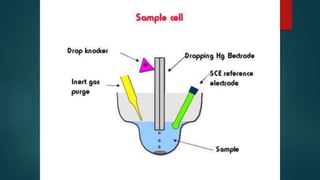
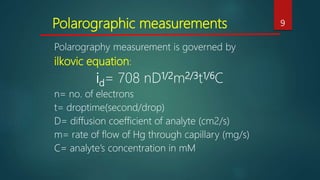
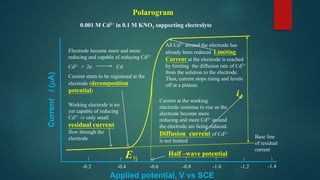
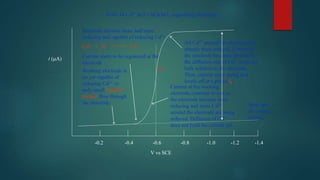
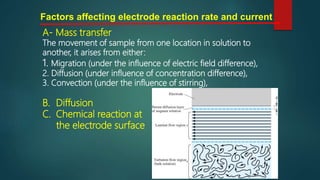
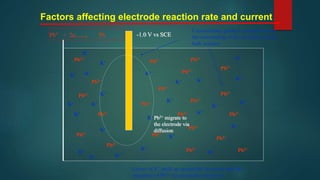
The document discusses polarography, an early voltammetric technique developed by Heyrovsky in 1922, which uses a dropping mercury electrode to analyze electroactive substances. It describes the principles of the technique, including the mechanisms of mass transport and the importance of the supporting electrolyte, as well as the polarographic measurements governed by the Ilkovic equation. Additionally, it outlines the advantages and disadvantages of using the dropping mercury electrode (DME), applications in both inorganic and organic analysis, and recent developments in the field.