PRESENTED BY FATHIMA SHIREEN C.P
MSc CHEMISTRY
ROLL.NO: 6
MALABAR CHRISTIAN COLLEGE
A plot of current as a function of applied
potential is called a polarogram and is the
electrochemical equivalent of a spectrum in
spectroscopy, providing quantitative and
qualitative information about the species
involved in the oxidation or reduction reaction.
What is polarography?
A time - dependent potential is applied to an
electrochemical cell, and the current flowing
through the cell is measured as a function of
that potential.
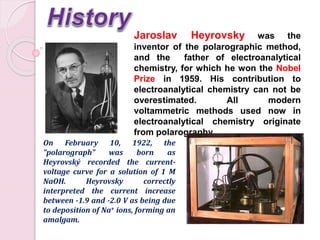
Jaroslav Heyrovsky was the
inventor of the polarographic method,
and the father of electroanalytical
chemistry, for which he won the Nobel
Prize in 1959. His contribution to
electroanalytical chemistry can not be
overestimated. All modern
voltammetric methods used now in
electroanalytical chemistry originate
from polarography.
On February 10, 1922, the
"polarograph" was born as
Heyrovský recorded the current-
voltage curve for a solution of 1 M
NaOH. Heyrovsky correctly
interpreted the current increase
between -1.9 and -2.0 V as being due
to deposition of Na+ ions, forming an
amalgam.
Polarography consists of electrolysis of the
analyte solution by applying potential difference
between two electrodes: (a) one that has a fixed
and known potential called the reference
electrode, and (b) the other that has a variable
potential, called the polarizable electrode or an
indicator electrode (also called the working
electrode).As voltage is applied to the
polarizable electrode, the resulting change in
the current through the solution is monitored
and the “current-voltage” curve is traced.
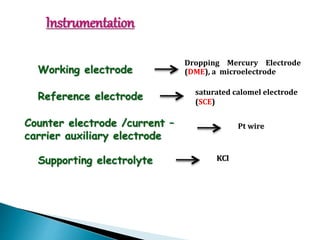
Instrumentation
Working electrode
saturated calomel electrode
(SCE)
Dropping Mercury Electrode
(DME), a microelectrode
Reference electrode
Counter electrode /current –
carrier auxiliary electrode
Pt wire
Supporting electrolyte KCl
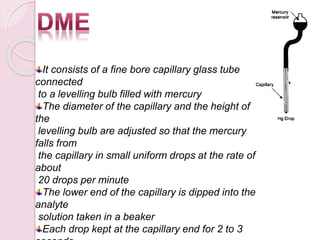
It consists of a fine bore capillary glass tube
connected
to a levelling bulb filled with mercury
The diameter of the capillary and the height of
the
levelling bulb are adjusted so that the mercury
falls from
the capillary in small uniform drops at the rate of
about
20 drops per minute
The lower end of the capillary is dipped into the
analyte
solution taken in a beaker
Each drop kept at the capillary end for 2 to 3
Why Dropping Mercury Electrode?
The surface area is reproducible with any capillary
The constant removal of electrode surface eliminates the
poisoning effect
Mercury forms amalgams with any metals and hence makes
many metal ions easily reducible
Surface area can be calculated from the weight of the drop
The diffusion current assumes steady value immediately and
thus is reproducible
There is a large Hydrogen over voltage on mercury.
Therefore reduction of even alkali metal ions can be observed
The small dimensions of the DME enable one to carry out
electrolysis even in small volumes of solution. For this reasons,
polarography offers the advantages of micron analytical
methods, capable of estimating even traces of analytes in
solutions
Disadvantages of DMG
Mercury may be easily oxidized. Thus limits the feasible
range of electrode
The area of the microelectrode is constantly changing as the
size of the drop changes
The capillary may be easily plugged, the care must be taken
to avoid touching the tip of the capillary with any foreign
material
metal-insoluble metal salt electrodes
Hg, Hg2Cl2 (s)| KCl (aq)
Concentration of KCl : saturated
Electrode Potential : 0.2415
Pure mercury is placed at the bottom of a glass tube
It is covered with a paste of mercurous chloride
(calomel) in pure mercury
The tube is then filled with saturated solution of KCI
added through the side tube S1
This solution also fills the curved side tube S2 ending
in a jet
It is through this side tube that the calomel electrode
is coupled with any other electrode
A platinum wire sealed into a thin glass tube
containing a little mercury at the bottom serves to
make electrical contact with the external circuit
The electroactive species (analyte) is taken in a highly
conducting electrolytic medium such as KCl solution
The concentration of this electrolyte is about 100 times higher
than that of the analyte
 And is electroinactive in the sense that it will not undergo
oxidation or reduction on the electrode surface in the range of
the required applied potential
 Hence, it is called a supporting (or indifferent) electrolyte
The need for such a medium is to practically eliminate the
migration current.
Elimination of migration current
The use of supporting electrolyte
In such a set up, the migration current i
practically carried by the ions of th
supporting electrolyte. This will allow th
analyte species to follow diffusiona
transport towards the electrode surface an
thereby make the current almost full
diffusion-controlled.
It is the majority current due to the migration of the charged
particles in the electric field, caused by the potential difference
existing between the electrode surface and the solution
Migrationcurrent
• Limiting current (il) region
Diffusion current (id) region
The residual current (ir) region
The polarogram has three current regions:
The advantages of the dropping mercury
electrode (DME)
Ilkovic diffusion current equation
Diffusion current equation
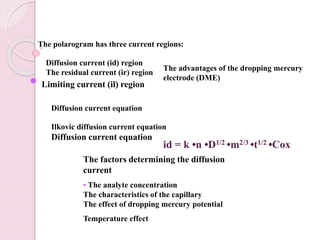
id = k •n •D1/2 •m2/3 •t1/2 •Cox
The factors determining the diffusion
current
• The analyte concentration
The characteristics of the capillary
The effect of dropping mercury potential
Temperature effect
Factors affecting the shape of the polargram
The residual current
The current maxima
The presence of oxygen
In polarography, the current flowing through the cell is
measured as a function of the potential of the working
electrode.
Usually this current is proportional to the
concentration of the analyte.
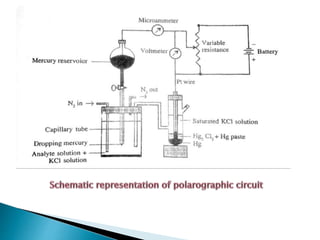
Apparatus for carrying out polarography is shown
below.
The working electrode is a dropping mercury electrode
or a mercury droplet suspended from a bottom of a
glass capillary tube.
Analyte is either reduced (most of the cases) or
oxidized at the surface of the mercury drop.
The current –carrier auxiliary electrode is a platinum
wire.
SCE or Ag/AgCl reference electrode is used.
The potential of the mercury drop is measured with
respect to the reference electrode.
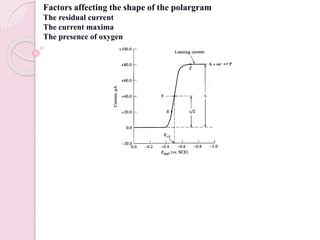
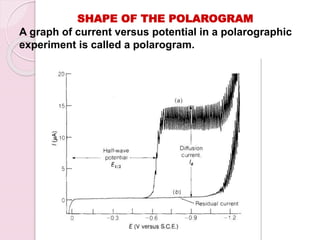
SHAPE OF THE POLAROGRAM
A graph of current versus potential in a polarographic
experiment is called a polarogram.
 When the potential is only slightly negative with
respect to the calomel electrode, essentially no
reduction of Cd2+ occurs. Only a small residual
current flows.
 At a sufficiently negative potential, reduction of Cd2+
commences and the current increases. The reduced
Cd dissolves in the Hg to form an amalgam.
 After a steep increase in current, concentration
polarization sets in: The rate of electron transfer
becomes limited by the rate at which Cd2+ can
diffuse from bulk solution to the surface of the
electrode.
 The magnitude of this diffusion current Id is
proportional to Cd2+ concentration and is used for
quantitative analysis. The upper trace in the Figure
above is called a polarographic wave.
– Three electrodes in solution containing analyte
: microelectrode whose potential is varied with
time
Reference electrode: potential remains constant
(or calomel)
Supporting electrolyte: excess of nonreactive
electrolyte (alkali metal) to conduct current
 When the potential is sufficiently negativ around -1.2 V,
reduction of H+ begins and the curve rises steeply.
 At positive potentials (near the left side of the
polarogram), oxidation of the Hg electrode produces a
negative current. By convention, a negative current
means that the working electrode is behaving as the
anode with respect to the auxiliary electrode. A positive
current means that the working electrode is behaving
as the cathode.
 The oscillating current in the Figure above is due to the
growth and fall of the Hg drops.
 As the drop grows, its area increases, more solute can
reach the surface in a given time, and more current
flows.
 The current increases as the drop grows until, finally,
the drop falls off and the current decreases sharply.
polarography
polarography
polarography

polarography

  • 2.
    PRESENTED BY FATHIMASHIREEN C.P MSc CHEMISTRY ROLL.NO: 6 MALABAR CHRISTIAN COLLEGE
  • 3.
    A plot ofcurrent as a function of applied potential is called a polarogram and is the electrochemical equivalent of a spectrum in spectroscopy, providing quantitative and qualitative information about the species involved in the oxidation or reduction reaction. What is polarography? A time - dependent potential is applied to an electrochemical cell, and the current flowing through the cell is measured as a function of that potential.
  • 4.
    Jaroslav Heyrovsky wasthe inventor of the polarographic method, and the father of electroanalytical chemistry, for which he won the Nobel Prize in 1959. His contribution to electroanalytical chemistry can not be overestimated. All modern voltammetric methods used now in electroanalytical chemistry originate from polarography. On February 10, 1922, the "polarograph" was born as Heyrovský recorded the current- voltage curve for a solution of 1 M NaOH. Heyrovsky correctly interpreted the current increase between -1.9 and -2.0 V as being due to deposition of Na+ ions, forming an amalgam.
  • 5.
    Polarography consists ofelectrolysis of the analyte solution by applying potential difference between two electrodes: (a) one that has a fixed and known potential called the reference electrode, and (b) the other that has a variable potential, called the polarizable electrode or an indicator electrode (also called the working electrode).As voltage is applied to the polarizable electrode, the resulting change in the current through the solution is monitored and the “current-voltage” curve is traced.
  • 6.
    Instrumentation Working electrode saturated calomelelectrode (SCE) Dropping Mercury Electrode (DME), a microelectrode Reference electrode Counter electrode /current – carrier auxiliary electrode Pt wire Supporting electrolyte KCl
  • 7.
    It consists ofa fine bore capillary glass tube connected to a levelling bulb filled with mercury The diameter of the capillary and the height of the levelling bulb are adjusted so that the mercury falls from the capillary in small uniform drops at the rate of about 20 drops per minute The lower end of the capillary is dipped into the analyte solution taken in a beaker Each drop kept at the capillary end for 2 to 3
  • 8.
    Why Dropping MercuryElectrode? The surface area is reproducible with any capillary The constant removal of electrode surface eliminates the poisoning effect Mercury forms amalgams with any metals and hence makes many metal ions easily reducible Surface area can be calculated from the weight of the drop The diffusion current assumes steady value immediately and thus is reproducible There is a large Hydrogen over voltage on mercury. Therefore reduction of even alkali metal ions can be observed The small dimensions of the DME enable one to carry out electrolysis even in small volumes of solution. For this reasons, polarography offers the advantages of micron analytical methods, capable of estimating even traces of analytes in solutions
  • 9.
    Disadvantages of DMG Mercurymay be easily oxidized. Thus limits the feasible range of electrode The area of the microelectrode is constantly changing as the size of the drop changes The capillary may be easily plugged, the care must be taken to avoid touching the tip of the capillary with any foreign material
  • 10.
    metal-insoluble metal saltelectrodes Hg, Hg2Cl2 (s)| KCl (aq) Concentration of KCl : saturated Electrode Potential : 0.2415 Pure mercury is placed at the bottom of a glass tube It is covered with a paste of mercurous chloride (calomel) in pure mercury The tube is then filled with saturated solution of KCI added through the side tube S1 This solution also fills the curved side tube S2 ending in a jet It is through this side tube that the calomel electrode is coupled with any other electrode A platinum wire sealed into a thin glass tube containing a little mercury at the bottom serves to make electrical contact with the external circuit
  • 12.
    The electroactive species(analyte) is taken in a highly conducting electrolytic medium such as KCl solution The concentration of this electrolyte is about 100 times higher than that of the analyte  And is electroinactive in the sense that it will not undergo oxidation or reduction on the electrode surface in the range of the required applied potential  Hence, it is called a supporting (or indifferent) electrolyte The need for such a medium is to practically eliminate the migration current. Elimination of migration current The use of supporting electrolyte
  • 13.
    In such aset up, the migration current i practically carried by the ions of th supporting electrolyte. This will allow th analyte species to follow diffusiona transport towards the electrode surface an thereby make the current almost full diffusion-controlled. It is the majority current due to the migration of the charged particles in the electric field, caused by the potential difference existing between the electrode surface and the solution Migrationcurrent
  • 14.
    • Limiting current(il) region Diffusion current (id) region The residual current (ir) region The polarogram has three current regions: The advantages of the dropping mercury electrode (DME) Ilkovic diffusion current equation Diffusion current equation Diffusion current equation id = k •n •D1/2 •m2/3 •t1/2 •Cox The factors determining the diffusion current • The analyte concentration The characteristics of the capillary The effect of dropping mercury potential Temperature effect
  • 16.
    Factors affecting theshape of the polargram The residual current The current maxima The presence of oxygen
  • 17.
    In polarography, thecurrent flowing through the cell is measured as a function of the potential of the working electrode. Usually this current is proportional to the concentration of the analyte. Apparatus for carrying out polarography is shown below. The working electrode is a dropping mercury electrode or a mercury droplet suspended from a bottom of a glass capillary tube. Analyte is either reduced (most of the cases) or oxidized at the surface of the mercury drop. The current –carrier auxiliary electrode is a platinum wire. SCE or Ag/AgCl reference electrode is used. The potential of the mercury drop is measured with respect to the reference electrode.
  • 20.
    SHAPE OF THEPOLAROGRAM A graph of current versus potential in a polarographic experiment is called a polarogram.
  • 21.
     When thepotential is only slightly negative with respect to the calomel electrode, essentially no reduction of Cd2+ occurs. Only a small residual current flows.  At a sufficiently negative potential, reduction of Cd2+ commences and the current increases. The reduced Cd dissolves in the Hg to form an amalgam.  After a steep increase in current, concentration polarization sets in: The rate of electron transfer becomes limited by the rate at which Cd2+ can diffuse from bulk solution to the surface of the electrode.  The magnitude of this diffusion current Id is proportional to Cd2+ concentration and is used for quantitative analysis. The upper trace in the Figure above is called a polarographic wave.
  • 22.
    – Three electrodesin solution containing analyte : microelectrode whose potential is varied with time Reference electrode: potential remains constant (or calomel) Supporting electrolyte: excess of nonreactive electrolyte (alkali metal) to conduct current
  • 23.
     When thepotential is sufficiently negativ around -1.2 V, reduction of H+ begins and the curve rises steeply.  At positive potentials (near the left side of the polarogram), oxidation of the Hg electrode produces a negative current. By convention, a negative current means that the working electrode is behaving as the anode with respect to the auxiliary electrode. A positive current means that the working electrode is behaving as the cathode.  The oscillating current in the Figure above is due to the growth and fall of the Hg drops.  As the drop grows, its area increases, more solute can reach the surface in a given time, and more current flows.  The current increases as the drop grows until, finally, the drop falls off and the current decreases sharply.