Electrochemical Methods
Presented by:
ALMAS TAMAKE
SIES,IIEM
Introduction
 Electrochemical methods are analytical techniques that use a
measurement of potential, charge, or current to determine an
analyte’s concentration or to characterize an analyte’s
chemical reactivity.
 It is a qualitative and quantitative methods of analysis based
on electrochemical phenomena occurring within a medium or
at the phase boundary and related to changes in the structure,
chemical composition, or concentration of the compound
being analyzed.
 These methods are divided into five major groups:
potentiometry, voltammetry, coulometry, conductometry, and
dielectrometry.
Application
1. Obtaining thermodynamic data about a reaction.
2. To generate an unstable intermediate such as radical ion
and study its rate of decay or it is spectroscopic properties.
3. They use to analyze a solution for trace amount of metal
ions or organic species.
4. The electrochemical properties of the system themselves
are of primary interest, for example, in the design of a new
power source or for the electrochemical method have been
developed.
Controlling and Measuring Current
and Potential
• We cannot simultaneously control both current and
potential
• If we choose to control the potential, then we must accept
the resulting current, and we must accept the resulting
potential if we choose to control the current.
• The second electrode, which we call the counter electrode,
completes the electrical circuit and provides a reference
potential against which we measure the working
electrodes potential. Ideally the counter electrode’s
potential remains constant so that we can assign to the
working electrode any change in the overall cell potential.
• measurements are made in an electrochemical cell
consisting of two or more electrodes and the electronic
circuitry for controlling and measuring the current and the
potential.
• The simplest electrochemical cell uses two electrodes. The
potential of one electrode is sensitive to the analyst’s
concentration, and is called the working electrode or the
indicator electrode.
• If the counter electrode’s potential is not constant, we
replace it with two electrodes: a reference electrode whose
potential remains constant and an auxiliary electrode that
completes the electrical circuit.
• Because we cannot simultaneously control the current and
the potential, there are only three basic experimental
designs.
(1) Measure the potential when the current is zero,
(2) Measure the potential while controlling the current,
(3) Measure the current while controlling the potential
 Each of these experimental designs relies on Ohm’s law,
which states that a current, i, passing through an electrical
circuit of resistance, R, generates a potential, E. (E =iR)
 Each of these experimental designs uses a different
Electrochemical techniques
The electrochemical techniques is divided into Static
techniques and dynamic techniques
1. Static technique: It is the current is not pass through
the analyte’s solution. Potentiometry, in which we
measure the potential of an electrochemical cell under
static conditions, is one of the most important
quantitative electrochemical methods.
2. Dynamic technique: In which we allow current to flow
through the analyte’s solution, it comprise the largest
group of interfacial electrochemical techniques e.g.
Coulometry, in which we measure current as a function of
time,Amperometry and voltammetry, in which we
measure current as a function of a fixed or variable
potential.
Types of electrochemical methods
1. Potentiometry methods: it measures the potential of
a solution between two electrodes. The potential is
then related to the concentration of one or more
analytes. The cell structure used is often referred to as
an electrode even though contains two electrodes: an
indicator electrode and a reference electrode.
 Potentiometry usually uses electrodes made selectively
sensitive to the ion of interest, such as a fluoride-
selective electrode. The most common potentiometric
electrode is the glass-membrane electrode used in a pH
meter.
 Potentiometric titration
It is a technique similar to direct titration of a redox reaction.
No indicator is used, instead the potential across the analyte,
typically an electrolyte solution is measured. To do this,two
electrodes are used, an indicator electrode and reference
electrode.
In potentiometry we measure the potential of an
electrochemical cell under static conditions. Because no
current—or only a negligible current—flows through the
electrochemical cell, its composition remains unchanged. For
this reason, potentiometry is a useful quantitative method.
 Potentiometric Measurements:
It is used to determine the difference between the potential
of two electrodes. The potential of one electrode the working
or indicator electrode responds to the analyte’s activity, and
the other electrode the counter or reference electrode has a
know, fixed potential.
 Potentiometric Electrochemical Cells
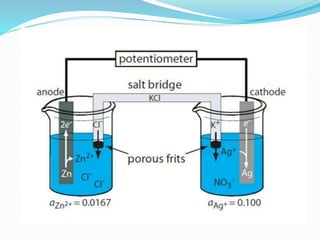
The electrochemical cell consists of two half cells, each
containing an electrode immersed in a solution of ions whose
activities determine the electrode’s potential. A salt bridge
containing an inert electrolyte, such as KCl, connect the two
half cells.
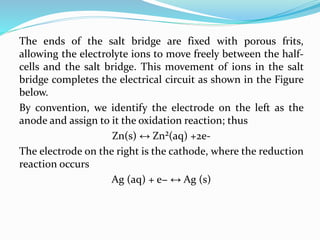
The ends of the salt bridge are fixed with porous frits,
allowing the electrolyte ions to move freely between the half-
cells and the salt bridge. This movement of ions in the salt
bridge completes the electrical circuit as shown in the Figure
below.
By convention, we identify the electrode on the left as the
anode and assign to it the oxidation reaction; thus
Zn(s) ↔ Zn²(aq) +2e-
The electrode on the right is the cathode, where the reduction
reaction occurs
Ag (aq) + e− ↔ Ag (s)
Advantages of potentiometric titrations over
'classical' visual indicator methods are:
1. Can be used for coloured, turbid or fluorescent analyte
solution.
2. Can be used if there is no suitable indicator or the
colour change is difficult to ascertain.
3. Can be used in the titration of polyprotic acids,
mixtures of acids, mixtures of bases or mixtures of
halides.
Types of Potentiometric Titration
Depending on the type of the reactions involved to which
potential measurement can be applied for end point
detection, potentiometric titrations can be
classified into followings:
(a) A cid-Base Titration
(b) Complexometric Titration
(c) Oxidation-Reduction Titration
(d) Precipitation Titration
Location of the End Point
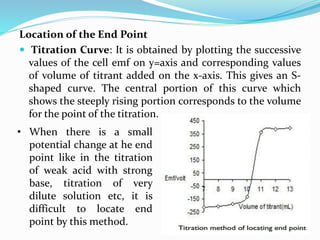
 Titration Curve: It is obtained by plotting the successive
values of the cell emf on y=axis and corresponding values
of volume of titrant added on the x-axis. This gives an S-
shaped curve. The central portion of this curve which
shows the steeply rising portion corresponds to the volume
for the point of the titration.
• When there is a small
potential change at he end
point like in the titration
of weak acid with strong
base, titration of very
dilute solution etc, it is
difficult to locate end
point by this method.
Analytical or Derivative Method:
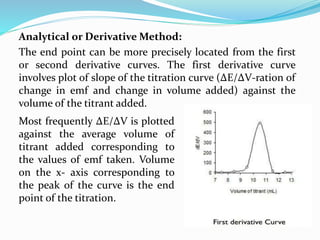
The end point can be more precisely located from the first
or second derivative curves. The first derivative curve
involves plot of slope of the titration curve (ΔE/ΔV-ration of
change in emf and change in volume added) against the
volume of the titrant added.
Most frequently ΔE/ΔV is plotted
against the average volume of
titrant added corresponding to
the values of emf taken. Volume
on the x- axis corresponding to
the peak of the curve is the end
point of the titration.
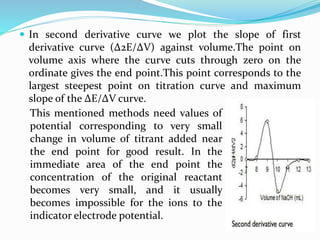
 In second derivative curve we plot the slope of first
derivative curve (Δ2E/ΔV) against volume.The point on
volume axis where the curve cuts through zero on the
ordinate gives the end point.This point corresponds to the
largest steepest point on titration curve and maximum
slope of the ΔE/ΔV curve.
This mentioned methods need values of
potential corresponding to very small
change in volume of titrant added near
the end point for good result. In the
immediate area of the end point the
concentration of the original reactant
becomes very small, and it usually
becomes impossible for the ions to the
indicator electrode potential.
2. Voltammetry method:
It is based on the applies a constant and/or varying potential
at an electrode's surface and measures the resulting current
with a three electrode system. Voltammetry, with its variety
of methods, constitutes the largest group of electrochemical
methods of analysis and is commonly used for the
determination of compounds in solutions(for example,
polarography and amperometry).
3. Conductometry methods:
In which the electrical conductivity of electrolytes (aqueous
and non-aqueous solutions, colloid systems and solids) is
measured. It is based on the change in the concentration of a
compound or the chemical composition of a medium in the
interelectrode space;
4. Coulometry methods:
It is based on the measurement of the amount of material
deposited on an electrode in the course of an electrochemical
reaction in accordance with Faraday’s laws. A distinction is
made between coulometry at constant potential and
coulometry at constant current.
Coulometry uses applied current or potential to completely
convert an analyte from one oxidation state to another. In
these experiments, the total current passed is measured
directly or indirectly to determine the number of electrons
passed. Knowing the number of electrons passed can indicate
the concentration of the analyte or, when the concentration is
known, the number of electrons transferred in the redox
reaction.
References
 Kissinger, Peter; William R. Heineman (1996-01-23). Laboratory Techniques
in Electroanalytical Chemistry, Second Edition, Revised and Expanded (2
ed.). CRC. ISBN 0-8247-9445-1.
 Zoski, Cynthia G. (2007-02-07).Handbook of Electrochemistry. Elsevier
Science. ISBN 0-444-51958-0.
 . F. Weber, Wied. Ann., 7, 536, 1879
 Fundamentals of Environmental sampling and analysis_Chunlong (Carl)
Zhang
 Bard, Allen J.; Larry R. Faulkner (2000-12-18). Electrochemical Methods:
Fundamentals and Applications (2 ed.). Wiley. ISBN 0-471-04372-9.
 Skoog, Douglas A.; Donald M. West; F. James Holler (1995-08-
25).Fundamentals of Analytical Chemistry (7th ed.). Harcourt Brace College
Publishers. ISBN 0-03-005938-0.
Thank You

Electrochemical methods: Environmental Analysis

  • 1.
  • 2.
    Introduction  Electrochemical methodsare analytical techniques that use a measurement of potential, charge, or current to determine an analyte’s concentration or to characterize an analyte’s chemical reactivity.  It is a qualitative and quantitative methods of analysis based on electrochemical phenomena occurring within a medium or at the phase boundary and related to changes in the structure, chemical composition, or concentration of the compound being analyzed.  These methods are divided into five major groups: potentiometry, voltammetry, coulometry, conductometry, and dielectrometry.
  • 3.
    Application 1. Obtaining thermodynamicdata about a reaction. 2. To generate an unstable intermediate such as radical ion and study its rate of decay or it is spectroscopic properties. 3. They use to analyze a solution for trace amount of metal ions or organic species. 4. The electrochemical properties of the system themselves are of primary interest, for example, in the design of a new power source or for the electrochemical method have been developed.
  • 4.
    Controlling and MeasuringCurrent and Potential • We cannot simultaneously control both current and potential • If we choose to control the potential, then we must accept the resulting current, and we must accept the resulting potential if we choose to control the current. • The second electrode, which we call the counter electrode, completes the electrical circuit and provides a reference potential against which we measure the working electrodes potential. Ideally the counter electrode’s potential remains constant so that we can assign to the working electrode any change in the overall cell potential.
  • 5.
    • measurements aremade in an electrochemical cell consisting of two or more electrodes and the electronic circuitry for controlling and measuring the current and the potential. • The simplest electrochemical cell uses two electrodes. The potential of one electrode is sensitive to the analyst’s concentration, and is called the working electrode or the indicator electrode. • If the counter electrode’s potential is not constant, we replace it with two electrodes: a reference electrode whose potential remains constant and an auxiliary electrode that completes the electrical circuit. • Because we cannot simultaneously control the current and the potential, there are only three basic experimental designs.
  • 6.
    (1) Measure thepotential when the current is zero, (2) Measure the potential while controlling the current, (3) Measure the current while controlling the potential  Each of these experimental designs relies on Ohm’s law, which states that a current, i, passing through an electrical circuit of resistance, R, generates a potential, E. (E =iR)  Each of these experimental designs uses a different
  • 7.
    Electrochemical techniques The electrochemicaltechniques is divided into Static techniques and dynamic techniques 1. Static technique: It is the current is not pass through the analyte’s solution. Potentiometry, in which we measure the potential of an electrochemical cell under static conditions, is one of the most important quantitative electrochemical methods. 2. Dynamic technique: In which we allow current to flow through the analyte’s solution, it comprise the largest group of interfacial electrochemical techniques e.g. Coulometry, in which we measure current as a function of time,Amperometry and voltammetry, in which we measure current as a function of a fixed or variable potential.
  • 8.
    Types of electrochemicalmethods 1. Potentiometry methods: it measures the potential of a solution between two electrodes. The potential is then related to the concentration of one or more analytes. The cell structure used is often referred to as an electrode even though contains two electrodes: an indicator electrode and a reference electrode.  Potentiometry usually uses electrodes made selectively sensitive to the ion of interest, such as a fluoride- selective electrode. The most common potentiometric electrode is the glass-membrane electrode used in a pH meter.
  • 9.
     Potentiometric titration Itis a technique similar to direct titration of a redox reaction. No indicator is used, instead the potential across the analyte, typically an electrolyte solution is measured. To do this,two electrodes are used, an indicator electrode and reference electrode. In potentiometry we measure the potential of an electrochemical cell under static conditions. Because no current—or only a negligible current—flows through the electrochemical cell, its composition remains unchanged. For this reason, potentiometry is a useful quantitative method.
  • 10.
     Potentiometric Measurements: Itis used to determine the difference between the potential of two electrodes. The potential of one electrode the working or indicator electrode responds to the analyte’s activity, and the other electrode the counter or reference electrode has a know, fixed potential.  Potentiometric Electrochemical Cells The electrochemical cell consists of two half cells, each containing an electrode immersed in a solution of ions whose activities determine the electrode’s potential. A salt bridge containing an inert electrolyte, such as KCl, connect the two half cells.
  • 11.
    The ends ofthe salt bridge are fixed with porous frits, allowing the electrolyte ions to move freely between the half- cells and the salt bridge. This movement of ions in the salt bridge completes the electrical circuit as shown in the Figure below. By convention, we identify the electrode on the left as the anode and assign to it the oxidation reaction; thus Zn(s) ↔ Zn²(aq) +2e- The electrode on the right is the cathode, where the reduction reaction occurs Ag (aq) + e− ↔ Ag (s)
  • 13.
    Advantages of potentiometrictitrations over 'classical' visual indicator methods are: 1. Can be used for coloured, turbid or fluorescent analyte solution. 2. Can be used if there is no suitable indicator or the colour change is difficult to ascertain. 3. Can be used in the titration of polyprotic acids, mixtures of acids, mixtures of bases or mixtures of halides.
  • 14.
    Types of PotentiometricTitration Depending on the type of the reactions involved to which potential measurement can be applied for end point detection, potentiometric titrations can be classified into followings: (a) A cid-Base Titration (b) Complexometric Titration (c) Oxidation-Reduction Titration (d) Precipitation Titration
  • 15.
    Location of theEnd Point  Titration Curve: It is obtained by plotting the successive values of the cell emf on y=axis and corresponding values of volume of titrant added on the x-axis. This gives an S- shaped curve. The central portion of this curve which shows the steeply rising portion corresponds to the volume for the point of the titration. • When there is a small potential change at he end point like in the titration of weak acid with strong base, titration of very dilute solution etc, it is difficult to locate end point by this method.
  • 16.
    Analytical or DerivativeMethod: The end point can be more precisely located from the first or second derivative curves. The first derivative curve involves plot of slope of the titration curve (ΔE/ΔV-ration of change in emf and change in volume added) against the volume of the titrant added. Most frequently ΔE/ΔV is plotted against the average volume of titrant added corresponding to the values of emf taken. Volume on the x- axis corresponding to the peak of the curve is the end point of the titration.
  • 17.
     In secondderivative curve we plot the slope of first derivative curve (Δ2E/ΔV) against volume.The point on volume axis where the curve cuts through zero on the ordinate gives the end point.This point corresponds to the largest steepest point on titration curve and maximum slope of the ΔE/ΔV curve. This mentioned methods need values of potential corresponding to very small change in volume of titrant added near the end point for good result. In the immediate area of the end point the concentration of the original reactant becomes very small, and it usually becomes impossible for the ions to the indicator electrode potential.
  • 18.
    2. Voltammetry method: Itis based on the applies a constant and/or varying potential at an electrode's surface and measures the resulting current with a three electrode system. Voltammetry, with its variety of methods, constitutes the largest group of electrochemical methods of analysis and is commonly used for the determination of compounds in solutions(for example, polarography and amperometry). 3. Conductometry methods: In which the electrical conductivity of electrolytes (aqueous and non-aqueous solutions, colloid systems and solids) is measured. It is based on the change in the concentration of a compound or the chemical composition of a medium in the interelectrode space;
  • 19.
    4. Coulometry methods: Itis based on the measurement of the amount of material deposited on an electrode in the course of an electrochemical reaction in accordance with Faraday’s laws. A distinction is made between coulometry at constant potential and coulometry at constant current. Coulometry uses applied current or potential to completely convert an analyte from one oxidation state to another. In these experiments, the total current passed is measured directly or indirectly to determine the number of electrons passed. Knowing the number of electrons passed can indicate the concentration of the analyte or, when the concentration is known, the number of electrons transferred in the redox reaction.
  • 20.
    References  Kissinger, Peter;William R. Heineman (1996-01-23). Laboratory Techniques in Electroanalytical Chemistry, Second Edition, Revised and Expanded (2 ed.). CRC. ISBN 0-8247-9445-1.  Zoski, Cynthia G. (2007-02-07).Handbook of Electrochemistry. Elsevier Science. ISBN 0-444-51958-0.  . F. Weber, Wied. Ann., 7, 536, 1879  Fundamentals of Environmental sampling and analysis_Chunlong (Carl) Zhang  Bard, Allen J.; Larry R. Faulkner (2000-12-18). Electrochemical Methods: Fundamentals and Applications (2 ed.). Wiley. ISBN 0-471-04372-9.  Skoog, Douglas A.; Donald M. West; F. James Holler (1995-08- 25).Fundamentals of Analytical Chemistry (7th ed.). Harcourt Brace College Publishers. ISBN 0-03-005938-0.
  • 21.