CYCLIC VOLTAMMETRY
Prepared by:
SHARON BENNY ALEX
Savitribai Phule Pune University
What is Cyclic Voltammetry?
• type of potentiodynamic electrochemical measurement.
• Here, the working electrode potential is ramped linearly versus time. The current at the working
electrode is plotted versus the applied voltage (that is, the working electrode's potential) to give the
cyclic voltammogram trace.
Uses:
 to study the electrochemical properties of an analyte in solution or of a molecule that is adsorbed
onto the electrode.
 to investigate the reduction and oxidation processes of molecular species (redox reactions).
 to study electron transfer-initiated chemical reactions
 to determine the stability of reaction products
 the presence of intermediates in redox reactions, electron transfer kinetics,
 reversibility of a reaction.
 to determine the electron stoichiometry of a system, the diffusion coefficient of an analyte, and the
formal reduction potential of an analyte,
Types:
• Linear sweep voltammetry
• Staircase voltammetry
• Squarewave voltammetry
• Anodic stripping voltammetry
• Cathodic stripping voltammetry
• Adsorptive stripping voltammetry
• Alternating current voltammetry
• Normal pulse voltammetry
• Differential pulse voltammetry
• Chronoamperometry
• Cyclic voltammetry (CV)
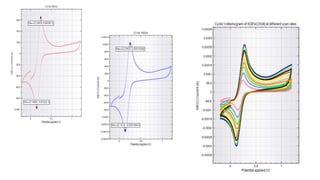
Understanding : A Voltammogram & “Duck Shape”
• Here, the traces are called as voltammograms.
• When sweeped in the positive direction we get the anodic trace and in the negative
direction we get the cathodic trace.
• Lets consider the reaction
• [Fe(CN)6]3- + e- ⇌ [Fe(CN)6]4-
• At the starting potential, no current flows. If an oxidizable species is present, ia will
increase and continues till it reaches maximum which denotes that all the species has
been oxidized.
• Then it will again decrease till it reaches the background current level.
• Now, the potential is reversed and as potential is negatively sweeped, the now-high
concentrated oxidized species start to get reduced.
• So, ic reaches a maximum where all has been reduced and back to the background level.
Experiment
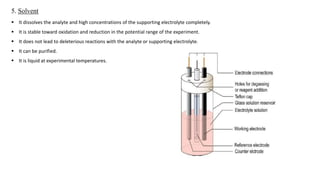
Electrochemical cell:
In CV, a three-electrode system is set up which includes
1. Working electrode
 The electrochemical reaction of our interest occurs at the interface of this electrode. Since the reaction occurs at the surface, the need to
polish and get a well-defined surface area is important.
 The main types of WE that are being used are Platinum, Glassy carbon etc.
 The potentiostat controls the applied potential of WE as a function of RE.
2. Reference electrode
 It has a well-defined and stable equilibrium potential and thus, used as a reference point.
 The commonly used electrode assemblies used in aqueous media include the saturated calomel electrode (SCE), standard hydrogen electrode
(SHE), and the AgCl/Ag electrode.
 RE is generally separated from the solution by a porous frit to minimize junction potentials by matching the solvent and electrolyte in the
reference compartment to the one used in the experiment.
3. Counter electrode
When potential is applied to the WE, current begins to flow and electrons start to flow between CE and WE. This completes the circuit.
Generally the surface area of CE is greater than that of WE such that the reactions happening at the CE will not affect the electrochemical
reaction of our interest.
Mainly used CE are Pt, glassy carbon etc.
4. Supporting electrolyte
Large concentrations are necessary to increase solution conductivity. As electron transfers occur at the electrodes, the supporting electrolyte will
migrate to balance the charge and complete the electrical circuit.
Without the electrolyte available to achieve charge balance, the solution will be resistive to charge transfer.
Large concentrations also limits the analyte migration.
It is highly soluble in the solvent chosen.
It is chemically and electrochemically inert in the conditions of the experiment.
It can be purified.
5. Solvent
 It dissolves the analyte and high concentrations of the supporting electrolyte completely.
 It is stable toward oxidation and reduction in the potential range of the experiment.
 It does not lead to deleterious reactions with the analyte or supporting electrolyte.
 It can be purified.
 It is liquid at experimental temperatures.
In Lab
 A 10-3 mM of K3[Fe(CN)6]3- was prepared in 0.1M KNO3 solution.
 The reference electrode, here Ag/AgCl was prepared by immersing the Ag wire in a 0.05M KCl solution to
coat it with a greyish-white layer of chloride. Further, it was kept in a tube filled with agar-agar and KCl
solution. It was kept still for 24 hours for the equilibrium to maintain.
 A Pt disc electrode and Pt flag electrode was used as WE and CE respectively.
 It was arranged in a cell and the CV was taken for different scan rates from 50mV to 500mV.
 The graph was plotted.
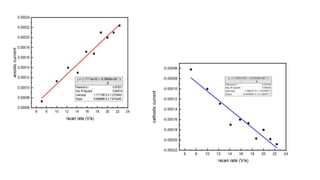
 Values of ip,a, ip,c, Eo, Ec from the graph and Do was calculated from the Randles - Sevick equation.
ip = 0.446nFACo (
𝑛𝐹𝑣𝐷0
𝑅𝑇
)1/2
THANK YOU

Cyclic voltammetry

  • 1.
    CYCLIC VOLTAMMETRY Prepared by: SHARONBENNY ALEX Savitribai Phule Pune University
  • 2.
    What is CyclicVoltammetry? • type of potentiodynamic electrochemical measurement. • Here, the working electrode potential is ramped linearly versus time. The current at the working electrode is plotted versus the applied voltage (that is, the working electrode's potential) to give the cyclic voltammogram trace. Uses:  to study the electrochemical properties of an analyte in solution or of a molecule that is adsorbed onto the electrode.  to investigate the reduction and oxidation processes of molecular species (redox reactions).  to study electron transfer-initiated chemical reactions  to determine the stability of reaction products  the presence of intermediates in redox reactions, electron transfer kinetics,  reversibility of a reaction.  to determine the electron stoichiometry of a system, the diffusion coefficient of an analyte, and the formal reduction potential of an analyte,
  • 3.
    Types: • Linear sweepvoltammetry • Staircase voltammetry • Squarewave voltammetry • Anodic stripping voltammetry • Cathodic stripping voltammetry • Adsorptive stripping voltammetry • Alternating current voltammetry • Normal pulse voltammetry • Differential pulse voltammetry • Chronoamperometry • Cyclic voltammetry (CV)
  • 4.
    Understanding : AVoltammogram & “Duck Shape” • Here, the traces are called as voltammograms. • When sweeped in the positive direction we get the anodic trace and in the negative direction we get the cathodic trace. • Lets consider the reaction • [Fe(CN)6]3- + e- ⇌ [Fe(CN)6]4- • At the starting potential, no current flows. If an oxidizable species is present, ia will increase and continues till it reaches maximum which denotes that all the species has been oxidized. • Then it will again decrease till it reaches the background current level. • Now, the potential is reversed and as potential is negatively sweeped, the now-high concentrated oxidized species start to get reduced. • So, ic reaches a maximum where all has been reduced and back to the background level.
  • 5.
    Experiment Electrochemical cell: In CV,a three-electrode system is set up which includes 1. Working electrode  The electrochemical reaction of our interest occurs at the interface of this electrode. Since the reaction occurs at the surface, the need to polish and get a well-defined surface area is important.  The main types of WE that are being used are Platinum, Glassy carbon etc.  The potentiostat controls the applied potential of WE as a function of RE. 2. Reference electrode  It has a well-defined and stable equilibrium potential and thus, used as a reference point.  The commonly used electrode assemblies used in aqueous media include the saturated calomel electrode (SCE), standard hydrogen electrode (SHE), and the AgCl/Ag electrode.  RE is generally separated from the solution by a porous frit to minimize junction potentials by matching the solvent and electrolyte in the reference compartment to the one used in the experiment.
  • 6.
    3. Counter electrode Whenpotential is applied to the WE, current begins to flow and electrons start to flow between CE and WE. This completes the circuit. Generally the surface area of CE is greater than that of WE such that the reactions happening at the CE will not affect the electrochemical reaction of our interest. Mainly used CE are Pt, glassy carbon etc. 4. Supporting electrolyte Large concentrations are necessary to increase solution conductivity. As electron transfers occur at the electrodes, the supporting electrolyte will migrate to balance the charge and complete the electrical circuit. Without the electrolyte available to achieve charge balance, the solution will be resistive to charge transfer. Large concentrations also limits the analyte migration. It is highly soluble in the solvent chosen. It is chemically and electrochemically inert in the conditions of the experiment. It can be purified.
  • 7.
    5. Solvent  Itdissolves the analyte and high concentrations of the supporting electrolyte completely.  It is stable toward oxidation and reduction in the potential range of the experiment.  It does not lead to deleterious reactions with the analyte or supporting electrolyte.  It can be purified.  It is liquid at experimental temperatures.
  • 8.
    In Lab  A10-3 mM of K3[Fe(CN)6]3- was prepared in 0.1M KNO3 solution.  The reference electrode, here Ag/AgCl was prepared by immersing the Ag wire in a 0.05M KCl solution to coat it with a greyish-white layer of chloride. Further, it was kept in a tube filled with agar-agar and KCl solution. It was kept still for 24 hours for the equilibrium to maintain.  A Pt disc electrode and Pt flag electrode was used as WE and CE respectively.  It was arranged in a cell and the CV was taken for different scan rates from 50mV to 500mV.  The graph was plotted.  Values of ip,a, ip,c, Eo, Ec from the graph and Do was calculated from the Randles - Sevick equation. ip = 0.446nFACo ( 𝑛𝐹𝑣𝐷0 𝑅𝑇 )1/2
  • 11.