PRESENTED BY-
NAZZNEEN .M.V
 Polarographic Analysis.
 Is a method of analysis based on the measurement of
current electrolysis of an electroactive species at a
given electrode potential under controlled conditions.
 It is the branch of voltammetry where the working
electrode is a dropping mercury electrode (DME) or a
static mercury drop electrode (SMDE), which useful for
their wide cathodic ranges and renewable surfaces.
 In 1922, Polarography was developed by (zech chemist,
Jaroslav Heyrovsky , who won the noble prize for his
discovery.
 An electromechanical techniques of analysing solutions
that measure the current flowing between two
electrodes in the solution as well as gradually
increasing applied voltage to determine respectively the
concentration of a solute and its nature.
 Is a method of analysis in which the solution
to be analysed is electrolysed in such a way
that the graph of current against voltage
shows what is in solution and how much is
present.
 In this method, a reference electrode and an
indicator electrode are required.
 Reference elecrode – acts to maintain a
constant potential throught the
measurement.
 Indicator electrode – acts to maintain a
constant potential impressed upon it from an
external source.
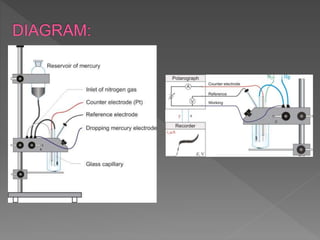
 In polarography , mercury is used as a
working electrode , because mercury it is a
liquid . The working electrode is often a drop
suspended from of a capillary tube.
 HMDE( HANGING MERCURY DROP ELECTRODE)-we
extrude the drop of Hg by rotating a
micrometer screw that pushes the mercury
from a reservoir through a narrow capillary.
 DME(DROPING MERCURY ELECTRODE )- mercury
drops at the end of the capillary tube as a
result of gravity. Unlike the HMDE , the
mercury drop of a DME grows continuously
as mercury flows from the reservoir under
the influence of gravity and has a infinite of
several seconds . At the end of its lifetime
the mercury drop dislodged ,either manually
or its own. and replaced by new drop.
 DSME (STATIC MERCURY DROP ELECTRODE)- uses a solenold
driven plunger to control the flow of mercury.
Activation of the solenold mometerily lifts the
plumber , allowing mercury to flow through
the capillary and forming a single,hanging
Hg drop
 Surface area is reproducible
 Constant renewal of electrode surface
eliminating poisoning effect
 Mercury forms amalgams with most metal
ions and alkali metal ions which are
reducible
 It is useful over the range of +0.4 to -1.8V
 Electrodes cannot be used above +0.4V
 Capillary is difficult to maintain sice dust or
either particularly matter can be block the
capillary
 Mercury can be easily oxidixied thus limit the
feasible range of the electrode
 Study of solutions or of electrode processes
by means of electrolysis with two electrodes
, one polarizable, the former formed by
mercury regularly dropping from capillary
tube.
 POLARIZED ELECTRODE : Dropping
Mercury Electrode (DME)
 DEPOLARIZED ELECTRODE : Saturated
Calomel Electrode
 Mercury continously drops from reservoir
through a capillary tube into nthe solution
 The optimum interval between drops for
most analysis is between 2 and 5 seconds.
 It consist of polarsable elctrode (DME) and
non polarsible electrode ( saturated calomel
electrode)
 Between these electrodes, the required
potential range (0 to -3v) can be applied
 It consist of sample cell in which the sample
solution to be analysied tis kept
 Sample cell made up of glass and has
tampering edge to hold at the bottom to hold
mercury – after the droplets have been
formed
 The capillary is dipped into the solution to
be analysed and the height of mercury
reservoir is analysied in such a way drop
time of about 2-7 sec is set
 Supporting electrolite be like kcl (50-100
times sample conc ) is added to the sample
solution to eliminate migration current.
 In polarographic analysis “ diffusion which is
proportional to the conc of the electrolite and
hence only the diffusion current has to be
measured
 In normal condition , without the supporting
electrolyte, migration current is also recorded
which is not required
 Oxygen present in sample solution is removed
by passing nitrogen or using alkaline pyrogallol
solution . Maximum suppressors are added in
the req conc.
 When all these things are done , initial and final
potential is set in the instrument the current
voltage cure is recorded
 From the current voltage curve , half wave
potential & diffusion current is determined
and thus qualitative and quantitative analysis
is performed
 Obtained from an automatic recording instrument is
called a polarogram, and the trace a polarographic
ware.
 POLAROGRAM
It is a graph of current versus potential in a
polarographic analysis.
3 categories:
A. Collectively referred to as residual current
B. Referred to as diffusion current resulting from
the reduction of the sample
C. Called the limiting current
 The diffusion current of a known
concentration of reference standard are first
determined followed by the determination of
the determination of the diffusion current of
the unknown concentration.
 (Residual current) which is the current obtained
when no electrochemical change takes place.
 (Average current/limiting current)is the current
obtained by average current values throuhtout
the life time of the drop while
 (Diffusion current) which is the current resulting
from the diffusion of electroactive species to the
drop surface.
 It is the sum of the relativity larger condens
current (charging current) and a very small
faradic current.
MIGRATION CURRENT
 It is due to migration of cations from the bulk
of the solution towards cathode due to
diffusive force . Irrespective of concentration
gradient
 Diffusion current is due to the actual diffusion
of electroreducible ion from the bulk of the
sample to the surface of the mercury
droplets due to concentration gradient
LIMITING CURRENT
 Beyond a certain potential , the current
reach a steady value called as the limiting
current
 CONCENTRATION : Diffusion current is
directly proportional to concentration of the
electroreducible ions . This forms the basis
quantitative analysis. i.e, if concentration is
less , then diffusion current is less . If
concentration is more then diffusion current
also more
 Diffusion of ions is being affected by
temperature hence diffusion current also
varies with respect is temperature (directly
proportional)
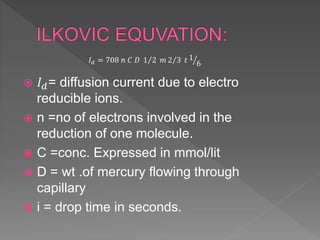
 𝐼 𝑑= diffusion current due to electro
reducible ions.
 n =no of electrons involved in the
reduction of one molecule.
 C =conc. Expressed in mmol/lit
 D = wt .of mercury flowing through
capillary
 i = drop time in seconds.
𝐼 𝑑 = 708 𝑛 𝐶 𝐷 1 2 𝑚 2 3 𝑡 1
6
 Direct comparison method.
 CCM- calibration curve method.
 Internal standard or pilot ion.
 Method of standard addition.
 composition of alloy.
 Purity of element.
 Analysis of trace trace elements like copper,
Zn, iron, nickle, lead, manganese.
 Trace metals and metal containing drugs.
 Blood and serum cancer diagnosis.
Polarography

Polarography

  • 1.
  • 2.
     Polarographic Analysis. Is a method of analysis based on the measurement of current electrolysis of an electroactive species at a given electrode potential under controlled conditions.  It is the branch of voltammetry where the working electrode is a dropping mercury electrode (DME) or a static mercury drop electrode (SMDE), which useful for their wide cathodic ranges and renewable surfaces.
  • 3.
     In 1922,Polarography was developed by (zech chemist, Jaroslav Heyrovsky , who won the noble prize for his discovery.  An electromechanical techniques of analysing solutions that measure the current flowing between two electrodes in the solution as well as gradually increasing applied voltage to determine respectively the concentration of a solute and its nature.
  • 4.
     Is amethod of analysis in which the solution to be analysed is electrolysed in such a way that the graph of current against voltage shows what is in solution and how much is present.  In this method, a reference electrode and an indicator electrode are required.
  • 5.
     Reference elecrode– acts to maintain a constant potential throught the measurement.  Indicator electrode – acts to maintain a constant potential impressed upon it from an external source.
  • 7.
     In polarography, mercury is used as a working electrode , because mercury it is a liquid . The working electrode is often a drop suspended from of a capillary tube.
  • 8.
     HMDE( HANGINGMERCURY DROP ELECTRODE)-we extrude the drop of Hg by rotating a micrometer screw that pushes the mercury from a reservoir through a narrow capillary.  DME(DROPING MERCURY ELECTRODE )- mercury drops at the end of the capillary tube as a result of gravity. Unlike the HMDE , the mercury drop of a DME grows continuously as mercury flows from the reservoir under the influence of gravity and has a infinite of several seconds . At the end of its lifetime the mercury drop dislodged ,either manually or its own. and replaced by new drop.
  • 9.
     DSME (STATICMERCURY DROP ELECTRODE)- uses a solenold driven plunger to control the flow of mercury. Activation of the solenold mometerily lifts the plumber , allowing mercury to flow through the capillary and forming a single,hanging Hg drop
  • 10.
     Surface areais reproducible  Constant renewal of electrode surface eliminating poisoning effect  Mercury forms amalgams with most metal ions and alkali metal ions which are reducible  It is useful over the range of +0.4 to -1.8V
  • 11.
     Electrodes cannotbe used above +0.4V  Capillary is difficult to maintain sice dust or either particularly matter can be block the capillary  Mercury can be easily oxidixied thus limit the feasible range of the electrode
  • 12.
     Study ofsolutions or of electrode processes by means of electrolysis with two electrodes , one polarizable, the former formed by mercury regularly dropping from capillary tube.  POLARIZED ELECTRODE : Dropping Mercury Electrode (DME)  DEPOLARIZED ELECTRODE : Saturated Calomel Electrode
  • 13.
     Mercury continouslydrops from reservoir through a capillary tube into nthe solution  The optimum interval between drops for most analysis is between 2 and 5 seconds.
  • 14.
     It consistof polarsable elctrode (DME) and non polarsible electrode ( saturated calomel electrode)  Between these electrodes, the required potential range (0 to -3v) can be applied  It consist of sample cell in which the sample solution to be analysied tis kept
  • 15.
     Sample cellmade up of glass and has tampering edge to hold at the bottom to hold mercury – after the droplets have been formed  The capillary is dipped into the solution to be analysed and the height of mercury reservoir is analysied in such a way drop time of about 2-7 sec is set  Supporting electrolite be like kcl (50-100 times sample conc ) is added to the sample solution to eliminate migration current.
  • 16.
     In polarographicanalysis “ diffusion which is proportional to the conc of the electrolite and hence only the diffusion current has to be measured  In normal condition , without the supporting electrolyte, migration current is also recorded which is not required  Oxygen present in sample solution is removed by passing nitrogen or using alkaline pyrogallol solution . Maximum suppressors are added in the req conc.  When all these things are done , initial and final potential is set in the instrument the current voltage cure is recorded
  • 17.
     From thecurrent voltage curve , half wave potential & diffusion current is determined and thus qualitative and quantitative analysis is performed
  • 18.
     Obtained froman automatic recording instrument is called a polarogram, and the trace a polarographic ware.  POLAROGRAM It is a graph of current versus potential in a polarographic analysis. 3 categories: A. Collectively referred to as residual current B. Referred to as diffusion current resulting from the reduction of the sample C. Called the limiting current
  • 19.
     The diffusioncurrent of a known concentration of reference standard are first determined followed by the determination of the determination of the diffusion current of the unknown concentration.
  • 20.
     (Residual current)which is the current obtained when no electrochemical change takes place.  (Average current/limiting current)is the current obtained by average current values throuhtout the life time of the drop while  (Diffusion current) which is the current resulting from the diffusion of electroactive species to the drop surface.
  • 21.
     It isthe sum of the relativity larger condens current (charging current) and a very small faradic current. MIGRATION CURRENT  It is due to migration of cations from the bulk of the solution towards cathode due to diffusive force . Irrespective of concentration gradient
  • 22.
     Diffusion currentis due to the actual diffusion of electroreducible ion from the bulk of the sample to the surface of the mercury droplets due to concentration gradient LIMITING CURRENT  Beyond a certain potential , the current reach a steady value called as the limiting current
  • 23.
     CONCENTRATION :Diffusion current is directly proportional to concentration of the electroreducible ions . This forms the basis quantitative analysis. i.e, if concentration is less , then diffusion current is less . If concentration is more then diffusion current also more
  • 24.
     Diffusion ofions is being affected by temperature hence diffusion current also varies with respect is temperature (directly proportional)
  • 25.
     𝐼 𝑑=diffusion current due to electro reducible ions.  n =no of electrons involved in the reduction of one molecule.  C =conc. Expressed in mmol/lit  D = wt .of mercury flowing through capillary  i = drop time in seconds. 𝐼 𝑑 = 708 𝑛 𝐶 𝐷 1 2 𝑚 2 3 𝑡 1 6
  • 26.
     Direct comparisonmethod.  CCM- calibration curve method.  Internal standard or pilot ion.  Method of standard addition.
  • 27.
     composition ofalloy.  Purity of element.  Analysis of trace trace elements like copper, Zn, iron, nickle, lead, manganese.  Trace metals and metal containing drugs.  Blood and serum cancer diagnosis.