Photosynthesis
Objective 1 To trace the primary food source in a food chain to the green plant
The Primary Food Source Green plants always found at the beginning of the food chain. Why? The only organisms that can produce their own food They are called producers
Objective 2 To define photosynthesis
PHOTOSYNTHESIS Photo = light Synthesis = building up
DEFINITION Photosynthesis Process by which plants use  water  &  carbon dioxide  to make  carbohydrates  in the presence of  light  and  chlorophyll . Oxygen  is given off during the process.
Objective 3 To understand the conditions necessary for plants to make their own food
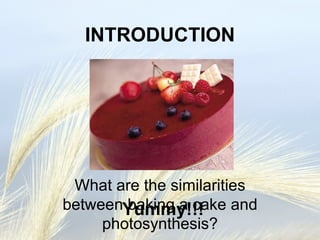
INTRODUCTION Yummy!!! What are the similarities between baking a cake and photosynthesis?
REQUIREMENTS Raw materials Carbon dioxide Water Conditions Chlorophyll Light energy
Answers Review 1 An organism that make its own food, e.g. green plant They make their own food by photosynthesis Review 2 Textbook pg 19 Review 3 Raw materials: water & carbon dioxide Conditions: sunlight & chlorophyll End products: oxygen & glucose
Objective 4 To outline the process of photosynthesis by which plants manufacture carbohydrates using raw materials To state that food is stored as starch in the plant
CARBON DIOXIDE From air Enters leaf by diffusion Pores: Stomata/Stoma Found underside of the leaf
Carbon dioxide
WATER From soil Absorb by root hair Enter by osmosis Transport by xylem vessel
Soil Water Water Root Hair To Xylem Vessel Water Water
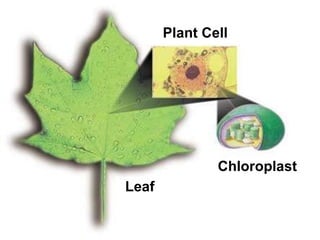
CHLOROPHYLL Structure: Chloroplast Green pigment: Chlorophyll Absorb light energy
Leaf Plant Cell Chloroplast
LIGHT ENERGY Chlorophyll absorbs light energy from sun Light energy converted into chemical energy Chemical energy is needed to convert carbon dioxide to carbohydrate Series of chemical reactions
Xylem H 2 O CO 2 H 2 O H 2 O CO 2
Carbon Dioxide +Water Light  Chlorophyll Glucose +  Oxygen O 2 O 2 Surroundings STARCH
WORD EQUATION CARBON DIOXIDE + WATER   GLUCOSE + OXYGEN  LIGHT ENERGY   CHLOROPHYLL
Review 4 Water, carbon dioxide, sunlight Chlorophyll It absorb the sunlight/light energy Chloroplasts The root hair absorb the water by osmosis Xylem vessel It enters through the stomata by diffusion Carbon dioxide + water  glucose + oxygen Light energy Chlorophyll
Objective 5 To state the conditions that affect the rate of photosynthesis
LIMITING FACTORS Rate of photosynthesis is affected by: carbon dioxide,  light intensity and  temperature
LIGHT INTENSITY Higher light intensity, faster the rate of photosynthesis After awhile, the rate will remain constant Due to limiting factors such carbon dioxide concentration or temperature
CARBON DIOXIDE Carbon dioxide in the air is 0.03% Increasing the carbon dioxide concentration to 0.1% increases the rate of photosynthesis After awhile the rate will remain constant due to limiting factor such as temperature and light intensity
TEMPERATURE Temperatures below 40°C, as it rises, the rate of photosynthesis is faster At 40°C, photosynthesis begins to decrease As temperature rises above 40°C, photosynthesis stop as the enzymes denatured
Other important things that plant need to grow Minerals Found in soil and fertilizers Magnesium: chlorophyll formation Nitrogen: for making proteins
Objective 6 To compare the conditions for healthy growth of ornamental plants and large scale crop productions
Ornamental Plants Use for decoration Usually grown in greenhouses
Ornamental Plants Conditions needed Types of soil – sand, organic matter Minerals – artificial or natural fertilizers Humidity - humid conditions better, by spraying and misting Temperature - warm Light - bright Carbon dioxide – burning fuels Water – watering plants Pests – hand pick/pesticides
Large scale crops Includes rice, wheat, vegetables Relies on farming methods and agricultural technology Plant in open field
Large scale crops Light, humidity, temperature and water – cannot be controlled Fertilizers – mostly used artificial fertilizers, machines  Pests – planes to spray pesticides over farm areas
Experiment Question
Experiment: Testing for starch in green leaves What does hot water do to the leaf? Kills the leaf to stop photosynthesis What does the alcohol do to the leaf? Breaks down chlorophyll – take the green colour out of the leaf What is the original colour of iodine? brown What does it mean when iodine turn blue-black? Starch is present

Photosynthesis

  • 1.
  • 2.
    Objective 1 Totrace the primary food source in a food chain to the green plant
  • 3.
    The Primary FoodSource Green plants always found at the beginning of the food chain. Why? The only organisms that can produce their own food They are called producers
  • 4.
    Objective 2 Todefine photosynthesis
  • 5.
    PHOTOSYNTHESIS Photo =light Synthesis = building up
  • 6.
    DEFINITION Photosynthesis Processby which plants use water & carbon dioxide to make carbohydrates in the presence of light and chlorophyll . Oxygen is given off during the process.
  • 7.
    Objective 3 Tounderstand the conditions necessary for plants to make their own food
  • 8.
    INTRODUCTION Yummy!!! Whatare the similarities between baking a cake and photosynthesis?
  • 9.
    REQUIREMENTS Raw materialsCarbon dioxide Water Conditions Chlorophyll Light energy
  • 10.
    Answers Review 1An organism that make its own food, e.g. green plant They make their own food by photosynthesis Review 2 Textbook pg 19 Review 3 Raw materials: water & carbon dioxide Conditions: sunlight & chlorophyll End products: oxygen & glucose
  • 11.
    Objective 4 Tooutline the process of photosynthesis by which plants manufacture carbohydrates using raw materials To state that food is stored as starch in the plant
  • 12.
    CARBON DIOXIDE Fromair Enters leaf by diffusion Pores: Stomata/Stoma Found underside of the leaf
  • 13.
  • 14.
    WATER From soilAbsorb by root hair Enter by osmosis Transport by xylem vessel
  • 15.
    Soil Water WaterRoot Hair To Xylem Vessel Water Water
  • 16.
    CHLOROPHYLL Structure: ChloroplastGreen pigment: Chlorophyll Absorb light energy
  • 17.
    Leaf Plant CellChloroplast
  • 18.
    LIGHT ENERGY Chlorophyllabsorbs light energy from sun Light energy converted into chemical energy Chemical energy is needed to convert carbon dioxide to carbohydrate Series of chemical reactions
  • 19.
    Xylem H 2O CO 2 H 2 O H 2 O CO 2
  • 20.
    Carbon Dioxide +WaterLight Chlorophyll Glucose + Oxygen O 2 O 2 Surroundings STARCH
  • 21.
    WORD EQUATION CARBONDIOXIDE + WATER GLUCOSE + OXYGEN LIGHT ENERGY CHLOROPHYLL
  • 22.
    Review 4 Water,carbon dioxide, sunlight Chlorophyll It absorb the sunlight/light energy Chloroplasts The root hair absorb the water by osmosis Xylem vessel It enters through the stomata by diffusion Carbon dioxide + water glucose + oxygen Light energy Chlorophyll
  • 23.
    Objective 5 Tostate the conditions that affect the rate of photosynthesis
  • 24.
    LIMITING FACTORS Rateof photosynthesis is affected by: carbon dioxide, light intensity and temperature
  • 25.
    LIGHT INTENSITY Higherlight intensity, faster the rate of photosynthesis After awhile, the rate will remain constant Due to limiting factors such carbon dioxide concentration or temperature
  • 26.
    CARBON DIOXIDE Carbondioxide in the air is 0.03% Increasing the carbon dioxide concentration to 0.1% increases the rate of photosynthesis After awhile the rate will remain constant due to limiting factor such as temperature and light intensity
  • 27.
    TEMPERATURE Temperatures below40°C, as it rises, the rate of photosynthesis is faster At 40°C, photosynthesis begins to decrease As temperature rises above 40°C, photosynthesis stop as the enzymes denatured
  • 28.
    Other important thingsthat plant need to grow Minerals Found in soil and fertilizers Magnesium: chlorophyll formation Nitrogen: for making proteins
  • 29.
    Objective 6 Tocompare the conditions for healthy growth of ornamental plants and large scale crop productions
  • 30.
    Ornamental Plants Usefor decoration Usually grown in greenhouses
  • 31.
    Ornamental Plants Conditionsneeded Types of soil – sand, organic matter Minerals – artificial or natural fertilizers Humidity - humid conditions better, by spraying and misting Temperature - warm Light - bright Carbon dioxide – burning fuels Water – watering plants Pests – hand pick/pesticides
  • 32.
    Large scale cropsIncludes rice, wheat, vegetables Relies on farming methods and agricultural technology Plant in open field
  • 33.
    Large scale cropsLight, humidity, temperature and water – cannot be controlled Fertilizers – mostly used artificial fertilizers, machines Pests – planes to spray pesticides over farm areas
  • 34.
  • 35.
    Experiment: Testing forstarch in green leaves What does hot water do to the leaf? Kills the leaf to stop photosynthesis What does the alcohol do to the leaf? Breaks down chlorophyll – take the green colour out of the leaf What is the original colour of iodine? brown What does it mean when iodine turn blue-black? Starch is present