.Electron diffraction for m.sc, student complete unit
This document discusses electron diffraction, including its principles and applications. Electron diffraction works by firing electrons at a sample and observing the scattering pattern, which can reveal information about the sample's structure. The key points covered are:
1. Electrons behave as waves and can diffract when passed through materials. Their wavelength depends on their energy.
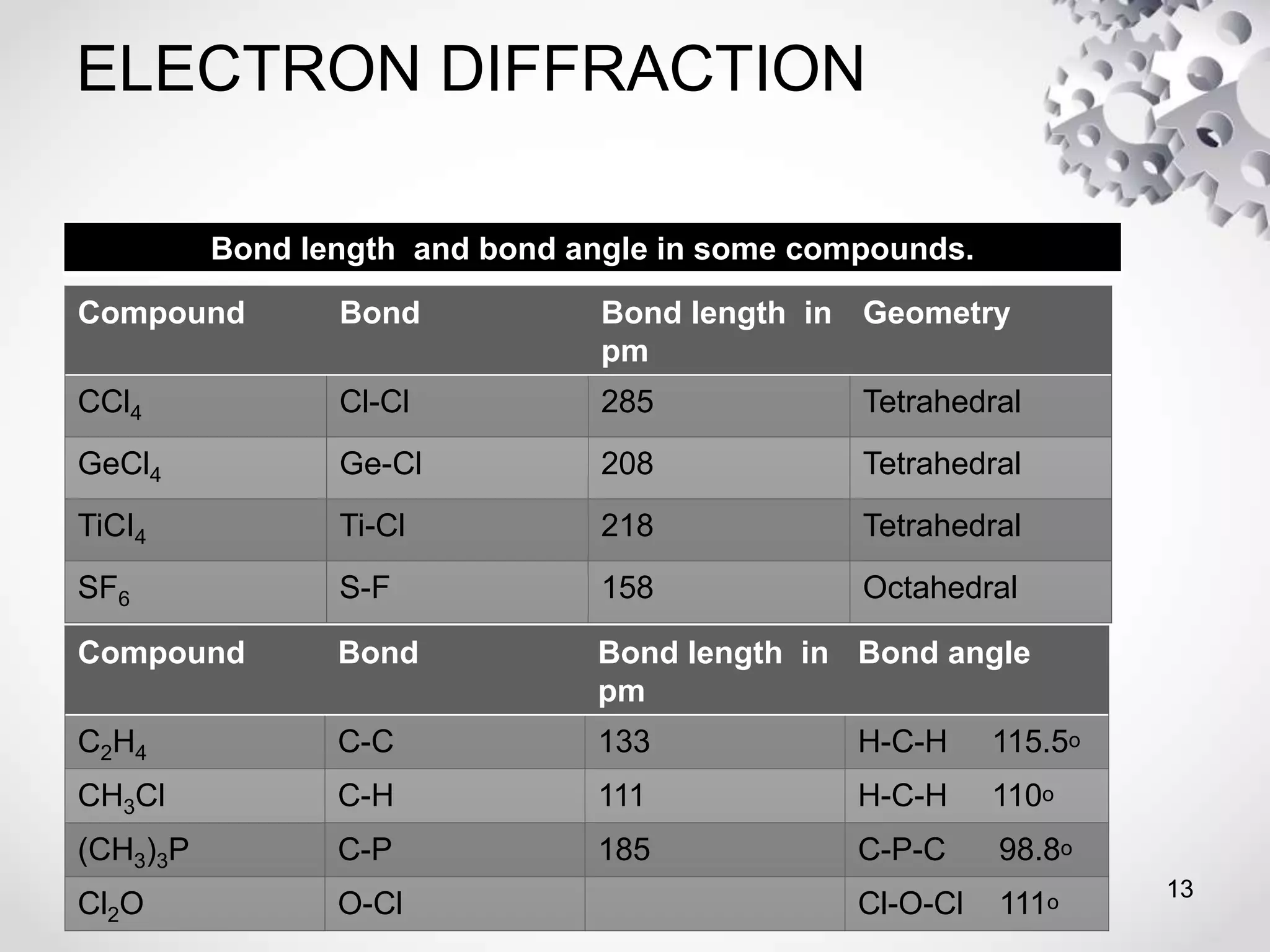
2. Electron diffraction is used to determine bond lengths and angles in molecules by observing how the intensity of scattered electrons varies with angle.
3. Low-energy electron diffraction (LEED) analyzes surface structures by firing low-energy electrons at a sample's surface and observing the diffraction pattern.
4. LEED patterns reveal the two-dimensional arrangement of surface atoms
CONTAIN
1. INTRODUCTION.
2. PRINCIPLE.
3.SCATTERING INTENSITY V/S SCATTING ANGLE.
4. WIERL EQUATION.
5. APPLICATIONS OF ELECTRON DIFFRACTION.
6. LEED & STRUCTURE OF SURFACES.
7. APPLICATIONS OF LEED.
2
3.
ELECTRON DIFFRACTION
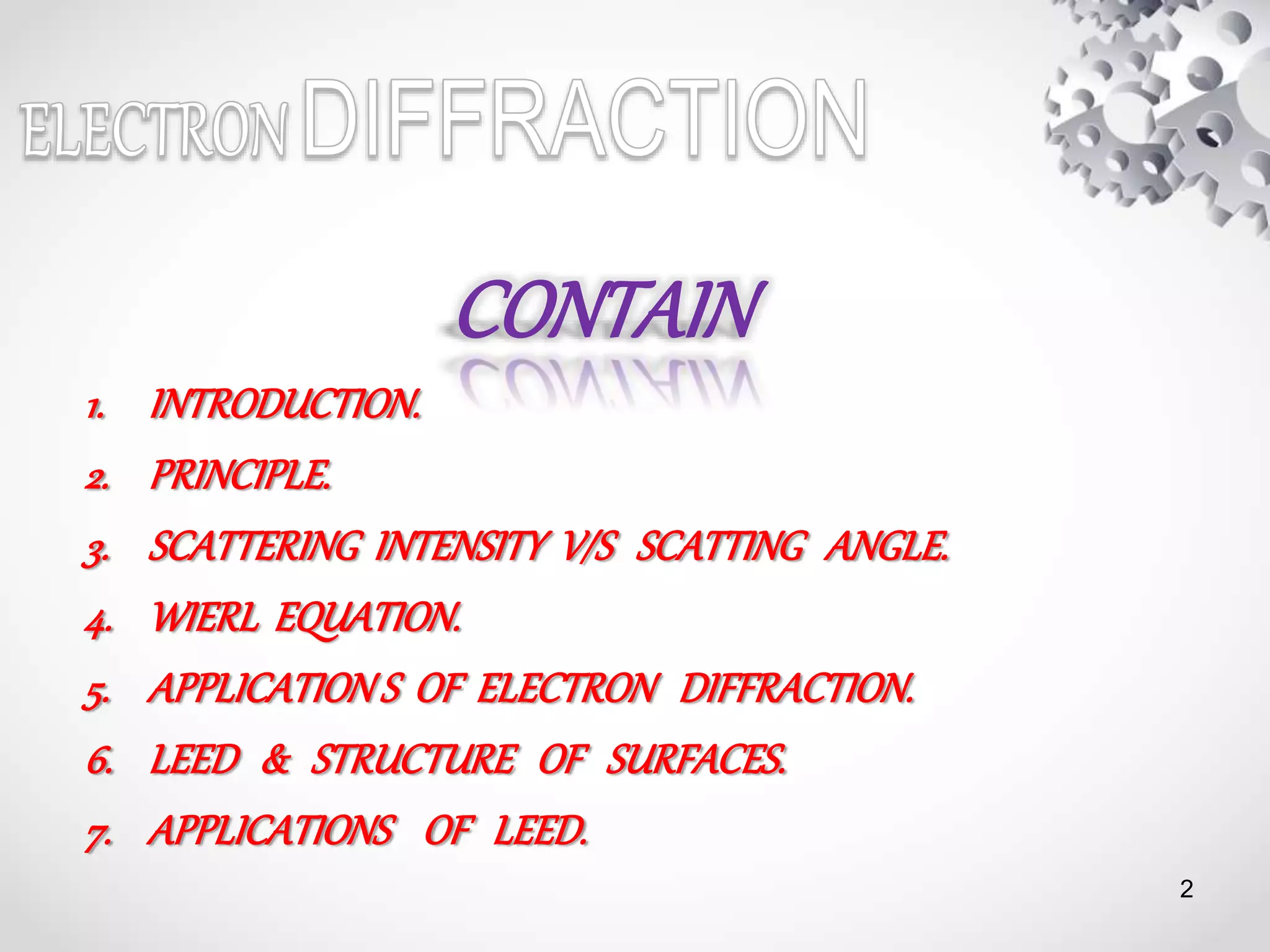
1) INTRODUCTION:- a)DIFFRACTION:-The process by
which a beam of light or other system of wave
spread out ad result of passing through a narrow
aperture or across an edge.
3
4.
ELECTRON DIFFRACTION
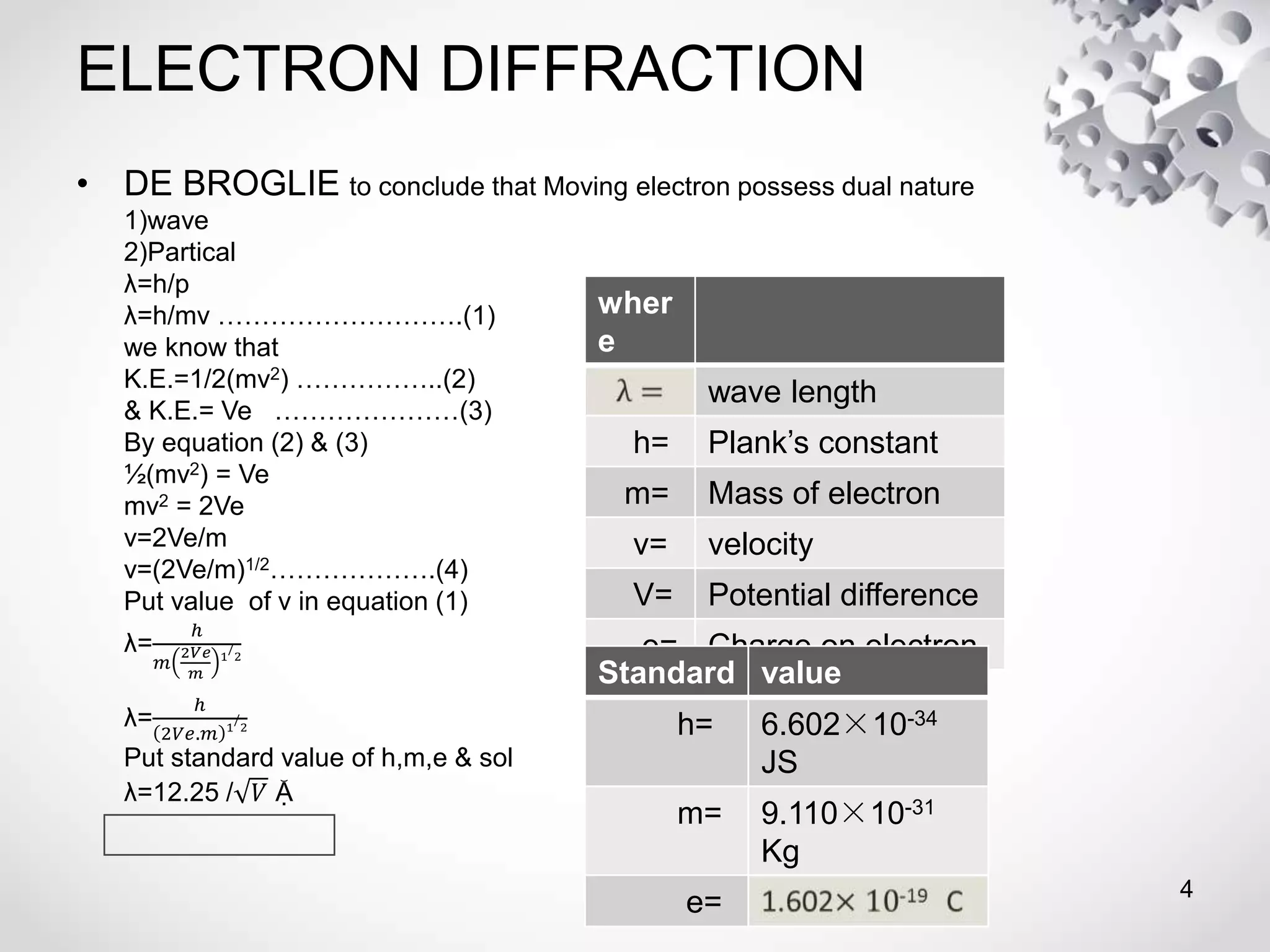
• DEBROGLIE to conclude that Moving electron possess dual nature
1)wave
2)Partical
λ=h/p
λ=h/mv ……………………….(1)
we know that
K.E.=1/2(mv2) ……………..(2)
& K.E.= Ve …………………(3)
By equation (2) & (3)
½(mv2) = Ve
mv2 = 2Ve
v=2Ve/m
v=(2Ve/m)1/2……………….(4)
Put value of v in equation (1)
λ=
ℎ
𝑚
2𝑉𝑒
𝑚
1
/
2
λ=
ℎ
2𝑉𝑒.𝑚 1
/
2
Put standard value of h,m,e & sol
λ=12.25 / 𝑉 Ặ
4
wher
e
wave length
h= Plank’s constant
m= Mass of electron
v= velocity
V= Potential difference
e= Charge on electron
Standard value
h= 6.602×10⁻³⁴
JS
m= 9.110×10⁻³¹
Kg
e=
5.
ELECTRON DIFFRACTOIN
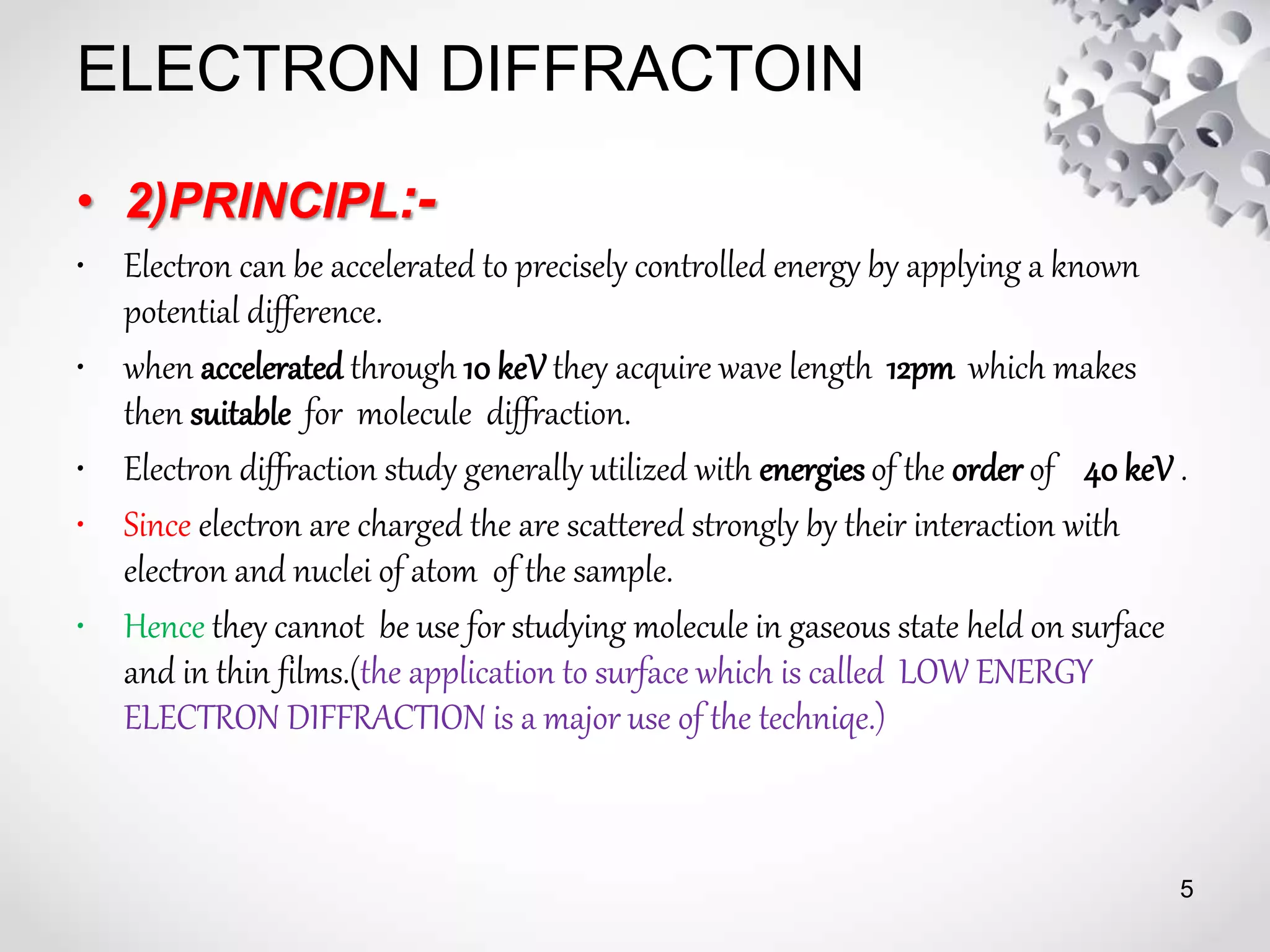
• 2)PRINCIPL:-
•Electron can be accelerated to precisely controlled energy by applying a known
potential difference.
• when accelerated through 10 keV they acquire wave length 12pm which makes
then suitable for molecule diffraction.
• Electron diffraction study generally utilized with energies of the order of 40 keV .
• Since electron are charged the are scattered strongly by their interaction with
electron and nuclei of atom of the sample.
• Hence they cannot be use for studying molecule in gaseous state held on surface
and in thin films.(the application to surface which is called LOW ENERGY
ELECTRON DIFFRACTION is a major use of the techniqe.)
5
6.
ELECTRON DIFFRACTION
• 3)SCATTERINGINTENSITY&SCATTERINGANGLE:-
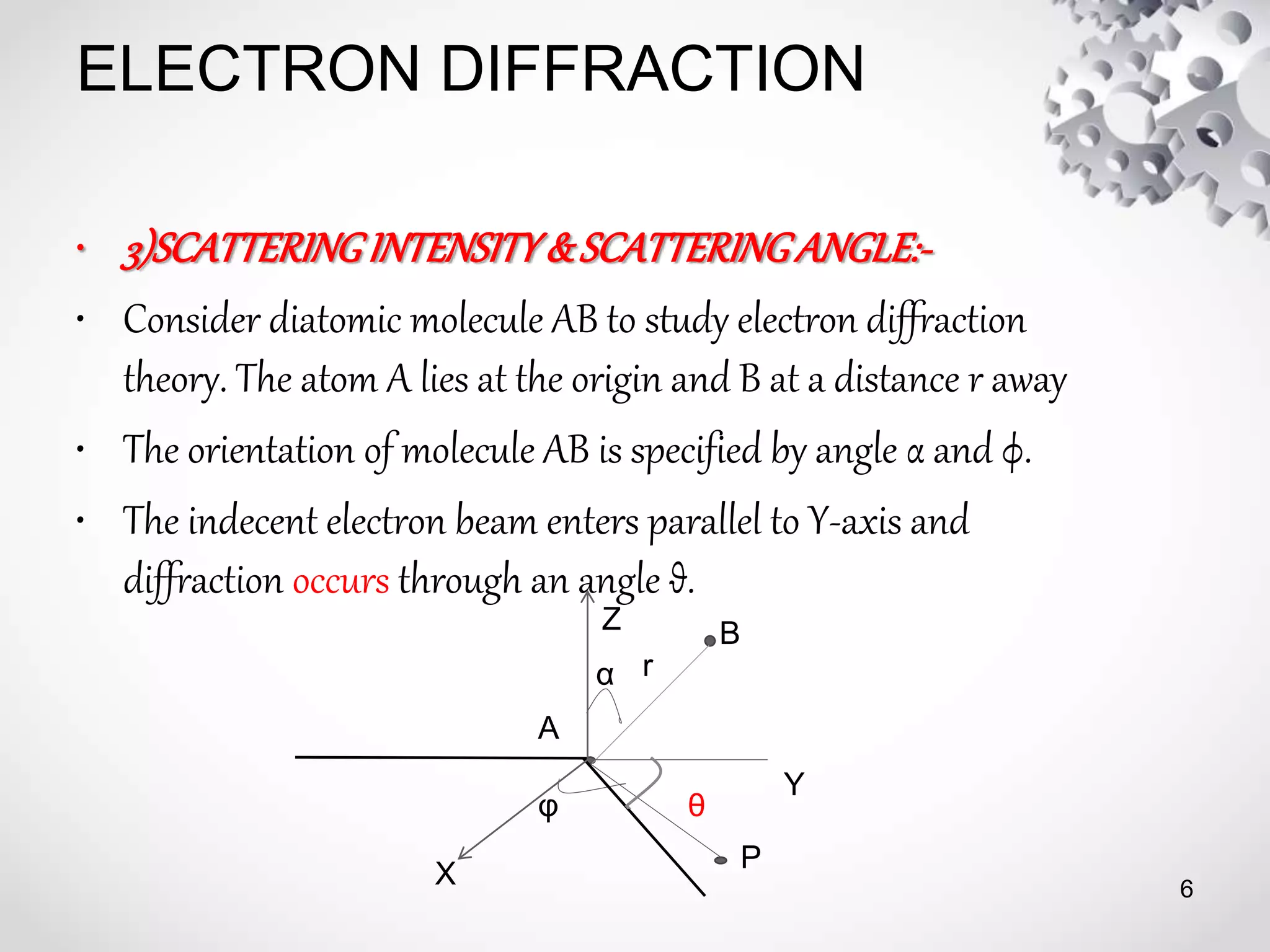
•Consider diatomic molecule AB to study electron diffraction
theory. The atom A lies at the origin and B at a distance r away
• The orientation of molecule AB is specified by angle α and φ.
• The indecent electron beam enters parallel to Y-axis and
diffraction occurs through an angle θ.
6
B
rα
P
φ
Z
X
Y
A
θ
7.
ELECTRON DIFFRACTION
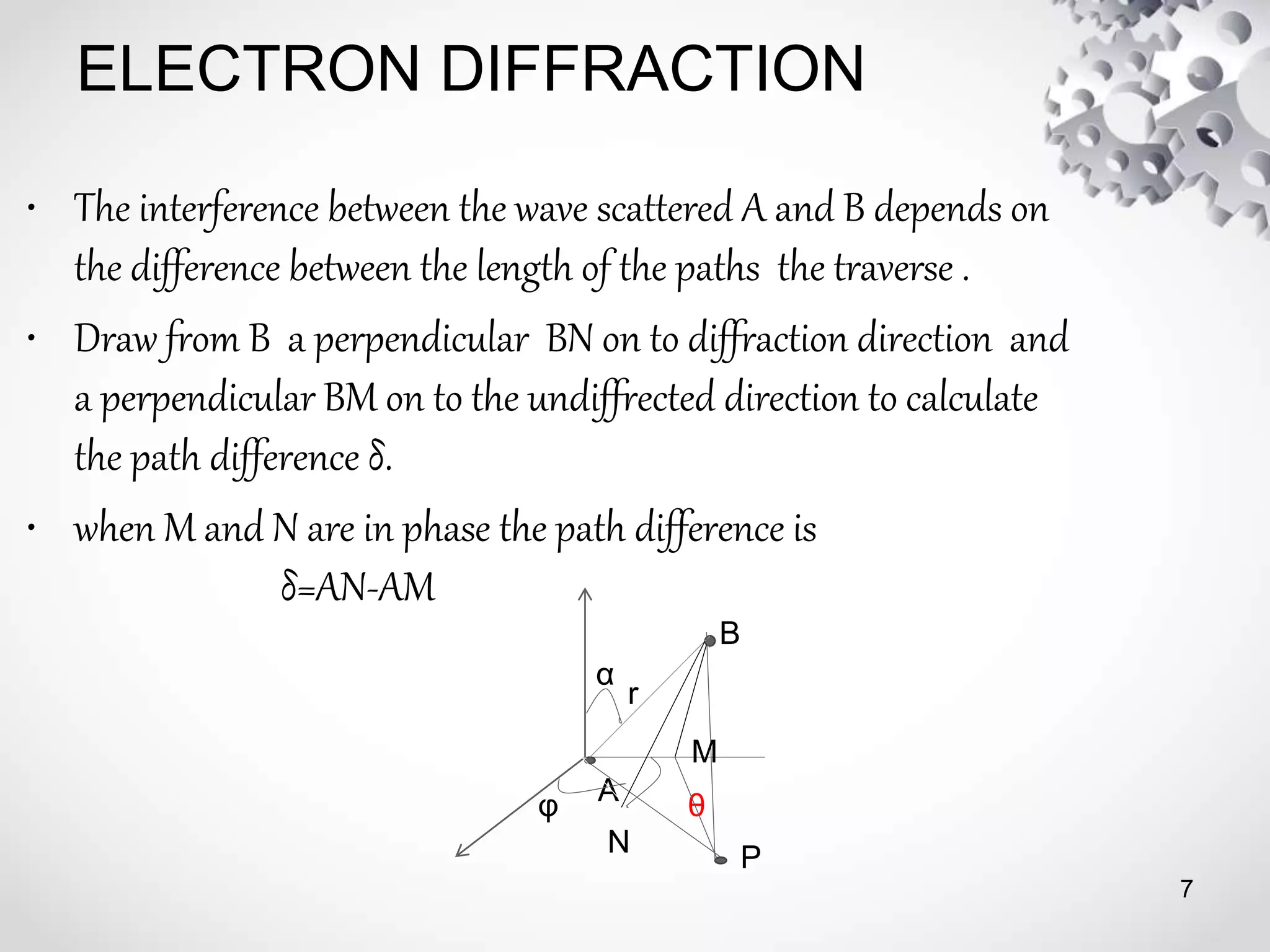
• Theinterference between the wave scattered A and B depends on
the difference between the length of the paths the traverse .
• Draw from B a perpendicular BN on to diffraction direction and
a perpendicular BM on to the undiffrected direction to calculate
the path difference δ.
• when M and N are in phase the path difference is
δ=AN-AM
7
A
B
r
P
α
φ θ
N
M
8.
ELECTRON DIFFRACTION
• PMis perpendicular to AY and PN is perpendicular to
the diffracted beam.
• δ=AN-AM
• δ=APcos 𝜃 + ∅ − 90 - APcos 90 − ∅
• ∴ 𝐴𝑃 = 𝑟 sin 𝛼
• δ = 𝑟 sin 𝛼 cos 𝜃 + ∅ − 90 −rsin 𝛼 cos 90 − ∅
• 𝛿 = 𝑟 sin 𝛼 cos 𝜃 + ∅ − 90 − cos 90 − ∅
• 𝛿 = 𝑟 sin 𝛼[cos − 90 − 𝜃 + ∅ − cos 90 − ∅ ]
• Formula [ cos −𝜃 = cos 𝜃 ]
• 𝛿 = 𝑟 sin 𝛼 cos 90 − 𝜃 + ∅ − cos 90 − ∅
• Formula [cos 90 − 𝜃 = sin 𝜃 ]
• 𝛿 = 𝑟 sin 𝛼 [sin 𝜃 + ∅ − sin ∅)]
• sin 𝐶 − sin 𝐷 = 2[cos
𝐶+𝐷
2
× sin
𝐶−𝐷
2
]
𝜃+∅+∅ 𝜃+∅−∅
8
90-φ
θ
Θ-(90-φ)
A
φ P
9.
ELECTRON DIFFRACTION
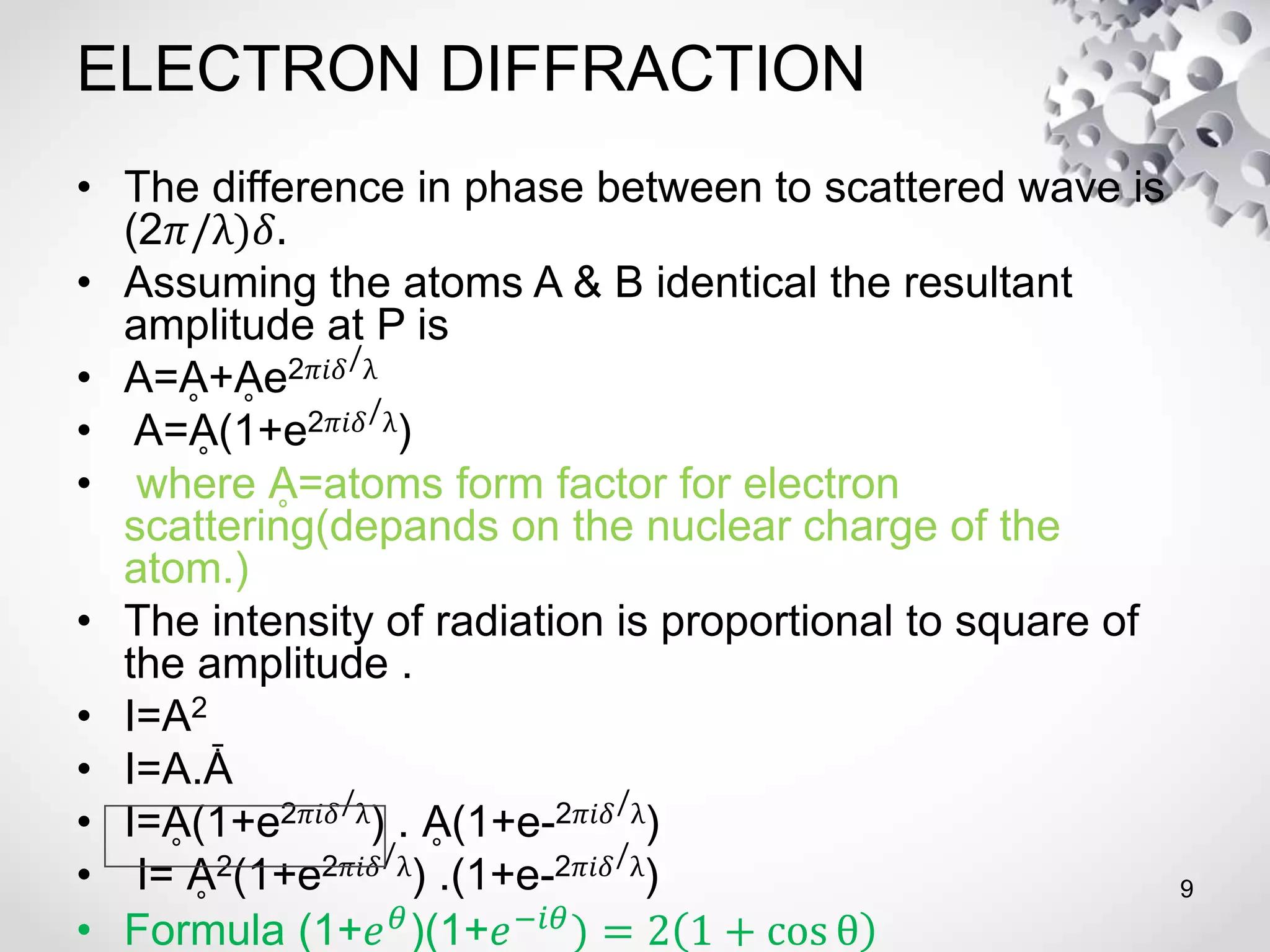
• Thedifference in phase between to scattered wave is
(2𝜋/λ)𝛿.
• Assuming the atoms A & B identical the resultant
amplitude at P is
• A=Ḁ+Ḁe2𝜋𝑖𝛿/λ
• A=Ḁ(1+e2𝜋𝑖𝛿/λ)
• where Ḁ=atoms form factor for electron
scattering(depands on the nuclear charge of the
atom.)
• The intensity of radiation is proportional to square of
the amplitude .
• I=A2
• I=A.Ǡ
• I=Ḁ(1+e2𝜋𝑖𝛿/λ) . Ḁ(1+e-2𝜋𝑖𝛿/λ)
• I= Ḁ2(1+e2𝜋𝑖𝛿/λ) .(1+e-2𝜋𝑖𝛿/λ)
• Formula (1+𝑒 𝜃
)(1+𝑒−𝑖𝜃
) = 2 1 + cos θ
9
10.
ELECTRON DIFFRACTION
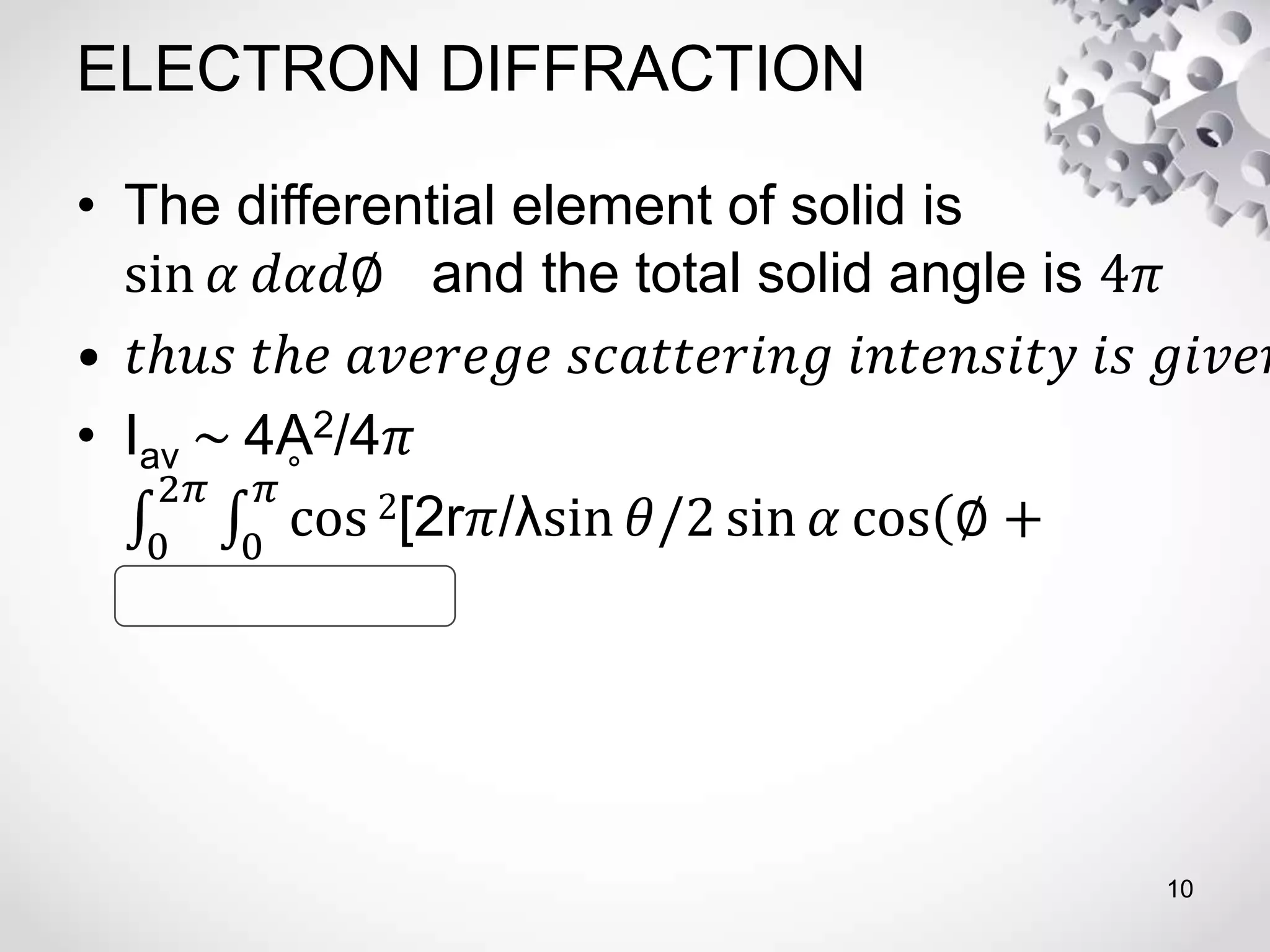
• Thedifferential element of solid is
sin 𝛼 𝑑𝛼𝑑∅ and the total solid angle is 4𝜋
• 𝑡ℎ𝑢𝑠 𝑡ℎ𝑒 𝑎𝑣𝑒𝑟𝑒𝑔𝑒 𝑠𝑐𝑎𝑡𝑡𝑒𝑟𝑖𝑛𝑔 𝑖𝑛𝑡𝑒𝑛𝑠𝑖𝑡𝑦 𝑖𝑠 𝑔𝑖𝑣𝑒𝑛
• Iav ~ 4Ḁ2/4𝜋
0
2𝜋
0
𝜋
cos 2[2r𝜋/λsin 𝜃/2 sin 𝛼 cos ∅ +
10
11.
ELECTRON DIFFRACTION
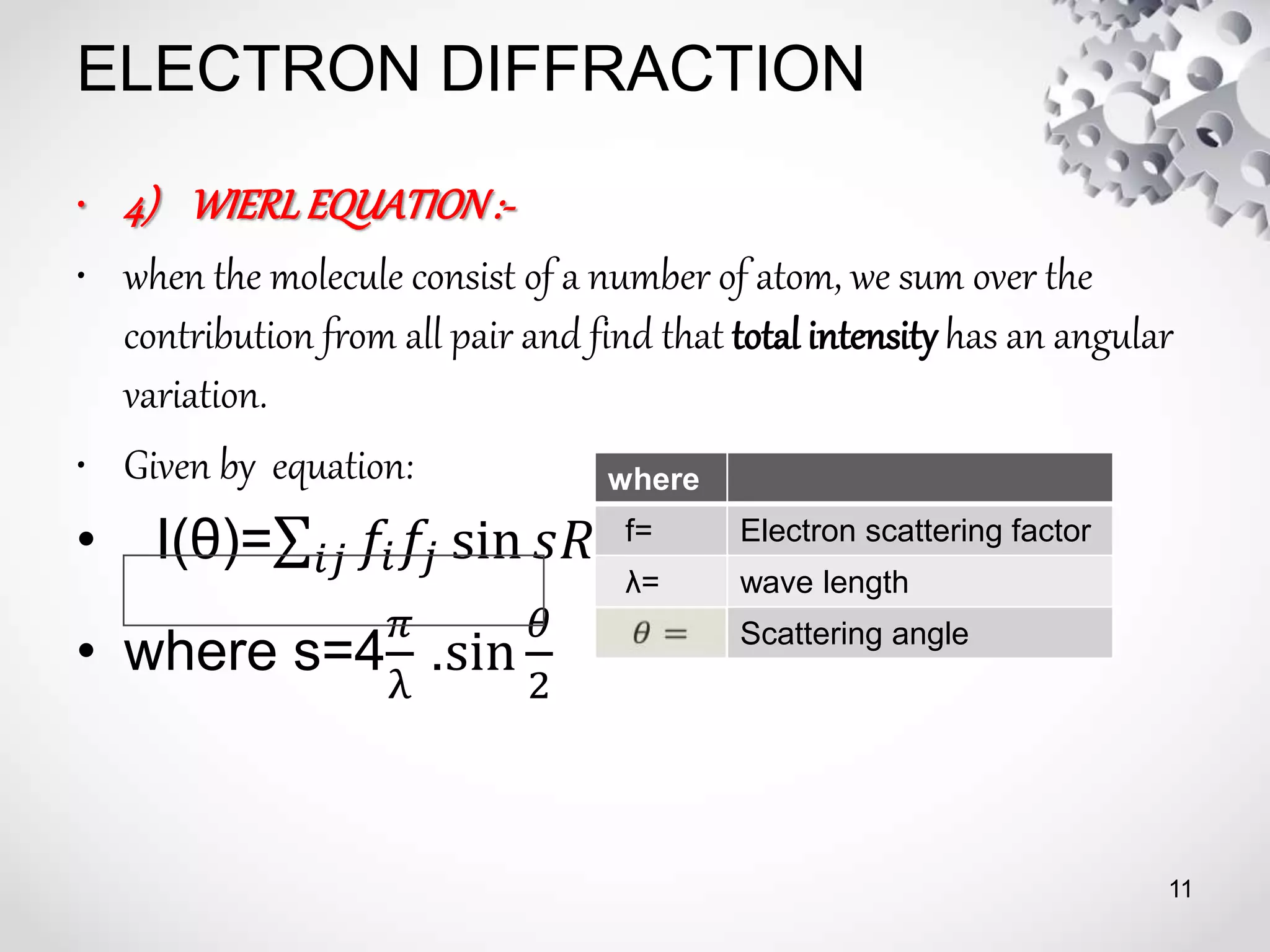
• 4)WIERLEQUATION:-
• when the molecule consist of a number of atom, we sum over the
contribution from all pair and find that total intensity has an angular
variation.
• Given by equation:
• I(θ)= 𝑖𝑗 𝑓𝑖 𝑓𝑗 sin 𝑠𝑅𝑖𝑗/s𝑅𝑖𝑗
• where s=4
𝜋
λ
.sin
𝜃
2
11
where
f= Electron scattering factor
λ= wave length
Scattering angle
12.
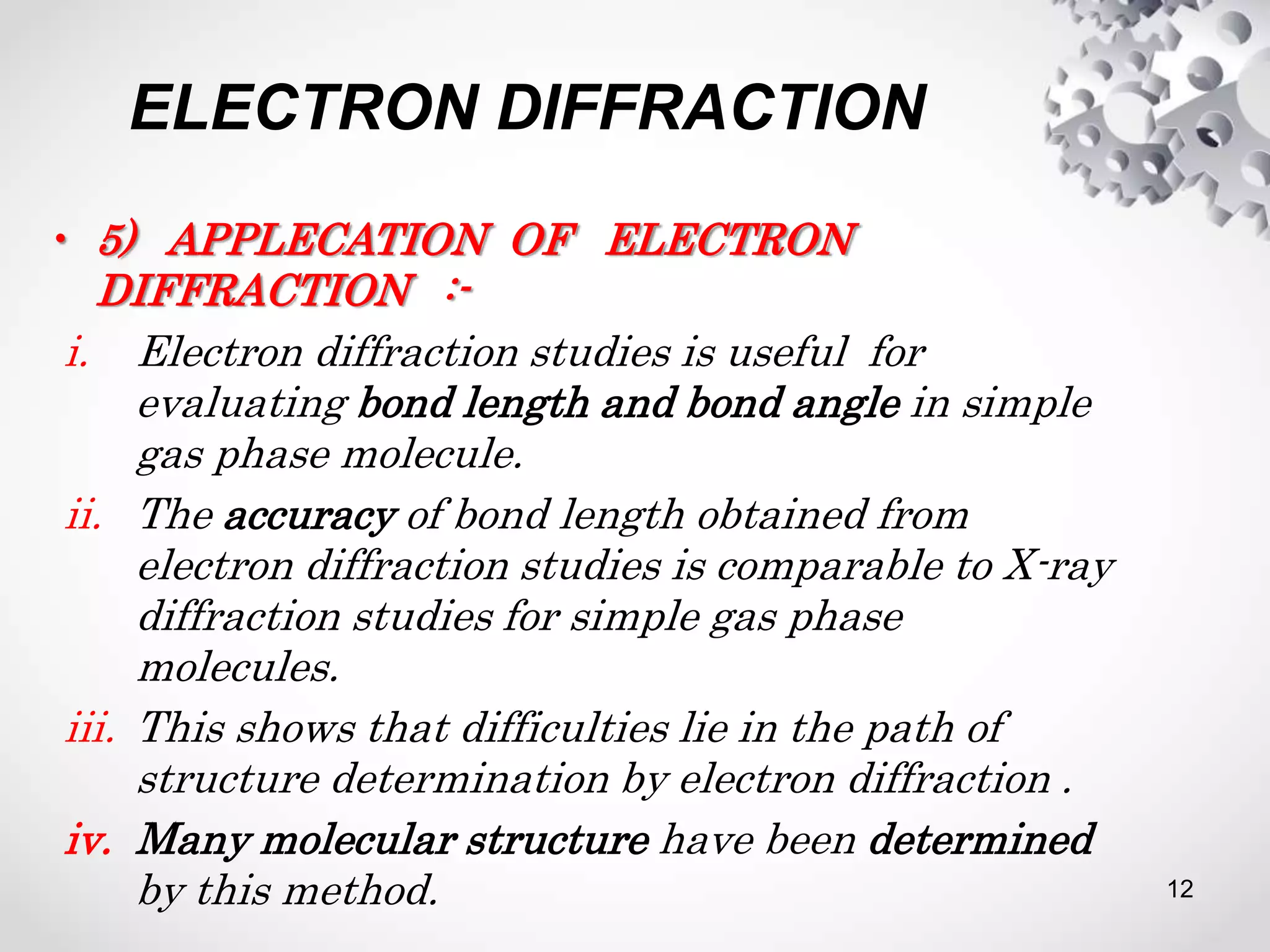
ELECTRON DIFFRACTION
• 5)APPLECATION OF ELECTRON
DIFFRACTION :-
i. Electron diffraction studies is useful for
evaluating bond length and bond angle in simple
gas phase molecule.
ii. The accuracy of bond length obtained from
electron diffraction studies is comparable to X-ray
diffraction studies for simple gas phase
molecules.
iii. This shows that difficulties lie in the path of
structure determination by electron diffraction .
iv. Many molecular structure have been determined
by this method. 12
13.
ELECTRON DIFFRACTION
Bond lengthand bond angle in some compounds.
13
Compound Bond Bond length in
pm
Geometry
CCl4 Cl-Cl 285 Tetrahedral
GeCl4 Ge-Cl 208 Tetrahedral
TiCI4 Ti-Cl 218 Tetrahedral
SF6 S-F 158 Octahedral
Compound Bond Bond length in
pm
Bond angle
C2H4 C-C 133 H-C-H 115.5o
CH3Cl C-H 111 H-C-H 110o
(CH3)3P C-P 185 C-P-C 98.8o
Cl2O O-Cl Cl-O-Cl 111o
14.
ELECTRON DIFFRACTION
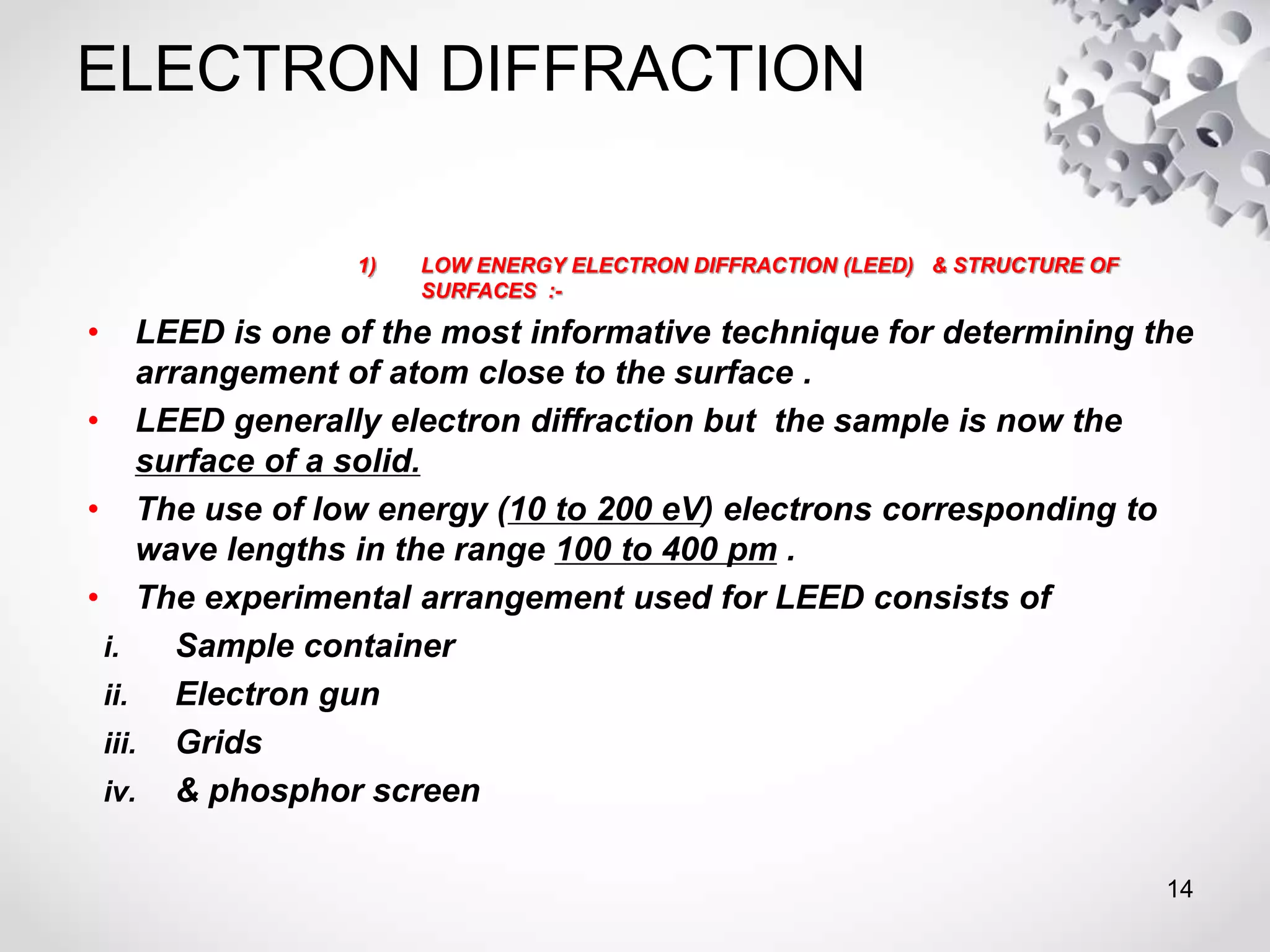
1) LOWENERGY ELECTRON DIFFRACTION (LEED) & STRUCTURE OF
SURFACES :-
• LEED is one of the most informative technique for determining the
arrangement of atom close to the surface .
• LEED generally electron diffraction but the sample is now the
surface of a solid.
• The use of low energy (10 to 200 eV) electrons corresponding to
wave lengths in the range 100 to 400 pm .
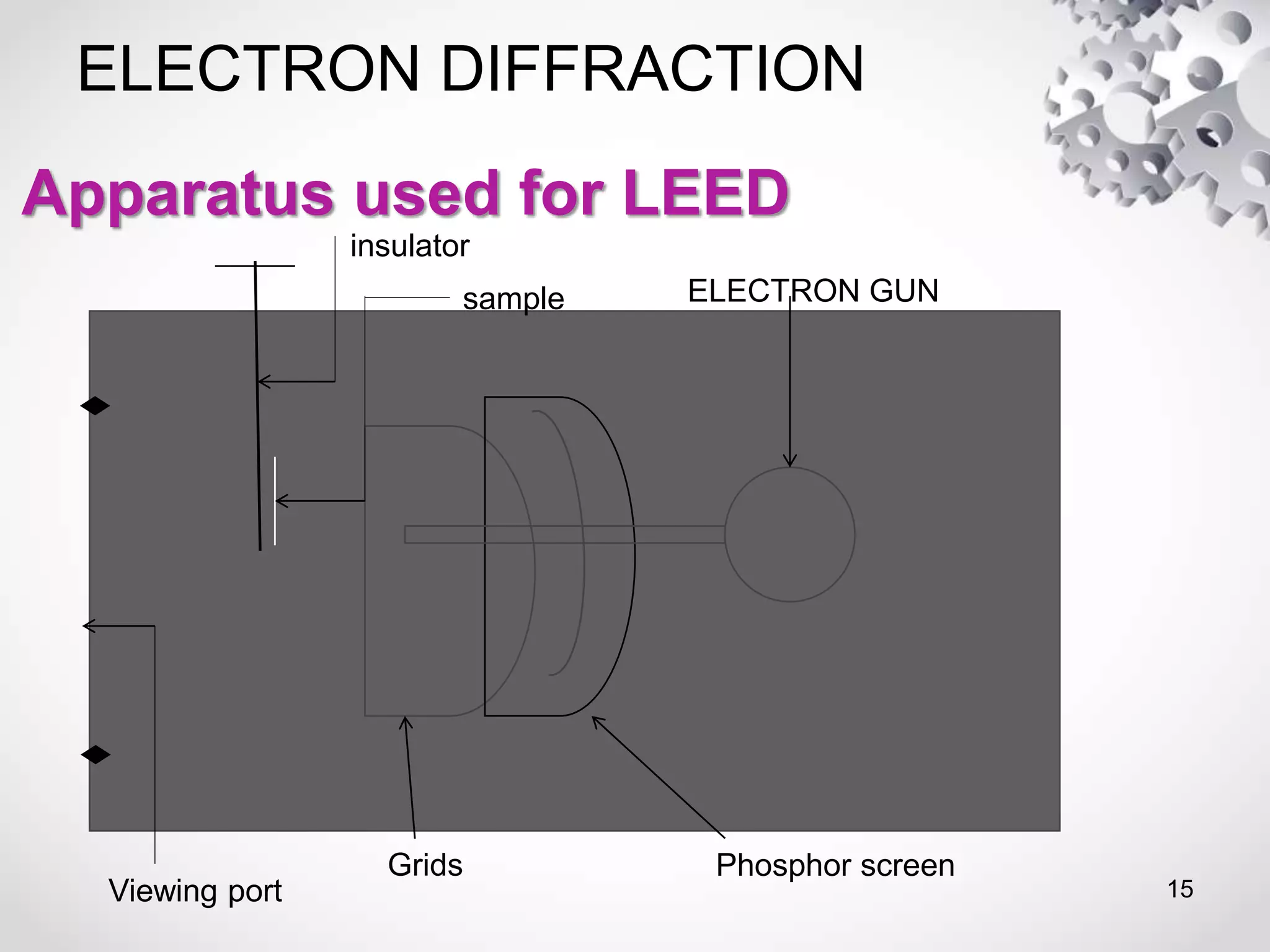
• The experimental arrangement used for LEED consists of
i. Sample container
ii. Electron gun
iii. Grids
iv. & phosphor screen
14
ELECTRON DIFFRACTION
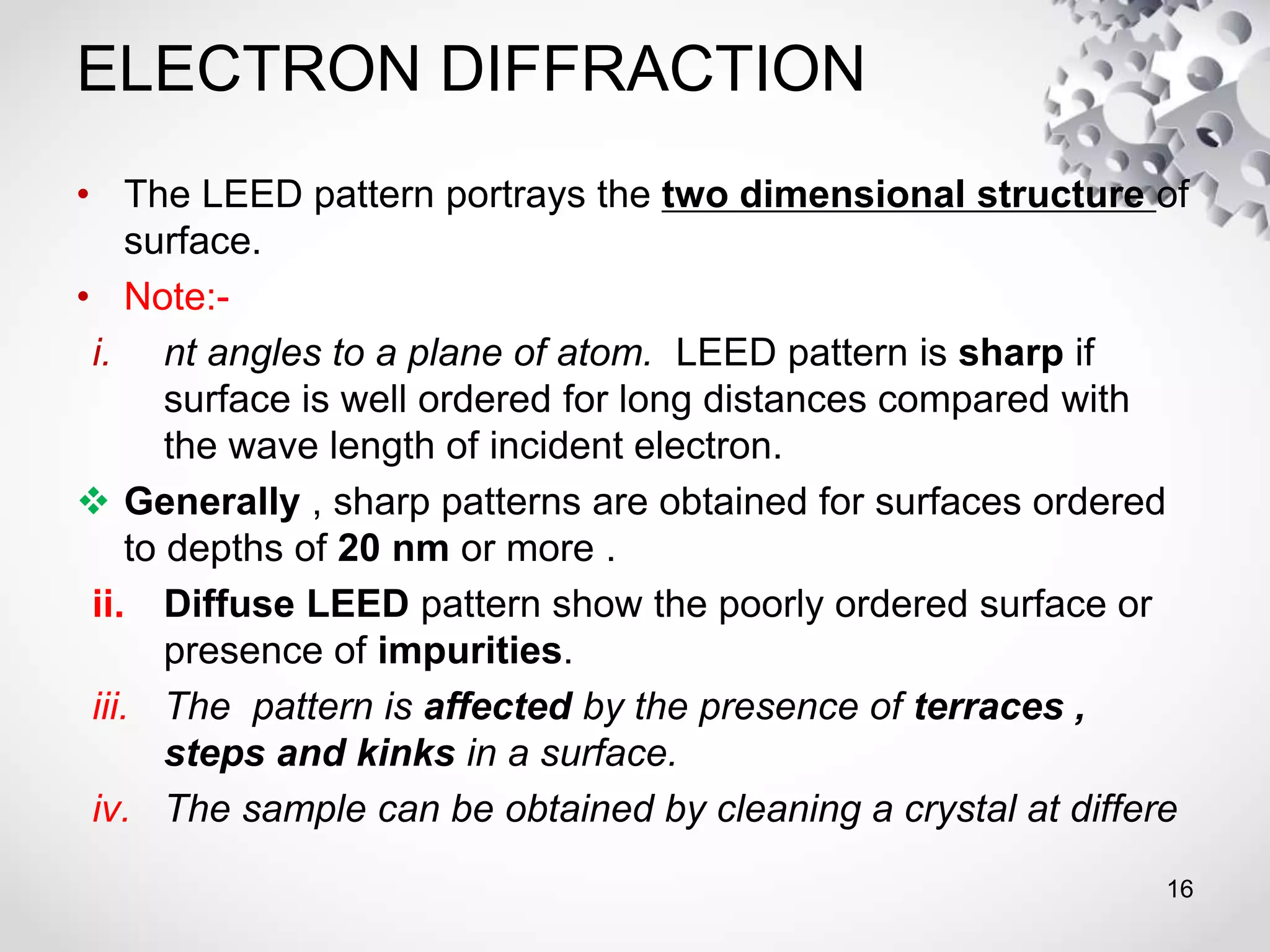
• TheLEED pattern portrays the two dimensional structure of
surface.
• Note:-
i. nt angles to a plane of atom. LEED pattern is sharp if
surface is well ordered for long distances compared with
the wave length of incident electron.
Generally , sharp patterns are obtained for surfaces ordered
to depths of 20 nm or more .
ii. Diffuse LEED pattern show the poorly ordered surface or
presence of impurities.
iii. The pattern is affected by the presence of terraces ,
steps and kinks in a surface.
iv. The sample can be obtained by cleaning a crystal at differe
16
17.
ELECTRON DIFFRACTION
7) APPLICATIONSOF LEED :-
LEED is one of the most informative
technique for Determining the
arrangement of atoms close to the
surface.
LEED pattern may be used to assess
the defect density .
17
![ELECTRON DIFFRACTION
• PM is perpendicular to AY and PN is perpendicular to
the diffracted beam.
• δ=AN-AM
• δ=APcos 𝜃 + ∅ − 90 - APcos 90 − ∅
• ∴ 𝐴𝑃 = 𝑟 sin 𝛼
• δ = 𝑟 sin 𝛼 cos 𝜃 + ∅ − 90 −rsin 𝛼 cos 90 − ∅
• 𝛿 = 𝑟 sin 𝛼 cos 𝜃 + ∅ − 90 − cos 90 − ∅
• 𝛿 = 𝑟 sin 𝛼[cos − 90 − 𝜃 + ∅ − cos 90 − ∅ ]
• Formula [ cos −𝜃 = cos 𝜃 ]
• 𝛿 = 𝑟 sin 𝛼 cos 90 − 𝜃 + ∅ − cos 90 − ∅
• Formula [cos 90 − 𝜃 = sin 𝜃 ]
• 𝛿 = 𝑟 sin 𝛼 [sin 𝜃 + ∅ − sin ∅)]
• sin 𝐶 − sin 𝐷 = 2[cos
𝐶+𝐷
2
× sin
𝐶−𝐷
2
]
𝜃+∅+∅ 𝜃+∅−∅
8
90-φ
θ
Θ-(90-φ)
A
φ P](https://image.slidesharecdn.com/random-170922020455/75/Electron-diffraction-for-m-sc-student-complete-unit-8-2048.jpg)