Nutrition in plants (I) Chapter 7
Learning Objectives Part I Why is photosynthesis important?  Pg 127 Photosynthesis overall Equation  pg 120 Fate of glucose formed  pg 125-126 Leaf structure & function  Chap 7.2   pg   128-130 How do CO 2  & H 2 O enter the plant?  pg132 What are the conditions necessary for photosynthesis?  Pg 118 Part II Testing for starch  investigation 7.1 Factors affecting the rate of photosynthesis (ICT)  pg 123-124 Limiting factors  pg 121
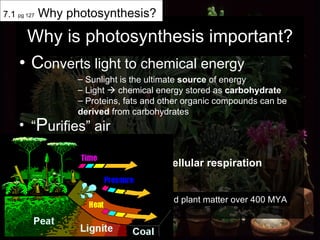
Why is photosynthesis important? C onverts light to chemical energy “ P urifies” air  F ossil fuel: Coal 7.1  pg 127  Why photosynthesis? Sunlight is the ultimate  source  of energy Light    chemical energy stored as  carbohydrate Proteins, fats and other organic compounds can be  derived  from carbohydrates Removes CO2;  Provides O2 for  cellular respiration Coal formed from dead plant matter over 400 MYA
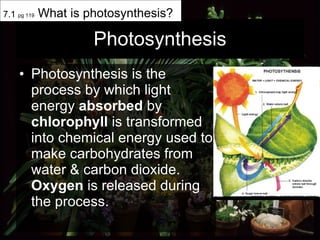
Photosynthesis Photosynthesis is the process by which light energy  absorbed  by  chlorophyll  is transformed into chemical energy used to make carbohydrates from water & carbon dioxide.  Oxygen  is released during the process.  7.1  pg 119  What is photosynthesis?
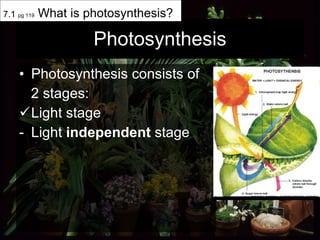
Photosynthesis Photosynthesis consists of  2 stages:  Light stage Light  independent  stage 7.1  pg 119  What is photosynthesis?
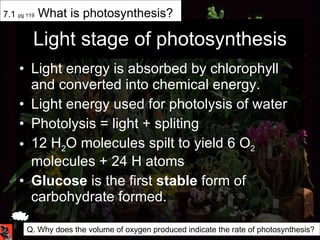
Light stage of photosynthesis Light energy is absorbed by chlorophyll and converted into chemical energy. Light energy used for photolysis of water Photolysis = light + spliting 12 H 2 O molecules spilt to yield 6 O 2  molecules + 24 H atoms Glucose  is the first  stable  form of carbohydrate formed.  7.1  pg 119  What is photosynthesis? Q. Why does the volume of oxygen produced indicate the rate of photosynthesis?
Light-independent stage of Photosynthesis H atoms from light stage help reduce 6 carbon dioxide molecules to glucose.
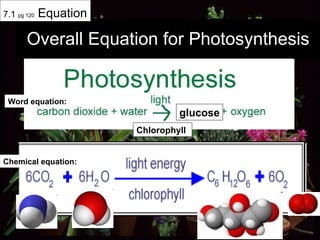
Overall Equation for Photosynthesis 7.1  pg 120  Equation glucose Chlorophyll Word equation: Chemical equation:
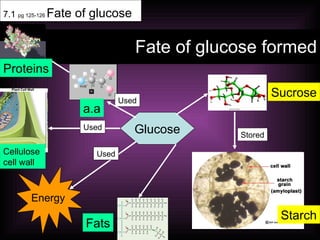
Fate of glucose formed 7.1  pg 125-126  Fate of glucose Glucose Sucrose Energy Used Used Used Stored Starch Fats a.a Proteins Cellulose  cell wall
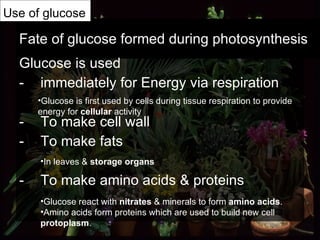
Fate of glucose formed during photosynthesis Glucose is used immediately for Energy via respiration To make cell wall To make fats To make amino acids & proteins  Use of glucose Glucose is first used by cells during tissue respiration to provide energy for  cellular  activity Glucose react with  nitrates  & minerals to form  amino acids . Amino acids form proteins which are used to build new cell  protoplasm .  In leaves &  storage organs
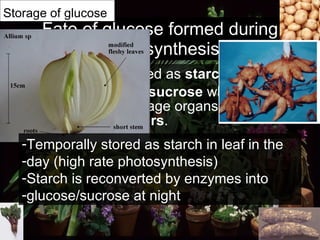
Fate of glucose formed during photosynthesis Glucose can be stored as  starch Excess glucose    sucrose  which is transported to storage organs e.g. stem  tubers  & root  tubers .  Storage of glucose Temporally stored as starch in leaf in the  day (high rate photosynthesis) Starch is reconverted by enzymes into  glucose/sucrose at night
Leaf  Structure & Function 7.2  pg 128  Leaf Structure & function
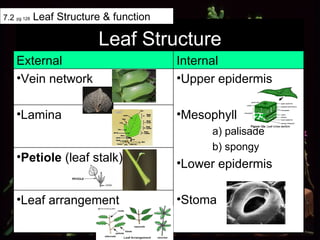
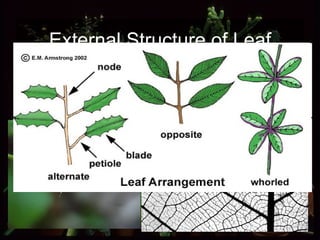
Leaf Structure 7.2  pg 128  Leaf Structure & function Lamina Petiole  (leaf stalk) Upper epidermis Mesophyll  a) palisade  b) spongy  Lower epidermis Stoma Vein network Leaf arrangement Internal External
External Structure of Leaf
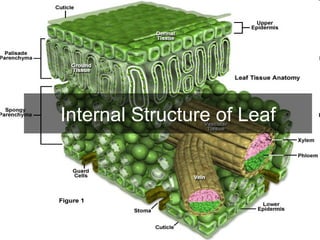
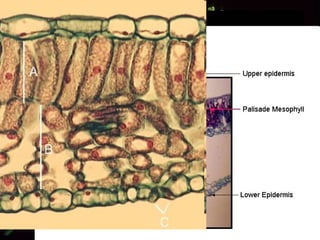
Internal Structure of Leaf
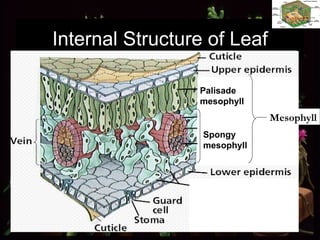
Internal Structure of Leaf Mesophyll Palisade mesophyll Spongy mesophyll
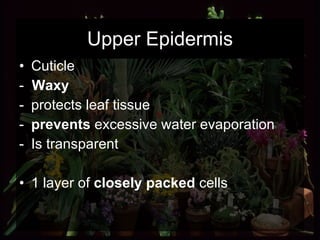
Upper Epidermis Cuticle  -  Waxy   protects leaf tissue prevents  excessive water evaporation Is transparent 1 layer of  closely packed  cells
Mesophyll Layer between upper and lower epidermis Consists of  Irregular cells Loosely packed; many intercellular air spaces Fewer chloroplasts than palisade mesophyll cells long, cylindrical cells  (1-2 layers) closely packed Cells here has many chloroplasts Spongy Mesophyll Palisade Mesophyll
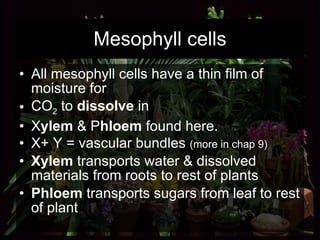
Mesophyll cells All mesophyll cells have a thin film of moisture for  CO 2  to  dissolve  in X ylem  & P hloem  found here. X+ Y = vascular bundles  (more in chap 9) Xylem  transports water & dissolved materials from roots to rest of plants Phloem  transports sugars from leaf to rest of plant
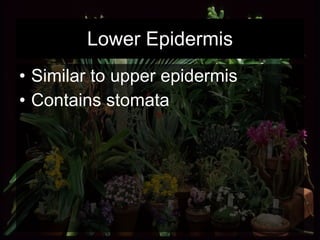
Lower Epidermis Similar to upper epidermis Contains stomata
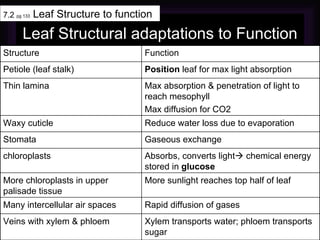
Leaf Structural adaptations to Function 7.2  pg 133  Leaf Structure to function Xylem transports water; phloem transports sugar Veins with xylem & phloem Rapid diffusion of gases Many intercellular air spaces More sunlight reaches top half of leaf More chloroplasts in upper palisade tissue Absorbs, converts light   chemical energy stored in  glucose chloroplasts Gaseous exchange Stomata Reduce water loss due to evaporation Waxy cuticle Max absorption & penetration of light to reach mesophyll Max diffusion for CO2 Thin lamina Position  leaf for max light absorption Petiole (leaf stalk) Function Structure
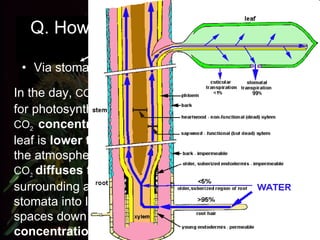
Q. How do CO 2  & H 2 O enters the leaf? Via stomata Via roots  Xylem   Veins   Cell to cell in leaf (osmosis) In the day,  CO 2   is used for photosynthesis. The  CO 2   concentration  in leaf is  lower than that  of the atmosphere. CO 2   diffuses  from surrounding air through stomata into leaf’s air spaces down a  concentration gradient .
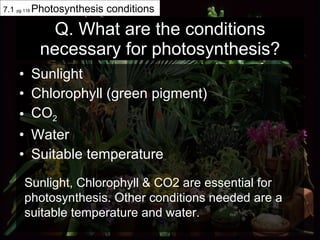
Q. What are the conditions necessary for photosynthesis? Sunlight Chlorophyll (green pigment) CO 2 Water Suitable temperature 7.1  pg 118  Photosynthesis conditions Sunlight, Chlorophyll & CO2 are essential for photosynthesis. Other conditions needed are a suitable temperature and water.
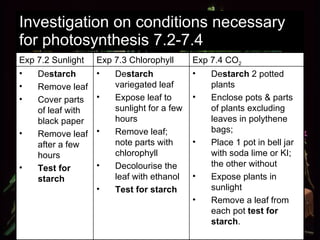
Investigation on conditions necessary for photosynthesis 7.2-7.4 De starch  2 potted plants Enclose pots & parts of plants excluding leaves in polythene bags;  Place 1 pot in bell jar with soda lime or KI; the other without Expose plants in sunlight Remove a leaf from each pot  test for starch .  De starch  variegated leaf Expose leaf to sunlight for a few hours Remove leaf; note parts with chlorophyll Decolourise the leaf with ethanol Test for starch De starch Remove leaf Cover parts of leaf with black paper Remove leaf after a few hours Test for starch Exp 7.4 CO 2 Exp 7.3 Chlorophyll Exp 7.2 Sunlight
Q. Why do we test for starch as an indicator of photosynthesis? Excess  glucose made by leaves are stored as starch Q. How do we “de-starch” plants? By placing the plant in  darkness  for 2 days. In darkness, no photosynthesis occurs. Glucose is used up for respiration. Some starch will be converted back to glucose for cellular respiration.
Summary Part I Why is photosynthesis important?  Pg 127 Photosynthesis Overall Equation  pg 120 Fate of glucose formed  pg 125-126 Leaf structure & function  Chap 7.2   pg   128-130 How do CO 2  & H 2 O enter the plant?  pg132 What are the conditions necessary for photosynthesis?  Pg 118 Part II Testing for starch  investigation 7.1 Factors affecting the rate of photosynthesis (ICT)  pg 123-124 Limiting factors  pg 121
Nutrition in plants (II) Chapter 7
Learning Objectives Part I Why is photosynthesis important?  Pg 127 Photosynthesis overall Equation  pg 120 Fate of glucose formed  pg 125-126 Leaf structure & function  Chap 7.2   pg   128-130 How do CO 2  & H 2 O enter the plant?  pg132 What are the conditions necessary for photosynthesis?  Pg 118 Part II Testing for starch  investigation 7.1 Factors affecting the rate of photosynthesis (ICT)  pg 123-124 Limiting factors  pg 121
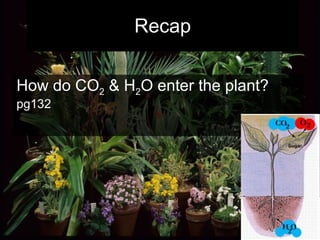
Recap How do CO 2  & H 2 O enter the plant?  pg132
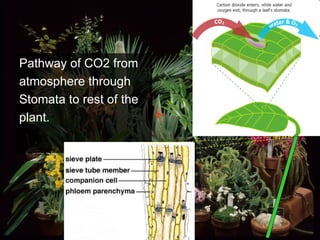
Pathway of CO2 from atmosphere through Stomata to rest of the plant.
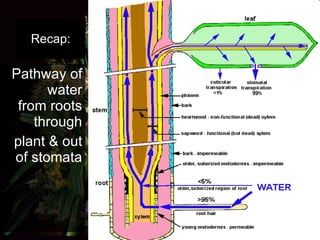
Recap: Pathway of water from roots through plant & out of stomata
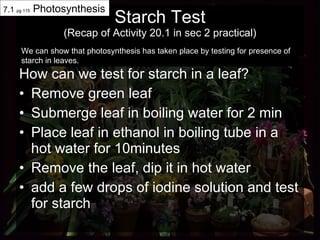
Starch Test (Recap of Activity 20.1 in sec 2 practical) How can we test for starch in a leaf? Remove green leaf Submerge leaf in boiling water for 2 min Place leaf in ethanol in boiling tube in a hot water for 10minutes Remove the leaf, dip it in hot water add a few drops of iodine solution and test for starch We can show that photosynthesis has taken place by testing for presence of starch in leaves. 7.1  pg 115  Photosynthesis
Factors affecting Photosynthetic Rate -Light intensity -temperature Carbon dioxide concentration Chlorophyll concentration Water pollution 7.1  pg 123-124  Photosynthesis
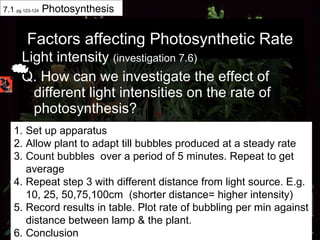
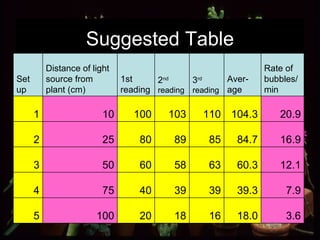
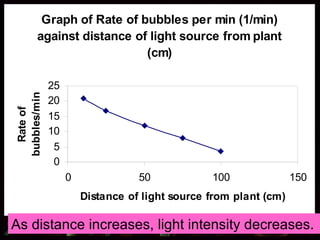
Factors affecting Photosynthetic Rate Light intensity  (investigation 7.6)   Q. How can we investigate the effect of different light intensities on the rate of photosynthesis? 7.1  pg 123-124  Photosynthesis Set up apparatus Allow plant to adapt till bubbles produced at a steady rate  Count bubbles  over a period of 5 minutes. Repeat to get average Repeat step 3 with different distance from light source. E.g. 10, 25, 50,75,100cm  (shorter distance= higher intensity) Record results in table. Plot rate of bubbling per min against distance between lamp & the plant.  Conclusion
Suggested Table 3.6 18.0 16 18 20 100 5 7.9 39.3 39 39 40 75 4 12.1 60.3 63 58 60 50 3 16.9 84.7 85 89 80 25 2 20.9 104.3 110 103 100 10 1 Rate of bubbles/min Aver-age 3 rd   reading 2 nd   reading 1st reading Distance of light  source from plant (cm) Set up
As distance increases, light intensity decreases.
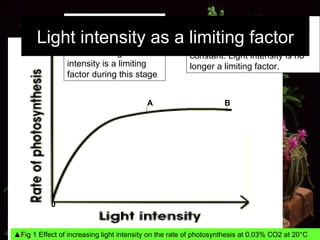
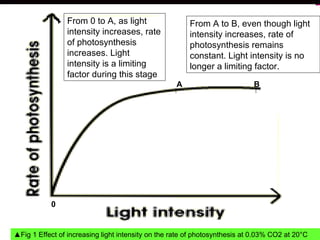
0 B ▲ Fig 1 Effect of increasing light intensity on the rate of photosynthesis at 0.03% CO2 at 20°C From A to B, even though light intensity increases, rate of photosynthesis remains constant. Light intensity is no longer a limiting factor. From 0 to A, as light intensity increases, rate of photosynthesis increases. Light intensity is a limiting factor during this stage A
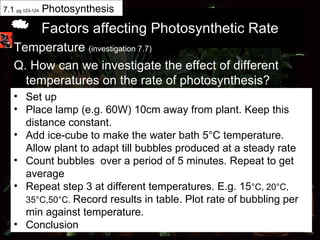
Factors affecting Photosynthetic Rate 7.1  pg 123-124  Photosynthesis Temperature  (investigation 7.7)   Q. How can we investigate the effect of different temperatures on the rate of photosynthesis? Set up Place lamp (e.g. 60W) 10cm away from plant. Keep this distance constant.  Add ice-cube to make the water bath 5°C temperature. Allow plant to adapt till bubbles produced at a steady rate  Count bubbles  over a period of 5 minutes. Repeat to get average Repeat step 3 at different temperatures. E.g. 15 °C, 20°C, 35°C,50°C.  Record results in table. Plot rate of bubbling per min against temperature.  Conclusion
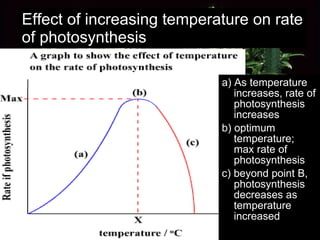
Effect of increasing temperature on rate of photosynthesis a) As temperature increases, rate of photosynthesis increases b) optimum temperature; max rate of photosynthesis c) beyond point B, photosynthesis decreases as temperature increased
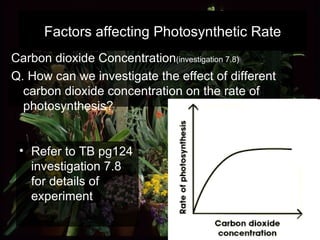
Carbon dioxide Concentration (investigation 7.8)   Q. How can we investigate the effect of different carbon dioxide concentration on the rate of photosynthesis? Factors affecting Photosynthetic Rate Refer to TB pg124 investigation 7.8 for details of experiment
Limiting factors Any factor that directly affects a process if its quantity is changed.  Rate of photosynthesis is affected by: Light intensity temperature CO 2  concentration 7.1  pg 121  Photosynthesis
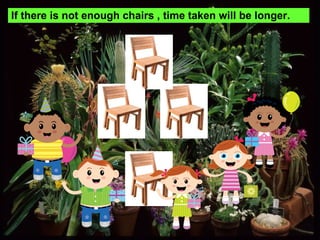
If there is not enough chairs , time taken will be longer.
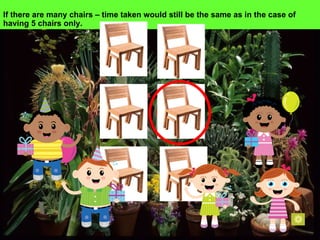
If there are many chairs – time taken would still be the same as in the case of having 5 chairs only.
0 B ▲ Fig 1 Effect of increasing light intensity on the rate of photosynthesis at 0.03% CO2 at 20°C From A to B, even though light intensity increases, rate of photosynthesis remains constant. Light intensity is no longer a limiting factor. From 0 to A, as light intensity increases, rate of photosynthesis increases. Light intensity is a limiting factor during this stage A Light intensity as a limiting factor
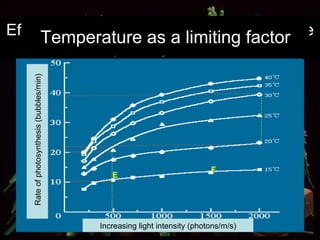
Effect of increasing temperature on the rate of photosynthesis  Increasing light intensity (photons/m/s) Rate of photosynthesis (bubbles/min) Temperature as a limiting factor F E
As temperature increases, rate of photosynthesis increases significantly From graph, every 10°C increase in temperature, rate of photosynthesis ≈ doubles.  Therefore temperature of surroundings is the limiting factor. Temperature as a limiting factor
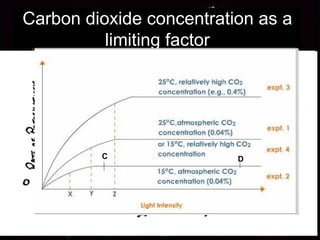
Carbon dioxide concentration as a limiting factor D C
Carbon dioxide concentration as a limiting factor Usually CO2 is an important limiting factor in the atmosphere.  As CO2 increases, rate of photosynthesis significantly increases. This indicates CO2 concentration is the limiting factor in CD.
Summary Part I Why is photosynthesis important?  Pg 127 Photosynthesis overall Equation  pg 120 Fate of glucose formed  pg 125-126 Leaf structure & function  Chap 7.2   pg   128-130 How do CO 2  & H 2 O enter the plant?  pg132 What are the conditions necessary for photosynthesis?  Pg 118 Part II Testing for starch  investigation 7.1 Factors affecting the rate of photosynthesis (ICT)  pg 123-124 Limiting factors  pg 121

Nutrition in plants

  • 1.
    Nutrition in plants(I) Chapter 7
  • 2.
    Learning Objectives PartI Why is photosynthesis important? Pg 127 Photosynthesis overall Equation pg 120 Fate of glucose formed pg 125-126 Leaf structure & function Chap 7.2 pg 128-130 How do CO 2 & H 2 O enter the plant? pg132 What are the conditions necessary for photosynthesis? Pg 118 Part II Testing for starch investigation 7.1 Factors affecting the rate of photosynthesis (ICT) pg 123-124 Limiting factors pg 121
  • 3.
    Why is photosynthesisimportant? C onverts light to chemical energy “ P urifies” air F ossil fuel: Coal 7.1 pg 127 Why photosynthesis? Sunlight is the ultimate source of energy Light  chemical energy stored as carbohydrate Proteins, fats and other organic compounds can be derived from carbohydrates Removes CO2; Provides O2 for cellular respiration Coal formed from dead plant matter over 400 MYA
  • 4.
    Photosynthesis Photosynthesis isthe process by which light energy absorbed by chlorophyll is transformed into chemical energy used to make carbohydrates from water & carbon dioxide. Oxygen is released during the process. 7.1 pg 119 What is photosynthesis?
  • 5.
    Photosynthesis Photosynthesis consistsof 2 stages: Light stage Light independent stage 7.1 pg 119 What is photosynthesis?
  • 6.
    Light stage ofphotosynthesis Light energy is absorbed by chlorophyll and converted into chemical energy. Light energy used for photolysis of water Photolysis = light + spliting 12 H 2 O molecules spilt to yield 6 O 2 molecules + 24 H atoms Glucose is the first stable form of carbohydrate formed. 7.1 pg 119 What is photosynthesis? Q. Why does the volume of oxygen produced indicate the rate of photosynthesis?
  • 7.
    Light-independent stage ofPhotosynthesis H atoms from light stage help reduce 6 carbon dioxide molecules to glucose.
  • 8.
    Overall Equation forPhotosynthesis 7.1 pg 120 Equation glucose Chlorophyll Word equation: Chemical equation:
  • 9.
    Fate of glucoseformed 7.1 pg 125-126 Fate of glucose Glucose Sucrose Energy Used Used Used Stored Starch Fats a.a Proteins Cellulose cell wall
  • 10.
    Fate of glucoseformed during photosynthesis Glucose is used immediately for Energy via respiration To make cell wall To make fats To make amino acids & proteins Use of glucose Glucose is first used by cells during tissue respiration to provide energy for cellular activity Glucose react with nitrates & minerals to form amino acids . Amino acids form proteins which are used to build new cell protoplasm . In leaves & storage organs
  • 11.
    Fate of glucoseformed during photosynthesis Glucose can be stored as starch Excess glucose  sucrose which is transported to storage organs e.g. stem tubers & root tubers . Storage of glucose Temporally stored as starch in leaf in the day (high rate photosynthesis) Starch is reconverted by enzymes into glucose/sucrose at night
  • 12.
    Leaf Structure& Function 7.2 pg 128 Leaf Structure & function
  • 13.
    Leaf Structure 7.2 pg 128 Leaf Structure & function Lamina Petiole (leaf stalk) Upper epidermis Mesophyll a) palisade b) spongy Lower epidermis Stoma Vein network Leaf arrangement Internal External
  • 14.
  • 15.
  • 16.
    Internal Structure ofLeaf Mesophyll Palisade mesophyll Spongy mesophyll
  • 17.
    Upper Epidermis Cuticle - Waxy protects leaf tissue prevents excessive water evaporation Is transparent 1 layer of closely packed cells
  • 18.
    Mesophyll Layer betweenupper and lower epidermis Consists of Irregular cells Loosely packed; many intercellular air spaces Fewer chloroplasts than palisade mesophyll cells long, cylindrical cells (1-2 layers) closely packed Cells here has many chloroplasts Spongy Mesophyll Palisade Mesophyll
  • 19.
    Mesophyll cells Allmesophyll cells have a thin film of moisture for CO 2 to dissolve in X ylem & P hloem found here. X+ Y = vascular bundles (more in chap 9) Xylem transports water & dissolved materials from roots to rest of plants Phloem transports sugars from leaf to rest of plant
  • 20.
    Lower Epidermis Similarto upper epidermis Contains stomata
  • 21.
    Leaf Structural adaptationsto Function 7.2 pg 133 Leaf Structure to function Xylem transports water; phloem transports sugar Veins with xylem & phloem Rapid diffusion of gases Many intercellular air spaces More sunlight reaches top half of leaf More chloroplasts in upper palisade tissue Absorbs, converts light  chemical energy stored in glucose chloroplasts Gaseous exchange Stomata Reduce water loss due to evaporation Waxy cuticle Max absorption & penetration of light to reach mesophyll Max diffusion for CO2 Thin lamina Position leaf for max light absorption Petiole (leaf stalk) Function Structure
  • 22.
    Q. How doCO 2 & H 2 O enters the leaf? Via stomata Via roots  Xylem  Veins  Cell to cell in leaf (osmosis) In the day, CO 2 is used for photosynthesis. The CO 2 concentration in leaf is lower than that of the atmosphere. CO 2 diffuses from surrounding air through stomata into leaf’s air spaces down a concentration gradient .
  • 23.
    Q. What arethe conditions necessary for photosynthesis? Sunlight Chlorophyll (green pigment) CO 2 Water Suitable temperature 7.1 pg 118 Photosynthesis conditions Sunlight, Chlorophyll & CO2 are essential for photosynthesis. Other conditions needed are a suitable temperature and water.
  • 24.
    Investigation on conditionsnecessary for photosynthesis 7.2-7.4 De starch 2 potted plants Enclose pots & parts of plants excluding leaves in polythene bags; Place 1 pot in bell jar with soda lime or KI; the other without Expose plants in sunlight Remove a leaf from each pot test for starch . De starch variegated leaf Expose leaf to sunlight for a few hours Remove leaf; note parts with chlorophyll Decolourise the leaf with ethanol Test for starch De starch Remove leaf Cover parts of leaf with black paper Remove leaf after a few hours Test for starch Exp 7.4 CO 2 Exp 7.3 Chlorophyll Exp 7.2 Sunlight
  • 25.
    Q. Why dowe test for starch as an indicator of photosynthesis? Excess glucose made by leaves are stored as starch Q. How do we “de-starch” plants? By placing the plant in darkness for 2 days. In darkness, no photosynthesis occurs. Glucose is used up for respiration. Some starch will be converted back to glucose for cellular respiration.
  • 26.
    Summary Part IWhy is photosynthesis important? Pg 127 Photosynthesis Overall Equation pg 120 Fate of glucose formed pg 125-126 Leaf structure & function Chap 7.2 pg 128-130 How do CO 2 & H 2 O enter the plant? pg132 What are the conditions necessary for photosynthesis? Pg 118 Part II Testing for starch investigation 7.1 Factors affecting the rate of photosynthesis (ICT) pg 123-124 Limiting factors pg 121
  • 27.
    Nutrition in plants(II) Chapter 7
  • 28.
    Learning Objectives PartI Why is photosynthesis important? Pg 127 Photosynthesis overall Equation pg 120 Fate of glucose formed pg 125-126 Leaf structure & function Chap 7.2 pg 128-130 How do CO 2 & H 2 O enter the plant? pg132 What are the conditions necessary for photosynthesis? Pg 118 Part II Testing for starch investigation 7.1 Factors affecting the rate of photosynthesis (ICT) pg 123-124 Limiting factors pg 121
  • 29.
    Recap How doCO 2 & H 2 O enter the plant? pg132
  • 30.
    Pathway of CO2from atmosphere through Stomata to rest of the plant.
  • 31.
    Recap: Pathway ofwater from roots through plant & out of stomata
  • 32.
    Starch Test (Recapof Activity 20.1 in sec 2 practical) How can we test for starch in a leaf? Remove green leaf Submerge leaf in boiling water for 2 min Place leaf in ethanol in boiling tube in a hot water for 10minutes Remove the leaf, dip it in hot water add a few drops of iodine solution and test for starch We can show that photosynthesis has taken place by testing for presence of starch in leaves. 7.1 pg 115 Photosynthesis
  • 33.
    Factors affecting PhotosyntheticRate -Light intensity -temperature Carbon dioxide concentration Chlorophyll concentration Water pollution 7.1 pg 123-124 Photosynthesis
  • 34.
    Factors affecting PhotosyntheticRate Light intensity (investigation 7.6) Q. How can we investigate the effect of different light intensities on the rate of photosynthesis? 7.1 pg 123-124 Photosynthesis Set up apparatus Allow plant to adapt till bubbles produced at a steady rate Count bubbles over a period of 5 minutes. Repeat to get average Repeat step 3 with different distance from light source. E.g. 10, 25, 50,75,100cm (shorter distance= higher intensity) Record results in table. Plot rate of bubbling per min against distance between lamp & the plant. Conclusion
  • 35.
    Suggested Table 3.618.0 16 18 20 100 5 7.9 39.3 39 39 40 75 4 12.1 60.3 63 58 60 50 3 16.9 84.7 85 89 80 25 2 20.9 104.3 110 103 100 10 1 Rate of bubbles/min Aver-age 3 rd reading 2 nd reading 1st reading Distance of light source from plant (cm) Set up
  • 36.
    As distance increases,light intensity decreases.
  • 37.
    0 B ▲Fig 1 Effect of increasing light intensity on the rate of photosynthesis at 0.03% CO2 at 20°C From A to B, even though light intensity increases, rate of photosynthesis remains constant. Light intensity is no longer a limiting factor. From 0 to A, as light intensity increases, rate of photosynthesis increases. Light intensity is a limiting factor during this stage A
  • 38.
    Factors affecting PhotosyntheticRate 7.1 pg 123-124 Photosynthesis Temperature (investigation 7.7) Q. How can we investigate the effect of different temperatures on the rate of photosynthesis? Set up Place lamp (e.g. 60W) 10cm away from plant. Keep this distance constant. Add ice-cube to make the water bath 5°C temperature. Allow plant to adapt till bubbles produced at a steady rate Count bubbles over a period of 5 minutes. Repeat to get average Repeat step 3 at different temperatures. E.g. 15 °C, 20°C, 35°C,50°C. Record results in table. Plot rate of bubbling per min against temperature. Conclusion
  • 39.
    Effect of increasingtemperature on rate of photosynthesis a) As temperature increases, rate of photosynthesis increases b) optimum temperature; max rate of photosynthesis c) beyond point B, photosynthesis decreases as temperature increased
  • 40.
    Carbon dioxide Concentration(investigation 7.8) Q. How can we investigate the effect of different carbon dioxide concentration on the rate of photosynthesis? Factors affecting Photosynthetic Rate Refer to TB pg124 investigation 7.8 for details of experiment
  • 41.
    Limiting factors Anyfactor that directly affects a process if its quantity is changed. Rate of photosynthesis is affected by: Light intensity temperature CO 2 concentration 7.1 pg 121 Photosynthesis
  • 42.
    If there isnot enough chairs , time taken will be longer.
  • 43.
    If there aremany chairs – time taken would still be the same as in the case of having 5 chairs only.
  • 44.
    0 B ▲Fig 1 Effect of increasing light intensity on the rate of photosynthesis at 0.03% CO2 at 20°C From A to B, even though light intensity increases, rate of photosynthesis remains constant. Light intensity is no longer a limiting factor. From 0 to A, as light intensity increases, rate of photosynthesis increases. Light intensity is a limiting factor during this stage A Light intensity as a limiting factor
  • 45.
    Effect of increasingtemperature on the rate of photosynthesis Increasing light intensity (photons/m/s) Rate of photosynthesis (bubbles/min) Temperature as a limiting factor F E
  • 46.
    As temperature increases,rate of photosynthesis increases significantly From graph, every 10°C increase in temperature, rate of photosynthesis ≈ doubles. Therefore temperature of surroundings is the limiting factor. Temperature as a limiting factor
  • 47.
    Carbon dioxide concentrationas a limiting factor D C
  • 48.
    Carbon dioxide concentrationas a limiting factor Usually CO2 is an important limiting factor in the atmosphere. As CO2 increases, rate of photosynthesis significantly increases. This indicates CO2 concentration is the limiting factor in CD.
  • 49.
    Summary Part IWhy is photosynthesis important? Pg 127 Photosynthesis overall Equation pg 120 Fate of glucose formed pg 125-126 Leaf structure & function Chap 7.2 pg 128-130 How do CO 2 & H 2 O enter the plant? pg132 What are the conditions necessary for photosynthesis? Pg 118 Part II Testing for starch investigation 7.1 Factors affecting the rate of photosynthesis (ICT) pg 123-124 Limiting factors pg 121

Editor's Notes

  • #44 When there are 6 chairs and 5 children, would there be any effect if I add another chair?