Vectors
Vocabulary
Magnitude
Direction
Location
Scalar
Vector
Perpendicular
Unit
Graphical
Geometric
Component
Size, amount
Place
Measurement with only magnitude
Measurement with magnitude and direction
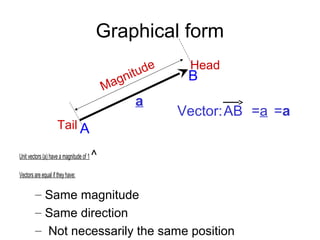
Graphical form
Unit vectors (a) have a magnitude of 1
Vectors are equal if theyhave:
– Same magnitude
– Same direction
– Not necessarily the same position
Magnitude Head
Tail
AB
^
A
B
a
Vector: =a =a
a
Multiplying (by a scalar)
Product is a:
Vector
v
Adding Vectors
Triangle Law
v
u
u+v
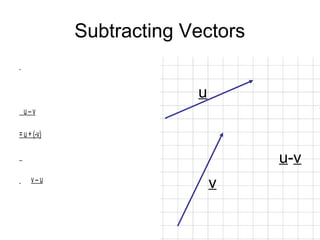
Subtracting Vectors
u – v
= u + (-v)
v – u
v
u
u-v
Ex. 26.2
1. Given that vector of magnitude 2, state
a) A vector of magnitude 4 in the direction of v
b) A vector of magnitude 0.5 in the direction of v
c) A vector of magnitude 6 in the opposite direction of
v
d) A unit vector in the direction of v
e) A unit vector in the opposite direction of v
S.E. 26.3
2. Which of the following are true and which are false?
a) a + b is the same as a + b
b) b – a is the same as a – b
c) a + b + c is the same as c + a + b
Explain the term ‘resultant as applied to two vectors
Ex 26.3
• Using the diagram below, find:
a) AB+BC b) AC+CD+ DE c) AC – EC
d) DE + EA + AC e) AB-CB f) BC-AC
g) EC+CB+BA
B
D
EA
C
1 2 3 4 5 6 7 8
9
8
7
6
5
4
3
2
1
P
AO
i
j
Component form
OP =
i =
j =
OA =
OP =
OP =
OA + AP
Unit vector (x)
Unit vector (y)
6i
8j
6i + 8j
S.E. 26.4
1. State a unit vector:
(a)In the x direction (b) in the ydirection
1. State a unit vector: (a) In the negative x direction (b) in the negative ydirection
2. What is the angle between
3. a) i and j b) i and i c) i and –i
4. State an expression for the magnitude of xi + yj
5. State a vector of magnitude 6 in the x direction
6. State a vector of magnitude 2 in the negative ydirection
Adding
a = a
1
i + a
2
j
b = b
1
i + b
2
j
a + b = (a
1
+ b
1
)i + (a
2
+ b
2
)j
eg:
a = 7i + 3j
b = i + 2j
a + b = (7+1)i + (3+2)j
= 8i + 5j
1 2 3 4 5 6 7 8
9
8
7
6
5
4
3
2
1
i
j
Multiplying (by a scalar)
v = v
1
i + v
2
j
av =a(v
1
i + v
2
j)
av =av
1
i + av
2
j
eg:
v = 2i + 3j
a = 3
av = 3(2i + 3j)
= 6i + 9j
1 2 3 4 5 6 7 8
9
8
7
6
5
4
3
2
1
i
j
Ex 26.4
1. Calculate the magnitude of:
a) i + 3j b) 3i + 4j c) –i d)1/2(i + j)
1. Calculate the vector from
a) (0,0) to (3,7)
b) 3,7) to (5,2)
c) (5,2) to (-1,-2)
1. Given a = 3i – 2j, b= - i – 3j, c = 2 i + 5j, find
a) 4a b) 3b + 2c c) 2a – 3b – 4c
d) IaI e) I4aI f) I3b + 2cI
Dot (scalar) product
• A scalar product of two vectors
• The product shows the magnitude of the influence that one vector has on another.
Eg
• Running a race
• Pushing a piano
• Mario kart zooms
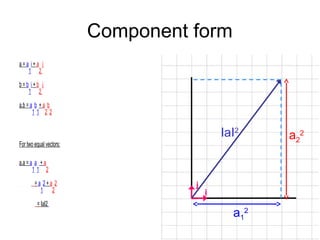
Component form
a = a
1
i + a
2
j
b = b
1
i + b
2
j
a.b = a
1
b
1
+ a
2
b
2
For two equal vectors:
a.a = a
1
a
1
+ a
2
= a
1
2 + a
2
2
= IaI2
i
j
IaI2
a1
2
a2
2
Cosine Rule:
c2 = a2 +b2 – 2ab.cosC
c =
c.c = (a-b).(a-b)
= a.a + b.b – 2a.b
IcI2 = IaI2 + IbI2 – 2a.b
a.b = IaIIbIcosC
Geometric form
a – b
Comparing the component and
geometric forms
Show:
• i.i=1
• i.j=0
a.b
• i.i = I1II1IcosC = 1
• i.j = I1II1IcosC = 0
= (a
1
i + a
2
j).(b
1
i+ b
2
j)
=a
1
b
1
i.i + a
2
b
2
j.j + a
2
b
1
i.j + a
1
b
2
i.j
= a
1
b
1
+ a
2
b
2
…as shown before
Exercise 26.5
1. Find the dot product of the following pairs of vectors:
(a) 2i-j, 3i+2j (b) –i+3j, 4i-j c) i-j, -2i-j
2. Find the angles between the following pairs of vectors:
(a) 3i+4j, i+2j (b) i+j, 2i-3j c) i-j, i-j (d) j,-j
3. Show that the vectors a=2i-j and b=-i-2j are perpendicular
4. Points A, B and C have coordinates (-6,2), (3,8) and (-3,-2) respectively.
(a) Find AB and BC
(b) Byusing the dot product, calculate the angle between AB and BC
Cross (vector) product
• A vector product produced by two vectors
• It also measures the interaction between the 2 vectors
• The vector should be the same irrespective of the vector set’s orientation
• Therefore, we need a vector which remains constant irrespective of orientation
• Which direction should the vector point in order to satisfy this requirement?
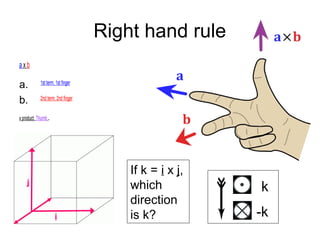
Right hand rule
a x b
a. 1st term, 1st finger
b. 2nd term, 2nd finger
xproduct. Thumb
j
i
If k = i x j,
which
direction
is k?
k
-k
Exercise
Find:
• i x j =
• i x k =
• k x i =
Notice:
u x v = -v x u
u x u = -u x u
u = -u =
i x i = j x j = k x k = 0
-j x i
-k x j
-i x k
k
i
j
=
=
=
0
Component form
u = u
1
i + u
2
j + u
3
k
v = v
1
i + v
2
j + v
3
k
u x v =
= (u
1
i + u
2
j + u
3
k)(v
1
i + v
2
j + v
3
k)
= u
1
iv
1
i + u
1
i v
2
j + u
1
iv
3
k + u
2
jv
1
i + u
2
jv
2
j + u
2
j v
3
k + u
3
kv
1
i + u
3
kv
2
j + u
3
k v
3
k
= u
1
i v
2
j + u
1
iv
3
k + u
2
jv
1
i + u
2
j v
3
k + u
3
kv
1
i + u
3
kv
2
j
u x v = (u
2
v
3
– u
3
v
2
)i + (u
3
v
1
– u
1
v
3
)j + (u
1
v
2
– u
2
v
1
)k
ixj = -jxi = k
jxk = -kxj = i
kxi = -ixk =j
Magnitude of cross product
u x v = (u
2
v
3
– u
3
v
2
) + (u
3
v
1
– u
1
v
3
) + (u
1
v
2
– u
2
v
1
)
From Pythagoras’ Theorem:
IuxvI2 = (u
2
v
3
– u
3
v
2
)2 + (u
3
v
1
– u
1
v
3
)2 + (u
1
v
2
– u
2
v
1
)2
= u
2
2v
3
2 – 2u
2
u
3
v
2
v
3
+ u
3
2v
2
2
+ u
3
2v
1
2 – 2u
1
u
3
v
1
v
3
+ u
1
2v
3
2
+ u
1
2v
2
2 – 2u
1
u
2
v
1
v
2
+ u
2
2v
1
2
= u
1
2(v
2
2+v
3
2) + u
2
2(v
1
2+v
3
2) + u
3
2(v
1
2+v
2
2)
- 2(u
2
u
3
v
2
v
3
+ u
1
u
3
v
1
v
3
+ u
1
u
2
v
1
v
2
)
1
IuIIvIcosC = u.v = u
1
v
1
+ u
2
v
2
+ u
3
v
3
IuI2IvI2cos2C = (u.v)2 = (u
1
v
1
+ u
2
v
2
+ u
3
v
3
)2
= u
1
2v
1
2 u
1
u
2
v
1
v
2
u
1
u
3
v
1
v
3
u
2
u
3
v
2
v
3
u
2
2v
2
2 + u
1
u
2
v
1
v
2
+ u
1
u
3
v
1
v
3
+ u
2
u
3
v
2
v
3
u
3
2v
3
2
= u
1
2v
1
2 + u
2
2v
2
2 + u
3
2v
3
2
+ 2(u
1
u
2
v
1
v
2
+ u
1
u
3
v
1
v
3
+ u
2
u
3
v
2
v
3
)
2
+
= IuxvI + IuI2IvI2cos2C
= u
1
2(v
2
2+v
3
2) + u
2
2(v
1
2+v
3
2) + u
3
2(v
1
2+v
2
2)
- 2(u
2
u
3
v
2
v
3
+ u
1
u
3
v
1
v
3
+ u
1
u
2
v
1
v
2
)
u
1
2v
1
2 + u
2
2v
2
2 + u
3
2v
3
2
+ 2(u
1
u
2
v
1
v
2
+ u
1
u
3
v
1
v
3
+ u
2
u
3
v
2
v
3
)
= u
1
2(v
2
2+v
3
2) + u
2
2(v
1
2+v
3
2) + u
3
2(v
1
2+v
2
2)
+ u
1
2v
1
2 + u
2
2v
2
2 + u
3
2v
3
2
= u
1
2(v
1
2+v
2
2+v
3
2) + u
2
2(v
1
2+v
2
2+v
3
2) + u
3
2(v
1
2+v
2
2+v
3
2)
= (u 2 + u 2 + u 2 )(v 2+v 2+v 2)
1 2
Bypythagoras’ Theorem:
(u
1
2 + u
2
2 + u
3
2 )(v
1
2+v
2
2+v
3
2)
= IuI2IvI2
In summary:
+ = Iu x vI2 + IuI2IvI2cos2C = IuI2IvI2
Iu x vI2 = IuI2IvI2 - IuI2IvI2cos2C
= IuI2IvI2 (1- cos2C)
= IuI2IvI2 (sin2C)
Iuxvi2 = IuI2IvI2 sin2C
1 2
Magnitude as a parallelogram

1. vectors

  • 1.
  • 2.
  • 3.
    Graphical form Unit vectors(a) have a magnitude of 1 Vectors are equal if theyhave: – Same magnitude – Same direction – Not necessarily the same position Magnitude Head Tail AB ^ A B a Vector: =a =a a
  • 4.
    Multiplying (by ascalar) Product is a: Vector v
  • 5.
  • 6.
    Subtracting Vectors u –v = u + (-v) v – u v u u-v
  • 7.
    Ex. 26.2 1. Giventhat vector of magnitude 2, state a) A vector of magnitude 4 in the direction of v b) A vector of magnitude 0.5 in the direction of v c) A vector of magnitude 6 in the opposite direction of v d) A unit vector in the direction of v e) A unit vector in the opposite direction of v
  • 8.
    S.E. 26.3 2. Whichof the following are true and which are false? a) a + b is the same as a + b b) b – a is the same as a – b c) a + b + c is the same as c + a + b Explain the term ‘resultant as applied to two vectors
  • 9.
    Ex 26.3 • Usingthe diagram below, find: a) AB+BC b) AC+CD+ DE c) AC – EC d) DE + EA + AC e) AB-CB f) BC-AC g) EC+CB+BA B D EA C
  • 10.
    1 2 34 5 6 7 8 9 8 7 6 5 4 3 2 1 P AO i j Component form OP = i = j = OA = OP = OP = OA + AP Unit vector (x) Unit vector (y) 6i 8j 6i + 8j
  • 11.
    S.E. 26.4 1. Statea unit vector: (a)In the x direction (b) in the ydirection 1. State a unit vector: (a) In the negative x direction (b) in the negative ydirection 2. What is the angle between 3. a) i and j b) i and i c) i and –i 4. State an expression for the magnitude of xi + yj 5. State a vector of magnitude 6 in the x direction 6. State a vector of magnitude 2 in the negative ydirection
  • 12.
    Adding a = a 1 i+ a 2 j b = b 1 i + b 2 j a + b = (a 1 + b 1 )i + (a 2 + b 2 )j eg: a = 7i + 3j b = i + 2j a + b = (7+1)i + (3+2)j = 8i + 5j 1 2 3 4 5 6 7 8 9 8 7 6 5 4 3 2 1 i j
  • 13.
    Multiplying (by ascalar) v = v 1 i + v 2 j av =a(v 1 i + v 2 j) av =av 1 i + av 2 j eg: v = 2i + 3j a = 3 av = 3(2i + 3j) = 6i + 9j 1 2 3 4 5 6 7 8 9 8 7 6 5 4 3 2 1 i j
  • 14.
    Ex 26.4 1. Calculatethe magnitude of: a) i + 3j b) 3i + 4j c) –i d)1/2(i + j) 1. Calculate the vector from a) (0,0) to (3,7) b) 3,7) to (5,2) c) (5,2) to (-1,-2) 1. Given a = 3i – 2j, b= - i – 3j, c = 2 i + 5j, find a) 4a b) 3b + 2c c) 2a – 3b – 4c d) IaI e) I4aI f) I3b + 2cI
  • 15.
    Dot (scalar) product •A scalar product of two vectors • The product shows the magnitude of the influence that one vector has on another. Eg • Running a race • Pushing a piano • Mario kart zooms
  • 16.
    Component form a =a 1 i + a 2 j b = b 1 i + b 2 j a.b = a 1 b 1 + a 2 b 2 For two equal vectors: a.a = a 1 a 1 + a 2 = a 1 2 + a 2 2 = IaI2 i j IaI2 a1 2 a2 2
  • 17.
    Cosine Rule: c2 =a2 +b2 – 2ab.cosC c = c.c = (a-b).(a-b) = a.a + b.b – 2a.b IcI2 = IaI2 + IbI2 – 2a.b a.b = IaIIbIcosC Geometric form a – b
  • 18.
    Comparing the componentand geometric forms Show: • i.i=1 • i.j=0 a.b • i.i = I1II1IcosC = 1 • i.j = I1II1IcosC = 0 = (a 1 i + a 2 j).(b 1 i+ b 2 j) =a 1 b 1 i.i + a 2 b 2 j.j + a 2 b 1 i.j + a 1 b 2 i.j = a 1 b 1 + a 2 b 2 …as shown before
  • 19.
    Exercise 26.5 1. Findthe dot product of the following pairs of vectors: (a) 2i-j, 3i+2j (b) –i+3j, 4i-j c) i-j, -2i-j 2. Find the angles between the following pairs of vectors: (a) 3i+4j, i+2j (b) i+j, 2i-3j c) i-j, i-j (d) j,-j 3. Show that the vectors a=2i-j and b=-i-2j are perpendicular 4. Points A, B and C have coordinates (-6,2), (3,8) and (-3,-2) respectively. (a) Find AB and BC (b) Byusing the dot product, calculate the angle between AB and BC
  • 20.
    Cross (vector) product •A vector product produced by two vectors • It also measures the interaction between the 2 vectors • The vector should be the same irrespective of the vector set’s orientation • Therefore, we need a vector which remains constant irrespective of orientation • Which direction should the vector point in order to satisfy this requirement?
  • 21.
    Right hand rule ax b a. 1st term, 1st finger b. 2nd term, 2nd finger xproduct. Thumb j i If k = i x j, which direction is k? k -k
  • 22.
    Exercise Find: • i xj = • i x k = • k x i = Notice: u x v = -v x u u x u = -u x u u = -u = i x i = j x j = k x k = 0 -j x i -k x j -i x k k i j = = = 0
  • 23.
    Component form u =u 1 i + u 2 j + u 3 k v = v 1 i + v 2 j + v 3 k u x v = = (u 1 i + u 2 j + u 3 k)(v 1 i + v 2 j + v 3 k) = u 1 iv 1 i + u 1 i v 2 j + u 1 iv 3 k + u 2 jv 1 i + u 2 jv 2 j + u 2 j v 3 k + u 3 kv 1 i + u 3 kv 2 j + u 3 k v 3 k = u 1 i v 2 j + u 1 iv 3 k + u 2 jv 1 i + u 2 j v 3 k + u 3 kv 1 i + u 3 kv 2 j u x v = (u 2 v 3 – u 3 v 2 )i + (u 3 v 1 – u 1 v 3 )j + (u 1 v 2 – u 2 v 1 )k ixj = -jxi = k jxk = -kxj = i kxi = -ixk =j
  • 24.
    Magnitude of crossproduct u x v = (u 2 v 3 – u 3 v 2 ) + (u 3 v 1 – u 1 v 3 ) + (u 1 v 2 – u 2 v 1 ) From Pythagoras’ Theorem: IuxvI2 = (u 2 v 3 – u 3 v 2 )2 + (u 3 v 1 – u 1 v 3 )2 + (u 1 v 2 – u 2 v 1 )2 = u 2 2v 3 2 – 2u 2 u 3 v 2 v 3 + u 3 2v 2 2 + u 3 2v 1 2 – 2u 1 u 3 v 1 v 3 + u 1 2v 3 2 + u 1 2v 2 2 – 2u 1 u 2 v 1 v 2 + u 2 2v 1 2 = u 1 2(v 2 2+v 3 2) + u 2 2(v 1 2+v 3 2) + u 3 2(v 1 2+v 2 2) - 2(u 2 u 3 v 2 v 3 + u 1 u 3 v 1 v 3 + u 1 u 2 v 1 v 2 ) 1
  • 25.
    IuIIvIcosC = u.v= u 1 v 1 + u 2 v 2 + u 3 v 3 IuI2IvI2cos2C = (u.v)2 = (u 1 v 1 + u 2 v 2 + u 3 v 3 )2 = u 1 2v 1 2 u 1 u 2 v 1 v 2 u 1 u 3 v 1 v 3 u 2 u 3 v 2 v 3 u 2 2v 2 2 + u 1 u 2 v 1 v 2 + u 1 u 3 v 1 v 3 + u 2 u 3 v 2 v 3 u 3 2v 3 2 = u 1 2v 1 2 + u 2 2v 2 2 + u 3 2v 3 2 + 2(u 1 u 2 v 1 v 2 + u 1 u 3 v 1 v 3 + u 2 u 3 v 2 v 3 ) 2
  • 26.
    + = IuxvI +IuI2IvI2cos2C = u 1 2(v 2 2+v 3 2) + u 2 2(v 1 2+v 3 2) + u 3 2(v 1 2+v 2 2) - 2(u 2 u 3 v 2 v 3 + u 1 u 3 v 1 v 3 + u 1 u 2 v 1 v 2 ) u 1 2v 1 2 + u 2 2v 2 2 + u 3 2v 3 2 + 2(u 1 u 2 v 1 v 2 + u 1 u 3 v 1 v 3 + u 2 u 3 v 2 v 3 ) = u 1 2(v 2 2+v 3 2) + u 2 2(v 1 2+v 3 2) + u 3 2(v 1 2+v 2 2) + u 1 2v 1 2 + u 2 2v 2 2 + u 3 2v 3 2 = u 1 2(v 1 2+v 2 2+v 3 2) + u 2 2(v 1 2+v 2 2+v 3 2) + u 3 2(v 1 2+v 2 2+v 3 2) = (u 2 + u 2 + u 2 )(v 2+v 2+v 2) 1 2
  • 27.
    Bypythagoras’ Theorem: (u 1 2 +u 2 2 + u 3 2 )(v 1 2+v 2 2+v 3 2) = IuI2IvI2 In summary: + = Iu x vI2 + IuI2IvI2cos2C = IuI2IvI2 Iu x vI2 = IuI2IvI2 - IuI2IvI2cos2C = IuI2IvI2 (1- cos2C) = IuI2IvI2 (sin2C) Iuxvi2 = IuI2IvI2 sin2C 1 2
  • 28.
    Magnitude as aparallelogram