Physics
Session
Kinematics - 1
Session Opener
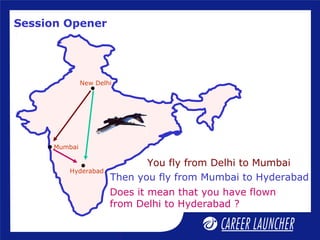
You fly from Delhi to Mumbai
New Delhi
Mumbai
Hyderabad
•
•
•
Then you fly from Mumbai to Hyderabad
Does it mean that you have flown
from Delhi to Hyderabad ?
Session Objectives
1. Scalars and vectors
2. Definitions
3. Vector addition and vector subtraction
4. Components of vectors
5. Multiplication of vectors
Scalars And Vectors
Scalars : physical quantities that can
be completely specified by
just numbers.
Vectors : physical quantities that cannot be
completely specified by their magnitude
alone. They also need a ‘direction’
specification.
For instance, displacement is a vector quantity.
Vectors
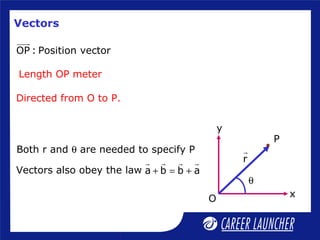
OP : Position vector
uuur
Length OP meter
Directed from O to P.
Both r and θ are needed to specify P
Vectors also obey the law a b b a+ = +
r r r r
O x
y
P
θ
r
r
Vectors
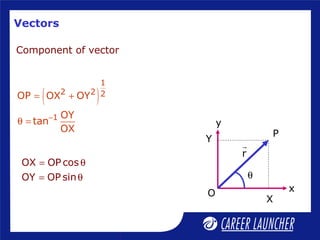
Component of vector
( )
1
2 2 2
1
OP OX OY
OY
tan
OX
−
= +
θ =
OX OP cos
OY OP sin
= θ
= θ
O x
y
P
θ
r
r
X
Y
Unit Vectors
O x
y
P
θ
r
r
X
Y
Unit vector : vector with magnitude
of unity
= =
= θ + θ
r
r
r
r
ˆ ˆr , r one unit
r
ˆ ˆr i r cos j r sin
O
x
y
θ
ˆrˆj
ˆi
Class Exercise
Class Exercise - 6
∧ ∧ ∧ ∧
= + = +
ur ur
A 3 i 4 j ; B 7 i 24 j .
Find such that C = B and is in
the direction of .
ur
C
ur
Cur
A
The unit vector in the direction of ,
where 5 is the magnitude of . Magnitude of
the vector = 25 units. Hence the value of
∧ ∧
+
=
ur 3 i 4 j
A
5ur
Aur
B
∧ ∧
∧ ∧
 
+ 
= = + 
  
ur 3 i 4 j
C 25 15 i 20 j
5
Solution :
Vector Definitions
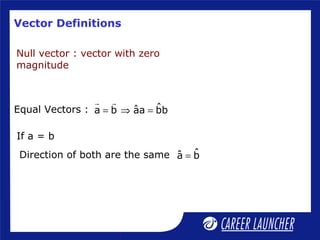
Null vector : vector with zero
magnitude
Equal Vectors : ˆˆa b aa bb= ⇒ =
r r
If a = b
Direction of both are the same ˆˆa b=
Addition of vectors
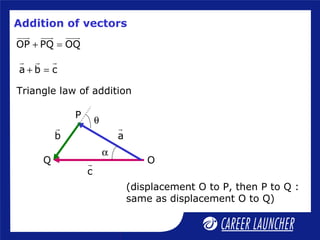
OP PQ OQ+ =
uuur uuur uuur
(displacement O to P, then P to Q :
same as displacement O to Q)
Triangle law of addition
a b c+ =
r r r
O
P
Q
b
r
a
r
c
r
α
θ
Addition of vectors
Parallelogram law
From geometry : ( )
1/2
2 2
c a b 2abcos= + + θ
bsin
tan
a bcos
θ
α =
+ θ
a b c+ =
r r r
b
r
a
r
c
r
αθ
a
b
θ
bsinθ
bcosθ
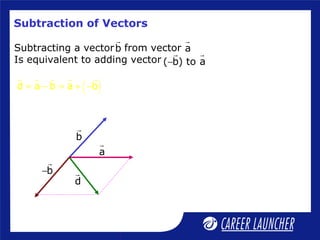
Subtraction of Vectors
Subtracting a vector from vector
Is equivalent to adding vector
b
r
a
r
( b) to a−
r r
( )d a b a b= − = + −
r r r r r
b
r
a
r
b−
r
d
r
Class Exercise
Class Exercise - 1
The maximum resultant of 2 vectors
is 18 units. The resultant magnitude
is 12. If the resultant is
perpendicular to the smaller vector ,
find the magnitude of the two
vectors.
R
A
B
A + B = 18 [The maximum amplitude of
the resultant is when they are collinear.]
Also 122
+ A2
= (18 – A)2
.
Solving, we get
A = 5 and B = 13
Solution :
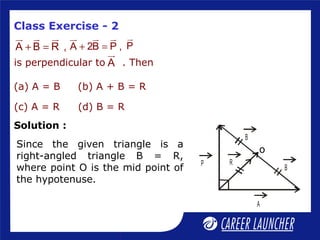
Class Exercise - 2
+ =
ur ur ur
A B R , + =
ur ur ur
A 2B P ,
ur
P
is perpendicular to . Then
ur
A
(a) A = B (b) A + B = R
(c) A = R (d) B = R
Since the given triangle is a
right-angled triangle B = R,
where point O is the mid point of
the hypotenuse.
P
A
B
B
R
o
Solution :
Class Exercise - 3
The components along the X and Y-axis of
are 3 m and 4 m respectively. The
components along X and Y-axis of the
vectors is 2 m and 6 m respectively.
Find the components of along X and Y-
axis?
ur
A
+
ur ur
A B ur
B
∧ ∧ ∧ ∧ ∧ ∧
= + + + + = +
ur
Let B x i y j .Then (3 x) i (4 y) j 2 i 6 j
So x = –1 and y = 2.
∧ ∧
= +
ur
Hence B – i 2 j
Solution :
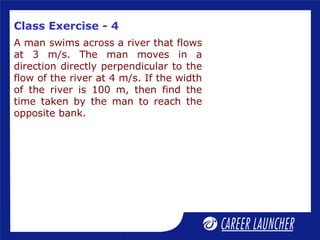
Class Exercise - 4
A man swims across a river that flows
at 3 m/s. The man moves in a
direction directly perpendicular to the
flow of the river at 4 m/s. If the width
of the river is 100 m, then find the
time taken by the man to reach the
opposite bank.
Solution - 4
r
R
m
m r R . m, r , R
→ → → → → →
+ = denote
the components of velocities of man,
river and resultant during the motion.
The resultant direction in which the
man moves is not along the shortest
line joining the two banks. But
nevertheless the component of the
velocities in the Y direction is 4 m/s.
Hence the man takes , i.e 25 s to
cross over to the opposite bank.
100
4
Multiplication of vector by a real
number
a multiplied by λ
r
b a a a= λ ⇒ λ = λ
r r r r
If is negativeλ
c a= −λ
r r
Direction : opposite a
r
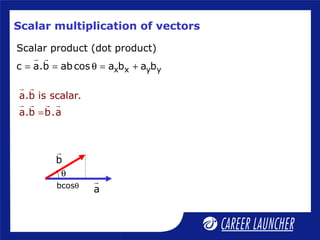
Scalar multiplication of vectors
Scalar product (dot product)
x x y yc a.b abcos a b a b= = θ = +
r r
a.b is scalar.
a.b b.a=
r r
r r r r
b
r
a
r
bcosθ
θ
Class Exercise
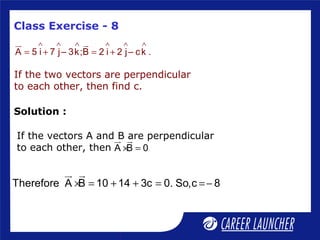
Class Exercise - 8
∧ ∧ ∧ ∧ ∧ ∧
= + = +
ur ur
A 5 i 7 j– 3k;B 2 i 2 j– ck .
If the two vectors are perpendicular
to each other, then find c.
If the vectors A and B are perpendicular
to each other, then × =
ur ur
A B 0
× = + + = =−
ur ur
Therefore A B 10 14 3c 0. So,c 8
Solution :
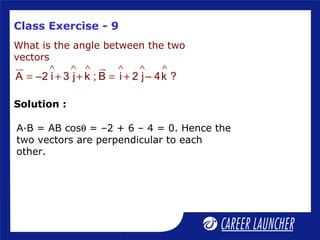
Class Exercise - 9
What is the angle between the two
vectors
∧ ∧ ∧ ∧ ∧ ∧
= + + = +
ur ur
A –2 i 3 j k ; B i 2 j– 4k ?
A·B = AB cosθ = –2 + 6 – 4 = 0. Hence the
two vectors are perpendicular to each
other.
Solution :
Class Exercise - 10
Find the component of the vector
in the direction of
the vector .
∧ ∧ ∧
= + +
ur
A 3 i 4 j 5k ∧ ∧
= +
ur
B 3 i 4 j
A·B = AB cosθ. This also means that A.B is the
product of the magnitude of B and the magnitude
of the component of A in the direction of B.
Magnitude of B = 5 units.
A·B = 25. Hence the magnitude of the component of
A in the direction of B is 5, which can happen only if
the component vector is .
∧ ∧
+3 i 4 j
Alternately, if we compare the components of the two
vectors along the X, Y directions, we find that they are
the same. Hence the component of A in the direction of
B must be same as the vector B.
Solution :
Vector multiplication of vectors
Vector product (cross product)
ˆc a b is vector absin c= × = θ
r r r
( )x y y x
ˆc k a b a b= −
r
a b b a× = − ×
r r r r b
r
a
r
θ
Vector multiplication of vectors
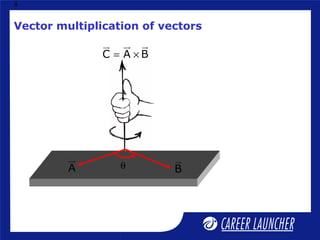
Vector product has an
orientation given by the
right-hand thumb rule.
Curl palm of your right hand from
the first vector to the second vector
keeping the thumb upright. The
direction of the thumb gives the
direction of resultant.
Vector multiplication of vectors
A
ur
θA
ur
B
ur
C A B= ×
ur ur ur
Product of two vectors
ˆˆ ˆi j k
ˆˆ ˆj k i
ˆ ˆ ˆk i j
× =
× =
× =
Some special cases
(ii) For unit vectors
ˆ ˆˆ ˆ ˆ ˆi i 0 j j k k× = = × = × = = =ˆ ˆˆ ˆ ˆ ˆi . i j. j k. k 1
=
=
=
ˆ ˆi. j 0
ˆˆj.k 0
ˆ ˆk . i 0
× = θ =
ur ur
A B AB sin 0(i) (for parallel vectors)
= θ =
ur ur
A.B AB cos 0 (for perpendicular vectors)
Class Exercise
Class Exercise - 7
What is the torque of a force
acting
at the point
and about the origin?
∧ ∧ ∧ 
= + ÷ ÷
 
r
F 2 i – 3 j 4k N
∧ ∧ ∧
= + +
r
r 3 i 2 j 3k
 τ = × 
r r r
Note r F
Solution :
∧ ∧ ∧ ∧ ∧ ∧
= + + = +
r r
r 3 i 2 j 3k,F 2 i – 3 j 4k
∧ ∧ ∧ ∧ ∧ ∧ ∧
= × = + + + =
r
F r f –9k– 12 j – 4k 8 i 6 j 9 i 17 i
Hence the moment of the force
Class Exercise - 5
The angle between two forces of
equal magnitude acting at a point,
such that the resultant force also has
the same magnitude is___.
Solution :
F
F
R=F
θ
120∴ θ = o
2 2 2
2 2
R F F 2F.F cos (but R F given)
F 2F (1 cos )
= + + θ =
= + θ
1
1 cos
2
1
cos
2
⇒ = + θ
⇒ θ = −
Thank you

Kinematics-1

  • 1.
  • 2.
  • 3.
    Session Opener You flyfrom Delhi to Mumbai New Delhi Mumbai Hyderabad • • • Then you fly from Mumbai to Hyderabad Does it mean that you have flown from Delhi to Hyderabad ?
  • 4.
    Session Objectives 1. Scalarsand vectors 2. Definitions 3. Vector addition and vector subtraction 4. Components of vectors 5. Multiplication of vectors
  • 5.
    Scalars And Vectors Scalars: physical quantities that can be completely specified by just numbers. Vectors : physical quantities that cannot be completely specified by their magnitude alone. They also need a ‘direction’ specification. For instance, displacement is a vector quantity.
  • 6.
    Vectors OP : Positionvector uuur Length OP meter Directed from O to P. Both r and θ are needed to specify P Vectors also obey the law a b b a+ = + r r r r O x y P θ r r
  • 7.
    Vectors Component of vector () 1 2 2 2 1 OP OX OY OY tan OX − = + θ = OX OP cos OY OP sin = θ = θ O x y P θ r r X Y
  • 8.
    Unit Vectors O x y P θ r r X Y Unitvector : vector with magnitude of unity = = = θ + θ r r r r ˆ ˆr , r one unit r ˆ ˆr i r cos j r sin O x y θ ˆrˆj ˆi
  • 9.
  • 10.
    Class Exercise -6 ∧ ∧ ∧ ∧ = + = + ur ur A 3 i 4 j ; B 7 i 24 j . Find such that C = B and is in the direction of . ur C ur Cur A The unit vector in the direction of , where 5 is the magnitude of . Magnitude of the vector = 25 units. Hence the value of ∧ ∧ + = ur 3 i 4 j A 5ur Aur B ∧ ∧ ∧ ∧   +  = = +     ur 3 i 4 j C 25 15 i 20 j 5 Solution :
  • 11.
    Vector Definitions Null vector: vector with zero magnitude Equal Vectors : ˆˆa b aa bb= ⇒ = r r If a = b Direction of both are the same ˆˆa b=
  • 12.
    Addition of vectors OPPQ OQ+ = uuur uuur uuur (displacement O to P, then P to Q : same as displacement O to Q) Triangle law of addition a b c+ = r r r O P Q b r a r c r α θ
  • 13.
    Addition of vectors Parallelogramlaw From geometry : ( ) 1/2 2 2 c a b 2abcos= + + θ bsin tan a bcos θ α = + θ a b c+ = r r r b r a r c r αθ a b θ bsinθ bcosθ
  • 14.
    Subtraction of Vectors Subtractinga vector from vector Is equivalent to adding vector b r a r ( b) to a− r r ( )d a b a b= − = + − r r r r r b r a r b− r d r
  • 15.
  • 16.
    Class Exercise -1 The maximum resultant of 2 vectors is 18 units. The resultant magnitude is 12. If the resultant is perpendicular to the smaller vector , find the magnitude of the two vectors. R A B A + B = 18 [The maximum amplitude of the resultant is when they are collinear.] Also 122 + A2 = (18 – A)2 . Solving, we get A = 5 and B = 13 Solution :
  • 17.
    Class Exercise -2 + = ur ur ur A B R , + = ur ur ur A 2B P , ur P is perpendicular to . Then ur A (a) A = B (b) A + B = R (c) A = R (d) B = R Since the given triangle is a right-angled triangle B = R, where point O is the mid point of the hypotenuse. P A B B R o Solution :
  • 18.
    Class Exercise -3 The components along the X and Y-axis of are 3 m and 4 m respectively. The components along X and Y-axis of the vectors is 2 m and 6 m respectively. Find the components of along X and Y- axis? ur A + ur ur A B ur B ∧ ∧ ∧ ∧ ∧ ∧ = + + + + = + ur Let B x i y j .Then (3 x) i (4 y) j 2 i 6 j So x = –1 and y = 2. ∧ ∧ = + ur Hence B – i 2 j Solution :
  • 19.
    Class Exercise -4 A man swims across a river that flows at 3 m/s. The man moves in a direction directly perpendicular to the flow of the river at 4 m/s. If the width of the river is 100 m, then find the time taken by the man to reach the opposite bank.
  • 20.
    Solution - 4 r R m mr R . m, r , R → → → → → → + = denote the components of velocities of man, river and resultant during the motion. The resultant direction in which the man moves is not along the shortest line joining the two banks. But nevertheless the component of the velocities in the Y direction is 4 m/s. Hence the man takes , i.e 25 s to cross over to the opposite bank. 100 4
  • 21.
    Multiplication of vectorby a real number a multiplied by λ r b a a a= λ ⇒ λ = λ r r r r If is negativeλ c a= −λ r r Direction : opposite a r
  • 22.
    Scalar multiplication ofvectors Scalar product (dot product) x x y yc a.b abcos a b a b= = θ = + r r a.b is scalar. a.b b.a= r r r r r r b r a r bcosθ θ
  • 23.
  • 24.
    Class Exercise -8 ∧ ∧ ∧ ∧ ∧ ∧ = + = + ur ur A 5 i 7 j– 3k;B 2 i 2 j– ck . If the two vectors are perpendicular to each other, then find c. If the vectors A and B are perpendicular to each other, then × = ur ur A B 0 × = + + = =− ur ur Therefore A B 10 14 3c 0. So,c 8 Solution :
  • 25.
    Class Exercise -9 What is the angle between the two vectors ∧ ∧ ∧ ∧ ∧ ∧ = + + = + ur ur A –2 i 3 j k ; B i 2 j– 4k ? A·B = AB cosθ = –2 + 6 – 4 = 0. Hence the two vectors are perpendicular to each other. Solution :
  • 26.
    Class Exercise -10 Find the component of the vector in the direction of the vector . ∧ ∧ ∧ = + + ur A 3 i 4 j 5k ∧ ∧ = + ur B 3 i 4 j A·B = AB cosθ. This also means that A.B is the product of the magnitude of B and the magnitude of the component of A in the direction of B. Magnitude of B = 5 units. A·B = 25. Hence the magnitude of the component of A in the direction of B is 5, which can happen only if the component vector is . ∧ ∧ +3 i 4 j Alternately, if we compare the components of the two vectors along the X, Y directions, we find that they are the same. Hence the component of A in the direction of B must be same as the vector B. Solution :
  • 27.
    Vector multiplication ofvectors Vector product (cross product) ˆc a b is vector absin c= × = θ r r r ( )x y y x ˆc k a b a b= − r a b b a× = − × r r r r b r a r θ
  • 28.
    Vector multiplication ofvectors Vector product has an orientation given by the right-hand thumb rule. Curl palm of your right hand from the first vector to the second vector keeping the thumb upright. The direction of the thumb gives the direction of resultant.
  • 29.
    Vector multiplication ofvectors A ur θA ur B ur C A B= × ur ur ur
  • 30.
    Product of twovectors ˆˆ ˆi j k ˆˆ ˆj k i ˆ ˆ ˆk i j × = × = × = Some special cases (ii) For unit vectors ˆ ˆˆ ˆ ˆ ˆi i 0 j j k k× = = × = × = = =ˆ ˆˆ ˆ ˆ ˆi . i j. j k. k 1 = = = ˆ ˆi. j 0 ˆˆj.k 0 ˆ ˆk . i 0 × = θ = ur ur A B AB sin 0(i) (for parallel vectors) = θ = ur ur A.B AB cos 0 (for perpendicular vectors)
  • 31.
  • 32.
    Class Exercise -7 What is the torque of a force acting at the point and about the origin? ∧ ∧ ∧  = + ÷ ÷   r F 2 i – 3 j 4k N ∧ ∧ ∧ = + + r r 3 i 2 j 3k  τ = ×  r r r Note r F Solution : ∧ ∧ ∧ ∧ ∧ ∧ = + + = + r r r 3 i 2 j 3k,F 2 i – 3 j 4k ∧ ∧ ∧ ∧ ∧ ∧ ∧ = × = + + + = r F r f –9k– 12 j – 4k 8 i 6 j 9 i 17 i Hence the moment of the force
  • 33.
    Class Exercise -5 The angle between two forces of equal magnitude acting at a point, such that the resultant force also has the same magnitude is___. Solution : F F R=F θ 120∴ θ = o 2 2 2 2 2 R F F 2F.F cos (but R F given) F 2F (1 cos ) = + + θ = = + θ 1 1 cos 2 1 cos 2 ⇒ = + θ ⇒ θ = −
  • 34.