PRESENTED BY: Deepti Singh
Ph.D. Biotechnology
FIRST SEMESTER
ENROL. NO. B-1384/14
COLLEGE OF BIOTECHNOLOGY
DUVASU, MATHURA
INTRODUCTION
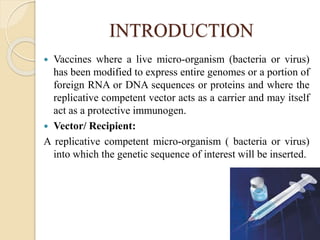
 Vaccines where a live micro-organism (bacteria or virus)
has been modified to express entire genomes or a portion of
foreign RNA or DNA sequences or proteins and where the
replicative competent vector acts as a carrier and may itself
act as a protective immunogen.
 Vector/ Recipient:
A replicative competent micro-organism ( bacteria or virus)
into which the genetic sequence of interest will be inserted.
DEFINITION
 Vector vaccines:
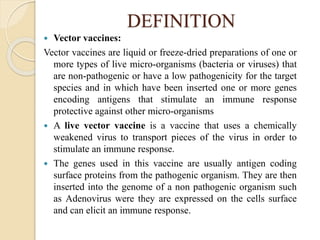
Vector vaccines are liquid or freeze-dried preparations of one or
more types of live micro-organisms (bacteria or viruses) that
are non-pathogenic or have a low pathogenicity for the target
species and in which have been inserted one or more genes
encoding antigens that stimulate an immune response
protective against other micro-organisms
 A live vector vaccine is a vaccine that uses a chemically
weakened virus to transport pieces of the virus in order to
stimulate an immune response.
 The genes used in this vaccine are usually antigen coding
surface proteins from the pathogenic organism. They are then
inserted into the genome of a non pathogenic organism such
as Adenovirus were they are expressed on the cells surface
and can elicit an immune response.
EXTENSIVELY USED VECTORS
 Poxviruses have been extensively studied as potential
vaccine vectors.
 Vaccinia virus, used as a vector in many vaccines,
induces strong immuno stimulation at the injection site.
Its large genome can integrate many transducible genes
and it has an excellent safety profile.
 Vaccinia has been administered to more than a billion
people since the WHO's 1967 launch of the Global
Smallpox Eradication Program.
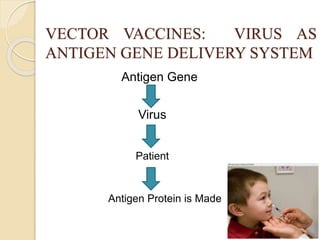
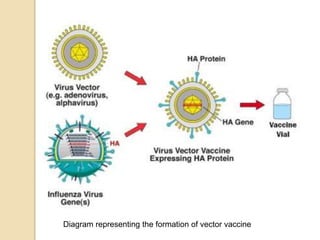
VECTOR VACCINES: VIRUS AS
ANTIGEN GENE DELIVERY SYSTEM
Antigen Gene
Virus
Patient
Antigen Protein is Made
Diagram representing the formation of vector vaccine
VACCINIA VECTOR VACCINES
Vaccinia is a good candidate for a live recombinant viral
vaccine because it is:
•benign virus
•replicate in cytoplasm (viral replication genes)
•easy to store
RECOMBINANT LIVE VECTOR
VACCINES
• Recombinant live vector vaccines are preparations of one or
more types of live bacteria or viruses.
• One or more DNA/RNA sequences have been inserted into
these organisms.
• These organisms generally have a stable non or low
pathogenic phenotype for the species the vaccine is intended
for.
• Recombinant live vector vaccines are expected to be
attenuated and genetically defined live vaccines, which have
defined, non-reverting mutations or deletions.
TYPES OF VECTOR
 Homologous vector:
When the target species of the vaccine is a natural host for
the vector, this is considered a homologous vector.
 Heterologous vector:
When the target species of the vaccine is not one of the
natural hosts for the vector, the vector is classified as a
heterologous vector.
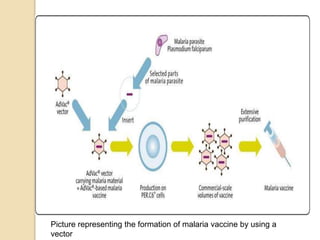
Picture representing the formation of malaria vaccine by using a
vector
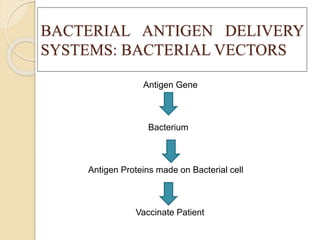
BACTERIAL ANTIGEN DELIVERY
SYSTEMS: BACTERIAL VECTORS
Antigen Gene
Bacterium
Antigen Proteins made on Bacterial cell
Vaccinate Patient
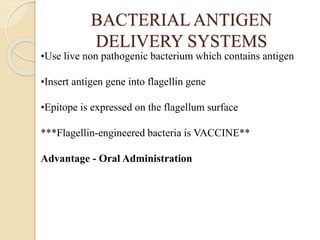
BACTERIAL ANTIGEN
DELIVERY SYSTEMS
•Use live non pathogenic bacterium which contains antigen
•Insert antigen gene into flagellin gene
•Epitope is expressed on the flagellum surface
***Flagellin-engineered bacteria is VACCINE**
Advantage - Oral Administration
VIRAL VECTOR
ADVANTAGES:
•Infects human cells but some do not replicate
•Better presentation of antigen
•Generate T cell response
DRAWBACKS:
•Can cause bad reactions
•Can be problems with pre-exisiting immunity to virus
•Often can only accommodate one or two antigens
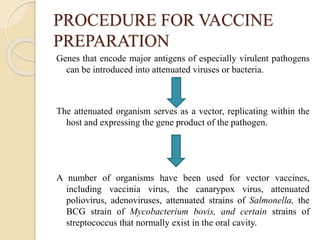
PROCEDURE FOR VACCINE
PREPARATION
Genes that encode major antigens of especially virulent pathogens
can be introduced into attenuated viruses or bacteria.
The attenuated organism serves as a vector, replicating within the
host and expressing the gene product of the pathogen.
A number of organisms have been used for vector vaccines,
including vaccinia virus, the canarypox virus, attenuated
poliovirus, adenoviruses, attenuated strains of Salmonella, the
BCG strain of Mycobacterium bovis, and certain strains of
streptococcus that normally exist in the oral cavity.
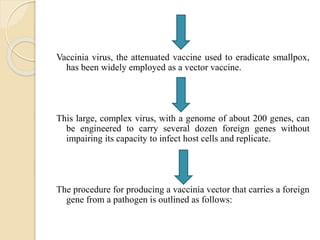
Vaccinia virus, the attenuated vaccine used to eradicate smallpox,
has been widely employed as a vector vaccine.
This large, complex virus, with a genome of about 200 genes, can
be engineered to carry several dozen foreign genes without
impairing its capacity to infect host cells and replicate.
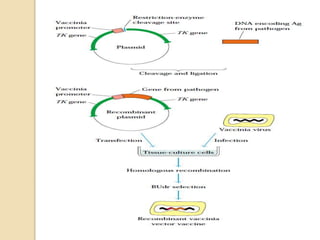
The procedure for producing a vaccinia vector that carries a foreign
gene from a pathogen is outlined as follows:
PRODUCTION OF VACCINIA
VECTOR VACCINE
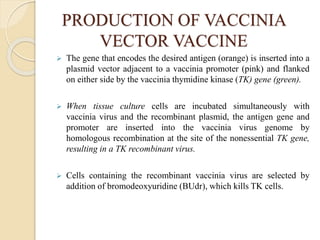
 The gene that encodes the desired antigen (orange) is inserted into a
plasmid vector adjacent to a vaccinia promoter (pink) and flanked
on either side by the vaccinia thymidine kinase (TK) gene (green).
 When tissue culture cells are incubated simultaneously with
vaccinia virus and the recombinant plasmid, the antigen gene and
promoter are inserted into the vaccinia virus genome by
homologous recombination at the site of the nonessential TK gene,
resulting in a TK recombinant virus.
 Cells containing the recombinant vaccinia virus are selected by
addition of bromodeoxyuridine (BUdr), which kills TK cells.
ADVANTAGES OF VECTOR
VACCINE
• The genetically engineered vaccinia expresses high levels
of the inserted gene product, which can then serve as a
potent immunogen in an inoculated host.
• Like the smallpox vaccine, genetically engineered vaccinia
vector vaccines can be administered simply by scratching
the skin, causing a localized infection in host cells.
• If the foreign gene product expressed by the vaccinia is a
viral envelope protein, it is inserted into the membrane of
the infected host cell, inducing development of cell-
mediated immunity as well as antibody-mediated
immunity.
ADVANTAGES OF VECTOR
VACCINE
• Other attenuated-vector vaccines may prove to be safer than
the vaccinia vaccine. The canarypox virus has recently been
tried as a vector vaccine. Like its relative vaccinia, the
canarypox virus is la genes.
• Unlike vaccinia, the canarypox virus does not appear to be
virulent even in individuals with severe immune suppression.
Another possible vector is an attenuated strain of Salmonella
typhimurium, which has been engineered with genes rge and
easily engineered to carry multiple from the bacterium that
causes cholera.
ADVANTAGES OF VECTOR
VACCINE
• Salmonella infects cells of the mucosal lining of the gut
and therefore will induce secretory IgA production.
• Effective immunity against a number of diseases, including
cholera and gonorrhea, depends on increased production of
secretory IgA at mucous membrane surfaces.
• Similar strategies using bacteria that are a normal part of
oral flora are in development.
• The strategy would involve introduction of genes encoding
antigens from pathogenic organisms into bacterial strains
that inhabit the oral cavity or respiratory tract.
• Eliciting immunity at the mucosal surface could provide
excellent protection at the portal used by the pathogen.
DISADVANTAGES OF VECTOR
VACCINE
 Since the genes for the desired antigens must be located,
cloned, and expressed efficiently in the new vector, the
cost of production is high.
 When engineered vaccinia virus is used to vaccinate, care
must be taken to spare immuno deficient individuals.
STILL A SIGNIFICANT NEED
FOR NEW VACCINES
For other diseases: TB
MALARIA
HIV
1. Increase safety of present
vaccine, lower cost, and
dissemination
2. Road to vaccine development is
long and laden with:
Side effects
Exacerbations of disease state
Acquisition of disease state
Vector vacccine

Vector vacccine

  • 1.
    PRESENTED BY: DeeptiSingh Ph.D. Biotechnology FIRST SEMESTER ENROL. NO. B-1384/14 COLLEGE OF BIOTECHNOLOGY DUVASU, MATHURA
  • 2.
    INTRODUCTION  Vaccines wherea live micro-organism (bacteria or virus) has been modified to express entire genomes or a portion of foreign RNA or DNA sequences or proteins and where the replicative competent vector acts as a carrier and may itself act as a protective immunogen.  Vector/ Recipient: A replicative competent micro-organism ( bacteria or virus) into which the genetic sequence of interest will be inserted.
  • 3.
    DEFINITION  Vector vaccines: Vectorvaccines are liquid or freeze-dried preparations of one or more types of live micro-organisms (bacteria or viruses) that are non-pathogenic or have a low pathogenicity for the target species and in which have been inserted one or more genes encoding antigens that stimulate an immune response protective against other micro-organisms  A live vector vaccine is a vaccine that uses a chemically weakened virus to transport pieces of the virus in order to stimulate an immune response.  The genes used in this vaccine are usually antigen coding surface proteins from the pathogenic organism. They are then inserted into the genome of a non pathogenic organism such as Adenovirus were they are expressed on the cells surface and can elicit an immune response.
  • 4.
    EXTENSIVELY USED VECTORS Poxviruses have been extensively studied as potential vaccine vectors.  Vaccinia virus, used as a vector in many vaccines, induces strong immuno stimulation at the injection site. Its large genome can integrate many transducible genes and it has an excellent safety profile.  Vaccinia has been administered to more than a billion people since the WHO's 1967 launch of the Global Smallpox Eradication Program.
  • 5.
    VECTOR VACCINES: VIRUSAS ANTIGEN GENE DELIVERY SYSTEM Antigen Gene Virus Patient Antigen Protein is Made
  • 6.
    Diagram representing theformation of vector vaccine
  • 7.
    VACCINIA VECTOR VACCINES Vacciniais a good candidate for a live recombinant viral vaccine because it is: •benign virus •replicate in cytoplasm (viral replication genes) •easy to store
  • 8.
    RECOMBINANT LIVE VECTOR VACCINES •Recombinant live vector vaccines are preparations of one or more types of live bacteria or viruses. • One or more DNA/RNA sequences have been inserted into these organisms. • These organisms generally have a stable non or low pathogenic phenotype for the species the vaccine is intended for. • Recombinant live vector vaccines are expected to be attenuated and genetically defined live vaccines, which have defined, non-reverting mutations or deletions.
  • 9.
    TYPES OF VECTOR Homologous vector: When the target species of the vaccine is a natural host for the vector, this is considered a homologous vector.  Heterologous vector: When the target species of the vaccine is not one of the natural hosts for the vector, the vector is classified as a heterologous vector.
  • 10.
    Picture representing theformation of malaria vaccine by using a vector
  • 11.
    BACTERIAL ANTIGEN DELIVERY SYSTEMS:BACTERIAL VECTORS Antigen Gene Bacterium Antigen Proteins made on Bacterial cell Vaccinate Patient
  • 12.
    BACTERIAL ANTIGEN DELIVERY SYSTEMS •Uselive non pathogenic bacterium which contains antigen •Insert antigen gene into flagellin gene •Epitope is expressed on the flagellum surface ***Flagellin-engineered bacteria is VACCINE** Advantage - Oral Administration
  • 13.
    VIRAL VECTOR ADVANTAGES: •Infects humancells but some do not replicate •Better presentation of antigen •Generate T cell response DRAWBACKS: •Can cause bad reactions •Can be problems with pre-exisiting immunity to virus •Often can only accommodate one or two antigens
  • 14.
    PROCEDURE FOR VACCINE PREPARATION Genesthat encode major antigens of especially virulent pathogens can be introduced into attenuated viruses or bacteria. The attenuated organism serves as a vector, replicating within the host and expressing the gene product of the pathogen. A number of organisms have been used for vector vaccines, including vaccinia virus, the canarypox virus, attenuated poliovirus, adenoviruses, attenuated strains of Salmonella, the BCG strain of Mycobacterium bovis, and certain strains of streptococcus that normally exist in the oral cavity.
  • 15.
    Vaccinia virus, theattenuated vaccine used to eradicate smallpox, has been widely employed as a vector vaccine. This large, complex virus, with a genome of about 200 genes, can be engineered to carry several dozen foreign genes without impairing its capacity to infect host cells and replicate. The procedure for producing a vaccinia vector that carries a foreign gene from a pathogen is outlined as follows:
  • 17.
    PRODUCTION OF VACCINIA VECTORVACCINE  The gene that encodes the desired antigen (orange) is inserted into a plasmid vector adjacent to a vaccinia promoter (pink) and flanked on either side by the vaccinia thymidine kinase (TK) gene (green).  When tissue culture cells are incubated simultaneously with vaccinia virus and the recombinant plasmid, the antigen gene and promoter are inserted into the vaccinia virus genome by homologous recombination at the site of the nonessential TK gene, resulting in a TK recombinant virus.  Cells containing the recombinant vaccinia virus are selected by addition of bromodeoxyuridine (BUdr), which kills TK cells.
  • 18.
    ADVANTAGES OF VECTOR VACCINE •The genetically engineered vaccinia expresses high levels of the inserted gene product, which can then serve as a potent immunogen in an inoculated host. • Like the smallpox vaccine, genetically engineered vaccinia vector vaccines can be administered simply by scratching the skin, causing a localized infection in host cells. • If the foreign gene product expressed by the vaccinia is a viral envelope protein, it is inserted into the membrane of the infected host cell, inducing development of cell- mediated immunity as well as antibody-mediated immunity.
  • 19.
    ADVANTAGES OF VECTOR VACCINE •Other attenuated-vector vaccines may prove to be safer than the vaccinia vaccine. The canarypox virus has recently been tried as a vector vaccine. Like its relative vaccinia, the canarypox virus is la genes. • Unlike vaccinia, the canarypox virus does not appear to be virulent even in individuals with severe immune suppression. Another possible vector is an attenuated strain of Salmonella typhimurium, which has been engineered with genes rge and easily engineered to carry multiple from the bacterium that causes cholera.
  • 20.
    ADVANTAGES OF VECTOR VACCINE •Salmonella infects cells of the mucosal lining of the gut and therefore will induce secretory IgA production. • Effective immunity against a number of diseases, including cholera and gonorrhea, depends on increased production of secretory IgA at mucous membrane surfaces. • Similar strategies using bacteria that are a normal part of oral flora are in development. • The strategy would involve introduction of genes encoding antigens from pathogenic organisms into bacterial strains that inhabit the oral cavity or respiratory tract. • Eliciting immunity at the mucosal surface could provide excellent protection at the portal used by the pathogen.
  • 21.
    DISADVANTAGES OF VECTOR VACCINE Since the genes for the desired antigens must be located, cloned, and expressed efficiently in the new vector, the cost of production is high.  When engineered vaccinia virus is used to vaccinate, care must be taken to spare immuno deficient individuals.
  • 22.
    STILL A SIGNIFICANTNEED FOR NEW VACCINES For other diseases: TB MALARIA HIV 1. Increase safety of present vaccine, lower cost, and dissemination 2. Road to vaccine development is long and laden with: Side effects Exacerbations of disease state Acquisition of disease state