Expressed protein
identification and
purification
Submmited by
Ajay Singh
Ph.D biotechnology
College of biotechnology, DUVASU, Mathura
DNA Vector
• Molecular carriers which carry fragments of DNA
into host cell.
• Usually derived from plasmids, which are small,
circular, double stranded DNA molecule.
Some widely used vectors
1. Plasmid
2. Cosmid
3. Yeast Artificial Chromosomes
4. Phage lambda vectors
5. Bacterial Artificial Chromosomes
6. Human Artificial Chromosomes
7. Transposons etc.
Basic steps to get recombinant protein
• Amplification of gene of interest. ( Using PCR)
• Insert into cloning vector. (Ex: PCR*8)
• Sub cloning into expression vector. (Ex: pKK223-3
or PSVK 3)
• Transformation into protein expressing bacteria (E
coli) or yeast
• Test for identification of recombinant protein.(
Western blot or Fluorescence)
• Large scale production.(large scale fermenter)
• Isolation and purification
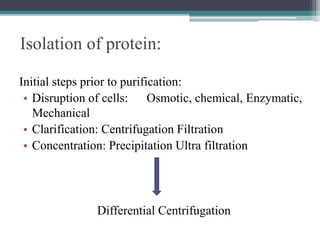
Isolation of protein:
Initial steps prior to purification:
• Disruption of cells: Osmotic, chemical, Enzymatic,
Mechanical
• Clarification: Centrifugation Filtration
• Concentration: Precipitation Ultra filtration
Differential Centrifugation
• It’s a procedure in which a homogenate is subjected
to repeated Centrifugations each time increasing the
Centrifugal force
• Separation is based predominantly on particle mass
and size with larger and heavier particles pelleting at
lower Centrifugal fields
• For specific organelle sub cellular fractions
Protein Isolation: Methods for isolation
Lysis buffer
• Used only for bacteria or animal cells
• May cause degradation
• Non machinery
From: bio-ggs.blogspot.com/2009/11/ggs-live-western...
Purification of isolated protein
1. Charge: IEC/IEF
2. Size: size exclusion chromatography
3. Hydrophobicity: Hydrophobic Interaction
Chromatography
4. Ligand specifity: affinity chromatography,
nucleotide and coenzymes resins, phosphoprotein
resins.
5. Avidin biotin matrices
6. Carbohydrate binding
7. Dye resins.
8. Solubility: Precipitation
Separation by expression site
• Selective use of tissues or organelles
• Separation of soluble from membrane proteins
by centrifugation
Separation by size
• Ultrafiltration
• Size exclusion chromatography
• Preparative native gel electrophoresis
Separation by charge
• exchange chromatography
• Isoelectric focusing (as chromatography, in solution
or in gel electrophoresis)
Separation by specific binding sites
• Metal affinity chromatography using natural or
artificial metal binding sites
• Immuno-Chromatography Immunochromatography
using immobilized antibodies
• Magnetic separation using magnetically tagged
antibodies
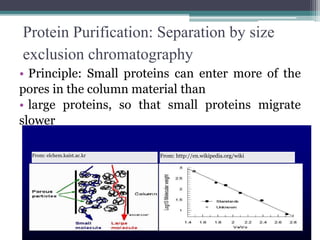
Protein Purification: Separation by size
exclusion chromatography
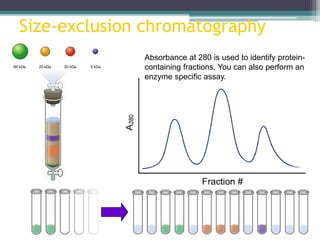
• Principle: Small proteins can enter more of the
pores in the column material than
• large proteins, so that small proteins migrate
slower
From: elchem.kaist.ac.kr From: http://en.wikipedia.org/wiki
Protein Purification: Separation by size
in native gels
• Principle: Small proteins are less retained by the
fibers of the gel than large proteins, so that small
proteins migrate faster
photo of a green gel (Küpper et al., 2003, Funct Plant Biol) From:www.columbia.edu/.../c2005/lectures/lec6_09.html
Size-exclusion chromatography
Absorbance at 280 is used to identify protein-
containing fractions. You can also perform an
enzyme specific assay.
Precipitation
• Proteins tend to precipitate at their isoelectric
point if the ionic strength of the solution is very
high
• First step in protein purification
• Ammonium sulfate and Trichloroacetate (TCA)
are the most common salt
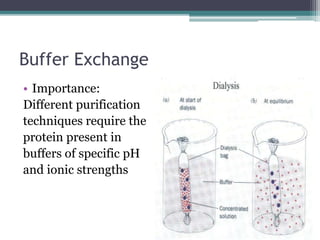
Buffer Exchange
• Importance:
Different purification
techniques require the
protein present in
buffers of specific pH
and ionic strengths
Ion
Exchange
Chromatog
raphy
Affinity
Chromatogra
phy
Hydrophobic Interaction
chromatography (HIC)
• It is based on hydrophobic attraction between the
stationary phase and the protein molecules
• The stationary phase consists of small non-polar
groups ( butyl, octyl or phenyl) attached to a
hydrophilic polymer backbone (cross-linked dextran
or agarose, for example)
• The sample is loaded in a buffer containing a high
concentration of a non-denaturing salt (frequently
ammonium sulfate)
• The proteins are then eluted as the concentration of
the salt in the buffer is decreased
Purification of Tagged Recombinant
Proteins
• Ni-NTA Agarose To purify recombinant
protein containing polyhistidine (6xHis)
sequence
• Streptavidin Agarose To purify biotinylated
recombinant protein
References
• photo of a green gel (Küpper et al., 2003, Funct
Plant Biol)
• From:www.columbia.edu/.../c2005/lectures/lec
6_09.html
• From: bio-ggs.blogspot.com/2009/11/ggs-live-
western...
• From: http://en.wikipedia.org/wiki
• From: elchem.kaist.ac.kr
• Willson and walker (2005) “instrumentation”
• Harper (2008) “fundamental of biochemistry”
Thanks!

Protein

  • 1.
    Expressed protein identification and purification Submmitedby Ajay Singh Ph.D biotechnology College of biotechnology, DUVASU, Mathura
  • 2.
    DNA Vector • Molecularcarriers which carry fragments of DNA into host cell. • Usually derived from plasmids, which are small, circular, double stranded DNA molecule.
  • 3.
    Some widely usedvectors 1. Plasmid 2. Cosmid 3. Yeast Artificial Chromosomes 4. Phage lambda vectors 5. Bacterial Artificial Chromosomes 6. Human Artificial Chromosomes 7. Transposons etc.
  • 4.
    Basic steps toget recombinant protein • Amplification of gene of interest. ( Using PCR) • Insert into cloning vector. (Ex: PCR*8) • Sub cloning into expression vector. (Ex: pKK223-3 or PSVK 3) • Transformation into protein expressing bacteria (E coli) or yeast • Test for identification of recombinant protein.( Western blot or Fluorescence) • Large scale production.(large scale fermenter) • Isolation and purification
  • 5.
    Isolation of protein: Initialsteps prior to purification: • Disruption of cells: Osmotic, chemical, Enzymatic, Mechanical • Clarification: Centrifugation Filtration • Concentration: Precipitation Ultra filtration Differential Centrifugation
  • 6.
    Differential Centrifugation • It’sa procedure in which a homogenate is subjected to repeated Centrifugations each time increasing the Centrifugal force • Separation is based predominantly on particle mass and size with larger and heavier particles pelleting at lower Centrifugal fields • For specific organelle sub cellular fractions
  • 7.
    Protein Isolation: Methodsfor isolation Lysis buffer • Used only for bacteria or animal cells • May cause degradation • Non machinery
  • 8.
  • 9.
    Purification of isolatedprotein 1. Charge: IEC/IEF 2. Size: size exclusion chromatography 3. Hydrophobicity: Hydrophobic Interaction Chromatography 4. Ligand specifity: affinity chromatography, nucleotide and coenzymes resins, phosphoprotein resins. 5. Avidin biotin matrices 6. Carbohydrate binding 7. Dye resins. 8. Solubility: Precipitation
  • 10.
    Separation by expressionsite • Selective use of tissues or organelles • Separation of soluble from membrane proteins by centrifugation Separation by size • Ultrafiltration • Size exclusion chromatography • Preparative native gel electrophoresis
  • 11.
    Separation by charge •exchange chromatography • Isoelectric focusing (as chromatography, in solution or in gel electrophoresis) Separation by specific binding sites • Metal affinity chromatography using natural or artificial metal binding sites • Immuno-Chromatography Immunochromatography using immobilized antibodies • Magnetic separation using magnetically tagged antibodies
  • 12.
    Protein Purification: Separationby size exclusion chromatography • Principle: Small proteins can enter more of the pores in the column material than • large proteins, so that small proteins migrate slower From: elchem.kaist.ac.kr From: http://en.wikipedia.org/wiki
  • 13.
    Protein Purification: Separationby size in native gels • Principle: Small proteins are less retained by the fibers of the gel than large proteins, so that small proteins migrate faster photo of a green gel (Küpper et al., 2003, Funct Plant Biol) From:www.columbia.edu/.../c2005/lectures/lec6_09.html
  • 14.
    Size-exclusion chromatography Absorbance at280 is used to identify protein- containing fractions. You can also perform an enzyme specific assay.
  • 15.
    Precipitation • Proteins tendto precipitate at their isoelectric point if the ionic strength of the solution is very high • First step in protein purification • Ammonium sulfate and Trichloroacetate (TCA) are the most common salt
  • 16.
    Buffer Exchange • Importance: Differentpurification techniques require the protein present in buffers of specific pH and ionic strengths
  • 17.
  • 18.
  • 19.
    Hydrophobic Interaction chromatography (HIC) •It is based on hydrophobic attraction between the stationary phase and the protein molecules • The stationary phase consists of small non-polar groups ( butyl, octyl or phenyl) attached to a hydrophilic polymer backbone (cross-linked dextran or agarose, for example) • The sample is loaded in a buffer containing a high concentration of a non-denaturing salt (frequently ammonium sulfate) • The proteins are then eluted as the concentration of the salt in the buffer is decreased
  • 20.
    Purification of TaggedRecombinant Proteins • Ni-NTA Agarose To purify recombinant protein containing polyhistidine (6xHis) sequence • Streptavidin Agarose To purify biotinylated recombinant protein
  • 21.
    References • photo ofa green gel (Küpper et al., 2003, Funct Plant Biol) • From:www.columbia.edu/.../c2005/lectures/lec 6_09.html • From: bio-ggs.blogspot.com/2009/11/ggs-live- western... • From: http://en.wikipedia.org/wiki • From: elchem.kaist.ac.kr • Willson and walker (2005) “instrumentation” • Harper (2008) “fundamental of biochemistry”
  • 22.