Presentation
on
Presented by:
Anshul Vishwakarma
M.PharmI Sem
Y21254007
SYNTHETIC PEPTIDE VACCINES , RECOMBINANT ANTIGEN
VACCINE, VECTOR VACCINES
[A central university]
contents
INTRODUCTION TO VACCINE
SYNTHETIC PEPTIDE VACCINES
RECOMBINANT ANTIGEN VACCINE
VECTOR VACCINES
TWO VECTOR VACCINE AGAINST CORONA VIRUS
REFERENCES
INTRODUCTION TO VACCINE
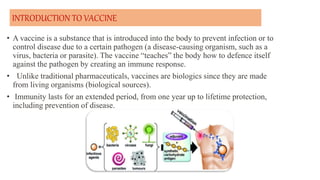
• A vaccine is a substance that is introduced into the body to prevent infection or to
control disease due to a certain pathogen (a disease-causing organism, such as a
virus, bacteria or parasite). The vaccine “teaches” the body how to defence itself
against the pathogen by creating an immune response.
• Unlike traditional pharmaceuticals, vaccines are biologics since they are made
from living organisms (biological sources).
• Immunity lasts for an extended period, from one year up to lifetime protection,
including prevention of disease.
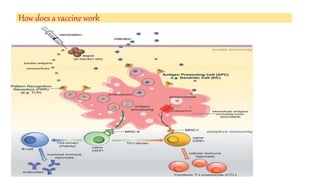
How does a vaccine work
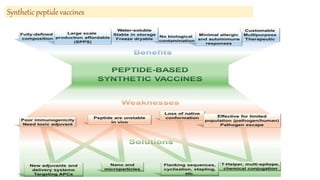
Synthetic peptide vaccines
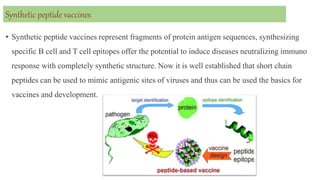
• Synthetic peptide vaccines represent fragments of protein antigen sequences, synthesizing
specific B cell and T cell epitopes offer the potential to induce diseases neutralizing immuno
response with completely synthetic structure. Now it is well established that short chain
peptides can be used to mimic antigenic sites of viruses and thus can be used the basics for
vaccines and development.
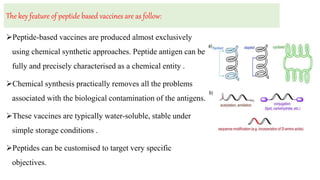
The key feature of peptide based vaccines are as follow:
Peptide-based vaccines are produced almost exclusively
using chemical synthetic approaches. Peptide antigen can be
fully and precisely characterised as a chemical entity .
Chemical synthesis practically removes all the problems
associated with the biological contamination of the antigens.
These vaccines are typically water-soluble, stable under
simple storage conditions .
Peptides can be customised to target very specific
objectives.
Synthetic peptide vaccines
RECOMBINANT ANTIGEN VACCINE
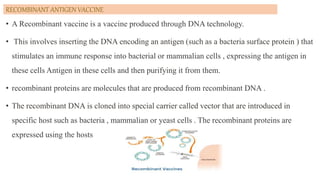
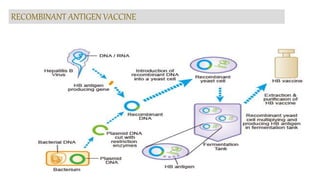
• A Recombinant vaccine is a vaccine produced through DNA technology.
• This involves inserting the DNA encoding an antigen (such as a bacteria surface protein ) that
stimulates an immune response into bacterial or mammalian cells , expressing the antigen in
these cells Antigen in these cells and then purifying it from them.
• recombinant proteins are molecules that are produced from recombinant DNA .
• The recombinant DNA is cloned into special carrier called vector that are introduced in
specific host such as bacteria , mammalian or yeast cells . The recombinant proteins are
expressed using the hosts
RECOMBINANT ANTIGEN VACCINE
TYPES OF RECOMBINANT VACCINE
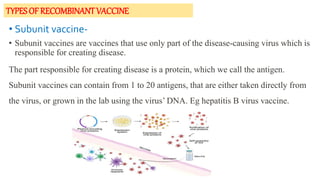
• Subunit vaccine-
• Subunit vaccines are vaccines that use only part of the disease-causing virus which is
responsible for creating disease.
The part responsible for creating disease is a protein, which we call the antigen.
Subunit vaccines can contain from 1 to 20 antigens, that are either taken directly from
the virus, or grown in the lab using the virus’ DNA. Eg hepatitis B virus vaccine.
Attenuated recombinant vaccines
• It is now possible to genetically engineer the organisms (bacteria or viruses) and use them
as live vaccines, and such vaccines are referred to as attenuated recombinant vaccines. The
genetic manipulations for the production of these vaccines are broadly of two types:
 1. Deletion or modification of virulence genes of pathogenic organisms.
 2. Genetic manipulation of non-pathogenic organisms to carry and express antigen
determinants from pathogenic organisms.
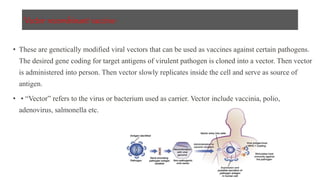
Vector recombinant vaccine-
• These are genetically modified viral vectors that can be used as vaccines against certain pathogens.
The desired gene coding for target antigens of virulent pathogen is cloned into a vector. Then vector
is administered into person. Then vector slowly replicates inside the cell and serve as source of
antigen.
• • “Vector” refers to the virus or bacterium used as carrier. Vector include vaccinia, polio,
adenovirus, salmonella etc.
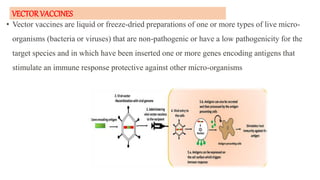
VECTOR VACCINES
• Vector vaccines are liquid or freeze-dried preparations of one or more types of live micro-
organisms (bacteria or viruses) that are non-pathogenic or have a low pathogenicity for the
target species and in which have been inserted one or more genes encoding antigens that
stimulate an immune response protective against other micro-organisms
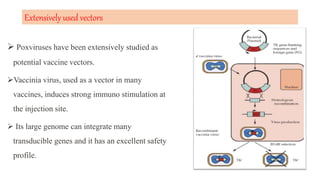
Extensively used vectors
 Poxviruses have been extensively studied as
potential vaccine vectors.
Vaccinia virus, used as a vector in many
vaccines, induces strong immuno stimulation at
the injection site.
 Its large genome can integrate many
transducible genes and it has an excellent safety
profile.
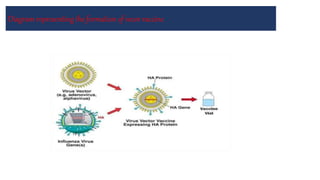
Diagram representing the formation of vecor vaccine
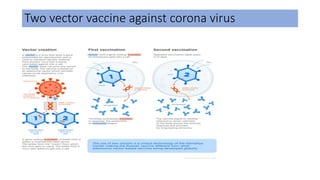
Two vector vaccine against corona virus
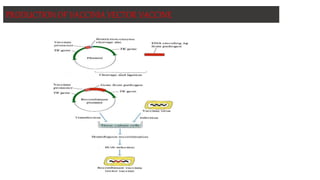
PRODUCTION OF VACCINIA VECTOR VACCINE
REFERENCES
• Vyas .s.p , Dixit v.k “Pharmaceutical biotecnology , 1st edition,1998 CBS publisherand distributors ,new
delhi india 330-338
• Shahzad D., Mudassar T., “Review on Recombinant Vaccines” nternational Journal of Scientific &
Engineering Research Volume 10, Issue 8, August-2019 ISSN 2229-551, 1473-1487
• Recombinant Vaccines: Strategies for Candidate Discovery and Vaccine Delivery BioPark Hertfordshire,
Welwyn Garden City, UK, 12 March 2010
• Mariusz Skwarczynski, A and Istvan Totha Peptide-based synthetic vaccines Chem. Sci., 2015
• G. Parmiani, V. Russo, C. Maccalli, D. Parolini, N. Rizzo and M. Maio, Human Vaccines &
Immunotherapeutics, 2014, 10, 3175-3178.
• Takehiro Ura, Kenji Okuda, and Masaru Shimada* Developments in Viral Vector-Based Vaccines 2014
Sep; 2(3): 624–641.Published online 2014 Jul 29.
Synthetic peptide vaccines.pptx

Synthetic peptide vaccines.pptx

  • 1.
    Presentation on Presented by: Anshul Vishwakarma M.PharmISem Y21254007 SYNTHETIC PEPTIDE VACCINES , RECOMBINANT ANTIGEN VACCINE, VECTOR VACCINES [A central university]
  • 2.
    contents INTRODUCTION TO VACCINE SYNTHETICPEPTIDE VACCINES RECOMBINANT ANTIGEN VACCINE VECTOR VACCINES TWO VECTOR VACCINE AGAINST CORONA VIRUS REFERENCES
  • 3.
    INTRODUCTION TO VACCINE •A vaccine is a substance that is introduced into the body to prevent infection or to control disease due to a certain pathogen (a disease-causing organism, such as a virus, bacteria or parasite). The vaccine “teaches” the body how to defence itself against the pathogen by creating an immune response. • Unlike traditional pharmaceuticals, vaccines are biologics since they are made from living organisms (biological sources). • Immunity lasts for an extended period, from one year up to lifetime protection, including prevention of disease.
  • 4.
    How does avaccine work
  • 5.
    Synthetic peptide vaccines •Synthetic peptide vaccines represent fragments of protein antigen sequences, synthesizing specific B cell and T cell epitopes offer the potential to induce diseases neutralizing immuno response with completely synthetic structure. Now it is well established that short chain peptides can be used to mimic antigenic sites of viruses and thus can be used the basics for vaccines and development.
  • 6.
    The key featureof peptide based vaccines are as follow: Peptide-based vaccines are produced almost exclusively using chemical synthetic approaches. Peptide antigen can be fully and precisely characterised as a chemical entity . Chemical synthesis practically removes all the problems associated with the biological contamination of the antigens. These vaccines are typically water-soluble, stable under simple storage conditions . Peptides can be customised to target very specific objectives.
  • 7.
  • 8.
    RECOMBINANT ANTIGEN VACCINE •A Recombinant vaccine is a vaccine produced through DNA technology. • This involves inserting the DNA encoding an antigen (such as a bacteria surface protein ) that stimulates an immune response into bacterial or mammalian cells , expressing the antigen in these cells Antigen in these cells and then purifying it from them. • recombinant proteins are molecules that are produced from recombinant DNA . • The recombinant DNA is cloned into special carrier called vector that are introduced in specific host such as bacteria , mammalian or yeast cells . The recombinant proteins are expressed using the hosts
  • 9.
  • 10.
    TYPES OF RECOMBINANTVACCINE • Subunit vaccine- • Subunit vaccines are vaccines that use only part of the disease-causing virus which is responsible for creating disease. The part responsible for creating disease is a protein, which we call the antigen. Subunit vaccines can contain from 1 to 20 antigens, that are either taken directly from the virus, or grown in the lab using the virus’ DNA. Eg hepatitis B virus vaccine.
  • 11.
    Attenuated recombinant vaccines •It is now possible to genetically engineer the organisms (bacteria or viruses) and use them as live vaccines, and such vaccines are referred to as attenuated recombinant vaccines. The genetic manipulations for the production of these vaccines are broadly of two types:  1. Deletion or modification of virulence genes of pathogenic organisms.  2. Genetic manipulation of non-pathogenic organisms to carry and express antigen determinants from pathogenic organisms.
  • 12.
    Vector recombinant vaccine- •These are genetically modified viral vectors that can be used as vaccines against certain pathogens. The desired gene coding for target antigens of virulent pathogen is cloned into a vector. Then vector is administered into person. Then vector slowly replicates inside the cell and serve as source of antigen. • • “Vector” refers to the virus or bacterium used as carrier. Vector include vaccinia, polio, adenovirus, salmonella etc.
  • 13.
    VECTOR VACCINES • Vectorvaccines are liquid or freeze-dried preparations of one or more types of live micro- organisms (bacteria or viruses) that are non-pathogenic or have a low pathogenicity for the target species and in which have been inserted one or more genes encoding antigens that stimulate an immune response protective against other micro-organisms
  • 14.
    Extensively used vectors Poxviruses have been extensively studied as potential vaccine vectors. Vaccinia virus, used as a vector in many vaccines, induces strong immuno stimulation at the injection site.  Its large genome can integrate many transducible genes and it has an excellent safety profile.
  • 15.
    Diagram representing theformation of vecor vaccine
  • 16.
    Two vector vaccineagainst corona virus
  • 17.
    PRODUCTION OF VACCINIAVECTOR VACCINE
  • 18.
    REFERENCES • Vyas .s.p, Dixit v.k “Pharmaceutical biotecnology , 1st edition,1998 CBS publisherand distributors ,new delhi india 330-338 • Shahzad D., Mudassar T., “Review on Recombinant Vaccines” nternational Journal of Scientific & Engineering Research Volume 10, Issue 8, August-2019 ISSN 2229-551, 1473-1487 • Recombinant Vaccines: Strategies for Candidate Discovery and Vaccine Delivery BioPark Hertfordshire, Welwyn Garden City, UK, 12 March 2010 • Mariusz Skwarczynski, A and Istvan Totha Peptide-based synthetic vaccines Chem. Sci., 2015 • G. Parmiani, V. Russo, C. Maccalli, D. Parolini, N. Rizzo and M. Maio, Human Vaccines & Immunotherapeutics, 2014, 10, 3175-3178. • Takehiro Ura, Kenji Okuda, and Masaru Shimada* Developments in Viral Vector-Based Vaccines 2014 Sep; 2(3): 624–641.Published online 2014 Jul 29.