Presented By:
Manali Baghel
Ph.D. Scholar
College of Biotechnology
DUVASU
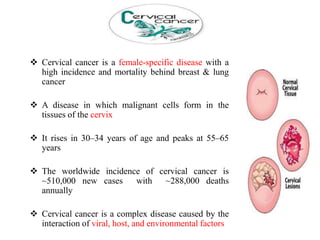
 Cervical cancer is a female-specific disease with a
high incidence and mortality behind breast & lung
cancer
 A disease in which malignant cells form in the
tissues of the cervix
 It rises in 30–34 years of age and peaks at 55–65
years
 The worldwide incidence of cervical cancer is
~510,000 new cases with ~288,000 deaths
annually
 Cervical cancer is a complex disease caused by the
interaction of viral, host, and environmental factors
 Prevention, diagnosis, and treatment of female-specific diseases are
increasingly important issues due to lifestyle changes of women
 Human pappilomavirus (HPV) has been detected in more than 90% of
cervical cancers and therefore implicated as the main cause of cervical
cancer
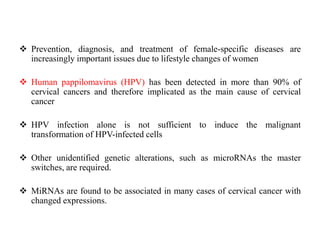
 HPV infection alone is not sufficient to induce the malignant
transformation of HPV-infected cells
 Other unidentified genetic alterations, such as microRNAs the master
switches, are required.
 MiRNAs are found to be associated in many cases of cervical cancer with
changed expressions.
Signs and Symptoms
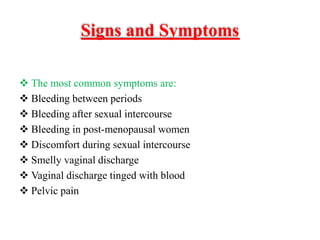
 The most common symptoms are:
 Bleeding between periods
 Bleeding after sexual intercourse
 Bleeding in post-menopausal women
 Discomfort during sexual intercourse
 Smelly vaginal discharge
 Vaginal discharge tinged with blood
 Pelvic pain
Causes
Risk factors which are known to increase the risk of
developing cervical cancer-
 Human pappilomavirus (HPV)
 Many sexual partners, becoming sexually active early
 Smoking
 Weakened immune system
 Giving birth at a very young age
 Several pregnancies
 Contraceptive pill
 Other sexually transmitted diseases (STD)
Chlamydia, gonorrhea
 Genetic Alterations
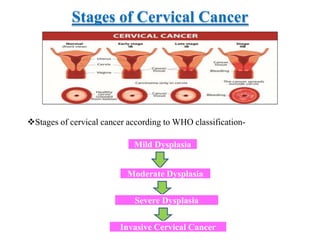
Stages of Cervical Cancer
Mild Dysplasia
Moderate Dysplasia
Severe Dysplasia
Invasive Cervical Cancer
Stages of cervical cancer according to WHO classification-
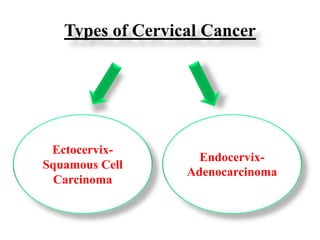
Types of Cervical Cancer
Ectocervix-
Squamous Cell
Carcinoma
Endocervix-
Adenocarcinoma
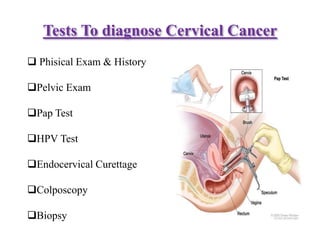
Tests To diagnose Cervical Cancer
 Phisical Exam & History
Pelvic Exam
Pap Test
HPV Test
Endocervical Curettage
Colposcopy
Biopsy
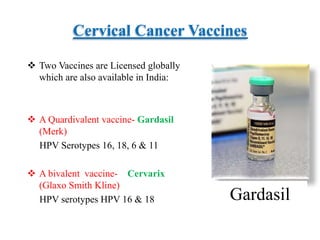
Cervical Cancer Vaccines
 Two Vaccines are Licensed globally
which are also available in India:
 A Quardivalent vaccine- Gardasil
(Merk)
HPV Serotypes 16, 18, 6 & 11
 A bivalent vaccine- Cervarix
(Glaxo Smith Kline)
HPV serotypes HPV 16 & 18 Gardasil
Human Pappilomavirus (HPV)
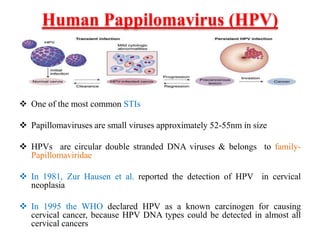
 One of the most common STIs
 Papillomaviruses are small viruses approximately 52-55nm in size
 HPVs are circular double stranded DNA viruses & belongs to family-
Papillomaviridae
 In 1981, Zur Hausen et al. reported the detection of HPV in cervical
neoplasia
 In 1995 the WHO declared HPV as a known carcinogen for causing
cervical cancer, because HPV DNA types could be detected in almost all
cervical cancers
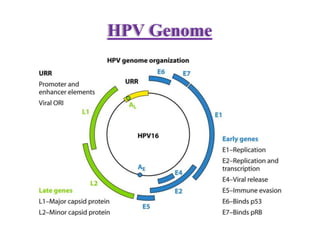
HPV Genome
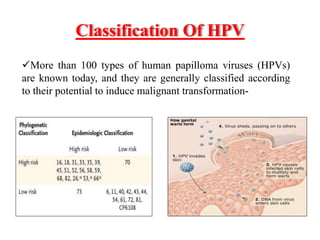
Classification Of HPV
More than 100 types of human papilloma viruses (HPVs)
are known today, and they are generally classified according
to their potential to induce malignant transformation-
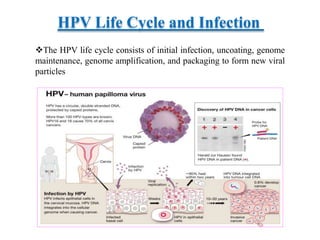
HPV Life Cycle and Infection
The HPV life cycle consists of initial infection, uncoating, genome
maintenance, genome amplification, and packaging to form new viral
particles
HPV Induced Dysregulation
 Once viral DNA is incorporated into host DNA, oncogenic transformation
is induced
 Oncoproteins E6 & E7 inactivate tumor suppressor genes p53 & pRB.
 E6 protein binds to E6-associated protein (E6-AP), a ubiquitin protein
ligase , & forms E6/E6-AP complex & targets p53
 E6 degrades p53, inhibits p53 binding to DNA & binds to p53 enhancers &
suppressed p53 function
 E6/E6-AP complex also activates telomerase & contributes to cell
immortalization
 E7 protein contributes to carcinogenesis by degrading Rb family proteins
necessary for cell cycle progression
HPV Determition
 PCR-based methods are commonly used for HPV Detection
after DNA isolation
 Most PCR assays utilize consensus primers, directed to a
conserved L1 gene, and hence are able to amplify most of the
mucosal HPV types
 The other PCR type used to detect specific HPV is HPV type
specific PCR such as HPV 16 or 18
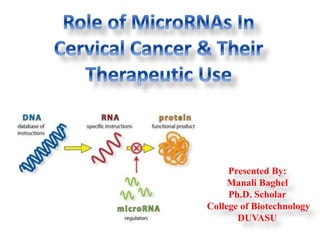
MicroRNA
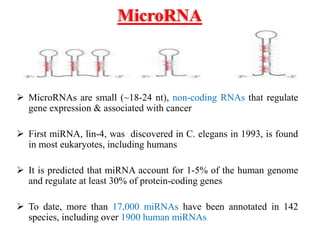
 MicroRNAs are small (~18-24 nt), non-coding RNAs that regulate
gene expression & associated with cancer
 First miRNA, lin-4, was discovered in C. elegans in 1993, is found
in most eukaryotes, including humans
 It is predicted that miRNA account for 1-5% of the human genome
and regulate at least 30% of protein-coding genes
 To date, more than 17,000 miRNAs have been annotated in 142
species, including over 1900 human miRNAs
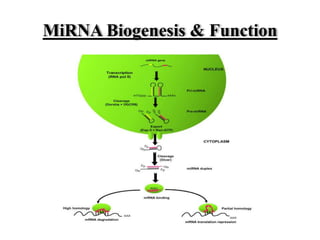
MiRNA Biogenesis & Function
Classification of MiRNAs
 MicroRNAs are classified in two group depending on their
origin-
 Intergenic or Exonic miRNAs: located between the introns of
genes & transcribed by RNA pol II or pol III as a stem loop structure called
pri-miRNA
 Interagenic or Intronic miRNAs: miRNAs located within an
intron of a protein coding gene & transcribed by RNA pol II as part of pre-
mRNA
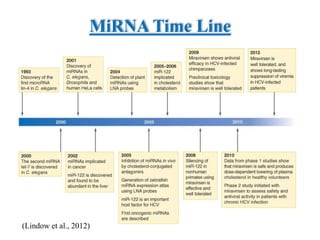
MiRNA Time Line
(Lindow et al., 2012)
MiRNA Expression Profiling
 Initially it was conducted on samples extracted from tissues, now stable
miRNAs are found in readily available body fluids including, serum ,
plasma, urine and saliva
 MiRNA expressions are generally analyzed by microarray & qRT-PCR
using microRNA specific primers
 U6 RNA, RNU44, and RNU48 is usually used as reference control & A.
thaliana miRNA as negative control
 Quantification is done using the 2 delta Ct method, where fold change in
expression of a gene in an experimental sample is quantified relative to the
same gene in a reference sample
MiRNAs In Cervical Cancer
 MiRNAs play a vital role in cancer regulating pathways, like controlling
cell proliferation, differentiation and survival
 MiRNAs involved in carcinogenesis are classified into oncogenic miRNAs
(oncomiRs) and tumor suppressor miRNAs(TSG)
 Involved in cancer pathogenesis by posttranscriptional regulation of gene
expression
 50% of miRNA genes are localized in cancer-associated genomic regions
or in fragile sites or integration sites of high-risk HPVs
 Expression patterns of miRNAs suggested that beyond HPV, microRNAs
play a major role in cervical cancer
Altered Expressions of MiRNAs in
Cervical Cancer
 MicroRNAs expressions were analyzed for normal cervix and cervical
cancer tissues, by microarray in combination with RT-PCR verification &
found to be deregulated
 On comparision, many miRNAs with cancer-specific upregulation or
downregulation have been found-
 MiR-21 is overexpressed in cervical cancer and is a negative regulator of
expression of the tumor suppressor gene programmed cell death 4
(PDCD4)
 MiR Let-7a was found to be downregulated by HPV & this
downregulation of miR let-7a leads to the aberrant expression of STAT3
(validate target of let-7a) developing CC
 MiR- 218 is found to be underexpressed in CC tissues compared to the
normal cervix & leads to the decreased expression of LAMB3, which is
involved in cell migration and tumorigenicity
 MiR-34a was identified as a direct transcriptional target of cellular
transcription factor p53, since HPV E6 oncoprotein destabilizes p53 during
virus infection, it causes down-regulation of miR-34a expression in most
CC tissues
Cont..
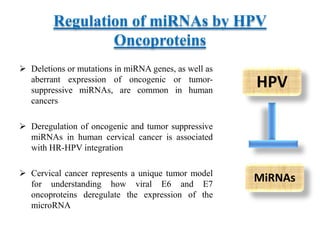
Regulation of miRNAs by HPV
Oncoproteins
 Deletions or mutations in miRNA genes, as well as
aberrant expression of oncogenic or tumor-
suppressive miRNAs, are common in human
cancers
 Deregulation of oncogenic and tumor suppressive
miRNAs in human cervical cancer is associated
with HR-HPV integration
 Cervical cancer represents a unique tumor model
for understanding how viral E6 and E7
oncoproteins deregulate the expression of the
microRNA
MiRNAs
HPV
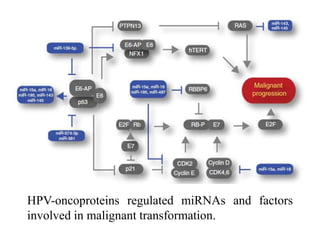
HPV-oncoproteins regulated miRNAs and factors
involved in malignant transformation.
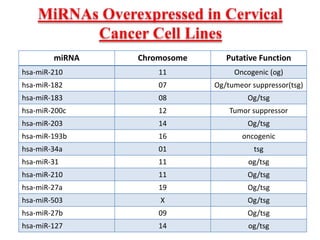
miRNA Chromosome Putative Function
hsa-miR-210 11 Oncogenic (og)
hsa-miR-182 07 Og/tumeor suppressor(tsg)
hsa-miR-183 08 Og/tsg
hsa-miR-200c 12 Tumor suppressor
hsa-miR-203 14 Og/tsg
hsa-miR-193b 16 oncogenic
hsa-miR-34a 01 tsg
hsa-miR-31 11 og/tsg
hsa-miR-210 11 Og/tsg
hsa-miR-27a 19 Og/tsg
hsa-miR-503 X Og/tsg
hsa-miR-27b 09 Og/tsg
hsa-miR-127 14 og/tsg
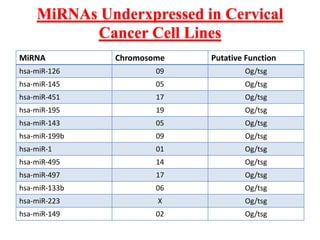
MiRNAs Underxpressed in Cervical
Cancer Cell Lines
MiRNA Chromosome Putative Function
hsa-miR-126 09 Og/tsg
hsa-miR-145 05 Og/tsg
hsa-miR-451 17 Og/tsg
hsa-miR-195 19 Og/tsg
hsa-miR-143 05 Og/tsg
hsa-miR-199b 09 Og/tsg
hsa-miR-1 01 Og/tsg
hsa-miR-495 14 Og/tsg
hsa-miR-497 17 Og/tsg
hsa-miR-133b 06 Og/tsg
hsa-miR-223 X Og/tsg
hsa-miR-149 02 Og/tsg
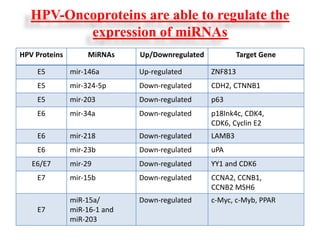
HPV-Oncoproteins are able to regulate the
expression of miRNAs
HPV Proteins MiRNAs Up/Downregulated Target Gene
E5 mir-146a Up-regulated ZNF813
E5 mir-324-5p Down-regulated CDH2, CTNNB1
E5 mir-203 Down-regulated p63
E6 mir-34a Down-regulated p18Ink4c, CDK4,
CDK6, Cyclin E2
E6 mir-218 Down-regulated LAMB3
E6 mir-23b Down-regulated uPA
E6/E7 mir-29 Down-regulated YY1 and CDK6
E7 mir-15b Down-regulated CCNA2, CCNB1,
CCNB2 MSH6
E7
miR-15a/
miR-16-1 and
miR-203
Down-regulated c-Myc, c-Myb, PPAR
Diagnosis & Treatment
of Cervical Cancer
Using miRNAs
Many studies have examined the use of
miRNAs as cancer diagnostic marker and as
anticancer therapy.
Diagnosis of Cervical Cancer Using
miRNAs in Serum
 MiRNAs with expression changes in cancer have the potential to be
diagnostic biomarkers based on plasma & serum tests
 miR-21 and miR-126 are found to be overexpressed in serum and are
associated with cervical cancer.
 Overexpression of other miRs including miR-27a, miR-34, miR-34a, miR-
146a, miR-155, miR-196a, miR-203, and miR-221 was detected in the
serum of CC samples
 These results indicate that miRNA levels in serum can be used for
diagnosis of cervical cancer
Diagnosis of Lymph Node Metastasis
Using miRNAs in Serum
 Several miRNAs in serum have been identified as candidate markers for
lymph node metastasis in CC
 Zhao et al. analyzed expression of miR-20a and miR-203 in serum
collected before surgery and treatment in 80 patients:
 The miR-20a level in serum of patients with CC was markedly higher than
that in healthy volunteers and was overexpressed in patients with lymph
node metastasis
 The expression level of miR-203 in patients with CC was higher in
comparison with healthy volunteers, however, lymph node metastasis was
found only when miR-203 expression was suppressed
MiRNA Therapeutic Approaches
MiRNA
Inhibition therapy
when the target miRNA
is overexpressed
MiRNA
Supplementation
therapy when the
miRNA is repressed
Treatment with miRNA
Supplementation
 Anticancer treatment may be achieved by regulating the expression
level of miRNAs
 The function of tumor suppressor miRs with reduced levels may be
recovered by supplementation of the miRNA itself
 Atelocollagen, is being examined as a potential delivery system for
nucleic-acid-based drugs
 This protein is extracted from calf dermis and then digested with
protease to reduce antigenicity & can be transferred in to tissues or
cells
 Supplementary agents can be classified as:
o Hairpin single-stranded pre-miRNA
o Double-stranded RNA
 Liu et al. introduced miR-143 into HeLa CC cells and showed that cell
growth was inhibited and apoptosis was enhanced with increased miR-143
expression & maintained Bcl2 (oncogene) expression
o Therefore, miR-143 has an association with Bcl2 and treatment targeting
this pathway may be possible
 Similarly, supplementing anti-let7a miR in HPV16 positive CC cases can
increase the expression of down-regulated let-7a miR & maintain the
expression of STAT3
Cont..
Treatment by Inhibition of
miRNA Function
 One strategy for overexpressed miRNA in cancer is to inhibit the miRNA
function using agents with complementary binding to the miRNA
 Antisense miRNA oligonucleotides (AMOs) or ‘antagomirs’ are the most
common miRNA inhibitors based on Antisense technology
• For miR-21, an oncomiR in cervical cancer, anti-miR-21 was developed as
a modified 2’-O-methoxyethyl (2’-O-MOE) phosphorothioate antisense
agent
• Wang et al. found, miR-21 expression was downregulated and tumor
growth was markedly suppressed by the AMO in comparison with a control
group
• MiR-21 inhibition may be achieved with other approaches,
including miRNA sponges, miRNA erasers, and tough decoys
• Tough decoys may have particularly potent inhibitory activity
• Haraguchi et al. inhibited miR-21 using a tough decoy and
recovered expression of PDCD4, a target gene of miR-21
Cont..
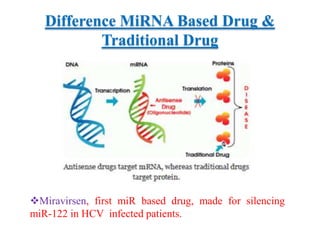
Difference MiRNA Based Drug &
Traditional Drug
Miravirsen, first miR based drug, made for silencing
miR-122 in HCV infected patients.
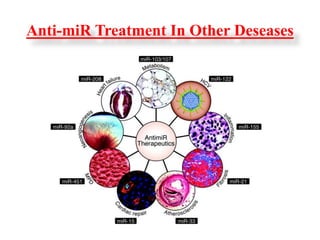
Anti-miR Treatment In Other Deseases
miRNAs Associated with Therapeutic
Resistance for Cervical Cancer
 Expression of various miRNAs is up- or downregulated in cervical cancer
and these expression levels can increase or decrease sensitivity to
chemotherapy and radiotherapy
 Phuah et al. showed that the expression patterns of 25 miRNAs, including
miR-138, miR-210, and miR-744, altered the sensitivity to 1’S-1’-
acetoxychavicol (ACA) and cisplatin
 Lei et al. found that miR-155 negatively regulates the EGF-induced
epithelial-mesenchymal transition(EMT), inhibits proliferation, metastasis,
invasion, and increases sensitivity to cisplatin
 Thus, miRNAs may have an important role in the response to
chemotherapy
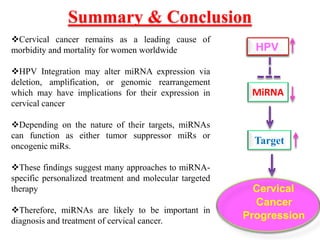
Summary & Conclusion
HPV
Cervical
Cancer
Progression
Cervical cancer remains as a leading cause of
morbidity and mortality for women worldwide
HPV Integration may alter miRNA expression via
deletion, amplification, or genomic rearrangement
which may have implications for their expression in
cervical cancer
Depending on the nature of their targets, miRNAs
can function as either tumor suppressor miRs or
oncogenic miRs.
These findings suggest many approaches to miRNA-
specific personalized treatment and molecular targeted
therapy
Therefore, miRNAs are likely to be important in
diagnosis and treatment of cervical cancer.
Target
MiRNA
References
• Walboomers JM, Jacobs MV, Manos MM, Bosch FX, Kummer JA, et al.
(1999) Human papillomavirus is a necessary cause of invasive cervical
cancer worldwide. J Pathol 189: 12-19.
• de Villiers EM, Fauquet C, Broker TR, Bernard HU, zur Hausen H (2004)
Classification of papillomaviruses. Virology 324: 17-27.
• Ho GY, Bierman R, Beardsley L, Chang CJ, Burk RD (1998) Natural history of
cervicovaginal papillomavirus infection in young women. N Engl J Med
338: 423-428.
• zur Hausen H (2002) Papillomaviruses and cancer: from basic studies to
clinical application. Nat Rev Cancer 2: 342-350.
• Klingelhutz AJ, Foster SA, McDougall JK (1996) Telomerase activation by
the E6 gene product of human papillomavirus type 16. Nature 380: 79-82.
• Scheffner M, Werness BA, Huibregtse JM, Levine AJ, Howley PM (1990)
The E6 oncoprotein encoded by human papillomavirus types 16 and 18
promotes the degradation of p53. Cell 63: 1129-1136.
• Werness BA, Levine AJ, Howley PM (1990) Association of human
papillomavirus types 16 and 18 E6 proteins with p53. Science 248: 76-79.
• Huibregtse JM, Scheffner M, Howley PM (1991) A cellular protein
mediates association of p53 with the E6 oncoprotein of human
papillomavirus types 16 or 18. EMBO J 10: 4129-4135.
• Dyson N, Howley PM, Munger K, Harlow E (1989) The human papilloma
virus-16 E7 oncoprotein is able to bind to the retinoblastoma gene
product. Science 243: 934-937.
• Munger K, Werness BA, Dyson N, Phelps WC, Harlow E, et al. (1989)
Complex formation of human papillomavirus E7 proteins with the
retinoblastoma tumor suppressor gene product. EMBO J 8: 4099-4105.
• Farh KK, Grimson A, Jan C, Lewis BP, Johnston WK, et al. (2005) The
widespread impact of mammalian MicroRNAs on mRNA repression and
evolution. Science 310: 1817-1821.
• Volinia S, Calin GA, Liu CG, Ambs S, Cimmino A, et al. (2006) A
microRNA expression signature of human solid tumors defines cancer gene
targets. Proc Natl Acad Sci U S A 103: 2257-2261.
• He, L., He X., Lim, L.P. et al., (2007). A microRNA component of the p53
tumour suppressor network. Nature. 447, 1130–1134.
• H. L. Howie, R. A. Katzenellenbogen, and D. A. Galloway, “Papillomavirus
E6 proteins,” Virology, vol. 384, no. 2, pp. 324–334, 2009.
• T. Kiyono, A. Hiraiwa,M. Fujita, Y. Hayashi, T. Akiyama, and M. Ishibashi,
“Binding of high-risk human papillomavirus E6 oncoproteins to the human
homologue of the Drosophila discs large tumor suppressor protein,”
Proceedings of the National Academy of Sciences of the United States of
America, vol. 94, no.21, pp. 11612–11616, 1997.
• Kozomara A, Griffiths-Jones S. MiRBase: integrating microRNA annotation
and deep-sequencing data. Nucleic Acids Res 2011;39:D152–7.
• Q. Yao, H. Xu, Q.-Q. Zhang, H. Zhou, and L.-H. Qu, “MicroRNA-21 promotes
cell proliferation and down-regulates the expression of programmed cell
death 4 (PDCD4) in HeLa cervical carcinoma cells,” Biochemical and
Biophysical Research Communications, vol. 388, no. 3, pp. 539–542, 2009.
• S. Gilad, E. Meiri, Y. Yogev et al., “Serum microRNAs are promising novel
biomarkers,” PLoS One, vol. 3, no. 9,Article ID e3148, 2008.
• P. S. Mitchell, R. K. Parkin, E. M. Kroh et al., “Circulating microRNAs as stable
blood-based markers for cancer detection,” Proceedings of the National
Academy of Sciences of the United States of America, vol. 105, no. 30, pp.
10513–10518, 2008.
• C. H. Lawrie, S. Gal, H. M. Dunlop et al., “Detection of elevated levels of
tumour-associated microRNAs in serum of patients with diffuse large B-cell
lymphoma,” British Journal of Haematology, vol. 141, no. 5, pp. 672–675,
2008.
• S. M. Wilting, R. A. van Boerdonk, F. E. Henken et al., “Methylation-mediated
silencing and tumour suppressive function of hsa-miR-124 in cervical cancer,”
Molecular Cancer, vol. 9, article 167, 2010.
• X. M. Wang, J. Xu, Z. Q. Cheng et al., “Study on effects of microRNA-21
antisense oligonucleotide in vivo and in vitro on bionomics of human cervical
squamous carcinoma cell lines SiHa,” Chinese Journal of Pathology, vol. 41, no.
4, pp. 254–259, 2012.
• T. Haraguchi, Y. Ozaki, and H. Iba, “Vectors expressing efficient RNA decoys
achieve the long-term suppression of specific microRNAactivity inmammalian
cells,”Nucleic Acids Research, vol. 37, no. 6, article e43, 2009.
Doc seminar cervical cancer

Doc seminar cervical cancer

  • 1.
    Presented By: Manali Baghel Ph.D.Scholar College of Biotechnology DUVASU
  • 2.
     Cervical canceris a female-specific disease with a high incidence and mortality behind breast & lung cancer  A disease in which malignant cells form in the tissues of the cervix  It rises in 30–34 years of age and peaks at 55–65 years  The worldwide incidence of cervical cancer is ~510,000 new cases with ~288,000 deaths annually  Cervical cancer is a complex disease caused by the interaction of viral, host, and environmental factors
  • 3.
     Prevention, diagnosis,and treatment of female-specific diseases are increasingly important issues due to lifestyle changes of women  Human pappilomavirus (HPV) has been detected in more than 90% of cervical cancers and therefore implicated as the main cause of cervical cancer  HPV infection alone is not sufficient to induce the malignant transformation of HPV-infected cells  Other unidentified genetic alterations, such as microRNAs the master switches, are required.  MiRNAs are found to be associated in many cases of cervical cancer with changed expressions.
  • 4.
    Signs and Symptoms The most common symptoms are:  Bleeding between periods  Bleeding after sexual intercourse  Bleeding in post-menopausal women  Discomfort during sexual intercourse  Smelly vaginal discharge  Vaginal discharge tinged with blood  Pelvic pain
  • 5.
    Causes Risk factors whichare known to increase the risk of developing cervical cancer-  Human pappilomavirus (HPV)  Many sexual partners, becoming sexually active early  Smoking  Weakened immune system  Giving birth at a very young age  Several pregnancies  Contraceptive pill  Other sexually transmitted diseases (STD) Chlamydia, gonorrhea  Genetic Alterations
  • 6.
    Stages of CervicalCancer Mild Dysplasia Moderate Dysplasia Severe Dysplasia Invasive Cervical Cancer Stages of cervical cancer according to WHO classification-
  • 7.
    Types of CervicalCancer Ectocervix- Squamous Cell Carcinoma Endocervix- Adenocarcinoma
  • 8.
    Tests To diagnoseCervical Cancer  Phisical Exam & History Pelvic Exam Pap Test HPV Test Endocervical Curettage Colposcopy Biopsy
  • 9.
    Cervical Cancer Vaccines Two Vaccines are Licensed globally which are also available in India:  A Quardivalent vaccine- Gardasil (Merk) HPV Serotypes 16, 18, 6 & 11  A bivalent vaccine- Cervarix (Glaxo Smith Kline) HPV serotypes HPV 16 & 18 Gardasil
  • 10.
    Human Pappilomavirus (HPV) One of the most common STIs  Papillomaviruses are small viruses approximately 52-55nm in size  HPVs are circular double stranded DNA viruses & belongs to family- Papillomaviridae  In 1981, Zur Hausen et al. reported the detection of HPV in cervical neoplasia  In 1995 the WHO declared HPV as a known carcinogen for causing cervical cancer, because HPV DNA types could be detected in almost all cervical cancers
  • 11.
  • 12.
    Classification Of HPV Morethan 100 types of human papilloma viruses (HPVs) are known today, and they are generally classified according to their potential to induce malignant transformation-
  • 13.
    HPV Life Cycleand Infection The HPV life cycle consists of initial infection, uncoating, genome maintenance, genome amplification, and packaging to form new viral particles
  • 14.
    HPV Induced Dysregulation Once viral DNA is incorporated into host DNA, oncogenic transformation is induced  Oncoproteins E6 & E7 inactivate tumor suppressor genes p53 & pRB.  E6 protein binds to E6-associated protein (E6-AP), a ubiquitin protein ligase , & forms E6/E6-AP complex & targets p53  E6 degrades p53, inhibits p53 binding to DNA & binds to p53 enhancers & suppressed p53 function  E6/E6-AP complex also activates telomerase & contributes to cell immortalization  E7 protein contributes to carcinogenesis by degrading Rb family proteins necessary for cell cycle progression
  • 15.
    HPV Determition  PCR-basedmethods are commonly used for HPV Detection after DNA isolation  Most PCR assays utilize consensus primers, directed to a conserved L1 gene, and hence are able to amplify most of the mucosal HPV types  The other PCR type used to detect specific HPV is HPV type specific PCR such as HPV 16 or 18
  • 16.
    MicroRNA  MicroRNAs aresmall (~18-24 nt), non-coding RNAs that regulate gene expression & associated with cancer  First miRNA, lin-4, was discovered in C. elegans in 1993, is found in most eukaryotes, including humans  It is predicted that miRNA account for 1-5% of the human genome and regulate at least 30% of protein-coding genes  To date, more than 17,000 miRNAs have been annotated in 142 species, including over 1900 human miRNAs
  • 17.
  • 18.
    Classification of MiRNAs MicroRNAs are classified in two group depending on their origin-  Intergenic or Exonic miRNAs: located between the introns of genes & transcribed by RNA pol II or pol III as a stem loop structure called pri-miRNA  Interagenic or Intronic miRNAs: miRNAs located within an intron of a protein coding gene & transcribed by RNA pol II as part of pre- mRNA
  • 19.
  • 20.
    MiRNA Expression Profiling Initially it was conducted on samples extracted from tissues, now stable miRNAs are found in readily available body fluids including, serum , plasma, urine and saliva  MiRNA expressions are generally analyzed by microarray & qRT-PCR using microRNA specific primers  U6 RNA, RNU44, and RNU48 is usually used as reference control & A. thaliana miRNA as negative control  Quantification is done using the 2 delta Ct method, where fold change in expression of a gene in an experimental sample is quantified relative to the same gene in a reference sample
  • 21.
    MiRNAs In CervicalCancer  MiRNAs play a vital role in cancer regulating pathways, like controlling cell proliferation, differentiation and survival  MiRNAs involved in carcinogenesis are classified into oncogenic miRNAs (oncomiRs) and tumor suppressor miRNAs(TSG)  Involved in cancer pathogenesis by posttranscriptional regulation of gene expression  50% of miRNA genes are localized in cancer-associated genomic regions or in fragile sites or integration sites of high-risk HPVs  Expression patterns of miRNAs suggested that beyond HPV, microRNAs play a major role in cervical cancer
  • 22.
    Altered Expressions ofMiRNAs in Cervical Cancer  MicroRNAs expressions were analyzed for normal cervix and cervical cancer tissues, by microarray in combination with RT-PCR verification & found to be deregulated  On comparision, many miRNAs with cancer-specific upregulation or downregulation have been found-  MiR-21 is overexpressed in cervical cancer and is a negative regulator of expression of the tumor suppressor gene programmed cell death 4 (PDCD4)
  • 23.
     MiR Let-7awas found to be downregulated by HPV & this downregulation of miR let-7a leads to the aberrant expression of STAT3 (validate target of let-7a) developing CC  MiR- 218 is found to be underexpressed in CC tissues compared to the normal cervix & leads to the decreased expression of LAMB3, which is involved in cell migration and tumorigenicity  MiR-34a was identified as a direct transcriptional target of cellular transcription factor p53, since HPV E6 oncoprotein destabilizes p53 during virus infection, it causes down-regulation of miR-34a expression in most CC tissues Cont..
  • 24.
    Regulation of miRNAsby HPV Oncoproteins  Deletions or mutations in miRNA genes, as well as aberrant expression of oncogenic or tumor- suppressive miRNAs, are common in human cancers  Deregulation of oncogenic and tumor suppressive miRNAs in human cervical cancer is associated with HR-HPV integration  Cervical cancer represents a unique tumor model for understanding how viral E6 and E7 oncoproteins deregulate the expression of the microRNA MiRNAs HPV
  • 25.
    HPV-oncoproteins regulated miRNAsand factors involved in malignant transformation.
  • 26.
    miRNA Chromosome PutativeFunction hsa-miR-210 11 Oncogenic (og) hsa-miR-182 07 Og/tumeor suppressor(tsg) hsa-miR-183 08 Og/tsg hsa-miR-200c 12 Tumor suppressor hsa-miR-203 14 Og/tsg hsa-miR-193b 16 oncogenic hsa-miR-34a 01 tsg hsa-miR-31 11 og/tsg hsa-miR-210 11 Og/tsg hsa-miR-27a 19 Og/tsg hsa-miR-503 X Og/tsg hsa-miR-27b 09 Og/tsg hsa-miR-127 14 og/tsg
  • 27.
    MiRNAs Underxpressed inCervical Cancer Cell Lines MiRNA Chromosome Putative Function hsa-miR-126 09 Og/tsg hsa-miR-145 05 Og/tsg hsa-miR-451 17 Og/tsg hsa-miR-195 19 Og/tsg hsa-miR-143 05 Og/tsg hsa-miR-199b 09 Og/tsg hsa-miR-1 01 Og/tsg hsa-miR-495 14 Og/tsg hsa-miR-497 17 Og/tsg hsa-miR-133b 06 Og/tsg hsa-miR-223 X Og/tsg hsa-miR-149 02 Og/tsg
  • 28.
    HPV-Oncoproteins are ableto regulate the expression of miRNAs HPV Proteins MiRNAs Up/Downregulated Target Gene E5 mir-146a Up-regulated ZNF813 E5 mir-324-5p Down-regulated CDH2, CTNNB1 E5 mir-203 Down-regulated p63 E6 mir-34a Down-regulated p18Ink4c, CDK4, CDK6, Cyclin E2 E6 mir-218 Down-regulated LAMB3 E6 mir-23b Down-regulated uPA E6/E7 mir-29 Down-regulated YY1 and CDK6 E7 mir-15b Down-regulated CCNA2, CCNB1, CCNB2 MSH6 E7 miR-15a/ miR-16-1 and miR-203 Down-regulated c-Myc, c-Myb, PPAR
  • 29.
    Diagnosis & Treatment ofCervical Cancer Using miRNAs Many studies have examined the use of miRNAs as cancer diagnostic marker and as anticancer therapy.
  • 30.
    Diagnosis of CervicalCancer Using miRNAs in Serum  MiRNAs with expression changes in cancer have the potential to be diagnostic biomarkers based on plasma & serum tests  miR-21 and miR-126 are found to be overexpressed in serum and are associated with cervical cancer.  Overexpression of other miRs including miR-27a, miR-34, miR-34a, miR- 146a, miR-155, miR-196a, miR-203, and miR-221 was detected in the serum of CC samples  These results indicate that miRNA levels in serum can be used for diagnosis of cervical cancer
  • 31.
    Diagnosis of LymphNode Metastasis Using miRNAs in Serum  Several miRNAs in serum have been identified as candidate markers for lymph node metastasis in CC  Zhao et al. analyzed expression of miR-20a and miR-203 in serum collected before surgery and treatment in 80 patients:  The miR-20a level in serum of patients with CC was markedly higher than that in healthy volunteers and was overexpressed in patients with lymph node metastasis  The expression level of miR-203 in patients with CC was higher in comparison with healthy volunteers, however, lymph node metastasis was found only when miR-203 expression was suppressed
  • 32.
    MiRNA Therapeutic Approaches MiRNA Inhibitiontherapy when the target miRNA is overexpressed MiRNA Supplementation therapy when the miRNA is repressed
  • 33.
    Treatment with miRNA Supplementation Anticancer treatment may be achieved by regulating the expression level of miRNAs  The function of tumor suppressor miRs with reduced levels may be recovered by supplementation of the miRNA itself  Atelocollagen, is being examined as a potential delivery system for nucleic-acid-based drugs  This protein is extracted from calf dermis and then digested with protease to reduce antigenicity & can be transferred in to tissues or cells
  • 34.
     Supplementary agentscan be classified as: o Hairpin single-stranded pre-miRNA o Double-stranded RNA  Liu et al. introduced miR-143 into HeLa CC cells and showed that cell growth was inhibited and apoptosis was enhanced with increased miR-143 expression & maintained Bcl2 (oncogene) expression o Therefore, miR-143 has an association with Bcl2 and treatment targeting this pathway may be possible  Similarly, supplementing anti-let7a miR in HPV16 positive CC cases can increase the expression of down-regulated let-7a miR & maintain the expression of STAT3 Cont..
  • 35.
    Treatment by Inhibitionof miRNA Function  One strategy for overexpressed miRNA in cancer is to inhibit the miRNA function using agents with complementary binding to the miRNA  Antisense miRNA oligonucleotides (AMOs) or ‘antagomirs’ are the most common miRNA inhibitors based on Antisense technology • For miR-21, an oncomiR in cervical cancer, anti-miR-21 was developed as a modified 2’-O-methoxyethyl (2’-O-MOE) phosphorothioate antisense agent • Wang et al. found, miR-21 expression was downregulated and tumor growth was markedly suppressed by the AMO in comparison with a control group
  • 36.
    • MiR-21 inhibitionmay be achieved with other approaches, including miRNA sponges, miRNA erasers, and tough decoys • Tough decoys may have particularly potent inhibitory activity • Haraguchi et al. inhibited miR-21 using a tough decoy and recovered expression of PDCD4, a target gene of miR-21 Cont..
  • 37.
    Difference MiRNA BasedDrug & Traditional Drug Miravirsen, first miR based drug, made for silencing miR-122 in HCV infected patients.
  • 38.
    Anti-miR Treatment InOther Deseases
  • 39.
    miRNAs Associated withTherapeutic Resistance for Cervical Cancer  Expression of various miRNAs is up- or downregulated in cervical cancer and these expression levels can increase or decrease sensitivity to chemotherapy and radiotherapy  Phuah et al. showed that the expression patterns of 25 miRNAs, including miR-138, miR-210, and miR-744, altered the sensitivity to 1’S-1’- acetoxychavicol (ACA) and cisplatin  Lei et al. found that miR-155 negatively regulates the EGF-induced epithelial-mesenchymal transition(EMT), inhibits proliferation, metastasis, invasion, and increases sensitivity to cisplatin  Thus, miRNAs may have an important role in the response to chemotherapy
  • 40.
    Summary & Conclusion HPV Cervical Cancer Progression Cervicalcancer remains as a leading cause of morbidity and mortality for women worldwide HPV Integration may alter miRNA expression via deletion, amplification, or genomic rearrangement which may have implications for their expression in cervical cancer Depending on the nature of their targets, miRNAs can function as either tumor suppressor miRs or oncogenic miRs. These findings suggest many approaches to miRNA- specific personalized treatment and molecular targeted therapy Therefore, miRNAs are likely to be important in diagnosis and treatment of cervical cancer. Target MiRNA
  • 41.
    References • Walboomers JM,Jacobs MV, Manos MM, Bosch FX, Kummer JA, et al. (1999) Human papillomavirus is a necessary cause of invasive cervical cancer worldwide. J Pathol 189: 12-19. • de Villiers EM, Fauquet C, Broker TR, Bernard HU, zur Hausen H (2004) Classification of papillomaviruses. Virology 324: 17-27. • Ho GY, Bierman R, Beardsley L, Chang CJ, Burk RD (1998) Natural history of cervicovaginal papillomavirus infection in young women. N Engl J Med 338: 423-428. • zur Hausen H (2002) Papillomaviruses and cancer: from basic studies to clinical application. Nat Rev Cancer 2: 342-350. • Klingelhutz AJ, Foster SA, McDougall JK (1996) Telomerase activation by the E6 gene product of human papillomavirus type 16. Nature 380: 79-82. • Scheffner M, Werness BA, Huibregtse JM, Levine AJ, Howley PM (1990) The E6 oncoprotein encoded by human papillomavirus types 16 and 18 promotes the degradation of p53. Cell 63: 1129-1136.
  • 42.
    • Werness BA,Levine AJ, Howley PM (1990) Association of human papillomavirus types 16 and 18 E6 proteins with p53. Science 248: 76-79. • Huibregtse JM, Scheffner M, Howley PM (1991) A cellular protein mediates association of p53 with the E6 oncoprotein of human papillomavirus types 16 or 18. EMBO J 10: 4129-4135. • Dyson N, Howley PM, Munger K, Harlow E (1989) The human papilloma virus-16 E7 oncoprotein is able to bind to the retinoblastoma gene product. Science 243: 934-937. • Munger K, Werness BA, Dyson N, Phelps WC, Harlow E, et al. (1989) Complex formation of human papillomavirus E7 proteins with the retinoblastoma tumor suppressor gene product. EMBO J 8: 4099-4105. • Farh KK, Grimson A, Jan C, Lewis BP, Johnston WK, et al. (2005) The widespread impact of mammalian MicroRNAs on mRNA repression and evolution. Science 310: 1817-1821. • Volinia S, Calin GA, Liu CG, Ambs S, Cimmino A, et al. (2006) A microRNA expression signature of human solid tumors defines cancer gene targets. Proc Natl Acad Sci U S A 103: 2257-2261.
  • 43.
    • He, L.,He X., Lim, L.P. et al., (2007). A microRNA component of the p53 tumour suppressor network. Nature. 447, 1130–1134. • H. L. Howie, R. A. Katzenellenbogen, and D. A. Galloway, “Papillomavirus E6 proteins,” Virology, vol. 384, no. 2, pp. 324–334, 2009. • T. Kiyono, A. Hiraiwa,M. Fujita, Y. Hayashi, T. Akiyama, and M. Ishibashi, “Binding of high-risk human papillomavirus E6 oncoproteins to the human homologue of the Drosophila discs large tumor suppressor protein,” Proceedings of the National Academy of Sciences of the United States of America, vol. 94, no.21, pp. 11612–11616, 1997. • Kozomara A, Griffiths-Jones S. MiRBase: integrating microRNA annotation and deep-sequencing data. Nucleic Acids Res 2011;39:D152–7. • Q. Yao, H. Xu, Q.-Q. Zhang, H. Zhou, and L.-H. Qu, “MicroRNA-21 promotes cell proliferation and down-regulates the expression of programmed cell death 4 (PDCD4) in HeLa cervical carcinoma cells,” Biochemical and Biophysical Research Communications, vol. 388, no. 3, pp. 539–542, 2009.
  • 44.
    • S. Gilad,E. Meiri, Y. Yogev et al., “Serum microRNAs are promising novel biomarkers,” PLoS One, vol. 3, no. 9,Article ID e3148, 2008. • P. S. Mitchell, R. K. Parkin, E. M. Kroh et al., “Circulating microRNAs as stable blood-based markers for cancer detection,” Proceedings of the National Academy of Sciences of the United States of America, vol. 105, no. 30, pp. 10513–10518, 2008. • C. H. Lawrie, S. Gal, H. M. Dunlop et al., “Detection of elevated levels of tumour-associated microRNAs in serum of patients with diffuse large B-cell lymphoma,” British Journal of Haematology, vol. 141, no. 5, pp. 672–675, 2008. • S. M. Wilting, R. A. van Boerdonk, F. E. Henken et al., “Methylation-mediated silencing and tumour suppressive function of hsa-miR-124 in cervical cancer,” Molecular Cancer, vol. 9, article 167, 2010. • X. M. Wang, J. Xu, Z. Q. Cheng et al., “Study on effects of microRNA-21 antisense oligonucleotide in vivo and in vitro on bionomics of human cervical squamous carcinoma cell lines SiHa,” Chinese Journal of Pathology, vol. 41, no. 4, pp. 254–259, 2012. • T. Haraguchi, Y. Ozaki, and H. Iba, “Vectors expressing efficient RNA decoys achieve the long-term suppression of specific microRNAactivity inmammalian cells,”Nucleic Acids Research, vol. 37, no. 6, article e43, 2009.