Presented by-
Rahima Akhter Nury: 132 1722 046
Suraiya Ahmed: 132 0916 046
Anik khan: 132 0430 046
MD Isfat Hasan Tomal: 132 0378 046
Ramisha Rifat Tony: 132 0332 646
DNA Vaccine
production
What is DNA
vaccine?
• DNA vaccines are the vaccines
which contain DNA that codes for
specific proteins (antigens) from a
pathogen.
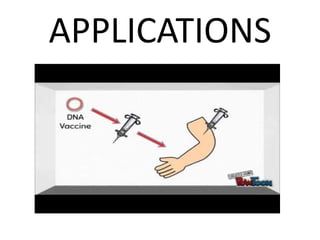
• The DNA is injected into cells
• uses the DNA to synthesize the
proteins
• Because these proteins are
recognized as foreign, when they are
processed by the host cells and
displayed on their surface, the
immune system is alerted,
• which then triggers immune
responses.
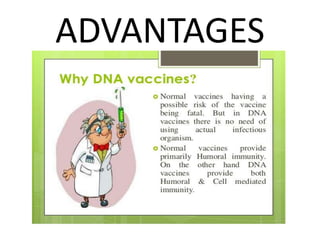
Why DNA vaccines?
This approach offers a number of potential
advantages over traditional approaches
Uses only the DNA from
infectious organisms.
Avoid the risk of using actual
infectious organism.
Provide both Humoral & Cell
mediated immunity
Refrigeration is not required
DNA vaccines Traditional vaccines
Uses weakened or killed form
of infectious organism.
Create possible risk of the
vaccine being fatal.
Provide primarily Humoral
immunity
Usually requires Refrigeration.
Including :
• the stimulation of both B- and T-cell
responses,
• improved vaccine stability,
• the absence of any infectious agent
• the relative ease of large-scale manufacture.
• immune responses in animals have been
obtained using genes from a variety of
infectious agents, including influenza virus,
hepatitis B virus, human immunodeficiency
virus, rabies virus, malarial parasites etc.
• In some cases, protection from disease in
animals has also been obtained.
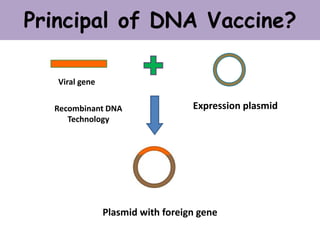
Viral gene
Recombinant DNA
Technology
Expression plasmid
Plasmid with foreign gene
Principal of DNA Vaccine?
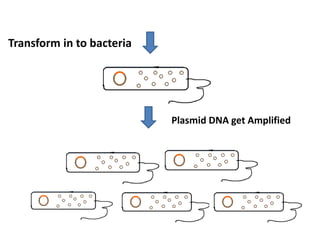
Transform in to bacteria
Plasmid DNA get Amplified
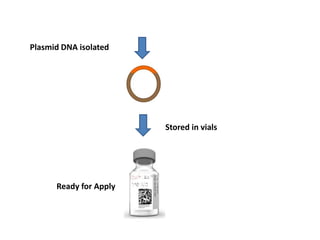
Plasmid DNA isolated
Stored in vials
Ready for Apply
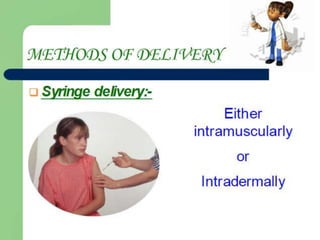
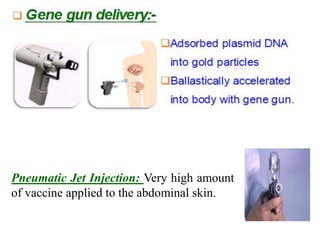
Pneumatic Jet Injection: Very high amount
of vaccine applied to the abdominal skin.
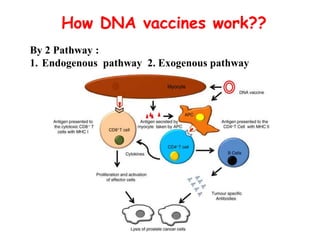
How DNA vaccines work??
By 2 Pathway :
1. Endogenous pathway 2. Exogenous pathway
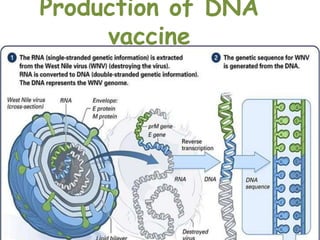
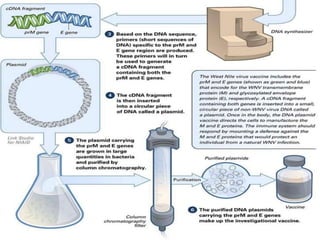
Production of DNA
vaccine
ADVANTAGES
DISADVANTAGES
APPLICATIONS
CONCLUSION
REFERENCES
1. Wolff JA, Malone RW, Williams P, et al. Direct gene
transfer into mouse muscle in
vivo. Science.1990;247(4949 Pt 1):1465–8. [PubMed]
2. Klinman DM, Yamshchikov G, Ishigatsubo Y. Contribution
of CpG motifs to the immunogenicity of DNA vaccines. J
Immunol. 1997;158(8):3635–9. [PubMed]
3. Khan KH. Vectors Used in Gene Manipulation – A
retrospective. Advanced Biotech Journal - Online -
Tutorial review. 2009;9(2):1–8
4. Corr M, Lee DJ, Carson DA, et al. Gene vaccination with
naked plasmid DNA: mechanism of CTL priming. J Exp
Med. 1996;184(4):1555–60. [PMC free article] [PubMed]
5. http://www.mdpi.com/2076-393X/1/3/225/htm
DNA Vaccine

DNA Vaccine

  • 1.
    Presented by- Rahima AkhterNury: 132 1722 046 Suraiya Ahmed: 132 0916 046 Anik khan: 132 0430 046 MD Isfat Hasan Tomal: 132 0378 046 Ramisha Rifat Tony: 132 0332 646
  • 2.
  • 3.
    What is DNA vaccine? •DNA vaccines are the vaccines which contain DNA that codes for specific proteins (antigens) from a pathogen. • The DNA is injected into cells • uses the DNA to synthesize the proteins • Because these proteins are recognized as foreign, when they are processed by the host cells and displayed on their surface, the immune system is alerted, • which then triggers immune responses.
  • 4.
    Why DNA vaccines? Thisapproach offers a number of potential advantages over traditional approaches Uses only the DNA from infectious organisms. Avoid the risk of using actual infectious organism. Provide both Humoral & Cell mediated immunity Refrigeration is not required DNA vaccines Traditional vaccines Uses weakened or killed form of infectious organism. Create possible risk of the vaccine being fatal. Provide primarily Humoral immunity Usually requires Refrigeration.
  • 5.
    Including : • thestimulation of both B- and T-cell responses, • improved vaccine stability, • the absence of any infectious agent • the relative ease of large-scale manufacture. • immune responses in animals have been obtained using genes from a variety of infectious agents, including influenza virus, hepatitis B virus, human immunodeficiency virus, rabies virus, malarial parasites etc. • In some cases, protection from disease in animals has also been obtained.
  • 6.
    Viral gene Recombinant DNA Technology Expressionplasmid Plasmid with foreign gene Principal of DNA Vaccine?
  • 7.
    Transform in tobacteria Plasmid DNA get Amplified
  • 8.
    Plasmid DNA isolated Storedin vials Ready for Apply
  • 10.
    Pneumatic Jet Injection:Very high amount of vaccine applied to the abdominal skin.
  • 11.
    How DNA vaccineswork?? By 2 Pathway : 1. Endogenous pathway 2. Exogenous pathway
  • 12.
  • 14.
  • 15.
  • 16.
  • 17.
  • 18.
    REFERENCES 1. Wolff JA,Malone RW, Williams P, et al. Direct gene transfer into mouse muscle in vivo. Science.1990;247(4949 Pt 1):1465–8. [PubMed] 2. Klinman DM, Yamshchikov G, Ishigatsubo Y. Contribution of CpG motifs to the immunogenicity of DNA vaccines. J Immunol. 1997;158(8):3635–9. [PubMed] 3. Khan KH. Vectors Used in Gene Manipulation – A retrospective. Advanced Biotech Journal - Online - Tutorial review. 2009;9(2):1–8 4. Corr M, Lee DJ, Carson DA, et al. Gene vaccination with naked plasmid DNA: mechanism of CTL priming. J Exp Med. 1996;184(4):1555–60. [PMC free article] [PubMed] 5. http://www.mdpi.com/2076-393X/1/3/225/htm