- Chhabi Acharya
Binod Rasaili
Rupesh K.C
Hope Int’l College
B. Pharmacy
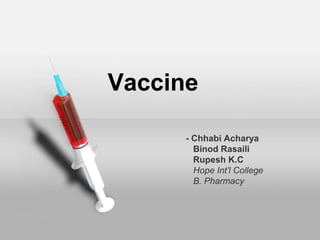
Vaccine
Contents:
• Introduction
• History
• Types
- 7 Types
- Their uses with exaple
- Saponins as vaccine adjuvants
• Vaccine Schedule (Nepal)
• Conclusion
Introduction:
• A vaccine is a biological preparation that
improves immunity to a particular disease.
• A vaccine typically contains an agent that
resembles a disease-causing microorganism
and is often made from weakened or killed forms
of the microbe.
• The agent stimulates the body's immune
system to recognize the agent as foreign,
destroy it, and keep a record of it.
• So that the immune system can more easily
recognize and destroy any of these
microorganisms that it later encounters.
• The terms vaccine and vaccination are derived
from Variolae vaccinae (smallpox of the cow),
the term devised by Edward Jenner to
denote cowpox.
Contd..
History:
• During the late 1760s whilst
serving his apprenticeship as
a surgeon Edward
Jenner learned of the story,
common in rural areas, that
dairy workers would never
have the often-fatal or
disfiguring disease smallpox
•Because they had already
had cowpox, which has a very
mild effect in humans.
Edward Jenner
• In 1796, Jenner took pus from the hand of a
milkmaid with cowpox, scratched it into the arm
of an 8-year-old boy.
• Six weeks later inoculated the boy with
smallpox, afterwards observing that he did not
catch smallpox.
• Jenner extended his studies and in 1798
reported that his vaccine was safe in children
and adults.
Contd..
• The second generation of vaccines was
introduced in the 1880s by Louis Pasteur who
developed vaccines for chicken cholera and
anthrax.
• From the late nineteenth century vaccines were
considered a matter of national prestige, and
compulsory vaccination laws were passed.
Louis Pasteur
Contd..
Types:
1. Live, attenuated vaccines
2. Inactivated vaccines
3. Subunit vaccines
4. Toxoid vaccines
5. Conjugate vaccines
6. DNA vaccines
7. Recombinant vector vaccines
1. Live, Attenuated Vaccines:
• Live, attenuated vaccines contain a version of the
living microbe that has been weakened in the lab
so it can’t cause disease.
• Because a live, attenuated vaccine is the closest
thing to a natural infection, these vaccines are
good “teachers” of the immune system.
• Example: Vaccines against measles, mumps, and
chickenpox
• Scientists produce inactivated vaccines by killing
the disease-causing microbe with chemicals,
heat, or radiation. Such vaccines are more
stable and safer than live vaccines.
• Because dead microbes can’t mutate back to
their disease-causing state.
• Example: Vaccines against influenza,
polio, hepatitis A, and rabies.
2. Inactivated Vaccines:
3.Subunits Vaccines:
• Instead of the entire microbe, subunit vaccines
include only the antigens that best stimulate the
immune system.
• In some cases, these vaccines use epitopes the
very specific parts of the antigen that antibodies
or T cells recognize and bind to.
• Because subunit vaccines contain only the
essential antigens and not all the other
molecules that make up the microbe.
• Example: Plague immunization.
4.Toxoid Vaccines:
• For bacteria that secrete toxins, or harmful
chemicals, a toxoid vaccine might be the
answer.
• These vaccines are used when a bacterial toxin
is the main cause of illness.
• Scientists have found that they can inactivate
toxins by treating them with formalin. Such
“detoxified” toxins, called toxoids, are safe for
use in vaccines.
• Example: Crotalus atrox toxoid is used to
vaccinate dogs against rattlesnake bites.
5.Conjugate Vaccines:
• If a bacterium possesses an outer coating of
sugar molecules called polysaccharides, as
many harmful bacteria do, researchers may try
making a conjugate vaccine for it.
• Polysaccharide coatings disguise a bacterium’s
antigens so that the immature immune systems
of infants and younger children can’t recognize
or respond to them.
• Example : Haemophilus influenzae type B vaccine.
6.DNA Vaccines:
• Still in the experimental stages, these vaccines
show great promise, and several types are being
tested in humans.
• DNA vaccines take immunization to a new
technological level.
• These vaccines dispense with both the whole
organism and its parts and get right down to the
essentials: the microbe’s genetic material.
• Example: Influenza vaccine.
7.Recombinant Vector Vaccines:
• Recombinant vector vaccines are experimental
vaccines similar to DNA vaccines
• But they use an attenuated virus or bacterium to
introduce microbial DNA to cells of the body.
• “Vector” refers to the virus or bacterium used as
the carrier.
• Example : DPT
Saponins as vaccine adjuvant:
• At first: what is vaccine adjuvant ?
• A vaccine adjuvant is a substance that is added
to the vaccine to increase the body's immune
response to the vaccine.
• Saponins are natural glycosides of steroid or
triterpene which exhibited many different
biological and pharmacological activities.
• Notably, saponins can activate the mammalian
immune system, which have led to significant
interest in their potential as vaccine adjuvants.
Contd..
• The most widely used saponinbased adjuvants
are Quil A and its derivatives QS-21, isolated
from the bark of Quillaja saponaria Molina, which
have been evaluated in numerous clinical trials.
• Their unique capacity to stimulate both the Th1
immune response and the production of
cytotoxic T-lymphocytes (CTLs) against
exogenous antigens makes them ideal for use in
subunit vaccines and vaccines directed against
intracellular pathogens as well as for therapeutic
cancer vaccines.
Research & Development:
• WHO have a separate unit for the research and
development of vaccine.
• WHO’s Initiative for Vaccine Research (IVR)
facilitates vaccine research and development
(R&D) against pathogens with significant
disease and economic burden, with a particular
focus on low and middle income countries.
• Finding a safe, effective, and durable HIV
vaccine remains a top priority for world.
Contd..
• Through the Vaccine Research Center and the
Division of Acquired Immunodeficiency
Syndrome, NIAID (National Institute of Allergy
and Infectious Disease) is recently busy in
conducing and supporting biomedical research
that leads to increased knowledge about how
HIV interacts with the human immune system
and evaluation of the most promising vaccine
candidates.
***
References:
• World Health Organisation
http://www.who.int/topics/vaccines/en/
• A federal government Website managed by the U.S.
Department of Health and Human Services
http://www.vaccines.gov/more_info/types/
• http://www.ncbi.nlm.nih.gov/pmc/articles/PMC1810383/
• http://www.niaid.nih.gov/topics/hivaids/research/vaccines
/Pages/default.aspx
• http://www.ncbi.nlm.nih.gov/pubmed/19208455
Vaccine & Its Type

Vaccine & Its Type

  • 1.
    - Chhabi Acharya BinodRasaili Rupesh K.C Hope Int’l College B. Pharmacy Vaccine
  • 2.
    Contents: • Introduction • History •Types - 7 Types - Their uses with exaple - Saponins as vaccine adjuvants • Vaccine Schedule (Nepal) • Conclusion
  • 3.
    Introduction: • A vaccineis a biological preparation that improves immunity to a particular disease. • A vaccine typically contains an agent that resembles a disease-causing microorganism and is often made from weakened or killed forms of the microbe.
  • 4.
    • The agentstimulates the body's immune system to recognize the agent as foreign, destroy it, and keep a record of it. • So that the immune system can more easily recognize and destroy any of these microorganisms that it later encounters. • The terms vaccine and vaccination are derived from Variolae vaccinae (smallpox of the cow), the term devised by Edward Jenner to denote cowpox. Contd..
  • 5.
    History: • During thelate 1760s whilst serving his apprenticeship as a surgeon Edward Jenner learned of the story, common in rural areas, that dairy workers would never have the often-fatal or disfiguring disease smallpox •Because they had already had cowpox, which has a very mild effect in humans. Edward Jenner
  • 6.
    • In 1796,Jenner took pus from the hand of a milkmaid with cowpox, scratched it into the arm of an 8-year-old boy. • Six weeks later inoculated the boy with smallpox, afterwards observing that he did not catch smallpox. • Jenner extended his studies and in 1798 reported that his vaccine was safe in children and adults. Contd..
  • 7.
    • The secondgeneration of vaccines was introduced in the 1880s by Louis Pasteur who developed vaccines for chicken cholera and anthrax. • From the late nineteenth century vaccines were considered a matter of national prestige, and compulsory vaccination laws were passed. Louis Pasteur Contd..
  • 8.
    Types: 1. Live, attenuatedvaccines 2. Inactivated vaccines 3. Subunit vaccines 4. Toxoid vaccines 5. Conjugate vaccines 6. DNA vaccines 7. Recombinant vector vaccines
  • 9.
    1. Live, AttenuatedVaccines: • Live, attenuated vaccines contain a version of the living microbe that has been weakened in the lab so it can’t cause disease. • Because a live, attenuated vaccine is the closest thing to a natural infection, these vaccines are good “teachers” of the immune system. • Example: Vaccines against measles, mumps, and chickenpox
  • 10.
    • Scientists produceinactivated vaccines by killing the disease-causing microbe with chemicals, heat, or radiation. Such vaccines are more stable and safer than live vaccines. • Because dead microbes can’t mutate back to their disease-causing state. • Example: Vaccines against influenza, polio, hepatitis A, and rabies. 2. Inactivated Vaccines:
  • 11.
    3.Subunits Vaccines: • Insteadof the entire microbe, subunit vaccines include only the antigens that best stimulate the immune system. • In some cases, these vaccines use epitopes the very specific parts of the antigen that antibodies or T cells recognize and bind to. • Because subunit vaccines contain only the essential antigens and not all the other molecules that make up the microbe. • Example: Plague immunization.
  • 12.
    4.Toxoid Vaccines: • Forbacteria that secrete toxins, or harmful chemicals, a toxoid vaccine might be the answer. • These vaccines are used when a bacterial toxin is the main cause of illness. • Scientists have found that they can inactivate toxins by treating them with formalin. Such “detoxified” toxins, called toxoids, are safe for use in vaccines. • Example: Crotalus atrox toxoid is used to vaccinate dogs against rattlesnake bites.
  • 13.
    5.Conjugate Vaccines: • Ifa bacterium possesses an outer coating of sugar molecules called polysaccharides, as many harmful bacteria do, researchers may try making a conjugate vaccine for it. • Polysaccharide coatings disguise a bacterium’s antigens so that the immature immune systems of infants and younger children can’t recognize or respond to them. • Example : Haemophilus influenzae type B vaccine.
  • 14.
    6.DNA Vaccines: • Stillin the experimental stages, these vaccines show great promise, and several types are being tested in humans. • DNA vaccines take immunization to a new technological level. • These vaccines dispense with both the whole organism and its parts and get right down to the essentials: the microbe’s genetic material. • Example: Influenza vaccine.
  • 15.
    7.Recombinant Vector Vaccines: •Recombinant vector vaccines are experimental vaccines similar to DNA vaccines • But they use an attenuated virus or bacterium to introduce microbial DNA to cells of the body. • “Vector” refers to the virus or bacterium used as the carrier. • Example : DPT
  • 16.
    Saponins as vaccineadjuvant: • At first: what is vaccine adjuvant ? • A vaccine adjuvant is a substance that is added to the vaccine to increase the body's immune response to the vaccine. • Saponins are natural glycosides of steroid or triterpene which exhibited many different biological and pharmacological activities. • Notably, saponins can activate the mammalian immune system, which have led to significant interest in their potential as vaccine adjuvants.
  • 17.
    Contd.. • The mostwidely used saponinbased adjuvants are Quil A and its derivatives QS-21, isolated from the bark of Quillaja saponaria Molina, which have been evaluated in numerous clinical trials. • Their unique capacity to stimulate both the Th1 immune response and the production of cytotoxic T-lymphocytes (CTLs) against exogenous antigens makes them ideal for use in subunit vaccines and vaccines directed against intracellular pathogens as well as for therapeutic cancer vaccines.
  • 18.
    Research & Development: •WHO have a separate unit for the research and development of vaccine. • WHO’s Initiative for Vaccine Research (IVR) facilitates vaccine research and development (R&D) against pathogens with significant disease and economic burden, with a particular focus on low and middle income countries. • Finding a safe, effective, and durable HIV vaccine remains a top priority for world.
  • 19.
    Contd.. • Through theVaccine Research Center and the Division of Acquired Immunodeficiency Syndrome, NIAID (National Institute of Allergy and Infectious Disease) is recently busy in conducing and supporting biomedical research that leads to increased knowledge about how HIV interacts with the human immune system and evaluation of the most promising vaccine candidates. ***
  • 20.
    References: • World HealthOrganisation http://www.who.int/topics/vaccines/en/ • A federal government Website managed by the U.S. Department of Health and Human Services http://www.vaccines.gov/more_info/types/ • http://www.ncbi.nlm.nih.gov/pmc/articles/PMC1810383/ • http://www.niaid.nih.gov/topics/hivaids/research/vaccines /Pages/default.aspx • http://www.ncbi.nlm.nih.gov/pubmed/19208455