JAYSHREE
Ph.D SCHOLAR
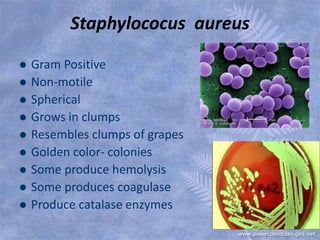
Staphylococus aureus
 Gram Positive
 Non-motile
 Spherical
 Grows in clumps
 Resembles clumps of grapes
 Golden color- colonies
 Some produce hemolysis
 Some produces coagulase
 Produce catalase enzymes
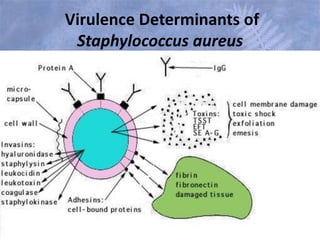
Virulence Determinants of
Staphylococcus aureus
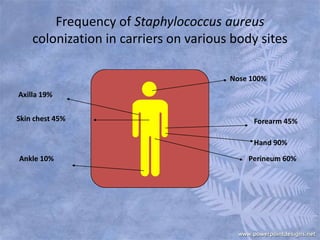
Frequency of Staphylococcus aureus
colonization in carriers on various body sites
Nose 100%
Skin chest 45%
Perineum 60%Ankle 10%
Axilla 19%
Hand 90%
Forearm 45%
4
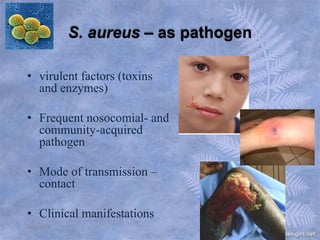
S. aureus – as pathogen
• virulent factors (toxins
and enzymes)
• Frequent nosocomial- and
community-acquired
pathogen
• Mode of transmission –
contact
• Clinical manifestations
1/31/2015 5
Superficial Infections
Scalded Skin Syndrome: Classic Toxic
Shock
Systemic Menstrual Toxic Shock
Cont…
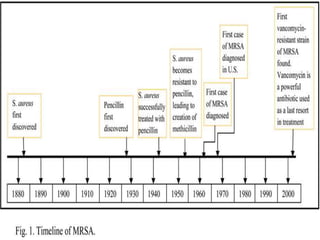
• The Staphyloccoccus aureus bacterium,
commonly known as staph, was discovered in
the 1880s - painful skin and soft tissue
conditions
• Initially cases were treated by draining the
abscess or boil
Cont…
• In the 1940s, medical treatment for S.
aureus infections became routine as
Penicillin was introduced as drug of choice.
• Penicillin- bacterial cell wall synthesis- inflow
of water- cell burst
Cont…
• But resistance to penicillin in Staph. aureus -
due to the presence of penicillinases in them.
• Later on due to development of resistance to
penicillin
Cont…..
• In 1959 methicillin was introduced for Staph.
aureus resistant to penicillinases (Leonard and
Markey, 2008)
• In recent time resistance leading to use of
vancomycin.
Cont..
• Most strains of MRSA are inhibited by
concentrations of vancomycin ranging from
0.5- 2.0 mcg/mL, although strains have been
reported with intermediate sensitivity that
have been called Glycopeptide intermediate
staph aureus or Vancomycin intermediate staph
aureus.
What Is MRSA?
• MRSA is the term used for any strain of
Staphylococcus aureus that has developed
resistance to β- lactam antibiotics, which include
the penicillins (methicillins, oxacillin,
dicloxacillin etc.) and cephalosporins
• MRSA causes a variety of disseminated, lethal
infections in humans.
• Has the ability to easily transfer resistant genes to
other species directly and indirectly
•Resistance of MRSA to β- lactam antibiotics including
penicillinase stable β- lactam is mediated by the mecA gene.
•This gene is expressed in bacterial cell wall and encodes
for a penicillin binding protein (PBP2a) which has a low
affinity for β- lactam antibiotics (Leonard and Markey, 2008).
•SCCmec element is a genomic island of unknown origin
containing this antibiotic resistant mecA gene (Batabyal et al.,
2012).
how MRSA is resistant to methicillin?
How “Tough” is MRSA?
• Staphylococci can survive many extreme
environmental conditions.
• The bacteria can be cultured from dried clinical
material after several months, are relatively heat
resistant, and can tolerate high salt media.
So, “What Do we Do?”
• You can not get rid of MRSA; you can only
control it.
How is MRSA spread?
1. Direct contact with infected or colonized
host -human-to-human contact
2. Contaminated intermediate surfaces
-hand towels
-faucets
-tub/shower
3. Airborne fluid droplets
CA-MRSA and HA-MRSA
 CA-MRSA
Unique
microbiologic and
genetic properties
compared with
HA-MRSA may
allow the
community strains
to spread more
easily or cause
more skin disease
Community-Associated (CA)-MRSA
• CA-MRSA has only been known since the
1990s.
• CA-MRSA is of great concern to public health
professionals because of who it can affect.
• CA-MRSA skin infections are known to spread
in crowded settings
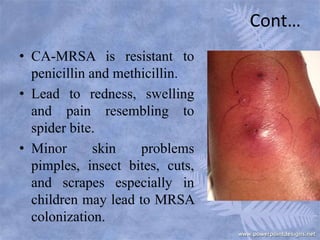
Cont…
• CA-MRSA is resistant to
penicillin and methicillin.
• Lead to redness, swelling
and pain resembling to
spider bite.
• Minor skin problems
pimples, insect bites, cuts,
and scrapes especially in
children may lead to MRSA
colonization.
Hospital-acquired MRSA (HA-MRSA)
HA-MRSA Healthcare-acquired Methicillin
resistant Staph. aureus
Many hospitals now seeing CA-MRSA in
healthcare associated infections
Vancomycin resistance……..?
• Isolate of S. aureus in 1997 was observed
resistant mediated not via acquisition of van A by
a strain of methicillin-resistant S. aureus (MRSA)
but by an unusually thickened cell wall containing
dipeptides capable of binding vancomycin,
thereby reducing availability of the drug for
intracellular target molecules.
• This was the first observation of vancomycin-
intermediate S. aureus (VISA).
Cont….
• The predicted mechanism of van A gene
plasmid-mediated transfer from enterococci
to S. aureus was later observed for the first
time in 2002; this was the first description of
vancomycin-resistant S. aureus (VRSA).
Drugs against MRSA
• Daptomycin
• Linezolid(belonging to oxazolidiones class)
Drugs In Development
• Oritavancin-Binds to normal cell wall
precursors
• Tigecyclin-Works on efflux pumps
• Dalbavancin- Bacteriacidal
Who is at risk for MRSA?
 ANYONE can get MRSA – those most at risk:
Spend a lot of time in crowded places such
as hospitals, schools or dorms
Share sports equipment
Share personal hygiene items
Play contact sports
Overuse or misuse antibiotics
Can Healthy People Get MRSA?
• Yes. MRSA skin infections are showing up more
frequently in healthy people, with none of the
usual risks factors.
• This type of MRSA - called community-
associated MRSA (CA MRSA) - has been
reported among athletes, prisoners, and military
recruits.
Diagnosis
• S. aureus infections in humans are diagnosed
by culture and identification of the organism,
as in animals. (Staphylococcal food poisoning
is diagnosed by examination of the food for the
organisms and/or toxins.).
Cont…..
• Methicillin-Resistant Staphylococcus aureus
(MRSA) as the causal agent of nosocomial
infection demands a quick and trustworthy
characterization of isolates
Phenotypic Methods
• Antibiogram typing
• Phage typing
• Serotyping
• Biotyping
• Protein electrophoretic typing
Whole cell protein typing
Immunoblotting
Zymotyping
Genotypic Methods
• Plasmid DNA analysis
• Chromosomal DNA analysis
• Southern blot analysis of RFLP
• Ribotyping
• Binary typing
• Pulsed field gel electrophoresis
Prevention
The best defense against spreading MRSA is to
practice good hygiene, as follows:
• Keep your hands clean
• Use hand sanitizer containing at least 62
percent alcohol.
• Keep cuts and scrapes clean and covered with
a bandage until healed.
• Follow your healthcare provider’s instructions
on proper care of the wound.
• Bandages or tape can be discarded with regular
trash.
Cont…
• Avoid contact with other people’s wounds
or bandages.
• Avoid sharing personal items, such as
towels, washcloths, razors, clothes, or
uniforms.
• Wash sheets, towels, and clothes that
become soiled with water and laundry
detergent; use bleach and hot water if
possible.
Cont….
• Drying clothes in a hot dryer, rather than air-
drying, also helps kill bacteria in clothes.
• Tell any healthcare providers who treat you if
you have or had an S. aureus or MRSA skin
infection.
• If you have a skin infection that requires
treatment, ask your healthcare provider if you
should be tested for MRSA.
Cont….
• Many healthcare providers prescribe drugs that
are not effective against antibiotic-resistant
staph, which delays treatment and creates more
resistant germs.
• Healthcare providers are fighting back against
MRSA infection by tracking bacterial
outbreaks and by investing in products
Vaccination
• Development of StaphVAX®, a
polysaccharide conjugate vaccine against S.
aureus infections in process.
• The results of the phase 3 clinical trials of the
vaccine (Staph VAX) will be presented 2006.
Future Prospects
• What of the future? Many new avenues are
under exploration.
• Tea-tree oil in a nasal application together with
a body wash was shown to be as effective as
mupirocin with antiseptic washes in the
eradication of carriage of MRSA
• Antiseptic-coated endotracheal tubes are
undergoing trials.
Cont…
• Other techniques under investigation include a
hydrogen-peroxide-based gas to decontaminate
the environment, air filtration units and diagnostic
kits, phage therapy and, perhaps the most
interesting
• A search of Medline yielded no published data on
this last approach. Whatever new answers emerge,
we must hope they will not go the way of
methicillin.
MRSA- Indian Scenario
• MRSA is endemic in India and is a dangerous
pathogen for hospital acquired infections.
• This study was conducted in Indian tertiary
care centres during a two year period from
January 2008 to December 2009 to determine
the prevalence of MRSA and susceptibility
pattern of S. aureus isolates in India.
Cont….
• In India first MRSA, 6th in world was isolated
in 2005 at Kolkata from the cases of wounds in
children.
• Till than it has been reported from various part
of country including animals and supposed to
be major cause of mastitis in bovines (Kiran,
2014).
• National Guidelines for controlling MRSA
were published in 1998 and are currently under
revision.
• A two-tier control programme was
recommended.
References
1. http://www.niaid.nih.gov/topics/antimicrobialresistance/examples/mrsa/pages/default.aspx
2. Mitchell, David.MRSA.”what’s New”. Inoculum. Volume 8, number 2 (1999) 1-12.
3. textbookofbacteriology.net/resantimicrobial.htm
4. healthsciences.columbia.edu/ dept/ps/2007/mid/2006/transcript_02_mid22.pdf
5. http://www.bioteach.ubc.ca/Biodiversity/AttackOfTheSuperbugs
6. Foster, Timothy. The staphylococcus aureus “superbug”.J. clin Ivestigation
7. Volume number114 (2004) 1693-1696.
8. www.channing.harvard.edu/4a.htm
9. ww.ncbi.nlm.nih.gov.
10. www.aafp.org/afp/ 20000815/804.html
11. Journal of Clinical Microbiology, June 2000, p. 2378-2380, Vol. 38, No. 6
0095-1137/04.00+0
12. www.FDA.com (FDA archives)
13. www.postgradmed.com/issues/2001/10_01/hoel.htm
14. www.cdc.gov/ncidod/hip/aresist/mrsa_CDCactions.htm
15. www.medscape.com
16. http://www.nabi.com/images/factsheets/fsStaphVAX.pdf
17. http://textbookofbacteriology.net/staph_2.html
18. http://aic-server4.aic.cuhk.edu.hk/web8/0205_MRSA.jpg
Cont…
19. Duckworth G. Controlling methicillin-resistant Staphylococcus aureus. BMJ 2003;327: 1177–8[PMC free
article] [PubMed]
20. Voss A. Preventing the spread of MRSA. BMJ 2004;329: 521. [PMC free article] [PubMed]
21. Thompson DS. Methicillin-resistant Staphylococcus aureus in a general intensive care unit. J R Soc Med2004;97:
521–6 [PMC free article] [PubMed]
22. Rolinson GL, Stevens S, Batchelor FR, Cameron Wood J, Chain EB. Bacteriological studies on a new
penicillin. Lancet 1960;ii: 564–9 [PubMed]
23. Elek SD, Fleming PC. A new technique for the control of hospital cross infection. Lancet 1960;ii: 569–
72[PubMed]
24. Jevons MP. ‘Celbenin-resistant’ staphylococci. BMJ 1961;i: 124–5
25. Cox RA, Conquest C, Mallaghan C, Marples RR. A major outbreak of methicillin-resistant staphylococci caused by
a new phage type (EMRSA-16). J Hosp Infect 1995;29: 87–106 [PubMed]
26. Farrington M, Redpath C, Trundle C, Coomber S, Brown NM. Winning the battle, but losing the war: methicillin-
resistant Staphylococcus aureus (MRSA) at a teaching hospital. Q J Med 1998;91: 539–48[PubMed]
27. British Society for Antimicrobial Chemotherapy, Hospital Infection Society, Infection Control Nurses Association.
Revised guidelines for the control of methicillin-resistant Staphylococcus aureus infection in hospitals. J Hosp
Infect 1998;39: 253–90 [PubMed]
28. Emmerson AM, Enstone JE, Griffin M, Kelsey MC, Smyth ETM. The Second National Prevalence Survey of
Infection in Hospitals—overview of the results. J Hosp Infect 1996;32: 175–90 [PubMed]
29. Barrett SP, Mummery RV, Chattopadhyay. Trying to control MRSA causes more problems than it solves. J Hosp
Infect 1998;39: 85–93 [PubMed]
30. Farrington M, Redpath C, Trundle C, Brown NM. Controlling MRSA. J Hosp Infect 1999;40: 251–4[PubMed]
•
Cont…
31. Cooper BS, Stone SP, Kibbler CC, et al. Isolation measures in the hospital management of methicillin-
resistant Staphylococcus aureus (MRSA): systematic review of the literature. BMJ 2004;329: 533–9[PMC free
article] [PubMed]
32. Wertheim HFK, Vos MC, Boelens HAM, et al. Low prevalence of methicillin-resistant Staphylococcus
aureus (MRSA) at hospital admission in the Netherlands: the value of the search and destroy and restrictive
antibiotic use. J Hosp Infect 2004;56: 321–5 [PubMed]
33. Marshall C, Wolfe R, Kossman T, Wesselingh S, Harrington G, Spelman D. Risk factors for acquisition of
methicillin-resistant Staphylococcus aureus by trauma patients in the intensive care unit. J Hosp Infect2004;57:
245–52 [PubMed]
34. Silvestri L, van Saene HKF, Milanese M, et al. Prevention of MRSA pneumonia by oral vancomycin
decontamination: a randomised trial. Eur Respir J 2004;23: 921–6 [PubMed]
35. de la Cal MA, Cerda E, van Saene HKF, et al. Effectiveness and safety of enteral vancomycin to control
endemicity of methicillin-resistant Staphylococcus aureus in a medical/surgical intensive care unit. J Hosp
Infect 2004;56: 175–83 [PubMed]
36. Van Saene HKF, Weir WI, de la Cal MA, Silvestri L, Petros AJ, Barrett SP. MRSA—time for a more pragmatic
approach. J Hosp Infect 1998;56: 175–83
37. Howe R, Monk A, Wootton M, Wash T, Enright MC. Vancomycin susceptibility within methicillin-
resistant Staphylococcus aureus lineages. Emerg Infect Dis 2004;10: 855–7 [PMC free article] [PubMed]
38. Dryden MS, Dailly S, Crouch M. A randomised, controlled trial of tea tree topical preparations versus a standard
topical regime for the clearance of MRSA colonisation. J Hosp Infect 2004;56: 283–6 [PubMed]
39. Pancheco-Fowler V, Gaonakar T, Wyer PC, Modak K. Antiseptic impregnated endotracheal tubes for the
prevention of bacterial colonisation. J Hosp Infect 2004;57: 170–4 [PubMed]
40. French GL, Otter J, Shannon KP, Adams NMT, Watling D, Parks MJ. Tackling hospital environmental
contamination with methicillin-resistant Staphylococcus aureus (MRSA): a comparison between conventional
terminal cleaning and hydrogen peroxide vapour decontamination. J Hosp Infect (in press)[PubMed]
MRSA

MRSA

  • 1.
  • 2.
    Staphylococus aureus  GramPositive  Non-motile  Spherical  Grows in clumps  Resembles clumps of grapes  Golden color- colonies  Some produce hemolysis  Some produces coagulase  Produce catalase enzymes
  • 3.
  • 4.
    Frequency of Staphylococcusaureus colonization in carriers on various body sites Nose 100% Skin chest 45% Perineum 60%Ankle 10% Axilla 19% Hand 90% Forearm 45% 4
  • 5.
    S. aureus –as pathogen • virulent factors (toxins and enzymes) • Frequent nosocomial- and community-acquired pathogen • Mode of transmission – contact • Clinical manifestations 1/31/2015 5
  • 6.
  • 7.
    Scalded Skin Syndrome:Classic Toxic Shock
  • 8.
  • 9.
    Cont… • The Staphyloccoccusaureus bacterium, commonly known as staph, was discovered in the 1880s - painful skin and soft tissue conditions • Initially cases were treated by draining the abscess or boil
  • 10.
    Cont… • In the1940s, medical treatment for S. aureus infections became routine as Penicillin was introduced as drug of choice. • Penicillin- bacterial cell wall synthesis- inflow of water- cell burst
  • 11.
    Cont… • But resistanceto penicillin in Staph. aureus - due to the presence of penicillinases in them. • Later on due to development of resistance to penicillin
  • 12.
    Cont….. • In 1959methicillin was introduced for Staph. aureus resistant to penicillinases (Leonard and Markey, 2008) • In recent time resistance leading to use of vancomycin.
  • 13.
    Cont.. • Most strainsof MRSA are inhibited by concentrations of vancomycin ranging from 0.5- 2.0 mcg/mL, although strains have been reported with intermediate sensitivity that have been called Glycopeptide intermediate staph aureus or Vancomycin intermediate staph aureus.
  • 14.
    What Is MRSA? •MRSA is the term used for any strain of Staphylococcus aureus that has developed resistance to β- lactam antibiotics, which include the penicillins (methicillins, oxacillin, dicloxacillin etc.) and cephalosporins • MRSA causes a variety of disseminated, lethal infections in humans. • Has the ability to easily transfer resistant genes to other species directly and indirectly
  • 15.
    •Resistance of MRSAto β- lactam antibiotics including penicillinase stable β- lactam is mediated by the mecA gene. •This gene is expressed in bacterial cell wall and encodes for a penicillin binding protein (PBP2a) which has a low affinity for β- lactam antibiotics (Leonard and Markey, 2008). •SCCmec element is a genomic island of unknown origin containing this antibiotic resistant mecA gene (Batabyal et al., 2012). how MRSA is resistant to methicillin?
  • 16.
    How “Tough” isMRSA? • Staphylococci can survive many extreme environmental conditions. • The bacteria can be cultured from dried clinical material after several months, are relatively heat resistant, and can tolerate high salt media. So, “What Do we Do?” • You can not get rid of MRSA; you can only control it.
  • 17.
    How is MRSAspread? 1. Direct contact with infected or colonized host -human-to-human contact 2. Contaminated intermediate surfaces -hand towels -faucets -tub/shower 3. Airborne fluid droplets
  • 18.
    CA-MRSA and HA-MRSA CA-MRSA Unique microbiologic and genetic properties compared with HA-MRSA may allow the community strains to spread more easily or cause more skin disease
  • 19.
    Community-Associated (CA)-MRSA • CA-MRSAhas only been known since the 1990s. • CA-MRSA is of great concern to public health professionals because of who it can affect. • CA-MRSA skin infections are known to spread in crowded settings
  • 20.
    Cont… • CA-MRSA isresistant to penicillin and methicillin. • Lead to redness, swelling and pain resembling to spider bite. • Minor skin problems pimples, insect bites, cuts, and scrapes especially in children may lead to MRSA colonization.
  • 21.
    Hospital-acquired MRSA (HA-MRSA) HA-MRSAHealthcare-acquired Methicillin resistant Staph. aureus Many hospitals now seeing CA-MRSA in healthcare associated infections
  • 22.
    Vancomycin resistance……..? • Isolateof S. aureus in 1997 was observed resistant mediated not via acquisition of van A by a strain of methicillin-resistant S. aureus (MRSA) but by an unusually thickened cell wall containing dipeptides capable of binding vancomycin, thereby reducing availability of the drug for intracellular target molecules. • This was the first observation of vancomycin- intermediate S. aureus (VISA).
  • 23.
    Cont…. • The predictedmechanism of van A gene plasmid-mediated transfer from enterococci to S. aureus was later observed for the first time in 2002; this was the first description of vancomycin-resistant S. aureus (VRSA).
  • 25.
    Drugs against MRSA •Daptomycin • Linezolid(belonging to oxazolidiones class)
  • 26.
    Drugs In Development •Oritavancin-Binds to normal cell wall precursors • Tigecyclin-Works on efflux pumps • Dalbavancin- Bacteriacidal
  • 27.
    Who is atrisk for MRSA?  ANYONE can get MRSA – those most at risk: Spend a lot of time in crowded places such as hospitals, schools or dorms Share sports equipment Share personal hygiene items Play contact sports Overuse or misuse antibiotics
  • 28.
    Can Healthy PeopleGet MRSA? • Yes. MRSA skin infections are showing up more frequently in healthy people, with none of the usual risks factors. • This type of MRSA - called community- associated MRSA (CA MRSA) - has been reported among athletes, prisoners, and military recruits.
  • 29.
    Diagnosis • S. aureusinfections in humans are diagnosed by culture and identification of the organism, as in animals. (Staphylococcal food poisoning is diagnosed by examination of the food for the organisms and/or toxins.).
  • 30.
    Cont….. • Methicillin-Resistant Staphylococcusaureus (MRSA) as the causal agent of nosocomial infection demands a quick and trustworthy characterization of isolates
  • 31.
    Phenotypic Methods • Antibiogramtyping • Phage typing • Serotyping • Biotyping • Protein electrophoretic typing Whole cell protein typing Immunoblotting Zymotyping
  • 32.
    Genotypic Methods • PlasmidDNA analysis • Chromosomal DNA analysis • Southern blot analysis of RFLP • Ribotyping • Binary typing • Pulsed field gel electrophoresis
  • 33.
    Prevention The best defenseagainst spreading MRSA is to practice good hygiene, as follows: • Keep your hands clean • Use hand sanitizer containing at least 62 percent alcohol. • Keep cuts and scrapes clean and covered with a bandage until healed. • Follow your healthcare provider’s instructions on proper care of the wound. • Bandages or tape can be discarded with regular trash.
  • 34.
    Cont… • Avoid contactwith other people’s wounds or bandages. • Avoid sharing personal items, such as towels, washcloths, razors, clothes, or uniforms. • Wash sheets, towels, and clothes that become soiled with water and laundry detergent; use bleach and hot water if possible.
  • 35.
    Cont…. • Drying clothesin a hot dryer, rather than air- drying, also helps kill bacteria in clothes. • Tell any healthcare providers who treat you if you have or had an S. aureus or MRSA skin infection. • If you have a skin infection that requires treatment, ask your healthcare provider if you should be tested for MRSA.
  • 36.
    Cont…. • Many healthcareproviders prescribe drugs that are not effective against antibiotic-resistant staph, which delays treatment and creates more resistant germs. • Healthcare providers are fighting back against MRSA infection by tracking bacterial outbreaks and by investing in products
  • 37.
    Vaccination • Development ofStaphVAX®, a polysaccharide conjugate vaccine against S. aureus infections in process. • The results of the phase 3 clinical trials of the vaccine (Staph VAX) will be presented 2006.
  • 38.
    Future Prospects • Whatof the future? Many new avenues are under exploration. • Tea-tree oil in a nasal application together with a body wash was shown to be as effective as mupirocin with antiseptic washes in the eradication of carriage of MRSA • Antiseptic-coated endotracheal tubes are undergoing trials.
  • 39.
    Cont… • Other techniquesunder investigation include a hydrogen-peroxide-based gas to decontaminate the environment, air filtration units and diagnostic kits, phage therapy and, perhaps the most interesting • A search of Medline yielded no published data on this last approach. Whatever new answers emerge, we must hope they will not go the way of methicillin.
  • 40.
    MRSA- Indian Scenario •MRSA is endemic in India and is a dangerous pathogen for hospital acquired infections. • This study was conducted in Indian tertiary care centres during a two year period from January 2008 to December 2009 to determine the prevalence of MRSA and susceptibility pattern of S. aureus isolates in India.
  • 41.
    Cont…. • In Indiafirst MRSA, 6th in world was isolated in 2005 at Kolkata from the cases of wounds in children. • Till than it has been reported from various part of country including animals and supposed to be major cause of mastitis in bovines (Kiran, 2014).
  • 42.
    • National Guidelinesfor controlling MRSA were published in 1998 and are currently under revision. • A two-tier control programme was recommended.
  • 43.
    References 1. http://www.niaid.nih.gov/topics/antimicrobialresistance/examples/mrsa/pages/default.aspx 2. Mitchell,David.MRSA.”what’s New”. Inoculum. Volume 8, number 2 (1999) 1-12. 3. textbookofbacteriology.net/resantimicrobial.htm 4. healthsciences.columbia.edu/ dept/ps/2007/mid/2006/transcript_02_mid22.pdf 5. http://www.bioteach.ubc.ca/Biodiversity/AttackOfTheSuperbugs 6. Foster, Timothy. The staphylococcus aureus “superbug”.J. clin Ivestigation 7. Volume number114 (2004) 1693-1696. 8. www.channing.harvard.edu/4a.htm 9. ww.ncbi.nlm.nih.gov. 10. www.aafp.org/afp/ 20000815/804.html 11. Journal of Clinical Microbiology, June 2000, p. 2378-2380, Vol. 38, No. 6 0095-1137/04.00+0 12. www.FDA.com (FDA archives) 13. www.postgradmed.com/issues/2001/10_01/hoel.htm 14. www.cdc.gov/ncidod/hip/aresist/mrsa_CDCactions.htm 15. www.medscape.com 16. http://www.nabi.com/images/factsheets/fsStaphVAX.pdf 17. http://textbookofbacteriology.net/staph_2.html 18. http://aic-server4.aic.cuhk.edu.hk/web8/0205_MRSA.jpg
  • 44.
    Cont… 19. Duckworth G.Controlling methicillin-resistant Staphylococcus aureus. BMJ 2003;327: 1177–8[PMC free article] [PubMed] 20. Voss A. Preventing the spread of MRSA. BMJ 2004;329: 521. [PMC free article] [PubMed] 21. Thompson DS. Methicillin-resistant Staphylococcus aureus in a general intensive care unit. J R Soc Med2004;97: 521–6 [PMC free article] [PubMed] 22. Rolinson GL, Stevens S, Batchelor FR, Cameron Wood J, Chain EB. Bacteriological studies on a new penicillin. Lancet 1960;ii: 564–9 [PubMed] 23. Elek SD, Fleming PC. A new technique for the control of hospital cross infection. Lancet 1960;ii: 569– 72[PubMed] 24. Jevons MP. ‘Celbenin-resistant’ staphylococci. BMJ 1961;i: 124–5 25. Cox RA, Conquest C, Mallaghan C, Marples RR. A major outbreak of methicillin-resistant staphylococci caused by a new phage type (EMRSA-16). J Hosp Infect 1995;29: 87–106 [PubMed] 26. Farrington M, Redpath C, Trundle C, Coomber S, Brown NM. Winning the battle, but losing the war: methicillin- resistant Staphylococcus aureus (MRSA) at a teaching hospital. Q J Med 1998;91: 539–48[PubMed] 27. British Society for Antimicrobial Chemotherapy, Hospital Infection Society, Infection Control Nurses Association. Revised guidelines for the control of methicillin-resistant Staphylococcus aureus infection in hospitals. J Hosp Infect 1998;39: 253–90 [PubMed] 28. Emmerson AM, Enstone JE, Griffin M, Kelsey MC, Smyth ETM. The Second National Prevalence Survey of Infection in Hospitals—overview of the results. J Hosp Infect 1996;32: 175–90 [PubMed] 29. Barrett SP, Mummery RV, Chattopadhyay. Trying to control MRSA causes more problems than it solves. J Hosp Infect 1998;39: 85–93 [PubMed] 30. Farrington M, Redpath C, Trundle C, Brown NM. Controlling MRSA. J Hosp Infect 1999;40: 251–4[PubMed] •
  • 45.
    Cont… 31. Cooper BS,Stone SP, Kibbler CC, et al. Isolation measures in the hospital management of methicillin- resistant Staphylococcus aureus (MRSA): systematic review of the literature. BMJ 2004;329: 533–9[PMC free article] [PubMed] 32. Wertheim HFK, Vos MC, Boelens HAM, et al. Low prevalence of methicillin-resistant Staphylococcus aureus (MRSA) at hospital admission in the Netherlands: the value of the search and destroy and restrictive antibiotic use. J Hosp Infect 2004;56: 321–5 [PubMed] 33. Marshall C, Wolfe R, Kossman T, Wesselingh S, Harrington G, Spelman D. Risk factors for acquisition of methicillin-resistant Staphylococcus aureus by trauma patients in the intensive care unit. J Hosp Infect2004;57: 245–52 [PubMed] 34. Silvestri L, van Saene HKF, Milanese M, et al. Prevention of MRSA pneumonia by oral vancomycin decontamination: a randomised trial. Eur Respir J 2004;23: 921–6 [PubMed] 35. de la Cal MA, Cerda E, van Saene HKF, et al. Effectiveness and safety of enteral vancomycin to control endemicity of methicillin-resistant Staphylococcus aureus in a medical/surgical intensive care unit. J Hosp Infect 2004;56: 175–83 [PubMed] 36. Van Saene HKF, Weir WI, de la Cal MA, Silvestri L, Petros AJ, Barrett SP. MRSA—time for a more pragmatic approach. J Hosp Infect 1998;56: 175–83 37. Howe R, Monk A, Wootton M, Wash T, Enright MC. Vancomycin susceptibility within methicillin- resistant Staphylococcus aureus lineages. Emerg Infect Dis 2004;10: 855–7 [PMC free article] [PubMed] 38. Dryden MS, Dailly S, Crouch M. A randomised, controlled trial of tea tree topical preparations versus a standard topical regime for the clearance of MRSA colonisation. J Hosp Infect 2004;56: 283–6 [PubMed] 39. Pancheco-Fowler V, Gaonakar T, Wyer PC, Modak K. Antiseptic impregnated endotracheal tubes for the prevention of bacterial colonisation. J Hosp Infect 2004;57: 170–4 [PubMed] 40. French GL, Otter J, Shannon KP, Adams NMT, Watling D, Parks MJ. Tackling hospital environmental contamination with methicillin-resistant Staphylococcus aureus (MRSA): a comparison between conventional terminal cleaning and hydrogen peroxide vapour decontamination. J Hosp Infect (in press)[PubMed]