Vaccine production using recombinant DNA technology.
By:
N.K.Sathish Kumar
J.Arrshath Roshan
Pre-Final Year,
Dept of Biotechnology,
K.S.Rangasamy College of Technology.
Necessity is the mother of invention
What is Biotechnology?
The exploitation of biological
processes for the industrial and
other purposes, especially the
genetic manipulation of
microorganisms for the
production of antibiotics,
hormones, etc.,
Vaccine:
 A substance used to stimulate the production of antibodies and provide
immunity against one or several diseases , that are usually prepared from
the causative agent of a disease , its products , or a synthetic substitute ,
treated to act as an antigen without inducing disease.
History of vaccines:
 British physician Edward Jenner , who in 1796 used the cowpox virus
(Latin variola vaccinia) to confer protection against smallpox.
 In 1885 the French microbiologist
Louis Pasteur and Emile Roux
developed the first vaccine against
Rabies.
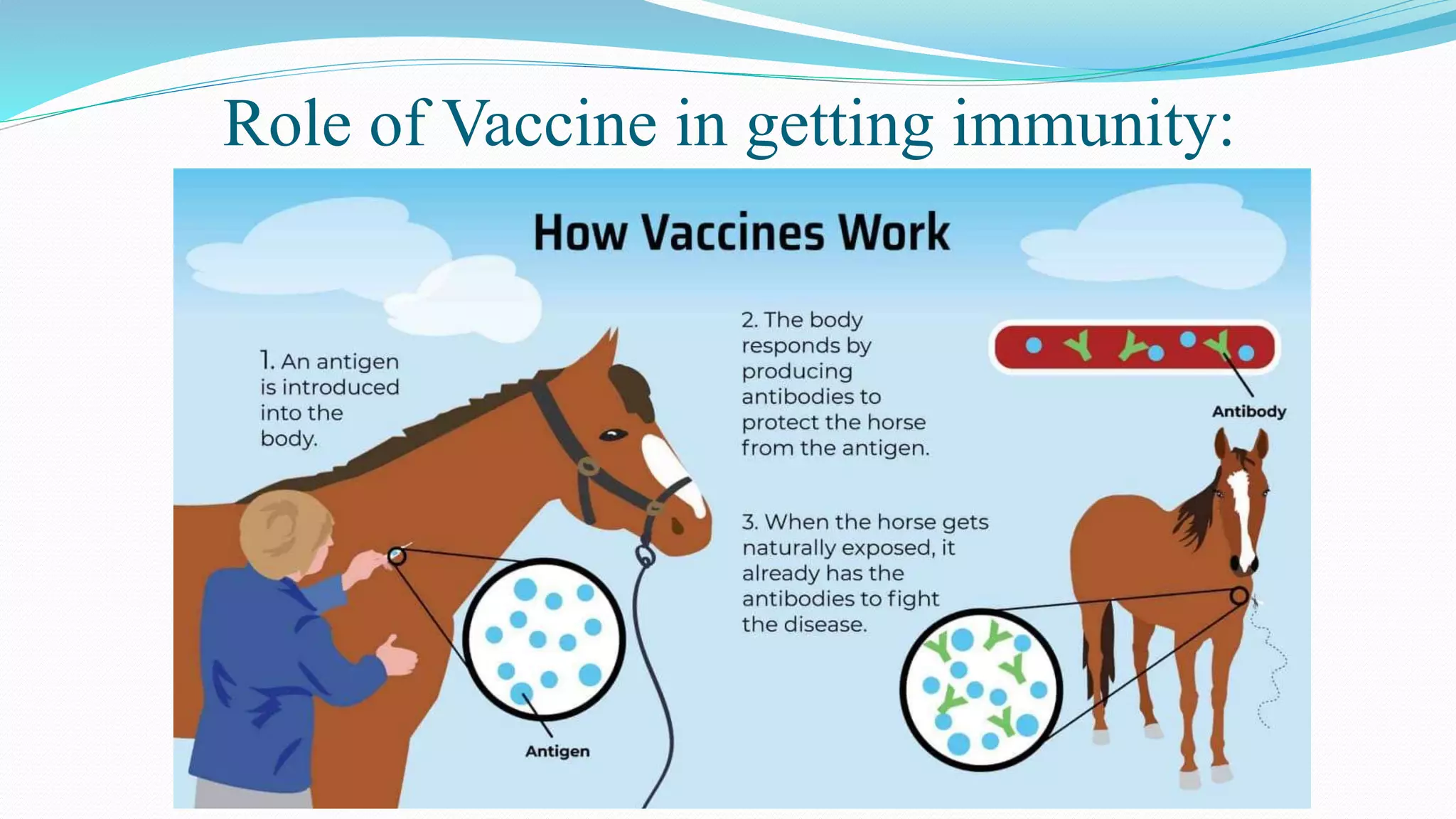
Role of Vaccine in getting immunity:
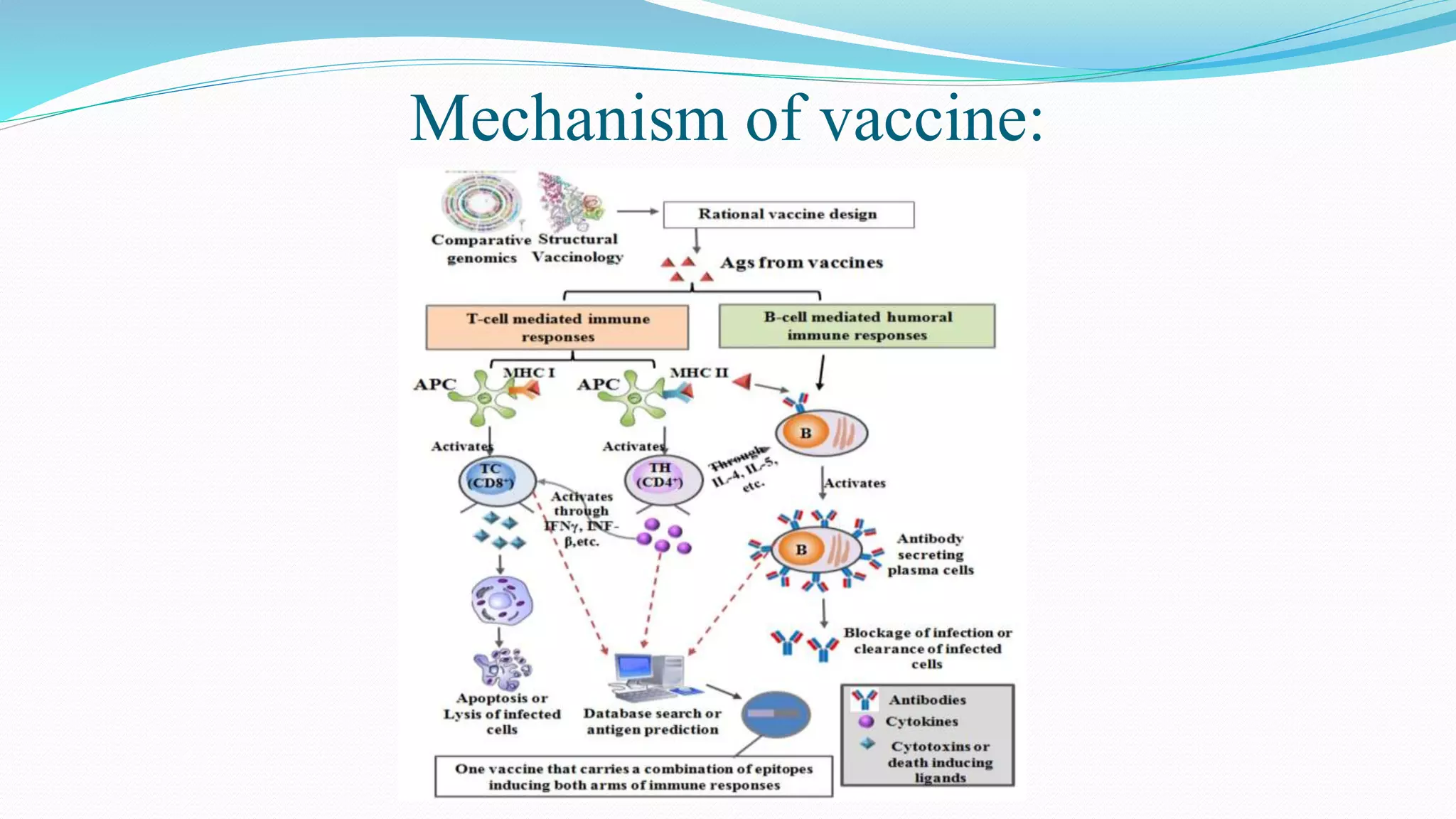
Mechanism of vaccine:
Types:
 Live , attenuated vaccines
 Inactive vaccines
 Subunit vaccines
 Toxoid vaccines
 Conjugate vaccines
 DNA vaccines
 Recombinant vector vaccines
1) Live, attenuated vaccine:
 These vaccines contain a version of the living microbe that has been weakened
in the lab so that it can’t cause disease
 Because a live , attenuated vaccine is the closest thing to a natural infection ,
these vaccines are good “teachers” of the immune system.
 Eg: Vaccines against Measles , Mumps, and Chicken pox.
2) Inactivated or killed vaccines:
 Another common means to achieve attenuation of a vaccine is inactivation of the
pathogen by heat or chemical means so that the pathogen raises an immune response
but is not capable of replication in the host.
 Live attenuated vaccines only require only one dose to induce long lasting immunity.
Killed vaccines on the other hand often require repeated boosters to maintain the
immunity.
 Eg:Polio.
3) Subunit vaccine:
 Many of the risks associated with attenuated or killed whole organism
vaccines can be avoided with vaccines that consists of specific purified
macromolecules derived from pathogens
 Three general forms of vaccines that are components or subunits of the target
pathogens in current use are inactivated exotoxins or toxoids , capsular
polysaccharides and recombinant protein antigens.
 Eg : Plague immunization.
4) Toxoid vaccine:
 Vaccines have been made by purifying the bacterial exotoxin and then
inactivating it with formaldehyde to form toxoids
 Vaccination with the toxoid induces anti-toxoid antibodies , which are capable
of binding to the toxin and neutralizing its effects.
 Eg: Vaccine against Diphtheria and Tetanus.
5) Conjugate vaccine:
 If a possesses an outer coating of sugar molecules called polysaccharides, as
many harmful bacteria do, researchers may try making a conjugate vaccine for
it
 Polysaccharide coatings distinguish a bacterium’s antigens so that the
immature immune systems of infants and younger children can’t recognize or
respond to them
 Eg: Haemophilus influenza type B vaccine
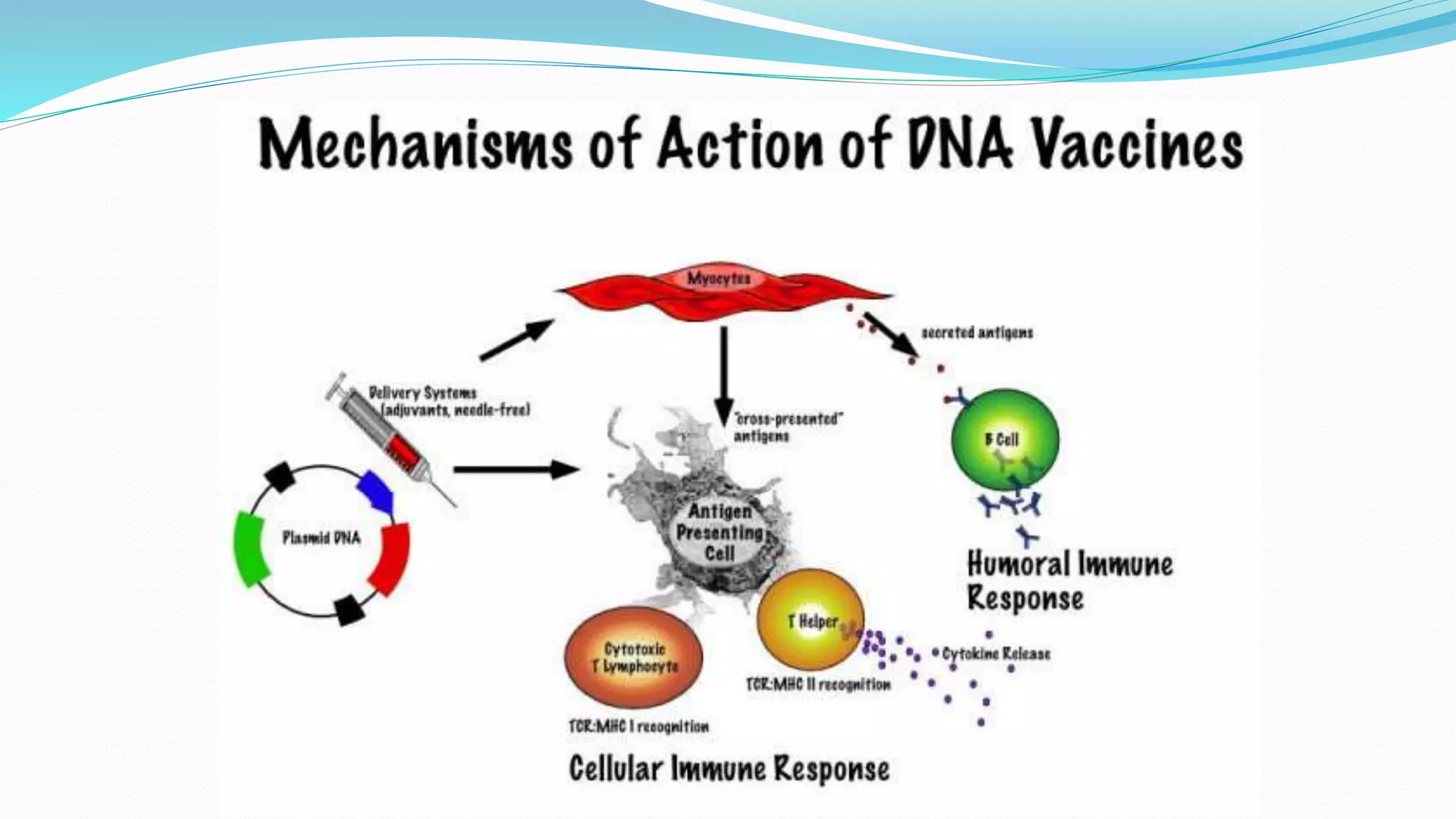
6) DNA vaccine:
A vaccination strategy under investigation
for a number of diseases utilizes DNA
encoding antigenic proteins, which is
injected directly into the muscle of the
recipient.
Advantages:
 DNA vaccines offer advantages over many of the existing vaccines . For
example , the encoded protein is expressed in the host in its natural form, there
is no denaturation or modification,
 DNA vaccines also induce both humoral and cell mediated immunity
 DNA vaccines cause prolonged expression of the antigens , which generates
significant immunological memory.
Refrigeration is not required for handling and storage of plasmid DNA , a
feature that greatly lowers the cost and complexity of delivery.
One manufacturing operation can produce a variety of DNA vaccines from a
single plasmid vectors.
Limitation:
 DNA vaccines are not a universal solution to the problems of vaccination.
 For example, only protein antigens can be encoded, and certain vaccines such
as those for pneumococcal, meningococcal infections, use polysaccharide
antigens and are not candidates for delivery via DNA.
7) Recombinant vector vaccine:
 Recombinant vector vaccines are experimental vaccines similar to DNA
vaccine.
 But they use an attenuated virus or bacterium to introduce microbial DNA to
cells of the body.
 “Vector” refers to the virus or bacterium used as the carrier.
 Eg: DPT.
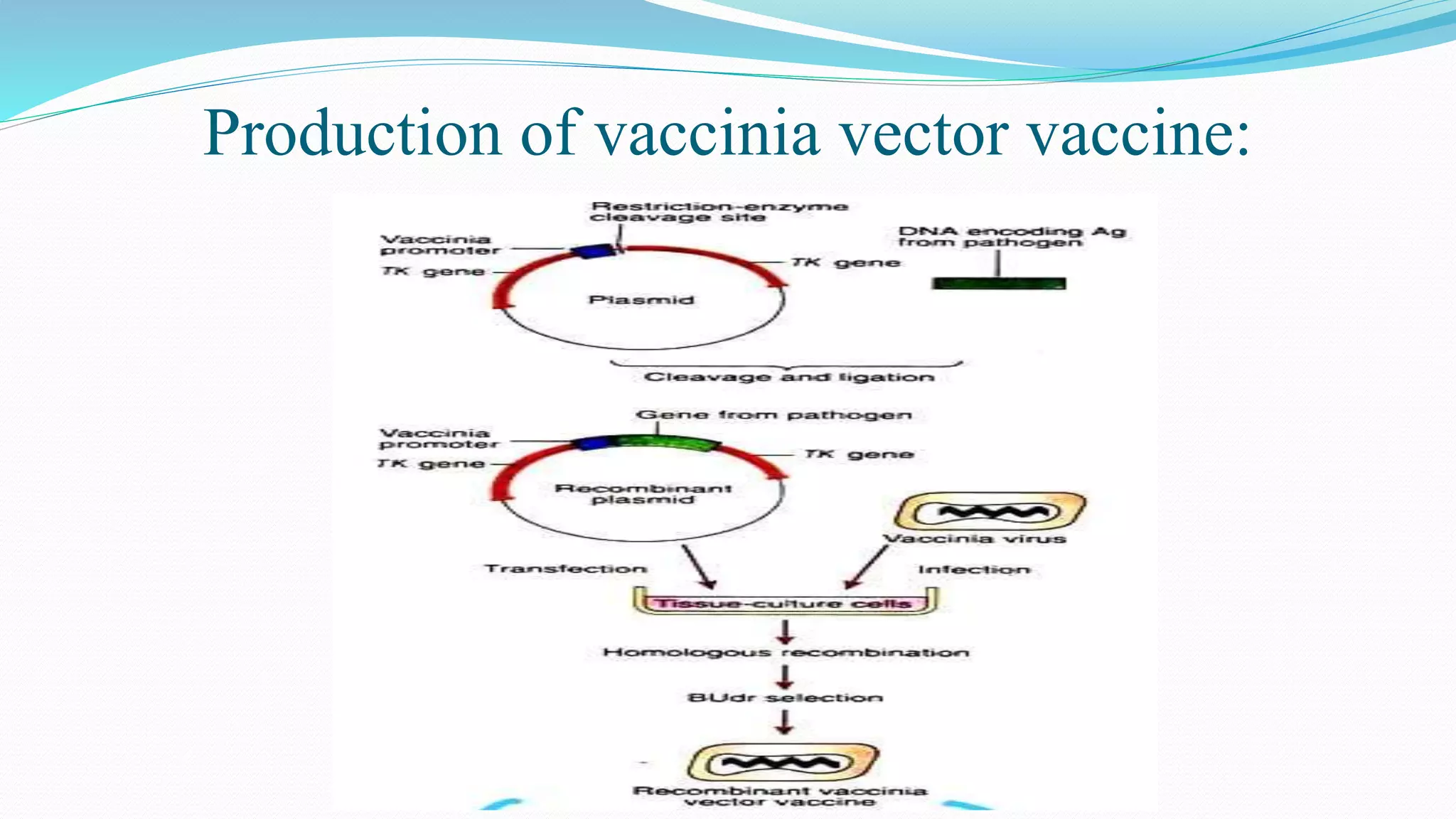
Production of vaccinia vector vaccine:
Advantages:
 Live recombinant bacterial or viral vectors effectively stimulate the immune
system as in natural infections .
 Another possible vector is an attenuated strain of salmonella typhimurium,
which has been engineered with genes from the bacterium that causes cholera.
 This provide effective immunity against a number of diseases, including
cholera and gonorrhea, depends on the increased production of secretory
IgA at mucous membrane surface.
Reference:
 World Health Organisation.
http://www.who.int/topics/vaccines/en/
• National Centre for Biotechnological Information.
http://www.ncbi.nlm.nih.gov/pubmed/19208455
• “Kuby Immunology” (sixth edition) by Thomas J. Kindt , Richard A. Goldsby ,
Barbara A. Osborne.
• Department of Health and Human Services.
https://www.vaccines.gov/more_info/types/
Emerging trend in_biotechnology: Recombinant Vaccine technology

Emerging trend in_biotechnology: Recombinant Vaccine technology

  • 1.
    Vaccine production usingrecombinant DNA technology. By: N.K.Sathish Kumar J.Arrshath Roshan Pre-Final Year, Dept of Biotechnology, K.S.Rangasamy College of Technology.
  • 2.
    Necessity is themother of invention
  • 3.
    What is Biotechnology? Theexploitation of biological processes for the industrial and other purposes, especially the genetic manipulation of microorganisms for the production of antibiotics, hormones, etc.,
  • 4.
    Vaccine:  A substanceused to stimulate the production of antibodies and provide immunity against one or several diseases , that are usually prepared from the causative agent of a disease , its products , or a synthetic substitute , treated to act as an antigen without inducing disease.
  • 5.
    History of vaccines: British physician Edward Jenner , who in 1796 used the cowpox virus (Latin variola vaccinia) to confer protection against smallpox.  In 1885 the French microbiologist Louis Pasteur and Emile Roux developed the first vaccine against Rabies.
  • 6.
    Role of Vaccinein getting immunity:
  • 7.
  • 8.
    Types:  Live ,attenuated vaccines  Inactive vaccines  Subunit vaccines  Toxoid vaccines  Conjugate vaccines  DNA vaccines  Recombinant vector vaccines
  • 9.
    1) Live, attenuatedvaccine:  These vaccines contain a version of the living microbe that has been weakened in the lab so that it can’t cause disease  Because a live , attenuated vaccine is the closest thing to a natural infection , these vaccines are good “teachers” of the immune system.  Eg: Vaccines against Measles , Mumps, and Chicken pox.
  • 10.
    2) Inactivated orkilled vaccines:  Another common means to achieve attenuation of a vaccine is inactivation of the pathogen by heat or chemical means so that the pathogen raises an immune response but is not capable of replication in the host.  Live attenuated vaccines only require only one dose to induce long lasting immunity. Killed vaccines on the other hand often require repeated boosters to maintain the immunity.  Eg:Polio.
  • 11.
    3) Subunit vaccine: Many of the risks associated with attenuated or killed whole organism vaccines can be avoided with vaccines that consists of specific purified macromolecules derived from pathogens  Three general forms of vaccines that are components or subunits of the target pathogens in current use are inactivated exotoxins or toxoids , capsular polysaccharides and recombinant protein antigens.  Eg : Plague immunization.
  • 12.
    4) Toxoid vaccine: Vaccines have been made by purifying the bacterial exotoxin and then inactivating it with formaldehyde to form toxoids  Vaccination with the toxoid induces anti-toxoid antibodies , which are capable of binding to the toxin and neutralizing its effects.  Eg: Vaccine against Diphtheria and Tetanus.
  • 13.
    5) Conjugate vaccine: If a possesses an outer coating of sugar molecules called polysaccharides, as many harmful bacteria do, researchers may try making a conjugate vaccine for it  Polysaccharide coatings distinguish a bacterium’s antigens so that the immature immune systems of infants and younger children can’t recognize or respond to them  Eg: Haemophilus influenza type B vaccine
  • 14.
    6) DNA vaccine: Avaccination strategy under investigation for a number of diseases utilizes DNA encoding antigenic proteins, which is injected directly into the muscle of the recipient.
  • 16.
    Advantages:  DNA vaccinesoffer advantages over many of the existing vaccines . For example , the encoded protein is expressed in the host in its natural form, there is no denaturation or modification,  DNA vaccines also induce both humoral and cell mediated immunity  DNA vaccines cause prolonged expression of the antigens , which generates significant immunological memory. Refrigeration is not required for handling and storage of plasmid DNA , a feature that greatly lowers the cost and complexity of delivery. One manufacturing operation can produce a variety of DNA vaccines from a single plasmid vectors.
  • 17.
    Limitation:  DNA vaccinesare not a universal solution to the problems of vaccination.  For example, only protein antigens can be encoded, and certain vaccines such as those for pneumococcal, meningococcal infections, use polysaccharide antigens and are not candidates for delivery via DNA.
  • 18.
    7) Recombinant vectorvaccine:  Recombinant vector vaccines are experimental vaccines similar to DNA vaccine.  But they use an attenuated virus or bacterium to introduce microbial DNA to cells of the body.  “Vector” refers to the virus or bacterium used as the carrier.  Eg: DPT.
  • 19.
    Production of vacciniavector vaccine:
  • 20.
    Advantages:  Live recombinantbacterial or viral vectors effectively stimulate the immune system as in natural infections .  Another possible vector is an attenuated strain of salmonella typhimurium, which has been engineered with genes from the bacterium that causes cholera.  This provide effective immunity against a number of diseases, including cholera and gonorrhea, depends on the increased production of secretory IgA at mucous membrane surface.
  • 21.
    Reference:  World HealthOrganisation. http://www.who.int/topics/vaccines/en/ • National Centre for Biotechnological Information. http://www.ncbi.nlm.nih.gov/pubmed/19208455 • “Kuby Immunology” (sixth edition) by Thomas J. Kindt , Richard A. Goldsby , Barbara A. Osborne. • Department of Health and Human Services. https://www.vaccines.gov/more_info/types/