Submitted by
Deepika kritaniya
Ph.D Biotechnology
(1st sem)
Human Immunodeficiency Virus (HIV) is a deadly and
incurable illness impacting millions annually. Targeting the T-
helper CD4+ cells of the immune system, HIV is a complex
enveloped pseudo-diploid RNA virus. Of the nineteen proteins
encoded, one of the most readily produced and unique is the
p24 inner capsid protein.
• The development of an HIV vaccine is a crucial
component required to bring the HIV/AIDS epidemic to
an end.
• Vaccines can be either therapeutic or prophylactic.
• Therapeutic vaccines are designed to control/clear HIV
from already infected individuals whereas,
• Prophylactic or preventive vaccines are designed to
reduce the risk of infection in people who are not
infected with HIV and also to reduce the viral load set
point in people infected with HIV.
Species of HIV
• There are currently two known species of HIV, classified as HIV-1
and HIV-2.
• The virus is believed to be the result of at least 11 zoonotic
infections, arising from the transfer of simian immunodeficiency
virus (SIV) in chimpanzees to humans.
• A study of genomic markers places the first SIV infection in
chimpanzees sometime around the year 1492 and the migration to
humans by 1963. While HIV-2 is highly genetically similar to SIV,
HIV-1 is both more virulent as well as more readily transferred.
• HIV-1 is classified into three groups, namely group M (main), O
(other), and N (non-M/non-O), varying in slight genetic
modifications, mainly in the capsid proteins.
• Group M is further broken down into 9 subgroups, again with slight
variations. Further groups continue to arise as the result of genetic
combination of two or more varying strains.
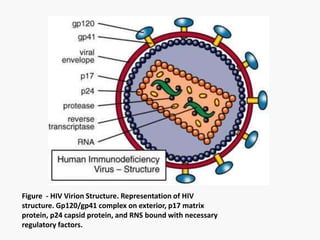
Figure - HIV Virion Structure. Representation of HIV
structure. Gp120/gp41 complex on exterior, p17 matrix
protein, p24 capsid protein, and RNS bound with necessary
regulatory factors.
• The genes referred to as group specific antigen, polymerase,
envelope, transactivators, and regulators.
• Group specific antigen (gag) is a single gene responsible for
the coding of four proteins, p6, p7, p17, and p24, all related
to internal structural or core functions to the virus.
• Both p6 and p7 are nucleo capsids used to protect the RNA
from degradation by way of nucleases, structured in a ratio of
one molecule RNA per hexemer of protein.
• p17 and p24 are both structural proteins, p24 being the main
component of the inner capsid, and p17 used as the anchor to
attach the inner capsid to the outer envelope as well as the
proteins found there in.
• Polymerase (pol) gene encodes three main proteins
responsible for the reverse transcriptase, protease, and
integrases enzymes. Reverse transcriptase is the enzyme by
which RNA is transcribed into DNA. In the case of Retrovirus,
this is used in order to produce the material to insert the viral
RNA genome into the host cell DNA genome.
• Envelope (env) encodes for the exterior viral proteins. Making
use of a host cell enzyme Furin, the fusion protein gp160
coded for my env, is cleaved into two smaller subunits, gp120
and gp41.
• A gp41 trimer is directly attached to the exterior of the virion
with the trimer gp120 affixed onto the end of it. The role of
gp41 is that of mechanical cellular entry into CD4+ cells , as
recognized by the gp120 complex.
Transactivator
• The purpose of a transactivator is to selectively
increase or decrease the rate of gene expression.
• The three produced by HIV are transactivator of
transcription (tat), regulator of virion (rev), and
viral protein-r (vpr).
• Tat works by enhancing the phosphorylation of
cellular factors, thereby increasing their expression.
• Rev is believed to assist with the exportation of
RNA from the cell nucleus to the ctytoplasm,
allowing for the increased production of RNA.
• vpr may potentially work by accelerating the
import of viral precursor into the nucleus, to aid in
RNA production.
Regulatory factors
• Three other miscellaneous regulatory factors are also
present within HIV, viral infectivity factor (vif), negative
regulatory factor (nef), and viral protein-u (vpu).
• Vif works to interrupt a main human antiviral protein,
APOBEC, by targeting it for degradation by the bodies own
immune system.
• Nef decreases the expression of MHC surface protein
signals of the host cell, making it less likely to be marked
for degradation by the immune system, and thereby
increasing the chances of virion survival.
• Vpu is involved in one of the final step of virion production,
the budding of the virion from the host cell.
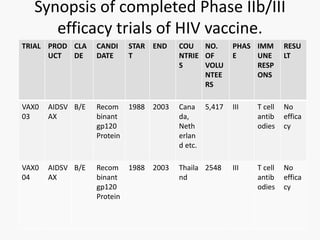
Synopsis of completed Phase IIb/III
efficacy trials of HIV vaccine.
TRIAL PROD
UCT
CLA
DE
CANDI
DATE
STAR
T
END COU
NTRIE
S
NO.
OF
VOLU
NTEE
RS
PHAS
E
IMM
UNE
RESP
ONS
RESU
LT
VAX0
03
AIDSV
AX
B/E Recom
binant
gp120
Protein
1988 2003 Cana
da,
Neth
erlan
d etc.
5,417 III T cell
antib
odies
No
effica
cy
VAX0
04
AIDSV
AX
B/E Recom
binant
gp120
Protein
1988 2003 Thaila
nd
2548 III T cell
antib
odies
No
effica
cy
STEP MRK-
Ad5
B Ad5
gag/p
ol/nef
2005 2007 Austra
lia,
Brazil
etc.
3000 IIb T cell No
efficac
y
PHAM
BILI
MRK-
Ad5
B Ad5
gag/p
ol/nef
2005 2007 South
Africa
801 IIb T cell No
efficac
y
RV144 ALVAC
-HIV
and
AIDSV
AX
B/E Recom
binant
gp120
Protei
n +
Canary
pox
vector
2003 2009 Thilan
d
16402 III T cell
antibo
dies
31.20
%
HVTN
505
DNA
and
Ad5
A/B/C DNA
Ad5
gag/p
ol/ nef
2009 2013 USA 2500 IIb T cell
antibo
dies
No
efficac
y
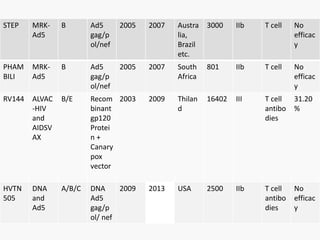
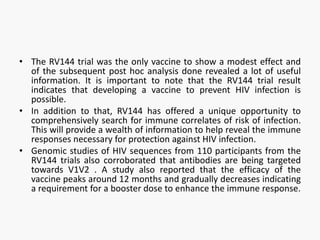
• The RV144 trial was the only vaccine to show a modest effect and
of the subsequent post hoc analysis done revealed a lot of useful
information. It is important to note that the RV144 trial result
indicates that developing a vaccine to prevent HIV infection is
possible.
• In addition to that, RV144 has offered a unique opportunity to
comprehensively search for immune correlates of risk of infection.
This will provide a wealth of information to help reveal the immune
responses necessary for protection against HIV infection.
• Genomic studies of HIV sequences from 110 participants from the
RV144 trials also corroborated that antibodies are being targeted
towards V1V2 . A study also reported that the efficacy of the
vaccine peaks around 12 months and gradually decreases indicating
a requirement for a booster dose to enhance the immune response.
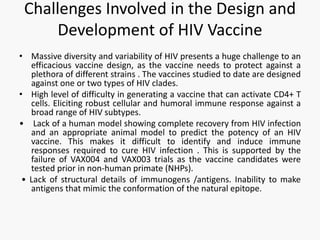
Challenges Involved in the Design and
Development of HIV Vaccine
• Massive diversity and variability of HIV presents a huge challenge to an
efficacious vaccine design, as the vaccine needs to protect against a
plethora of different strains . The vaccines studied to date are designed
against one or two types of HIV clades.
• High level of difficulty in generating a vaccine that can activate CD4+ T
cells. Eliciting robust cellular and humoral immune response against a
broad range of HIV subtypes.
• Lack of a human model showing complete recovery from HIV infection
and an appropriate animal model to predict the potency of an HIV
vaccine. This makes it difficult to identify and induce immune
responses required to cure HIV infection . This is supported by the
failure of VAX004 and VAX003 trials as the vaccine candidates were
tested prior in non-human primate (NHPs).
• Lack of structural details of immunogens /antigens. Inability to make
antigens that mimic the conformation of the natural epitope.
• Non neutralizing antibodies interfering with protective response of
the broadly neutralizing antibodies (bnAbs). Immune correlates of
the RV144 trial have shown production of Non neutralizing
antibodies.
• Person to person variability in T-cell and antibody responses induced
by the vaccine candidates . This was revealed from the study of
Immune correlates of the clinical trials.
• Designing an antigen binding to the B-Cell Receptor (BCR) with high
affinity. Accessibility of epitopes to antibodies .
• Study of the immune correlates of the vaccine trial indicates it is
important to stimulate the production of both IgA and IgG
antibodies.
• Clearance of latent virus. None of the trials have been shown to
effectively clear the latent viruses.
Designs and Strategies for HIV Vaccine
Attenuated and killed virus vaccines
These vaccines rely on direct mimicking of the viral
infection and have been tested in non-human
primate (NHP). None of these approaches induced
neutralizing antibody responses and hence did not
advance to human trials. Setback of these vaccines is
the risk of reversal to pathogenic forms also poses
safety concerns .
Recombinant protein subunit
vaccines
• These are subunits of HIV surface proteins, example gp120
and gp160, made using recombinant DNA technology.
AIDSVAX used in the VAX003 and VAX004 trials was based
on recombinant gp120 (rgp120).
• The failure of the rgp120 based vaccine caused researchers
to focus on developing soluble, recombinant Env trimers as
antigens which resemble the functional HIV Env spike.
• Lately, a soluble trimer that closely mimics antigenic
properties of the natural Env trimer has been developed
and shown to induce enhanced neutralizing antibody
responses relative to monomers in guinea pigs .
• Discovery of broadly neutralizing antibodies (bnAbs) against
HIV-1 with high potency had significant consequences in
vaccine design. bnAbs namely PG9, PG16 and 10E8 showed
neutralization breadth ranging from 80-98% .
• The bnAbs have been shown to bind to different sites like
the CD4 binding site (CD4bs), the first and second variable
regions (V1/V2), the glycan-V3 site on gp120 and the
membrane-proximal external region (MPER) of the gp41
subunit. High potency bnAbs have been shown to provide
robust protection against mucosal SHIV challenge in NHPs .
• Drawback of these vaccines is that they do not effectively
induce cellular immunity and also not mimic the natural
route of infection.
DNA vaccines
• DNA vaccines contain a plasmid with a few HIV genes encoding
proteins of interest that are inserted into the backbone. The vaccine
is administered into the recipient and HIV proteins are expressed.
• The proteins are broken down into peptides and presented on the
surface of the cell for the immune system to respond. The DNA
vaccines will deliver the genes without any immunity generated
against the vector itself.
• The most recent HVTN505 vaccine efficacy trial was a heterologous
prime-boost strategy which evaluated a DNA vector expressing Gag,
Pol, Nef, and Env as a prime and rAd5 vector expressed Gag, Pol,
and Env as a booster.
• No DNA vaccines have yet been accepted for use in humans.
Disadvantages of these vaccines is that they are limited to protein
immunogen only, extended immunostimulation leads to chronic
inflammation.
Live vectors
• Genes of interest are inserted into the genomes of
engineered virus to express the proteins inside the host.
• Viral vectors include non-disease causing viruses that are
replication defective in mammalian cells or viruses that were
engineered to be replication defective by deleting essential
genes
• Genetic sequences that could encompass T-cell epitopes from
global HIV-1 strains have also been created. These sequences
called mosaic sequences constructed for insertion into viral
vectors .
• Adeno Associated virus (AAV), vectors with genes
encoding for a bnAb against HIV-1 have been studied.
This approach confers advantage of directly expressing
broadly neutralizing IgGs, thereby avoiding the difficult
process of eliciting broadly neutralizing antibodies
(bnAbs) by the immune cells.
• A recent study has shown that injection of AAV vectors
with inserts of genes encoding bnAbs into the muscles
of humanized mice has conferred superior protection
against high doses of intravenous HIV challenges. The
design and development of viral vectors has been the
strongest of all other strategies used with some
promising results.
Peptide or protein vaccines
• This approach uses chemically synthesized protein
subunits or peptides as vaccines to elicit cellular and
humoral immune responses.
• The disadvantage is these vaccines require adjuvants
to enhance the immunogenicity and currently alum
is approved as the only adjuvant.
Virus like-particles (VLPs)
• VLPs are look-alikes of infectious virions containing
empty shells of the HIV envelope protein; they lack
viral genome and are therefore non-pathogenic.
• As VLPs resemble the virus, they are capable of
inducing high-level titers of bnAbs to protect against
HIV which exhibit multivalent structures.
• VLPs do not require adjuvant to elicit robust antibody
response as they are highly immunogenic themselves.
• Drawback of VLPs is that they stimulate strain-specific
antibodies and induce an immune response against
host cellular proteins, hence complicating the use of
VLPs as antigens.
Discussion
• For the last two decades or so conventional vaccination
methodologies have so far been unsuccessful in eliciting
strong immune responses against HIV-1 and hence the field of
HIV vaccine research has focused on many alternative vaccine
strategies.
• It is imperative to note that a successful vaccine needs to
elicit both B cell and T cell responses in order to be an
effective preventive vaccine.
• Integrated research endeavors in designing and developing
antigens that elicit broadly neutralizing antibody responses
and protect against HIV infection, boosting up the T cell
response to control viral replication and handling the problem
of enormous HIV diversity are crucial elements in the pursuit
of an HIV vaccine.
• Immune correlates of the modestly efficient RV144
trial have identified the V1V2 region to be the target of
neutralizing antibodies and follow up studies are
underway to evaluate multiple prime-boost regimens
which will generate more data and insights in to the
development of a vaccine.
• Recent discovery of bnAbs has provided a new and
exciting avenue for designing an efficient vaccine.
• Unique approaches like B-cell lineage vaccine and AAV
vector vaccines to elicit bnAb responses are being
studied.
References
• Nageswara Rao A (2014) The Pursuit of a HIV
Vaccine – Trials, Challenges and Strategies. J AIDS
Clin Res 5: 298. doi:10.4172/2155-
6113.1000298.
• Design of Recombinant HIV Vaccine by
Orthoreovirus 5’ Duplication,A Major Qualifying
Project: Submitted to the Faculty of the
WORCESTER POLYTEHCNIC INSTITUTE in partial
fulfillment of the requirements for the Degree of
Bachelor of Science in BiochemistryCameron W.
Habib Thursday, April 29, 2010
hiv vaccine

hiv vaccine

  • 1.
    Submitted by Deepika kritaniya Ph.DBiotechnology (1st sem)
  • 2.
    Human Immunodeficiency Virus(HIV) is a deadly and incurable illness impacting millions annually. Targeting the T- helper CD4+ cells of the immune system, HIV is a complex enveloped pseudo-diploid RNA virus. Of the nineteen proteins encoded, one of the most readily produced and unique is the p24 inner capsid protein.
  • 3.
    • The developmentof an HIV vaccine is a crucial component required to bring the HIV/AIDS epidemic to an end. • Vaccines can be either therapeutic or prophylactic. • Therapeutic vaccines are designed to control/clear HIV from already infected individuals whereas, • Prophylactic or preventive vaccines are designed to reduce the risk of infection in people who are not infected with HIV and also to reduce the viral load set point in people infected with HIV.
  • 4.
    Species of HIV •There are currently two known species of HIV, classified as HIV-1 and HIV-2. • The virus is believed to be the result of at least 11 zoonotic infections, arising from the transfer of simian immunodeficiency virus (SIV) in chimpanzees to humans. • A study of genomic markers places the first SIV infection in chimpanzees sometime around the year 1492 and the migration to humans by 1963. While HIV-2 is highly genetically similar to SIV, HIV-1 is both more virulent as well as more readily transferred. • HIV-1 is classified into three groups, namely group M (main), O (other), and N (non-M/non-O), varying in slight genetic modifications, mainly in the capsid proteins. • Group M is further broken down into 9 subgroups, again with slight variations. Further groups continue to arise as the result of genetic combination of two or more varying strains.
  • 5.
    Figure - HIVVirion Structure. Representation of HIV structure. Gp120/gp41 complex on exterior, p17 matrix protein, p24 capsid protein, and RNS bound with necessary regulatory factors.
  • 6.
    • The genesreferred to as group specific antigen, polymerase, envelope, transactivators, and regulators. • Group specific antigen (gag) is a single gene responsible for the coding of four proteins, p6, p7, p17, and p24, all related to internal structural or core functions to the virus. • Both p6 and p7 are nucleo capsids used to protect the RNA from degradation by way of nucleases, structured in a ratio of one molecule RNA per hexemer of protein. • p17 and p24 are both structural proteins, p24 being the main component of the inner capsid, and p17 used as the anchor to attach the inner capsid to the outer envelope as well as the proteins found there in.
  • 7.
    • Polymerase (pol)gene encodes three main proteins responsible for the reverse transcriptase, protease, and integrases enzymes. Reverse transcriptase is the enzyme by which RNA is transcribed into DNA. In the case of Retrovirus, this is used in order to produce the material to insert the viral RNA genome into the host cell DNA genome. • Envelope (env) encodes for the exterior viral proteins. Making use of a host cell enzyme Furin, the fusion protein gp160 coded for my env, is cleaved into two smaller subunits, gp120 and gp41. • A gp41 trimer is directly attached to the exterior of the virion with the trimer gp120 affixed onto the end of it. The role of gp41 is that of mechanical cellular entry into CD4+ cells , as recognized by the gp120 complex.
  • 8.
    Transactivator • The purposeof a transactivator is to selectively increase or decrease the rate of gene expression. • The three produced by HIV are transactivator of transcription (tat), regulator of virion (rev), and viral protein-r (vpr). • Tat works by enhancing the phosphorylation of cellular factors, thereby increasing their expression. • Rev is believed to assist with the exportation of RNA from the cell nucleus to the ctytoplasm, allowing for the increased production of RNA. • vpr may potentially work by accelerating the import of viral precursor into the nucleus, to aid in RNA production.
  • 9.
    Regulatory factors • Threeother miscellaneous regulatory factors are also present within HIV, viral infectivity factor (vif), negative regulatory factor (nef), and viral protein-u (vpu). • Vif works to interrupt a main human antiviral protein, APOBEC, by targeting it for degradation by the bodies own immune system. • Nef decreases the expression of MHC surface protein signals of the host cell, making it less likely to be marked for degradation by the immune system, and thereby increasing the chances of virion survival. • Vpu is involved in one of the final step of virion production, the budding of the virion from the host cell.
  • 10.
    Synopsis of completedPhase IIb/III efficacy trials of HIV vaccine. TRIAL PROD UCT CLA DE CANDI DATE STAR T END COU NTRIE S NO. OF VOLU NTEE RS PHAS E IMM UNE RESP ONS RESU LT VAX0 03 AIDSV AX B/E Recom binant gp120 Protein 1988 2003 Cana da, Neth erlan d etc. 5,417 III T cell antib odies No effica cy VAX0 04 AIDSV AX B/E Recom binant gp120 Protein 1988 2003 Thaila nd 2548 III T cell antib odies No effica cy
  • 11.
    STEP MRK- Ad5 B Ad5 gag/p ol/nef 20052007 Austra lia, Brazil etc. 3000 IIb T cell No efficac y PHAM BILI MRK- Ad5 B Ad5 gag/p ol/nef 2005 2007 South Africa 801 IIb T cell No efficac y RV144 ALVAC -HIV and AIDSV AX B/E Recom binant gp120 Protei n + Canary pox vector 2003 2009 Thilan d 16402 III T cell antibo dies 31.20 % HVTN 505 DNA and Ad5 A/B/C DNA Ad5 gag/p ol/ nef 2009 2013 USA 2500 IIb T cell antibo dies No efficac y
  • 12.
    • The RV144trial was the only vaccine to show a modest effect and of the subsequent post hoc analysis done revealed a lot of useful information. It is important to note that the RV144 trial result indicates that developing a vaccine to prevent HIV infection is possible. • In addition to that, RV144 has offered a unique opportunity to comprehensively search for immune correlates of risk of infection. This will provide a wealth of information to help reveal the immune responses necessary for protection against HIV infection. • Genomic studies of HIV sequences from 110 participants from the RV144 trials also corroborated that antibodies are being targeted towards V1V2 . A study also reported that the efficacy of the vaccine peaks around 12 months and gradually decreases indicating a requirement for a booster dose to enhance the immune response.
  • 13.
    Challenges Involved inthe Design and Development of HIV Vaccine • Massive diversity and variability of HIV presents a huge challenge to an efficacious vaccine design, as the vaccine needs to protect against a plethora of different strains . The vaccines studied to date are designed against one or two types of HIV clades. • High level of difficulty in generating a vaccine that can activate CD4+ T cells. Eliciting robust cellular and humoral immune response against a broad range of HIV subtypes. • Lack of a human model showing complete recovery from HIV infection and an appropriate animal model to predict the potency of an HIV vaccine. This makes it difficult to identify and induce immune responses required to cure HIV infection . This is supported by the failure of VAX004 and VAX003 trials as the vaccine candidates were tested prior in non-human primate (NHPs). • Lack of structural details of immunogens /antigens. Inability to make antigens that mimic the conformation of the natural epitope.
  • 14.
    • Non neutralizingantibodies interfering with protective response of the broadly neutralizing antibodies (bnAbs). Immune correlates of the RV144 trial have shown production of Non neutralizing antibodies. • Person to person variability in T-cell and antibody responses induced by the vaccine candidates . This was revealed from the study of Immune correlates of the clinical trials. • Designing an antigen binding to the B-Cell Receptor (BCR) with high affinity. Accessibility of epitopes to antibodies . • Study of the immune correlates of the vaccine trial indicates it is important to stimulate the production of both IgA and IgG antibodies. • Clearance of latent virus. None of the trials have been shown to effectively clear the latent viruses.
  • 15.
    Designs and Strategiesfor HIV Vaccine Attenuated and killed virus vaccines These vaccines rely on direct mimicking of the viral infection and have been tested in non-human primate (NHP). None of these approaches induced neutralizing antibody responses and hence did not advance to human trials. Setback of these vaccines is the risk of reversal to pathogenic forms also poses safety concerns .
  • 16.
    Recombinant protein subunit vaccines •These are subunits of HIV surface proteins, example gp120 and gp160, made using recombinant DNA technology. AIDSVAX used in the VAX003 and VAX004 trials was based on recombinant gp120 (rgp120). • The failure of the rgp120 based vaccine caused researchers to focus on developing soluble, recombinant Env trimers as antigens which resemble the functional HIV Env spike. • Lately, a soluble trimer that closely mimics antigenic properties of the natural Env trimer has been developed and shown to induce enhanced neutralizing antibody responses relative to monomers in guinea pigs .
  • 17.
    • Discovery ofbroadly neutralizing antibodies (bnAbs) against HIV-1 with high potency had significant consequences in vaccine design. bnAbs namely PG9, PG16 and 10E8 showed neutralization breadth ranging from 80-98% . • The bnAbs have been shown to bind to different sites like the CD4 binding site (CD4bs), the first and second variable regions (V1/V2), the glycan-V3 site on gp120 and the membrane-proximal external region (MPER) of the gp41 subunit. High potency bnAbs have been shown to provide robust protection against mucosal SHIV challenge in NHPs . • Drawback of these vaccines is that they do not effectively induce cellular immunity and also not mimic the natural route of infection.
  • 18.
    DNA vaccines • DNAvaccines contain a plasmid with a few HIV genes encoding proteins of interest that are inserted into the backbone. The vaccine is administered into the recipient and HIV proteins are expressed. • The proteins are broken down into peptides and presented on the surface of the cell for the immune system to respond. The DNA vaccines will deliver the genes without any immunity generated against the vector itself. • The most recent HVTN505 vaccine efficacy trial was a heterologous prime-boost strategy which evaluated a DNA vector expressing Gag, Pol, Nef, and Env as a prime and rAd5 vector expressed Gag, Pol, and Env as a booster. • No DNA vaccines have yet been accepted for use in humans. Disadvantages of these vaccines is that they are limited to protein immunogen only, extended immunostimulation leads to chronic inflammation.
  • 19.
    Live vectors • Genesof interest are inserted into the genomes of engineered virus to express the proteins inside the host. • Viral vectors include non-disease causing viruses that are replication defective in mammalian cells or viruses that were engineered to be replication defective by deleting essential genes • Genetic sequences that could encompass T-cell epitopes from global HIV-1 strains have also been created. These sequences called mosaic sequences constructed for insertion into viral vectors .
  • 20.
    • Adeno Associatedvirus (AAV), vectors with genes encoding for a bnAb against HIV-1 have been studied. This approach confers advantage of directly expressing broadly neutralizing IgGs, thereby avoiding the difficult process of eliciting broadly neutralizing antibodies (bnAbs) by the immune cells. • A recent study has shown that injection of AAV vectors with inserts of genes encoding bnAbs into the muscles of humanized mice has conferred superior protection against high doses of intravenous HIV challenges. The design and development of viral vectors has been the strongest of all other strategies used with some promising results.
  • 21.
    Peptide or proteinvaccines • This approach uses chemically synthesized protein subunits or peptides as vaccines to elicit cellular and humoral immune responses. • The disadvantage is these vaccines require adjuvants to enhance the immunogenicity and currently alum is approved as the only adjuvant.
  • 22.
    Virus like-particles (VLPs) •VLPs are look-alikes of infectious virions containing empty shells of the HIV envelope protein; they lack viral genome and are therefore non-pathogenic. • As VLPs resemble the virus, they are capable of inducing high-level titers of bnAbs to protect against HIV which exhibit multivalent structures. • VLPs do not require adjuvant to elicit robust antibody response as they are highly immunogenic themselves. • Drawback of VLPs is that they stimulate strain-specific antibodies and induce an immune response against host cellular proteins, hence complicating the use of VLPs as antigens.
  • 23.
    Discussion • For thelast two decades or so conventional vaccination methodologies have so far been unsuccessful in eliciting strong immune responses against HIV-1 and hence the field of HIV vaccine research has focused on many alternative vaccine strategies. • It is imperative to note that a successful vaccine needs to elicit both B cell and T cell responses in order to be an effective preventive vaccine. • Integrated research endeavors in designing and developing antigens that elicit broadly neutralizing antibody responses and protect against HIV infection, boosting up the T cell response to control viral replication and handling the problem of enormous HIV diversity are crucial elements in the pursuit of an HIV vaccine.
  • 24.
    • Immune correlatesof the modestly efficient RV144 trial have identified the V1V2 region to be the target of neutralizing antibodies and follow up studies are underway to evaluate multiple prime-boost regimens which will generate more data and insights in to the development of a vaccine. • Recent discovery of bnAbs has provided a new and exciting avenue for designing an efficient vaccine. • Unique approaches like B-cell lineage vaccine and AAV vector vaccines to elicit bnAb responses are being studied.
  • 25.
    References • Nageswara RaoA (2014) The Pursuit of a HIV Vaccine – Trials, Challenges and Strategies. J AIDS Clin Res 5: 298. doi:10.4172/2155- 6113.1000298. • Design of Recombinant HIV Vaccine by Orthoreovirus 5’ Duplication,A Major Qualifying Project: Submitted to the Faculty of the WORCESTER POLYTEHCNIC INSTITUTE in partial fulfillment of the requirements for the Degree of Bachelor of Science in BiochemistryCameron W. Habib Thursday, April 29, 2010