A. Thangamani ramalingam
PT, MSc(psy),PGDRM,
ACspss MIAP
 Management of vascular disease[8 Hours]:
thrombosis, phlebitis and phlebothrombosis,
 burger’s disease, varicose veins, DVT, venous
ulcers, lymphoedema & its PT management
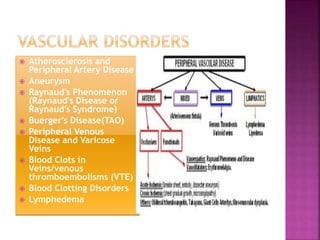
 Atherosclerosis and
Peripheral Artery Disease
 Aneurysm
 Raynaud's Phenomenon
(Raynaud's Disease or
Raynaud's Syndrome)
 Buerger's Disease(TAO)
 Peripheral Venous
Disease and Varicose
Veins
 Blood Clots in
Veins/venous
thromboembolisms (VTE)
 Blood Clotting Disorders
 Lymphedema
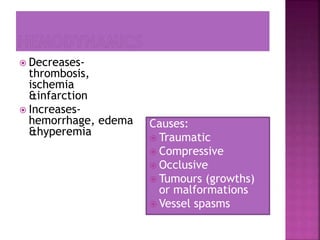
 Decreases-
thrombosis,
ischemia
&infarction
 Increases-
hemorrhage, edema
&hyperemia
Causes:
 Traumatic
 Compressive
 Occlusive
 Tumours (growths)
or malformations
 Vessel spasms
 not engaging in physical exercise
 poor eating habits
 smoking
 drug use
 over age 50
 overweight
 abnormal cholesterol level
 history of cerebrovascular disease or stroke
 heart disease
 diabetes
 family history of high cholesterol, high blood
pressure, or PVD
 high blood pressure
 kidney disease on hemodialysis
 extreme injuries
 blood vessel
inflammation
 infection.
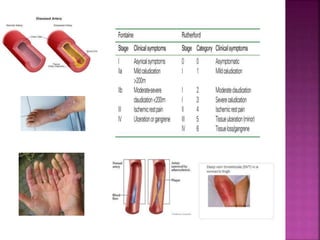
 Pain
 Decreased or no pulse
 Abnormal color
changes in the
fingertips(palor)
 Ulcers or wounds that
do not heal/gangrene
 Hand problems when
in cold temperatures
or locations
 Numbness or tingling
of the fingertips
 Swelling
 Reduced hair growth
 Severe burning of
extremities
 Heavy limbs
 Cramps
 Claudication
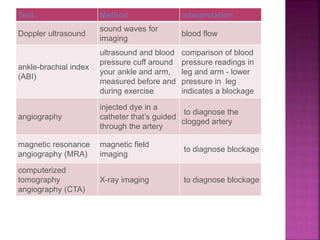
Test Method interpretation
Doppler ultrasound
sound waves for
imaging
blood flow
ankle-brachial index
(ABI)
ultrasound and blood
pressure cuff around
your ankle and arm,
measured before and
during exercise
comparison of blood
pressure readings in
leg and arm - lower
pressure in leg
indicates a blockage
angiography
injected dye in a
catheter that’s guided
through the artery
to diagnose the
clogged artery
magnetic resonance
angiography (MRA)
magnetic field
imaging
to diagnose blockage
computerized
tomography
angiography (CTA)
X-ray imaging to diagnose blockage
Medications
 cilostazol or pentoxifylline
to increase blood flow and
relieve symptoms of
claudication
 clopidogrel or daily aspirin
to reduce blood clotting
 atorvastatin, simvastatin,
or other statins to lower
high cholesterol
 angiotensin-converting
enzyme (ACE) inhibitors to
lower high blood pressure
 diabetes medication to
control blood sugar
 Surgery
 Phlebotomy
 Amputation
Phlebo thrombosis occurs when
a blood clot in a vein, forms
independently from the presence
of inflammation of the vein
(phlebitis). Thrombophlebitis is
phlebitis (vein inflammation)
related to a thrombus (blood
clot). These are conditions usually
of the superficial venous system
and generally mild and
uncomplicated as opposed
to deep vein thromboses which
can be life-threatening
 Phlebitis refers to
inflammation of a vein
 Thrombophlebitis refers to
the formation of a blood
clot associated with
phlebitis.
 Thrombophlebitis can be
superficial (skin level) or
deep (in deeper veins).
 First described by the
Scottish surgeon John
Hunter in 1784.
 Treatment usually consists
of NSAIDs
 Pain
 Swelling
 Redness
 Tenderness
 Hard and cord like
veins
 Increased temp
 Tender/swollen calf
 Red/shiny skin
 Homan’s test positive
 Engorged veins/edema
 Cord like veins
 Pain along the course of the vein
Risk of DVT may begin
during,in24-48hrs or late as
3 months of surgery
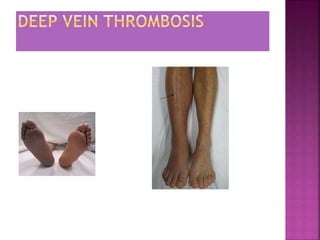
 Homans' sign is a sign of deep vein
thrombosis (DVT). A positive sign is present
when there is pain in the calf or popliteal
region with examiner's abrupt dorsiflexion of
the patient's foot at the ankle while the knee is
flexed to 90 degrees.
 Pratt's sign is an indication of femoral deep
vein thrombosis. It is seen as the presence of
dilated pretibial veins in the affected leg,
which remain dilated on raising the leg.
 The sign was described
by American surgeon Gerald H. Pratt of St.
Vincent's Hospital in 1949
 Wells score or criteria: (Possible score -2 to 9)
 Active cancer (treatment within last 6 months or
palliative) +1 point
 Calf swelling >3 cm compared to other calf (measured
10 cm below tibial tuberosity) +1 point
 Collateral superficial veins (non-varicose) +1 point
 Pitting edema (confined to symptomatic leg) +1 point
 Previous documented DVT +1 point.
 Swelling of entire leg +1 point
 Localized pain along distribution of deep venous system +1 point
 Paralysis, paresis, or recent cast immobilization of lower
extremities +1 point
 Recently bedridden > 3 days, or major surgery requiring regional
or general anesthetic in past 4 weeks +1 point
 Alternative diagnosis at least as likely -2 points
Interpretation:
 Score of 2 or higher — deep vein
thrombosis is likely. Consider imaging the
leg veins.
 Score of less than 2 — deep vein
thrombosis is unlikely. Consider blood test
such as d-dimer test to further rule out
deep vein thrombosis.
 Night pain
 Venous ulceration
 edema
 Duplex ultra sound
 Venography
 Impedance plethysmography
 MRI
 D-dimer blood test
 Heparin
 Warfarin
 Aspirin
 Dextran
 Compression devices
Medicines don’t usually work
well to treat the disease.
surgery may be effective
stop using all tobacco products
 recurring progressive
inflammation and
thrombosis (clotting)
of small and medium
arteries and veins of
the hands and feet.
 Pain
 Claudication at
rest/walking
 ischemic ulcers or
gangrene
 Cold hands or feet
 Skin changes
 With the patient
supine, note the
colour of the feet
soles. They should be
pink. Then elevate
both legs to 45
degrees for more than
1 minute. Observe
the soles. If there is
marked pallor
(whiteness), ischemia
should be suspected.
 Capillary refill test
 Rubor of dependency:
Sit the patient upright
and observe the feet.
In normal patients,
the feet quickly turn
pink. If, more slowly,
they turn red like a
cooked lobster,
suspect ischemia.
 Elevate leg to approximately 60 for 1‐2
minutes • Allow gravity to drain distal veins •
Quickly lower leg over edge of table/bed to
dependent position (leg hanging
perpendicular to floor) • Observe superficial
veins and record amount of time required for
them to refill and return to baseline
appearance • Normal 5‐15 seconds • > 20
seconds indicative of moderate to sever
arterial insufficiency • If refill < 5 seconds
suspect venous insufficiency
 The ankle pressure should be equal to or
slightly higher than the arm pressure in the
absence of arterial occlusive disease
 Buerger exercises is a system
of exercises for arterial
insufficiency of lower limbs,
consisting of legs elevation,
followed by dependency of the
legs, and finally horizontal
position of legs for rest.
Published in 1924 by Leo
Buerger (1879-1943), New York
physician.
 Buerger exercises augmented
by active exercises of the feet.
These exercises consist in
flexion, extension, and
circumduction of the ankles
and are done during the phase
of dependency of the legs, as
suggested in 1931 by Arthur W.
Allen (1887-1958).
 Buerger-Allen exercise - Specific
exercises intended to improve
circulation to the feet and legs. The
lower extremities are elevated to a
45 to 90 degree angle and supported
in this position until the skin blanches
(appears dead white). The feet and
legs are then lowered below the level
of the rest of the body until redness
appears (care should be taken that
there is no pressure against the back
of the knees); finally, the legs are
placed flat on the bed for a few
minutes. The length of time for each
position varies with the patient's
tolerance and the speed with which
color change occurs. Usually the
exercises are prescribed so that the
legs are elevated for 2 to 3 minutes,
down 5 to 10 minutes, and then flat
on the bed for 10 minutes.
 Valvular
insufficiency/valvular
incompetence
 visible, bulging, palpable
(can be felt by touching),
long, and dilated (greater
than 4 millimeters in
diameter).
 retrograde flow or venous
reflux
 leg swelling, stasis
dermatitis/venous eczema,
skin
thickening(lipodermatosclero
sis) and ulceration
 Cramps
 telangiectasia/spider veins
 sclerotherapy, elastic
stockings, leg elevation and
exercise.
 ultrasound-guided foam
sclerotherapy,
radiofrequency ablation and
endovenous laser treatment.
 Cryotherapy
 patient in the supine position
 leg is flexed at the hip and raised
 A tourniquet is applied around the upper thigh to compress the
superficial veins
 The leg is then lowered by asking the patient to stand.
 Normally the superficial saphenous vein will fill from below
within 30–35 seconds as blood from the capillary beds reaches the
veins; if the superficial veins fill more rapidly with the tourniquet
in place there is valvular incompetence below the level of the
tourniquet in the "deep" or "communicating" veins. After 20
seconds, if there has been no rapid filling, the tourniquet is
released. If there is sudden filling at this point, it indicates that
the deep and communicating veins are competent but the
superficial veins are incompetent
 The test can be repeated with the tourniquet at different levels
 above the knee - to assess the mid-thigh perforators
 below the knee - to assess incompetence between the short
saphenous vein and the popliteal vein
 commonly used as sclerosants are
polidocanol, sodium tetradecyl sulphate
(STS), Sclerodex , Hypertonic Saline, Glycerin
and Chromated Glycerin.
 Flavonoids drug therapy.
 An ulcer is a shallow destruction of the
skin tissues & mucous membrane
which may occur at any part of the
body. Various ulcers are the
complication of various veinous
problems
 Stasis and congestion both in veins &
lymphatics
 Slight trauma – break down of skin –
infected – ulcer – chronic inflammation
–pain & stiffness – less usage –
hypotonia of the muscle – decreased
venous pumping –stasis & congestion –
skin more prone for injuries(vicious
cycle)
 Massage/pain relief/FUP/UVR/Laser
 Bisguard bandage method
Infected
ulcer
Hyper
granulating
ulcer
Healing ulcer
Chronic ulcer
Indurated
chronic ulcer
Indolent
ulcer
 Primary
 Secondary
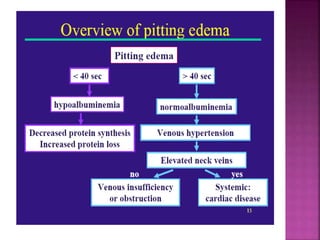
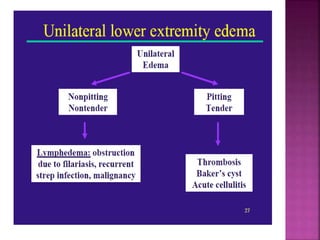
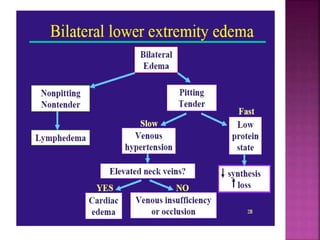
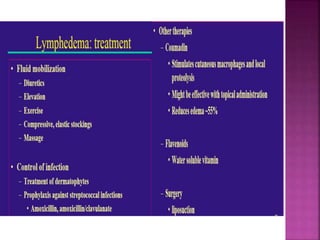
 1. Increased Hydro static Pressure of blood
 2. Decreased Osmotic Pressure of blood
 3. Increased Capillary permeability
 4. Lymphatic obstruction
 5. Slowed flow of blood and lymph
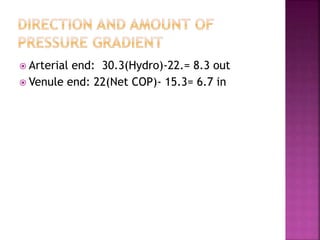
 Arterial end: 30.3(Hydro)-22.= 8.3 out
 Venule end: 22(Net COP)- 15.3= 6.7 in
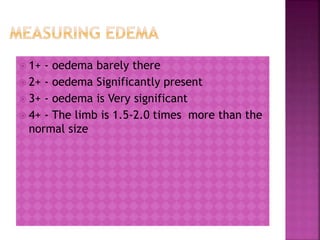
 1+ - oedema barely there
 2+ - oedema Significantly present
 3+ - oedema is Very significant
 4+ - The limb is 1.5-2.0 times more than the
normal size
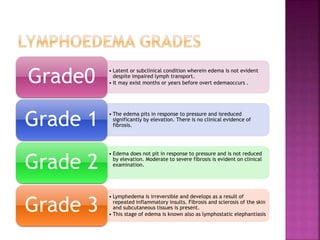
• Latent or subclinical condition wherein edema is not evident
despite impaired lymph transport.
• It may exist months or years before overt edemaoccurs .Grade0
• The edema pits in response to pressure and isreduced
significantly by elevation. There is no clinical evidence of
fibrosis.Grade 1
• Edema does not pit in response to pressure and is not reduced
by elevation. Moderate to severe fibrosis is evident on clinical
examination.Grade 2
• Lymphedema is irreversible and develops as a result of
repeated inflammatory insults. Fibrosis and sclerosis of the skin
and subcutaneous tissues is present.
• This stage of edema is known also as lymphostatic elephantiasis
Grade 3
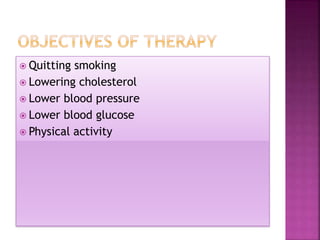
 Quitting smoking
 Lowering cholesterol
 Lower blood pressure
 Lower blood glucose
 Physical activity
 The recommended parameters of physical exercise
are a 6 month program of 30-35 minutes walking
sessions at a frequency of 3-5 times a week at near-
maximal pain tolerant (Mahameed, AA, Bartholomew,
JR, Disease of Peripheral Vessels. In: Topol, EJ,
editor. Textbook of Cardiovascular Medicine. 3rd ed.
New York: Lippincott Williams &amp; Wilkins, 2007,
p.1531-1537).
 NICE recommends PAD patients to exercise at near-
maximal pain for a total of 2 hours per week for 3
months to improve quality of life (NICE National
Institute for Health and Care Excellence. Lower limb
peripheral arterial disease: diagnosis and
management,2012. https://www.nice.org.uk/guidanc
e/cg147/chapter/guidance#management-of-
intermittent-claudication)
• Gardner AW, Poehlman ET. Exercise rehabilitation programs for the
treatment of claudication pain. A meta-analysis. JAMA. 1995;274:975-80.
• Lauret GJ, Fakhry F, Fokkenrood HJ, Hunink MG, Teijink JA, Spronk
S. Modes of exercise training for intermittent claudication. Cochrane
Database Syst Rev. 2014;7:CD009638
 The duration and frequency of the exercise training
sessions and duration of the exercise training program are
important to achieve maximal benefit with training
sessions: >30 minutes per session provides greater benefit
than <30 minutes per session; >3 sessions per week is more
effective than <3 sessions per week, and program lengths
of >26 weeks are more effective than program lengths of
<26 weeks .
 Alternatives to treadmill exercise potentially consist of
various forms of lower extremity exercise alone or in
combination (brisk walking, bicycle ergometer, and
strength training). However, the outcomes of treadmill
exercise have so far been found to be superior to the
outcomes of several other lower extremity exercises,
namely cycling, stair climbing, and static and dynamic leg
exercises .
Vascular disorders

Vascular disorders

  • 1.
    A. Thangamani ramalingam PT,MSc(psy),PGDRM, ACspss MIAP
  • 2.
     Management ofvascular disease[8 Hours]: thrombosis, phlebitis and phlebothrombosis,  burger’s disease, varicose veins, DVT, venous ulcers, lymphoedema & its PT management
  • 3.
     Atherosclerosis and PeripheralArtery Disease  Aneurysm  Raynaud's Phenomenon (Raynaud's Disease or Raynaud's Syndrome)  Buerger's Disease(TAO)  Peripheral Venous Disease and Varicose Veins  Blood Clots in Veins/venous thromboembolisms (VTE)  Blood Clotting Disorders  Lymphedema
  • 4.
     Decreases- thrombosis, ischemia &infarction  Increases- hemorrhage,edema &hyperemia Causes:  Traumatic  Compressive  Occlusive  Tumours (growths) or malformations  Vessel spasms
  • 5.
     not engagingin physical exercise  poor eating habits  smoking  drug use  over age 50  overweight  abnormal cholesterol level  history of cerebrovascular disease or stroke  heart disease  diabetes  family history of high cholesterol, high blood pressure, or PVD  high blood pressure  kidney disease on hemodialysis  extreme injuries  blood vessel inflammation  infection.
  • 6.
     Pain  Decreasedor no pulse  Abnormal color changes in the fingertips(palor)  Ulcers or wounds that do not heal/gangrene  Hand problems when in cold temperatures or locations  Numbness or tingling of the fingertips  Swelling  Reduced hair growth  Severe burning of extremities  Heavy limbs  Cramps  Claudication
  • 8.
    Test Method interpretation Dopplerultrasound sound waves for imaging blood flow ankle-brachial index (ABI) ultrasound and blood pressure cuff around your ankle and arm, measured before and during exercise comparison of blood pressure readings in leg and arm - lower pressure in leg indicates a blockage angiography injected dye in a catheter that’s guided through the artery to diagnose the clogged artery magnetic resonance angiography (MRA) magnetic field imaging to diagnose blockage computerized tomography angiography (CTA) X-ray imaging to diagnose blockage
  • 9.
    Medications  cilostazol orpentoxifylline to increase blood flow and relieve symptoms of claudication  clopidogrel or daily aspirin to reduce blood clotting  atorvastatin, simvastatin, or other statins to lower high cholesterol  angiotensin-converting enzyme (ACE) inhibitors to lower high blood pressure  diabetes medication to control blood sugar  Surgery  Phlebotomy  Amputation
  • 10.
    Phlebo thrombosis occurswhen a blood clot in a vein, forms independently from the presence of inflammation of the vein (phlebitis). Thrombophlebitis is phlebitis (vein inflammation) related to a thrombus (blood clot). These are conditions usually of the superficial venous system and generally mild and uncomplicated as opposed to deep vein thromboses which can be life-threatening  Phlebitis refers to inflammation of a vein  Thrombophlebitis refers to the formation of a blood clot associated with phlebitis.  Thrombophlebitis can be superficial (skin level) or deep (in deeper veins).  First described by the Scottish surgeon John Hunter in 1784.  Treatment usually consists of NSAIDs  Pain  Swelling  Redness  Tenderness  Hard and cord like veins
  • 11.
     Increased temp Tender/swollen calf  Red/shiny skin  Homan’s test positive  Engorged veins/edema  Cord like veins  Pain along the course of the vein
  • 13.
    Risk of DVTmay begin during,in24-48hrs or late as 3 months of surgery
  • 14.
     Homans' signis a sign of deep vein thrombosis (DVT). A positive sign is present when there is pain in the calf or popliteal region with examiner's abrupt dorsiflexion of the patient's foot at the ankle while the knee is flexed to 90 degrees.
  • 15.
     Pratt's signis an indication of femoral deep vein thrombosis. It is seen as the presence of dilated pretibial veins in the affected leg, which remain dilated on raising the leg.  The sign was described by American surgeon Gerald H. Pratt of St. Vincent's Hospital in 1949
  • 16.
     Wells scoreor criteria: (Possible score -2 to 9)  Active cancer (treatment within last 6 months or palliative) +1 point  Calf swelling >3 cm compared to other calf (measured 10 cm below tibial tuberosity) +1 point  Collateral superficial veins (non-varicose) +1 point  Pitting edema (confined to symptomatic leg) +1 point  Previous documented DVT +1 point.  Swelling of entire leg +1 point  Localized pain along distribution of deep venous system +1 point  Paralysis, paresis, or recent cast immobilization of lower extremities +1 point  Recently bedridden > 3 days, or major surgery requiring regional or general anesthetic in past 4 weeks +1 point  Alternative diagnosis at least as likely -2 points
  • 17.
    Interpretation:  Score of2 or higher — deep vein thrombosis is likely. Consider imaging the leg veins.  Score of less than 2 — deep vein thrombosis is unlikely. Consider blood test such as d-dimer test to further rule out deep vein thrombosis.
  • 18.
     Night pain Venous ulceration  edema
  • 19.
     Duplex ultrasound  Venography  Impedance plethysmography  MRI  D-dimer blood test
  • 20.
     Heparin  Warfarin Aspirin  Dextran  Compression devices
  • 21.
    Medicines don’t usuallywork well to treat the disease. surgery may be effective stop using all tobacco products  recurring progressive inflammation and thrombosis (clotting) of small and medium arteries and veins of the hands and feet.  Pain  Claudication at rest/walking  ischemic ulcers or gangrene  Cold hands or feet  Skin changes
  • 22.
     With thepatient supine, note the colour of the feet soles. They should be pink. Then elevate both legs to 45 degrees for more than 1 minute. Observe the soles. If there is marked pallor (whiteness), ischemia should be suspected.  Capillary refill test  Rubor of dependency: Sit the patient upright and observe the feet. In normal patients, the feet quickly turn pink. If, more slowly, they turn red like a cooked lobster, suspect ischemia.
  • 23.
     Elevate legto approximately 60 for 1‐2 minutes • Allow gravity to drain distal veins • Quickly lower leg over edge of table/bed to dependent position (leg hanging perpendicular to floor) • Observe superficial veins and record amount of time required for them to refill and return to baseline appearance • Normal 5‐15 seconds • > 20 seconds indicative of moderate to sever arterial insufficiency • If refill < 5 seconds suspect venous insufficiency
  • 24.
     The anklepressure should be equal to or slightly higher than the arm pressure in the absence of arterial occlusive disease
  • 25.
     Buerger exercisesis a system of exercises for arterial insufficiency of lower limbs, consisting of legs elevation, followed by dependency of the legs, and finally horizontal position of legs for rest. Published in 1924 by Leo Buerger (1879-1943), New York physician.  Buerger exercises augmented by active exercises of the feet. These exercises consist in flexion, extension, and circumduction of the ankles and are done during the phase of dependency of the legs, as suggested in 1931 by Arthur W. Allen (1887-1958).  Buerger-Allen exercise - Specific exercises intended to improve circulation to the feet and legs. The lower extremities are elevated to a 45 to 90 degree angle and supported in this position until the skin blanches (appears dead white). The feet and legs are then lowered below the level of the rest of the body until redness appears (care should be taken that there is no pressure against the back of the knees); finally, the legs are placed flat on the bed for a few minutes. The length of time for each position varies with the patient's tolerance and the speed with which color change occurs. Usually the exercises are prescribed so that the legs are elevated for 2 to 3 minutes, down 5 to 10 minutes, and then flat on the bed for 10 minutes.
  • 26.
     Valvular insufficiency/valvular incompetence  visible,bulging, palpable (can be felt by touching), long, and dilated (greater than 4 millimeters in diameter).  retrograde flow or venous reflux  leg swelling, stasis dermatitis/venous eczema, skin thickening(lipodermatosclero sis) and ulceration  Cramps  telangiectasia/spider veins  sclerotherapy, elastic stockings, leg elevation and exercise.  ultrasound-guided foam sclerotherapy, radiofrequency ablation and endovenous laser treatment.  Cryotherapy
  • 27.
     patient inthe supine position  leg is flexed at the hip and raised  A tourniquet is applied around the upper thigh to compress the superficial veins  The leg is then lowered by asking the patient to stand.  Normally the superficial saphenous vein will fill from below within 30–35 seconds as blood from the capillary beds reaches the veins; if the superficial veins fill more rapidly with the tourniquet in place there is valvular incompetence below the level of the tourniquet in the "deep" or "communicating" veins. After 20 seconds, if there has been no rapid filling, the tourniquet is released. If there is sudden filling at this point, it indicates that the deep and communicating veins are competent but the superficial veins are incompetent  The test can be repeated with the tourniquet at different levels  above the knee - to assess the mid-thigh perforators  below the knee - to assess incompetence between the short saphenous vein and the popliteal vein
  • 28.
     commonly usedas sclerosants are polidocanol, sodium tetradecyl sulphate (STS), Sclerodex , Hypertonic Saline, Glycerin and Chromated Glycerin.  Flavonoids drug therapy.
  • 29.
     An ulceris a shallow destruction of the skin tissues & mucous membrane which may occur at any part of the body. Various ulcers are the complication of various veinous problems  Stasis and congestion both in veins & lymphatics  Slight trauma – break down of skin – infected – ulcer – chronic inflammation –pain & stiffness – less usage – hypotonia of the muscle – decreased venous pumping –stasis & congestion – skin more prone for injuries(vicious cycle)  Massage/pain relief/FUP/UVR/Laser  Bisguard bandage method Infected ulcer Hyper granulating ulcer Healing ulcer Chronic ulcer Indurated chronic ulcer Indolent ulcer
  • 30.
  • 31.
     1. IncreasedHydro static Pressure of blood  2. Decreased Osmotic Pressure of blood  3. Increased Capillary permeability  4. Lymphatic obstruction  5. Slowed flow of blood and lymph
  • 32.
     Arterial end:30.3(Hydro)-22.= 8.3 out  Venule end: 22(Net COP)- 15.3= 6.7 in
  • 33.
     1+ -oedema barely there  2+ - oedema Significantly present  3+ - oedema is Very significant  4+ - The limb is 1.5-2.0 times more than the normal size
  • 34.
    • Latent orsubclinical condition wherein edema is not evident despite impaired lymph transport. • It may exist months or years before overt edemaoccurs .Grade0 • The edema pits in response to pressure and isreduced significantly by elevation. There is no clinical evidence of fibrosis.Grade 1 • Edema does not pit in response to pressure and is not reduced by elevation. Moderate to severe fibrosis is evident on clinical examination.Grade 2 • Lymphedema is irreversible and develops as a result of repeated inflammatory insults. Fibrosis and sclerosis of the skin and subcutaneous tissues is present. • This stage of edema is known also as lymphostatic elephantiasis Grade 3
  • 41.
     Quitting smoking Lowering cholesterol  Lower blood pressure  Lower blood glucose  Physical activity
  • 42.
     The recommendedparameters of physical exercise are a 6 month program of 30-35 minutes walking sessions at a frequency of 3-5 times a week at near- maximal pain tolerant (Mahameed, AA, Bartholomew, JR, Disease of Peripheral Vessels. In: Topol, EJ, editor. Textbook of Cardiovascular Medicine. 3rd ed. New York: Lippincott Williams &amp; Wilkins, 2007, p.1531-1537).  NICE recommends PAD patients to exercise at near- maximal pain for a total of 2 hours per week for 3 months to improve quality of life (NICE National Institute for Health and Care Excellence. Lower limb peripheral arterial disease: diagnosis and management,2012. https://www.nice.org.uk/guidanc e/cg147/chapter/guidance#management-of- intermittent-claudication)
  • 43.
    • Gardner AW,Poehlman ET. Exercise rehabilitation programs for the treatment of claudication pain. A meta-analysis. JAMA. 1995;274:975-80. • Lauret GJ, Fakhry F, Fokkenrood HJ, Hunink MG, Teijink JA, Spronk S. Modes of exercise training for intermittent claudication. Cochrane Database Syst Rev. 2014;7:CD009638  The duration and frequency of the exercise training sessions and duration of the exercise training program are important to achieve maximal benefit with training sessions: >30 minutes per session provides greater benefit than <30 minutes per session; >3 sessions per week is more effective than <3 sessions per week, and program lengths of >26 weeks are more effective than program lengths of <26 weeks .  Alternatives to treadmill exercise potentially consist of various forms of lower extremity exercise alone or in combination (brisk walking, bicycle ergometer, and strength training). However, the outcomes of treadmill exercise have so far been found to be superior to the outcomes of several other lower extremity exercises, namely cycling, stair climbing, and static and dynamic leg exercises .