Injuries of shoulder girdle
clavicle fracture
scapula fracture
CLAVICLE :
Is an S-shape long, curved ,tubular bone , lies horizontally
a cross the root of neck .
It articulate with sternum medially to form sternoclavicular
joint.
Also articulate with acromion process of scapula at
acromioclavicular joint and acromioclavicular ligament .
the muscles inserting on clavicle are : sternocleidomastoid,
And subclavius muscles .
The subclavian vessels and brachial plexus lie posterior to
clavicle .
CLAVICLE ANATOMY
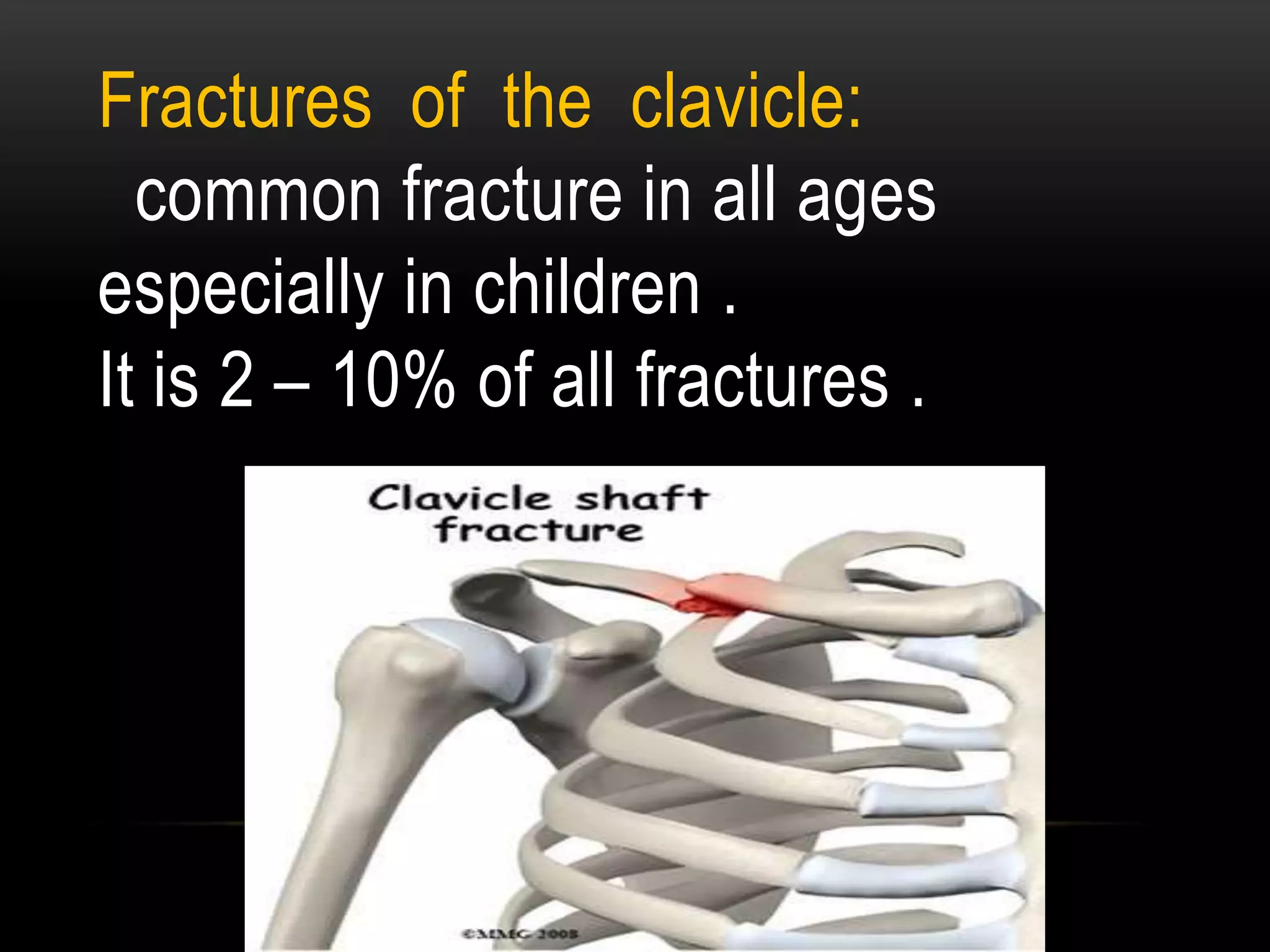
Fractures of the clavicle:
common fracture in all ages
especially in children .
It is 2 – 10% of all fractures .
Mechanism of injury :
Direct traumatic impact or fall on the shoulder 87% .
Direct impact to clavicle 07% .
Fall on outstretched hand 06% .
From fall on the side .
Vigorous muscle contraction , seizures [rare] .
Pathological fracture [rare] .
Mechanism of injury
Most common causes are :
Road traffic accident [RTA]
Sporting injuries
Allman classification : according to site of
fracture :
group 1: Fracture mostly occur in the
middle one third of clavicle 80% .
group 2: The fractures of outer third is 15% .
Fractures involving the acromioclavicular joint 28% .
group 3: fracture of inner [medial] third 5% .
Why does the fracture occur in middle
third more ?
It is the thinnest part of the bone .
It is the junction of the tow main curves of shaft .
Site of entrance of nutrient artery .
common pattern of fractures of
clavicle are :
1 - Green stick fracture :
Common at the junction between
middle and outer third .
Common in children .
2 - Un displaced fracture in :
3 - Separation of bone end :
4 - With greater displacement :
•There is over lapping and shortening .
Clinical presentation :
pain and tenderness at site of injury .
Obvious deformity and swelling sometimes
occur .
Patient come support his injured limb with other
hand and head tilted
toward injured side .
Local bruising .
vascular compilication are rare , but we must look
for it by : check pulse , gently palpate root of neck
.
Outer third # are easily missed for
acromioclavicular joint .
Diagnosis :
- Clinical picture  examination .
investigation :
x-ray [AP view ] :
# is usually in middle third, outer fragment below
the inner .
#of outer third may be missed .
CT scan : useful for non union assessment .
arteriography : if vascular injury suspected .
Treatment :
The aim is to provide support for the weight of the
arm .
Fracture of clavicle unite with or without treatment .
Healing occurs usually in 3-6 weeks .
It may be :
conservative or surgical .
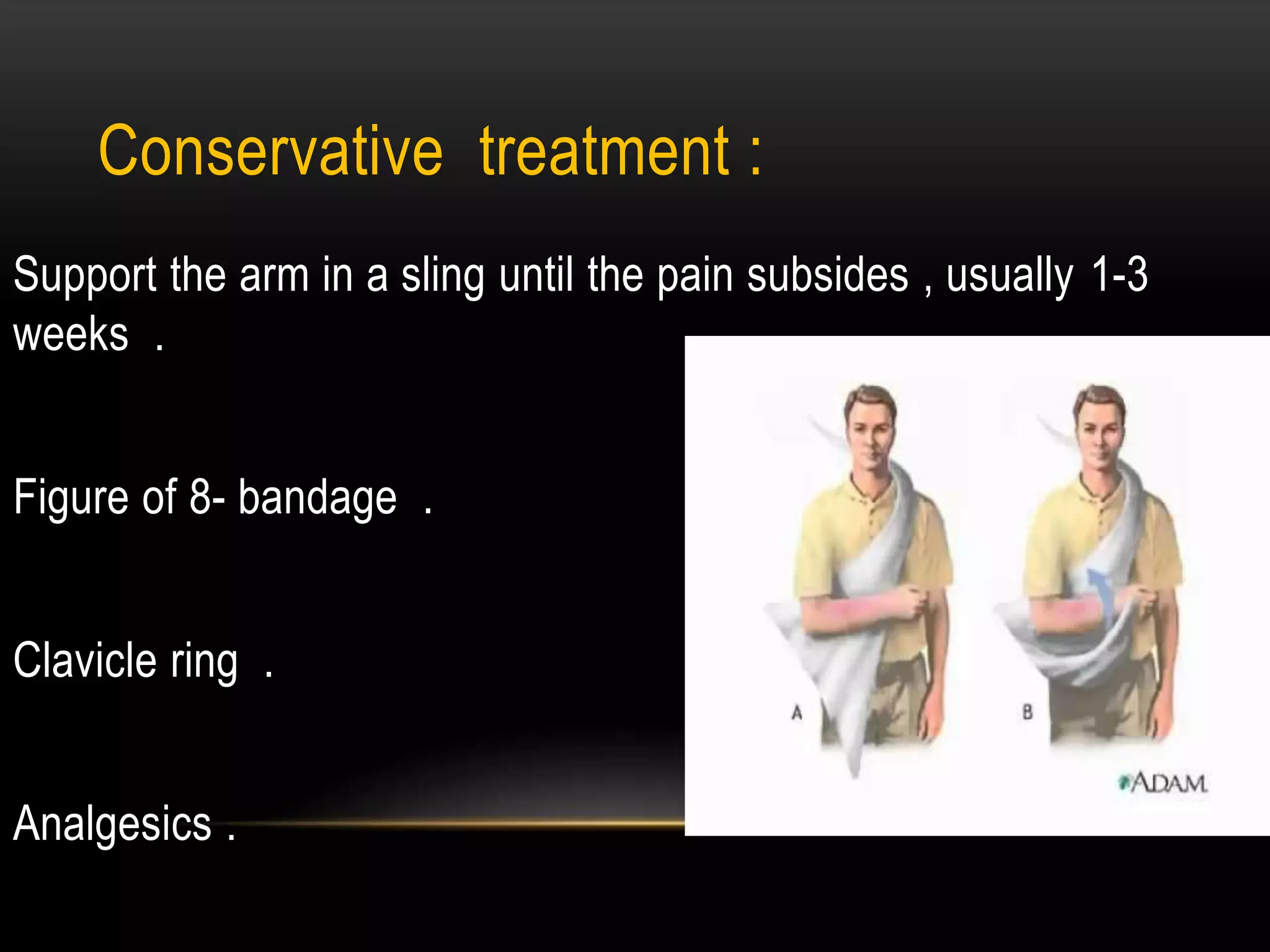
Conservative treatment :
Support the arm in a sling until the pain subsides , usually 1-3
weeks .
Figure of 8- bandage .
Clavicle ring .
Analgesics .
Rehabilitation :
The patient should be instructed regarding hand
wrist and elbow exercises during immobilization .
And regarding shoulder exercises once fracture
healed .
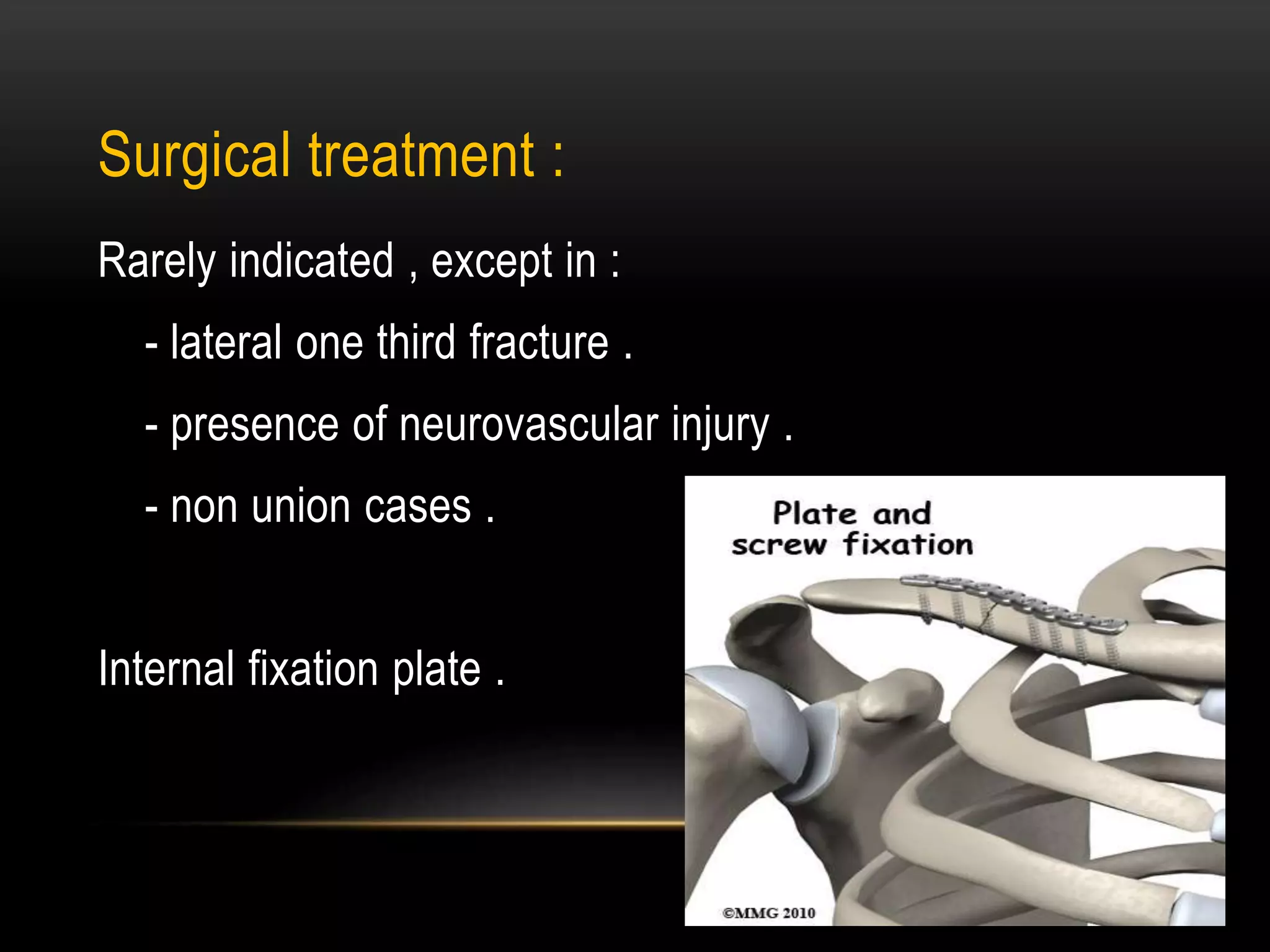
Surgical treatment :
Rarely indicated , except in :
- lateral one third fracture .
- presence of neurovascular injury .
- non union cases .
Internal fixation plate .
Complication:
late :
Malunion .
Ununion : treated by internal fixation and bone grafting .
Neurovascular injury [rare] . .
Stiffness of shoulder in elderly .
Ulnar neuropathy .
Refracture .
Early : [subclavian or carotid artery injury
,pneumothorax and hemothorax ,brachial injury ]
Scapula
Fractures of scapula …
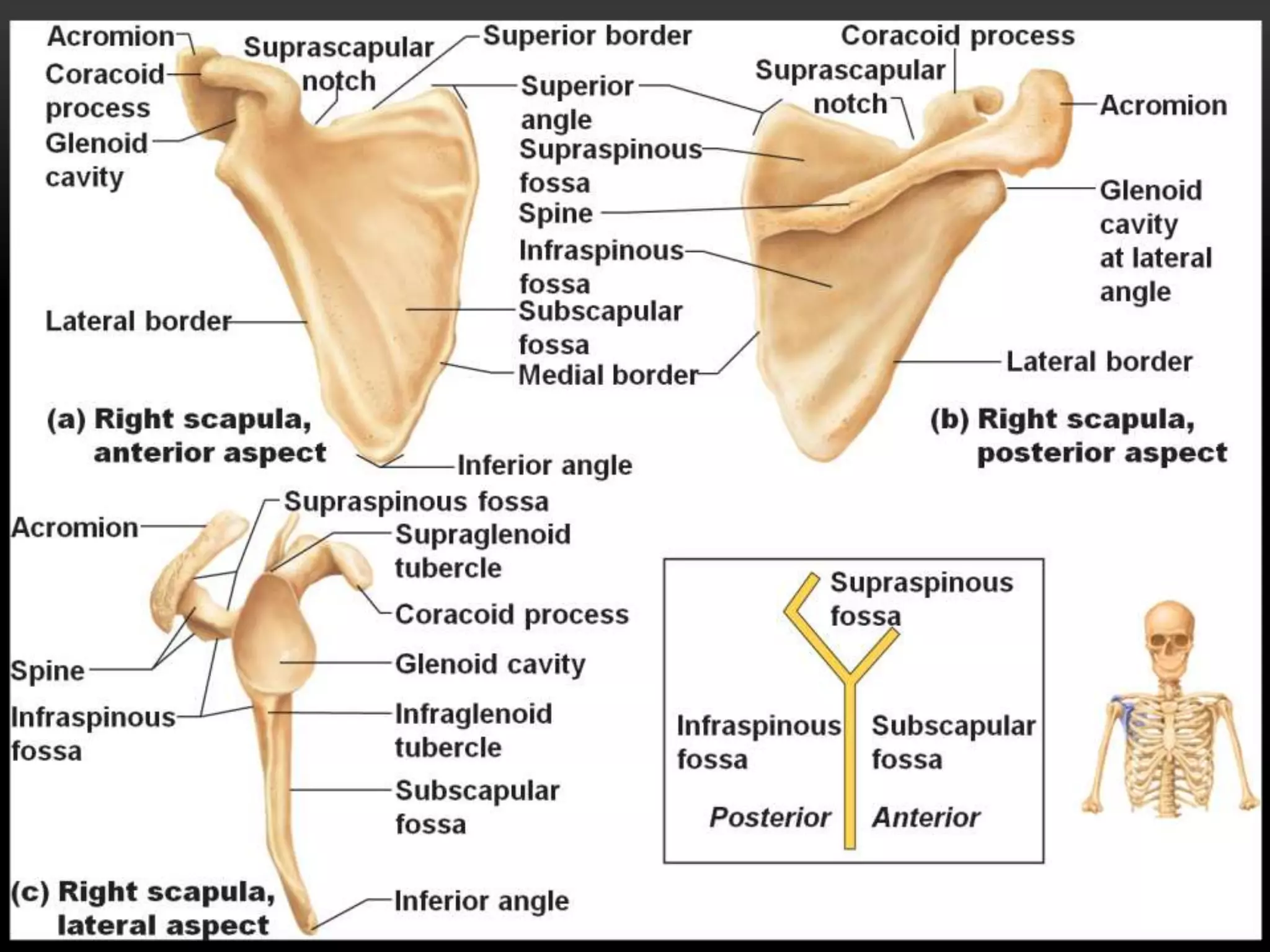
Scapula :
Is a flat triangular bone that lies on the posterior thorax wall
between 2-7 rib.
It envelope by :
supraspinatus muscle
infraspinatus muscle
subscapularis muscle
Attached to clavicle at acromioclavicular joint ,secured by
acromioclavicular ligament .
Articulate with humerus at glenohumeral joint .
Attached to thorax in scapulothoraxic joint .
Fracture of scapula :
Fractures of scapula are uncommon because of
scapula location and surrounding muscles whitch
protect it .
-Fractures of scapula
are result of high energy
trauma with high incidence
Of associated injuries
by 60-98 % .
Associated life threatening injuries with scapula # :
pneumothorax
pulmonary contusion
arterial injury
abdominal injury
head injury
splenic or liver laceration
brachial plexus injury
Fractures of scapula are classified
according to location :
body fracture 50 % .
neck fracture 5-30 % .
glenoid fracture 10 % .
Coracoid fracture 8 % .
Acromion fracture 7 % .
Mechanism of injury :
# of body : from sever direct trauma
- fall from height with direct landing on posterior aspect of trunk .
- motor vehicle crush .
# of neck : direct blow to shoulder
- fall on shoulder .
- fall on outstretched hand .
# of glenoid : direct blow to lateral aspect of shoulder .
or impaction of humeral head in to glenoid fossa .
# of coracoid process :
direct blow or shoulder dislocation .
# of acromion :
direct down ward blow to shoulder .
Clinical picture :
Sight > swelling deformity ecchymosis erosion .
Touch > pain tenderness crepitation .
Pain exacerbated by movment .
Clinical picture :
-Brusing over scapula or chest area .
-Pain in movement .
-Swelling around back of shoulder .
-Tenderness at site of # .
Arm is held immobile .
Diagnosis :
After initial assessment , according to advanced trauma
life support [ATLS] principles , radiograghic evaluation is
indicated as soon as possible as patient stable .
X – ray :
Anteroposterior view  lateral  axillary view .
C T scan :is useful in glenoid or body # . .
Treatment :
Reduction is usually unnecessary .
Patient wears a sling for comfort and from start
movement.
Check repeatedly for dislocation of the shoulder .
# of body by :
conservatively by analgesics and simple
sling to rest shoulder for 2-3 weeks .
# of acromion process :
Un displaced :
sling for 3-4 weeks for rest shoulder.
displaced :
acromion should be reduced and fixed .
# of coracoid :
conservatively in major , using a sling for 2-3
weeks.
Vigorous exercises should be prohibited for 2 m .
If there is marked displacement > open reduction .
# of neck and glenoid :
- sling for 2-3 weeks
- if there is displacement > shoulder spica after reduction .
- open reduction > indicated if there is isolated glenoid rim
fractures associated with dislocation or subluxation of
shoulder .
Complication :
Malunion non union > rare
Glenohumeral arthritis .
Limitation in range of motion .
After surgery :
local dyscomfort
infection
nerve injuries
post traumatic arthritis
rotator cuff dysfunction
Notes :
Scapular fracture should alert the surgeon to
presence of other injuries .
Sever chest injury should also raise suspicion
of possible scapular injury .
Clavicle fracture

Clavicle fracture

  • 1.
    Injuries of shouldergirdle clavicle fracture scapula fracture
  • 2.
    CLAVICLE : Is anS-shape long, curved ,tubular bone , lies horizontally a cross the root of neck . It articulate with sternum medially to form sternoclavicular joint. Also articulate with acromion process of scapula at acromioclavicular joint and acromioclavicular ligament . the muscles inserting on clavicle are : sternocleidomastoid, And subclavius muscles . The subclavian vessels and brachial plexus lie posterior to clavicle .
  • 3.
  • 6.
    Fractures of theclavicle: common fracture in all ages especially in children . It is 2 – 10% of all fractures .
  • 8.
    Mechanism of injury: Direct traumatic impact or fall on the shoulder 87% . Direct impact to clavicle 07% . Fall on outstretched hand 06% . From fall on the side . Vigorous muscle contraction , seizures [rare] . Pathological fracture [rare] .
  • 9.
  • 10.
    Most common causesare : Road traffic accident [RTA] Sporting injuries
  • 11.
    Allman classification :according to site of fracture : group 1: Fracture mostly occur in the middle one third of clavicle 80% . group 2: The fractures of outer third is 15% . Fractures involving the acromioclavicular joint 28% . group 3: fracture of inner [medial] third 5% .
  • 12.
    Why does thefracture occur in middle third more ? It is the thinnest part of the bone . It is the junction of the tow main curves of shaft . Site of entrance of nutrient artery .
  • 14.
    common pattern offractures of clavicle are : 1 - Green stick fracture : Common at the junction between middle and outer third . Common in children .
  • 15.
    2 - Undisplaced fracture in :
  • 16.
    3 - Separationof bone end :
  • 17.
    4 - Withgreater displacement : •There is over lapping and shortening .
  • 18.
    Clinical presentation : painand tenderness at site of injury . Obvious deformity and swelling sometimes occur . Patient come support his injured limb with other hand and head tilted toward injured side . Local bruising .
  • 19.
    vascular compilication arerare , but we must look for it by : check pulse , gently palpate root of neck . Outer third # are easily missed for acromioclavicular joint .
  • 20.
    Diagnosis : - Clinicalpicture examination . investigation : x-ray [AP view ] : # is usually in middle third, outer fragment below the inner . #of outer third may be missed . CT scan : useful for non union assessment . arteriography : if vascular injury suspected .
  • 22.
    Treatment : The aimis to provide support for the weight of the arm . Fracture of clavicle unite with or without treatment . Healing occurs usually in 3-6 weeks . It may be : conservative or surgical .
  • 23.
    Conservative treatment : Supportthe arm in a sling until the pain subsides , usually 1-3 weeks . Figure of 8- bandage . Clavicle ring . Analgesics .
  • 24.
    Rehabilitation : The patientshould be instructed regarding hand wrist and elbow exercises during immobilization . And regarding shoulder exercises once fracture healed .
  • 28.
    Surgical treatment : Rarelyindicated , except in : - lateral one third fracture . - presence of neurovascular injury . - non union cases . Internal fixation plate .
  • 31.
    Complication: late : Malunion . Ununion: treated by internal fixation and bone grafting . Neurovascular injury [rare] . . Stiffness of shoulder in elderly . Ulnar neuropathy . Refracture . Early : [subclavian or carotid artery injury ,pneumothorax and hemothorax ,brachial injury ]
  • 32.
  • 33.
  • 35.
    Scapula : Is aflat triangular bone that lies on the posterior thorax wall between 2-7 rib. It envelope by : supraspinatus muscle infraspinatus muscle subscapularis muscle Attached to clavicle at acromioclavicular joint ,secured by acromioclavicular ligament . Articulate with humerus at glenohumeral joint . Attached to thorax in scapulothoraxic joint .
  • 39.
    Fracture of scapula: Fractures of scapula are uncommon because of scapula location and surrounding muscles whitch protect it . -Fractures of scapula are result of high energy trauma with high incidence Of associated injuries by 60-98 % .
  • 40.
    Associated life threateninginjuries with scapula # : pneumothorax pulmonary contusion arterial injury abdominal injury head injury splenic or liver laceration brachial plexus injury
  • 41.
    Fractures of scapulaare classified according to location : body fracture 50 % . neck fracture 5-30 % . glenoid fracture 10 % . Coracoid fracture 8 % . Acromion fracture 7 % .
  • 42.
    Mechanism of injury: # of body : from sever direct trauma - fall from height with direct landing on posterior aspect of trunk . - motor vehicle crush . # of neck : direct blow to shoulder - fall on shoulder . - fall on outstretched hand . # of glenoid : direct blow to lateral aspect of shoulder . or impaction of humeral head in to glenoid fossa .
  • 43.
    # of coracoidprocess : direct blow or shoulder dislocation . # of acromion : direct down ward blow to shoulder .
  • 44.
    Clinical picture : Sight> swelling deformity ecchymosis erosion . Touch > pain tenderness crepitation . Pain exacerbated by movment .
  • 45.
    Clinical picture : -Brusingover scapula or chest area . -Pain in movement . -Swelling around back of shoulder . -Tenderness at site of # . Arm is held immobile .
  • 46.
    Diagnosis : After initialassessment , according to advanced trauma life support [ATLS] principles , radiograghic evaluation is indicated as soon as possible as patient stable . X – ray : Anteroposterior view lateral axillary view . C T scan :is useful in glenoid or body # . .
  • 50.
    Treatment : Reduction isusually unnecessary . Patient wears a sling for comfort and from start movement. Check repeatedly for dislocation of the shoulder .
  • 51.
    # of bodyby : conservatively by analgesics and simple sling to rest shoulder for 2-3 weeks . # of acromion process : Un displaced : sling for 3-4 weeks for rest shoulder. displaced : acromion should be reduced and fixed .
  • 52.
    # of coracoid: conservatively in major , using a sling for 2-3 weeks. Vigorous exercises should be prohibited for 2 m . If there is marked displacement > open reduction . # of neck and glenoid : - sling for 2-3 weeks - if there is displacement > shoulder spica after reduction . - open reduction > indicated if there is isolated glenoid rim fractures associated with dislocation or subluxation of shoulder .
  • 58.
    Complication : Malunion nonunion > rare Glenohumeral arthritis . Limitation in range of motion . After surgery : local dyscomfort infection nerve injuries post traumatic arthritis rotator cuff dysfunction
  • 59.
    Notes : Scapular fractureshould alert the surgeon to presence of other injuries . Sever chest injury should also raise suspicion of possible scapular injury .