Principles
Significance
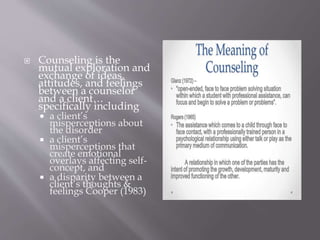
 Counseling is the
mutual exploration and
exchange of ideas,
attitudes, and feelings
between a counselor
and a client…
specifically including
 a client’s
misperceptions about
the disorder
 a client’s
misperceptions that
create emotional
overlays affecting self-
concept, and
 a disparity between a
client’s thoughts &
feelings Cooper (1983)
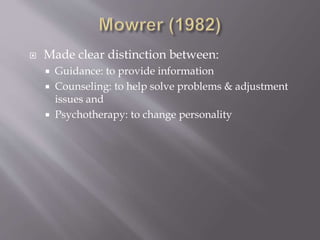
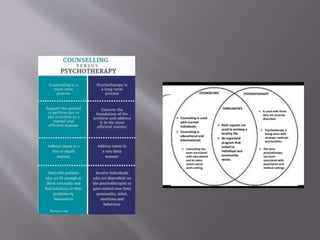
 Made clear distinction between:
 Guidance: to provide information
 Counseling: to help solve problems & adjustment
issues and
 Psychotherapy: to change personality
 Rarely be a problem solver; help
guide the client to coming up with
own solutions
 Trust your intuition
 Provide a sense of direction for the
client
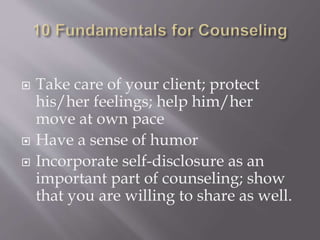
 Take care of your client; protect
his/her feelings; help him/her
move at own pace
 Have a sense of humor
 Incorporate self-disclosure as an
important part of counseling; show
that you are willing to share as well.
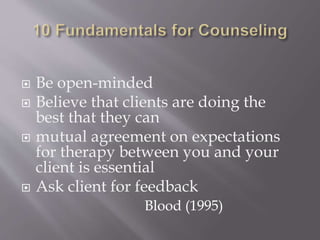
 Be open-minded
 Believe that clients are doing the
best that they can
 mutual agreement on expectations
for therapy between you and your
client is essential
 Ask client for feedback
Blood (1995)
 Counseling provided
by trained
professionals can make
a profound impact on
the lives of individuals,
families and
communities. This
service helps people
navigate difficult life
situations, such as the
death of a loved one,
divorce, natural
disasters, school stress
and the loss of a job.
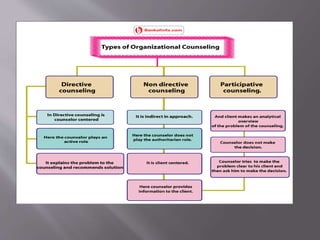
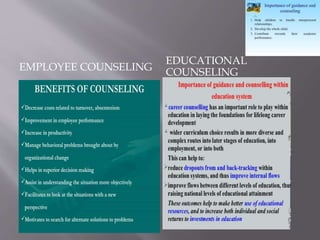
EMPLOYEE COUNSELING
EDUCATIONAL
COUNSELING
Counselling
Counselling
Counselling
Counselling

Counselling

  • 1.
  • 3.
     Counseling isthe mutual exploration and exchange of ideas, attitudes, and feelings between a counselor and a client… specifically including  a client’s misperceptions about the disorder  a client’s misperceptions that create emotional overlays affecting self- concept, and  a disparity between a client’s thoughts & feelings Cooper (1983)
  • 5.
     Made cleardistinction between:  Guidance: to provide information  Counseling: to help solve problems & adjustment issues and  Psychotherapy: to change personality
  • 7.
     Rarely bea problem solver; help guide the client to coming up with own solutions  Trust your intuition  Provide a sense of direction for the client
  • 8.
     Take careof your client; protect his/her feelings; help him/her move at own pace  Have a sense of humor  Incorporate self-disclosure as an important part of counseling; show that you are willing to share as well.
  • 9.
     Be open-minded Believe that clients are doing the best that they can  mutual agreement on expectations for therapy between you and your client is essential  Ask client for feedback Blood (1995)
  • 11.
     Counseling provided bytrained professionals can make a profound impact on the lives of individuals, families and communities. This service helps people navigate difficult life situations, such as the death of a loved one, divorce, natural disasters, school stress and the loss of a job.
  • 12.