A.THANGAMANI RAMALINGAM
P.T., M.Sc.psychology, Cspss(Advanced),PGDRM
Lecturer in physiotherapy,
Sarvajanik college of physiotherapy,
Mob: 94264 39169 ,8866384194
email: atramalingam@gmail.com
goldbell_76@yahoo.co.in
METHODOLOGY IN RESEARCH
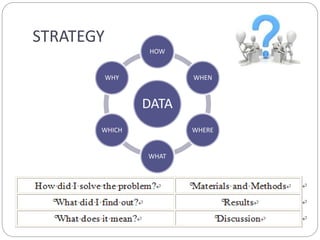
STRATEGY
DATA
HOW
WHEN
WHERE
WHAT
WHICH
WHY
STRUCTURE OF METHODOLOGY
Research design
Sample design
Observational design
Statistical design
1.Research design
Research design
2.Sample design
Statistics is the science of
dealing with numbers
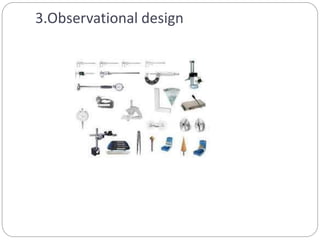
3.Observational design
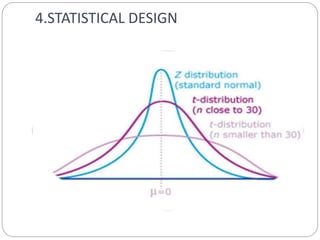
4.STATISTICAL DESIGN
Tests to address the question: Is there a
difference between groups – unpaired
(parallel and independent groups)
situation?
Tests to address the question: Is
there a difference between groups –
paired situation?
Tests to address the question: Is there an
association between variables?
Tests to address the question: Is there an
agreement between assessment
(screening / rating / diagnostic)
techniques?
5.Misuses of Statistics
Copyright © 2004 Pearson Education, Inc.
 Misleading Graphs
 Bad Samples
 Small Samples
Figure 1-1
COMMON SIGNS OF DUBIOUS DATA
 Slippery decimal point(eg:4%-1990,7%-2000)
 Botched translations(25% increase in risk)
 Misleading graphs
 Careless calculation
 Big round numbers(bird window deaths)
 Hyperbole(using superlatives)
 Broad definitions
 Odd units of analysis
 Convenient time frame ,selective comparisions,
misleading samples &statistical adjustments
 Short term benefits are converted to longterm benefits
Copyright © 2004 Pearson
Education, Inc.
 Bad Samples
 Small Samples
 Misleading Graphs
 Pictographs
 Distorted Percentages
 Loaded Questions
 Order of Questions
 Refusals
 Correlation & Causality
 Self Interest Study
 Precise Numbers
 Partial Pictures
 Deliberate Distortions
Misuses of Statistics
News
Nature 418, 113 (11 July 2002)
| doi:10.1038/418113a
 Dubious data remain in print two years after misconduct
inquiry
Alison Abbott & Johanna Schwarz
Many of the 94 scientific papers listed two years ago by a
German inquiry as likely to contain manipulated data
have yet to be retracted from the literature, Nature has
discovered. The suspect papers were identified during a
high-profile investigation into misconduct in German
cancer research, the results of which were published in
June 2000.
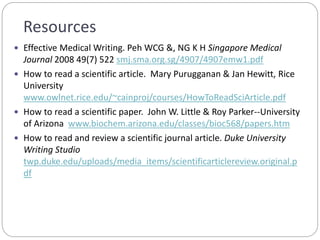
Resources
 Effective Medical Writing. Peh WCG &, NG K H Singapore Medical
Journal 2008 49(7) 522 smj.sma.org.sg/4907/4907emw1.pdf
 How to read a scientific article. Mary Purugganan & Jan Hewitt, Rice
University
www.owlnet.rice.edu/~cainproj/courses/HowToReadSciArticle.pdf
 How to read a scientific paper. John W. Little & Roy Parker--University
of Arizona www.biochem.arizona.edu/classes/bioc568/papers.htm
 How to read and review a scientific journal article. Duke University
Writing Studio
twp.duke.edu/uploads/media_items/scientificarticlereview.original.p
df
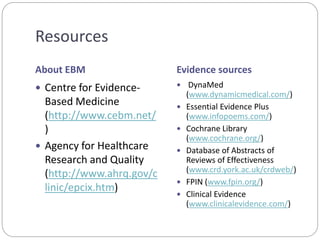
Resources
About EBM
 Centre for Evidence-
Based Medicine
(http://www.cebm.net/
)
 Agency for Healthcare
Research and Quality
(http://www.ahrq.gov/c
linic/epcix.htm)
Evidence sources
 DynaMed
(www.dynamicmedical.com/)
 Essential Evidence Plus
(www.infopoems.com/)
 Cochrane Library
(www.cochrane.org/)
 Database of Abstracts of
Reviews of Effectiveness
(www.crd.york.ac.uk/crdweb/)
 FPIN (www.fpin.org/)
 Clinical Evidence
(www.clinicalevidence.com/)
METHODOLOGY IN RESEARCH

METHODOLOGY IN RESEARCH

  • 1.
    A.THANGAMANI RAMALINGAM P.T., M.Sc.psychology,Cspss(Advanced),PGDRM Lecturer in physiotherapy, Sarvajanik college of physiotherapy, Mob: 94264 39169 ,8866384194 email: atramalingam@gmail.com goldbell_76@yahoo.co.in METHODOLOGY IN RESEARCH
  • 3.
  • 4.
    STRUCTURE OF METHODOLOGY Researchdesign Sample design Observational design Statistical design
  • 6.
  • 7.
  • 11.
  • 12.
    Statistics is thescience of dealing with numbers
  • 16.
  • 22.
  • 24.
    Tests to addressthe question: Is there a difference between groups – unpaired (parallel and independent groups) situation? Tests to address the question: Is there a difference between groups – paired situation?
  • 25.
    Tests to addressthe question: Is there an association between variables? Tests to address the question: Is there an agreement between assessment (screening / rating / diagnostic) techniques?
  • 27.
    5.Misuses of Statistics Copyright© 2004 Pearson Education, Inc.  Misleading Graphs  Bad Samples  Small Samples Figure 1-1
  • 29.
    COMMON SIGNS OFDUBIOUS DATA  Slippery decimal point(eg:4%-1990,7%-2000)  Botched translations(25% increase in risk)  Misleading graphs  Careless calculation  Big round numbers(bird window deaths)  Hyperbole(using superlatives)  Broad definitions  Odd units of analysis  Convenient time frame ,selective comparisions, misleading samples &statistical adjustments  Short term benefits are converted to longterm benefits
  • 30.
    Copyright © 2004Pearson Education, Inc.  Bad Samples  Small Samples  Misleading Graphs  Pictographs  Distorted Percentages  Loaded Questions  Order of Questions  Refusals  Correlation & Causality  Self Interest Study  Precise Numbers  Partial Pictures  Deliberate Distortions Misuses of Statistics
  • 31.
    News Nature 418, 113(11 July 2002) | doi:10.1038/418113a  Dubious data remain in print two years after misconduct inquiry Alison Abbott & Johanna Schwarz Many of the 94 scientific papers listed two years ago by a German inquiry as likely to contain manipulated data have yet to be retracted from the literature, Nature has discovered. The suspect papers were identified during a high-profile investigation into misconduct in German cancer research, the results of which were published in June 2000.
  • 32.
    Resources  Effective MedicalWriting. Peh WCG &, NG K H Singapore Medical Journal 2008 49(7) 522 smj.sma.org.sg/4907/4907emw1.pdf  How to read a scientific article. Mary Purugganan & Jan Hewitt, Rice University www.owlnet.rice.edu/~cainproj/courses/HowToReadSciArticle.pdf  How to read a scientific paper. John W. Little & Roy Parker--University of Arizona www.biochem.arizona.edu/classes/bioc568/papers.htm  How to read and review a scientific journal article. Duke University Writing Studio twp.duke.edu/uploads/media_items/scientificarticlereview.original.p df
  • 33.
    Resources About EBM  Centrefor Evidence- Based Medicine (http://www.cebm.net/ )  Agency for Healthcare Research and Quality (http://www.ahrq.gov/c linic/epcix.htm) Evidence sources  DynaMed (www.dynamicmedical.com/)  Essential Evidence Plus (www.infopoems.com/)  Cochrane Library (www.cochrane.org/)  Database of Abstracts of Reviews of Effectiveness (www.crd.york.ac.uk/crdweb/)  FPIN (www.fpin.org/)  Clinical Evidence (www.clinicalevidence.com/)