PERIPHERAL VASCULAR DISEASE
BY:-
SUDESHNA BANERJEE
M.SC 1ST YEAR
MODERATOR:- MADAM GIJI JOHN
LECTURER
HFCON
Definition
• Peripheral vascular disease (PVD) is a slow
and progressive circulation disorder caused
by narrowing, blockage, or spasms in a
blood vessel
• PVD may involve disease in any of the blood
vessels outside of the heart including the
arteries, veins, or lymphatic vessels
ETIOLOGY AND RISK FACTORS
 Primarily caused by atherosclerosis
 Embolism
 Thrombosis
 Trauma
 Vasospasm
 Inflammation
 Family history
 Sedentary lifestyle
 Stress
 Autoimmunity
 Smoking
 Hypertension
 obesity
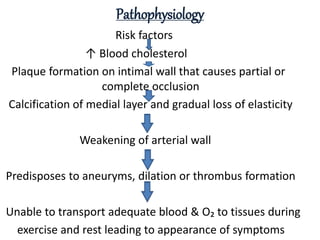
Pathophysiology
Risk factors
↑ Blood cholesterol
Plaque formation on intimal wall that causes partial or
complete occlusion
Calcification of medial layer and gradual loss of elasticity
Weakening of arterial wall
Predisposes to aneuryms, dilation or thrombus formation
Unable to transport adequate blood & O₂ to tissues during
exercise and rest leading to appearance of symptoms
TYPES
• Thromboangitis obliterans
• Raynauds disease
• Aneurysm
• Arterial embolism
• Deep vein thrombosis(DVT)
Thromboangitis obliterans
1. Acute inflammatory lesions and occlusive
thrombosis of the arteries and veins
2. Strong association with smoking
3. Commonly occurs in male between 20-40yrs
CLINICAL MANIFESTATIONS OF
THROMBOANGITIS OBLITERANS
Intermittent claudication
Pain during rest
Coldness
Paresthesia
Weak or absent pulse in posterior tibial, dorsalis
pedis
Extremities are cyanotic
Ulceration and gangrene
INTERVENTIONS
Advise patient to stop smoking
Avoid trauma
Emotional support
Avoid injuries to feet
Amputation of leg is done only when
Gangrene extends well into foot
Pain is severe
Severe infection
RAYNAUDS DISEASE
Intermittent episodes during which small arteries of
left or right arm constrict causing changes in skin
color & temperature
Symmetric bilateral involvement & may affect only
1or 2 fingers
May occur after exposure to cold, trauma
Characterised by reduction of blood flow to fingers
manifested by pallor
ETIOLOGY
 Unknown etiology
 Common in women may be stimulated by
stress, hypersensitivity to cold
CLINICAL MANIFESTATIONS OF
RAYNAUDS DISEASE
During arterial spasm-sluggish blood flow occurs
Following the spasm the area becomes reddened
with tingling & throbbing sensation
With longstanding raynaud’s disease-ulcerations
can develop on fingertips & toes
INTERVENTIONS
Prevent injury
Provide comfort
Avoid smoking
Avoid exposure to cold
Wear warm clothing, gloves & socks
Avoid drugs that will cause vasoconstriction
Suggest anti inflammatory analgesics
ANEURYSM
• Is a localized or diffuse enlargement of an
artery at some point along its course
• Can occur when the vessel becomes
weakened from trauma, congenital vascular
disease, infection or atherosclerosis
TYPES OF ANEURYSM
• Saccular aneurysm – involves only part of the
circumference of the artery
• Fusiform aneurysm – spindle shaped, involves the
entire circumference of the arterial wall
• Dissecting aneurysm – involves hemorrhage into a
vessel wall, which splits and dissects the wall
causing a widening of the vessel
• caused by degenerative defect in the tunica media
and tunica intima
DIAGNOSTIC TESTS
• CHEST & ABDOMINAL X-RAYS – helpful in
preliminary diagnosis of aortic aneurysm
• ULTRASOUND – is useful in determining the
size, shape and location of the aneurysm
• CT & MRA
THORACIC AORTIC ANEURYSM
Aneurysm in the thoracic area
Can develop in the ascending, transverse or
descending aorta
S/Sx
• Chest pain
• Cough
• Dyspnea
• Hoarseness
• Dysphagia
ABDOMINAL AORTIC ANEURYSM
 Abdominal aorta below the renal arteries
S/Sx:
• Pulsatile abdominal mass on palpation
• Pain or tenderness in the mid-or upper abdomen
• The aneurysm may extend to impinge on the renal,
iliac, or mesenteric arteries
• Stasis of blood favors thrombus formation along the
wall of the vessel
COMPLICATIONS
• Rupture of the aneurysm – most feared
complication
can occur if the aneurysm is large
• can lead to death
• Tx: Surgery – resection of the lesion and
replacement with a graft
Arterial Embolism
• Blood clots floating in the circulating arterial
blood
• The embolus is frequently a fragment of
arterioschlerotic plaque loosened from the
aorta
• Emboli will tend to lodge in femoral or
popliteal arteries, blood flow is impaired and
ischemia develops
CLINICAL MANIFESTATIONS
• Abrupt onset of severe pain
• Muscular weakness and burning, aching pain
• Distal pulses are absent and extremity becomes
cold, numb and pale
• Symptoms of shock may develop
DEEP VEIN THROMBOSIS (DVT)
• Tends to occur at the deep veins due to stasis
of blood
• A major risk during the acute phase of
thrombophlebitis is dislodgment of the
thrombus
• Pulmonary embolus – is a serious
complication arising from DVT of the lower
extremities
CLINICAL MANIFESTATIONS
• Pain and edema of extremity
• (+) Homan’s sign
• Do not check for the Homan’s sign if DVT is already
known to be present risk of embolus formation
• If superficial veins are affected redness, warmth,
tenderness will occur, the veins feel hard and
thready & sensitive to pressure
MEDICAL MANAGEMENT
• Requires hospitalization
• Bed rest with legs elevated to 15-20 degrees
• Application of warm moist heat to reduce pain
• Elastic stocking or bandage
• Anticoagulants, initially with IV heparin then Coumarin
• Fibrinolytic
• Vasodilator if needed to control vessel spasm
Assessment
• Condition of the skin: shiny, taut, absence of hair growth
• Ulcerations/ necrotic tissues
• Extremely cold to touch
• Peripheral pulses: diminished, weak, absent, bilateral inequality
• Grading 0 - absent
1 + weak & thready
2 + normal
3 + full & bounding
• Prolonged(> 3 secs) or absent capillary refill of nailbeds
• Loss of muscle tone or weakness
Diagnostic Evaluation
• Doppler ultrasonography
• Ankle brachial index to measure arterial blood flow
• Colour flow imaging
• Transcutaneous Oximetry
• Angiography
Complications
• Gangrene
• Extremity amputation
• Possible infection and sepsis
MEDICAL MANAGEMENT
• Weight reduction
• Exercise
• Stop smoking
• Blood lipid reduction
• Statins,Nicotinic acid, fibric acid derivative, bile acid
resins
• Promote arterial flow- Pentoxifylline
• Cilastazol – vasodilator & anti platelet
• Trendelenberg position
Surgical interventions
• Embolectomy
• Endartectomy is removal of a blood clot and stripping of
atherosclerotic plaque along with the inner arterial wall
• Arterial by-pass surgery- an obstructed arterial segment
may be by passed by using a prosthetic material( teflon) or
patient’s own artery or vein(saphenous vein)
• Percutaneous Transluminal Angioplasty- the balloon tip of
the catheter is inflated to provide compression of the
plaque
• Amputation
NURSING DIAGNOSIS
• Ineffective peripheral tissue perfusion
• Activity intolerance related to poor blood flow to
the lower extremities
• Ineffective health maintainance related to smoking
and lack of information about disease
• Risk for impaired skin integrity related to ischemic
tissues of legs and feet
FOOT CARE FOR PATIENTS WITHPERIPHERALATHEROSCLEROSIS
1. Keep legs & feet clean, dry & comfortable
o Clean with warm water & mild soap
o Pat dry using soft towel
o Apply cream after drying
o Wear a pair of cotton socks everyday
2. Prevent accidents and injuries to health
o Always wear shoes
o Walk on ground levels
o Don’t go barefoot
o Report if there is any foot problems
3. Improve blood supply to legs & feet
o Don’t cross legs
o Don’t wear knee stockings
o Don’t swim in cold water
preventions
Do passive exercise of legs
Walk for atleast 30 mins daily
Avoid cold water for bathing
Stop smoking
If edema occurs, then elevate the legs
Dorsiflex legs at regular intervals to prevent venous
pooling
Avoid massaging the affected extremity
Keep extremity warm but do not heat
Use elastic stockings on affected leg
Health teaching
Stop smoking
Lose weight
Eat low fat diet
Avoid walking barefoot
Begin walking & exercise programme
Don’t wear restrictive clothing
Wear proper fitting shoes
PVD

PVD

  • 1.
    PERIPHERAL VASCULAR DISEASE BY:- SUDESHNABANERJEE M.SC 1ST YEAR MODERATOR:- MADAM GIJI JOHN LECTURER HFCON
  • 2.
    Definition • Peripheral vasculardisease (PVD) is a slow and progressive circulation disorder caused by narrowing, blockage, or spasms in a blood vessel • PVD may involve disease in any of the blood vessels outside of the heart including the arteries, veins, or lymphatic vessels
  • 3.
    ETIOLOGY AND RISKFACTORS  Primarily caused by atherosclerosis  Embolism  Thrombosis  Trauma  Vasospasm  Inflammation  Family history  Sedentary lifestyle  Stress  Autoimmunity  Smoking  Hypertension  obesity
  • 4.
    Pathophysiology Risk factors ↑ Bloodcholesterol Plaque formation on intimal wall that causes partial or complete occlusion Calcification of medial layer and gradual loss of elasticity Weakening of arterial wall Predisposes to aneuryms, dilation or thrombus formation Unable to transport adequate blood & O₂ to tissues during exercise and rest leading to appearance of symptoms
  • 6.
    TYPES • Thromboangitis obliterans •Raynauds disease • Aneurysm • Arterial embolism • Deep vein thrombosis(DVT)
  • 7.
    Thromboangitis obliterans 1. Acuteinflammatory lesions and occlusive thrombosis of the arteries and veins 2. Strong association with smoking 3. Commonly occurs in male between 20-40yrs
  • 9.
    CLINICAL MANIFESTATIONS OF THROMBOANGITISOBLITERANS Intermittent claudication Pain during rest Coldness Paresthesia Weak or absent pulse in posterior tibial, dorsalis pedis Extremities are cyanotic Ulceration and gangrene
  • 10.
    INTERVENTIONS Advise patient tostop smoking Avoid trauma Emotional support Avoid injuries to feet Amputation of leg is done only when Gangrene extends well into foot Pain is severe Severe infection
  • 11.
    RAYNAUDS DISEASE Intermittent episodesduring which small arteries of left or right arm constrict causing changes in skin color & temperature Symmetric bilateral involvement & may affect only 1or 2 fingers May occur after exposure to cold, trauma Characterised by reduction of blood flow to fingers manifested by pallor
  • 13.
    ETIOLOGY  Unknown etiology Common in women may be stimulated by stress, hypersensitivity to cold
  • 14.
    CLINICAL MANIFESTATIONS OF RAYNAUDSDISEASE During arterial spasm-sluggish blood flow occurs Following the spasm the area becomes reddened with tingling & throbbing sensation With longstanding raynaud’s disease-ulcerations can develop on fingertips & toes
  • 15.
    INTERVENTIONS Prevent injury Provide comfort Avoidsmoking Avoid exposure to cold Wear warm clothing, gloves & socks Avoid drugs that will cause vasoconstriction Suggest anti inflammatory analgesics
  • 16.
    ANEURYSM • Is alocalized or diffuse enlargement of an artery at some point along its course • Can occur when the vessel becomes weakened from trauma, congenital vascular disease, infection or atherosclerosis
  • 17.
    TYPES OF ANEURYSM •Saccular aneurysm – involves only part of the circumference of the artery • Fusiform aneurysm – spindle shaped, involves the entire circumference of the arterial wall • Dissecting aneurysm – involves hemorrhage into a vessel wall, which splits and dissects the wall causing a widening of the vessel • caused by degenerative defect in the tunica media and tunica intima
  • 19.
    DIAGNOSTIC TESTS • CHEST& ABDOMINAL X-RAYS – helpful in preliminary diagnosis of aortic aneurysm • ULTRASOUND – is useful in determining the size, shape and location of the aneurysm • CT & MRA
  • 20.
    THORACIC AORTIC ANEURYSM Aneurysmin the thoracic area Can develop in the ascending, transverse or descending aorta S/Sx • Chest pain • Cough • Dyspnea • Hoarseness • Dysphagia
  • 21.
    ABDOMINAL AORTIC ANEURYSM Abdominal aorta below the renal arteries S/Sx: • Pulsatile abdominal mass on palpation • Pain or tenderness in the mid-or upper abdomen • The aneurysm may extend to impinge on the renal, iliac, or mesenteric arteries • Stasis of blood favors thrombus formation along the wall of the vessel
  • 23.
    COMPLICATIONS • Rupture ofthe aneurysm – most feared complication can occur if the aneurysm is large • can lead to death • Tx: Surgery – resection of the lesion and replacement with a graft
  • 24.
    Arterial Embolism • Bloodclots floating in the circulating arterial blood • The embolus is frequently a fragment of arterioschlerotic plaque loosened from the aorta • Emboli will tend to lodge in femoral or popliteal arteries, blood flow is impaired and ischemia develops
  • 26.
    CLINICAL MANIFESTATIONS • Abruptonset of severe pain • Muscular weakness and burning, aching pain • Distal pulses are absent and extremity becomes cold, numb and pale • Symptoms of shock may develop
  • 27.
    DEEP VEIN THROMBOSIS(DVT) • Tends to occur at the deep veins due to stasis of blood • A major risk during the acute phase of thrombophlebitis is dislodgment of the thrombus • Pulmonary embolus – is a serious complication arising from DVT of the lower extremities
  • 29.
    CLINICAL MANIFESTATIONS • Painand edema of extremity • (+) Homan’s sign • Do not check for the Homan’s sign if DVT is already known to be present risk of embolus formation • If superficial veins are affected redness, warmth, tenderness will occur, the veins feel hard and thready & sensitive to pressure
  • 30.
    MEDICAL MANAGEMENT • Requireshospitalization • Bed rest with legs elevated to 15-20 degrees • Application of warm moist heat to reduce pain • Elastic stocking or bandage • Anticoagulants, initially with IV heparin then Coumarin • Fibrinolytic • Vasodilator if needed to control vessel spasm
  • 31.
    Assessment • Condition ofthe skin: shiny, taut, absence of hair growth • Ulcerations/ necrotic tissues • Extremely cold to touch • Peripheral pulses: diminished, weak, absent, bilateral inequality • Grading 0 - absent 1 + weak & thready 2 + normal 3 + full & bounding • Prolonged(> 3 secs) or absent capillary refill of nailbeds • Loss of muscle tone or weakness
  • 32.
    Diagnostic Evaluation • Dopplerultrasonography • Ankle brachial index to measure arterial blood flow • Colour flow imaging • Transcutaneous Oximetry • Angiography
  • 33.
    Complications • Gangrene • Extremityamputation • Possible infection and sepsis
  • 34.
    MEDICAL MANAGEMENT • Weightreduction • Exercise • Stop smoking • Blood lipid reduction • Statins,Nicotinic acid, fibric acid derivative, bile acid resins • Promote arterial flow- Pentoxifylline • Cilastazol – vasodilator & anti platelet • Trendelenberg position
  • 35.
    Surgical interventions • Embolectomy •Endartectomy is removal of a blood clot and stripping of atherosclerotic plaque along with the inner arterial wall • Arterial by-pass surgery- an obstructed arterial segment may be by passed by using a prosthetic material( teflon) or patient’s own artery or vein(saphenous vein) • Percutaneous Transluminal Angioplasty- the balloon tip of the catheter is inflated to provide compression of the plaque • Amputation
  • 36.
    NURSING DIAGNOSIS • Ineffectiveperipheral tissue perfusion • Activity intolerance related to poor blood flow to the lower extremities • Ineffective health maintainance related to smoking and lack of information about disease • Risk for impaired skin integrity related to ischemic tissues of legs and feet
  • 37.
    FOOT CARE FORPATIENTS WITHPERIPHERALATHEROSCLEROSIS 1. Keep legs & feet clean, dry & comfortable o Clean with warm water & mild soap o Pat dry using soft towel o Apply cream after drying o Wear a pair of cotton socks everyday 2. Prevent accidents and injuries to health o Always wear shoes o Walk on ground levels o Don’t go barefoot o Report if there is any foot problems
  • 38.
    3. Improve bloodsupply to legs & feet o Don’t cross legs o Don’t wear knee stockings o Don’t swim in cold water
  • 39.
    preventions Do passive exerciseof legs Walk for atleast 30 mins daily Avoid cold water for bathing Stop smoking If edema occurs, then elevate the legs Dorsiflex legs at regular intervals to prevent venous pooling Avoid massaging the affected extremity Keep extremity warm but do not heat Use elastic stockings on affected leg
  • 40.
    Health teaching Stop smoking Loseweight Eat low fat diet Avoid walking barefoot Begin walking & exercise programme Don’t wear restrictive clothing Wear proper fitting shoes