INTERPRETATION
OF
STATISTICS
A.THANGAMANI RAMALINGAM
PT, MSc(PSY),PGDRM,ACS
atramalingam@gmail.com
Objectives
DATA
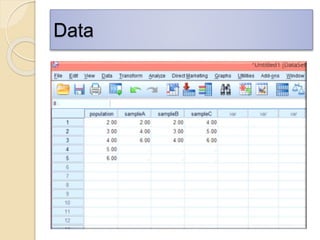
Data
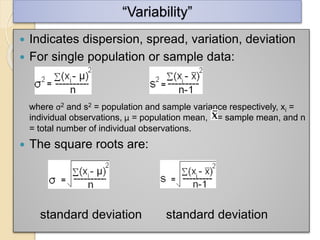
“Variability”
 Indicates dispersion, spread, variation, deviation
 For single population or sample data:
where σ2 and s2 = population and sample variance respectively, xi =
individual observations, μ = population mean, = sample mean, and n
= total number of individual observations.
 The square roots are:
standard deviation standard deviation
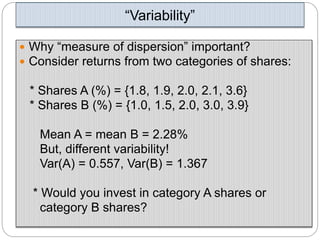
“Variability”
 Why “measure of dispersion” important?
 Consider returns from two categories of shares:
* Shares A (%) = {1.8, 1.9, 2.0, 2.1, 3.6}
* Shares B (%) = {1.0, 1.5, 2.0, 3.0, 3.9}
Mean A = mean B = 2.28%
But, different variability!
Var(A) = 0.557, Var(B) = 1.367
* Would you invest in category A shares or
category B shares?
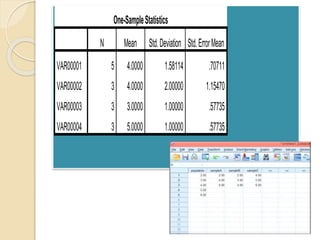
One-SampleStatistics
N Mean Std.Deviation Std.ErrorMean
VAR00001 5 4.0000 1.58114 .70711
VAR00002 3 4.0000 2.00000 1.15470
VAR00003 3 3.0000 1.00000 .57735
VAR00004 3 5.0000 1.00000 .57735
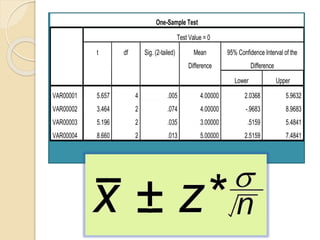
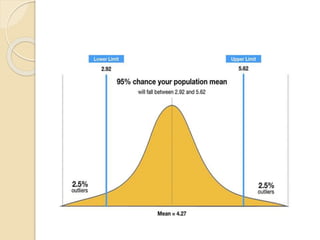
CONFIDENCE INTERVAL
One-Sample Test
Test Value = 0
t df Sig. (2-tailed) Mean
Difference
95% Confidence Interval of the
Difference
Lower Upper
VAR00001 5.657 4 .005 4.00000 2.0368 5.9632
VAR00002 3.464 2 .074 4.00000 -.9683 8.9683
VAR00003 5.196 2 .035 3.00000 .5159 5.4841
VAR00004 8.660 2 .013 5.00000 2.5159 7.4841
P Value
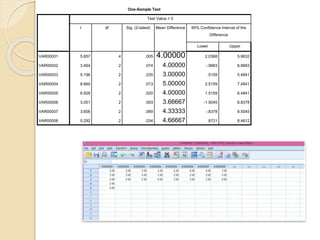
One-Sample Test
Test Value = 0
t df Sig. (2-tailed) Mean Difference 95% Confidence Interval of the
Difference
Lower Upper
VAR00001 5.657 4 .005 4.00000 2.0368 5.9632
VAR00002 3.464 2 .074 4.00000 -.9683 8.9683
VAR00003 5.196 2 .035 3.00000 .5159 5.4841
VAR00004 8.660 2 .013 5.00000 2.5159 7.4841
VAR00005 6.928 2 .020 4.00000 1.5159 6.4841
VAR00006 3.051 2 .093 3.66667 -1.5045 8.8378
VAR00007 3.606 2 .069 4.33333 -.8378 9.5045
VAR00008 5.292 2 .034 4.66667 .8721 8.4612
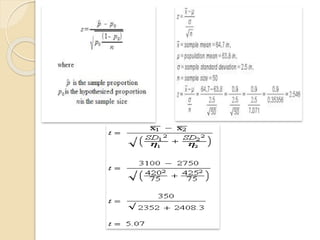
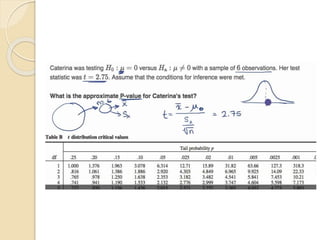
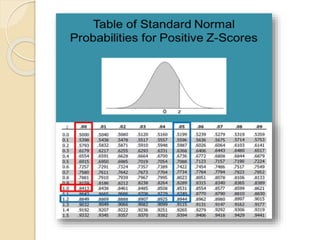
TEST STATISTIC
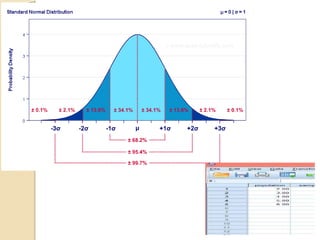
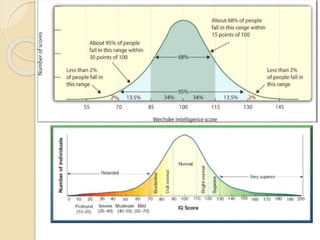
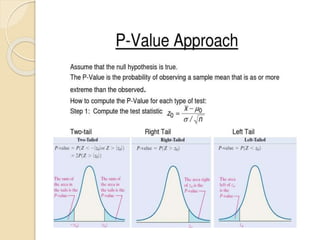
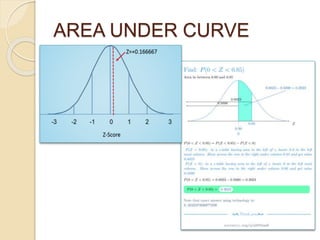
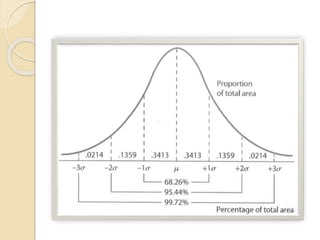
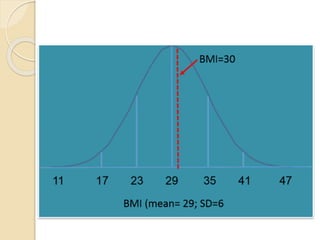
AREA UNDER CURVE
Take home message
 Frequency data distribution/ sampling
distribution
 Standard normal distribution/ t, z, f
and chi-square distributions
 Large the sample ,narrow the CI
 Large the mean difference, less the p
value.
 Why CI when p less than 0,05
Interprertation of statistics

Interprertation of statistics

  • 1.
  • 2.
  • 3.
  • 4.
  • 5.
    “Variability”  Indicates dispersion,spread, variation, deviation  For single population or sample data: where σ2 and s2 = population and sample variance respectively, xi = individual observations, μ = population mean, = sample mean, and n = total number of individual observations.  The square roots are: standard deviation standard deviation
  • 6.
    “Variability”  Why “measureof dispersion” important?  Consider returns from two categories of shares: * Shares A (%) = {1.8, 1.9, 2.0, 2.1, 3.6} * Shares B (%) = {1.0, 1.5, 2.0, 3.0, 3.9} Mean A = mean B = 2.28% But, different variability! Var(A) = 0.557, Var(B) = 1.367 * Would you invest in category A shares or category B shares?
  • 7.
    One-SampleStatistics N Mean Std.DeviationStd.ErrorMean VAR00001 5 4.0000 1.58114 .70711 VAR00002 3 4.0000 2.00000 1.15470 VAR00003 3 3.0000 1.00000 .57735 VAR00004 3 5.0000 1.00000 .57735
  • 10.
  • 11.
    One-Sample Test Test Value= 0 t df Sig. (2-tailed) Mean Difference 95% Confidence Interval of the Difference Lower Upper VAR00001 5.657 4 .005 4.00000 2.0368 5.9632 VAR00002 3.464 2 .074 4.00000 -.9683 8.9683 VAR00003 5.196 2 .035 3.00000 .5159 5.4841 VAR00004 8.660 2 .013 5.00000 2.5159 7.4841
  • 13.
  • 14.
    One-Sample Test Test Value= 0 t df Sig. (2-tailed) Mean Difference 95% Confidence Interval of the Difference Lower Upper VAR00001 5.657 4 .005 4.00000 2.0368 5.9632 VAR00002 3.464 2 .074 4.00000 -.9683 8.9683 VAR00003 5.196 2 .035 3.00000 .5159 5.4841 VAR00004 8.660 2 .013 5.00000 2.5159 7.4841 VAR00005 6.928 2 .020 4.00000 1.5159 6.4841 VAR00006 3.051 2 .093 3.66667 -1.5045 8.8378 VAR00007 3.606 2 .069 4.33333 -.8378 9.5045 VAR00008 5.292 2 .034 4.66667 .8721 8.4612
  • 15.
  • 19.
  • 23.
    Take home message Frequency data distribution/ sampling distribution  Standard normal distribution/ t, z, f and chi-square distributions  Large the sample ,narrow the CI  Large the mean difference, less the p value.  Why CI when p less than 0,05