Peripheral Vascular Diseases
Arteries are thick-walled vessels that transport 0 2  and blood via the aorta from the heart to the tissues 3 Layers of Arteries inner layer of endothelium (intima)  middle layer of connective tissue, smooth muscle and elastic fibers (media) outer layer of connective tissue (adventitia) have smooth muscles that contracts & relaxes to respond changes in blood volume.
Veins are thin-walled vessels that transport deoxygenated blood from the capillaries back to the right side of the heart 3 Layers – intima, media, adventitia there is little smooth muscle &  connective tissue    makes the  veins more distensible     they accumulate large volumes of blood Major veins, particularly in the lower  extremities, have  one-way valves  --- allow blood flow against gravity Valves allow blood to be pumped back  to the heart but prevent it from  draining back into the  periphery
Peripheral Vascular Diseases charac. by a reduction in blood flow and hence 0 2  through the peripheral vessels  when the need of the tissues for 0 2  exceeds the supply, areas of ischemia and necrosis will develop   Factors that can contribute to the development of peripheral vascular disorders : atherosclerotic changes thrombus formation   embolization    coagulability of blood  hypertension inflammatory process/infection
Arterial Insufficiency there is a deceased blood flow toward the tissues, producing ischemia pulses one usually diminished or absent sharp, stabbing pain occurs because of the ischemia, particularly with activity there is interference with nutrients and 0 2  arriving to the tissues, leading to  ischemic ulcers  and  changes in the skin . Venous Insufficiency  there is deceased return of blood from the tissues to the heart leads to venous congestion and stasis of blood pulses are present lead to  edema ,  skin changes  and  stasis ulcers
Comparison of characteristics of Arterial & Venous Disorders Arterial Disease Venous Disease Skin cool or cold, hairless, dry, shiny, pallor on elevation, rubor on dangling warm, though, thickened,  mottled, pigmented areas Pain sharp, stabbing, worsens w/ activity and walking, lowering feet may relieve pain aching, cramping, activity and walking sometimes help, elevating the feet relieves pain Ulcers severely painful, pale, gray base, found on heel, toes, dorsum of foot moderately painful, pink base, found on medial aspect of the ankle Pulse often absent or diminished usually present Edema infrequent frequent, esp. at the end of the day and in areas of ulceration
Risk Factors Age (elderly)  – blood vessels become less elastic, become thin walled and calcified –    PVR –    BP Sex (male ) Cigarette smoking nicotine causes vasoconstriction and spasm of the arteries –    circulation to the extremities C0 2  inhaled in cigarette smoke reduces 0 2  transport to tissues Hypertension  – cause elastic tissues to be replaced by fibrous collagen tissue    arterial wall become less distensible      resistance to blood flow       BP Hyperlipedimia  – atherosclerotic plaque Obesit y – places added burden on the heart & blood vessels excess fat contribute to    venous congestion
Lack of physical activity Physical activity – promotes muscle contraction       venous return to the heart aids in development of collateral circulation Emotional stress  – stimulates sympathetic N.S.  - peripheral vasoconstriction       BP Diabetes mellitus  – changes in glucose & fat metabolism promote the atherosclerotic process Family history of arthrosclerosis  Risk Factors (cont.)
Arteriosclerosis Obliterans is a disorder in which there is an arteriosclerotic narrowing or obstruction of the inner & middle layer of the artery most common cause of arterial obstructive disease in the extremities the lower extremities are involved more than upper extremities common site of disease –  femoral artery ,  iliac arteries ,  popliteal arteries in a diabetic, the disease becomes more progressive, affects the smaller arteries and often involves vessels below the knee
 
 
Pathophysiology Plaque formation  on the intimal wall that causes partial or complete occlusion Calcification  of the medial layer and a gradual loss of elasticity    weakens the arterial walls predisposes to aneurysm, dilation or thrombus formation   artery is unable to transport an adequate blood volume to the tissues during exercise or rest Symptoms appear when the blood vessels can no longer provide enough blood to supply 0 2  and nutrients and remove metabolic waste products
Clinical Manifestations Intermittent claudication  – most common pain in the extremity that develops in a muscle that has an inadequate blood supply  during exercise  the cramping pain  disappear  w/in 1-2 mins. after stopping the exercise or  resting the  femoral artery  is often affected – pain in the calf muscle – common symptom pain at rest is indicative of severe disease gnawing, burning pain, occur more frequently at night feelings of coldness numbness tingling sensation advanced arteriosclerosis obliterans    ischemia may lead to necrosis, ulceration and gangrene – toes and distal foot
Diagnostic Tests Doppler ultrasonography – high frequency sound waves directed to artery or veins through a hand-held transducer moved evenly across skin surface audible tone produced in proportion to blood velocity measure blood flow through vessels
 
–  directed toward prevention of vessel occlusion use of vasodilators Surgical intervention – in advanced disease – ischemic changes and pain severely impairs activity Embolectomy removal of a blood clot, done when large arteries are obstructed Endarterectomy is removal of a blood clot and stripping of atherosclerotic plaque along with the inner arterial wall. Arterial by-pass surgery  an obstructed arterial segment may be bypassed by using a prosthetic material (Teflon) or the pt’s. own artery or vein (saphenous vein) Management
Endarterectomy


Percutaneous Transluminal Angioplasty  The balloon tip of the catheter is inflated to provide compression of the plaque Amputation with advanced atherosclerosis & gangrene of extremities toes are the most often amputated part of the body The surgical goal is the remove the least amt. of tissue possible and create a stump adequate for the fitting of a prosthesis Management
Assessment
Nursing Interventions prevent further progression of existing disease  Acute care monitor the limb distal to the affected site for changes in color or temperature    arterial flow – pale & cool (initially)    bluish/darker    tissue become necrotic & black activities that cause pain should be avoided give vasodilators if prescribed – relaxation of vascular smooth muscle    decreases the pain comfort measures – proper body positioning to dec. pressure on affected area
Post – operative care for arterial surgery pt. is monitored for signs of    circulation in the affected limb and interventions done to promote circulation & comfort Assess and report changes in skin color and temperature distal to the surgical site, every 2-4 hrs. assess peripheral pulses sudden absence of pulse may indicate thrombosis mark location of pulse with a pen to facilitate frequent assessment use a dapper if pulse in difficult to palpate assess wound for redness, swelling and drainage promote circulation reposition pt.  every 2 hrs. tell pt. not to cross legs encourage progressive activity when permitted medication with analgesics to reduce pain
Arterial by-pass surgery Post-operative care assess sensation and movement of the limb monitor extremity for edema monitor & report signs of complications – increase pain, fever, limitation of movement or paresthesia avoid sharp flexion in the area of the graft to prevent decreased circulation to the graft.
Thromboangitis Obliterans ( Buerger’s Disease) characterized by acute inflammatory lesions and occlusive thrombosis of the arteries & veins has a very strong assoc. with cigarette smoking commonly occurs in male – bet. 20-40 y.o may involve the arteries of the upper extremities (wrists) usually affect the lower leg. toes, feet
Clinical Manifestation intermittent claudication in the  arch of the foot pain during rest – toes coldness – due to persistent ischemia paresthesia pulsation in posterior tibial, dorsalis pedis – weak or absent extremities are red or cyanotic ulceration & gangrene are frequent complications – early    can occur spontaneously but often follow trauma
Thromboangitis Obliterans
Interventions advise the person to stop smoking vasodilators prevent progression of disease avoid trauma to ischemic tissues relieve pain provide emotional support whiskey or brandy may be of some value during periods of exacerbations    vasodilation advise pt. to avoid mechanical, chemical or thermal injuries to the feet Amputation of the leg is done only when the ff. occurs: gangrene extends well into the foot pain is severe and cannot be controlled severe infection or toxicity occurs
Raynaud’s phenomenon refers to intermittent episodes during which small arteries or arterioles of L and R arm constrict (spasm) causing changes in skin color and temperature generally unilateral and may affect only 1 or 2 fingers may occur after trauma, neurogenic lesions, occlusive arterial disease, connective tissues disease charac. by reduction of blood flow to the fingers manifested by cutaneous vessel constriction and resulting in blanching (pallor) Raynauds’ Disease unknown etiology, may be due to immunologic abnormalities common in women 20-40 y.o maybe stimulated by emotional stress, hypersensitivity to cold, alteration in sympathetic innervation
Raynauds’ Disease
Clinical Manifestations usually bilateral –(both  arms or feet are affected) during arterial spasm – sluggish blood flow causes pallor, coldness, numbness, cutaneous cyanosis and pain following the spasm – the involve area becomes intensely reddened with tingling and throbbing sensations with longstanding or prolonged Raynaud’s disease – ulcerations can develop on the fingertips and toes
Raynauds’ Disease
Medical Management aimed at prevention person is advised to protect against exposure to cold quit smoking Drug therapy – calcium channel blockers, vascular smooth muscle relaxants, vasodilators – to promote circulation and reduce pain sympathectomy ( cutting off of sympathetic nerve fibers) to relieve symptoms in the early stage of advanced ischemia if ulceration/gangrene occur, the area may need to be amputated
Nursing Interventions similar to other arterial disorders collect data on effect of assoc. factors – emotional stress, exposure to cold, cigarette smoking prevent injury, promote circulation provide comfort teach pt. on effects of smoking, advise to quit discuss ways of avoiding exposure to cold wear adequate clothing to promote warmth wear gloves and socks use caution when cleaning ref. & freezer wear gloves when handling frozen foods avoid drugs that will cause vasoconstriction (birth control pills, ergotamine) suggest anti-inflammatory analgesics to promote comfort
Aneurysm is a localized or diffuse enlargement of an artery at some point along its course can occur when the vessel becomes weakened from trauma, congenital vascular disease, infection or atherosclerosis Pathophysiology enlargement of a segment of an artery    the tunica media (middle layer composed of smooth muscle & elastic tissue) is damaged    progressive dilation, degeneration     risk of rupture * most common site is the aorta may develop in any blood vessel  
Types of Aneurysm Saccular aneurysm  – involves only part of the circumference of the artery, it takes the form of a sac or pouch-like dilation attached to the side of the artery Fusiform aneurysm  – spindle shaped, involves the entire circumference of the arterial wall Dissecting aneurysm  – involves hemorrhage into a vessel wall, which splits and dissects the wall causing a widening of the vessel caused by degenerative defect in the tunica media and tunica intima Diagnostic Tests chest & abdominal x-rays – helpful in preliminary diagnosis of aortic aneurysm Ultrasound – is useful in determining the size, shape and location of the aneurysm


Throracic Aortic Aneurysm  aneurysm in the thoracic area occur most frequently in hypertensive men bet. 40-70 y.o can develop in the ascending, transverse or descending aorta S/Sx   chest pain – most frequent; perceived when pt. is in a supine position cough dyspnea hoarseness dysphagia related  to the pressure of the sac of aneurysm pressing against internal structures
 
Abdominal Aortic Aneurysm most common site for the formation of an aortic aneurysm    abdominal aorta below the renal arteries S/Sx: presence of a  pulsatile abdominal mass  on palpation  pain or tenderness in the mid-or upper abdomen the aneurysm may extend to impinge on the renal, iliac, or mesenteric arteries stasis of blood favors thrombus formation along the wall of the vessel Rupture of the aneurysm  – most feared complication can occur if the aneurysm is large can lead to death Tx: Surgery  – resection of the lesion and replacement with a graft
 
 
Arterial Embolism blood clots floating in the circulating arterial blood. the embolus is frequently a fragment of arterioscherotic plaque loosened from the aorta emboli will tend to lodge in  femoral  or  popliteal arteries , blood flow is impaired and ischemia develops Clinical manifestations: S/Sx depends on the size of the embolus, the presence of collateral circulation and if it is close to a major organ abrupt onset of severe pain from the sudden cessation of circulation muscular weakness and burning, aching pain occur distal pulses are absent and extremity becomes cold, numb and pale symptoms of shock may develop if the embolus blocks a large artery
Medical Management bed rest anticoagulants – prolong the clotting time of the blood and are used to prevent clot extension and new clot formation Ex. 1. heparin – inhibits thrombin action – prevents clotting IV or SQ, antidote – Protamine sulfate 2. Warfarin sodium – inhibits Vit. K dependent clotting factor   (Coumadin)   synthesis,    prothrombin activity - oral (10-15 mg/day)  antidote – Vit. K Fibrinolytics or thrombolytics – are useful for dissolving existing thrombus or clot when rapid dissolution of the clot is required to preserve organ and limb function Ex. Streptokinase, Urokinase IV  side effect - bleeding Embolectomy – surgical removal of a blood clot, when large arteries are obstructed must be performed w/in 6-10 hrs. to prevent muscle necrosis and loss of the extremity
Nursing Management Monitor the pt. during the acute phase for changes in color & temp. of the extremity distal to the clot assess for increasing  pallor, cyanosis, coldness of the skin     indicates vessel occlusion keep the extremity warm, but do not apply heat, avoid chilling monitor peripheral pulses – quality – weak/absent CBR - to prevent further progression of the embolism keep affected extremity flat or slightly dependent position to promote circulation monitor anticoagulant or fibrinolytic therapy & assess for signs of bleeding – nose or gum bleeding , petechiae (pinpoint red areas on skin), ecchymosis (bruising) , hematoma formation monitor urine, stool, emesis and gastric secretions for blood avoid IM injections, use soft toothbrush, use electric razor rather than razor blade, avoid rectal thermometer
Venous Disorders alteration in the transport/flow of blood from the capillary back to the heart changes in smooth muscle and connective tissue make the veins less distensible with limited recoil capacity valves may malfunction, causing backflow of blood Virchow’s triad: blood stasis, vessel wall injury, and altered blood coagulation
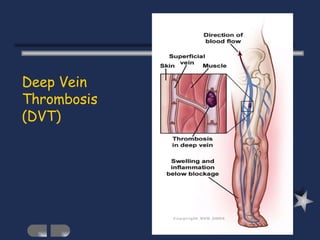
Thrombophlebitis inflammation of the veins caused by thrombus or blood clot Factors assoc. with the devt. of Thrombophlebitis venous stasis damage to the vessel wall hypercoagulability of the blood – oral contraceptive use common to hospitalized pts. , undergone major surgery (pelvic or hip surgery), MI Pathophysiology  develops in both the deep and superficial veins of the lower extremity deep veins – femoral, popliteal, small calf veins superficial veins – saphenous vein Thrombus  – form in the veins from accumulation of platelets, fibrin, WBC and RBC
 
Deep Vein Thrombosis (DVT) tends to occur at bifurcations of the deep veins, which are sites of turbulent blood flow a major risk during the acute phase of thrombophlebitis is dislodgment of the thrombus    embolus pulmonary embolus  – is a serious complication arising from DVT of the  lower extremities  Clinical Manifestations : pain and edema of extremity –  obstruction of venous flow    circumference of the thigh or calf (+) Homan’s sign – dorsiflexion of the foot produces calf pain Do not check for the Homan’s sign if DVT is already known to be present       risk of embolus formation * if superficial veins are affected - signs of inflammation may be noted – redness, warmth, tenderness along the course of the vein, the veins feel hard and thready & sensitive to pressure
Deep Vein Thrombosis (DVT)
 
Medical Management Superficial thrombophlebitis bed rest with legs elevated apply moist heat NSAID’s ( Non – steroidal anti-inflammatory drugs) - aspirin Deep vein thrombosis requires hospitalization bed rest w/ legs elevated to 15-20 degrees above heart level  ( knees slightly flexed, trunk horizontal (head may be raised) to promote venous return and help prevent further emboli and prevent edema application of warm moist heat to reduce pain, promotes venous return elastic stocking or bandage anticoagulants, initially with IV heparin then coumadin fibrinolytic to resolve the thrombus vasodilator if needed to control vessel spasm and improve circulation
Surgery   if the thrombus is recurrent and extensive or if the pt. is at high risk for pulmonary embolism Thrombectomy  – incising the common femoral vein in the groin and extracting the clots Vena caval interruption  – transvenous placement of a grid or umbrella filter in the vena cava to block the passage of emboli Assessment characteristic of the pain onset & duration of symptoms history of thrombophlebitis or venous disorders color & temp. of extremity edema of calf of thigh  - use a tape measure, measure both legs for comparison
 
 
Nursing Intervention Preventive care prevent long periods of standing or sitting that impair venous return elevate legs when sitting, dorsiflex feet at regular intervals to prevent venous pooling if edema occurs, elevate above heart level regular exercise program to promote circulation avoid crossing legs at the knees avoid wearing constrictive clothing such as tight bands around socks or garters use elastic stocking on affected leg do leg exercises during periods of enforced immobility such as after surgery
Nursing Management Acute care explain purpose of bed rest and leg elevation use elastic stockings monitor pt. on anticoagulant & fibrinolytic therapy for signs of bleeding monitor for signs of  pulmonary embolism  – sudden onset of chest pain, dyspnea, rapid breathing, tachycardia  Nsg. intervention often surgery of vena caval interruption assess insertion site – bleeding, hematoma, apply pressure over site and inform physician keep pt. on bed rest for 1 st  24 hrs. then encourage ROM exercises to promote venous return assist pt. in ambulation when permitted, elevate legs when sitting keep elastic bandage avoid rubbing or massaging the affected extremity give analgesic and anti-inflammatory agents to promote comfort
Results from obstruction of venous valves in legs or reflux of blood back through valves Venous ulceration is serious complication Pharmacological therapy is antibiotics for infections Debridement to promote healing Topical Therapy may be used with cleansing and debridement Chronic Venous Insufficiency
Venous ulceration
Varicose Veins are abnormally dilated veins with incompetent valves, occurring most often in the lower extremities usually affected are woman 30-50 years old. Causes :  congenital absence of a valve incompetent valves due to external pressure on the veins from pregnancy, ascites or abdominal tumors sustained    in venous pressure due to CHF, cirrhosis Prevention wear elastic stockings during activities that require long standing or when pregnant  moderate exercise, elevation of legs
 
Pathophysiology the great and small saphenous veins are most often involved weakening of the vein wall    does not withstand normal pressure    veins dilate , pooling of blood    valves become stretched and incompetent    more accumulation of blood in the veins
Clinical Manifestations Primary varicosities  – gradual onset and affect superficial veins, appearance of dark tortuous veins S/sx  – dull aches, muscle cramps, pressure, heaviness or fatigue arising from reduced blood flow to the tissues Secondary Varicosities  – affect the deep veins occur due to chronic venous insufficiency or venous thrombosis S/sx  – edema, pain, changes in skin color, ulcerations may occur from venous stasis
 
Trendelenburg test  assess competency of venous valves through measurement of venous filling time the pt. lies down with the affected leg raised to allow for venous emptying a tourniquet is then applied above the knee and the pt. stands. The direction and filling time are recorded both before & after the tourniquet is removed * Incompetent valves are evident when the veins fill rapidly from backward blood flow
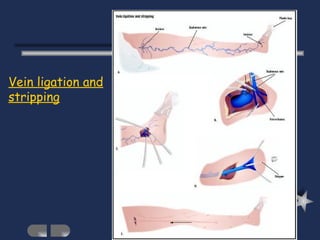
Surgical Intervention indicated or done for prevention or relief of edema, for recurrent leg ulcers or pain or for cosmetic purposes Vein ligation and stripping  the great sapheneous vein is ligated (tied) close to the femoral junction the veins are stripped out through small incisions at the groin, above & below the knee and at the ankles. sterile dressing are placed over the incisions and an elastic bandage extending from the foot to the groin is firmly applied
Vein ligation and stripping
Nursing care after vein ligation & stripping Monitor for signs of bleeding, esp. on 1 st  post-op day  if there is bleeding, elevate the leg, apply pressure over the wound and notify the surgeon Keep pt. flat on bed for first 4 hrs. after surgery, elevate leg to promote venous return when lying or sitting Medicate 30 mins. before ambulation and assist patient Keep elastic bandage snug and intact,  do not  remove bandage

Peripheral Vascular Diseases

  • 1.
  • 2.
    Arteries are thick-walledvessels that transport 0 2 and blood via the aorta from the heart to the tissues 3 Layers of Arteries inner layer of endothelium (intima) middle layer of connective tissue, smooth muscle and elastic fibers (media) outer layer of connective tissue (adventitia) have smooth muscles that contracts & relaxes to respond changes in blood volume.
  • 3.
    Veins are thin-walledvessels that transport deoxygenated blood from the capillaries back to the right side of the heart 3 Layers – intima, media, adventitia there is little smooth muscle & connective tissue  makes the veins more distensible  they accumulate large volumes of blood Major veins, particularly in the lower extremities, have one-way valves --- allow blood flow against gravity Valves allow blood to be pumped back to the heart but prevent it from draining back into the periphery
  • 4.
    Peripheral Vascular Diseasescharac. by a reduction in blood flow and hence 0 2 through the peripheral vessels when the need of the tissues for 0 2 exceeds the supply, areas of ischemia and necrosis will develop   Factors that can contribute to the development of peripheral vascular disorders : atherosclerotic changes thrombus formation embolization  coagulability of blood hypertension inflammatory process/infection
  • 5.
    Arterial Insufficiency thereis a deceased blood flow toward the tissues, producing ischemia pulses one usually diminished or absent sharp, stabbing pain occurs because of the ischemia, particularly with activity there is interference with nutrients and 0 2 arriving to the tissues, leading to ischemic ulcers and changes in the skin . Venous Insufficiency there is deceased return of blood from the tissues to the heart leads to venous congestion and stasis of blood pulses are present lead to edema , skin changes and stasis ulcers
  • 6.
    Comparison of characteristicsof Arterial & Venous Disorders Arterial Disease Venous Disease Skin cool or cold, hairless, dry, shiny, pallor on elevation, rubor on dangling warm, though, thickened, mottled, pigmented areas Pain sharp, stabbing, worsens w/ activity and walking, lowering feet may relieve pain aching, cramping, activity and walking sometimes help, elevating the feet relieves pain Ulcers severely painful, pale, gray base, found on heel, toes, dorsum of foot moderately painful, pink base, found on medial aspect of the ankle Pulse often absent or diminished usually present Edema infrequent frequent, esp. at the end of the day and in areas of ulceration
  • 7.
    Risk Factors Age(elderly) – blood vessels become less elastic, become thin walled and calcified –  PVR –  BP Sex (male ) Cigarette smoking nicotine causes vasoconstriction and spasm of the arteries –  circulation to the extremities C0 2 inhaled in cigarette smoke reduces 0 2 transport to tissues Hypertension – cause elastic tissues to be replaced by fibrous collagen tissue  arterial wall become less distensible   resistance to blood flow   BP Hyperlipedimia – atherosclerotic plaque Obesit y – places added burden on the heart & blood vessels excess fat contribute to  venous congestion
  • 8.
    Lack of physicalactivity Physical activity – promotes muscle contraction   venous return to the heart aids in development of collateral circulation Emotional stress – stimulates sympathetic N.S. - peripheral vasoconstriction   BP Diabetes mellitus – changes in glucose & fat metabolism promote the atherosclerotic process Family history of arthrosclerosis Risk Factors (cont.)
  • 9.
    Arteriosclerosis Obliterans isa disorder in which there is an arteriosclerotic narrowing or obstruction of the inner & middle layer of the artery most common cause of arterial obstructive disease in the extremities the lower extremities are involved more than upper extremities common site of disease – femoral artery , iliac arteries , popliteal arteries in a diabetic, the disease becomes more progressive, affects the smaller arteries and often involves vessels below the knee
  • 10.
  • 11.
  • 12.
    Pathophysiology Plaque formation on the intimal wall that causes partial or complete occlusion Calcification of the medial layer and a gradual loss of elasticity  weakens the arterial walls predisposes to aneurysm, dilation or thrombus formation  artery is unable to transport an adequate blood volume to the tissues during exercise or rest Symptoms appear when the blood vessels can no longer provide enough blood to supply 0 2 and nutrients and remove metabolic waste products
  • 13.
    Clinical Manifestations Intermittentclaudication – most common pain in the extremity that develops in a muscle that has an inadequate blood supply during exercise the cramping pain disappear w/in 1-2 mins. after stopping the exercise or resting the femoral artery is often affected – pain in the calf muscle – common symptom pain at rest is indicative of severe disease gnawing, burning pain, occur more frequently at night feelings of coldness numbness tingling sensation advanced arteriosclerosis obliterans  ischemia may lead to necrosis, ulceration and gangrene – toes and distal foot
  • 14.
    Diagnostic Tests Dopplerultrasonography – high frequency sound waves directed to artery or veins through a hand-held transducer moved evenly across skin surface audible tone produced in proportion to blood velocity measure blood flow through vessels
  • 15.
  • 16.
    – directedtoward prevention of vessel occlusion use of vasodilators Surgical intervention – in advanced disease – ischemic changes and pain severely impairs activity Embolectomy removal of a blood clot, done when large arteries are obstructed Endarterectomy is removal of a blood clot and stripping of atherosclerotic plaque along with the inner arterial wall. Arterial by-pass surgery an obstructed arterial segment may be bypassed by using a prosthetic material (Teflon) or the pt’s. own artery or vein (saphenous vein) Management
  • 17.
  • 18.
  • 19.
  • 20.
  • 21.
  • 22.
    Percutaneous Transluminal Angioplasty The balloon tip of the catheter is inflated to provide compression of the plaque Amputation with advanced atherosclerosis & gangrene of extremities toes are the most often amputated part of the body The surgical goal is the remove the least amt. of tissue possible and create a stump adequate for the fitting of a prosthesis Management
  • 23.
  • 24.
    Nursing Interventions preventfurther progression of existing disease Acute care monitor the limb distal to the affected site for changes in color or temperature  arterial flow – pale & cool (initially)  bluish/darker  tissue become necrotic & black activities that cause pain should be avoided give vasodilators if prescribed – relaxation of vascular smooth muscle  decreases the pain comfort measures – proper body positioning to dec. pressure on affected area
  • 25.
    Post – operativecare for arterial surgery pt. is monitored for signs of  circulation in the affected limb and interventions done to promote circulation & comfort Assess and report changes in skin color and temperature distal to the surgical site, every 2-4 hrs. assess peripheral pulses sudden absence of pulse may indicate thrombosis mark location of pulse with a pen to facilitate frequent assessment use a dapper if pulse in difficult to palpate assess wound for redness, swelling and drainage promote circulation reposition pt. every 2 hrs. tell pt. not to cross legs encourage progressive activity when permitted medication with analgesics to reduce pain
  • 26.
    Arterial by-pass surgeryPost-operative care assess sensation and movement of the limb monitor extremity for edema monitor & report signs of complications – increase pain, fever, limitation of movement or paresthesia avoid sharp flexion in the area of the graft to prevent decreased circulation to the graft.
  • 27.
    Thromboangitis Obliterans (Buerger’s Disease) characterized by acute inflammatory lesions and occlusive thrombosis of the arteries & veins has a very strong assoc. with cigarette smoking commonly occurs in male – bet. 20-40 y.o may involve the arteries of the upper extremities (wrists) usually affect the lower leg. toes, feet
  • 28.
    Clinical Manifestation intermittentclaudication in the arch of the foot pain during rest – toes coldness – due to persistent ischemia paresthesia pulsation in posterior tibial, dorsalis pedis – weak or absent extremities are red or cyanotic ulceration & gangrene are frequent complications – early  can occur spontaneously but often follow trauma
  • 29.
  • 30.
    Interventions advise theperson to stop smoking vasodilators prevent progression of disease avoid trauma to ischemic tissues relieve pain provide emotional support whiskey or brandy may be of some value during periods of exacerbations  vasodilation advise pt. to avoid mechanical, chemical or thermal injuries to the feet Amputation of the leg is done only when the ff. occurs: gangrene extends well into the foot pain is severe and cannot be controlled severe infection or toxicity occurs
  • 31.
    Raynaud’s phenomenon refersto intermittent episodes during which small arteries or arterioles of L and R arm constrict (spasm) causing changes in skin color and temperature generally unilateral and may affect only 1 or 2 fingers may occur after trauma, neurogenic lesions, occlusive arterial disease, connective tissues disease charac. by reduction of blood flow to the fingers manifested by cutaneous vessel constriction and resulting in blanching (pallor) Raynauds’ Disease unknown etiology, may be due to immunologic abnormalities common in women 20-40 y.o maybe stimulated by emotional stress, hypersensitivity to cold, alteration in sympathetic innervation
  • 32.
  • 33.
    Clinical Manifestations usuallybilateral –(both arms or feet are affected) during arterial spasm – sluggish blood flow causes pallor, coldness, numbness, cutaneous cyanosis and pain following the spasm – the involve area becomes intensely reddened with tingling and throbbing sensations with longstanding or prolonged Raynaud’s disease – ulcerations can develop on the fingertips and toes
  • 34.
  • 35.
    Medical Management aimedat prevention person is advised to protect against exposure to cold quit smoking Drug therapy – calcium channel blockers, vascular smooth muscle relaxants, vasodilators – to promote circulation and reduce pain sympathectomy ( cutting off of sympathetic nerve fibers) to relieve symptoms in the early stage of advanced ischemia if ulceration/gangrene occur, the area may need to be amputated
  • 36.
    Nursing Interventions similarto other arterial disorders collect data on effect of assoc. factors – emotional stress, exposure to cold, cigarette smoking prevent injury, promote circulation provide comfort teach pt. on effects of smoking, advise to quit discuss ways of avoiding exposure to cold wear adequate clothing to promote warmth wear gloves and socks use caution when cleaning ref. & freezer wear gloves when handling frozen foods avoid drugs that will cause vasoconstriction (birth control pills, ergotamine) suggest anti-inflammatory analgesics to promote comfort
  • 37.
    Aneurysm is alocalized or diffuse enlargement of an artery at some point along its course can occur when the vessel becomes weakened from trauma, congenital vascular disease, infection or atherosclerosis Pathophysiology enlargement of a segment of an artery  the tunica media (middle layer composed of smooth muscle & elastic tissue) is damaged  progressive dilation, degeneration  risk of rupture * most common site is the aorta may develop in any blood vessel  
  • 38.
    Types of AneurysmSaccular aneurysm – involves only part of the circumference of the artery, it takes the form of a sac or pouch-like dilation attached to the side of the artery Fusiform aneurysm – spindle shaped, involves the entire circumference of the arterial wall Dissecting aneurysm – involves hemorrhage into a vessel wall, which splits and dissects the wall causing a widening of the vessel caused by degenerative defect in the tunica media and tunica intima Diagnostic Tests chest & abdominal x-rays – helpful in preliminary diagnosis of aortic aneurysm Ultrasound – is useful in determining the size, shape and location of the aneurysm
  • 39.
  • 40.
  • 41.
  • 42.
    Throracic Aortic Aneurysm aneurysm in the thoracic area occur most frequently in hypertensive men bet. 40-70 y.o can develop in the ascending, transverse or descending aorta S/Sx chest pain – most frequent; perceived when pt. is in a supine position cough dyspnea hoarseness dysphagia related to the pressure of the sac of aneurysm pressing against internal structures
  • 43.
  • 44.
    Abdominal Aortic Aneurysmmost common site for the formation of an aortic aneurysm  abdominal aorta below the renal arteries S/Sx: presence of a pulsatile abdominal mass on palpation pain or tenderness in the mid-or upper abdomen the aneurysm may extend to impinge on the renal, iliac, or mesenteric arteries stasis of blood favors thrombus formation along the wall of the vessel Rupture of the aneurysm – most feared complication can occur if the aneurysm is large can lead to death Tx: Surgery – resection of the lesion and replacement with a graft
  • 45.
  • 46.
  • 47.
    Arterial Embolism bloodclots floating in the circulating arterial blood. the embolus is frequently a fragment of arterioscherotic plaque loosened from the aorta emboli will tend to lodge in femoral or popliteal arteries , blood flow is impaired and ischemia develops Clinical manifestations: S/Sx depends on the size of the embolus, the presence of collateral circulation and if it is close to a major organ abrupt onset of severe pain from the sudden cessation of circulation muscular weakness and burning, aching pain occur distal pulses are absent and extremity becomes cold, numb and pale symptoms of shock may develop if the embolus blocks a large artery
  • 48.
    Medical Management bedrest anticoagulants – prolong the clotting time of the blood and are used to prevent clot extension and new clot formation Ex. 1. heparin – inhibits thrombin action – prevents clotting IV or SQ, antidote – Protamine sulfate 2. Warfarin sodium – inhibits Vit. K dependent clotting factor (Coumadin) synthesis,  prothrombin activity - oral (10-15 mg/day) antidote – Vit. K Fibrinolytics or thrombolytics – are useful for dissolving existing thrombus or clot when rapid dissolution of the clot is required to preserve organ and limb function Ex. Streptokinase, Urokinase IV side effect - bleeding Embolectomy – surgical removal of a blood clot, when large arteries are obstructed must be performed w/in 6-10 hrs. to prevent muscle necrosis and loss of the extremity
  • 49.
    Nursing Management Monitorthe pt. during the acute phase for changes in color & temp. of the extremity distal to the clot assess for increasing pallor, cyanosis, coldness of the skin  indicates vessel occlusion keep the extremity warm, but do not apply heat, avoid chilling monitor peripheral pulses – quality – weak/absent CBR - to prevent further progression of the embolism keep affected extremity flat or slightly dependent position to promote circulation monitor anticoagulant or fibrinolytic therapy & assess for signs of bleeding – nose or gum bleeding , petechiae (pinpoint red areas on skin), ecchymosis (bruising) , hematoma formation monitor urine, stool, emesis and gastric secretions for blood avoid IM injections, use soft toothbrush, use electric razor rather than razor blade, avoid rectal thermometer
  • 50.
    Venous Disorders alterationin the transport/flow of blood from the capillary back to the heart changes in smooth muscle and connective tissue make the veins less distensible with limited recoil capacity valves may malfunction, causing backflow of blood Virchow’s triad: blood stasis, vessel wall injury, and altered blood coagulation
  • 51.
    Thrombophlebitis inflammation ofthe veins caused by thrombus or blood clot Factors assoc. with the devt. of Thrombophlebitis venous stasis damage to the vessel wall hypercoagulability of the blood – oral contraceptive use common to hospitalized pts. , undergone major surgery (pelvic or hip surgery), MI Pathophysiology develops in both the deep and superficial veins of the lower extremity deep veins – femoral, popliteal, small calf veins superficial veins – saphenous vein Thrombus – form in the veins from accumulation of platelets, fibrin, WBC and RBC
  • 52.
  • 53.
    Deep Vein Thrombosis(DVT) tends to occur at bifurcations of the deep veins, which are sites of turbulent blood flow a major risk during the acute phase of thrombophlebitis is dislodgment of the thrombus  embolus pulmonary embolus – is a serious complication arising from DVT of the lower extremities Clinical Manifestations : pain and edema of extremity – obstruction of venous flow  circumference of the thigh or calf (+) Homan’s sign – dorsiflexion of the foot produces calf pain Do not check for the Homan’s sign if DVT is already known to be present   risk of embolus formation * if superficial veins are affected - signs of inflammation may be noted – redness, warmth, tenderness along the course of the vein, the veins feel hard and thready & sensitive to pressure
  • 54.
  • 55.
  • 56.
    Medical Management Superficialthrombophlebitis bed rest with legs elevated apply moist heat NSAID’s ( Non – steroidal anti-inflammatory drugs) - aspirin Deep vein thrombosis requires hospitalization bed rest w/ legs elevated to 15-20 degrees above heart level ( knees slightly flexed, trunk horizontal (head may be raised) to promote venous return and help prevent further emboli and prevent edema application of warm moist heat to reduce pain, promotes venous return elastic stocking or bandage anticoagulants, initially with IV heparin then coumadin fibrinolytic to resolve the thrombus vasodilator if needed to control vessel spasm and improve circulation
  • 57.
    Surgery if the thrombus is recurrent and extensive or if the pt. is at high risk for pulmonary embolism Thrombectomy – incising the common femoral vein in the groin and extracting the clots Vena caval interruption – transvenous placement of a grid or umbrella filter in the vena cava to block the passage of emboli Assessment characteristic of the pain onset & duration of symptoms history of thrombophlebitis or venous disorders color & temp. of extremity edema of calf of thigh - use a tape measure, measure both legs for comparison
  • 58.
  • 59.
  • 60.
    Nursing Intervention Preventivecare prevent long periods of standing or sitting that impair venous return elevate legs when sitting, dorsiflex feet at regular intervals to prevent venous pooling if edema occurs, elevate above heart level regular exercise program to promote circulation avoid crossing legs at the knees avoid wearing constrictive clothing such as tight bands around socks or garters use elastic stocking on affected leg do leg exercises during periods of enforced immobility such as after surgery
  • 61.
    Nursing Management Acutecare explain purpose of bed rest and leg elevation use elastic stockings monitor pt. on anticoagulant & fibrinolytic therapy for signs of bleeding monitor for signs of pulmonary embolism – sudden onset of chest pain, dyspnea, rapid breathing, tachycardia Nsg. intervention often surgery of vena caval interruption assess insertion site – bleeding, hematoma, apply pressure over site and inform physician keep pt. on bed rest for 1 st 24 hrs. then encourage ROM exercises to promote venous return assist pt. in ambulation when permitted, elevate legs when sitting keep elastic bandage avoid rubbing or massaging the affected extremity give analgesic and anti-inflammatory agents to promote comfort
  • 62.
    Results from obstructionof venous valves in legs or reflux of blood back through valves Venous ulceration is serious complication Pharmacological therapy is antibiotics for infections Debridement to promote healing Topical Therapy may be used with cleansing and debridement Chronic Venous Insufficiency
  • 63.
  • 64.
    Varicose Veins areabnormally dilated veins with incompetent valves, occurring most often in the lower extremities usually affected are woman 30-50 years old. Causes : congenital absence of a valve incompetent valves due to external pressure on the veins from pregnancy, ascites or abdominal tumors sustained  in venous pressure due to CHF, cirrhosis Prevention wear elastic stockings during activities that require long standing or when pregnant moderate exercise, elevation of legs
  • 65.
  • 66.
    Pathophysiology the greatand small saphenous veins are most often involved weakening of the vein wall  does not withstand normal pressure  veins dilate , pooling of blood  valves become stretched and incompetent  more accumulation of blood in the veins
  • 67.
    Clinical Manifestations Primaryvaricosities – gradual onset and affect superficial veins, appearance of dark tortuous veins S/sx – dull aches, muscle cramps, pressure, heaviness or fatigue arising from reduced blood flow to the tissues Secondary Varicosities – affect the deep veins occur due to chronic venous insufficiency or venous thrombosis S/sx – edema, pain, changes in skin color, ulcerations may occur from venous stasis
  • 68.
  • 69.
    Trendelenburg test assess competency of venous valves through measurement of venous filling time the pt. lies down with the affected leg raised to allow for venous emptying a tourniquet is then applied above the knee and the pt. stands. The direction and filling time are recorded both before & after the tourniquet is removed * Incompetent valves are evident when the veins fill rapidly from backward blood flow
  • 70.
    Surgical Intervention indicatedor done for prevention or relief of edema, for recurrent leg ulcers or pain or for cosmetic purposes Vein ligation and stripping the great sapheneous vein is ligated (tied) close to the femoral junction the veins are stripped out through small incisions at the groin, above & below the knee and at the ankles. sterile dressing are placed over the incisions and an elastic bandage extending from the foot to the groin is firmly applied
  • 71.
  • 72.
    Nursing care aftervein ligation & stripping Monitor for signs of bleeding, esp. on 1 st post-op day if there is bleeding, elevate the leg, apply pressure over the wound and notify the surgeon Keep pt. flat on bed for first 4 hrs. after surgery, elevate leg to promote venous return when lying or sitting Medicate 30 mins. before ambulation and assist patient Keep elastic bandage snug and intact, do not remove bandage