25/11/2015 1
 INTRODUCTION
 PRINCIPLE
 THEORY OF ULTRA VIOLET SPECTRA
 TYPES Of ELECTRONIC TRANSITIONS
 ABSORBANCE LAWS
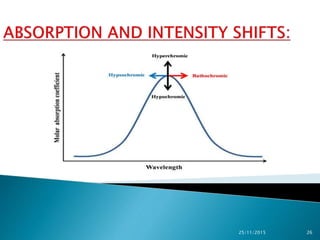
 ABSORPTION AND INTENSITY SHIFTS
25/11/2015 2
 Spectroscopy
 Electromagnetic Radiation
 Wavelength
 Frequency
 Wave-Number
25/11/2015 3
25/11/2015 4
Any molecules has either n,π or Ϭ or a
combination of these electrons. These bonding (Ϭ
& π ) and non-bonding (n)electrons absorb the
characteristic radiation and undergoes transition
from ground state to excited state.
By the characteristic absorption peaks, the
nature of the electrons present and hence the
molecular structure can be elucidated.
25/11/2015 5
• When the molecule absorbs ultraviolet or visible
light, its electrons get promoted from the ground
state to the higher energy state.
• In the ground state, the spins of the electrons in
each molecular orbital are essentially paired.
• In the higher energy state, if the spins of the
electrons are paired, then it is called an excited
singlet state
25/11/2015 6
25/11/2015 7
Cont…
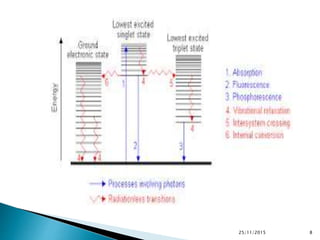
• On the other hand, if the spins of the
electrons in the excited state are parallel, it is
called an excited triplet state.
• The triplet state is always lower in energy
than the corresponding excited singlet state.
• Therefore, triplet state is more stable as
compared to the excited singlet state.
• An excited singlet state is converted to
excited triplet state with the emission of
energy as light.
25/11/2015 8
25/11/2015 9
Cont…
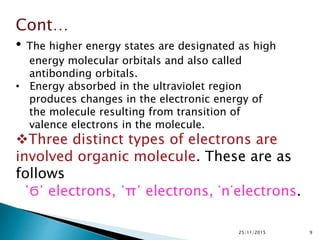
• The higher energy states are designated as high
energy molecular orbitals and also called
antibonding orbitals.
• Energy absorbed in the ultraviolet region
produces changes in the electronic energy of
the molecule resulting from transition of
valence electrons in the molecule.
Three distinct types of electrons are
involved organic molecule. These are as
follows
῾Ϭ᾽ electrons, ῾π᾿ electrons, ῾n᾿electrons.
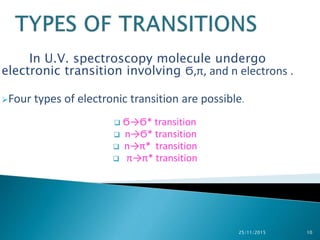
In U.V. spectroscopy molecule undergo
electronic transition involving Ϭ,π, and n electrons .
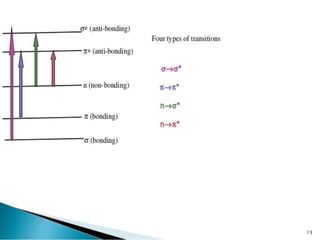
Four types of electronic transition are possible.
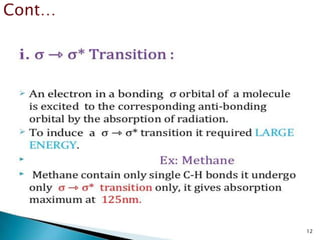
 Ϭ→Ϭ* transition
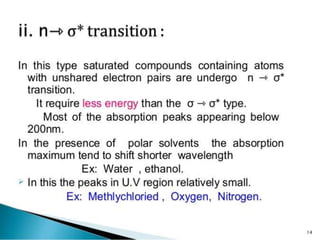
 n→Ϭ* transition
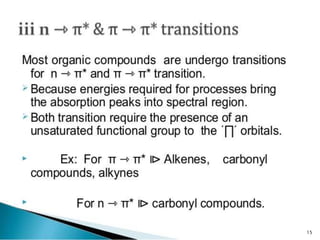
 n→π* transition
 π→π* transition
25/11/2015 10
25/11/2015 11
Cont…
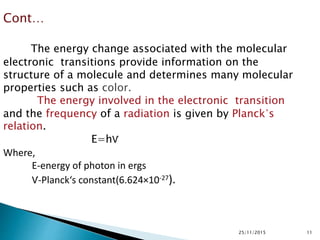
The energy change associated with the molecular
electronic transitions provide information on the
structure of a molecule and determines many molecular
properties such as color.
The energy involved in the electronic transition
and the frequency of a radiation is given by Planck᾿s
relation.
E=hѴ
Where,
E-energy of photon in ergs
Ѵ-Planck‘s constant(6.624×10⁻²⁷).
25/11/2015 12
Cont…
12
25/11/2015 13
25/11/2015 14
25/11/2015 15
25/11/2015 16
LAWS GOVERNING ABSORPTION OF
RADIATION
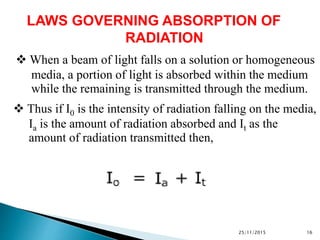
 When a beam of light falls on a solution or homogeneous
media, a portion of light is absorbed within the medium
while the remaining is transmitted through the medium.
 Thus if I0 is the intensity of radiation falling on the media,
Ia is the amount of radiation absorbed and It as the
amount of radiation transmitted then,
25/11/2015 17
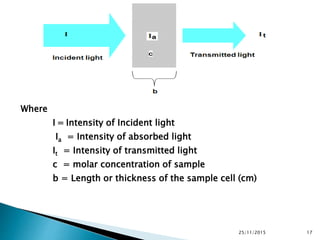
Where
I = Intensity of Incident light
Ia = Intensity of absorbed light
It = Intensity of transmitted light
c = molar concentration of sample
b = Length or thickness of the sample cell (cm)
25/11/2015 18
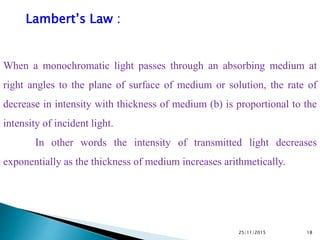
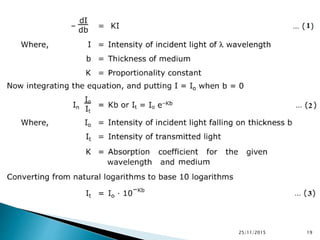
Lambert’s Law :
When a monochromatic light passes through an absorbing medium at
right angles to the plane of surface of medium or solution, the rate of
decrease in intensity with thickness of medium (b) is proportional to the
intensity of incident light.
In other words the intensity of transmitted light decreases
exponentially as the thickness of medium increases arithmetically.
25/11/2015 19
25/11/2015 20
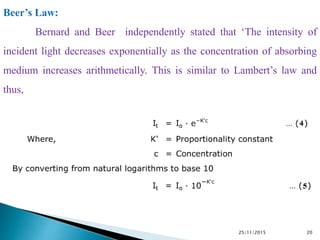
Beer’s Law:
Bernard and Beer independently stated that ‘The intensity of
incident light decreases exponentially as the concentration of absorbing
medium increases arithmetically. This is similar to Lambert’s law and
thus,
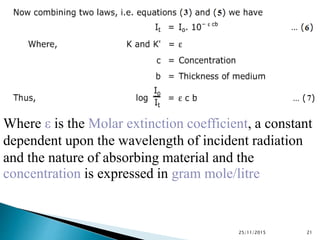
25/11/2015 21
Where ε is the Molar extinction coefficient, a constant
dependent upon the wavelength of incident radiation
and the nature of absorbing material and the
concentration is expressed in gram mole/litre
25/11/2015 22
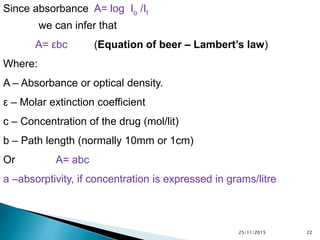
Since absorbance A= log Io /It
we can infer that
A= εbc (Equation of beer – Lambert’s law)
Where:
A – Absorbance or optical density.
ε – Molar extinction coefficient
c – Concentration of the drug (mol/lit)
b – Path length (normally 10mm or 1cm)
Or A= abc
a –absorptivity, if concentration is expressed in grams/litre
25/11/2015 23
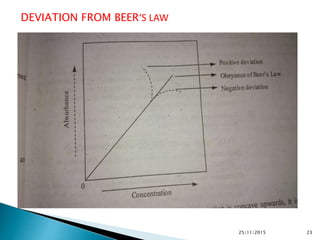
DEVIATION FROM BEER‘S LAW
25/11/2015 24
REASONS FOR DEVATION FROM BEER LAMBERT’S LAW:
 True deviation : True deviations are related to the
concentration of the absorbing substance. Beers law holds
good only for dilute solutions.
 Chemical deviation : Chemical deviations arise if the
absorbing species undergo chemical changes such as
association, complex formation, dissociation, hydrogen
bonding, hydrolysis, ionization or polymerization
25/11/2015 25
Instrumental Deviation :
 Only monochromatic light gives beers law use of
polychromatic light gives negative deviation.
 Any fluctuations in intensity of light, change in
the sensitivity of detector, improper slit width can
lead to deviation from beer lamberts law.
25/11/2015 26
 The term chromophore is defined as the any
system which is responsible for imparting
color to the compound .
 Auxochrome:
 Its is defined as any group which does not itself
act as a chromophore but whose presence
brings about shift of the absorption band
towards the red end of the spectrum.
25/11/2015 27
 Instrumental Methods Of Chemical Analysis
by Gurdeep R.Chatwal;Sham K.Anand (page
no:2.149-2.154).
 Text Book Of Pharmaceutical Analysis by
Dr.S.Ravi Sankar.(pg.no:2-1:2-5)
25/11/2015 28
25/11/2015 29

UV-VISIBLE SPECTROSCOPY

  • 1.
  • 2.
     INTRODUCTION  PRINCIPLE THEORY OF ULTRA VIOLET SPECTRA  TYPES Of ELECTRONIC TRANSITIONS  ABSORBANCE LAWS  ABSORPTION AND INTENSITY SHIFTS 25/11/2015 2
  • 3.
     Spectroscopy  ElectromagneticRadiation  Wavelength  Frequency  Wave-Number 25/11/2015 3
  • 4.
  • 5.
    Any molecules haseither n,π or Ϭ or a combination of these electrons. These bonding (Ϭ & π ) and non-bonding (n)electrons absorb the characteristic radiation and undergoes transition from ground state to excited state. By the characteristic absorption peaks, the nature of the electrons present and hence the molecular structure can be elucidated. 25/11/2015 5
  • 6.
    • When themolecule absorbs ultraviolet or visible light, its electrons get promoted from the ground state to the higher energy state. • In the ground state, the spins of the electrons in each molecular orbital are essentially paired. • In the higher energy state, if the spins of the electrons are paired, then it is called an excited singlet state 25/11/2015 6
  • 7.
    25/11/2015 7 Cont… • Onthe other hand, if the spins of the electrons in the excited state are parallel, it is called an excited triplet state. • The triplet state is always lower in energy than the corresponding excited singlet state. • Therefore, triplet state is more stable as compared to the excited singlet state. • An excited singlet state is converted to excited triplet state with the emission of energy as light.
  • 8.
  • 9.
    25/11/2015 9 Cont… • Thehigher energy states are designated as high energy molecular orbitals and also called antibonding orbitals. • Energy absorbed in the ultraviolet region produces changes in the electronic energy of the molecule resulting from transition of valence electrons in the molecule. Three distinct types of electrons are involved organic molecule. These are as follows ῾Ϭ᾽ electrons, ῾π᾿ electrons, ῾n᾿electrons.
  • 10.
    In U.V. spectroscopymolecule undergo electronic transition involving Ϭ,π, and n electrons . Four types of electronic transition are possible.  Ϭ→Ϭ* transition  n→Ϭ* transition  n→π* transition  π→π* transition 25/11/2015 10
  • 11.
    25/11/2015 11 Cont… The energychange associated with the molecular electronic transitions provide information on the structure of a molecule and determines many molecular properties such as color. The energy involved in the electronic transition and the frequency of a radiation is given by Planck᾿s relation. E=hѴ Where, E-energy of photon in ergs Ѵ-Planck‘s constant(6.624×10⁻²⁷).
  • 12.
  • 13.
  • 14.
  • 15.
  • 16.
    25/11/2015 16 LAWS GOVERNINGABSORPTION OF RADIATION  When a beam of light falls on a solution or homogeneous media, a portion of light is absorbed within the medium while the remaining is transmitted through the medium.  Thus if I0 is the intensity of radiation falling on the media, Ia is the amount of radiation absorbed and It as the amount of radiation transmitted then,
  • 17.
    25/11/2015 17 Where I =Intensity of Incident light Ia = Intensity of absorbed light It = Intensity of transmitted light c = molar concentration of sample b = Length or thickness of the sample cell (cm)
  • 18.
    25/11/2015 18 Lambert’s Law: When a monochromatic light passes through an absorbing medium at right angles to the plane of surface of medium or solution, the rate of decrease in intensity with thickness of medium (b) is proportional to the intensity of incident light. In other words the intensity of transmitted light decreases exponentially as the thickness of medium increases arithmetically.
  • 19.
  • 20.
    25/11/2015 20 Beer’s Law: Bernardand Beer independently stated that ‘The intensity of incident light decreases exponentially as the concentration of absorbing medium increases arithmetically. This is similar to Lambert’s law and thus,
  • 21.
    25/11/2015 21 Where εis the Molar extinction coefficient, a constant dependent upon the wavelength of incident radiation and the nature of absorbing material and the concentration is expressed in gram mole/litre
  • 22.
    25/11/2015 22 Since absorbanceA= log Io /It we can infer that A= εbc (Equation of beer – Lambert’s law) Where: A – Absorbance or optical density. ε – Molar extinction coefficient c – Concentration of the drug (mol/lit) b – Path length (normally 10mm or 1cm) Or A= abc a –absorptivity, if concentration is expressed in grams/litre
  • 23.
  • 24.
    25/11/2015 24 REASONS FORDEVATION FROM BEER LAMBERT’S LAW:  True deviation : True deviations are related to the concentration of the absorbing substance. Beers law holds good only for dilute solutions.  Chemical deviation : Chemical deviations arise if the absorbing species undergo chemical changes such as association, complex formation, dissociation, hydrogen bonding, hydrolysis, ionization or polymerization
  • 25.
    25/11/2015 25 Instrumental Deviation:  Only monochromatic light gives beers law use of polychromatic light gives negative deviation.  Any fluctuations in intensity of light, change in the sensitivity of detector, improper slit width can lead to deviation from beer lamberts law.
  • 26.
  • 27.
     The termchromophore is defined as the any system which is responsible for imparting color to the compound .  Auxochrome:  Its is defined as any group which does not itself act as a chromophore but whose presence brings about shift of the absorption band towards the red end of the spectrum. 25/11/2015 27
  • 28.
     Instrumental MethodsOf Chemical Analysis by Gurdeep R.Chatwal;Sham K.Anand (page no:2.149-2.154).  Text Book Of Pharmaceutical Analysis by Dr.S.Ravi Sankar.(pg.no:2-1:2-5) 25/11/2015 28
  • 29.