
By:
Dipanshu sharma
M-PHARMACY
(pharmaceutics)

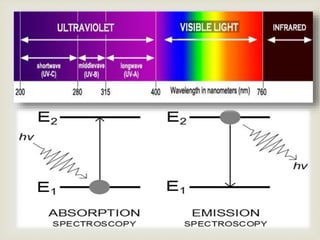
TYPES:
1) Absorption Spectroscopy : the study of
absorbed radiation by molecule , in form of spectra
Eg: UV , IR
2) Emission Spectroscopy: the radiation
emitted by molecule can also be studied to reveal
the structure of molecule
Eg : flourimetry , flame photometry
SPECTROSCOPY
“The study of interaction of electromagnetic radiation
with molecule /atom”

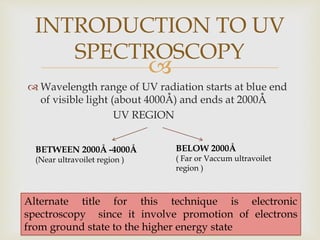
 Wavelength range of UV radiation starts at blue end
of visible light (about 4000Å) and ends at 2000Å
UV REGION
INTRODUCTION TO UV
SPECTROSCOPY
BETWEEN 2000Å -4000Å
(Near ultravoilet region )
BELOW 2000Å
( Far or Vaccum ultravoilet
region )
Alternate title for this technique is electronic
spectroscopy since it involve promotion of electrons
from ground state to the higher energy state


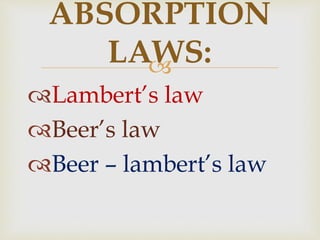
Lambert’s law
Beer’s law
Beer – lambert’s law
ABSORPTION
LAWS:
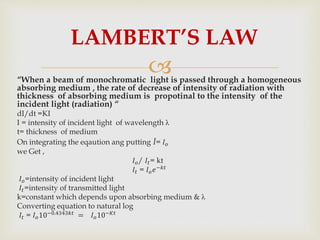
“When a beam of monochromatic light is passed through a homogeneous
absorbing medium , the rate of decrease of intensity of radiation with
thickness of absorbing medium is propotinal to the intensity of the
incident light (radiation) “
dI/dt =KI
I = intensity of incident light of wavelength λ
t= thickness of medium
On integrating the eqaution ang putting I= 𝐼 𝑜
we Get ,
𝐼 𝑜/ 𝐼𝑡= kt
𝐼𝑡 = 𝐼 𝑜 𝑒−𝑘𝑡
𝐼 𝑜=intensity of incident light
𝐼𝑡=intensity of transmitted light
k=constant which depends upon absorbing medium & λ
Converting equation to natural log
𝐼𝑡 = 𝐼 𝑜10−0.4343𝑘𝑡
= 𝐼 𝑜10−𝐾𝑡
LAMBERT’S LAW

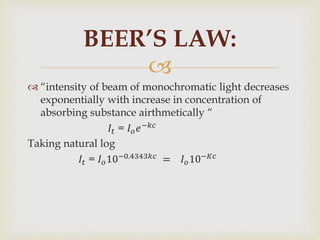
 “intensity of beam of monochromatic light decreases
exponentially with increase in concentration of
absorbing substance airthmetically “
𝐼𝑡 = 𝐼 𝑜 𝑒−𝑘𝑐
Taking natural log
𝐼𝑡 = 𝐼 𝑜10−0.4343𝑘𝑐 = 𝐼 𝑜10−𝐾𝑐
BEER’S LAW:

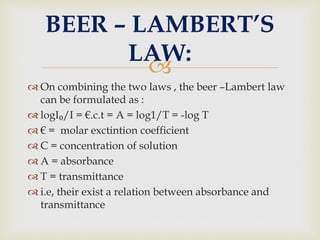
 On combining the two laws , the beer –Lambert law
can be formulated as :
 logI₀/I = €.c.t = A = log1/T = -log T
 € = molar exctintion coefficient
 C = concentration of solution
 A = absorbance
 T = transmittance
 i.e, their exist a relation between absorbance and
transmittance
BEER – LAMBERT’S
LAW:

UV spectroscopy measures the response of a
sample to a ultraviolet range of EMW
Molecules have either n , or σ electrons .
These electrons absorb UV radiation &
undergoes transitions from ground state to
excited state
PRINCIPLE:
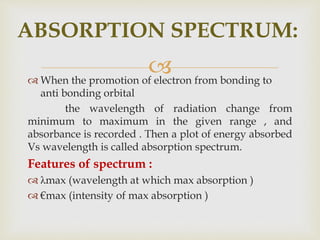
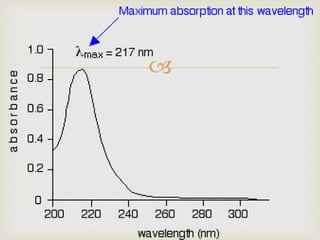
 When the promotion of electron from bonding to
anti bonding orbital
the wavelength of radiation change from
minimum to maximum in the given range , and
absorbance is recorded . Then a plot of energy absorbed
Vs wavelength is called absorption spectrum.
Features of spectrum :
 λmax (wavelength at which max absorption )
 €max (intensity of max absorption )
ABSORPTION SPECTRUM:


 *
 *
 n *
 n *
 *
 *
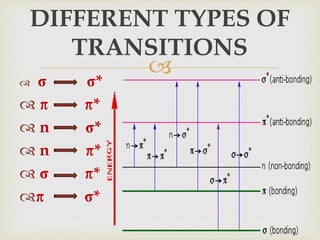
DIFFERENT TYPES OF
TRANSITIONS

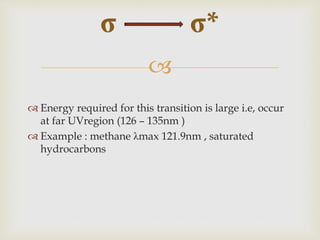
 Energy required for this transition is large i.e, occur
at far UVregion (126 – 135nm )
 Example : methane λmax 121.9nm , saturated
hydrocarbons
*

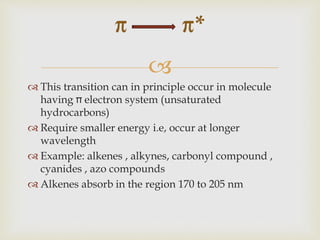
 This transition can in principle occur in molecule
having electron system (unsaturated
hydrocarbons)
 Require smaller energy i.e, occur at longer
wavelength
 Example: alkenes , alkynes, carbonyl compound ,
cyanides , azo compounds
 Alkenes absorb in the region 170 to 205 nm
*

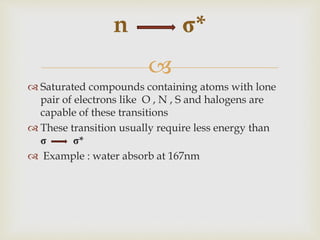
 Saturated compounds containing atoms with lone
pair of electrons like O , N , S and halogens are
capable of these transitions
 These transition usually require less energy than
*
 Example : water absorb at 167nm
n *

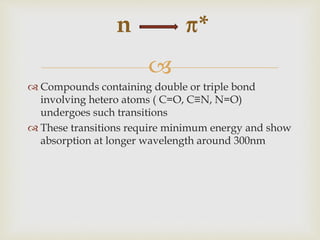
 Compounds containing double or triple bond
involving hetero atoms ( C=O, C≡N, N=O)
undergoes such transitions
 These transitions require minimum energy and show
absorption at longer wavelength around 300nm
n *

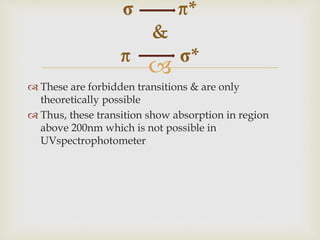
 These are forbidden transitions & are only
theoretically possible
 Thus, these transition show absorption in region
above 200nm which is not possible in
UVspectrophotometer
*
&
*

 UV radiation may be absorbed by organic
compounds that contain N , O , S, halogen atom or
unsaturated hydrocarbons ( such as olefins ) .
Functional group that contain these groups and
absorb radiation in UV region are called
chromophores
CHROMPHORES

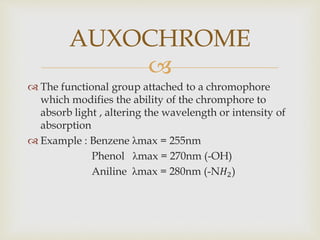
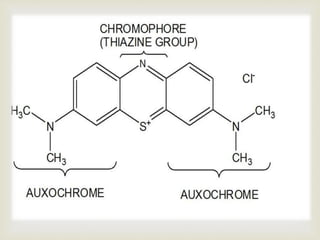
 The functional group attached to a chromophore
which modifies the ability of the chromphore to
absorb light , altering the wavelength or intensity of
absorption
 Example : Benzene λmax = 255nm
Phenol λmax = 270nm (-OH)
Aniline λmax = 280nm (-N𝐻2)
AUXOCHROME


ABSORPTION AND
INTENSITY SHIFTS


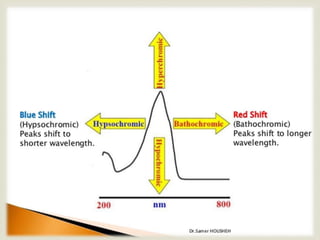
 When absorption maxima shift toward longer
wavelength due to presence of an auxocrome or by
the change of solvent
 Example : n * transition for carbonyl
compound experience shift when polarity of solvent
decreases
groups like (–OH -OCH3) causes absorption at longer
wavelength
BATHOCHROMIC
SHIFT(RED SHIFT)

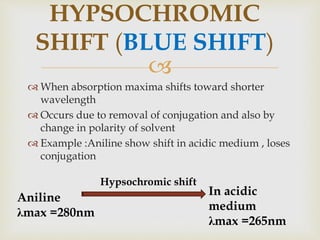
 When absorption maxima shifts toward shorter
wavelength
 Occurs due to removal of conjugation and also by
change in polarity of solvent
 Example :Aniline show shift in acidic medium , loses
conjugation
HYPSOCHROMIC
SHIFT (BLUE SHIFT)
Aniline
λmax =280nm
In acidic
medium
λmax =265nm
Hypsochromic shift

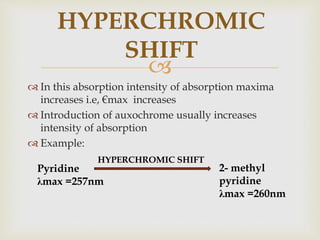
 In this absorption intensity of absorption maxima
increases i.e, €max increases
 Introduction of auxochrome usually increases
intensity of absorption
 Example:
HYPERCHROMIC
SHIFT
Pyridine
λmax =257nm
2- methyl
pyridine
λmax =260nm
HYPERCHROMIC SHIFT

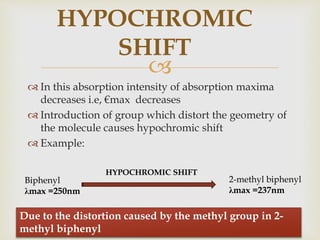
 In this absorption intensity of absorption maxima
decreases i.e, €max decreases
 Introduction of group which distort the geometry of
the molecule causes hypochromic shift
 Example:
HYPOCHROMIC
SHIFT
Biphenyl
λmax =250nm
2-methyl biphenyl
λmax =237nm
HYPOCHROMIC SHIFT
Due to the distortion caused by the methyl group in 2-
methyl biphenyl


Ultravoilet spectroscopy

  • 1.
  • 2.
     TYPES: 1) Absorption Spectroscopy: the study of absorbed radiation by molecule , in form of spectra Eg: UV , IR 2) Emission Spectroscopy: the radiation emitted by molecule can also be studied to reveal the structure of molecule Eg : flourimetry , flame photometry SPECTROSCOPY “The study of interaction of electromagnetic radiation with molecule /atom”
  • 3.
      Wavelength rangeof UV radiation starts at blue end of visible light (about 4000Å) and ends at 2000Å UV REGION INTRODUCTION TO UV SPECTROSCOPY BETWEEN 2000Å -4000Å (Near ultravoilet region ) BELOW 2000Å ( Far or Vaccum ultravoilet region ) Alternate title for this technique is electronic spectroscopy since it involve promotion of electrons from ground state to the higher energy state
  • 4.
  • 5.
     Lambert’s law Beer’s law Beer– lambert’s law ABSORPTION LAWS:
  • 6.
    “When a beamof monochromatic light is passed through a homogeneous absorbing medium , the rate of decrease of intensity of radiation with thickness of absorbing medium is propotinal to the intensity of the incident light (radiation) “ dI/dt =KI I = intensity of incident light of wavelength λ t= thickness of medium On integrating the eqaution ang putting I= 𝐼 𝑜 we Get , 𝐼 𝑜/ 𝐼𝑡= kt 𝐼𝑡 = 𝐼 𝑜 𝑒−𝑘𝑡 𝐼 𝑜=intensity of incident light 𝐼𝑡=intensity of transmitted light k=constant which depends upon absorbing medium & λ Converting equation to natural log 𝐼𝑡 = 𝐼 𝑜10−0.4343𝑘𝑡 = 𝐼 𝑜10−𝐾𝑡 LAMBERT’S LAW
  • 7.
      “intensity ofbeam of monochromatic light decreases exponentially with increase in concentration of absorbing substance airthmetically “ 𝐼𝑡 = 𝐼 𝑜 𝑒−𝑘𝑐 Taking natural log 𝐼𝑡 = 𝐼 𝑜10−0.4343𝑘𝑐 = 𝐼 𝑜10−𝐾𝑐 BEER’S LAW:
  • 8.
      On combiningthe two laws , the beer –Lambert law can be formulated as :  logI₀/I = €.c.t = A = log1/T = -log T  € = molar exctintion coefficient  C = concentration of solution  A = absorbance  T = transmittance  i.e, their exist a relation between absorbance and transmittance BEER – LAMBERT’S LAW:
  • 9.
     UV spectroscopy measuresthe response of a sample to a ultraviolet range of EMW Molecules have either n , or σ electrons . These electrons absorb UV radiation & undergoes transitions from ground state to excited state PRINCIPLE:
  • 10.
     When thepromotion of electron from bonding to anti bonding orbital the wavelength of radiation change from minimum to maximum in the given range , and absorbance is recorded . Then a plot of energy absorbed Vs wavelength is called absorption spectrum. Features of spectrum :  λmax (wavelength at which max absorption )  €max (intensity of max absorption ) ABSORPTION SPECTRUM:
  • 11.
  • 12.
      *  * n *  n *  *  * DIFFERENT TYPES OF TRANSITIONS
  • 13.
      Energy requiredfor this transition is large i.e, occur at far UVregion (126 – 135nm )  Example : methane λmax 121.9nm , saturated hydrocarbons *
  • 14.
      This transitioncan in principle occur in molecule having electron system (unsaturated hydrocarbons)  Require smaller energy i.e, occur at longer wavelength  Example: alkenes , alkynes, carbonyl compound , cyanides , azo compounds  Alkenes absorb in the region 170 to 205 nm *
  • 15.
      Saturated compoundscontaining atoms with lone pair of electrons like O , N , S and halogens are capable of these transitions  These transition usually require less energy than *  Example : water absorb at 167nm n *
  • 16.
      Compounds containingdouble or triple bond involving hetero atoms ( C=O, C≡N, N=O) undergoes such transitions  These transitions require minimum energy and show absorption at longer wavelength around 300nm n *
  • 17.
      These areforbidden transitions & are only theoretically possible  Thus, these transition show absorption in region above 200nm which is not possible in UVspectrophotometer * & *
  • 18.
      UV radiationmay be absorbed by organic compounds that contain N , O , S, halogen atom or unsaturated hydrocarbons ( such as olefins ) . Functional group that contain these groups and absorb radiation in UV region are called chromophores CHROMPHORES
  • 19.
      The functionalgroup attached to a chromophore which modifies the ability of the chromphore to absorb light , altering the wavelength or intensity of absorption  Example : Benzene λmax = 255nm Phenol λmax = 270nm (-OH) Aniline λmax = 280nm (-N𝐻2) AUXOCHROME
  • 20.
  • 21.
  • 22.
  • 23.
      When absorptionmaxima shift toward longer wavelength due to presence of an auxocrome or by the change of solvent  Example : n * transition for carbonyl compound experience shift when polarity of solvent decreases groups like (–OH -OCH3) causes absorption at longer wavelength BATHOCHROMIC SHIFT(RED SHIFT)
  • 24.
      When absorptionmaxima shifts toward shorter wavelength  Occurs due to removal of conjugation and also by change in polarity of solvent  Example :Aniline show shift in acidic medium , loses conjugation HYPSOCHROMIC SHIFT (BLUE SHIFT) Aniline λmax =280nm In acidic medium λmax =265nm Hypsochromic shift
  • 25.
      In thisabsorption intensity of absorption maxima increases i.e, €max increases  Introduction of auxochrome usually increases intensity of absorption  Example: HYPERCHROMIC SHIFT Pyridine λmax =257nm 2- methyl pyridine λmax =260nm HYPERCHROMIC SHIFT
  • 26.
      In thisabsorption intensity of absorption maxima decreases i.e, €max decreases  Introduction of group which distort the geometry of the molecule causes hypochromic shift  Example: HYPOCHROMIC SHIFT Biphenyl λmax =250nm 2-methyl biphenyl λmax =237nm HYPOCHROMIC SHIFT Due to the distortion caused by the methyl group in 2- methyl biphenyl
  • 27.