TOPIC: FACTORS AFFECTING FLUORIMETRY
AND QUENCHING
ABIYA SARA CHERIAN
1ST YEAR M PHARM
DEP OF PHARMACEUTICS
ST JOSEPH’S COLLEGE OF PHARMACY,CHETHALA.
1
FACTORS AFFECTING FLUORESCENCE
1. Nature of molecules.
2. Effect of substituent.
3. Effect of concentration.
4. Adsorption, Light.
5. Photodecomposition.
6. Oxygen, PH.
7. Temperature and viscosity.
8. Quantum yield of fluorescence.
9. Intensity of incident light.
10.Path length.
2
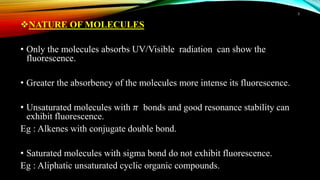
NATURE OF MOLECULES
• Only the molecules absorbs UV/Visible radiation can show the
fluorescence.
• Greater the absorbency of the molecules more intense its fluorescence.
• Unsaturated molecules with 𝜋 bonds and good resonance stability can
exhibit fluorescence.
Eg : Alkenes with conjugate double bond.
• Saturated molecules with sigma bond do not exhibit fluorescence.
Eg : Aliphatic unsaturated cyclic organic compounds.
3
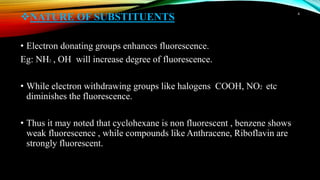
NATURE OF SUBSTITUENTS
• Electron donating groups enhances fluorescence.
Eg: NH2 , OH will increase degree of fluorescence.
• While electron withdrawing groups like halogens COOH, NO2 etc
diminishes the fluorescence.
• Thus it may noted that cyclohexane is non fluorescent , benzene shows
weak fluorescence , while compounds like Anthracene, Riboflavin are
strongly fluorescent.
4
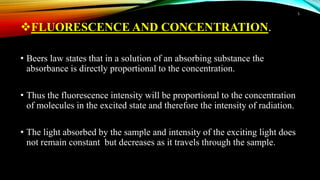
FLUORESCENCE AND CONCENTRATION.
• Beers law states that in a solution of an absorbing substance the
absorbance is directly proportional to the concentration.
• Thus the fluorescence intensity will be proportional to the concentration
of molecules in the excited state and therefore the intensity of radiation.
• The light absorbed by the sample and intensity of the exciting light does
not remain constant but decreases as it travels through the sample.
5
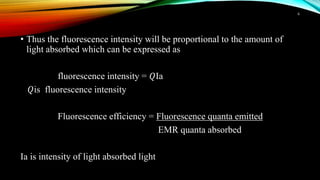
• Thus the fluorescence intensity will be proportional to the amount of
light absorbed which can be expressed as
fluorescence intensity = 𝑄Ia
𝑄is fluorescence intensity
Fluorescence efficiency = Fluorescence quanta emitted
EMR quanta absorbed
Ia is intensity of light absorbed light
6
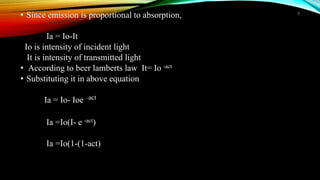
• Since emission is proportional to absorption,
Ia = Io-It
Io is intensity of incident light
It is intensity of transmitted light
• According to beer lamberts law It= Io -act
• Substituting it in above equation
Ia = Io- Ioe –act
Ia =Io(I- e -act)
Ia =Io(1-(1-act)
7
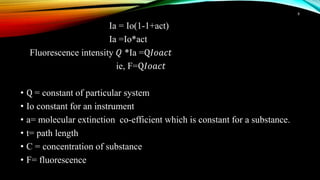
Ia = Io(1-1+act)
Ia =Io*act
Fluorescence intensity 𝑄 *Ia =Q𝐼𝑜𝑎𝑐𝑡
ie, F=Q𝐼𝑜𝑎𝑐𝑡
• Q = constant of particular system
• Io constant for an instrument
• a= molecular extinction co-efficient which is constant for a substance.
• t= path length
• C = concentration of substance
• F= fluorescence
8
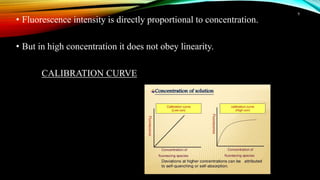
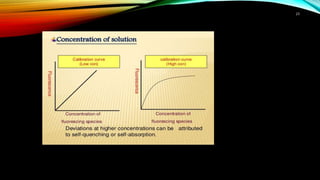
• Fluorescence intensity is directly proportional to concentration.
• But in high concentration it does not obey linearity.
CALIBRATION CURVE
9
ADSORPTION
• The extreme sensitivity of the methods requires very dilute solutions.
• Adsorption of fluorescent substance on the container will may therefore
present a serious problem.
• Stock solution must be kept diluted as required.
• Eg: Quinine is a example of a substance which is adsorbed into the cell
wall.
10
LIGHT
• Monochromatic light is essential for the excitation of fluorescence
because the intensity will vary with wave length.
 PHOTODECOMPOSITION
• Excitation of a weakly fluorescing or dilute solution with intense light
sources will cause photochemical decomposition of analyte.
• To minimize decomposition
• Use of longest feasible wavelength for excitation.
• Remove dissolved oxygen.
• Protect the unstable solutions from ambient light by storing them in dark
bottles.
11
OXYGEN
• The presence of oxygen may interfere in 2 ways
• 1. By direct oxidation of the fluorescent substance to non florescent
substance.
• 2. By quenching of fluorescence.
• The paramagnetic substance like dissolved oxygen and many transition
metals with unpaired electron will dramatically decrease fluorescence.
• Anthracene is well known to be susceptible to the presence of oxygen.
12
PH
• In the molecules containing acidic and basic functional group the changes
in the pH of the medium change the degree of ionisation of the functional
group.
• Eg: Phenols : Acidic undissociate no fluorescence
Alkaline dissociate good fluorescence
Alkaline : Acidic fluorescence in visible region
Alkaline fluorescence in UV region
13
TEMPERATURE AND VISCOSITY
Temperature ↑ ↑ collision ↓ fluorescence
Viscosity ↑ ↓ collision ↑fluorescence
QUANTUM YEILD OF FLUORESCENCE
• Quantum yield of fluorescence = Number of photons emitted
Number of photons absorbed
14
• Since the absorbed energy is lost by pathways, the quantum efficiency is
less than 1.
• Highly fluorescent substance have ∅ value near 1 which shows that most
of the absorbed energy is re- emitted as fluorescence.
INTENSITY OF INCIDENT LIGHT
• ↑ Intensity of light incident on the sample produces a proportional ↑ in
fluorescence.
15
• The intensity of light depends upon ,
 Light emitted from the lamp.
Excitation monochromators.
Excitation slit width.
PATH LENGTH
• Effective path length depends on both excitation and emission slit width.
• Use of micro cuvette does not reduce fluorescence.
• Use of microcell may reduce fluorescence.
16
QUENCHING
17
QUENCHING
• Decrease in fluorescence intensity due to the specific effects of
constituents of the solution.
• Eg :Concentration, pH , Pressure of chemical substance, Temperature,
Viscosity.
• Quenching takes place due to the presence of an anion or ions with
loosely bound electrons.
• The oxidising agents like nitrate has a good quenching effect.
18
• Organic substance like polyhydroxy phenols , amines as well as
antioxidants are efficient quenchers.
• During quenching there is no permanent reaction between the
fluorescent substance and the quenchers.
• There is usually a reversible oxidation – reduction reaction involved
between quencher and the excited molecule.

19
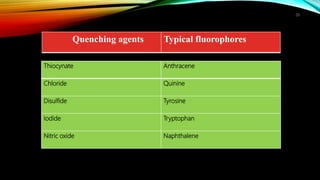
Thiocynate Anthracene
Chloride Quinine
Disulfide Tyrosine
Iodide Tryptophan
Nitric oxide Naphthalene
20
Quenching agents Typical fluorophores
TYPES OF QUENCHING
1. Self quenching
2. Chemical quenching
3. Static quenching
4. Collisional quenching
21
•SELF QUENCHING
• Concentration quenching may be caused by excessive absorption of
either primary or fluorescent radiation by the solution.
• This is also called inner filter effect.
• If this effect occurs as a result of fluorescent substance itself the
phenomenon is called self quenching.
22
23
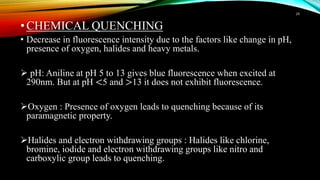
•CHEMICAL QUENCHING
• Decrease in fluorescence intensity due to the factors like change in pH,
presence of oxygen, halides and heavy metals.
 pH: Aniline at pH 5 to 13 gives blue fluorescence when excited at
290nm. But at pH <5 and >13 it does not exhibit fluorescence.
Oxygen : Presence of oxygen leads to quenching because of its
paramagnetic property.
Halides and electron withdrawing groups : Halides like chlorine,
bromine, iodide and electron withdrawing groups like nitro and
carboxylic group leads to quenching.
24
Heavy metals: Presence of heavy metals also leads to quenching because
of collisions and triplet ground.
•STATIC QUENCHING
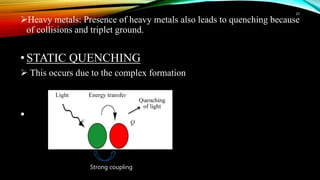
 This occurs due to the complex formation
•
25
Strong coupling
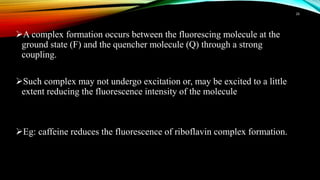
A complex formation occurs between the fluorescing molecule at the
ground state (F) and the quencher molecule (Q) through a strong
coupling.
Such complex may not undergo excitation or, may be excited to a little
extent reducing the fluorescence intensity of the molecule
Eg: caffeine reduces the fluorescence of riboflavin complex formation.
26
27
•COLLISIONAL QUENCHING
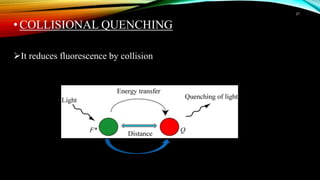
It reduces fluorescence by collision
Collisional quenching occurs by the interaction of a quencher molecule
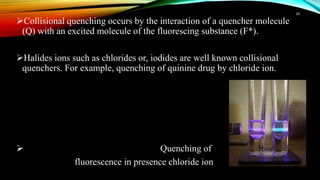
(Q) with an excited molecule of the fluorescing substance (F*).
Halides ions such as chlorides or, iodides are well known collisional
quenchers. For example, quenching of quinine drug by chloride ion.
 Quenching of
fluorescence in presence chloride ion
28
 This phenomenon can be used as an analytical means for determining
the concentration of the compounds known to quench fluorescence.
 Quenching study can also be used to reveal the localization of
fluorophores in proteins or, membranes and their permeability to the
quenchers.
29
30

Flourimetry factors

  • 1.
    TOPIC: FACTORS AFFECTINGFLUORIMETRY AND QUENCHING ABIYA SARA CHERIAN 1ST YEAR M PHARM DEP OF PHARMACEUTICS ST JOSEPH’S COLLEGE OF PHARMACY,CHETHALA. 1
  • 2.
    FACTORS AFFECTING FLUORESCENCE 1.Nature of molecules. 2. Effect of substituent. 3. Effect of concentration. 4. Adsorption, Light. 5. Photodecomposition. 6. Oxygen, PH. 7. Temperature and viscosity. 8. Quantum yield of fluorescence. 9. Intensity of incident light. 10.Path length. 2
  • 3.
    NATURE OF MOLECULES •Only the molecules absorbs UV/Visible radiation can show the fluorescence. • Greater the absorbency of the molecules more intense its fluorescence. • Unsaturated molecules with 𝜋 bonds and good resonance stability can exhibit fluorescence. Eg : Alkenes with conjugate double bond. • Saturated molecules with sigma bond do not exhibit fluorescence. Eg : Aliphatic unsaturated cyclic organic compounds. 3
  • 4.
    NATURE OF SUBSTITUENTS •Electron donating groups enhances fluorescence. Eg: NH2 , OH will increase degree of fluorescence. • While electron withdrawing groups like halogens COOH, NO2 etc diminishes the fluorescence. • Thus it may noted that cyclohexane is non fluorescent , benzene shows weak fluorescence , while compounds like Anthracene, Riboflavin are strongly fluorescent. 4
  • 5.
    FLUORESCENCE AND CONCENTRATION. •Beers law states that in a solution of an absorbing substance the absorbance is directly proportional to the concentration. • Thus the fluorescence intensity will be proportional to the concentration of molecules in the excited state and therefore the intensity of radiation. • The light absorbed by the sample and intensity of the exciting light does not remain constant but decreases as it travels through the sample. 5
  • 6.
    • Thus thefluorescence intensity will be proportional to the amount of light absorbed which can be expressed as fluorescence intensity = 𝑄Ia 𝑄is fluorescence intensity Fluorescence efficiency = Fluorescence quanta emitted EMR quanta absorbed Ia is intensity of light absorbed light 6
  • 7.
    • Since emissionis proportional to absorption, Ia = Io-It Io is intensity of incident light It is intensity of transmitted light • According to beer lamberts law It= Io -act • Substituting it in above equation Ia = Io- Ioe –act Ia =Io(I- e -act) Ia =Io(1-(1-act) 7
  • 8.
    Ia = Io(1-1+act) Ia=Io*act Fluorescence intensity 𝑄 *Ia =Q𝐼𝑜𝑎𝑐𝑡 ie, F=Q𝐼𝑜𝑎𝑐𝑡 • Q = constant of particular system • Io constant for an instrument • a= molecular extinction co-efficient which is constant for a substance. • t= path length • C = concentration of substance • F= fluorescence 8
  • 9.
    • Fluorescence intensityis directly proportional to concentration. • But in high concentration it does not obey linearity. CALIBRATION CURVE 9
  • 10.
    ADSORPTION • The extremesensitivity of the methods requires very dilute solutions. • Adsorption of fluorescent substance on the container will may therefore present a serious problem. • Stock solution must be kept diluted as required. • Eg: Quinine is a example of a substance which is adsorbed into the cell wall. 10
  • 11.
    LIGHT • Monochromatic lightis essential for the excitation of fluorescence because the intensity will vary with wave length.  PHOTODECOMPOSITION • Excitation of a weakly fluorescing or dilute solution with intense light sources will cause photochemical decomposition of analyte. • To minimize decomposition • Use of longest feasible wavelength for excitation. • Remove dissolved oxygen. • Protect the unstable solutions from ambient light by storing them in dark bottles. 11
  • 12.
    OXYGEN • The presenceof oxygen may interfere in 2 ways • 1. By direct oxidation of the fluorescent substance to non florescent substance. • 2. By quenching of fluorescence. • The paramagnetic substance like dissolved oxygen and many transition metals with unpaired electron will dramatically decrease fluorescence. • Anthracene is well known to be susceptible to the presence of oxygen. 12
  • 13.
    PH • In themolecules containing acidic and basic functional group the changes in the pH of the medium change the degree of ionisation of the functional group. • Eg: Phenols : Acidic undissociate no fluorescence Alkaline dissociate good fluorescence Alkaline : Acidic fluorescence in visible region Alkaline fluorescence in UV region 13
  • 14.
    TEMPERATURE AND VISCOSITY Temperature↑ ↑ collision ↓ fluorescence Viscosity ↑ ↓ collision ↑fluorescence QUANTUM YEILD OF FLUORESCENCE • Quantum yield of fluorescence = Number of photons emitted Number of photons absorbed 14
  • 15.
    • Since theabsorbed energy is lost by pathways, the quantum efficiency is less than 1. • Highly fluorescent substance have ∅ value near 1 which shows that most of the absorbed energy is re- emitted as fluorescence. INTENSITY OF INCIDENT LIGHT • ↑ Intensity of light incident on the sample produces a proportional ↑ in fluorescence. 15
  • 16.
    • The intensityof light depends upon ,  Light emitted from the lamp. Excitation monochromators. Excitation slit width. PATH LENGTH • Effective path length depends on both excitation and emission slit width. • Use of micro cuvette does not reduce fluorescence. • Use of microcell may reduce fluorescence. 16
  • 17.
  • 18.
    QUENCHING • Decrease influorescence intensity due to the specific effects of constituents of the solution. • Eg :Concentration, pH , Pressure of chemical substance, Temperature, Viscosity. • Quenching takes place due to the presence of an anion or ions with loosely bound electrons. • The oxidising agents like nitrate has a good quenching effect. 18
  • 19.
    • Organic substancelike polyhydroxy phenols , amines as well as antioxidants are efficient quenchers. • During quenching there is no permanent reaction between the fluorescent substance and the quenchers. • There is usually a reversible oxidation – reduction reaction involved between quencher and the excited molecule. 19
  • 20.
    Thiocynate Anthracene Chloride Quinine DisulfideTyrosine Iodide Tryptophan Nitric oxide Naphthalene 20 Quenching agents Typical fluorophores
  • 21.
    TYPES OF QUENCHING 1.Self quenching 2. Chemical quenching 3. Static quenching 4. Collisional quenching 21
  • 22.
    •SELF QUENCHING • Concentrationquenching may be caused by excessive absorption of either primary or fluorescent radiation by the solution. • This is also called inner filter effect. • If this effect occurs as a result of fluorescent substance itself the phenomenon is called self quenching. 22
  • 23.
  • 24.
    •CHEMICAL QUENCHING • Decreasein fluorescence intensity due to the factors like change in pH, presence of oxygen, halides and heavy metals.  pH: Aniline at pH 5 to 13 gives blue fluorescence when excited at 290nm. But at pH <5 and >13 it does not exhibit fluorescence. Oxygen : Presence of oxygen leads to quenching because of its paramagnetic property. Halides and electron withdrawing groups : Halides like chlorine, bromine, iodide and electron withdrawing groups like nitro and carboxylic group leads to quenching. 24
  • 25.
    Heavy metals: Presenceof heavy metals also leads to quenching because of collisions and triplet ground. •STATIC QUENCHING  This occurs due to the complex formation • 25 Strong coupling
  • 26.
    A complex formationoccurs between the fluorescing molecule at the ground state (F) and the quencher molecule (Q) through a strong coupling. Such complex may not undergo excitation or, may be excited to a little extent reducing the fluorescence intensity of the molecule Eg: caffeine reduces the fluorescence of riboflavin complex formation. 26
  • 27.
  • 28.
    Collisional quenching occursby the interaction of a quencher molecule (Q) with an excited molecule of the fluorescing substance (F*). Halides ions such as chlorides or, iodides are well known collisional quenchers. For example, quenching of quinine drug by chloride ion.  Quenching of fluorescence in presence chloride ion 28
  • 29.
     This phenomenoncan be used as an analytical means for determining the concentration of the compounds known to quench fluorescence.  Quenching study can also be used to reveal the localization of fluorophores in proteins or, membranes and their permeability to the quenchers. 29
  • 30.