A presentationon-
Different Light of Sources used in UV Visible Spectroscopy & Lambert’s Beers Law
Presented by-
Anit Kumar
1st Sem. M.Pharm
(Pharmacology)
Central University of South Bihar, Gaya
• Transmittance And Absorbance
• Lambert’s Beers Law
• Sources of light used in UV spectroscopy
• Conclusion
Table of Content
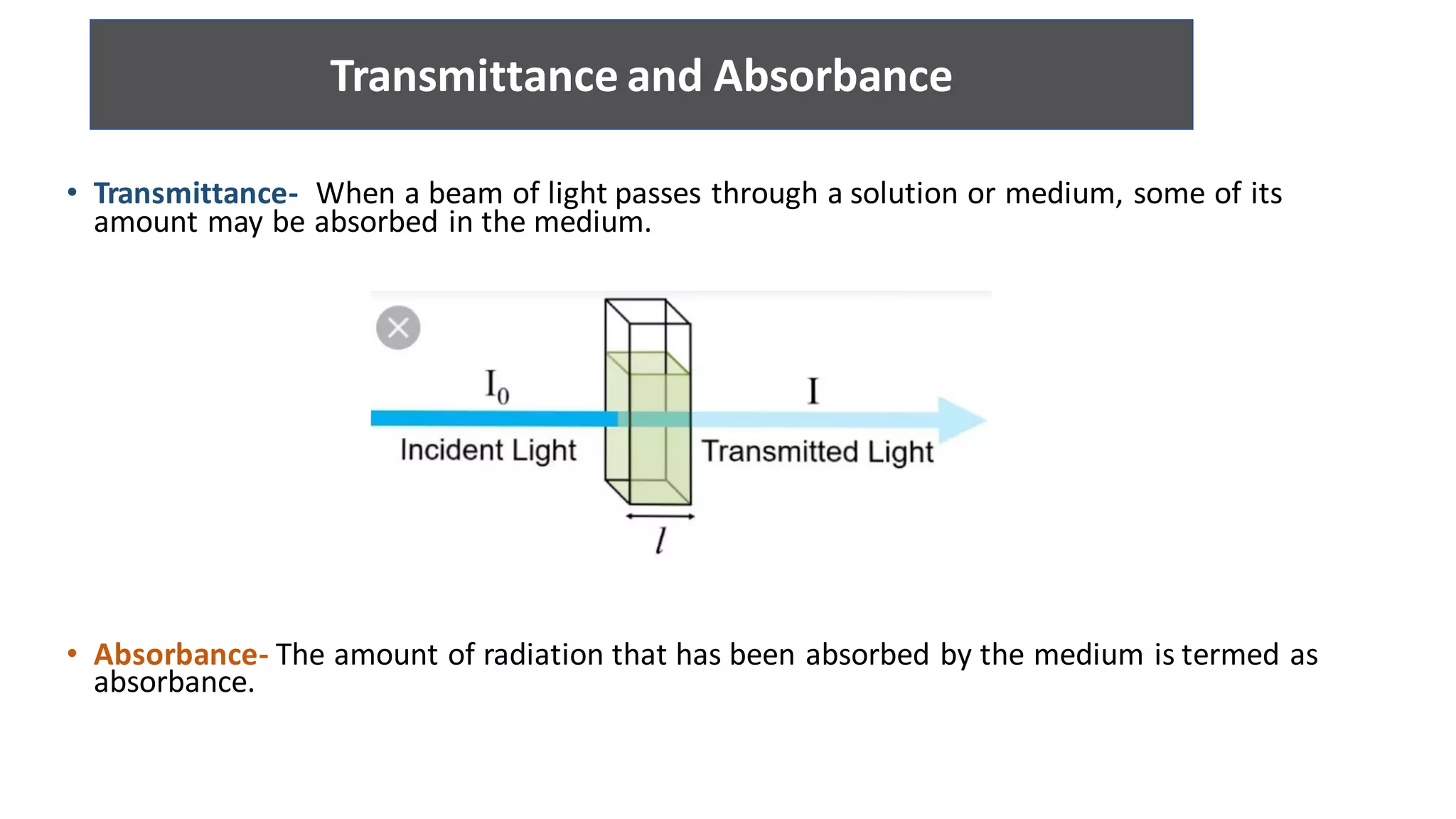
• Transmittance- When a beam of light passes through a solution or medium, some of its
amount may be absorbed in the medium.
• Absorbance- The amount of radiation that has been absorbed by the medium is termed as
absorbance.
Transmittance and Absorbance
• Case -1
If the sample solution is transparent, then the incident radiation (I°) will be equal to the transmitted radiation (I).
thus, %A (absorbance) = 0
%T (transmittance) = 100
. I°(incidentradiation) = I (transmitted radiation)
• Case-2
If the sample solution is not transparent, then the strength of incident radiation is greater than the transmitted radiation.
Thus, I° > I
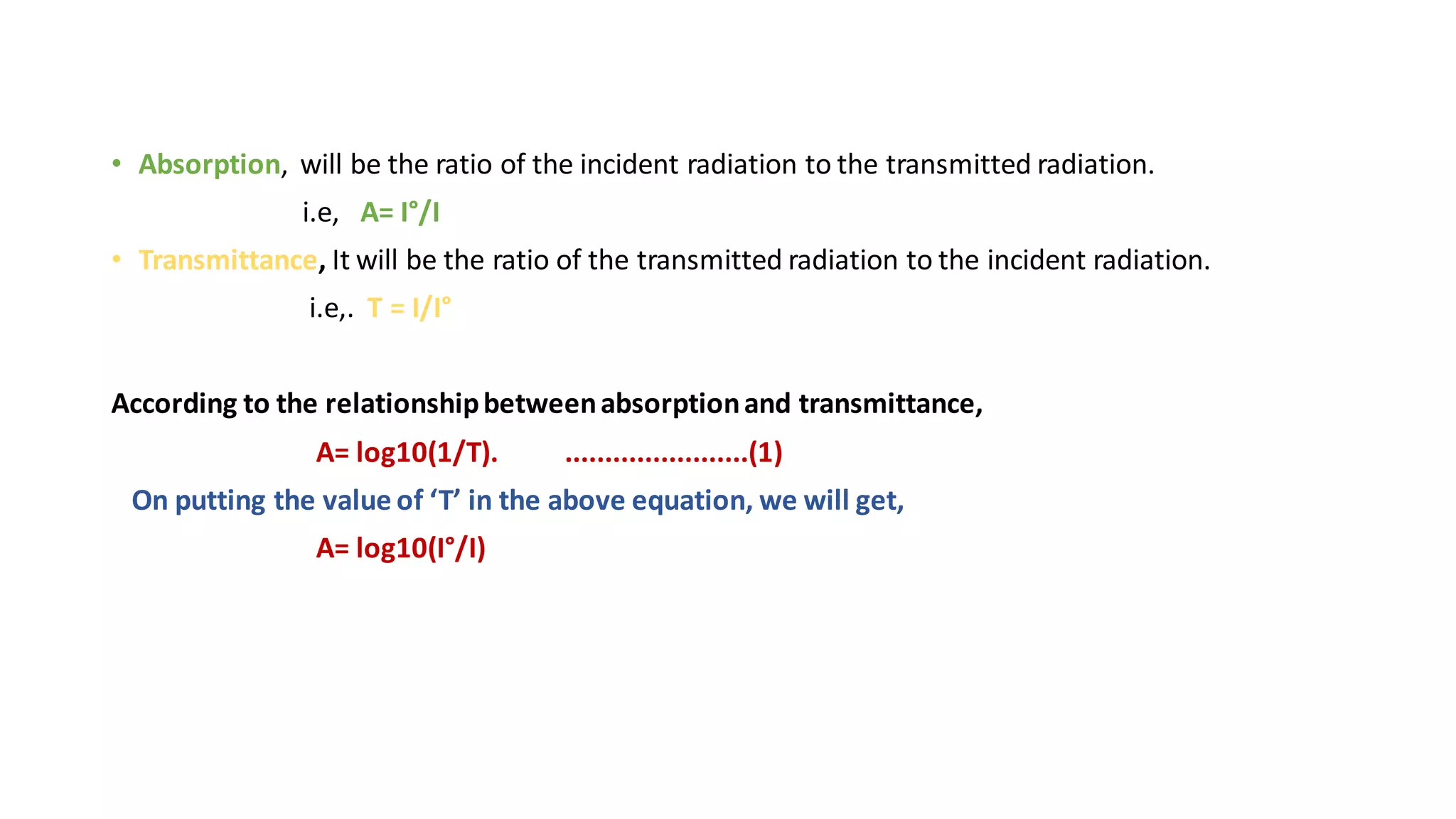
• Absorption, will be the ratio of the incident radiation to the transmitted radiation.
i.e, A= I°/I
• Transmittance, It will be the ratio of the transmitted radiation to the incident radiation.
i.e,. T = I/I°
According to the relationshipbetweenabsorptionand transmittance,
A= log10(1/T). .......................(1)
On putting the value of ‘T’ in the above equation, we will get,
A= log10(I°/I)
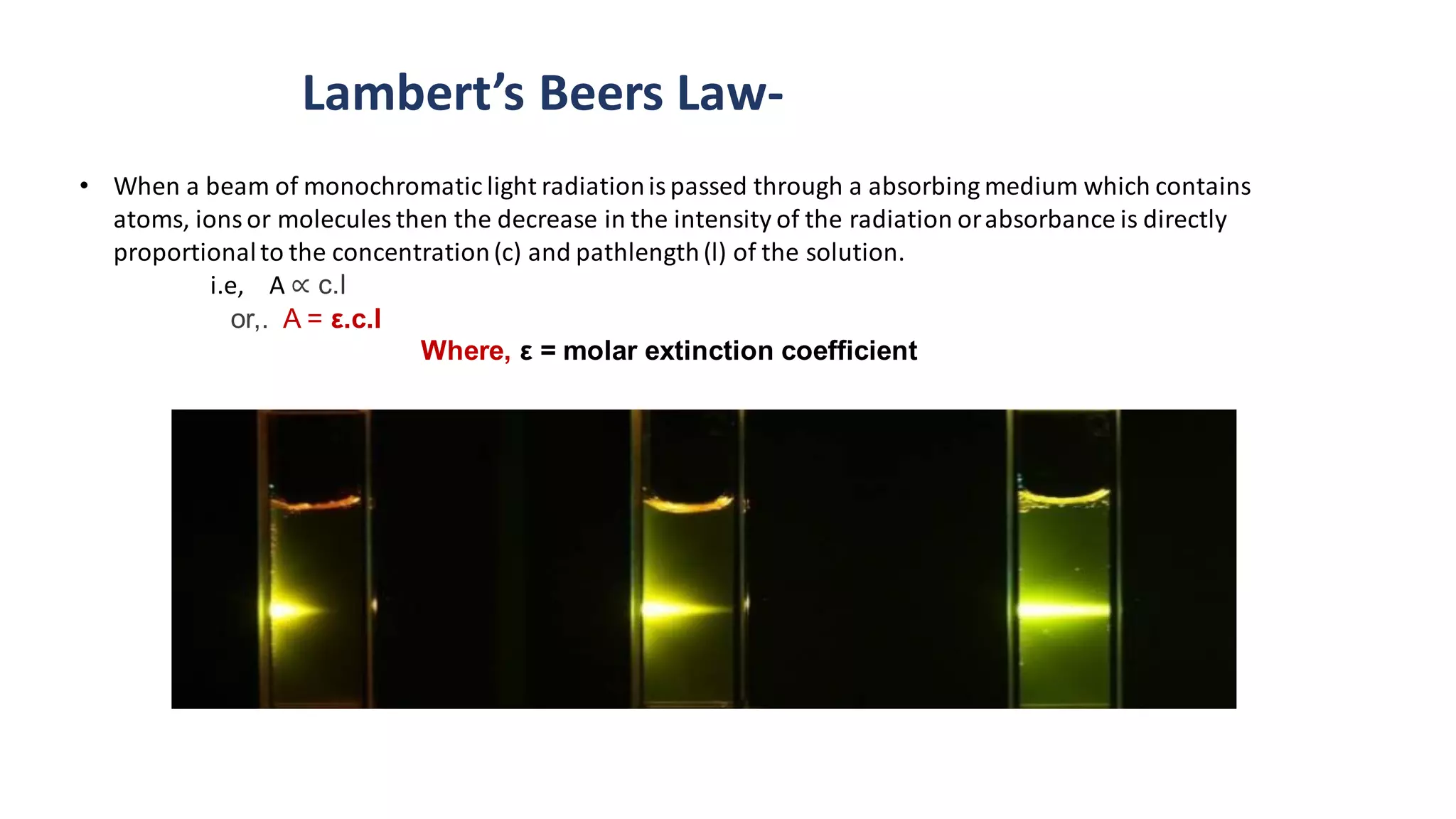
• When a beam of monochromatic light radiationis passed through a absorbing medium which contains
atoms, ions or molecules then the decrease in the intensity of the radiation orabsorbance is directly
proportionalto the concentration(c) and pathlength(l) of the solution.
i.e, A ∝ c.l
or,. A = ε.c.l
Where, ε = molar extinction coefficient
Lambert’s Beers Law-
Merits of Lambert’s Beers Law
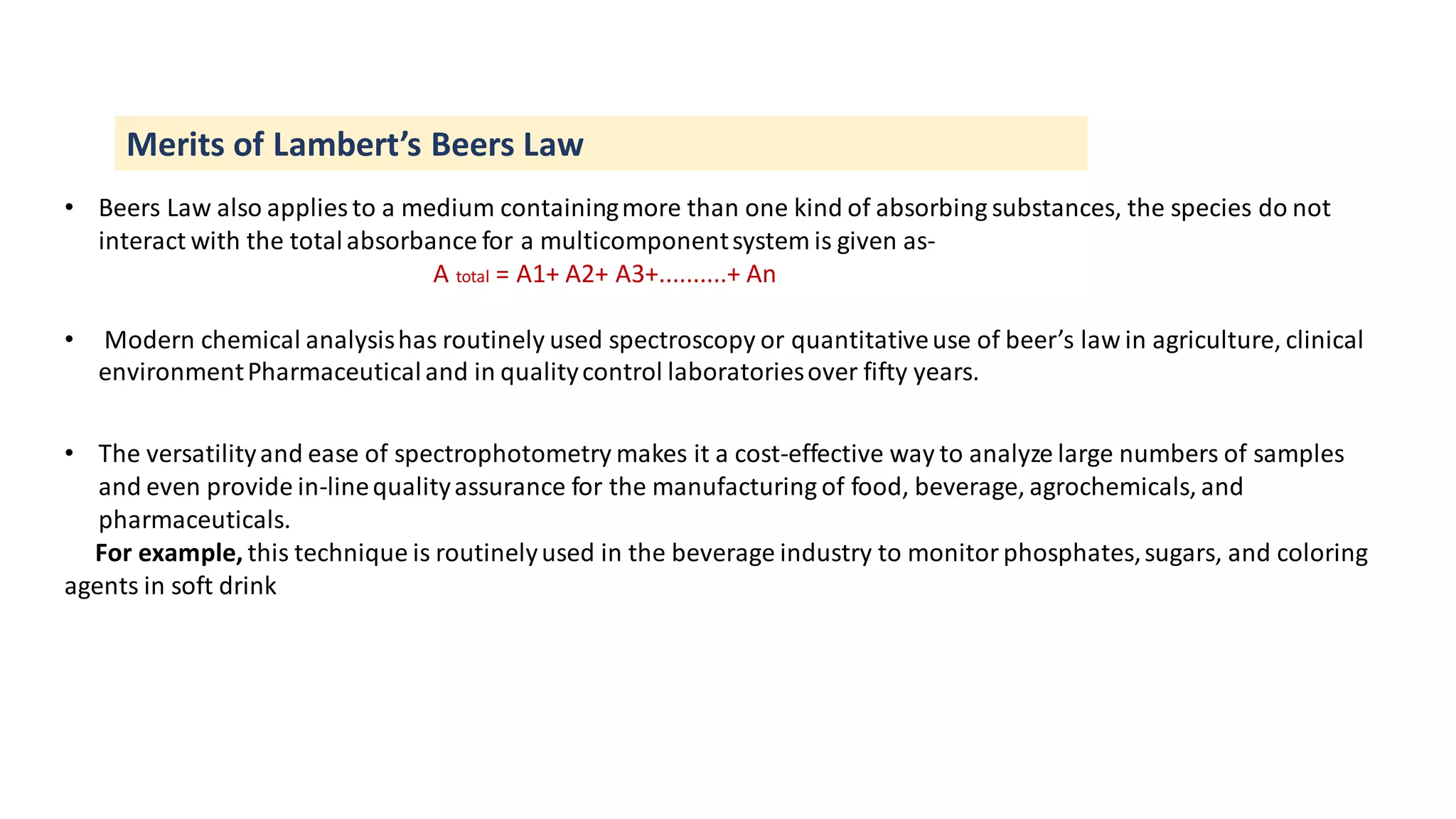
• Beers Law also applies to a medium containingmore than one kind of absorbing substances, the species do not
interact with the totalabsorbance for a multicomponentsystem is given as-
A total = A1+ A2+ A3+..........+ An
• Modern chemical analysishas routinely used spectroscopy or quantitativeuse of beer’s law in agriculture, clinical
environmentPharmaceuticaland in qualitycontrol laboratoriesover fifty years.
• The versatilityand ease of spectrophotometry makes it a cost-effective way to analyze large numbers of samples
and even provide in-linequalityassurance for the manufacturing of food, beverage, agrochemicals, and
pharmaceuticals.
For example, this technique is routinelyused in the beverage industry to monitor phosphates,sugars, and coloring
agents in soft drink
• The Beers Law describes the absorption behaviourof media containingrelativelylow analyte concentration,
this it is a limiting law.
• At high concentration(usually >0.01 M), the extent of solute solvent interaction,solute solute interactionor
H- bondingcan affect the analyte enviornmentand its absorptivity.
• Deviationsfrom Beers Law also arise because absorptivitydependson the refractive indexof the medium.
Thus, if the concentrationchanges significantlyalterationsin the refractive index(n) of the solution.
Limitations of Lambert’s Beers Law
Sources of light used in UV Spectroscopy
Conditions for the selection of light (radiation) sources
• The light or radiation source should mustbe stable
• It should be of sufficient intensity, for the detection at the end of the
optical path.
• A continuous source is required whose radiant power doesn’t changes
sharply over a considerable range of wavelengths.
• Hydrogen Discharge Lamp
• Deuterium Lamp
• Tungsten Filament Lamp
• Xenon Discharge Lamp
• Mercury Arch Lamp
• Light Emitting Diodes
Different light (radiation) sources used in UV Spectroscopy
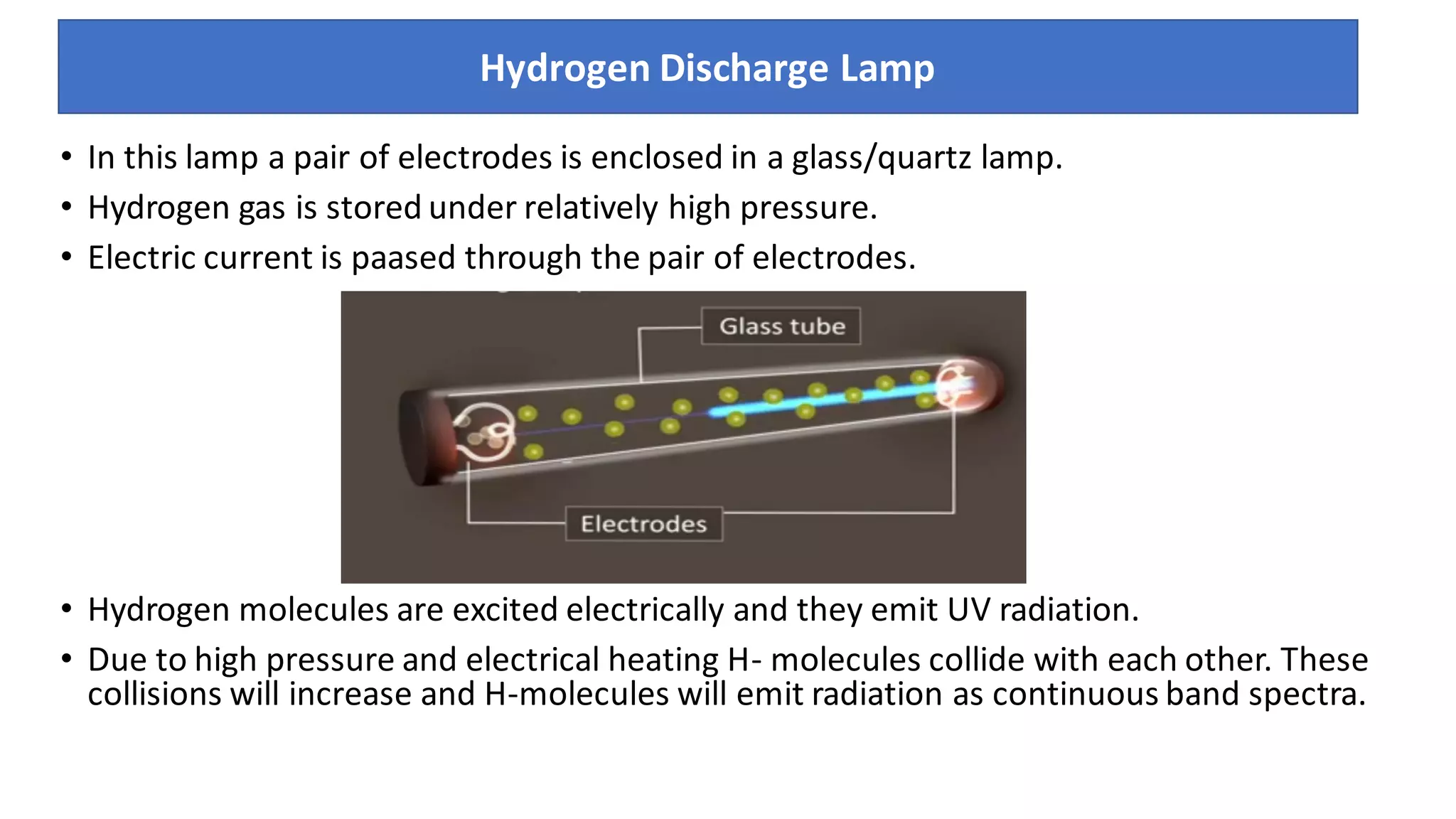
• In this lamp a pair of electrodes is enclosed in a glass/quartz lamp.
• Hydrogen gas is stored under relatively high pressure.
• Electric current is paased through the pair of electrodes.
• Hydrogen molecules are excited electrically and they emit UV radiation.
• Due to high pressure and electrical heating H- molecules collide with each other. These
collisions will increase and H-molecules will emit radiation as continuous band spectra.
Hydrogen Discharge Lamp
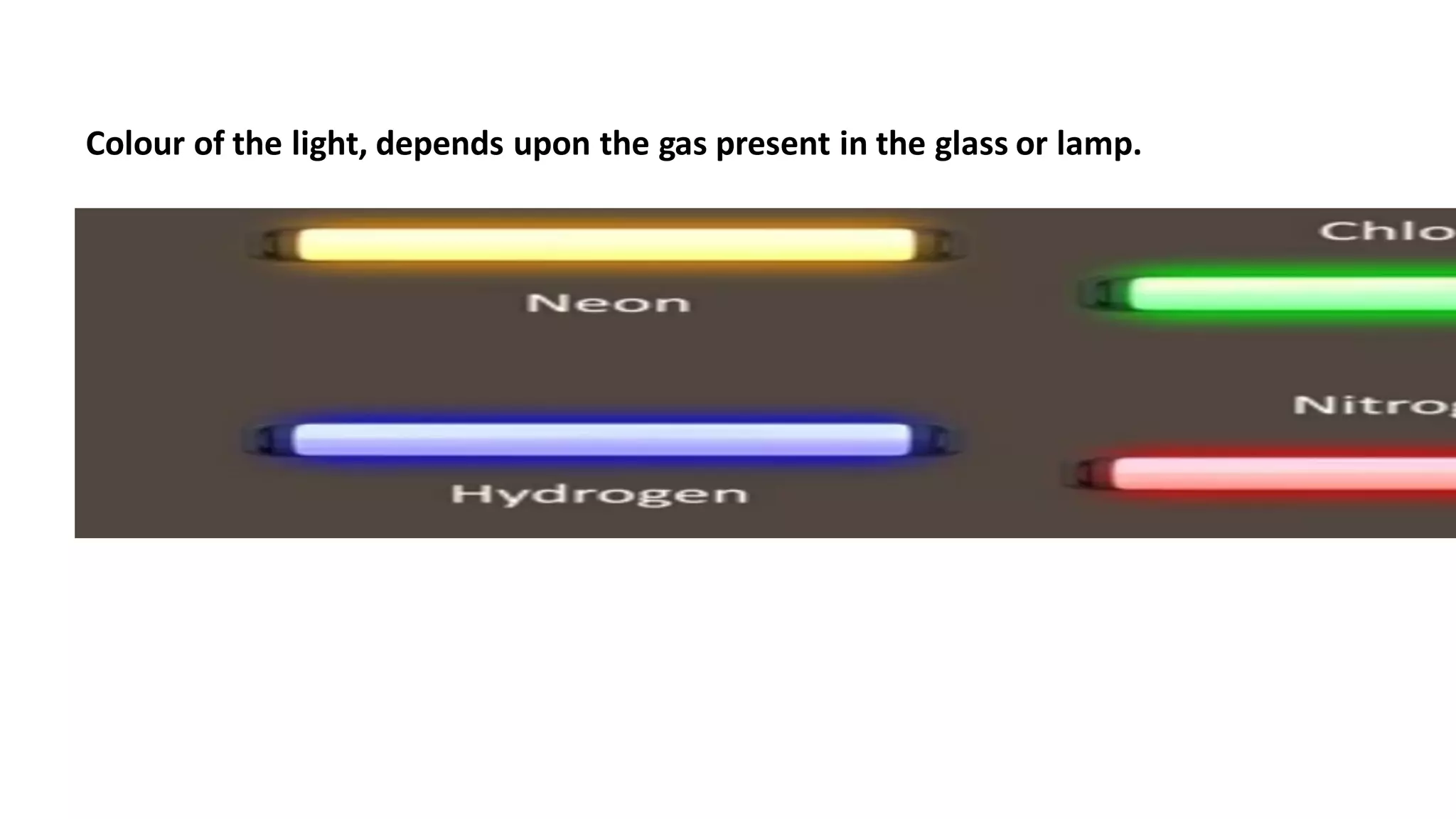
Colour of the light, depends upon the gas present in the glass or lamp.
• It is continuous source of radiation.
• It covers a range of 160-375 nm.
• It is stable, robust and Widely used.
Advantages of Hydrogen Discharge Lamp
Deuterium Lamp
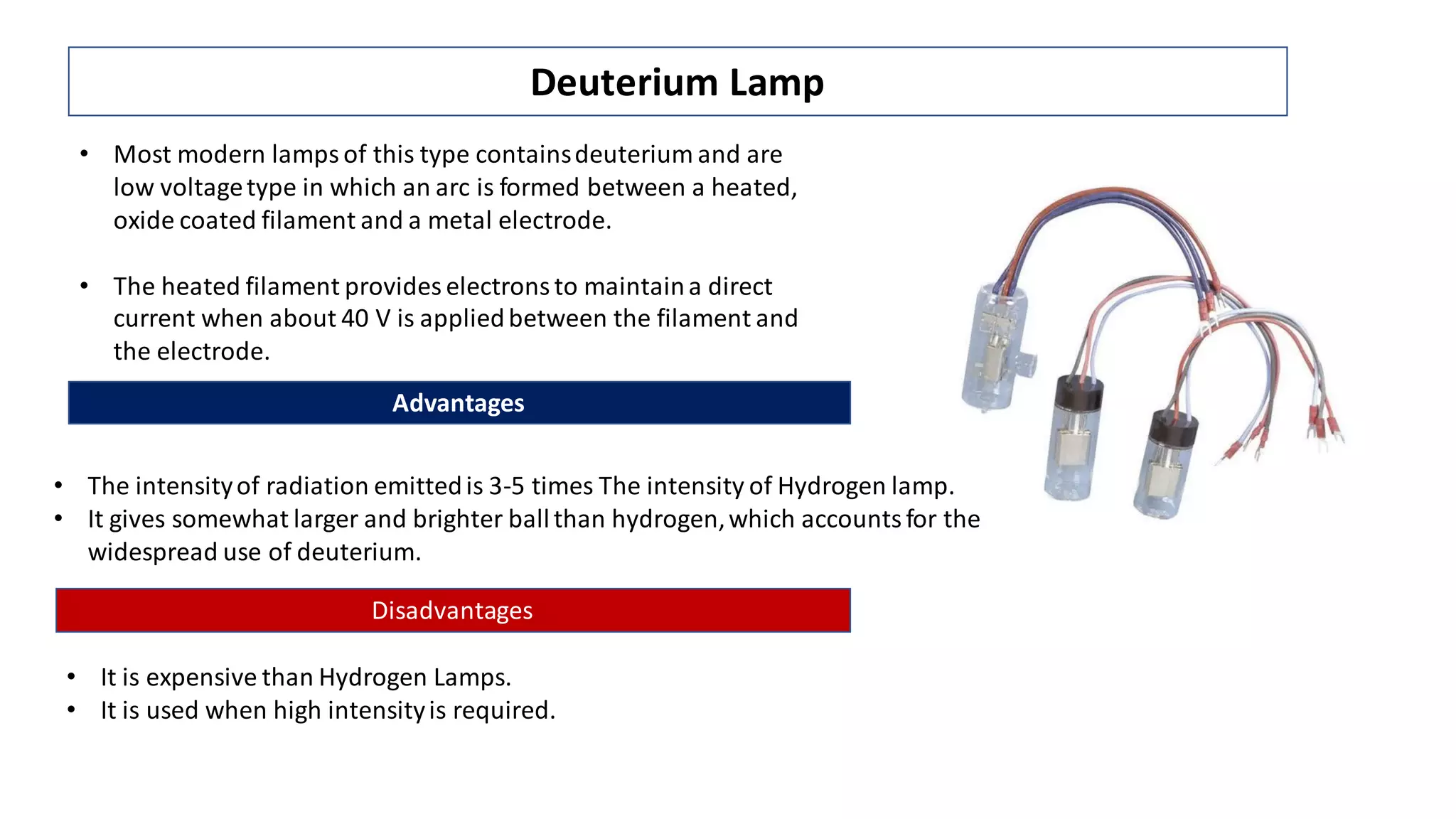
• Most modern lamps of this type containsdeuterium and are
low voltagetype in which an arc is formed between a heated,
oxide coated filament and a metal electrode.
• The heated filament provides electrons to maintaina direct
current when about 40 V is appliedbetween the filament and
the electrode.
Advantages
• The intensityof radiation emittedis 3-5 times The intensity of Hydrogen lamp.
• It gives somewhat larger and brighter ballthan hydrogen,which accountsfor the
widespread use of deuterium.
Disadvantages
• It is expensive than Hydrogen Lamps.
• It is used when high intensityis required.
Tungusten Filament Lamps
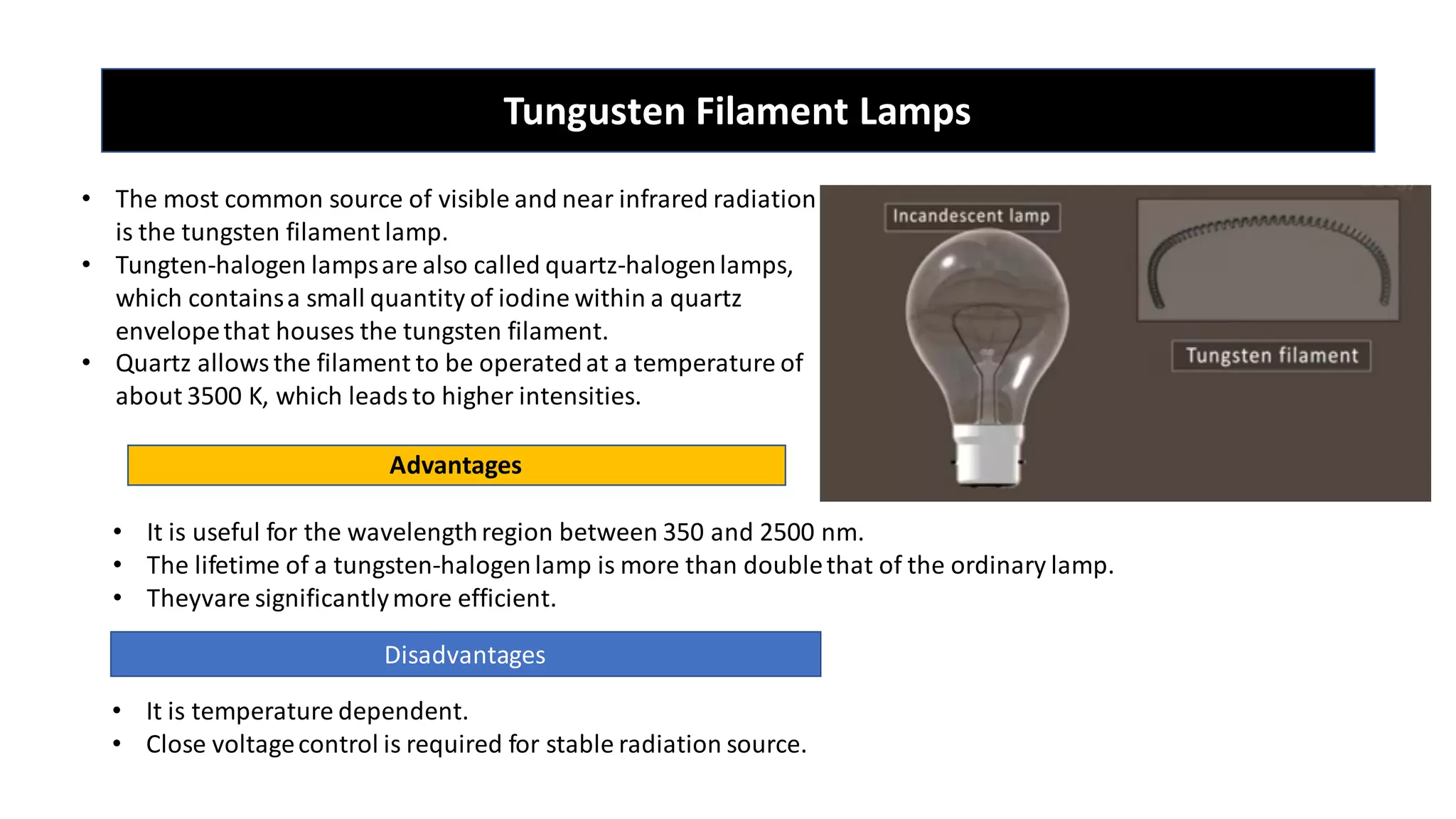
• The most common source of visible and near infrared radiation
is the tungsten filament lamp.
• Tungten-halogen lampsare also called quartz-halogenlamps,
which containsa small quantity of iodine within a quartz
envelopethat houses the tungsten filament.
• Quartz allowsthe filament to be operatedat a temperature of
about 3500 K, which leadsto higher intensities.
Advantages
• It is useful for the wavelengthregion between 350 and 2500 nm.
• The lifetime of a tungsten-halogenlamp is more than doublethat of the ordinary lamp.
• Theyvare significantlymore efficient.
Disadvantages
• It is temperature dependent.
• Close voltagecontrol is required for stable radiation source.
Xenon Arc Lamps
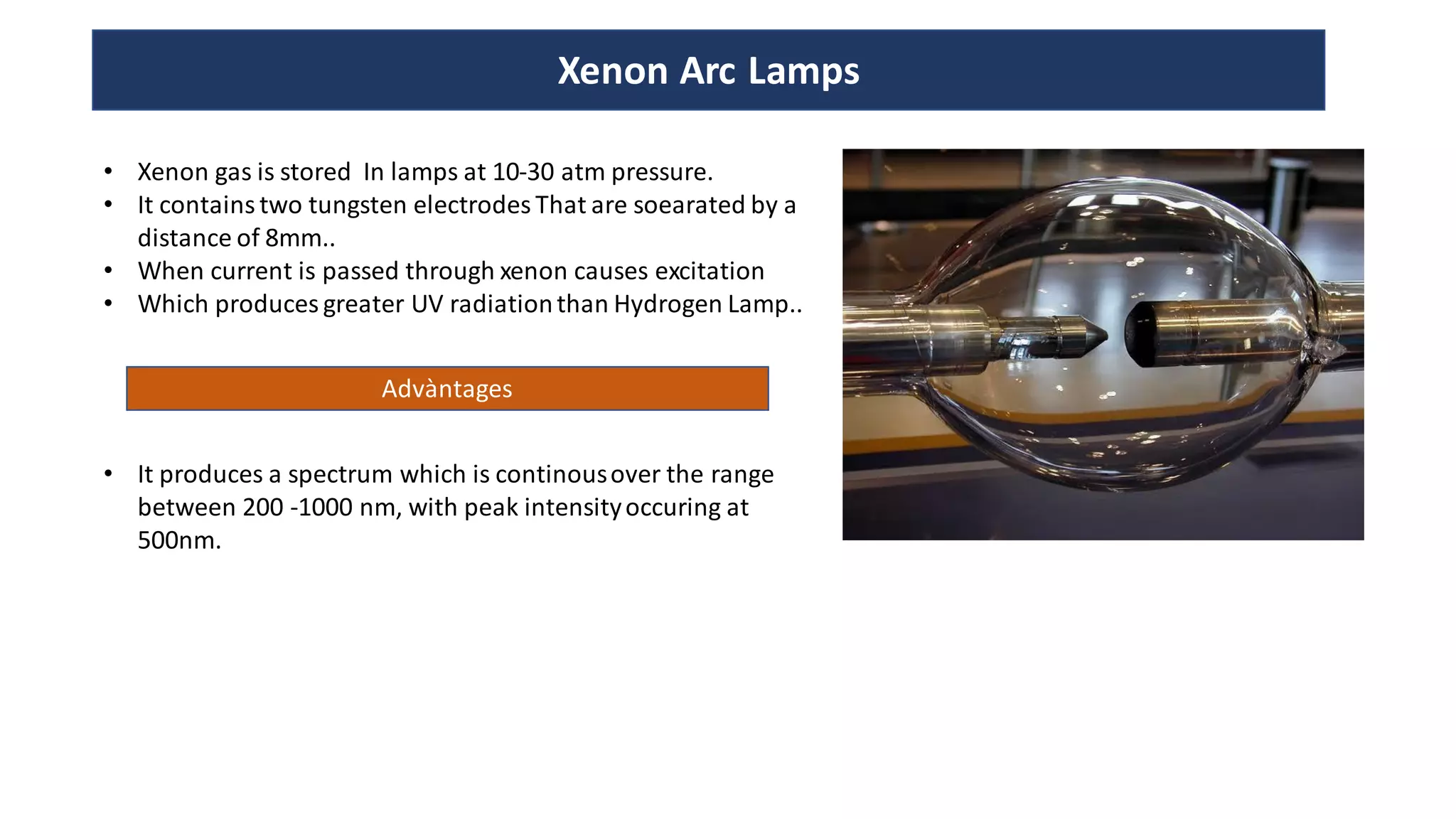
• Xenon gas is stored In lamps at 10-30 atm pressure.
• It contains two tungsten electrodes That are soearated by a
distance of 8mm..
• When current is passed through xenon causes excitation
• Which produces greater UV radiationthan Hydrogen Lamp..
Advàntages
• It produces a spectrum which is continousover the range
between 200 -1000 nm, with peak intensityoccuring at
500nm.
Light EmittingDiodes
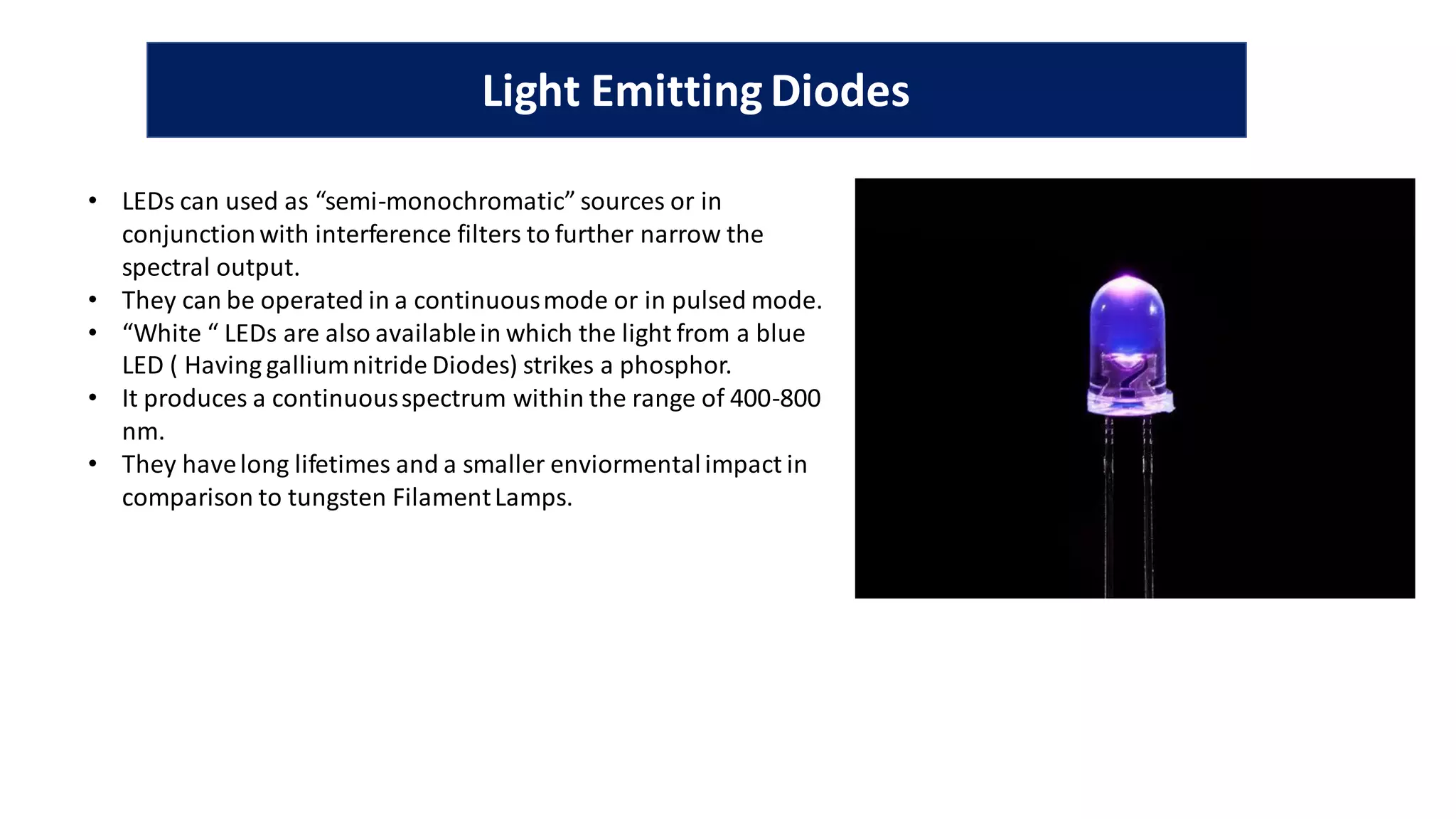
• LEDs can used as “semi-monochromatic” sources or in
conjunctionwith interference filters to further narrow the
spectral output.
• They can be operated in a continuousmode or in pulsed mode.
• “White “ LEDs are also availablein which the light from a blue
LED ( Having galliumnitride Diodes) strikes a phosphor.
• It produces a continuousspectrum within the range of 400-800
nm.
• They havelong lifetimes and a smaller enviormentalimpact in
comparison to tungsten FilamentLamps.
Mercury Arc Lamp
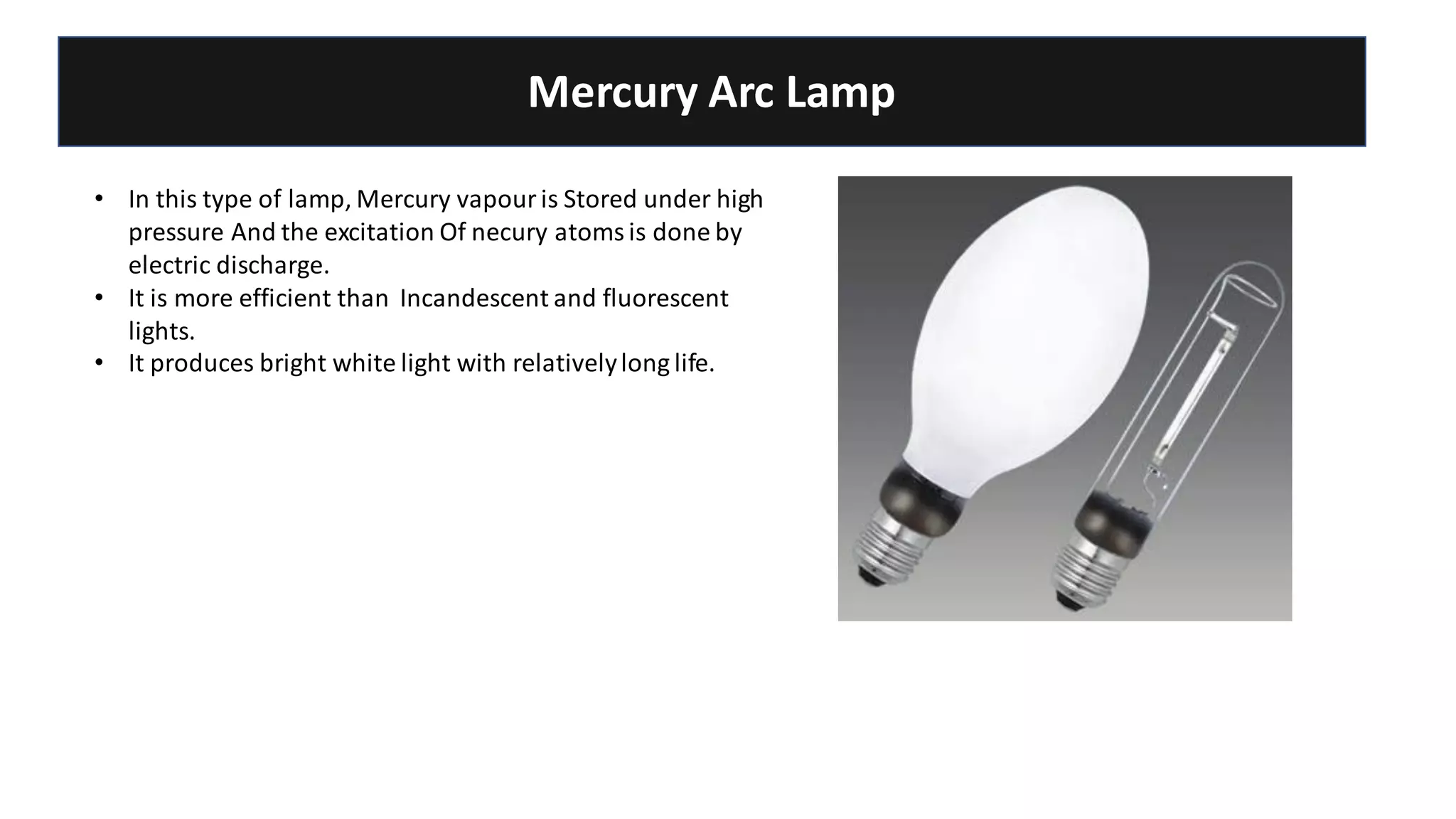
• In this type of lamp, Mercury vapour is Stored under high
pressure And the excitation Of necury atoms is done by
electric discharge.
• It is more efficient than Incandescent and fluorescent
lights.
• It produces bright white light with relativelylong life.
• When a beam of monochromatic light radiation is passed through a absorbing medium which
contains atoms, ions or molecules then the decrease in the intensity of the radiation or
absorbance is directly proportional to the concentration (c) and pathlength (l) of the solution.
i.e, A ∝ c.l
• The various radiation sources used in UV spectroscopy are- HydrogenDischarge
Lamp,Deuteriumm Lamp,TungstenFilament Lamp,Xenonn Discharge Lamp,Mercury Arch
Lam,LighttEmitting Diodes.
• The electrical excitation of Deuterium and Hydrogen at low pressure produces a Continuous UV
radiation.
• Both Hydrogen and Deuterium lamps Emits radiation in the range of 160nm-375nm.
• The tungten filament Lamp is used in wavelength range of 350-2500nm.
• The energy emitted by tungten filament Lamp is proportional to the fourth Power of operating
volatage.
Conclusion
Thank you
🙏

Different Sources of radiation used in UV VISIBLE SPECTROSCOPY

  • 1.
    A presentationon- Different Lightof Sources used in UV Visible Spectroscopy & Lambert’s Beers Law Presented by- Anit Kumar 1st Sem. M.Pharm (Pharmacology) Central University of South Bihar, Gaya
  • 2.
    • Transmittance AndAbsorbance • Lambert’s Beers Law • Sources of light used in UV spectroscopy • Conclusion Table of Content
  • 3.
    • Transmittance- Whena beam of light passes through a solution or medium, some of its amount may be absorbed in the medium. • Absorbance- The amount of radiation that has been absorbed by the medium is termed as absorbance. Transmittance and Absorbance
  • 4.
    • Case -1 Ifthe sample solution is transparent, then the incident radiation (I°) will be equal to the transmitted radiation (I). thus, %A (absorbance) = 0 %T (transmittance) = 100 . I°(incidentradiation) = I (transmitted radiation) • Case-2 If the sample solution is not transparent, then the strength of incident radiation is greater than the transmitted radiation. Thus, I° > I
  • 5.
    • Absorption, willbe the ratio of the incident radiation to the transmitted radiation. i.e, A= I°/I • Transmittance, It will be the ratio of the transmitted radiation to the incident radiation. i.e,. T = I/I° According to the relationshipbetweenabsorptionand transmittance, A= log10(1/T). .......................(1) On putting the value of ‘T’ in the above equation, we will get, A= log10(I°/I)
  • 6.
    • When abeam of monochromatic light radiationis passed through a absorbing medium which contains atoms, ions or molecules then the decrease in the intensity of the radiation orabsorbance is directly proportionalto the concentration(c) and pathlength(l) of the solution. i.e, A ∝ c.l or,. A = ε.c.l Where, ε = molar extinction coefficient Lambert’s Beers Law-
  • 7.
    Merits of Lambert’sBeers Law • Beers Law also applies to a medium containingmore than one kind of absorbing substances, the species do not interact with the totalabsorbance for a multicomponentsystem is given as- A total = A1+ A2+ A3+..........+ An • Modern chemical analysishas routinely used spectroscopy or quantitativeuse of beer’s law in agriculture, clinical environmentPharmaceuticaland in qualitycontrol laboratoriesover fifty years. • The versatilityand ease of spectrophotometry makes it a cost-effective way to analyze large numbers of samples and even provide in-linequalityassurance for the manufacturing of food, beverage, agrochemicals, and pharmaceuticals. For example, this technique is routinelyused in the beverage industry to monitor phosphates,sugars, and coloring agents in soft drink
  • 8.
    • The BeersLaw describes the absorption behaviourof media containingrelativelylow analyte concentration, this it is a limiting law. • At high concentration(usually >0.01 M), the extent of solute solvent interaction,solute solute interactionor H- bondingcan affect the analyte enviornmentand its absorptivity. • Deviationsfrom Beers Law also arise because absorptivitydependson the refractive indexof the medium. Thus, if the concentrationchanges significantlyalterationsin the refractive index(n) of the solution. Limitations of Lambert’s Beers Law
  • 9.
    Sources of lightused in UV Spectroscopy Conditions for the selection of light (radiation) sources • The light or radiation source should mustbe stable • It should be of sufficient intensity, for the detection at the end of the optical path. • A continuous source is required whose radiant power doesn’t changes sharply over a considerable range of wavelengths.
  • 10.
    • Hydrogen DischargeLamp • Deuterium Lamp • Tungsten Filament Lamp • Xenon Discharge Lamp • Mercury Arch Lamp • Light Emitting Diodes Different light (radiation) sources used in UV Spectroscopy
  • 11.
    • In thislamp a pair of electrodes is enclosed in a glass/quartz lamp. • Hydrogen gas is stored under relatively high pressure. • Electric current is paased through the pair of electrodes. • Hydrogen molecules are excited electrically and they emit UV radiation. • Due to high pressure and electrical heating H- molecules collide with each other. These collisions will increase and H-molecules will emit radiation as continuous band spectra. Hydrogen Discharge Lamp
  • 12.
    Colour of thelight, depends upon the gas present in the glass or lamp.
  • 13.
    • It iscontinuous source of radiation. • It covers a range of 160-375 nm. • It is stable, robust and Widely used. Advantages of Hydrogen Discharge Lamp
  • 14.
    Deuterium Lamp • Mostmodern lamps of this type containsdeuterium and are low voltagetype in which an arc is formed between a heated, oxide coated filament and a metal electrode. • The heated filament provides electrons to maintaina direct current when about 40 V is appliedbetween the filament and the electrode. Advantages • The intensityof radiation emittedis 3-5 times The intensity of Hydrogen lamp. • It gives somewhat larger and brighter ballthan hydrogen,which accountsfor the widespread use of deuterium. Disadvantages • It is expensive than Hydrogen Lamps. • It is used when high intensityis required.
  • 15.
    Tungusten Filament Lamps •The most common source of visible and near infrared radiation is the tungsten filament lamp. • Tungten-halogen lampsare also called quartz-halogenlamps, which containsa small quantity of iodine within a quartz envelopethat houses the tungsten filament. • Quartz allowsthe filament to be operatedat a temperature of about 3500 K, which leadsto higher intensities. Advantages • It is useful for the wavelengthregion between 350 and 2500 nm. • The lifetime of a tungsten-halogenlamp is more than doublethat of the ordinary lamp. • Theyvare significantlymore efficient. Disadvantages • It is temperature dependent. • Close voltagecontrol is required for stable radiation source.
  • 16.
    Xenon Arc Lamps •Xenon gas is stored In lamps at 10-30 atm pressure. • It contains two tungsten electrodes That are soearated by a distance of 8mm.. • When current is passed through xenon causes excitation • Which produces greater UV radiationthan Hydrogen Lamp.. Advàntages • It produces a spectrum which is continousover the range between 200 -1000 nm, with peak intensityoccuring at 500nm.
  • 17.
    Light EmittingDiodes • LEDscan used as “semi-monochromatic” sources or in conjunctionwith interference filters to further narrow the spectral output. • They can be operated in a continuousmode or in pulsed mode. • “White “ LEDs are also availablein which the light from a blue LED ( Having galliumnitride Diodes) strikes a phosphor. • It produces a continuousspectrum within the range of 400-800 nm. • They havelong lifetimes and a smaller enviormentalimpact in comparison to tungsten FilamentLamps.
  • 18.
    Mercury Arc Lamp •In this type of lamp, Mercury vapour is Stored under high pressure And the excitation Of necury atoms is done by electric discharge. • It is more efficient than Incandescent and fluorescent lights. • It produces bright white light with relativelylong life.
  • 19.
    • When abeam of monochromatic light radiation is passed through a absorbing medium which contains atoms, ions or molecules then the decrease in the intensity of the radiation or absorbance is directly proportional to the concentration (c) and pathlength (l) of the solution. i.e, A ∝ c.l • The various radiation sources used in UV spectroscopy are- HydrogenDischarge Lamp,Deuteriumm Lamp,TungstenFilament Lamp,Xenonn Discharge Lamp,Mercury Arch Lam,LighttEmitting Diodes. • The electrical excitation of Deuterium and Hydrogen at low pressure produces a Continuous UV radiation. • Both Hydrogen and Deuterium lamps Emits radiation in the range of 160nm-375nm. • The tungten filament Lamp is used in wavelength range of 350-2500nm. • The energy emitted by tungten filament Lamp is proportional to the fourth Power of operating volatage. Conclusion
  • 20.