Subject Name: Instrumental Methods of
Analysis
Unit Name: UV Visible Spectroscopy
Topic Name(s): UV Visible Spectroscopy
Lecture No: 01-07
What is Light?
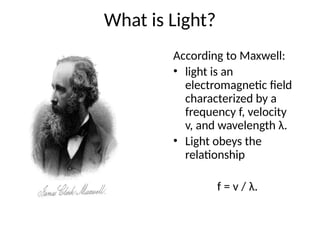
According to Maxwell:
• light is an
electromagnetic field
characterized by a
frequency f, velocity
v, and wavelength λ.
• Light obeys the
relationship
f = v / λ.
Electromagnetic Radiation
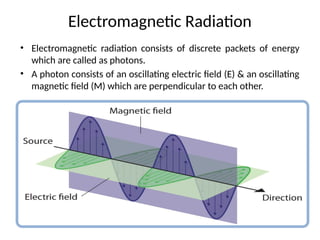
• Electromagnetic radiation consists of discrete packets of energy
which are called as photons.
• A photon consists of an oscillating electric field (E) & an oscillating
magnetic field (M) which are perpendicular to each other.
Electromagnetic Radiation
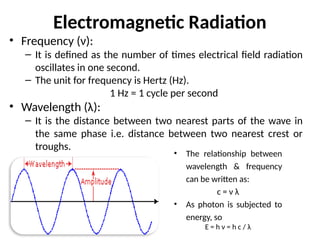
• Frequency (ν):
– It is defined as the number of times electrical field radiation
oscillates in one second.
– The unit for frequency is Hertz (Hz).
1 Hz = 1 cycle per second
• Wavelength (λ):
– It is the distance between two nearest parts of the wave in
the same phase i.e. distance between two nearest crest or
troughs.
• The relationship between
wavelength & frequency
can be written as:
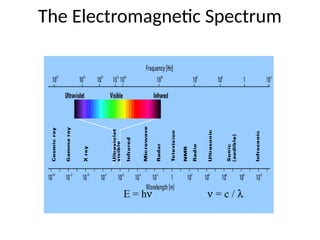
c = ν λ
• As photon is subjected to
energy, so
E = h ν = h c / λ
The Electromagnetic Spectrum
n = c / l
E = hn
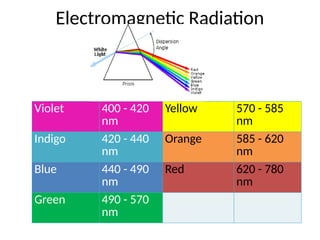
Electromagnetic Radiation
Violet 400 - 420
nm
Yellow 570 - 585
nm
Indigo 420 - 440
nm
Orange 585 - 620
nm
Blue 440 - 490
nm
Red 620 - 780
nm
Green 490 - 570
nm
08/27/2024 Unit Number: 1, Lecture Number: 1-8 7
Principles of
Spectroscopy
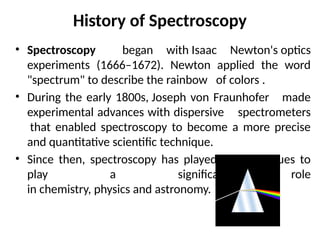
History of Spectroscopy
• Spectroscopy began with Isaac Newton's optics
experiments (1666–1672). Newton applied the word
"spectrum" to describe the rainbow of colors .
• During the early 1800s, Joseph von Fraunhofer made
experimental advances with dispersive spectrometers
that enabled spectroscopy to become a more precise
and quantitative scientific technique.
• Since then, spectroscopy has played and continues to
play a significant role
in chemistry, physics and astronomy.
Principles of Spectroscopy
• The principle is based on the measurement of
spectrum of a sample containing atoms/
molecules.
• Spectrum is a graph of intensity of absorbed or
emitted radiation by sample verses frequency
(ν) or wavelength (λ).
• Spectrometer is an instrument design to
measure the spectrum of a compound.
1. Absorption Spectroscopy:
• An analytical technique which concerns with the
measurement of absorption of electromagnetic
radiation.
• e.g. UV (185 - 400 nm) / Visible (400 - 800 nm)
Spectroscopy, IR Spectroscopy (0.76 - 15 μm)
2. Emission Spectroscopy:
• An analytical technique in which emission (of a particle
or radiation) is dispersed according to some property of
the emission & the amount of dispersion is measured.
• e.g. Mass Spectroscopy
Principles of Spectroscopy
08/27/2024 Unit Number: 1, Lecture Number: 1-8 11
Interaction of
EMR with
Matter
Interaction of EMR with Matter
1.Electronic Energy Levels:
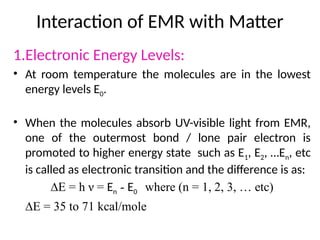
• At room temperature the molecules are in the lowest
energy levels E0.
• When the molecules absorb UV-visible light from EMR,
one of the outermost bond / lone pair electron is
promoted to higher energy state such as E1, E2, …En, etc
is called as electronic transition and the difference is as:
∆E = h ν = En - E0 where (n = 1, 2, 3, … etc)
∆E = 35 to 71 kcal/mole
Interaction of EMR with Matter
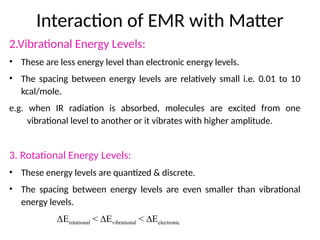
2.Vibrational Energy Levels:
• These are less energy level than electronic energy levels.
• The spacing between energy levels are relatively small i.e. 0.01 to 10
kcal/mole.
e.g. when IR radiation is absorbed, molecules are excited from one
vibrational level to another or it vibrates with higher amplitude.
3. Rotational Energy Levels:
• These energy levels are quantized & discrete.
• The spacing between energy levels are even smaller than vibrational
energy levels.
∆Erotational < ∆Evibrational < ∆Eelectronic
08/27/2024 Unit Number: 1, Lecture Number: 1-8
14
Electronic
Transitions
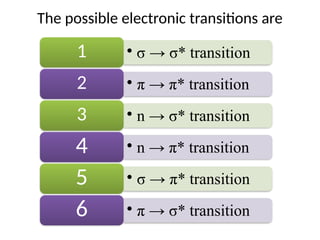
• σ → σ* transition
1
• π → π* transition
2
• n → σ* transition
3
• n → π* transition
4
• σ → π* transition
5
• π → σ* transition
6
The possible electronic transitions are
• σ electron from orbital is excited to
corresponding anti-bonding orbital σ*.
• The energy required is large for this
transition.
• e.g. Methane (CH4) has C-H bond only
and can undergo σ → σ* transition and
shows absorbance maxima at 125 nm.
• σ → σ* transition
1
• π electron in a bonding orbital is excited
to corresponding anti-bonding orbital π*.
• Compounds containing multiple bonds
like alkenes, alkynes, carbonyl, nitriles,
aromatic compounds, etc undergo π →
π* transitions.
• e.g. Alkenes generally absorb in the
region 170 to 205 nm.
• π → π* transition
2
• Saturated compounds containing atoms
with lone pair of electrons like O, N, S and
halogens are capable of n → σ* transition.
• These transitions usually requires less
energy than σ → σ* transitions.
• The number of organic functional groups
with n → σ* peaks in UV region is small
(150 – 250 nm).
• n → σ* transition
3
• An electron from non-bonding orbital is
promoted to anti-bonding π* orbital.
• Compounds containing double bond
involving hetero atoms (C=O, C≡N, N=O)
undergo such transitions.
• n → π* transitions require minimum
energy and show absorption at longer
wavelength around 300 nm.
• n → π* transition
4
•These electronic transitions are forbidden
transitions & are only theoretically possible.
•Thus, n → π* & π → π* electronic transitions
show absorption in region above 200 nm
which is accessible to UV-visible
spectrophotometer.
•The UV spectrum is of only a few broad of
absorption.
• σ → π* transition
5
• π → σ* transition 6
&
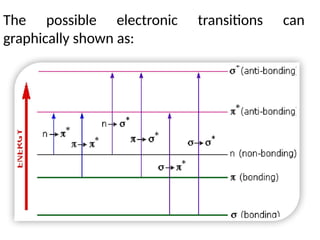
The possible electronic transitions can
graphically shown as:
08/27/2024 Unit Number: 1, Lecture Number: 1-8 22
Various terms
used in
UV / Visible
Spectroscopy
Chromophore
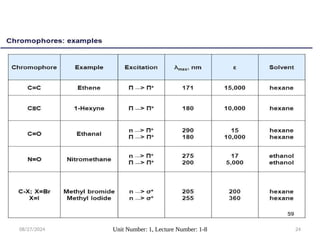
The part of a molecule responsible for
imparting color, are called as chromospheres.
or
The functional groups containing multiple
bonds capable of absorbing radiations above
200 nm due to n → π* & π → π* transitions.
08/27/2024 Unit Number: 1, Lecture Number: 1-8 24
Auxochrome
The functional groups attached to a
chromophore which modifies the ability of the
chromophore to absorb light, altering the
wavelength or intensity of absorption.
or
The functional group with non-bonding
electrons that does not absorb radiation in
near UV region but when attached to a
chromophore alters the wavelength &
intensity of absorption.
Auxochrome
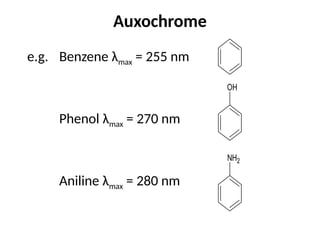
e.g. Benzene λmax = 255 nm
Phenol λmax = 270 nm
Aniline λmax = 280 nm
OH
NH2
08/27/2024 Unit Number: 1, Lecture Number: 1-8 27
Absorption
&
Intensity Shifts
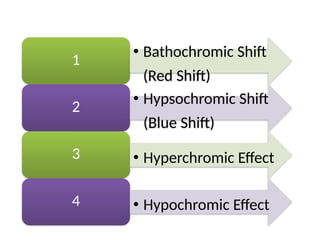
1
• Bathochromic Shift
(Red Shift)
2
• Hypsochromic Shift
(Blue Shift)
3 • Hyperchromic Effect
4 • Hypochromic Effect
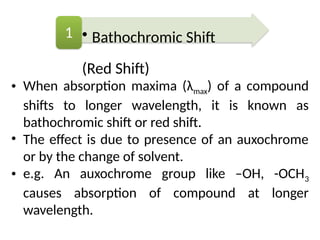
• When absorption maxima (λmax) of a compound
shifts to longer wavelength, it is known as
bathochromic shift or red shift.
• The effect is due to presence of an auxochrome
or by the change of solvent.
• e.g. An auxochrome group like –OH, -OCH3
causes absorption of compound at longer
wavelength.
• Bathochromic Shift
(Red Shift)
1
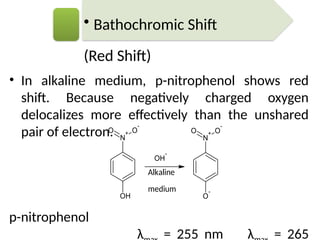
• In alkaline medium, p-nitrophenol shows red
shift. Because negatively charged oxygen
delocalizes more effectively than the unshared
pair of electron.
p-nitrophenol
λ = 255 nm λ = 265
OH
N
+ O
-
O
OH
-
Alkaline
medium
O
-
N
+ O
-
O
• Bathochromic Shift
(Red Shift)
1
• When absorption maxima (λmax) of a compound
shifts to shorter wavelength, it is known as
hypsochromic shift or blue shift.
• The effect is due to presence of an group causes
removal of conjugation or by the change of
solvent.
• Hypsochromic Shift (Blue
Shift)
2
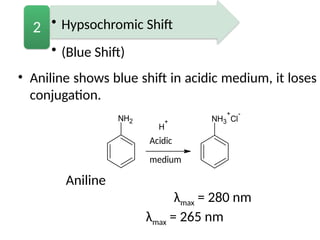
• Aniline shows blue shift in acidic medium, it loses
conjugation.
Aniline
λmax = 280 nm
λmax = 265 nm
NH2
H
+
Acidic
medium
NH3
+
Cl
-
• Hypsochromic Shift
• (Blue Shift)
2
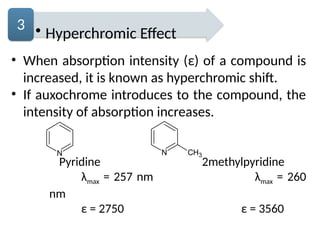
• When absorption intensity (ε) of a compound is
increased, it is known as hyperchromic shift.
• If auxochrome introduces to the compound, the
intensity of absorption increases.
Pyridine 2methylpyridine
λmax = 257 nm λmax = 260
nm
ε = 2750 ε = 3560
• Hyperchromic Effect
3
N N CH3
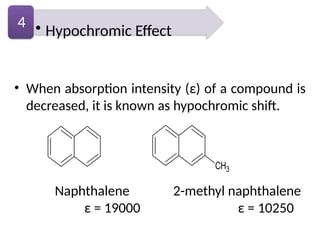
• When absorption intensity (ε) of a compound is
decreased, it is known as hypochromic shift.
Naphthalene 2-methyl naphthalene
ε = 19000 ε = 10250
CH3
• Hypochromic Effect
4
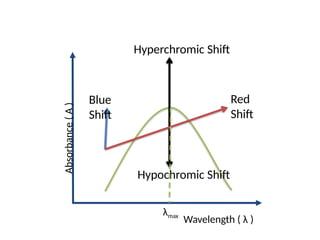
Wavelength ( λ )
Absorbance
(
A
)
Shifts and Effects
Hyperchromic Shift
Hypochromic Shift
Red
Shift
Blue
Shift
λmax
08/27/2024 Unit Number: 1, Lecture Number: 1-8 36
Beer-Lambert’s
Law
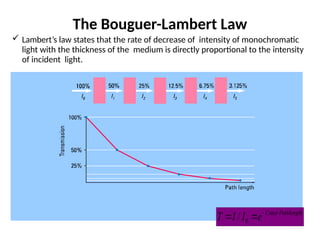
The Bouguer-Lambert Law
Pathlength
Const
e
I
I
T 


 0
/
 Lambert’s law states that the rate of decrease of intensity of monochromatic
light with the thickness of the medium is directly proportional to the intensity
of incident light.
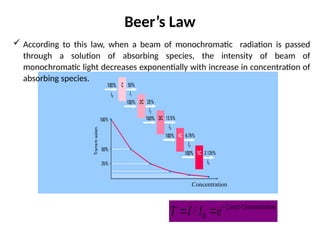
Beer’s Law
ion
Concentrat
Const
e
I
I
T 


 0
/
Concentration
 According to this law, when a beam of monochromatic radiation is passed
through a solution of absorbing species, the intensity of beam of
monochromatic light decreases exponentially with increase in concentration of
absorbing species.
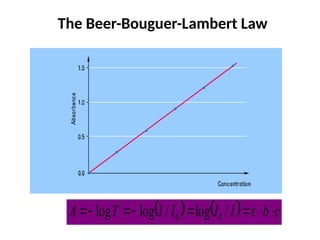
The Beer-Bouguer-Lambert Law
    c
b
I
I
I
I
T
A 






 
/
log
/
log
log 0
0
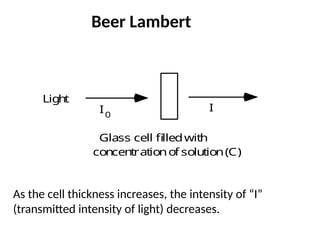
Beer Lambert Law
Glass cell filledwith
concentrationof solution(C)
I
I
Light
0
As the cell thickness increases, the intensity of “I”
(transmitted intensity of light) decreases.
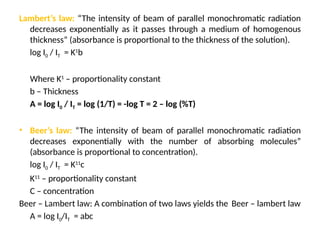
Lambert’s law: “The intensity of beam of parallel monochromatic radiation
decreases exponentially as it passes through a medium of homogenous
thickness” (absorbance is proportional to the thickness of the solution).
log I0 / IT = K1
b
Where K1
– proportionality constant
b – Thickness
A = log I0 / IT = log (1/T) = -log T = 2 – log (%T)
• Beer’s law: “The intensity of beam of parallel monochromatic radiation
decreases exponentially with the number of absorbing molecules”
(absorbance is proportional to concentration).
log I0 / IT = K11
c
K11
– proportionality constant
C – concentration
Beer – Lambert law: A combination of two laws yields the Beer – lambert law
A = log I0/IT = abc
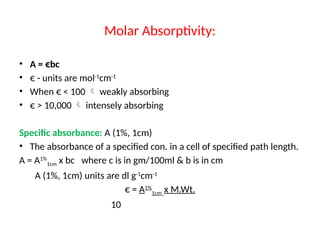
• A = €bc
• € - units are mol-1
cm-1
• When € < 100  weakly absorbing
• € > 10,000  intensely absorbing
Specific absorbance: A (1%, 1cm)
• The absorbance of a specified con. in a cell of specified path length.
A = A1%
1cm x bc where c is in gm/100ml & b is in cm
A (1%, 1cm) units are dl g-1
cm-1
€ = A1%
1cm x M.Wt.
10
Molar Absorptivity:
4
3
Deviations from Beer Lambert Law
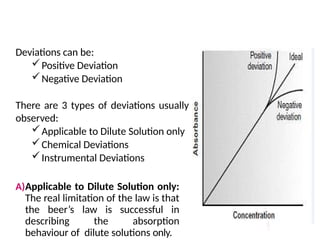
Deviations can be:
Positive Deviation
Negative Deviation
There are 3 types of deviations usually
observed:
Applicable to Dilute Solution only
Chemical Deviations
Instrumental Deviations
A)Applicable to Dilute Solution only:
The real limitation of the law is that
the beer’s law is successful in
describing the absorption
behaviour of dilute solutions only.
4
4
Deviations from Beer Lambert Law
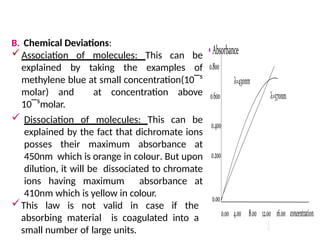
B. Chemical Deviations:
Association of molecules: This can be
explained by taking the examples of
methylene blue at small concentration(10‾⁵
molar) and at concentration above
10‾⁵molar.
 Dissociation of molecules: This can be
explained by the fact that dichromate ions
posses their maximum absorbance at
450nm which is orange in colour. But upon
dilution, it will be dissociated to chromate
ions having maximum absorbance at
410nm which is yellow in colour.
This law is not valid in case if the
absorbing material is coagulated into a
small number of large units.
This law shows deviation if the absorbing material at the
required wavelength contains presence of impurities.
 This law is not applicable in case of suspension.
4
6
Deviations from Beer Lambert Law
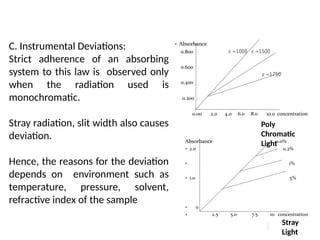
C. Instrumental Deviations:
Strict adherence of an absorbing
system to this law is observed only
when the radiation used is
monochromatic.
Stray radiation, slit width also causes
deviation.
Hence, the reasons for the deviation
depends on environment such as
temperature, pressure, solvent,
refractive index of the sample
Poly
Chromatic
Light
Stray
Light
08/27/2024 Unit Number: 1, Lecture Number: 1-8 47
Principles of
UV – Visible
Spectroscopy
Principle
• The UV radiation region extends from 10 nm to 400 nm
and the visible radiation region extends from 400 nm to
800 nm.
Near UV Region: 200 nm to 400 nm
Far UV Region: below 200 nm
• Far UV spectroscopy is studied under vacuum condition.
• The common solvent used for preparing sample to be
analyzed is either ethyl alcohol or hexane.
Instrumentation
Components of UV-Visible
Spectrophotometer
• Source
• Filters & Monochromator
• Sample compartment
• Detector
• Recorder
Five Basic Optical Instrument Components
1)Source – A stable source of radiant energy at the desired
wavelength (or range).
2)Wavelength Selector – A device that isolates a restricted
region of the EM spectrum used for measurement
(monochromators, prisms & filters).
3)Sample Container – A transparent container used to
hold the sample (cells, cuvettes, etc).
4)Detector/Photoelectric Transducer – Converts the
radiant energy into a useable signal (usually electrical).
5)Signal Processor & Readout – Amplifies or attenuates
the transduced signal and sends it to a readout device as
a meter, digital readout, chart recorder, computer, etc.
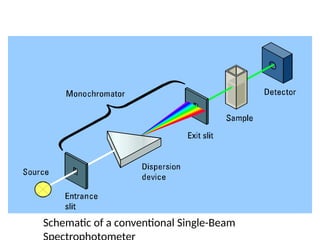
Schematic of a conventional Single-Beam
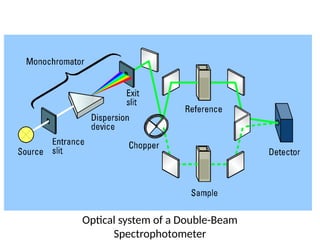
Optical system of a Double-Beam
Spectrophotometer
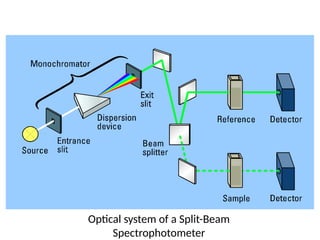
Optical system of a Split-Beam
Spectrophotometer
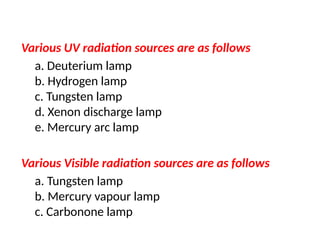
Light Sources
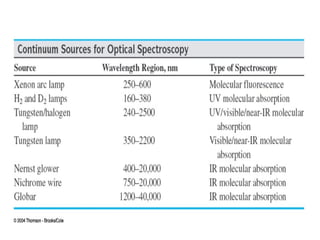
Various UV radiation sources are as follows
a. Deuterium lamp
b. Hydrogen lamp
c. Tungsten lamp
d. Xenon discharge lamp
e. Mercury arc lamp
Various Visible radiation sources are as follows
a. Tungsten lamp
b. Mercury vapour lamp
c. Carbonone lamp
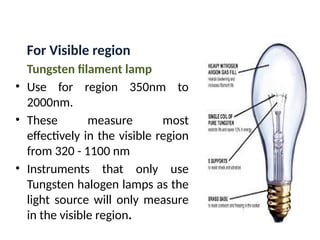
For Visible region
Tungsten filament lamp
• Use for region 350nm to
2000nm.
• These measure most
effectively in the visible region
from 320 - 1100 nm
• Instruments that only use
Tungsten halogen lamps as the
light source will only measure
in the visible region.
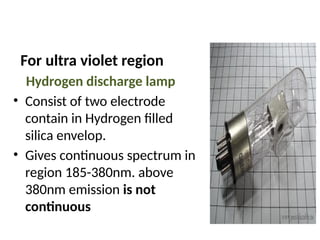
For ultra violet region
Hydrogen discharge lamp
• Consist of two electrode
contain in Hydrogen filled
silica envelop.
• Gives continuous spectrum in
region 185-380nm. above
380nm emission is not
continuous
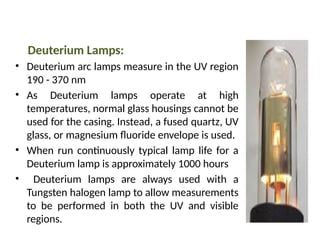
Deuterium Lamps:
• Deuterium arc lamps measure in the UV region
190 - 370 nm
• As Deuterium lamps operate at high
temperatures, normal glass housings cannot be
used for the casing. Instead, a fused quartz, UV
glass, or magnesium fluoride envelope is used.
• When run continuously typical lamp life for a
Deuterium lamp is approximately 1000 hours
• Deuterium lamps are always used with a
Tungsten halogen lamp to allow measurements
to be performed in both the UV and visible
regions.
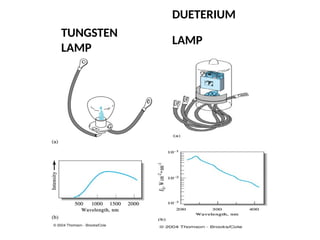
TUNGSTEN
LAMP
DUETERIUM
LAMP
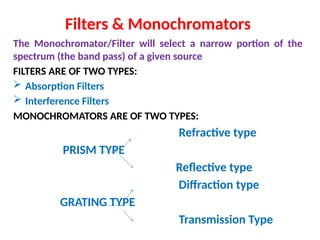
Filters & Monochromators
The Monochromator/Filter will select a narrow portion of the
spectrum (the band pass) of a given source
FILTERS ARE OF TWO TYPES:
 Absorption Filters
 Interference Filters
MONOCHROMATORS ARE OF TWO TYPES:
Refractive type
PRISM TYPE
Reflective type
Diffraction type
GRATING TYPE
Transmission Type
Filters
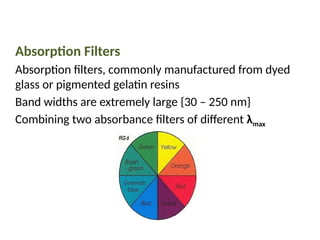
Absorption Filters
Absorption filters, commonly manufactured from dyed
glass or pigmented gelatin resins
Band widths are extremely large {30 – 250 nm}
Combining two absorbance filters of different λmax
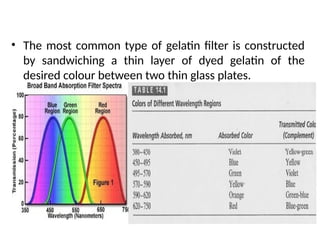
• The most common type of gelatin filter is constructed
by sandwiching a thin layer of dyed gelatin of the
desired colour between two thin glass plates.
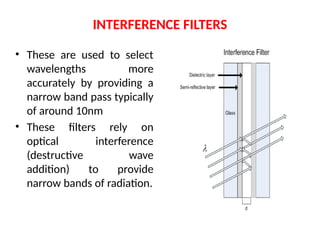
INTERFERENCE FILTERS
• These are used to select
wavelengths more
accurately by providing a
narrow band pass typically
of around 10nm
• These filters rely on
optical interference
(destructive wave
addition) to provide
narrow bands of radiation.
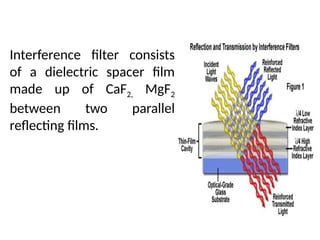
Interference filter consists
of a dielectric spacer film
made up of CaF2, MgF2
between two parallel
reflecting films.
INTERFERENCE FILTERS
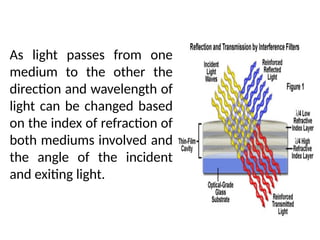
As light passes from one
medium to the other the
direction and wavelength of
light can be changed based
on the index of refraction of
both mediums involved and
the angle of the incident
and exiting light.
INTERFERENCE FILTERS
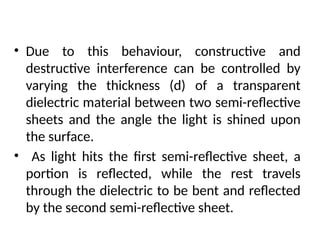
• Due to this behaviour, constructive and
destructive interference can be controlled by
varying the thickness (d) of a transparent
dielectric material between two semi-reflective
sheets and the angle the light is shined upon
the surface.
• As light hits the first semi-reflective sheet, a
portion is reflected, while the rest travels
through the dielectric to be bent and reflected
by the second semi-reflective sheet.
INTERFERENCE FILTERS
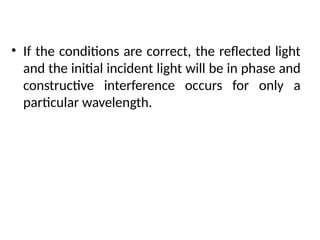
• If the conditions are correct, the reflected light
and the initial incident light will be in phase and
constructive interference occurs for only a
particular wavelength.
INTERFERENCE FILTERS
MONOCHROMATORS
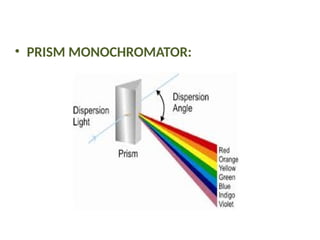
• PRISM MONOCHROMATOR:
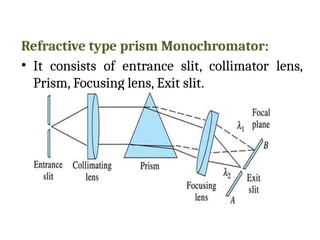
Refractive type prism Monochromator:
• It consists of entrance slit, collimator lens,
Prism, Focusing lens, Exit slit.
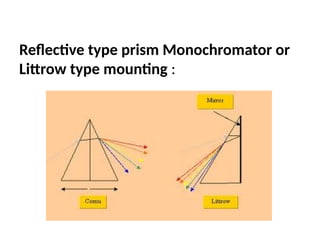
Reflective type prism Monochromator or
Littrow type mounting :
GRATING MONOCHROMATOR
• Gratings are rulings made on glass, Quartz
or alkyl halides
• Depending upon the instrument no. of
rulings per mm defers
• If it is UV-Visible no. of gratings per mm
are more than 3600.
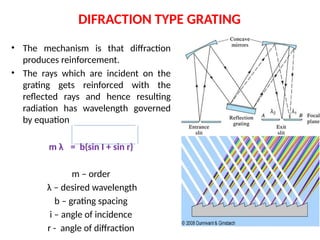
DIFRACTION TYPE GRATING
• The mechanism is that diffraction
produces reinforcement.
• The rays which are incident on the
grating gets reinforced with the
reflected rays and hence resulting
radiation has wavelength governed
by equation
m λ = b(sin I + sin r)
m – order
λ – desired wavelength
b – grating spacing
i – angle of incidence
r - angle of diffraction
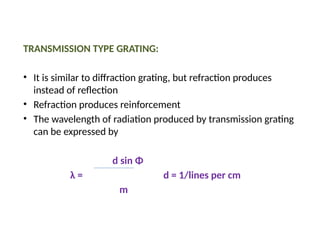
TRANSMISSION TYPE GRATING:
• It is similar to diffraction grating, but refraction produces
instead of reflection
• Refraction produces reinforcement
• The wavelength of radiation produced by transmission grating
can be expressed by
d sin Φ
λ = d = 1/lines per cm
m
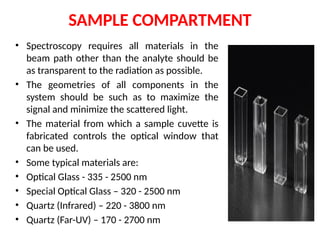
SAMPLE COMPARTMENT
• Spectroscopy requires all materials in the
beam path other than the analyte should be
as transparent to the radiation as possible.
• The geometries of all components in the
system should be such as to maximize the
signal and minimize the scattered light.
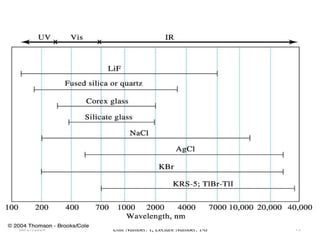
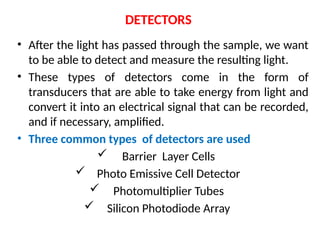
• The material from which a sample cuvette is
fabricated controls the optical window that
can be used.
• Some typical materials are:
• Optical Glass - 335 - 2500 nm
• Special Optical Glass – 320 - 2500 nm
• Quartz (Infrared) – 220 - 3800 nm
• Quartz (Far-UV) – 170 - 2700 nm
08/27/2024 Unit Number: 1, Lecture Number: 1-8 75
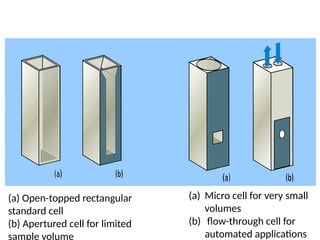
(a) Open-topped rectangular
standard cell
(b) Apertured cell for limited
sample volume
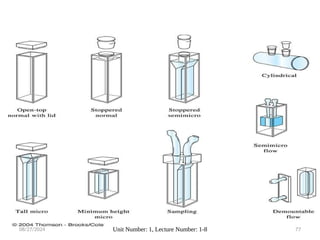
Cell Type I Cell Type II
(a) Micro cell for very small
volumes
(b) flow-through cell for
automated applications
08/27/2024 Unit Number: 1, Lecture Number: 1-8 77
DETECTORS
• After the light has passed through the sample, we want
to be able to detect and measure the resulting light.
• These types of detectors come in the form of
transducers that are able to take energy from light and
convert it into an electrical signal that can be recorded,
and if necessary, amplified.
• Three common types of detectors are used
 Barrier Layer Cells
 Photo Emissive Cell Detector
 Photomultiplier Tubes
 Silicon Photodiode Array
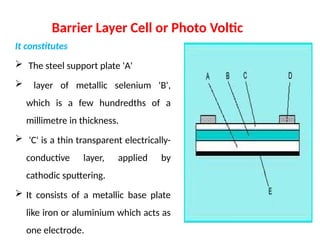
It constitutes
 The steel support plate 'A'
 layer of metallic selenium 'B',
which is a few hundredths of a
millimetre in thickness.
 'C' is a thin transparent electrically-
conductive layer, applied by
cathodic sputtering.
 It consists of a metallic base plate
like iron or aluminium which acts as
one electrode.
Barrier Layer Cell or Photo Voltic Cell
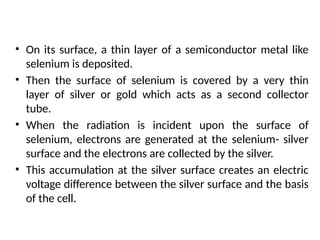
• On its surface, a thin layer of a semiconductor metal like
selenium is deposited.
• Then the surface of selenium is covered by a very thin
layer of silver or gold which acts as a second collector
tube.
• When the radiation is incident upon the surface of
selenium, electrons are generated at the selenium- silver
surface and the electrons are collected by the silver.
• This accumulation at the silver surface creates an electric
voltage difference between the silver surface and the basis
of the cell.
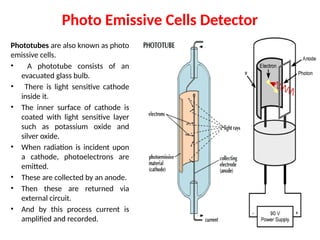
Photo Emissive Cells Detector
Phototubes are also known as photo
emissive cells.
• A phototube consists of an
evacuated glass bulb.
• There is light sensitive cathode
inside it.
• The inner surface of cathode is
coated with light sensitive layer
such as potassium oxide and
silver oxide.
• When radiation is incident upon
a cathode, photoelectrons are
emitted.
• These are collected by an anode.
• Then these are returned via
external circuit.
• And by this process current is
amplified and recorded.
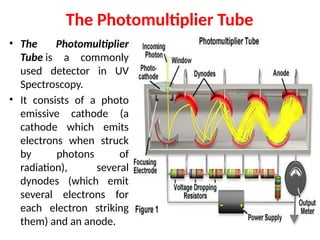
The Photomultiplier Tube
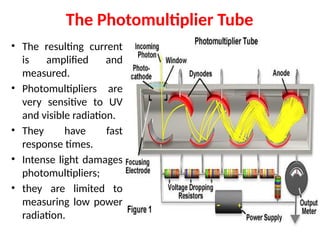
• The Photomultiplier
Tube is a commonly
used detector in UV
Spectroscopy.
• It consists of a photo
emissive cathode (a
cathode which emits
electrons when struck
by photons of
radiation), several
dynodes (which emit
several electrons for
each electron striking
them) and an anode.
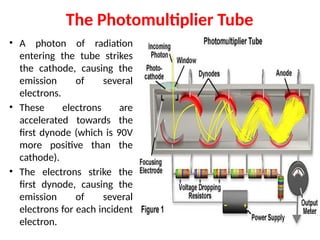
The Photomultiplier Tube
• A photon of radiation
entering the tube strikes
the cathode, causing the
emission of several
electrons.
• These electrons are
accelerated towards the
first dynode (which is 90V
more positive than the
cathode).
• The electrons strike the
first dynode, causing the
emission of several
electrons for each incident
electron.
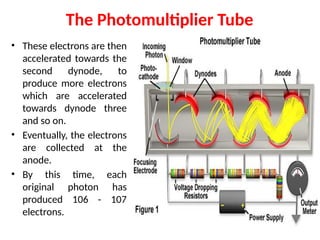
• These electrons are then
accelerated towards the
second dynode, to
produce more electrons
which are accelerated
towards dynode three
and so on.
• Eventually, the electrons
are collected at the
anode.
• By this time, each
original photon has
produced 106 - 107
electrons.
The Photomultiplier Tube
• The resulting current
is amplified and
measured.
• Photomultipliers are
very sensitive to UV
and visible radiation.
• They have fast
response times.
• Intense light damages
photomultipliers;
• they are limited to
measuring low power
radiation.
The Photomultiplier Tube
86
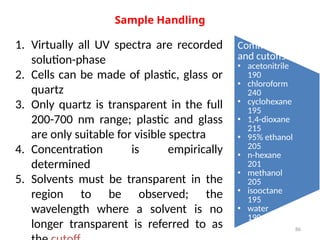
1. Virtually all UV spectra are recorded
solution-phase
2. Cells can be made of plastic, glass or
quartz
3. Only quartz is transparent in the full
200-700 nm range; plastic and glass
are only suitable for visible spectra
4. Concentration is empirically
determined
5. Solvents must be transparent in the
region to be observed; the
wavelength where a solvent is no
longer transparent is referred to as
Sample Handling
Common solvents
and cutoffs:
• acetonitrile
190
• chloroform
240
• cyclohexane
195
• 1,4-dioxane
215
• 95% ethanol
205
• n-hexane
201
• methanol
205
• isooctane
195
• water
190
87
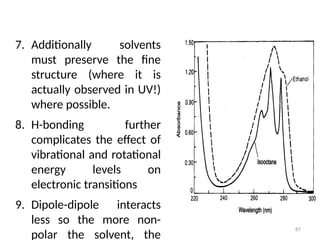
7. Additionally solvents
must preserve the fine
structure (where it is
actually observed in UV!)
where possible.
8. H-bonding further
complicates the effect of
vibrational and rotational
energy levels on
electronic transitions
9. Dipole-dipole interacts
less so the more non-
polar the solvent, the
08/27/2024 Unit Number: 1, Lecture Number: 1-8 88
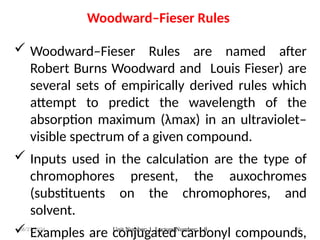
 Woodward–Fieser Rules are named after
Robert Burns Woodward and Louis Fieser) are
several sets of empirically derived rules which
attempt to predict the wavelength of the
absorption maximum (λmax) in an ultraviolet–
visible spectrum of a given compound.
 Inputs used in the calculation are the type of
chromophores present, the auxochromes
(substituents on the chromophores, and
solvent.
 Examples are conjugated carbonyl compounds,
Woodward–Fieser Rules
08/27/2024 Unit Number: 1, Lecture Number: 1-8 89
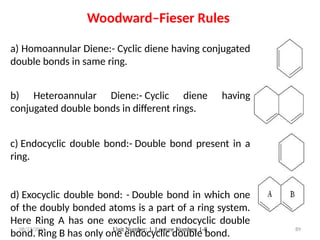
a) Homoannular Diene:- Cyclic diene having conjugated
double bonds in same ring.
b) Heteroannular Diene:- Cyclic diene having
conjugated double bonds in different rings.
c) Endocyclic double bond:- Double bond present in a
ring.
d) Exocyclic double bond: - Double bond in which one
of the doubly bonded atoms is a part of a ring system.
Here Ring A has one exocyclic and endocyclic double
bond. Ring B has only one endocyclic double bond.
Woodward–Fieser Rules
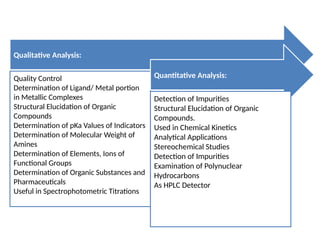
Qualitative Analysis:
Quality Control
Determination of Ligand/ Metal portion
in Metallic Complexes
Structural Elucidation of Organic
Compounds
Determination of pKa Values of Indicators
Determination of Molecular Weight of
Amines
Determination of Elements, Ions of
Functional Groups
Determination of Organic Substances and
Pharmaceuticals
Useful in Spectrophotometric Titrations
Quantitative Analysis:
Detection of Impurities
Structural Elucidation of Organic
Compounds.
Used in Chemical Kinetics
Analytical Applications
Stereochemical Studies
Detection of Impurities
Examination of Polynuclear
Hydrocarbons
As HPLC Detector
APPLICATIONS OF UV VISIBLE SPECTROPHOTOMETRY
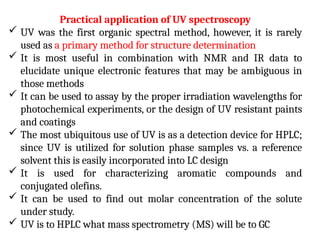
Practical application of UV spectroscopy
 UV was the first organic spectral method, however, it is rarely
used as a primary method for structure determination
 It is most useful in combination with NMR and IR data to
elucidate unique electronic features that may be ambiguous in
those methods
 It can be used to assay by the proper irradiation wavelengths for
photochemical experiments, or the design of UV resistant paints
and coatings
 The most ubiquitous use of UV is as a detection device for HPLC;
since UV is utilized for solution phase samples vs. a reference
solvent this is easily incorporated into LC design
 It is used for characterizing aromatic compounds and
conjugated olefins.
 It can be used to find out molar concentration of the solute
under study.
 UV is to HPLC what mass spectrometry (MS) will be to GC
08/27/2024 Unit Number: 1, Lecture Number: 1-8 92
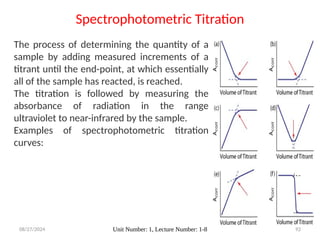
The process of determining the quantity of a
sample by adding measured increments of a
titrant until the end-point, at which essentially
all of the sample has reacted, is reached.
The titration is followed by measuring the
absorbance of radiation in the range
ultraviolet to near-infrared by the sample.
Examples of spectrophotometric titration
curves:
Spectrophotometric Titration
08/27/2024 Unit Number: 1, Lecture Number: 1-8 93
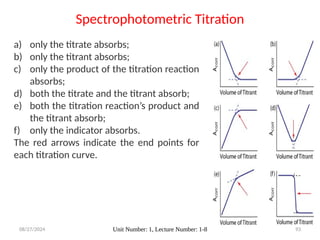
a) only the titrate absorbs;
b) only the titrant absorbs;
c) only the product of the titration reaction
absorbs;
d) both the titrate and the titrant absorb;
e) both the titration reaction’s product and
the titrant absorb;
f) only the indicator absorbs.
The red arrows indicate the end points for
each titration curve.
Spectrophotometric Titration
08/27/2024 Unit Number: 1, Lecture Number: 1-8 94
STEPS FOR ASSAY
Step1: Select the Solvent
Step2: Prepare the series of known dilutions.
Step3: Set λmax in spectrophotometer.
Step4: Measure absorbance.
Step5: Plot calibration curve.
Methods of calculating concentration in single component
analysis:
By using the relationship: A = E b c
Where,
A= Absorbance
E= Molar Extinction Coefficient
b= Path length of the sample (Cuvette)
C= Concentration of the compound in solution
Single Component Analysis
08/27/2024 Unit Number: 1, Lecture Number: 1-8 95
By using the formula: Cu =
[Au/As]×Cs×d;
Where,
Cu= Concentration of unknown,
Cs= Concentration of standard,
Au= Absorbance of Unknown
As= Absorbance of standard
d= Dilution factor
By using the equations through Beer’s
curve:
Y = mX + C
Where,
M= gradient of the line
C= y-intercept
X and Y are Axis of Graph
Single Component Analysis
08/27/2024 Unit Number: 1, Lecture Number: 1-8 96
Combination of drug
products occupy a
important role in
therapeutics.
When rationally formulated,
fixed-combination drugs
may produce greater
convenience, lower cost,
and sometimes greater
efficacy and safety.
Multi Component Analysis
Simultaneous Equation Method (Vierotd's method)
Absorbance Ratio Method (Q-Absorbance method)
Derivative Spectrophotometric Method
Multiwavelength UV-Spectrophotometry
Dual Wavelength Method
Area Under Curve Method
Difference Spectroscopy
Geometric Correction Method
Absorption Factor Method
Orthogonal Polynominal Method
Solvent Extraction Method
H-point Standard Addition Method
Least Square Approximation Method
08/27/2024 Unit Number: 1, Lecture Number: 1-8 97
Analysis of samples with
numerous components
presents a major challenge
in modern analysis.
Different analytical
techniques can be applied
for multicomponent analysis
including
spectrophotometry,
chromatography and
electrophoresis.
Multi Component Analysis
Simultaneous Equation Method (Vierotd's method)
Absorbance Ratio Method (Q-Absorbance method)
Derivative Spectrophotometric Method
Multiwavelength UV-Spectrophotometry
Dual Wavelength Method
Area Under Curve Method
Difference Spectroscopy
Geometric Correction Method
Absorption Factor Method
Orthogonal Polynominal Method
Solvent Extraction Method
H-point Standard Addition Method
Least Square Approximation Method
08/27/2024 Unit Number: 1, Lecture Number: 1-8 98
Simultaneous Equation Method (Vierotd’s Method)
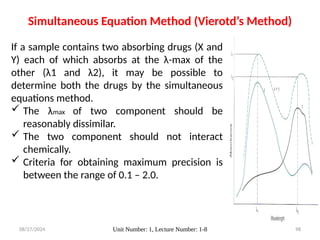
If a sample contains two absorbing drugs (X and
Y) each of which absorbs at the λ-max of the
other (λ1 and λ2), it may be possible to
determine both the drugs by the simultaneous
equations method.
 The λmax of two component should be
reasonably dissimilar.
 The two component should not interact
chemically.
 Criteria for obtaining maximum precision is
between the range of 0.1 – 2.0.
08/27/2024 Unit Number: 1, Lecture Number: 1-8 99
Simultaneous Equation Method (Vierotd’s Method)
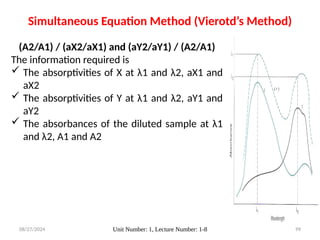
(A2/A1) / (aX2/aX1) and (aY2/aY1) / (A2/A1)
The information required is
 The absorptivities of X at λ1 and λ2, aX1 and
aX2
 The absorptivities of Y at λ1 and λ2, aY1 and
aY2
 The absorbances of the diluted sample at λ1
and λ2, A1 and A2
08/27/2024 Unit Number: 1, Lecture Number: 1-8 100
Absorbance Ratio Method (Q-Absorbance method)
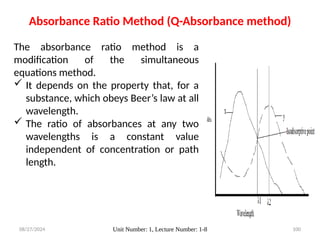
The absorbance ratio method is a
modification of the simultaneous
equations method.
 It depends on the property that, for a
substance, which obeys Beer’s law at all
wavelength.
 The ratio of absorbances at any two
wavelengths is a constant value
independent of concentration or path
length.
08/27/2024 Unit Number: 1, Lecture Number: 1-8 101
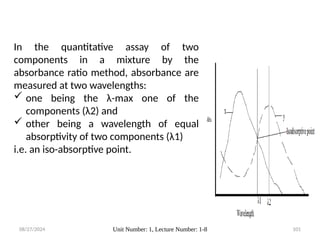
In the quantitative assay of two
components in a mixture by the
absorbance ratio method, absorbance are
measured at two wavelengths:
 one being the λ-max one of the
components (λ2) and
 other being a wavelength of equal
absorptivity of two components (λ1)
i.e. an iso-absorptive point.
08/27/2024 Unit Number: 1, Lecture Number: 1-8 102
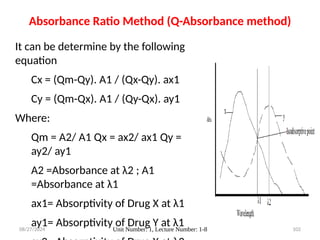
It can be determine by the following
equation
Cx = (Qm-Qy). A1 / (Qx-Qy). ax1
Cy = (Qm-Qx). A1 / (Qy-Qx). ay1
Where:
Qm = A2/ A1 Qx = ax2/ ax1 Qy =
ay2/ ay1
A2 =Absorbance at λ2 ; A1
=Absorbance at λ1
ax1= Absorptivity of Drug X at λ1
ay1= Absorptivity of Drug Y at λ1
Absorbance Ratio Method (Q-Absorbance method)
08/27/2024 Unit Number: 1, Lecture Number: 1-8 103
Derivative Spectrophotometric Method
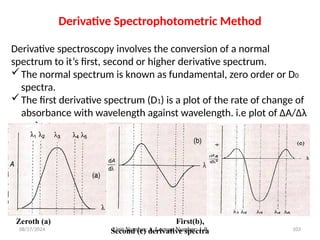
Derivative spectroscopy involves the conversion of a normal
spectrum to it’s first, second or higher derivative spectrum.
The normal spectrum is known as fundamental, zero order or D0
spectra.
The first derivative spectrum (D1) is a plot of the rate of change of
absorbance with wavelength against wavelength. i.e plot of ΔA/Δλ
vs. λ
The second derivative spectrum is a plot of Δ2A/ Δλ2 vs. λ
Zeroth (a) First(b),
Second (c) derivative spectra
08/27/2024 Unit Number: 1, Lecture Number: 1-8 104
For the quantitative estimation of binary mixtures by
the derivative spectroscopy
 First of all we have to find out the Zero Crossing
Points (ZCP) for both the components (A and B).
 Now select ZCP for A and B so that at that particular
ZCP other component shows remarkable
absorbance.
 Now prepare calibration curve of A at the ZCP of B
and of B at the ZCP of A
Derivative Spectrophotometric Method
08/27/2024 Unit Number: 1, Lecture Number: 1-8 105
Multiwavelength UV-Spectrophotometry
Its determine the composition of a binary mixture with
overlapping spectra without determining molar
absorptivities.
This method is very simple it requires only three
measurements, the absorbance of a standard solution
for each component and the unknown mixture itself.
The standard solutions of drugs in the ratio of 1:1
μg/mL were prepared in specific solvent.
08/27/2024 Unit Number: 1, Lecture Number: 1-8 106
Multiwavelength UV-Spectrophotometry
All the standard solutions were scanned over the range
of 200- 400nm, in the multicomponent mode, using
two sampling wavelength.
The overlay spectra of mix standard solution drawn.
The data from these scans were used to determine the
concentrations of two drugs in tablet sample solution.
08/27/2024 Unit Number: 1, Lecture Number: 1-8 107
Dual Wavelength Method
In dual wavelength method, two wavelengths were
selected for each drug in a way so that the difference
in absorbance is zero for another drug.
Dual wavelength spectroscopy offers an efficient
method for analyzing a component in presence of an
interfering component.
For elimination of interferences, dual analytical
wavelengths were selected in a way to make the
absorbance difference zero for one drug in order to
analyse the other drug.
References
• Elementary Organic Spectroscopy by Y. R. Sharma
• Chatwal, G.R., Anand, S.K. Instrumental Methods Of
Chemical Analysis, 5th Ed., Himalaya Publishing House Pvt.
Ltd., Mumbai.
• Skoog, D.A., Holler, F.J., Nieman. Principles of Instrumental
Analysis, 5th Ed. Brooks/Cole, A division of Thomsan
Learning, Inc., New York, 2006.
• http://www2.chemistry.msu.edu/faculty/reusch/VirtTxtJml
/Spectrpy/UV-Vis/spectrum.htm
• http://teaching.shu.ac.uk/hwb/chemistry/tutorials/molspe
c/uvvisab1.htm

UV Visible Spectroscopy, electronic transitions .pptx

  • 1.
    Subject Name: InstrumentalMethods of Analysis Unit Name: UV Visible Spectroscopy Topic Name(s): UV Visible Spectroscopy Lecture No: 01-07
  • 2.
    What is Light? Accordingto Maxwell: • light is an electromagnetic field characterized by a frequency f, velocity v, and wavelength λ. • Light obeys the relationship f = v / λ.
  • 3.
    Electromagnetic Radiation • Electromagneticradiation consists of discrete packets of energy which are called as photons. • A photon consists of an oscillating electric field (E) & an oscillating magnetic field (M) which are perpendicular to each other.
  • 4.
    Electromagnetic Radiation • Frequency(ν): – It is defined as the number of times electrical field radiation oscillates in one second. – The unit for frequency is Hertz (Hz). 1 Hz = 1 cycle per second • Wavelength (λ): – It is the distance between two nearest parts of the wave in the same phase i.e. distance between two nearest crest or troughs. • The relationship between wavelength & frequency can be written as: c = ν λ • As photon is subjected to energy, so E = h ν = h c / λ
  • 5.
  • 6.
    Electromagnetic Radiation Violet 400- 420 nm Yellow 570 - 585 nm Indigo 420 - 440 nm Orange 585 - 620 nm Blue 440 - 490 nm Red 620 - 780 nm Green 490 - 570 nm
  • 7.
    08/27/2024 Unit Number:1, Lecture Number: 1-8 7 Principles of Spectroscopy
  • 8.
    History of Spectroscopy •Spectroscopy began with Isaac Newton's optics experiments (1666–1672). Newton applied the word "spectrum" to describe the rainbow of colors . • During the early 1800s, Joseph von Fraunhofer made experimental advances with dispersive spectrometers that enabled spectroscopy to become a more precise and quantitative scientific technique. • Since then, spectroscopy has played and continues to play a significant role in chemistry, physics and astronomy.
  • 9.
    Principles of Spectroscopy •The principle is based on the measurement of spectrum of a sample containing atoms/ molecules. • Spectrum is a graph of intensity of absorbed or emitted radiation by sample verses frequency (ν) or wavelength (λ). • Spectrometer is an instrument design to measure the spectrum of a compound.
  • 10.
    1. Absorption Spectroscopy: •An analytical technique which concerns with the measurement of absorption of electromagnetic radiation. • e.g. UV (185 - 400 nm) / Visible (400 - 800 nm) Spectroscopy, IR Spectroscopy (0.76 - 15 μm) 2. Emission Spectroscopy: • An analytical technique in which emission (of a particle or radiation) is dispersed according to some property of the emission & the amount of dispersion is measured. • e.g. Mass Spectroscopy Principles of Spectroscopy
  • 11.
    08/27/2024 Unit Number:1, Lecture Number: 1-8 11 Interaction of EMR with Matter
  • 12.
    Interaction of EMRwith Matter 1.Electronic Energy Levels: • At room temperature the molecules are in the lowest energy levels E0. • When the molecules absorb UV-visible light from EMR, one of the outermost bond / lone pair electron is promoted to higher energy state such as E1, E2, …En, etc is called as electronic transition and the difference is as: ∆E = h ν = En - E0 where (n = 1, 2, 3, … etc) ∆E = 35 to 71 kcal/mole
  • 13.
    Interaction of EMRwith Matter 2.Vibrational Energy Levels: • These are less energy level than electronic energy levels. • The spacing between energy levels are relatively small i.e. 0.01 to 10 kcal/mole. e.g. when IR radiation is absorbed, molecules are excited from one vibrational level to another or it vibrates with higher amplitude. 3. Rotational Energy Levels: • These energy levels are quantized & discrete. • The spacing between energy levels are even smaller than vibrational energy levels. ∆Erotational < ∆Evibrational < ∆Eelectronic
  • 14.
    08/27/2024 Unit Number:1, Lecture Number: 1-8 14 Electronic Transitions
  • 15.
    • σ →σ* transition 1 • π → π* transition 2 • n → σ* transition 3 • n → π* transition 4 • σ → π* transition 5 • π → σ* transition 6 The possible electronic transitions are
  • 16.
    • σ electronfrom orbital is excited to corresponding anti-bonding orbital σ*. • The energy required is large for this transition. • e.g. Methane (CH4) has C-H bond only and can undergo σ → σ* transition and shows absorbance maxima at 125 nm. • σ → σ* transition 1
  • 17.
    • π electronin a bonding orbital is excited to corresponding anti-bonding orbital π*. • Compounds containing multiple bonds like alkenes, alkynes, carbonyl, nitriles, aromatic compounds, etc undergo π → π* transitions. • e.g. Alkenes generally absorb in the region 170 to 205 nm. • π → π* transition 2
  • 18.
    • Saturated compoundscontaining atoms with lone pair of electrons like O, N, S and halogens are capable of n → σ* transition. • These transitions usually requires less energy than σ → σ* transitions. • The number of organic functional groups with n → σ* peaks in UV region is small (150 – 250 nm). • n → σ* transition 3
  • 19.
    • An electronfrom non-bonding orbital is promoted to anti-bonding π* orbital. • Compounds containing double bond involving hetero atoms (C=O, C≡N, N=O) undergo such transitions. • n → π* transitions require minimum energy and show absorption at longer wavelength around 300 nm. • n → π* transition 4
  • 20.
    •These electronic transitionsare forbidden transitions & are only theoretically possible. •Thus, n → π* & π → π* electronic transitions show absorption in region above 200 nm which is accessible to UV-visible spectrophotometer. •The UV spectrum is of only a few broad of absorption. • σ → π* transition 5 • π → σ* transition 6 &
  • 21.
    The possible electronictransitions can graphically shown as:
  • 22.
    08/27/2024 Unit Number:1, Lecture Number: 1-8 22 Various terms used in UV / Visible Spectroscopy
  • 23.
    Chromophore The part ofa molecule responsible for imparting color, are called as chromospheres. or The functional groups containing multiple bonds capable of absorbing radiations above 200 nm due to n → π* & π → π* transitions.
  • 24.
    08/27/2024 Unit Number:1, Lecture Number: 1-8 24
  • 25.
    Auxochrome The functional groupsattached to a chromophore which modifies the ability of the chromophore to absorb light, altering the wavelength or intensity of absorption. or The functional group with non-bonding electrons that does not absorb radiation in near UV region but when attached to a chromophore alters the wavelength & intensity of absorption.
  • 26.
    Auxochrome e.g. Benzene λmax= 255 nm Phenol λmax = 270 nm Aniline λmax = 280 nm OH NH2
  • 27.
    08/27/2024 Unit Number:1, Lecture Number: 1-8 27 Absorption & Intensity Shifts
  • 28.
    1 • Bathochromic Shift (RedShift) 2 • Hypsochromic Shift (Blue Shift) 3 • Hyperchromic Effect 4 • Hypochromic Effect
  • 29.
    • When absorptionmaxima (λmax) of a compound shifts to longer wavelength, it is known as bathochromic shift or red shift. • The effect is due to presence of an auxochrome or by the change of solvent. • e.g. An auxochrome group like –OH, -OCH3 causes absorption of compound at longer wavelength. • Bathochromic Shift (Red Shift) 1
  • 30.
    • In alkalinemedium, p-nitrophenol shows red shift. Because negatively charged oxygen delocalizes more effectively than the unshared pair of electron. p-nitrophenol λ = 255 nm λ = 265 OH N + O - O OH - Alkaline medium O - N + O - O • Bathochromic Shift (Red Shift) 1
  • 31.
    • When absorptionmaxima (λmax) of a compound shifts to shorter wavelength, it is known as hypsochromic shift or blue shift. • The effect is due to presence of an group causes removal of conjugation or by the change of solvent. • Hypsochromic Shift (Blue Shift) 2
  • 32.
    • Aniline showsblue shift in acidic medium, it loses conjugation. Aniline λmax = 280 nm λmax = 265 nm NH2 H + Acidic medium NH3 + Cl - • Hypsochromic Shift • (Blue Shift) 2
  • 33.
    • When absorptionintensity (ε) of a compound is increased, it is known as hyperchromic shift. • If auxochrome introduces to the compound, the intensity of absorption increases. Pyridine 2methylpyridine λmax = 257 nm λmax = 260 nm ε = 2750 ε = 3560 • Hyperchromic Effect 3 N N CH3
  • 34.
    • When absorptionintensity (ε) of a compound is decreased, it is known as hypochromic shift. Naphthalene 2-methyl naphthalene ε = 19000 ε = 10250 CH3 • Hypochromic Effect 4
  • 35.
    Wavelength ( λ) Absorbance ( A ) Shifts and Effects Hyperchromic Shift Hypochromic Shift Red Shift Blue Shift λmax
  • 36.
    08/27/2024 Unit Number:1, Lecture Number: 1-8 36 Beer-Lambert’s Law
  • 37.
    The Bouguer-Lambert Law Pathlength Const e I I T    0 /  Lambert’s law states that the rate of decrease of intensity of monochromatic light with the thickness of the medium is directly proportional to the intensity of incident light.
  • 38.
    Beer’s Law ion Concentrat Const e I I T    0 / Concentration  According to this law, when a beam of monochromatic radiation is passed through a solution of absorbing species, the intensity of beam of monochromatic light decreases exponentially with increase in concentration of absorbing species.
  • 39.
    The Beer-Bouguer-Lambert Law    c b I I I I T A          / log / log log 0 0
  • 40.
    Beer Lambert Law Glasscell filledwith concentrationof solution(C) I I Light 0 As the cell thickness increases, the intensity of “I” (transmitted intensity of light) decreases.
  • 41.
    Lambert’s law: “Theintensity of beam of parallel monochromatic radiation decreases exponentially as it passes through a medium of homogenous thickness” (absorbance is proportional to the thickness of the solution). log I0 / IT = K1 b Where K1 – proportionality constant b – Thickness A = log I0 / IT = log (1/T) = -log T = 2 – log (%T) • Beer’s law: “The intensity of beam of parallel monochromatic radiation decreases exponentially with the number of absorbing molecules” (absorbance is proportional to concentration). log I0 / IT = K11 c K11 – proportionality constant C – concentration Beer – Lambert law: A combination of two laws yields the Beer – lambert law A = log I0/IT = abc
  • 42.
    • A =€bc • € - units are mol-1 cm-1 • When € < 100  weakly absorbing • € > 10,000  intensely absorbing Specific absorbance: A (1%, 1cm) • The absorbance of a specified con. in a cell of specified path length. A = A1% 1cm x bc where c is in gm/100ml & b is in cm A (1%, 1cm) units are dl g-1 cm-1 € = A1% 1cm x M.Wt. 10 Molar Absorptivity:
  • 43.
    4 3 Deviations from BeerLambert Law Deviations can be: Positive Deviation Negative Deviation There are 3 types of deviations usually observed: Applicable to Dilute Solution only Chemical Deviations Instrumental Deviations A)Applicable to Dilute Solution only: The real limitation of the law is that the beer’s law is successful in describing the absorption behaviour of dilute solutions only.
  • 44.
    4 4 Deviations from BeerLambert Law B. Chemical Deviations: Association of molecules: This can be explained by taking the examples of methylene blue at small concentration(10‾⁵ molar) and at concentration above 10‾⁵molar.  Dissociation of molecules: This can be explained by the fact that dichromate ions posses their maximum absorbance at 450nm which is orange in colour. But upon dilution, it will be dissociated to chromate ions having maximum absorbance at 410nm which is yellow in colour. This law is not valid in case if the absorbing material is coagulated into a small number of large units.
  • 45.
    This law showsdeviation if the absorbing material at the required wavelength contains presence of impurities.  This law is not applicable in case of suspension.
  • 46.
    4 6 Deviations from BeerLambert Law C. Instrumental Deviations: Strict adherence of an absorbing system to this law is observed only when the radiation used is monochromatic. Stray radiation, slit width also causes deviation. Hence, the reasons for the deviation depends on environment such as temperature, pressure, solvent, refractive index of the sample Poly Chromatic Light Stray Light
  • 47.
    08/27/2024 Unit Number:1, Lecture Number: 1-8 47 Principles of UV – Visible Spectroscopy
  • 48.
    Principle • The UVradiation region extends from 10 nm to 400 nm and the visible radiation region extends from 400 nm to 800 nm. Near UV Region: 200 nm to 400 nm Far UV Region: below 200 nm • Far UV spectroscopy is studied under vacuum condition. • The common solvent used for preparing sample to be analyzed is either ethyl alcohol or hexane.
  • 49.
    Instrumentation Components of UV-Visible Spectrophotometer •Source • Filters & Monochromator • Sample compartment • Detector • Recorder
  • 50.
    Five Basic OpticalInstrument Components 1)Source – A stable source of radiant energy at the desired wavelength (or range). 2)Wavelength Selector – A device that isolates a restricted region of the EM spectrum used for measurement (monochromators, prisms & filters). 3)Sample Container – A transparent container used to hold the sample (cells, cuvettes, etc). 4)Detector/Photoelectric Transducer – Converts the radiant energy into a useable signal (usually electrical). 5)Signal Processor & Readout – Amplifies or attenuates the transduced signal and sends it to a readout device as a meter, digital readout, chart recorder, computer, etc.
  • 51.
    Schematic of aconventional Single-Beam
  • 52.
    Optical system ofa Double-Beam Spectrophotometer
  • 53.
    Optical system ofa Split-Beam Spectrophotometer
  • 54.
    Light Sources Various UVradiation sources are as follows a. Deuterium lamp b. Hydrogen lamp c. Tungsten lamp d. Xenon discharge lamp e. Mercury arc lamp Various Visible radiation sources are as follows a. Tungsten lamp b. Mercury vapour lamp c. Carbonone lamp
  • 56.
    For Visible region Tungstenfilament lamp • Use for region 350nm to 2000nm. • These measure most effectively in the visible region from 320 - 1100 nm • Instruments that only use Tungsten halogen lamps as the light source will only measure in the visible region.
  • 57.
    For ultra violetregion Hydrogen discharge lamp • Consist of two electrode contain in Hydrogen filled silica envelop. • Gives continuous spectrum in region 185-380nm. above 380nm emission is not continuous
  • 58.
    Deuterium Lamps: • Deuteriumarc lamps measure in the UV region 190 - 370 nm • As Deuterium lamps operate at high temperatures, normal glass housings cannot be used for the casing. Instead, a fused quartz, UV glass, or magnesium fluoride envelope is used. • When run continuously typical lamp life for a Deuterium lamp is approximately 1000 hours • Deuterium lamps are always used with a Tungsten halogen lamp to allow measurements to be performed in both the UV and visible regions.
  • 59.
  • 60.
    Filters & Monochromators TheMonochromator/Filter will select a narrow portion of the spectrum (the band pass) of a given source FILTERS ARE OF TWO TYPES:  Absorption Filters  Interference Filters MONOCHROMATORS ARE OF TWO TYPES: Refractive type PRISM TYPE Reflective type Diffraction type GRATING TYPE Transmission Type
  • 61.
    Filters Absorption Filters Absorption filters,commonly manufactured from dyed glass or pigmented gelatin resins Band widths are extremely large {30 – 250 nm} Combining two absorbance filters of different λmax
  • 62.
    • The mostcommon type of gelatin filter is constructed by sandwiching a thin layer of dyed gelatin of the desired colour between two thin glass plates.
  • 63.
    INTERFERENCE FILTERS • Theseare used to select wavelengths more accurately by providing a narrow band pass typically of around 10nm • These filters rely on optical interference (destructive wave addition) to provide narrow bands of radiation.
  • 64.
    Interference filter consists ofa dielectric spacer film made up of CaF2, MgF2 between two parallel reflecting films. INTERFERENCE FILTERS
  • 65.
    As light passesfrom one medium to the other the direction and wavelength of light can be changed based on the index of refraction of both mediums involved and the angle of the incident and exiting light. INTERFERENCE FILTERS
  • 66.
    • Due tothis behaviour, constructive and destructive interference can be controlled by varying the thickness (d) of a transparent dielectric material between two semi-reflective sheets and the angle the light is shined upon the surface. • As light hits the first semi-reflective sheet, a portion is reflected, while the rest travels through the dielectric to be bent and reflected by the second semi-reflective sheet. INTERFERENCE FILTERS
  • 67.
    • If theconditions are correct, the reflected light and the initial incident light will be in phase and constructive interference occurs for only a particular wavelength. INTERFERENCE FILTERS
  • 68.
  • 69.
    Refractive type prismMonochromator: • It consists of entrance slit, collimator lens, Prism, Focusing lens, Exit slit.
  • 70.
    Reflective type prismMonochromator or Littrow type mounting :
  • 71.
    GRATING MONOCHROMATOR • Gratingsare rulings made on glass, Quartz or alkyl halides • Depending upon the instrument no. of rulings per mm defers • If it is UV-Visible no. of gratings per mm are more than 3600.
  • 72.
    DIFRACTION TYPE GRATING •The mechanism is that diffraction produces reinforcement. • The rays which are incident on the grating gets reinforced with the reflected rays and hence resulting radiation has wavelength governed by equation m λ = b(sin I + sin r) m – order λ – desired wavelength b – grating spacing i – angle of incidence r - angle of diffraction
  • 73.
    TRANSMISSION TYPE GRATING: •It is similar to diffraction grating, but refraction produces instead of reflection • Refraction produces reinforcement • The wavelength of radiation produced by transmission grating can be expressed by d sin Φ λ = d = 1/lines per cm m
  • 74.
    SAMPLE COMPARTMENT • Spectroscopyrequires all materials in the beam path other than the analyte should be as transparent to the radiation as possible. • The geometries of all components in the system should be such as to maximize the signal and minimize the scattered light. • The material from which a sample cuvette is fabricated controls the optical window that can be used. • Some typical materials are: • Optical Glass - 335 - 2500 nm • Special Optical Glass – 320 - 2500 nm • Quartz (Infrared) – 220 - 3800 nm • Quartz (Far-UV) – 170 - 2700 nm
  • 75.
    08/27/2024 Unit Number:1, Lecture Number: 1-8 75
  • 76.
    (a) Open-topped rectangular standardcell (b) Apertured cell for limited sample volume Cell Type I Cell Type II (a) Micro cell for very small volumes (b) flow-through cell for automated applications
  • 77.
    08/27/2024 Unit Number:1, Lecture Number: 1-8 77
  • 78.
    DETECTORS • After thelight has passed through the sample, we want to be able to detect and measure the resulting light. • These types of detectors come in the form of transducers that are able to take energy from light and convert it into an electrical signal that can be recorded, and if necessary, amplified. • Three common types of detectors are used  Barrier Layer Cells  Photo Emissive Cell Detector  Photomultiplier Tubes  Silicon Photodiode Array
  • 79.
    It constitutes  Thesteel support plate 'A'  layer of metallic selenium 'B', which is a few hundredths of a millimetre in thickness.  'C' is a thin transparent electrically- conductive layer, applied by cathodic sputtering.  It consists of a metallic base plate like iron or aluminium which acts as one electrode. Barrier Layer Cell or Photo Voltic Cell
  • 80.
    • On itssurface, a thin layer of a semiconductor metal like selenium is deposited. • Then the surface of selenium is covered by a very thin layer of silver or gold which acts as a second collector tube. • When the radiation is incident upon the surface of selenium, electrons are generated at the selenium- silver surface and the electrons are collected by the silver. • This accumulation at the silver surface creates an electric voltage difference between the silver surface and the basis of the cell.
  • 81.
    Photo Emissive CellsDetector Phototubes are also known as photo emissive cells. • A phototube consists of an evacuated glass bulb. • There is light sensitive cathode inside it. • The inner surface of cathode is coated with light sensitive layer such as potassium oxide and silver oxide. • When radiation is incident upon a cathode, photoelectrons are emitted. • These are collected by an anode. • Then these are returned via external circuit. • And by this process current is amplified and recorded.
  • 82.
    The Photomultiplier Tube •The Photomultiplier Tube is a commonly used detector in UV Spectroscopy. • It consists of a photo emissive cathode (a cathode which emits electrons when struck by photons of radiation), several dynodes (which emit several electrons for each electron striking them) and an anode.
  • 83.
    The Photomultiplier Tube •A photon of radiation entering the tube strikes the cathode, causing the emission of several electrons. • These electrons are accelerated towards the first dynode (which is 90V more positive than the cathode). • The electrons strike the first dynode, causing the emission of several electrons for each incident electron.
  • 84.
    • These electronsare then accelerated towards the second dynode, to produce more electrons which are accelerated towards dynode three and so on. • Eventually, the electrons are collected at the anode. • By this time, each original photon has produced 106 - 107 electrons. The Photomultiplier Tube
  • 85.
    • The resultingcurrent is amplified and measured. • Photomultipliers are very sensitive to UV and visible radiation. • They have fast response times. • Intense light damages photomultipliers; • they are limited to measuring low power radiation. The Photomultiplier Tube
  • 86.
    86 1. Virtually allUV spectra are recorded solution-phase 2. Cells can be made of plastic, glass or quartz 3. Only quartz is transparent in the full 200-700 nm range; plastic and glass are only suitable for visible spectra 4. Concentration is empirically determined 5. Solvents must be transparent in the region to be observed; the wavelength where a solvent is no longer transparent is referred to as Sample Handling Common solvents and cutoffs: • acetonitrile 190 • chloroform 240 • cyclohexane 195 • 1,4-dioxane 215 • 95% ethanol 205 • n-hexane 201 • methanol 205 • isooctane 195 • water 190
  • 87.
    87 7. Additionally solvents mustpreserve the fine structure (where it is actually observed in UV!) where possible. 8. H-bonding further complicates the effect of vibrational and rotational energy levels on electronic transitions 9. Dipole-dipole interacts less so the more non- polar the solvent, the
  • 88.
    08/27/2024 Unit Number:1, Lecture Number: 1-8 88  Woodward–Fieser Rules are named after Robert Burns Woodward and Louis Fieser) are several sets of empirically derived rules which attempt to predict the wavelength of the absorption maximum (λmax) in an ultraviolet– visible spectrum of a given compound.  Inputs used in the calculation are the type of chromophores present, the auxochromes (substituents on the chromophores, and solvent.  Examples are conjugated carbonyl compounds, Woodward–Fieser Rules
  • 89.
    08/27/2024 Unit Number:1, Lecture Number: 1-8 89 a) Homoannular Diene:- Cyclic diene having conjugated double bonds in same ring. b) Heteroannular Diene:- Cyclic diene having conjugated double bonds in different rings. c) Endocyclic double bond:- Double bond present in a ring. d) Exocyclic double bond: - Double bond in which one of the doubly bonded atoms is a part of a ring system. Here Ring A has one exocyclic and endocyclic double bond. Ring B has only one endocyclic double bond. Woodward–Fieser Rules
  • 90.
    Qualitative Analysis: Quality Control Determinationof Ligand/ Metal portion in Metallic Complexes Structural Elucidation of Organic Compounds Determination of pKa Values of Indicators Determination of Molecular Weight of Amines Determination of Elements, Ions of Functional Groups Determination of Organic Substances and Pharmaceuticals Useful in Spectrophotometric Titrations Quantitative Analysis: Detection of Impurities Structural Elucidation of Organic Compounds. Used in Chemical Kinetics Analytical Applications Stereochemical Studies Detection of Impurities Examination of Polynuclear Hydrocarbons As HPLC Detector APPLICATIONS OF UV VISIBLE SPECTROPHOTOMETRY
  • 91.
    Practical application ofUV spectroscopy  UV was the first organic spectral method, however, it is rarely used as a primary method for structure determination  It is most useful in combination with NMR and IR data to elucidate unique electronic features that may be ambiguous in those methods  It can be used to assay by the proper irradiation wavelengths for photochemical experiments, or the design of UV resistant paints and coatings  The most ubiquitous use of UV is as a detection device for HPLC; since UV is utilized for solution phase samples vs. a reference solvent this is easily incorporated into LC design  It is used for characterizing aromatic compounds and conjugated olefins.  It can be used to find out molar concentration of the solute under study.  UV is to HPLC what mass spectrometry (MS) will be to GC
  • 92.
    08/27/2024 Unit Number:1, Lecture Number: 1-8 92 The process of determining the quantity of a sample by adding measured increments of a titrant until the end-point, at which essentially all of the sample has reacted, is reached. The titration is followed by measuring the absorbance of radiation in the range ultraviolet to near-infrared by the sample. Examples of spectrophotometric titration curves: Spectrophotometric Titration
  • 93.
    08/27/2024 Unit Number:1, Lecture Number: 1-8 93 a) only the titrate absorbs; b) only the titrant absorbs; c) only the product of the titration reaction absorbs; d) both the titrate and the titrant absorb; e) both the titration reaction’s product and the titrant absorb; f) only the indicator absorbs. The red arrows indicate the end points for each titration curve. Spectrophotometric Titration
  • 94.
    08/27/2024 Unit Number:1, Lecture Number: 1-8 94 STEPS FOR ASSAY Step1: Select the Solvent Step2: Prepare the series of known dilutions. Step3: Set λmax in spectrophotometer. Step4: Measure absorbance. Step5: Plot calibration curve. Methods of calculating concentration in single component analysis: By using the relationship: A = E b c Where, A= Absorbance E= Molar Extinction Coefficient b= Path length of the sample (Cuvette) C= Concentration of the compound in solution Single Component Analysis
  • 95.
    08/27/2024 Unit Number:1, Lecture Number: 1-8 95 By using the formula: Cu = [Au/As]×Cs×d; Where, Cu= Concentration of unknown, Cs= Concentration of standard, Au= Absorbance of Unknown As= Absorbance of standard d= Dilution factor By using the equations through Beer’s curve: Y = mX + C Where, M= gradient of the line C= y-intercept X and Y are Axis of Graph Single Component Analysis
  • 96.
    08/27/2024 Unit Number:1, Lecture Number: 1-8 96 Combination of drug products occupy a important role in therapeutics. When rationally formulated, fixed-combination drugs may produce greater convenience, lower cost, and sometimes greater efficacy and safety. Multi Component Analysis Simultaneous Equation Method (Vierotd's method) Absorbance Ratio Method (Q-Absorbance method) Derivative Spectrophotometric Method Multiwavelength UV-Spectrophotometry Dual Wavelength Method Area Under Curve Method Difference Spectroscopy Geometric Correction Method Absorption Factor Method Orthogonal Polynominal Method Solvent Extraction Method H-point Standard Addition Method Least Square Approximation Method
  • 97.
    08/27/2024 Unit Number:1, Lecture Number: 1-8 97 Analysis of samples with numerous components presents a major challenge in modern analysis. Different analytical techniques can be applied for multicomponent analysis including spectrophotometry, chromatography and electrophoresis. Multi Component Analysis Simultaneous Equation Method (Vierotd's method) Absorbance Ratio Method (Q-Absorbance method) Derivative Spectrophotometric Method Multiwavelength UV-Spectrophotometry Dual Wavelength Method Area Under Curve Method Difference Spectroscopy Geometric Correction Method Absorption Factor Method Orthogonal Polynominal Method Solvent Extraction Method H-point Standard Addition Method Least Square Approximation Method
  • 98.
    08/27/2024 Unit Number:1, Lecture Number: 1-8 98 Simultaneous Equation Method (Vierotd’s Method) If a sample contains two absorbing drugs (X and Y) each of which absorbs at the λ-max of the other (λ1 and λ2), it may be possible to determine both the drugs by the simultaneous equations method.  The λmax of two component should be reasonably dissimilar.  The two component should not interact chemically.  Criteria for obtaining maximum precision is between the range of 0.1 – 2.0.
  • 99.
    08/27/2024 Unit Number:1, Lecture Number: 1-8 99 Simultaneous Equation Method (Vierotd’s Method) (A2/A1) / (aX2/aX1) and (aY2/aY1) / (A2/A1) The information required is  The absorptivities of X at λ1 and λ2, aX1 and aX2  The absorptivities of Y at λ1 and λ2, aY1 and aY2  The absorbances of the diluted sample at λ1 and λ2, A1 and A2
  • 100.
    08/27/2024 Unit Number:1, Lecture Number: 1-8 100 Absorbance Ratio Method (Q-Absorbance method) The absorbance ratio method is a modification of the simultaneous equations method.  It depends on the property that, for a substance, which obeys Beer’s law at all wavelength.  The ratio of absorbances at any two wavelengths is a constant value independent of concentration or path length.
  • 101.
    08/27/2024 Unit Number:1, Lecture Number: 1-8 101 In the quantitative assay of two components in a mixture by the absorbance ratio method, absorbance are measured at two wavelengths:  one being the λ-max one of the components (λ2) and  other being a wavelength of equal absorptivity of two components (λ1) i.e. an iso-absorptive point.
  • 102.
    08/27/2024 Unit Number:1, Lecture Number: 1-8 102 It can be determine by the following equation Cx = (Qm-Qy). A1 / (Qx-Qy). ax1 Cy = (Qm-Qx). A1 / (Qy-Qx). ay1 Where: Qm = A2/ A1 Qx = ax2/ ax1 Qy = ay2/ ay1 A2 =Absorbance at λ2 ; A1 =Absorbance at λ1 ax1= Absorptivity of Drug X at λ1 ay1= Absorptivity of Drug Y at λ1 Absorbance Ratio Method (Q-Absorbance method)
  • 103.
    08/27/2024 Unit Number:1, Lecture Number: 1-8 103 Derivative Spectrophotometric Method Derivative spectroscopy involves the conversion of a normal spectrum to it’s first, second or higher derivative spectrum. The normal spectrum is known as fundamental, zero order or D0 spectra. The first derivative spectrum (D1) is a plot of the rate of change of absorbance with wavelength against wavelength. i.e plot of ΔA/Δλ vs. λ The second derivative spectrum is a plot of Δ2A/ Δλ2 vs. λ Zeroth (a) First(b), Second (c) derivative spectra
  • 104.
    08/27/2024 Unit Number:1, Lecture Number: 1-8 104 For the quantitative estimation of binary mixtures by the derivative spectroscopy  First of all we have to find out the Zero Crossing Points (ZCP) for both the components (A and B).  Now select ZCP for A and B so that at that particular ZCP other component shows remarkable absorbance.  Now prepare calibration curve of A at the ZCP of B and of B at the ZCP of A Derivative Spectrophotometric Method
  • 105.
    08/27/2024 Unit Number:1, Lecture Number: 1-8 105 Multiwavelength UV-Spectrophotometry Its determine the composition of a binary mixture with overlapping spectra without determining molar absorptivities. This method is very simple it requires only three measurements, the absorbance of a standard solution for each component and the unknown mixture itself. The standard solutions of drugs in the ratio of 1:1 μg/mL were prepared in specific solvent.
  • 106.
    08/27/2024 Unit Number:1, Lecture Number: 1-8 106 Multiwavelength UV-Spectrophotometry All the standard solutions were scanned over the range of 200- 400nm, in the multicomponent mode, using two sampling wavelength. The overlay spectra of mix standard solution drawn. The data from these scans were used to determine the concentrations of two drugs in tablet sample solution.
  • 107.
    08/27/2024 Unit Number:1, Lecture Number: 1-8 107 Dual Wavelength Method In dual wavelength method, two wavelengths were selected for each drug in a way so that the difference in absorbance is zero for another drug. Dual wavelength spectroscopy offers an efficient method for analyzing a component in presence of an interfering component. For elimination of interferences, dual analytical wavelengths were selected in a way to make the absorbance difference zero for one drug in order to analyse the other drug.
  • 108.
    References • Elementary OrganicSpectroscopy by Y. R. Sharma • Chatwal, G.R., Anand, S.K. Instrumental Methods Of Chemical Analysis, 5th Ed., Himalaya Publishing House Pvt. Ltd., Mumbai. • Skoog, D.A., Holler, F.J., Nieman. Principles of Instrumental Analysis, 5th Ed. Brooks/Cole, A division of Thomsan Learning, Inc., New York, 2006. • http://www2.chemistry.msu.edu/faculty/reusch/VirtTxtJml /Spectrpy/UV-Vis/spectrum.htm • http://teaching.shu.ac.uk/hwb/chemistry/tutorials/molspe c/uvvisab1.htm

Editor's Notes

  • #3 What will the audience be able to do after this training is complete? Briefly describe each objective how the audience will benefit from this presentation.
  • #4 What will the audience be able to do after this training is complete? Briefly describe each objective how the audience will benefit from this presentation.
  • #6 What will the audience be able to do after this training is complete? Briefly describe each objective how the audience will benefit from this presentation.
  • #9 What will the audience be able to do after this training is complete? Briefly describe each objective how the audience will benefit from this presentation.
  • #10 What will the audience be able to do after this training is complete? Briefly describe each objective how the audience will benefit from this presentation.
  • #12 What will the audience be able to do after this training is complete? Briefly describe each objective how the audience will benefit from this presentation.
  • #13 What will the audience be able to do after this training is complete? Briefly describe each objective how the audience will benefit from this presentation.
  • #15 This is another option for an Overview slide.
  • #16 This is another option for an Overview slide.
  • #17 This is another option for an Overview slide.
  • #18 This is another option for an Overview slide.
  • #19 This is another option for an Overview slide.
  • #20 This is another option for an Overview slide.
  • #21 This is another option for an Overview slide.
  • #23 Add slides to each topic section as necessary, including slides with tables, graphs, and images. See next section for sample table, graph, image, and video layouts.
  • #25 Add slides to each topic section as necessary, including slides with tables, graphs, and images. See next section for sample table, graph, image, and video layouts.
  • #26 Add slides to each topic section as necessary, including slides with tables, graphs, and images. See next section for sample table, graph, image, and video layouts.
  • #28 This is another option for an Overview slide.
  • #29 This is another option for an Overview slide.
  • #30 This is another option for an Overview slide.
  • #31 This is another option for an Overview slide.
  • #32 This is another option for an Overview slide.
  • #33 This is another option for an Overview slide.
  • #34 This is another option for an Overview slide.
  • #48 Give a brief overview of the presentation. Describe the major focus of the presentation and why it is important. Introduce each of the major topics. To provide a road map for the audience, you can repeat this Overview slide throughout the presentation, highlighting the particular topic you will discuss next.
  • #90 Discuss outcomes of the case study or class simulation. Cover best practices.
  • #91 Discuss outcomes of the case study or class simulation. Cover best practices.