APPLICATIONS OF VISIBLE AND
UV SPECTROMETRY
Presented By-
ROHIT
M.Pharmacy
(Pharmaceutics)1
APPLICATION OF VISIBLE SPECTROMETRY
2
 Substance that are having intrinsic color (berberine
, clofazimine ,cyanocobalamin , riboflavin and
rifampicin) can be determined directly by
colorimetric method whereas colorless substance
can be estimated only after converting it into
colored derivative by treating them with appropriate
chromogenic reagent. Colorimetry is used in the
quantitative estimation of
1. Inorganic compound
2. Biochemical specimens
3. Organic and pharmaceutical compounds
INORGANIC COMPOUND
 Inorganic field it is used in the estimation of both
cation and anion .
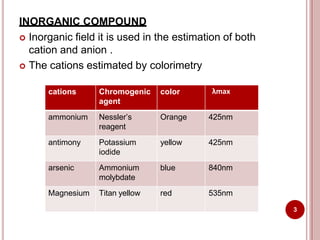
 The cations estimated by colorimetry
3
cations Chromogenic
agent
color λmax
ammonium Nessler’s
reagent
Orange 425nm
antimony Potassium
iodide
yellow 425nm
arsenic Ammonium
molybdate
blue 840nm
Magnesium Titan yellow red 535nm
BIOCHEMICAL SPECIMENS
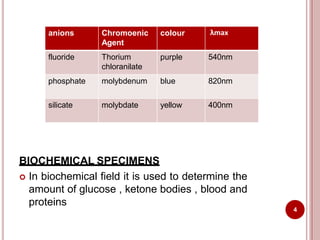
 In biochemical field it is used to determine the
amount of glucose , ketone bodies , blood and
proteins
4
anions Chromoenic
Agent
colour λmax
fluoride Thorium
chloranilate
purple 540nm
phosphate molybdenum blue 820nm
silicate molybdate yellow 400nm
Organic and pharmaceutical application
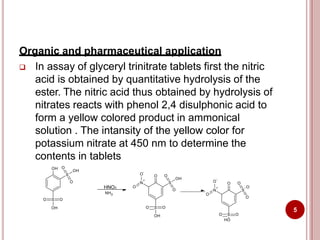
 In assay of glyceryl trinitrate tablets first the nitric
acid is obtained by quantitative hydrolysis of the
ester. The nitric acid thus obtained by hydrolysis of
nitrates reacts with phenol 2,4 disulphonic acid to
form a yellow colored product in ammonical
solution . The intansity of the yellow color for
potassium nitrate at 450 nm to determine the
contents in tablets
O S O
OH
S
O
O
OH
OH
N
O
-
+
O
S
O O
O
OH
O S O
OH
HNO3
NH3
N
O
-
+
O
S
O O
O
- O
O S O
HO
5
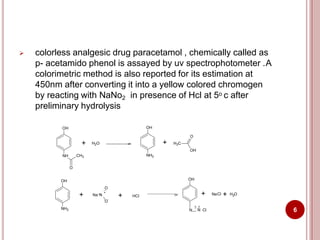
 colorless analgesic drug paracetamol , chemically called as
p- acetamido phenol is assayed by uv spectrophotometer .A
colorimetric method is also reported for its estimation at
450nm after converting it into a yellow colored chromogen
by reacting with NaNo2 in presence of Hcl at 5o c after
preliminary hydrolysis
OH
O
H2O+
NH CH3
OH
NH2
+ H3C
O
OH
OH
NH2
+ Na N
+
O
-
O
+ HCl
OH
+ +
N N Cl
+ NaCl H O+ 2
6
 Ergometrine maleate and ergot alkaloids from a
blue colored compound on reaction with p-dimethyl
amino benzaldehyde and a trace of ferric chloride in
sulphuric acid. The blue colored compound then
can be measured at 578nm
 The amount of carbachol in the injection is
determined by colorimetric method by reacting it
with reineckatte solution in acetone to from a pink
red color which is measured at 526nm
7
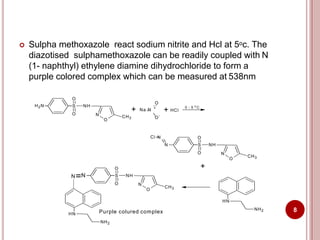
 Sulpha methoxazole react sodium nitrite and Hcl at 5oc. The
diazotised sulphamethoxazole can be readily coupled with N
(1- naphthyl) ethylene diamine dihydrochloride to form a
purple colored complex which can be measured at 538nm
H2N
O
S NH
O
O
N
+
O
-
O
+ Na N
CH3
+ HCl
0 - 5 O
C
O
S NH
O
O
N
CH3
N
Cl N
+
HN
NH2
HN
O
S NH
O
O
N
CH3
NN
Purple colured complex
NH2
8
 Vitamin A and vitaminD can be estimated colorimetrically by
by reacting them with antimony trichloride in chloroform ,
where the intense blue and green color obtained respectively
is measured between 520-590nm. the color formed is stable
for few secounds only hence the reagent is added directly to
the cuvette during measurement
 calciferol tablet and solution are determined by colorimetric
method after extracting it by light petroleuam from the
formulation .the residue of light petroleum extract in ethanol
free chloroform solution , on reaction with antimony trichloride
yield a brown orange color which can be measured at 500nm
9
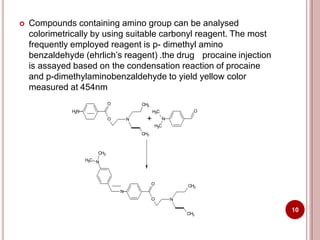
 Compounds containing amino group can be analysed
colorimetrically by using suitable carbonyl reagent. The most
frequently employed reagent is p- dimethyl amino
benzaldehyde (ehrlich’s reagent) .the drug procaine injection
is assayed based on the condensation reaction of procaine
and p-dimethylaminobenzaldehyde to yield yellow color
measured at 454nm
H2N
O
O N
CH3
H3C
+ N
H3C
CH3
O
O
N
O N
CH3
NH3C
CH3
CH3
10
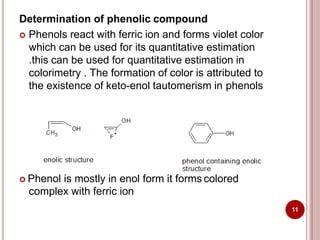
Determination of phenolic compound
 Phenols react with ferric ion and forms violet color
which can be used for its quantitative estimation
.this can be used for quantitative estimation in
colorimetry . The formation of color is attributed to
the existence of keto-enol tautomerism in phenols
 Phenol is mostly in enol form it forms colored
complex with ferric ion
11
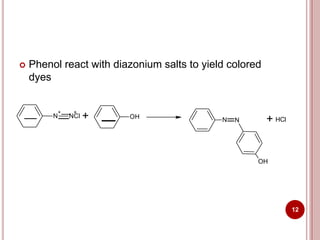
 Phenol react with diazonium salts to yield colored
dyes
+ +
N NCl + OH N N
OH
+ HCl
12
Advantages of colorimetry method
 This method is not time consuming and hence it is
ideally suited for routine work
 The operations involved in the estimation are
simple, particularly when the photoelectric
colorimetric is used
 Determination of minute quantities of substance (<1
to 2%) is possible
 The instrument employed for the work is
inexpensive
13
APPLICATIONS OF ULTRAVIOLET
SPECTROSCOPY
14
 The methods based on the absorption of radiation
are extremely important from the viewpoint of an
analytical chemist.
 Ultraviolet methods find extensive use in the
identification of various hydrocarbons , vitamins ,
steroids , heterocycles ,and conjugated aliphatics
I. QUANTITATIVEANALYSIS
II. QUALITATIVE ANALYSIS
Quantitative analysis of substance in
Single component sample
 The conc of a drug or absorbing substance in a
given sample can be easily analysed by measuring
the absorbance of the solution prepared in a
transparent solvent in a uv spectrophotometer. this
quantitative UV method is applicable to determine
the conc of a single component in the given sample
and to determined the conc of different components
in mixture
15
 The methods adopted to analyse single
component sample
1. Standard adsorptivity value method
2. Calibration graph/curve method
3. Single or double point standardization
method
16
standard absorptivity value method
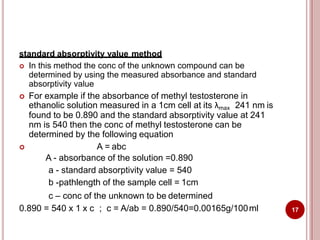
 In this method the conc of the unknown compound can be
determined by using the measured absorbance and standard
absorptivity value
 For example if the absorbance of methyl testosterone in
ethanolic solution measured in a 1cm cell at its λmax 241 nm is
found to be 0.890 and the standard absorptivity value at 241
nm is 540 then the conc of methyl testosterone can be
determined by the following equation
 A = abc
A - absorbance of the solution =0.890
a - standard absorptivity value = 540
b -pathlength of the sample cell = 1cm
c – conc of the unknown to be determined
0.890 = 540 x 1 x c ; c = A/ab = 0.890/540=0.00165g/100ml 17
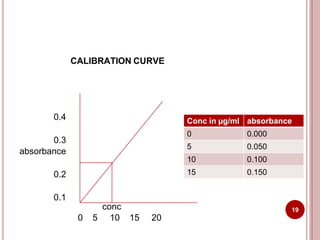
Calibration graph/ curve method
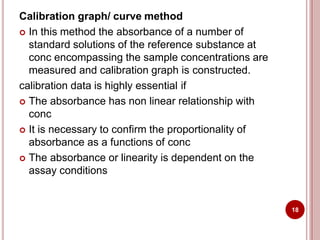
 In this method the absorbance of a number of
standard solutions of the reference substance at
conc encompassing the sample concentrations are
measured and calibration graph is constructed.
calibration data is highly essential if
 The absorbance has non linear relationship with
conc
 It is necessary to confirm the proportionality of
absorbance as a functions of conc
 The absorbance or linearity is dependent on the
assay conditions
18
CALIBRATION CURVE
0.4
0.3
absorbance
0.2
0.1
conc
0 5 10 15 20
Conc in µg/ml absorbance
0 0.000
5 0.050
10 0.100
15 0.150
19
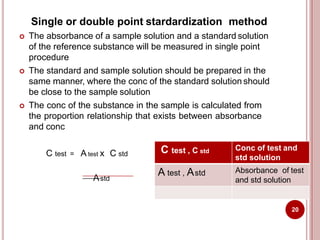
Single or double point stardardization method
 The absorbance of a sample solution and a standard solution
of the reference substance will be measured in single point
procedure
 The standard and sample solution should be prepared in the
same manner, where the conc of the standard solution should
be close to the sample solution
 The conc of the substance in the sample is calculated from
the proportion relationship that exists between absorbance
and conc
C test = A test x C std
Astd
C test , C std
20
Conc of test and
std solution
A test , Astd Absorbance of test
and std solution
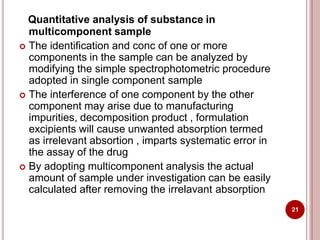
Quantitative analysis of substance in
multicomponent sample
 The identification and conc of one or more
components in the sample can be analyzed by
modifying the simple spectrophotometric procedure
adopted in single component sample
 The interference of one component by the other
component may arise due to manufacturing
impurities, decomposition product , formulation
excipients will cause unwanted absorption termed
as irrelevant absortion , imparts systematic error in
the assay of the drug
 By adopting multicomponent analysis the actual
amount of sample under investigation can be easily
calculated after removing the irrelavant absorption
21
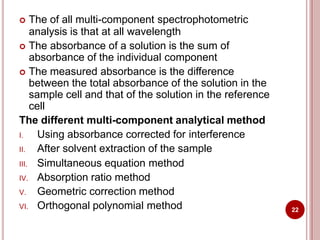
 The of all multi-component spectrophotometric
analysis is that at all wavelength
 The absorbance of a solution is the sum of
absorbance of the individual component
 The measured absorbance is the difference
between the total absorbance of the solution in the
sample cell and that of the solution in the reference
cell
The different multi-component analytical method
I. Using absorbance corrected for interference
II. After solvent extraction of the sample
III. Simultaneous equation method
IV. Absorption ratio method
V. Geometric correction method
VI. Orthogonal polynomial method 22
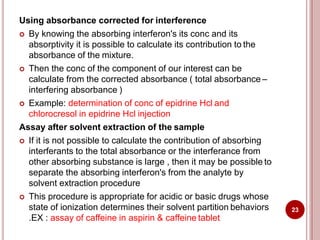
Using absorbance corrected for interference
 By knowing the absorbing interferon's its conc and its
absorptivity it is possible to calculate its contribution to the
absorbance of the mixture.
 Then the conc of the component of our interest can be
calculate from the corrected absorbance ( total absorbance –
interfering absorbance )
 Example: determination of conc of epidrine Hcl and
chlorocresol in epidrine Hcl injection
Assay after solvent extraction of the sample
 If it is not possible to calculate the contribution of absorbing
interferants to the total absorbance or the interferance from
other absorbing substance is large , then it may be possible to
separate the absorbing interferon's from the analyte by
solvent extraction procedure
 This procedure is appropriate for acidic or basic drugs whose
state of ionization determines their solvent partition behaviors
.EX : assay of caffeine in aspirin & caffeine tablet
23
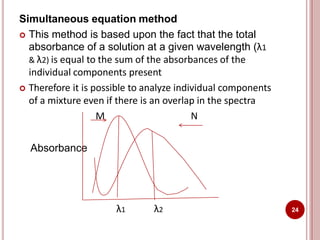
Simultaneous equation method
 This method is based upon the fact that the total
absorbance of a solution at a given wavelength (λ1
& λ2) is equal to the sum of the absorbances of the
individual components present
 Therefore it is possible to analyze individual components
of a mixture even if there is an overlap in the spectra
M N
Absorbance
λ1 λ2 24
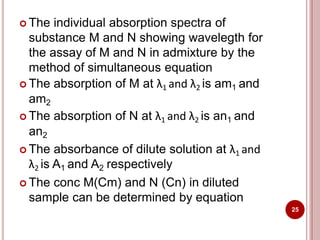
 The individual absorption spectra of
substance M and N showing wavelegth for
the assay of M and N in admixture by the
method of simultaneous equation
 The absorption of M at λ1 and λ2 is am1 and
am2
 The absorption of N at λ1 and λ2 is an1 and
an2
 The absorbance of dilute solution at λ1 and
λ2 is A1 and A2 respectively
 The conc M(Cm) and N (Cn) in diluted
sample can be determined by equation
25
λ1 A1 = am1 bCm + an1bCn (1)
λ2 A2 = am2bCm + an2bCn (2)
for measure in 1 cm cell b = 1
rearranging equation (2)
Cn = A2 – am2Cm
an2
substitnute Cn in equation (1) and rearranging
Cm = A2an1 – A1an2
am2an1 – am1an2
26
Qualitative analyis
 In qualitative analysis , UV spectra is mainly used to
detect the presence of different
chromophores,polynuclear compound and to detect the
extension conjugation
Detection of functional groups
 Uv technique is applied to detect the presence or
absence of the chromophore
 Uv wavelegth range from 200nm to 400nm,it shows the
absence of conjugation
 carbonyl group (aldehydes and ketones )
 benzene or aromatic compound
 bromo or iodo atoms 27
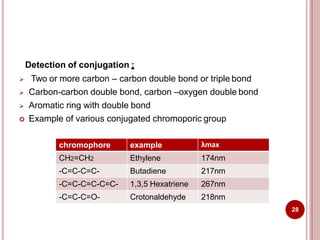
Detection of conjugation :
 Two or more carbon – carbon double bond or triple bond
 Carbon-carbon double bond, carbon –oxygen double bond
 Aromatic ring with double bond
 Example of various conjugated chromoporic group
28
chromophore example λmax
CH2=CH2 Ethylene 174nm
-C=C-C=C- Butadiene 217nm
-C=C-C=C-C=C- 1,3,5 Hexatriene 267nm
-C=C-C=O- Crotonaldehyde 218nm
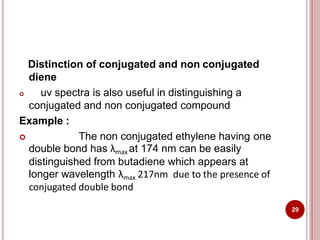
Distinction of conjugated and non conjugated
diene
29
 uv spectra is also useful in distinguishing a
conjugated and non conjugated compound
Example :
 The non conjugated ethylene having one
double bond has λmax at 174 nm can be easily
distinguished from butadiene which appears at
longer wavelength λmax 217nm due to the presence of
conjugated double bond
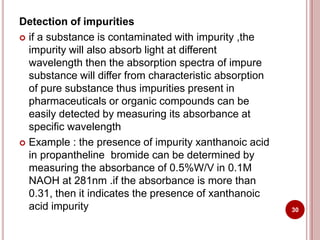
Detection of impurities
 if a substance is contaminated with impurity ,the
impurity will also absorb light at different
wavelength then the absorption spectra of impure
substance will differ from characteristic absorption
of pure substance thus impurities present in
pharmaceuticals or organic compounds can be
easily detected by measuring its absorbance at
specific wavelength
 Example : the presence of impurity xanthanoic acid
in propantheline bromide can be determined by
measuring the absorbance of 0.5%W/V in 0.1M
NAOH at 281nm .if the absorbance is more than
0.31, then it indicates the presence of xanthanoic
acid impurity 30
Identification of unknown compound
 An unknown compound can be identified by comparing its
spectrum with the known spectra. If the two spectra coincide ,
the two compound must be identical . If the spectra do not
coincide, then the expected structure is different from the
known compound
Detection of polynuclear hydrocarbons
 Benzene and polynuclear compounds have characteristic
spectra in ultra violet and visible radition . Thus the
identification of polynuclear hydrocarbons can be made by
comparison with the spectra of known polynuclear compounds
.
31
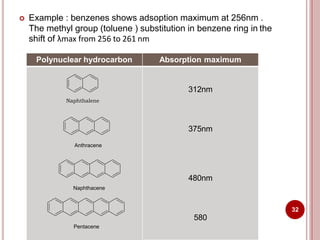
 Example : benzenes shows adsoption maximum at 256nm .
The methyl group (toluene ) substitution in benzene ring in the
shift of λmax from 256 to 261 nm
Polynuclear hydrocarbon Absorption maximum
Naphthalene
Anthracene
Naphthacene
Pentacene
312nm
375nm
480nm
580
32
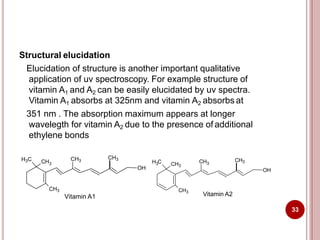
Structural elucidation
Elucidation of structure is another important qualitative
application of uv spectroscopy. For example structure of
vitamin A1 and A2 can be easily elucidated by uv spectra.
Vitamin A1 absorbs at 325nm and vitamin A2 absorbs at
351 nm . The absorption maximum appears at longer
wavelegth for vitamin A2 due to the presence of additional
ethylene bonds
H3C CH3
CH3
CH3
OH
CH3
Vitamin A1
H C3 CH3
CH3
CH3
OH
CH3
Vitamin A2
33
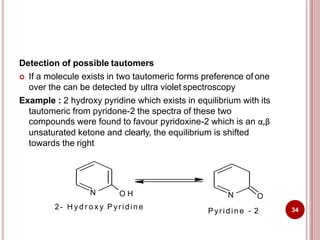
Detection of possible tautomers
 If a molecule exists in two tautomeric forms preference of one
over the can be detected by ultra violet spectroscopy
Example : 2 hydroxy pyridine which exists in equilibrium with its

tautomeric from pyridone-2 the spectra of these two
compounds were found to favour pyridoxine-2 which is an α,β
unsaturated ketone and clearly, the equilibrium is shifted
towards the right
N O H N O
2- H y d r o x y Pyridine
Pyridine - 2 34
References
 Instrumental methods of chemical analysis
by R.Chatwal
 Pharmaceutical analysis fourth edition
by S.Ravi sankar
 Principle and applications of uv and visible
spectroscopy by Rajasekaran
35
36

Application of UV-Visible spectroscopy

  • 1.
    APPLICATIONS OF VISIBLEAND UV SPECTROMETRY Presented By- ROHIT M.Pharmacy (Pharmaceutics)1
  • 2.
    APPLICATION OF VISIBLESPECTROMETRY 2  Substance that are having intrinsic color (berberine , clofazimine ,cyanocobalamin , riboflavin and rifampicin) can be determined directly by colorimetric method whereas colorless substance can be estimated only after converting it into colored derivative by treating them with appropriate chromogenic reagent. Colorimetry is used in the quantitative estimation of 1. Inorganic compound 2. Biochemical specimens 3. Organic and pharmaceutical compounds
  • 3.
    INORGANIC COMPOUND  Inorganicfield it is used in the estimation of both cation and anion .  The cations estimated by colorimetry 3 cations Chromogenic agent color λmax ammonium Nessler’s reagent Orange 425nm antimony Potassium iodide yellow 425nm arsenic Ammonium molybdate blue 840nm Magnesium Titan yellow red 535nm
  • 4.
    BIOCHEMICAL SPECIMENS  Inbiochemical field it is used to determine the amount of glucose , ketone bodies , blood and proteins 4 anions Chromoenic Agent colour λmax fluoride Thorium chloranilate purple 540nm phosphate molybdenum blue 820nm silicate molybdate yellow 400nm
  • 5.
    Organic and pharmaceuticalapplication  In assay of glyceryl trinitrate tablets first the nitric acid is obtained by quantitative hydrolysis of the ester. The nitric acid thus obtained by hydrolysis of nitrates reacts with phenol 2,4 disulphonic acid to form a yellow colored product in ammonical solution . The intansity of the yellow color for potassium nitrate at 450 nm to determine the contents in tablets O S O OH S O O OH OH N O - + O S O O O OH O S O OH HNO3 NH3 N O - + O S O O O - O O S O HO 5
  • 6.
     colorless analgesicdrug paracetamol , chemically called as p- acetamido phenol is assayed by uv spectrophotometer .A colorimetric method is also reported for its estimation at 450nm after converting it into a yellow colored chromogen by reacting with NaNo2 in presence of Hcl at 5o c after preliminary hydrolysis OH O H2O+ NH CH3 OH NH2 + H3C O OH OH NH2 + Na N + O - O + HCl OH + + N N Cl + NaCl H O+ 2 6
  • 7.
     Ergometrine maleateand ergot alkaloids from a blue colored compound on reaction with p-dimethyl amino benzaldehyde and a trace of ferric chloride in sulphuric acid. The blue colored compound then can be measured at 578nm  The amount of carbachol in the injection is determined by colorimetric method by reacting it with reineckatte solution in acetone to from a pink red color which is measured at 526nm 7
  • 8.
     Sulpha methoxazolereact sodium nitrite and Hcl at 5oc. The diazotised sulphamethoxazole can be readily coupled with N (1- naphthyl) ethylene diamine dihydrochloride to form a purple colored complex which can be measured at 538nm H2N O S NH O O N + O - O + Na N CH3 + HCl 0 - 5 O C O S NH O O N CH3 N Cl N + HN NH2 HN O S NH O O N CH3 NN Purple colured complex NH2 8
  • 9.
     Vitamin Aand vitaminD can be estimated colorimetrically by by reacting them with antimony trichloride in chloroform , where the intense blue and green color obtained respectively is measured between 520-590nm. the color formed is stable for few secounds only hence the reagent is added directly to the cuvette during measurement  calciferol tablet and solution are determined by colorimetric method after extracting it by light petroleuam from the formulation .the residue of light petroleum extract in ethanol free chloroform solution , on reaction with antimony trichloride yield a brown orange color which can be measured at 500nm 9
  • 10.
     Compounds containingamino group can be analysed colorimetrically by using suitable carbonyl reagent. The most frequently employed reagent is p- dimethyl amino benzaldehyde (ehrlich’s reagent) .the drug procaine injection is assayed based on the condensation reaction of procaine and p-dimethylaminobenzaldehyde to yield yellow color measured at 454nm H2N O O N CH3 H3C + N H3C CH3 O O N O N CH3 NH3C CH3 CH3 10
  • 11.
    Determination of phenoliccompound  Phenols react with ferric ion and forms violet color which can be used for its quantitative estimation .this can be used for quantitative estimation in colorimetry . The formation of color is attributed to the existence of keto-enol tautomerism in phenols  Phenol is mostly in enol form it forms colored complex with ferric ion 11
  • 12.
     Phenol reactwith diazonium salts to yield colored dyes + + N NCl + OH N N OH + HCl 12
  • 13.
    Advantages of colorimetrymethod  This method is not time consuming and hence it is ideally suited for routine work  The operations involved in the estimation are simple, particularly when the photoelectric colorimetric is used  Determination of minute quantities of substance (<1 to 2%) is possible  The instrument employed for the work is inexpensive 13
  • 14.
    APPLICATIONS OF ULTRAVIOLET SPECTROSCOPY 14 The methods based on the absorption of radiation are extremely important from the viewpoint of an analytical chemist.  Ultraviolet methods find extensive use in the identification of various hydrocarbons , vitamins , steroids , heterocycles ,and conjugated aliphatics I. QUANTITATIVEANALYSIS II. QUALITATIVE ANALYSIS
  • 15.
    Quantitative analysis ofsubstance in Single component sample  The conc of a drug or absorbing substance in a given sample can be easily analysed by measuring the absorbance of the solution prepared in a transparent solvent in a uv spectrophotometer. this quantitative UV method is applicable to determine the conc of a single component in the given sample and to determined the conc of different components in mixture 15
  • 16.
     The methodsadopted to analyse single component sample 1. Standard adsorptivity value method 2. Calibration graph/curve method 3. Single or double point standardization method 16
  • 17.
    standard absorptivity valuemethod  In this method the conc of the unknown compound can be determined by using the measured absorbance and standard absorptivity value  For example if the absorbance of methyl testosterone in ethanolic solution measured in a 1cm cell at its λmax 241 nm is found to be 0.890 and the standard absorptivity value at 241 nm is 540 then the conc of methyl testosterone can be determined by the following equation  A = abc A - absorbance of the solution =0.890 a - standard absorptivity value = 540 b -pathlength of the sample cell = 1cm c – conc of the unknown to be determined 0.890 = 540 x 1 x c ; c = A/ab = 0.890/540=0.00165g/100ml 17
  • 18.
    Calibration graph/ curvemethod  In this method the absorbance of a number of standard solutions of the reference substance at conc encompassing the sample concentrations are measured and calibration graph is constructed. calibration data is highly essential if  The absorbance has non linear relationship with conc  It is necessary to confirm the proportionality of absorbance as a functions of conc  The absorbance or linearity is dependent on the assay conditions 18
  • 19.
    CALIBRATION CURVE 0.4 0.3 absorbance 0.2 0.1 conc 0 510 15 20 Conc in µg/ml absorbance 0 0.000 5 0.050 10 0.100 15 0.150 19
  • 20.
    Single or doublepoint stardardization method  The absorbance of a sample solution and a standard solution of the reference substance will be measured in single point procedure  The standard and sample solution should be prepared in the same manner, where the conc of the standard solution should be close to the sample solution  The conc of the substance in the sample is calculated from the proportion relationship that exists between absorbance and conc C test = A test x C std Astd C test , C std 20 Conc of test and std solution A test , Astd Absorbance of test and std solution
  • 21.
    Quantitative analysis ofsubstance in multicomponent sample  The identification and conc of one or more components in the sample can be analyzed by modifying the simple spectrophotometric procedure adopted in single component sample  The interference of one component by the other component may arise due to manufacturing impurities, decomposition product , formulation excipients will cause unwanted absorption termed as irrelevant absortion , imparts systematic error in the assay of the drug  By adopting multicomponent analysis the actual amount of sample under investigation can be easily calculated after removing the irrelavant absorption 21
  • 22.
     The ofall multi-component spectrophotometric analysis is that at all wavelength  The absorbance of a solution is the sum of absorbance of the individual component  The measured absorbance is the difference between the total absorbance of the solution in the sample cell and that of the solution in the reference cell The different multi-component analytical method I. Using absorbance corrected for interference II. After solvent extraction of the sample III. Simultaneous equation method IV. Absorption ratio method V. Geometric correction method VI. Orthogonal polynomial method 22
  • 23.
    Using absorbance correctedfor interference  By knowing the absorbing interferon's its conc and its absorptivity it is possible to calculate its contribution to the absorbance of the mixture.  Then the conc of the component of our interest can be calculate from the corrected absorbance ( total absorbance – interfering absorbance )  Example: determination of conc of epidrine Hcl and chlorocresol in epidrine Hcl injection Assay after solvent extraction of the sample  If it is not possible to calculate the contribution of absorbing interferants to the total absorbance or the interferance from other absorbing substance is large , then it may be possible to separate the absorbing interferon's from the analyte by solvent extraction procedure  This procedure is appropriate for acidic or basic drugs whose state of ionization determines their solvent partition behaviors .EX : assay of caffeine in aspirin & caffeine tablet 23
  • 24.
    Simultaneous equation method This method is based upon the fact that the total absorbance of a solution at a given wavelength (λ1 & λ2) is equal to the sum of the absorbances of the individual components present  Therefore it is possible to analyze individual components of a mixture even if there is an overlap in the spectra M N Absorbance λ1 λ2 24
  • 25.
     The individualabsorption spectra of substance M and N showing wavelegth for the assay of M and N in admixture by the method of simultaneous equation  The absorption of M at λ1 and λ2 is am1 and am2  The absorption of N at λ1 and λ2 is an1 and an2  The absorbance of dilute solution at λ1 and λ2 is A1 and A2 respectively  The conc M(Cm) and N (Cn) in diluted sample can be determined by equation 25
  • 26.
    λ1 A1 =am1 bCm + an1bCn (1) λ2 A2 = am2bCm + an2bCn (2) for measure in 1 cm cell b = 1 rearranging equation (2) Cn = A2 – am2Cm an2 substitnute Cn in equation (1) and rearranging Cm = A2an1 – A1an2 am2an1 – am1an2 26
  • 27.
    Qualitative analyis  Inqualitative analysis , UV spectra is mainly used to detect the presence of different chromophores,polynuclear compound and to detect the extension conjugation Detection of functional groups  Uv technique is applied to detect the presence or absence of the chromophore  Uv wavelegth range from 200nm to 400nm,it shows the absence of conjugation  carbonyl group (aldehydes and ketones )  benzene or aromatic compound  bromo or iodo atoms 27
  • 28.
    Detection of conjugation:  Two or more carbon – carbon double bond or triple bond  Carbon-carbon double bond, carbon –oxygen double bond  Aromatic ring with double bond  Example of various conjugated chromoporic group 28 chromophore example λmax CH2=CH2 Ethylene 174nm -C=C-C=C- Butadiene 217nm -C=C-C=C-C=C- 1,3,5 Hexatriene 267nm -C=C-C=O- Crotonaldehyde 218nm
  • 29.
    Distinction of conjugatedand non conjugated diene 29  uv spectra is also useful in distinguishing a conjugated and non conjugated compound Example :  The non conjugated ethylene having one double bond has λmax at 174 nm can be easily distinguished from butadiene which appears at longer wavelength λmax 217nm due to the presence of conjugated double bond
  • 30.
    Detection of impurities if a substance is contaminated with impurity ,the impurity will also absorb light at different wavelength then the absorption spectra of impure substance will differ from characteristic absorption of pure substance thus impurities present in pharmaceuticals or organic compounds can be easily detected by measuring its absorbance at specific wavelength  Example : the presence of impurity xanthanoic acid in propantheline bromide can be determined by measuring the absorbance of 0.5%W/V in 0.1M NAOH at 281nm .if the absorbance is more than 0.31, then it indicates the presence of xanthanoic acid impurity 30
  • 31.
    Identification of unknowncompound  An unknown compound can be identified by comparing its spectrum with the known spectra. If the two spectra coincide , the two compound must be identical . If the spectra do not coincide, then the expected structure is different from the known compound Detection of polynuclear hydrocarbons  Benzene and polynuclear compounds have characteristic spectra in ultra violet and visible radition . Thus the identification of polynuclear hydrocarbons can be made by comparison with the spectra of known polynuclear compounds . 31
  • 32.
     Example :benzenes shows adsoption maximum at 256nm . The methyl group (toluene ) substitution in benzene ring in the shift of λmax from 256 to 261 nm Polynuclear hydrocarbon Absorption maximum Naphthalene Anthracene Naphthacene Pentacene 312nm 375nm 480nm 580 32
  • 33.
    Structural elucidation Elucidation ofstructure is another important qualitative application of uv spectroscopy. For example structure of vitamin A1 and A2 can be easily elucidated by uv spectra. Vitamin A1 absorbs at 325nm and vitamin A2 absorbs at 351 nm . The absorption maximum appears at longer wavelegth for vitamin A2 due to the presence of additional ethylene bonds H3C CH3 CH3 CH3 OH CH3 Vitamin A1 H C3 CH3 CH3 CH3 OH CH3 Vitamin A2 33
  • 34.
    Detection of possibletautomers  If a molecule exists in two tautomeric forms preference of one over the can be detected by ultra violet spectroscopy Example : 2 hydroxy pyridine which exists in equilibrium with its tautomeric from pyridone-2 the spectra of these two compounds were found to favour pyridoxine-2 which is an α,β unsaturated ketone and clearly, the equilibrium is shifted towards the right N O H N O 2- H y d r o x y Pyridine Pyridine - 2 34
  • 35.
    References  Instrumental methodsof chemical analysis by R.Chatwal  Pharmaceutical analysis fourth edition by S.Ravi sankar  Principle and applications of uv and visible spectroscopy by Rajasekaran 35
  • 36.