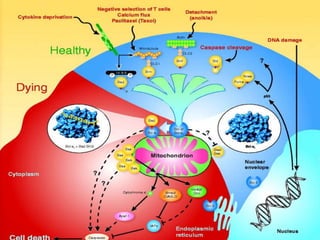
APOPTOSIS
ASHWINI SOMAYAJI
1ST M.PHARMA
PHARMACOLOGY
Content:
• The development of the term
Apoptosis
• The significance of Apoptosis
• Morphological features of
apoptosis
• Molecular mechanisms of apoptosis
signalling pathways.
• Regulatory mechanisms in
apoptosis signal
• Disease as a consequences of
dysregulated apoptosis.
APOPTOSIS
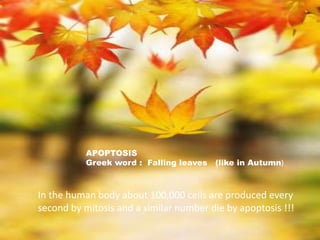
Greek word : Falling leaves (like in Autumn)
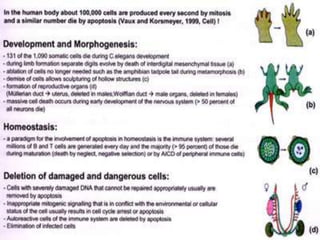
In the human body about 100,000 cells are produced every
second by mitosis and a similar number die by apoptosis !!!
• The word "apoptosis" (ἁπόπτωσισ) is used in Greek
to describe the "dropping off" or "falling off" of
petals from flowers, or leaves from trees.
• The second half of the word being pronounced like
"ptosis" (with the "p" silent), which comes from the
same root "to fall“
• The term programmed cell death was introduced in
1964, proposing that cell death during development
is not of accidential nature but follows a sequence of
controlled steps leading to locally and temporally
defined self-destruction.
DEVELOPMENT OF WORD APOPTOSIS
History
• Apoptotic principle was first described by
KARL VOGT in 1842
• “APOPTOSIS” term was coined by JAMES
CORMACK
• 2002 NOBEL PRIZE IN MEDICINE was awarded
to SYDNEY BRENNER,HORVITZ and
JOHN.E.SULSTON for their work in identifying
genes that control Apoptosis.
John E Sulton won Nobel
Prize in 2002 for his
pioneering research in
Apoptosis
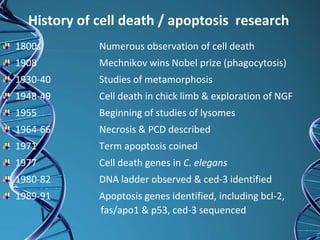
History of cell death / apoptosis research
1800s Numerous observation of cell death
1908 Mechnikov wins Nobel prize (phagocytosis)
1930-40 Studies of metamorphosis
1948-49 Cell death in chick limb & exploration of NGF
1955 Beginning of studies of lysomes
1964-66 Necrosis & PCD described
1971 Term apoptosis coined
1977 Cell death genes in C. elegans
1980-82 DNA ladder observed & ced-3 identified
1989-91 Apoptosis genes identified, including bcl-2,
fas/apo1 & p53, ced-3 sequenced
SIGNIFICANCE OF APOTOSIS
• The development and maintenance of multicellular
biological systems depends on a sophisticated
interplay between the cells forming the organism, it
sometimes even seems to involve an altruistic
behaviour of individual cells in favour of the
organism as a whole.
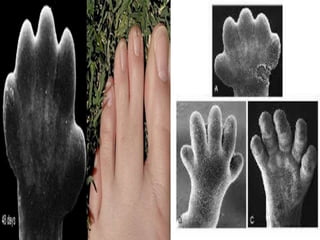
• During development many cells are produced in
excess which eventually undergo programmed cell
death and thereby contribute to sculpturing many
organs and tissues
An orderly
disposal of cells
that need to die
DNA has
sustained too
many injuries
Cell is infected
with a virus
Cell needs to
be removed for
body parts to
be formed
Cell is just too
old and ’ its time
has come’
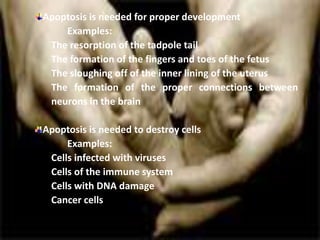
Apoptosis is needed for proper development
Examples:
The resorption of the tadpole tail
The formation of the fingers and toes of the fetus
The sloughing off of the inner lining of the uterus
The formation of the proper connections between
neurons in the brain
Apoptosis is needed to destroy cells
Examples:
Cells infected with viruses
Cells of the immune system
Cells with DNA damage
Cancer cells
membrane
blebbing &
changes
mitochondrial
leakage
organelle
reduction
cell
shrinkage
nuclear
fragmentation
chromatin
condensation
APOPTOSIS: Morphology
Hacker., 2000
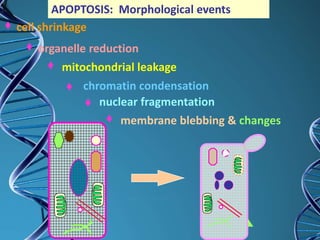
membrane blebbing & changes
mitochondrial leakage
organelle reduction
cell shrinkage
nuclear fragmentation
chromatin condensation
APOPTOSIS: Morphological events
Bleb
Blebbing & Apoptotic bodies
The control retained over the cell membrane
& cytoskeleton allows intact pieces of the cell
to separate for recognition & phagocytosis by
MFs
Apoptotic body
MF MF
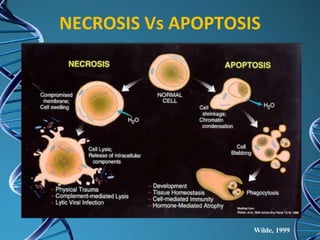
NECROSIS Vs APOPTOSIS
Wilde, 1999
Molecular mechanisms of apoptosis
signalling pathways
• What makes a cell commit suicide?
• withdrawal of positive signals (growth factors, Il-2)
• receipt of negative signals (increased levels of oxidants, DNA
damage via X-ray or UV light, chemotherapeutic drugs,
accumulation of improperly folded proteins, death activators
such as: TNF-a, TNF-b, Fas/FasL)
• Steps in apoptosis:
– the decision to activate the pathway;
– the actual "suicide" of the cell;
– engulfment of the cell remains by specialized immune
cells called phagocytes;
– degradation of engulfed cell.
Caenorhabditis elegans
1090 cells 131 cells apoptosis
ced-1
ced-2
ced-5
ced-6
ced-7
ced-10
ced-3
ced-4
ced-9egl-1
ces-1ces-2
nuc-1
execution
decision
to die
engulfment degradation
Four stages of apoptosis have been defined:
i. Commitment to death by extracellular or intracellular triggers/signals
ii. Cell killing (execution) by activation of intracellular proteases (caspases)
iii. Engulfment of cell corpse by other cells
iv. Degradation of the cell corpse within the lysosomes of phagocytic cells
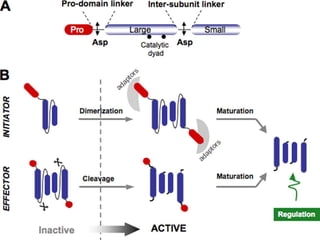
Caspases are a family of aspartate-specific, cysteine
proteases that serve as the primary mediators of apoptosis.
Mammalian caspases can be subdivided into three functional
groups, apoptotic initiator caspases (Caspase-2, -8, -9, -10),
apoptotic effector caspases (Caspase-3, -6, -7), and caspases
involved in inflammatory cytokine processing (Caspase-1, -4,
-5, 11, and -12L/12S). All caspases are synthesized as inactive
zymogens containing a variable length pro-domain, followed
by a large (20 kDa) and a small (10 kDa) subunit.
Caspases
Stimuli for Apoptotic Cell Death in Mammals
i. Growth factor deficiencies
ii. Ionizing radiation/ viral infection
iii. Free radical toxicity
iv. Death receptor activation (such as Fas or CD95
triggering)
v. Metabolic or cell cycle disturbance
Apoptosis
Extrinsic
pathway
Intrinsic
pathway
Granzyme
pathway
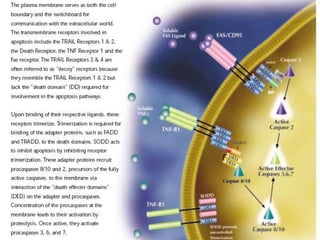
Ligand Receptor
FasL Fas (CD95)
TNF TNF-R
TRAIL DR4 (Trail-R)
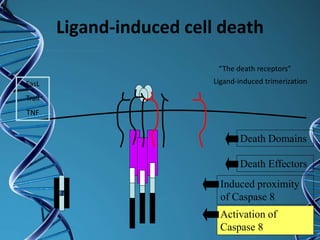
Ligand-induced cell death
“The death receptors”
Ligand-induced trimerization
Death Domains
Death Effectors
Induced proximity
of Caspase 8
Activation of
Caspase 8
FasL
Trail
TNF
Intracellular signals
Oxidative damage from free radicals, Radiation, Virus infection, Nutrient deprivation,
Pro-apoptotic Factors
Damage to the mitochondrial membrane increasing permeability
Entry of Cytochrome C into the cytoplasm
Cytochrome C binds to Apaf-1 forming an apoptosome
Apoptosome activates procaspase-9 to caspase-9
Caspase-9 cleaves and activates caspase-3 and caspase-7.
This executioner caspases activate a cascade of proteolytic activity that leads to:
Chromatin condensation, DNA fragmentation, Protein cleavage, Membrane
permeability
The intrinsic pathway of apoptosis depends on mitochondria
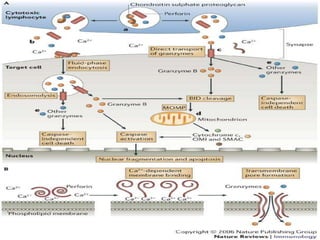
Granzyme mediated apoptosis
Granzymes are serine proteases that are released by cytoplasmic
granules within cytotoxic T cells and natural killer (NK) cells.
They induce programmed cell death in the target cell, thus
eliminating cells that have become cancerous or are infected
with viruses or bacteria. The granzymes also kill bacteria[ and
inhibit viral replication. In NK cells and T cells, the granzymes are
packaged in cytotoxic granules with perforin Other locations that
granzymes can be detected are in the rough endoplasmic
reticulum, golgi complex, and the trans-golgi reticulum. The
contents of the cytotoxic granules function to permit entry of
the granzymes into the target cell cytosol. The granules are
released into an immune synapse formed with a target cell,
where perforin mediates the delivery of the granzymes
into endosomes in the target cell, and finally into the target cell
cytosol. Granzymes are identified as being part of the serine
esterase family.[3]
Cells are balanced between life and death
DAMAGE Physiological death signals
DEATH SIGNAL
PROAPOPTOTIC
PROTEINS
(dozens!)
ANTIAPOPTOTIC
PROTEINS
(dozens!)
DEATH
Regulation of apoptosis
Regulatory proteins – BCL -2
 Bcl2 was the first apoptosis-related gene ,recognized to play a role tumor genesis
 BCL-2 is a human proto-oncogene located on chromosome 18.
 Its product is an integral membrane protein (called Bcl-2) located in the membranes of the
endoplasmic reticulum , nuclear envelope, and in the outer membrane of mitochondria.
 The gene was discovered as the translocated locus in a B-cell leukemia (hence the name).
This translocation is also found in some B-cell lymphomas
How pro-apoptotic BH3-only and anti-apoptotic Bcl2 proteins regulate
the intrinsic pathway of apoptosis
39
• Extracellular signal molecules that inhibit
apoptosis which are collectively called survival
factors.
• Most animal cells require continues signaling
from other cells to avoid apoptosis.
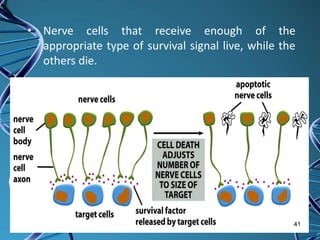
• Nerve cells are produced in excess in the
developing nervous system and then compete for
limited amount of survival factors that are
secreted by the target cells that they normally
connect to .
Extracellular survival factors inhibit apoptosis in various ways
40
• Nerve cells that receive enough of the
appropriate type of survival signal live, while the
others die.
41
42
Apoptosis and Cancer
• Apoptosis does not occur in
Cancer
• Cancerous cells trick and skip
Apoptosis in number of ways
Inactivation of p53 [shooting the
guard]
Produce Bcl-2 or a protein which
mimics Bcl-2
Inhibits expression of Apaf-1
Apoptosis and Autoimmune
Disease
Autoimmune Lymph
Proliferative
Syndrome[ALPS]
Apoptosis doesnot
occur in self
reactive T & B cells
RBC
Hemolytic
Anemia
Neutrophil
Neutrope
nia
Platelets
Thromboc
ytopenia
Apoptosis and HIV
Infected CD4
cell induces
Apoptosis in
surrounding
cells
• Deactivated Bcl-2
• Decreases CD4
Glycoprotein
markers on
innocent T cells
,getting them
killed
Infected CD4 cell
avoids Apoptosis in
itself
Decreases
Phosphatdylserine
marker for itself
allowing longer
survival.
Overview
Apoptosis is a good thing
Too little of a good thing
is bad [Cancer]
Too much of a good
thing is also bad [HIV]
REFERENCES
1. JORGE EDUARDO DUQUE-PARRA. Note on the Origin
and History of the Term“Apoptosis”. THE ANATOMICAL
RECORD (PART B: NEW ANAT.) 283B:2–4, 2005.
2. Hans JR,Doris E. Apoptosis, Cytotoxicity and Cell
Proliferation.ROCHE2008:4;2-16.
3. Andreas G. ApoReview - Introduction to Apoptosis
2003;1-26
4. Min W,Han FD,David EF.Apoptosis :molecular
mechanism. ENCYCLOPEDIA OF LIFE SCIENCES / &
2001 Nature Publishing Group / www.els.net;1-8
5. The molecular biology of cell by Albert,
Johnson,Lewis. 5th edition ;1115-28.
Apoptosis

Apoptosis

  • 1.
  • 2.
    Content: • The developmentof the term Apoptosis • The significance of Apoptosis • Morphological features of apoptosis • Molecular mechanisms of apoptosis signalling pathways. • Regulatory mechanisms in apoptosis signal • Disease as a consequences of dysregulated apoptosis.
  • 3.
    APOPTOSIS Greek word :Falling leaves (like in Autumn) In the human body about 100,000 cells are produced every second by mitosis and a similar number die by apoptosis !!!
  • 4.
    • The word"apoptosis" (ἁπόπτωσισ) is used in Greek to describe the "dropping off" or "falling off" of petals from flowers, or leaves from trees. • The second half of the word being pronounced like "ptosis" (with the "p" silent), which comes from the same root "to fall“ • The term programmed cell death was introduced in 1964, proposing that cell death during development is not of accidential nature but follows a sequence of controlled steps leading to locally and temporally defined self-destruction. DEVELOPMENT OF WORD APOPTOSIS
  • 5.
    History • Apoptotic principlewas first described by KARL VOGT in 1842 • “APOPTOSIS” term was coined by JAMES CORMACK • 2002 NOBEL PRIZE IN MEDICINE was awarded to SYDNEY BRENNER,HORVITZ and JOHN.E.SULSTON for their work in identifying genes that control Apoptosis. John E Sulton won Nobel Prize in 2002 for his pioneering research in Apoptosis
  • 6.
    History of celldeath / apoptosis research 1800s Numerous observation of cell death 1908 Mechnikov wins Nobel prize (phagocytosis) 1930-40 Studies of metamorphosis 1948-49 Cell death in chick limb & exploration of NGF 1955 Beginning of studies of lysomes 1964-66 Necrosis & PCD described 1971 Term apoptosis coined 1977 Cell death genes in C. elegans 1980-82 DNA ladder observed & ced-3 identified 1989-91 Apoptosis genes identified, including bcl-2, fas/apo1 & p53, ced-3 sequenced
  • 7.
    SIGNIFICANCE OF APOTOSIS •The development and maintenance of multicellular biological systems depends on a sophisticated interplay between the cells forming the organism, it sometimes even seems to involve an altruistic behaviour of individual cells in favour of the organism as a whole. • During development many cells are produced in excess which eventually undergo programmed cell death and thereby contribute to sculpturing many organs and tissues
  • 8.
    An orderly disposal ofcells that need to die DNA has sustained too many injuries Cell is infected with a virus Cell needs to be removed for body parts to be formed Cell is just too old and ’ its time has come’
  • 9.
    Apoptosis is neededfor proper development Examples: The resorption of the tadpole tail The formation of the fingers and toes of the fetus The sloughing off of the inner lining of the uterus The formation of the proper connections between neurons in the brain Apoptosis is needed to destroy cells Examples: Cells infected with viruses Cells of the immune system Cells with DNA damage Cancer cells
  • 12.
  • 13.
    membrane blebbing &changes mitochondrial leakage organelle reduction cell shrinkage nuclear fragmentation chromatin condensation APOPTOSIS: Morphological events
  • 14.
    Bleb Blebbing & Apoptoticbodies The control retained over the cell membrane & cytoskeleton allows intact pieces of the cell to separate for recognition & phagocytosis by MFs Apoptotic body MF MF
  • 15.
  • 16.
    Molecular mechanisms ofapoptosis signalling pathways • What makes a cell commit suicide? • withdrawal of positive signals (growth factors, Il-2) • receipt of negative signals (increased levels of oxidants, DNA damage via X-ray or UV light, chemotherapeutic drugs, accumulation of improperly folded proteins, death activators such as: TNF-a, TNF-b, Fas/FasL) • Steps in apoptosis: – the decision to activate the pathway; – the actual "suicide" of the cell; – engulfment of the cell remains by specialized immune cells called phagocytes; – degradation of engulfed cell.
  • 17.
    Caenorhabditis elegans 1090 cells131 cells apoptosis ced-1 ced-2 ced-5 ced-6 ced-7 ced-10 ced-3 ced-4 ced-9egl-1 ces-1ces-2 nuc-1 execution decision to die engulfment degradation
  • 18.
    Four stages ofapoptosis have been defined: i. Commitment to death by extracellular or intracellular triggers/signals ii. Cell killing (execution) by activation of intracellular proteases (caspases) iii. Engulfment of cell corpse by other cells iv. Degradation of the cell corpse within the lysosomes of phagocytic cells
  • 19.
    Caspases are afamily of aspartate-specific, cysteine proteases that serve as the primary mediators of apoptosis. Mammalian caspases can be subdivided into three functional groups, apoptotic initiator caspases (Caspase-2, -8, -9, -10), apoptotic effector caspases (Caspase-3, -6, -7), and caspases involved in inflammatory cytokine processing (Caspase-1, -4, -5, 11, and -12L/12S). All caspases are synthesized as inactive zymogens containing a variable length pro-domain, followed by a large (20 kDa) and a small (10 kDa) subunit. Caspases
  • 22.
    Stimuli for ApoptoticCell Death in Mammals i. Growth factor deficiencies ii. Ionizing radiation/ viral infection iii. Free radical toxicity iv. Death receptor activation (such as Fas or CD95 triggering) v. Metabolic or cell cycle disturbance
  • 23.
  • 25.
    Ligand Receptor FasL Fas(CD95) TNF TNF-R TRAIL DR4 (Trail-R)
  • 26.
    Ligand-induced cell death “Thedeath receptors” Ligand-induced trimerization Death Domains Death Effectors Induced proximity of Caspase 8 Activation of Caspase 8 FasL Trail TNF
  • 29.
    Intracellular signals Oxidative damagefrom free radicals, Radiation, Virus infection, Nutrient deprivation, Pro-apoptotic Factors Damage to the mitochondrial membrane increasing permeability Entry of Cytochrome C into the cytoplasm Cytochrome C binds to Apaf-1 forming an apoptosome Apoptosome activates procaspase-9 to caspase-9 Caspase-9 cleaves and activates caspase-3 and caspase-7. This executioner caspases activate a cascade of proteolytic activity that leads to: Chromatin condensation, DNA fragmentation, Protein cleavage, Membrane permeability
  • 31.
    The intrinsic pathwayof apoptosis depends on mitochondria
  • 32.
    Granzyme mediated apoptosis Granzymesare serine proteases that are released by cytoplasmic granules within cytotoxic T cells and natural killer (NK) cells. They induce programmed cell death in the target cell, thus eliminating cells that have become cancerous or are infected with viruses or bacteria. The granzymes also kill bacteria[ and inhibit viral replication. In NK cells and T cells, the granzymes are packaged in cytotoxic granules with perforin Other locations that granzymes can be detected are in the rough endoplasmic reticulum, golgi complex, and the trans-golgi reticulum. The contents of the cytotoxic granules function to permit entry of the granzymes into the target cell cytosol. The granules are released into an immune synapse formed with a target cell, where perforin mediates the delivery of the granzymes into endosomes in the target cell, and finally into the target cell cytosol. Granzymes are identified as being part of the serine esterase family.[3]
  • 35.
    Cells are balancedbetween life and death DAMAGE Physiological death signals DEATH SIGNAL PROAPOPTOTIC PROTEINS (dozens!) ANTIAPOPTOTIC PROTEINS (dozens!) DEATH
  • 36.
    Regulation of apoptosis Regulatoryproteins – BCL -2  Bcl2 was the first apoptosis-related gene ,recognized to play a role tumor genesis  BCL-2 is a human proto-oncogene located on chromosome 18.  Its product is an integral membrane protein (called Bcl-2) located in the membranes of the endoplasmic reticulum , nuclear envelope, and in the outer membrane of mitochondria.  The gene was discovered as the translocated locus in a B-cell leukemia (hence the name). This translocation is also found in some B-cell lymphomas
  • 39.
    How pro-apoptotic BH3-onlyand anti-apoptotic Bcl2 proteins regulate the intrinsic pathway of apoptosis 39
  • 40.
    • Extracellular signalmolecules that inhibit apoptosis which are collectively called survival factors. • Most animal cells require continues signaling from other cells to avoid apoptosis. • Nerve cells are produced in excess in the developing nervous system and then compete for limited amount of survival factors that are secreted by the target cells that they normally connect to . Extracellular survival factors inhibit apoptosis in various ways 40
  • 41.
    • Nerve cellsthat receive enough of the appropriate type of survival signal live, while the others die. 41
  • 42.
  • 43.
    Apoptosis and Cancer •Apoptosis does not occur in Cancer • Cancerous cells trick and skip Apoptosis in number of ways Inactivation of p53 [shooting the guard] Produce Bcl-2 or a protein which mimics Bcl-2 Inhibits expression of Apaf-1
  • 44.
    Apoptosis and Autoimmune Disease AutoimmuneLymph Proliferative Syndrome[ALPS] Apoptosis doesnot occur in self reactive T & B cells RBC Hemolytic Anemia Neutrophil Neutrope nia Platelets Thromboc ytopenia
  • 45.
    Apoptosis and HIV InfectedCD4 cell induces Apoptosis in surrounding cells • Deactivated Bcl-2 • Decreases CD4 Glycoprotein markers on innocent T cells ,getting them killed Infected CD4 cell avoids Apoptosis in itself Decreases Phosphatdylserine marker for itself allowing longer survival.
  • 46.
    Overview Apoptosis is agood thing Too little of a good thing is bad [Cancer] Too much of a good thing is also bad [HIV]
  • 47.
    REFERENCES 1. JORGE EDUARDODUQUE-PARRA. Note on the Origin and History of the Term“Apoptosis”. THE ANATOMICAL RECORD (PART B: NEW ANAT.) 283B:2–4, 2005. 2. Hans JR,Doris E. Apoptosis, Cytotoxicity and Cell Proliferation.ROCHE2008:4;2-16. 3. Andreas G. ApoReview - Introduction to Apoptosis 2003;1-26 4. Min W,Han FD,David EF.Apoptosis :molecular mechanism. ENCYCLOPEDIA OF LIFE SCIENCES / & 2001 Nature Publishing Group / www.els.net;1-8 5. The molecular biology of cell by Albert, Johnson,Lewis. 5th edition ;1115-28.